
Life, 1916-12-14 · page 18 of 42
Life — December 14, 1916 — page 18: what you’re looking at
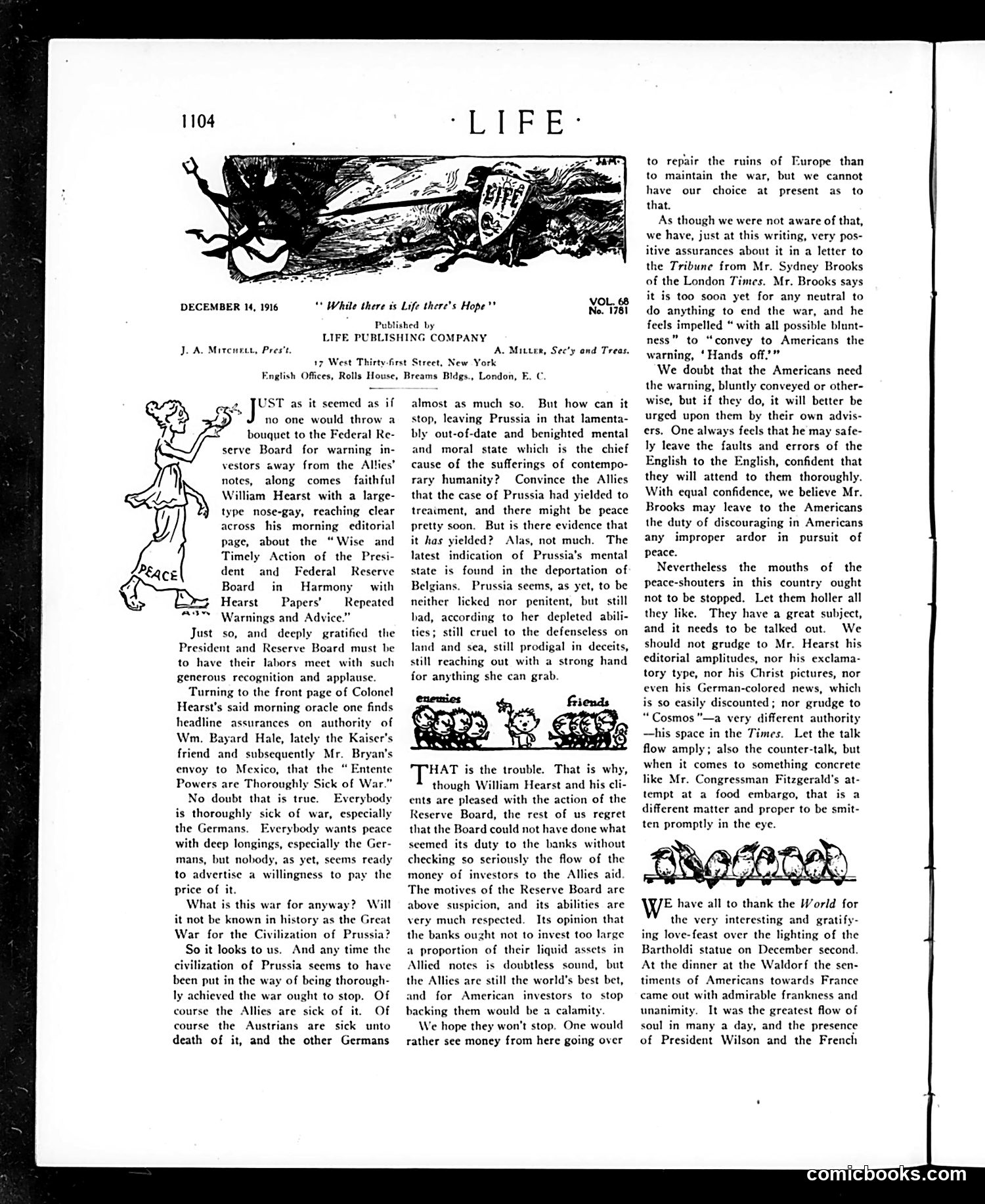
What you’re looking at
This page critiques William Randolph Hearst's contradictory editorial positions on World War I financing. The satire operates on two levels: **The Hypocrisy:** Hearst simultaneously praised the Federal Reserve Board for discouraging American investment in Allied war bonds while his own newspapers (via correspondent Wm. Bayard Hale, identified as "the Kaiser's friend") claimed the "Entente Powers are Thoroughly Sick of War"—implying peace was near and investment unnecessary. **The Argument:** Life's editors argue that since Germany (Prussia) remains unrepentant and cruel (citing Belgian deportations), the Allies *must* continue fighting. Therefore, American financial support isn't warmongering but moral necessity. Hearst's simultaneous positions are presented as either naive or duplicitous. **The Stakes:** This reflects genuine 1916 debate over America's role—published before U.S. entry into WWI (April 1917). The piece defends banker financing of the Allies as supporting civilization against Prussian militarism, while mocking Hearst's apparent pro-German sympathies masked by peace rhetoric.
📄 Transcribed text from this page (OCR, searchable)
Machine-transcribed from the original scan — historical spelling and the odd misread are preserved.
DECEMBER M4, 1916 “* While there is Life there's Hope”’ VOL. 68 No. 1781 hed by LIFE PUBLISHING COMPANY J. A. Mircuret, Pres't. A. Mitten, Sec’y and Treas, 17 West Thirty-first Street, New York English Offices, Rolls House, J ST as it seemed as if no one would throw a bouquet to the Federal Re- serve Board for warning in- vestors away from the Allies’ notes, along comes faithful William Hearst with a large- type nose-gay, reaching clear across his morning editorial page, about the “Wise and Timely Action of the Presi- dent and Federal Reserve Board in Harmony with Hearst Papers’ —_ Repeated Warnings and Advice.” Just so, and deeply gratified the President and Reserve Board must be to have their labors meet with such generous recognition and applause. Turning to the front page of Colonel Hearst’s said morning oracle one finds headline assurances on authority of Wm. Bayard Hale, lately the Kaiser's friend and subsequently Mr. Bryan's envoy to Mexico, that the “ Entente Powers are Thoroughly Sick of War.” No doubt that is true. Everybody is thoroughly sick of war, especially the Germans. Everybody wants peace with deep longings, especially the Ger- mans, but nobody, yet, seems ready to advertise a wv igness to pay the price of it. What is this war for anyway? Will it not be known in history as the Great War for the Civilization of Prussia? So it looks to us. And any time the civilization of Prussia seems to have been put in the way of being thorough- ly achieved the war ought to stop. Of course the Allies are sick of it. Of course the Austrians are sick unto death of it, and the other Germans Breams Bldgs., London, E. C. almost as much so. But how can it stop, leaving Prussia in that lamenta- bly out-of-date and benighted mental and moral state which is the chief cause of the sufferings of contempo- rary humanity? Convince the Allies that the case of Prussia had yielded to treaiment, and there might be peace pretty soon. But is there evidence that it has yielded? A not much. The latest indication of Prussia’s mental state is found in the deportation of Belgians. Prussia seems, as yet, to be neither licked nor penitent, but still had, according to her depleted abili- ties; still cruel to the defenseless on land and sea, still prodigal in deceits, still reaching out with a strong hand for anything she can grab. HAT is the trouble. That is why, though William Hearst and his cli- ents are pleased with the action of the Reserve Board, the rest of us regret that the Board could not have done what seemed its duty to the banks without checking so seriously the flow of the money of investors to the Allies aid. The motives of the Reserve Board are above suspicion, and its abilities are very much respected. Its opinion that the banks ought not to invest too large a proportion of their liquid assets in Allied notes is doubtless sound, but the Allies are still the world’s best bet, and for American investors to stop backing them would be a calamity. We hope they won't stop. One would rather see money from here going over to repair the ruins of Europe than to maintain the war, but we cannot have our choice at present as to that. As though we were not aware of that, we have, just at this writing, very pos- itive assurances about it in a letter to the Tribune from Mr. Sydney Brooks of the London Times. Mr. Brooks says it is too soon yet for any neutral to do anything to end the war, and he feels impelled “ with all possible blunt- ness” to “convey to Americans the warning, ‘Hands off” We doubt that the Americans need the warning, bluntly conveyed or other- wise, but if they do, it will better be urged upon them by their own advis- ers, One always feels that he may safe- ly leave the faults and errors of the English to the English, confident that they will attend to them thoroughly. With equal confidence, we believe Mr. Brooks may leave to the Americans the duty of discouraging in Americans any improper ardor in pursuit of peace. Nevertheless the mouths of the peace-shouters in this country ought not to be stopped. Let them holler all they like. They have a great subject, and it needs to be talked out. We should not grudge to Mr. Hearst his editorial amplitudes, nor his exclama- tory type, nor his Christ pictures, nor even his German-colored news, which is so easily discounted; nor grudge to “ Cosmo: a very different authority —his space in the Times. Let the talk flow amply; also the counter-talk, but when it comes to something concrete like Mr. Congressman Fitzgerald's at- tempt at a food embargo, that is a different matter and proper to be smit- ten promptly in the eye. E have all to thank the World for the very interesting and gratify- ing love-feast over the lighting of the Bartholdi statue on December second. At the dinner at the Waldorf the sen- timents of Americans towards France came out with admirable frankness and unanimity. It was the greatest flow of soul in many a day, and the presence of President Wilson and the French comicbooks.com