
Life, 1916-12-14 · page 22 of 42
Life — December 14, 1916 — page 22: what you’re looking at
What you’re looking at
This page discusses two theatrical productions and performers from the early 20th century: **Sarah Bernhardt**: The text praises the aging French actress's recent American tour, emphasizing her remarkable resilience despite being disabled (having lost a limb) and performing while ill. The article notes she overcame physical handicaps through sheer willpower and artistry, earning standing ovations even in "cynical New York." **"The Harp of Life"**: A play by Hartley Manners starring Laurette Taylor. The critic notes it addresses child education frankly—comparing it to another play ("The Blindness of Virtue") that tackled similar themes. The criticism is that while Taylor's charm carries a didactic speech about instructing children, the heavy-handed moralizing feels artificially inserted into the plot, raising questions about theater's educational role. The page includes theatrical illustrations and photographs supporting these reviews.
📄 Transcribed text from this page (OCR, searchable)
Machine-transcribed from the original scan — historical spelling and the odd misread are preserved.
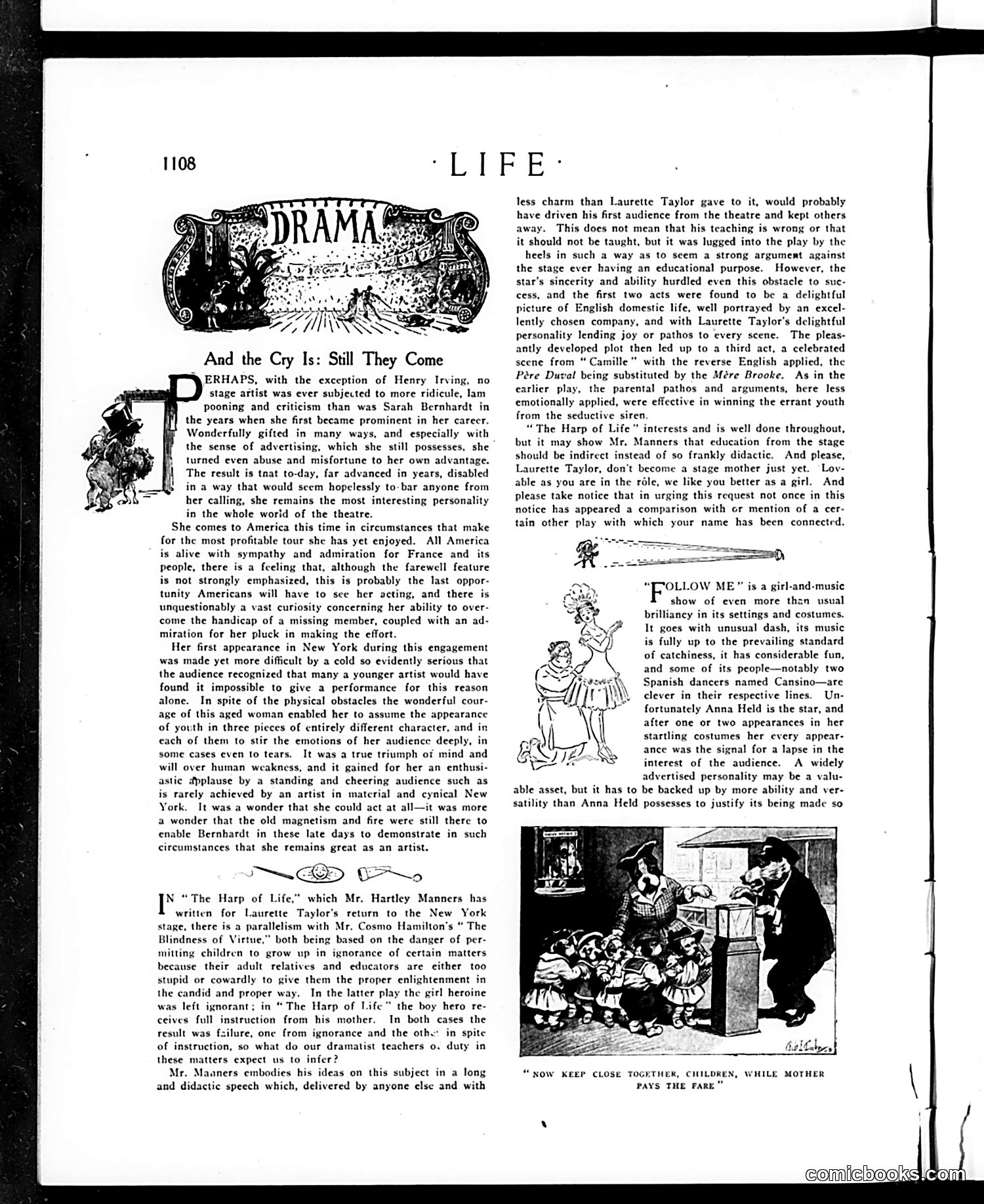
“LIFE: And the Cry Is: Still They Come ERHAPS, with the exception of Henry Irving, no stage artist was ever subjected to more ridicule, lam pooning and criticism than was Sarah Bernhardt in the years when she first became prominent in her carecr. Wonderfully gifted in many ways, and especially with the sense of advertising, which she still possesses, she turned even abuse and misfortune to her own advantage. The result is tnat to-day, far advanced in years, disabled in a way that would seem hopelessly to-bar anyone from her calling, she remains the most interesting personality in the whole worid of the theatre. She comes to America this time in circumstances that make for the most profitable tour she has yet enjoyed. All America is alive with sympathy and admiration for France and its people, there is a feeling that, although the farewell feature is not strongly emphasized, this is probably the last oppor- tunity Americans will have to see her acting, and there is unquestionably a vast curiosity concerning her ability to over- come the handicap of a missing member, coupled with an ad- miration for her pluck in making the effort. Her first appearance in New York during this engagement was made yet more difficult by a cold so evidently serious that the audience recognized that many a younger artist would have found it impossible to give a performance for this reason alone. In spite of the physical obstacles the wonderful cour- age of this aged woman enabled her to assume the appearance of youth in three pieces of entirely different character, and in each of them to stir the emotions of her audience deeply, in some cases even to tears. It was a true triumph of mind and will over human weakness, and it gained for her an enthusi- astic dpplause by a standing and cheering audience such as is rarely achieved by an artist in matcrial and cynical New York. It was a wonder that she could act at all—it was more a wonder that the old magnetism and fire were still there to enable Bernhardt in these late days to demonstrate in such circumstances that she remains great as an artist. IX “The Harp of Life,” which Mr. Hartley Manners h: written for Laurette Taylor's return to the New York stage, there is a parallelism with Mr. Cosmo Hamilton's “ The Blindness of Virtue,” both being based on the danger of per- mitting children to grow up in ignorance of certain matters because their adult relatives and educators are either too stupid or cowardly to give them the proper enlightenment in the candid and proper way. In the latter play the girl heroine was left ignorant; in “The Harp of Life” the boy hero re- ceives full instruction from his mother. In both cases the result was fzilure, one from ignorance and the othe in spite of instruction, so what do our dramatist teachers 0. duty these matters expect us to infer? Mr. Maaners embodies his ideas on this subject in a long and didactic speech which, delivered by anyone else and with less charm than Laurette Taylor gave to it, would probably have driven his first audience from the theatre and kept others away. This does not mean that his teaching is wrong or that it should not be taught, but it was lugged into the play by the heels in such a way as to seem a strong argument against the stage ever having an educational purpose. However, the star's sincerity and ability hurdled even this obstacle to suc- cess, and the first two acts were found to be a delightful picture of English domestic life, well portrayed by an excel- lently chosen company, and with Laurette Taylor's delightful personality lending joy or pathos to every scene. The pleas- antly developed plot then led up to a third act, a celebrated scene from “Camille” with the reverse English applied, the Pére Duval being substituted by the Mére Brooke. As in the earlier play, the parental pathos and arguments, here less emotionally applied, were effective in winning the errant youth from the seductive siren. “The Harp of Life” interests and is well done throughout, but it may show Mr. Manners that education from the stage should be indirect instead of so frankly didactic. And please, Laurette Taylor, don’t become a stage mother just yet. Lov- able as you are in the rale, we like you better as a girl. And please take notice that in urging this request not once in this notice has appeared a comparison with or mention of a cer- tain other play with which your name has been connected. “TCOLLOW ME” is a girl-and-music show of even more then usual brilliancy in its settings and costumes. It goes with unusual dash, its music is fully up to the prevailing standard of catchiness, it has considerable fun, and some of its people—notably two Spanish dancers named Cansino—are clever in their respective lines. Un- fortunately Anna Held is the star, and after one or two appearances in her startling costumes her every appear- ance was the signal for a lapse in the interest of the audience. A widely advertised personality may be a valu- able asset, but it has to be backed up by more ability and ver- satility than Anna Held possesses to justify its being made so “NOW KEEP CLOSE TOGETHER, CHILDREN, WHILE MOTHER PAYS THE FARE”