
Life, 1916-12-14 · page 26 of 42
Life — December 14, 1916 — page 26: what you’re looking at
What you’re looking at
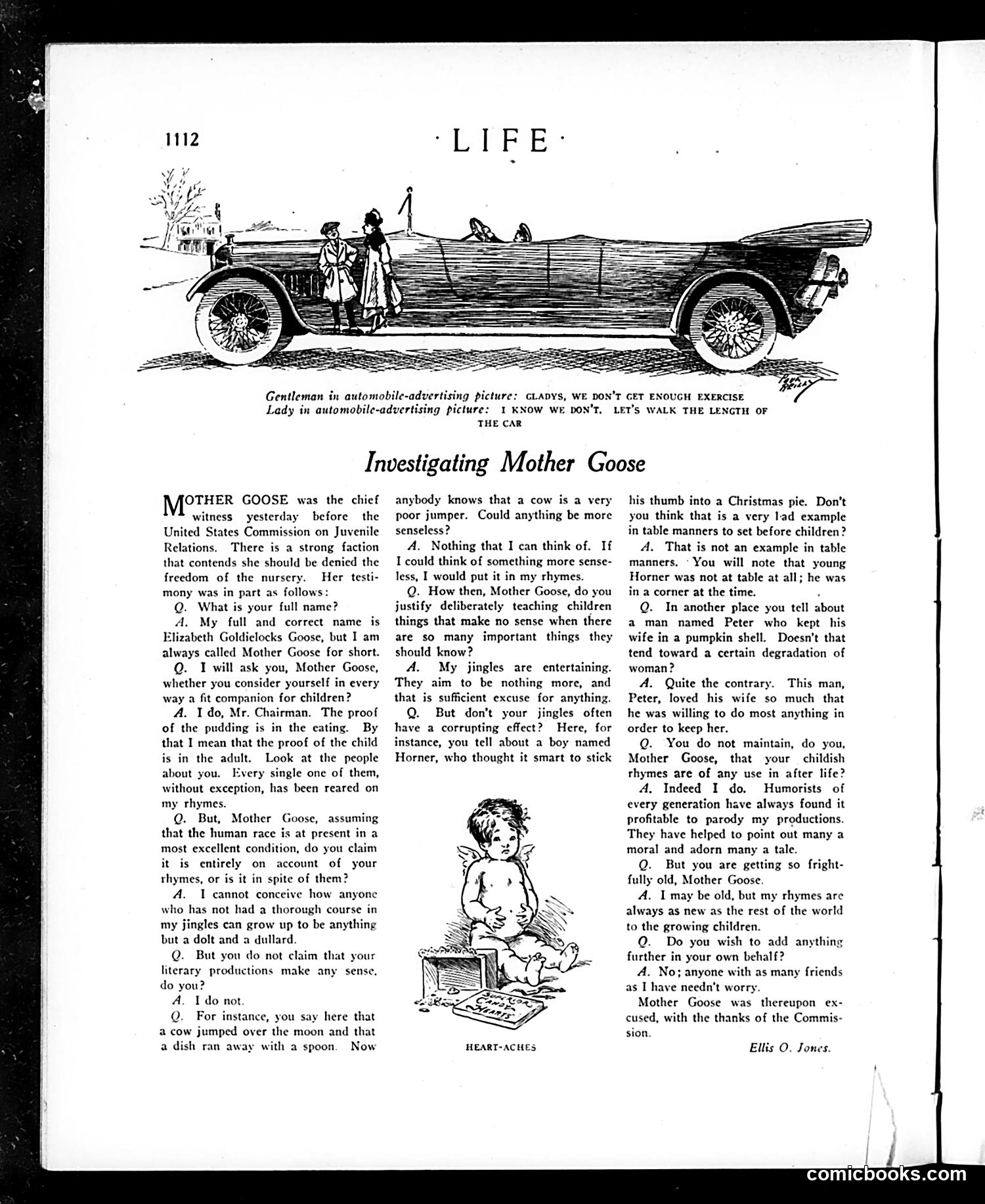
This satirical interview mocks progressive-era reformers who sought to regulate children's literature and upbringing. Mother Goose appears before a "Commission on Juvenile Relations" (a real type of early 20th-century body concerned with child welfare) to defend her nursery rhymes against charges that they're nonsensical, immoral, and unsuitable for children. The satire works by having Mother Goose unapologetically defend the absurdity of her rhymes—she admits they make no sense but argues they're entertaining and that children raised on them turned out fine. The interrogator challenges specific rhymes (cow jumping the moon, Jack Horner's theft, Peter's treatment of his wife) as teaching bad lessons. The joke is that reformers' earnest concern about children's moral development is portrayed as ridiculous—attacking beloved, harmless fairy tales as dangerous. The cartoon at top reinforces this theme: wealthy automobile owners joke about not getting enough exercise while sitting in a car, satirizing how modern conveniences (and modern anxieties) disconnect people from common sense.
📄 Transcribed text from this page (OCR, searchable)
Machine-transcribed from the original scan — historical spelling and the odd misread are preserved.
Ten Gentleman in automobile-advertising picture: GLADYS, WE DON’T GET ENOUGH EXERCISE Lady in automobile-advertising picture: 1 KNOW WE DON’T, THE CAR LET'S WALK THE LENGTH OF Investigating Mother Goose OTHER GOOSE was the chief witness yesterday before the United States Commission on Juvenile Relations. There is a strong faction that contends she should be denied the freedom of the nursery. Her testi- mony was in part as follows: Q. What is your full name? 4, My full and correct name is Elizabeth Goldiclocks Goose, but I am always called Mother Goose for short. Q. 1 will ask you, Mother Goose, whether you consider yourself in every way a fit companion for children? A, I do, Mr. Chairman. The proof of the pudding is in the cating. By that I mean that the proof of the child is in the adult. Look at the people about you. Every single one of them, without exception, has been reared on my rhymes. Q. But, Mother Goose, assuming that the human race is at present in a most excellent condition, do you claim it is entirely on account of your rhymes, or is it in spite of them? A. I cannot conceive how anyone who has not had a thorough course in my jingles can grow up to be anything but a dolt and a dullard. Q. But you do not claim that your literary productions make any sense, do you? A. Ido not Q. For instance, you say here that a cow jumped over the moon and that a dish ran away with a spoon. Now anybody knows that a cow is a very poor jumper. Could anything be more senseless? A. Nothing that I can think of. If I could think of something more sense- less, I would put it in my rhymes. Q. How then, Mother Goose, do you justify deliberately teaching children things that make no sense when there are so many important things they should know? A. My jingles are entertaining. They aim to be nothing more, and that is sufficient excuse for anything. Q. But don’t your jingles often have a corrupting effect? Here, for instance, you tell about a boy named Horner, who thought it smart to stick HEART-ACHES, his thumb into a Christmas you think that is a very lad example in table manners to set before children? A, That is not an example in table manners. - You will note that young Horner was not at table at all; he was in a corner at the time. . Q. In another place you tell about a man named Peter who kept his wife in a pumpkin shell. Doesn't that tend toward a certain degradation of woman? A. Quite the contrary. This man, Peter, loved his wife so much that he was willing to do most anything in order to keep her. Q. You do not maintain, do you, Mother Goose, that your childish rhymes are of any use in after life? A, Indeed I do. Humorists of every generation have always found it profitable to parody my productions. They have helped to point out many a moral and adorn many a tale. Q. But you are getting so fright- fully old, Mother Goose. A. I may be old, but my rhymes are always as new as the rest of the world to the growing children. Q. Do you wish to add anything further in your own behalf? A. No; anyone with as many friends as I have needn't worry. Mother Goose was thereupon ex- cused, with the thanks of the Commis- sion, Ellis O. Jones. lel comicbooks.com