
Life, 1916-12-14 · page 8 of 42
Life — December 14, 1916 — page 8: what you’re looking at
What you’re looking at
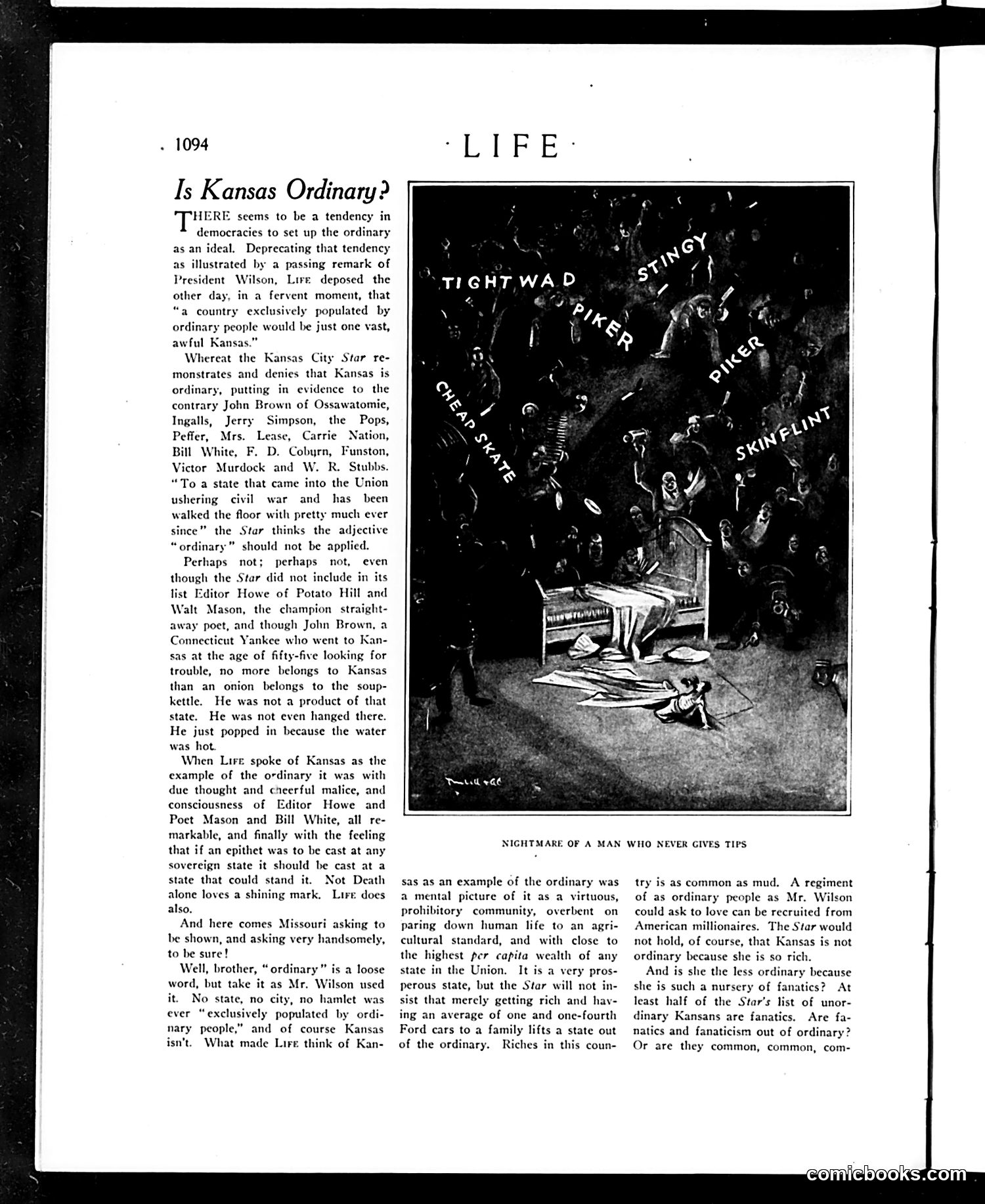
This page debates whether Kansas deserves its reputation as an "ordinary" state. President Wilson apparently called Kansas "a country exclusively populated by ordinary people" — meant as an insult. The text defends Kansas by listing notable citizens: John Brown (abolitionist), various editors and writers. It argues Kansas produced extraordinary people despite Wilson's dismissal. The cartoon titled "Nightmare of a Man Who Never Gives Tips" depicts a man tormented by angry spirits labeled with Kansas river names (Piker River, Stingy, Tightwad, Skinflint, Cimarron). The imagery suggests Kansas residents are miserly or cheap — playing on regional stereotypes. The satire works both ways: defending Kansas's actual contributions while poking fun at Kansans' supposed stinginess.
📄 Transcribed text from this page (OCR, searchable)
Machine-transcribed from the original scan — historical spelling and the odd misread are preserved.
- 1094 Is Kansas Ordinary? H seems to be a tendency in democracies to set up the ordinary as an ideal. Deprecating that tendency as illustrated by a passing remark of President Wilson, Lire deposed the other day, in a fervent moment, that “a country exclusively populated by ordinary people would be just one vast, awful Kansas.” Whereat the Kansas City Star re- monstrates and denies that Kansas ordinary, putting in evidence to the contrary John Brown of Ossawatomie, Ingalls, Jerry Simpson, the Pops, Peffer, Mrs. Lease, Carrie Nation, Bill White, F. D. Cobyrn, Funston, Victor Murdock and W. R. Stubbs. “To a state that came into the Union ushering civil war and has been walked the floor with pretty much ever since” the Star thinks the adjective “ordinary” should not be applied. Perhaps not; perhaps not, even though the Star did not include in its list Editor Howe of Potato Hill and Walt Mason, the champion straight- away poet, and though John Brown, a Connecticut Yankee who went to Kan- sas at the age of fifty-five looking for trouble, no more belongs to Kansas than an onion belongs to the soup- kettle. He was not a product of that state. He was not even hanged there. He just popped in because the water was hot. When Lire spoke of Kansas as the example of the ordinary it was with due thought and cheerful malice, and consciousness of itor Howe and Poet Mason and Bill White, all re- markable, and finally with the feeling that if an epithet was to be cast at any sovereign state it should be cast at a state that could stand Not Death alone loves a shining mark. Lire does also. And here comes Missouri asking to be shown, and asking very handsomely, to be sure! Well, brother, “ordinary” is a loose word, but take it as Mr. Wilson used it. No state, no city, no hamlet was ever “exclusively populated by ordi- nary people,” and of course Kansas isn't. What made Lire think of Kan- NIGHTMARE OF A MAN WHO NEVER GIVES TIPS sas as an example of the ordinary was a mental picture of it as a virtuous, prohibitory community, overbent on paring down human life to an agri- cultural standard, and with close to the highest per capita wealth of any state in the Union. It is a very pros- perous state, but the Star will not in- sist that merely getting rich and hav- ing an average of one and one-fourth Ford cars to a family lifts a state out of the ordinary. Riches in this coun- try is as common as mud. A regiment of as ordinary people as Mr. Wilson could ask to love can be recruited from American millionaires. The Star would not hold, of course, that Kansas is not ordinary because she is so rich. And is she the less ordinary because she is such a nursery of fanatics? At least half of the Star’s list of unor- dinary Kansans are fanatics. Are fa- natics and fanaticism out of ordinary? Or are they common, common, com-