
Life, 1916-12-14 · page 9 of 42
Life — December 14, 1916 — page 9: what you’re looking at
What you’re looking at
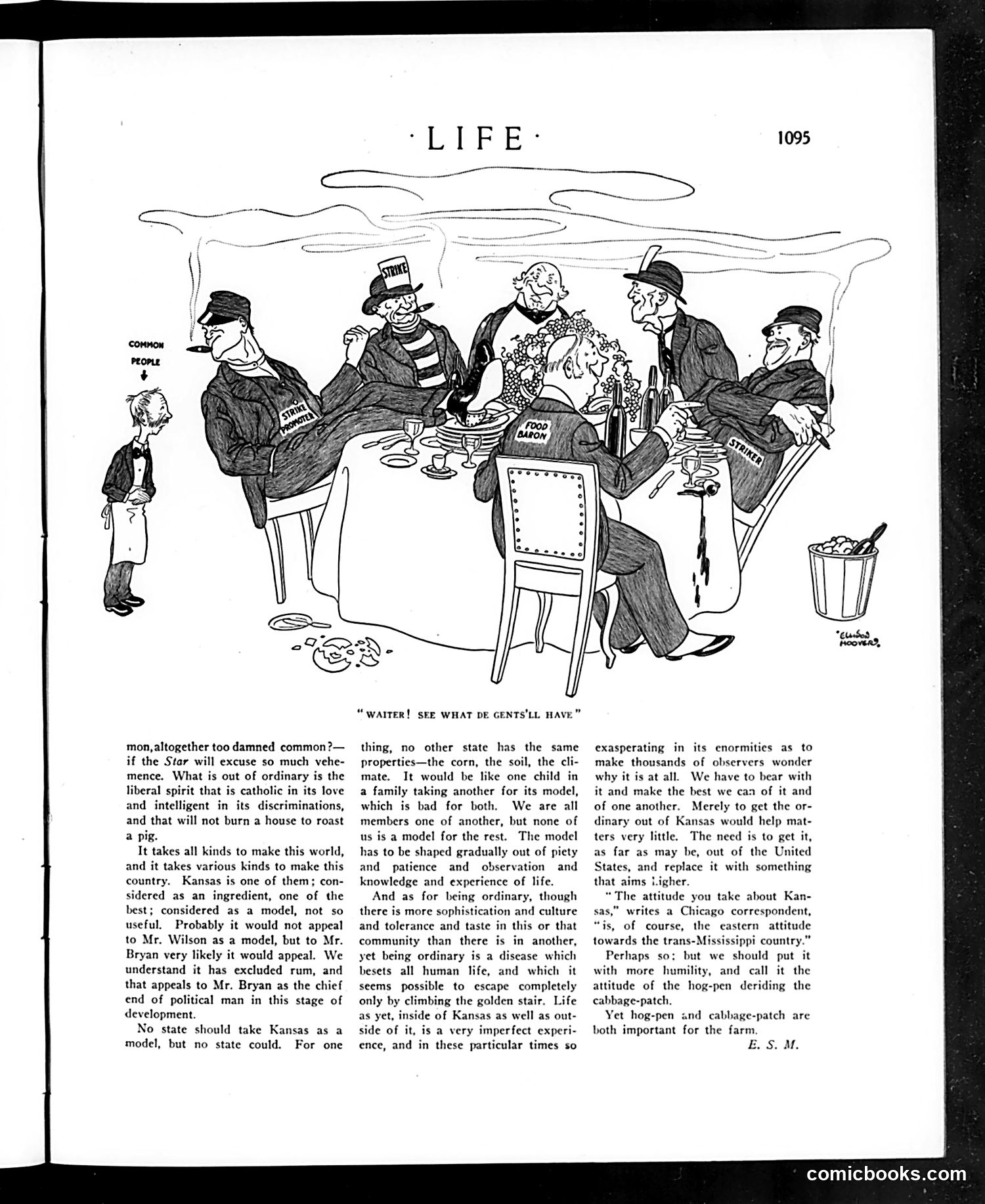
This cartoon satirizes wealthy, upper-class men dining together while a small child labeled "Common People" stands excluded outside. The diners wear hats labeled with various interests (one reads "Food Baron"), suggesting they represent powerful economic or political elites. The accompanying text discusses Kansas as a state model, critiquing its ordinary character while defending it against eastern dismissal. The satire appears to be about **class division and economic inequality**: the privileged few feast together while ordinary people remain marginalized observers. The waiter's question ("See what de gents'll have") emphasizes their exclusive access to resources and power, contrasting sharply with the child's exclusion from the table.
📄 Transcribed text from this page (OCR, searchable)
Machine-transcribed from the original scan — historical spelling and the odd misread are preserved.
mon, altogether too damned common?— if the Star will excuse so much vehe- mence. What is out of ordinary is the liberal spirit that is catholic in its love and intelligent in its discriminations, and that will not burn a house to roast a pig. It takes all kinds to make this world, and it takes various kinds to make this country. Kansas is one of them; con- sidered as an ingredient, one of the best; considered as a model, not so useful. Probably it would not appeal to Mr. Wilson as a model, but to Mr. Bryan very likely it would appeal. We understand it has excluded rum, and that appeals to Mr. Bryan as the chief end of political man in this stage of development. No state should take Kansas as a model, but no state could. For one “WAITER! SEE WHAT DE GENTS'LL HAV thing, no other state has the same propertics—the corn, the soil, the cli- mate. It would be like one child in a family taking another for its model, which is bad for both, We are all members one of another, but none of us is a model for the rest. The model has to be shaped gradually out of piety and patience and observation and knowledge and experience of life. And as for being ordinary, though there is more sophistication and culture and tolerance and taste in this or that community than there is in another, yet being ordinary is a disease which besets all human life, and which it seems possible to escape completely only by climbing the golden stair. Life as yet, inside of Kansas as well as out- side of it, is a very imperfect experi- ence, and in these particular times so exasperating in its enormities as to make thousands of observers wonder why it is at all. We have to bear with it and make the best we can of it and of one another. Merely to get the or- dinary out of Kansas would help mat- ters very little. The need is to get it, as far as may be, out of the United States, and replace it with something that aims ‘.igher. “The attitude you take about Kan- ," writes a Chicago correspondent, » of course, the castern attitude towards the trans-Mississippi country.” Perhaps so: but we should put it with more humility, and call it the attitude of the hog-pen deriding the cabbage-patch. Yet hog-pen and cabbage-patch are both important for the farm. ES. M. comicbooks.com