
Life, 1916-12-14 · page 25 of 42
Life — December 14, 1916 — page 25: what you’re looking at
What you’re looking at
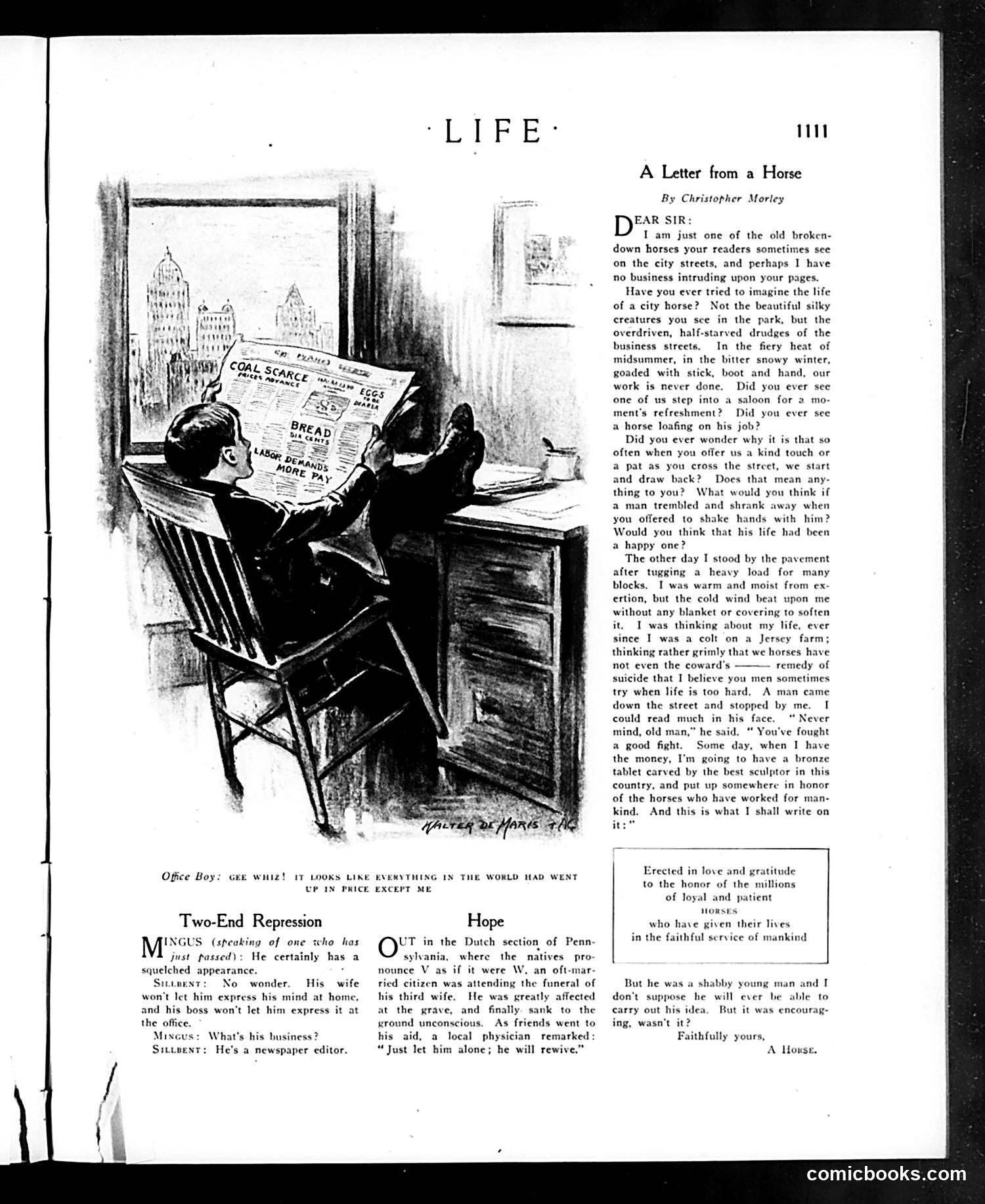
**The Cartoons:** 1. **"Office Boy"** (top): A newspaper office boy observes that everything has gone up in price except himself—a joke about wage stagnation during inflation. 2. **"Two-End Repression"**: A man appears miserable because his wife censors him at home and his boss censors him at work. The punchline reveals he's a newspaper editor—ironic since editors typically control speech, but he's silenced everywhere else. 3. **"Hope"** (bottom): A linguistic joke. In Dutch Pennsylvania, a man attending his *third* wife's funeral faints at the grave. A doctor says "he will rewive" (using the Dutch pronunciation of "revive" as "rewive"), creating dark humor: the man will recover, then presumably marry again. **"A Letter from a Horse"** is a sentimental essay by Christopher Morley personifying an overworked city horse, advocating for animal welfare and compassion toward working animals—a Progressive-era social concern.
📄 Transcribed text from this page (OCR, searchable)
Machine-transcribed from the original scan — historical spelling and the odd misread are preserved.
Office Boy: Gre wuiz! 17 Looks Like UP IN PRICE Two-End Repression ING just passed) squelched appearance. 1S (speaking of one who has He certainly has a Stuument: No wonder. His wife won't let him express his mind at home, and his boss won't let him express it at the office. Minus: Site business? What's xt: He's a newspaper editor. EVERYTHING. CEPT ME IN THE WORLD MAD WENT Hope UT in the Dutch section of Penn- sylvania, where the natives pro nounce V as if it were W, an oft-mar- ed citizen was attending the funeral of third wife. He was greatly affected at the grave, and finally. sank to the xround unconscious. As friends went to his aid, a local physician remarked: “Just let him alone; he will rewive.” Wit A Letter from a Horse By Christopher Morley EAR SIR: I am just one of the old broken- down horses your readers sometimes see on the city streets, and perhaps I have no business intruding upon your pages. Have you ever tried to imagine the life of a city horse? Not the beautiful silky creatures you sce in the park, but the overdriven, half-starved drudges of the business streets. In the fiery heat of midsummer, in the bitter snowy winter, goaded with stick, boot and hand, our work is never done. Did you ever see one of us step into a saloon for a mo- ment’s refreshment? Did you ever see a horse loafing on his job? Did you ever wonder why it is that so often when you offer us a kind touch or a pat as you cross the street, we start and draw back? Does that mean any- thing to you? What would you think if a man trembled and shrank away when you offered to shake hands with him? Would you think that his life had been a happy one? The other day I stood by the pavement after tugging a heavy load for many blocks. T was warm and moist from ex- ertion, but the cold wind beat upon me without any blanket or covering to soften it. I was thinking about my life, ever since I was a colt on a Jersey farm; thinking rather grimly that we horses have not even the coward’s ~ remedy of suicide that I believe you men sometimes try when life is too hard. A man came down the street and stopped by me. I could read much in his face,“ Never mind, old man,” he said. “ You've fought a good fight. Some day, when I have the money, I'm going to have a bronze tablet carved by the best sculptor in this country, and put up somewhere in honor of the horses who have worked for man- kind. And this is what I shall write on Erected in love and gratitude to the honor of the millions of Joyal and patient Horses who have given their lives in the faithful service of manki But he was a shabby young don’t suppose he will ever be able to carry out his idea ing, wasn't it? Faithfully yours, A House, But it was encourag- comicbooks.com