
A complete issue · 42 pages · 1916
Life — November 30, 1916
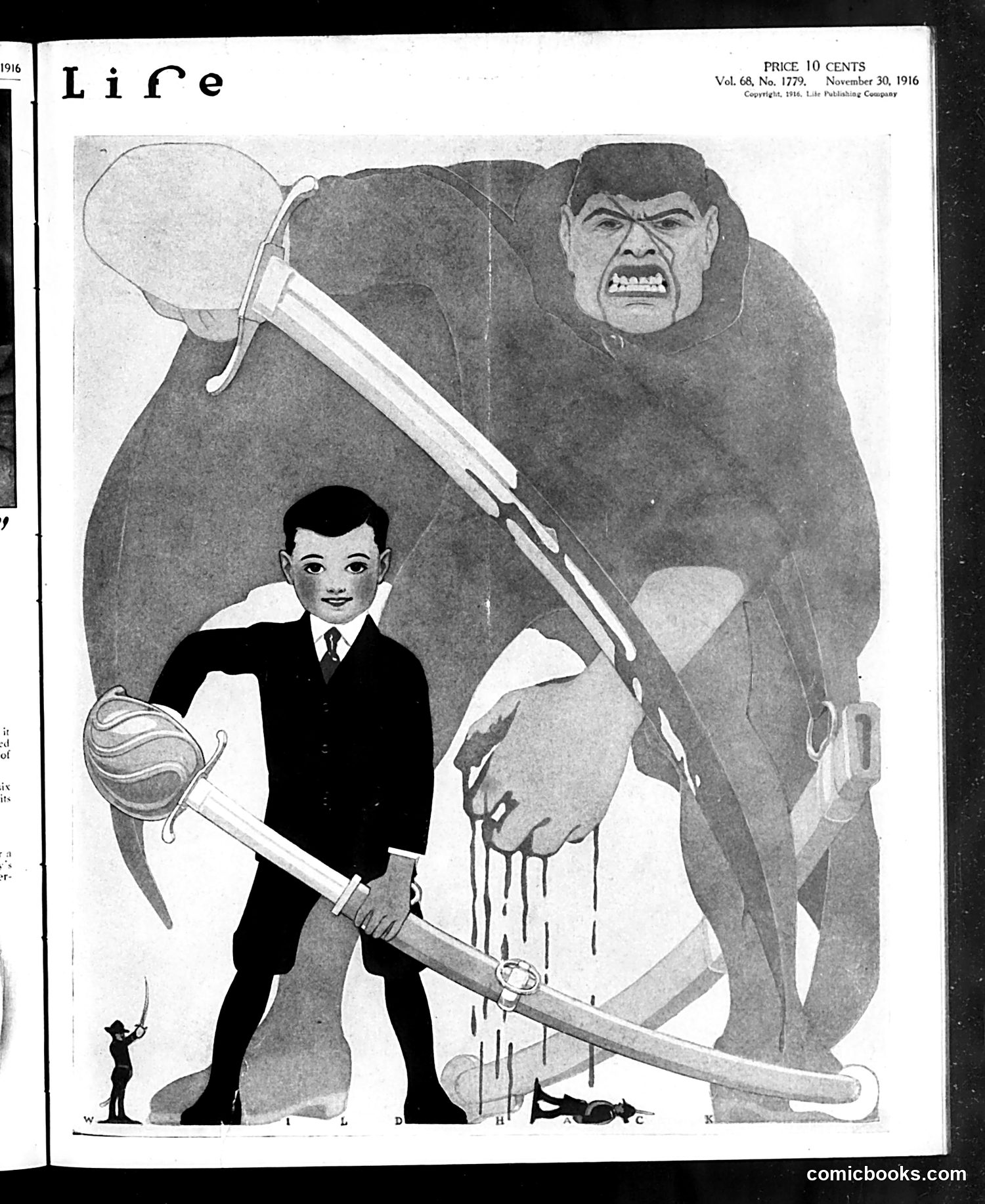
This political cartoon depicts a David-and-Goliath scenario from the 1916 U.S. presidential election. A small, well-dressed man (likely representing a political figure or candidate) wielding an axe confronts a massive, menacing giant towering behind him. The giant's grotesque expression and size suggest a formidable opponent or threat—possibly representing either an incumbent political power or a major opposing force. The cartoon's satire plays on the underdog narrative: a small figure facing seemingly impossible odds. Without additional text identifying the specific figures, the exact political context remains unclear, though the timing (November 1916) suggests relevance to that year's presidential contest between Woodrow Wilson and Charles Hughes.
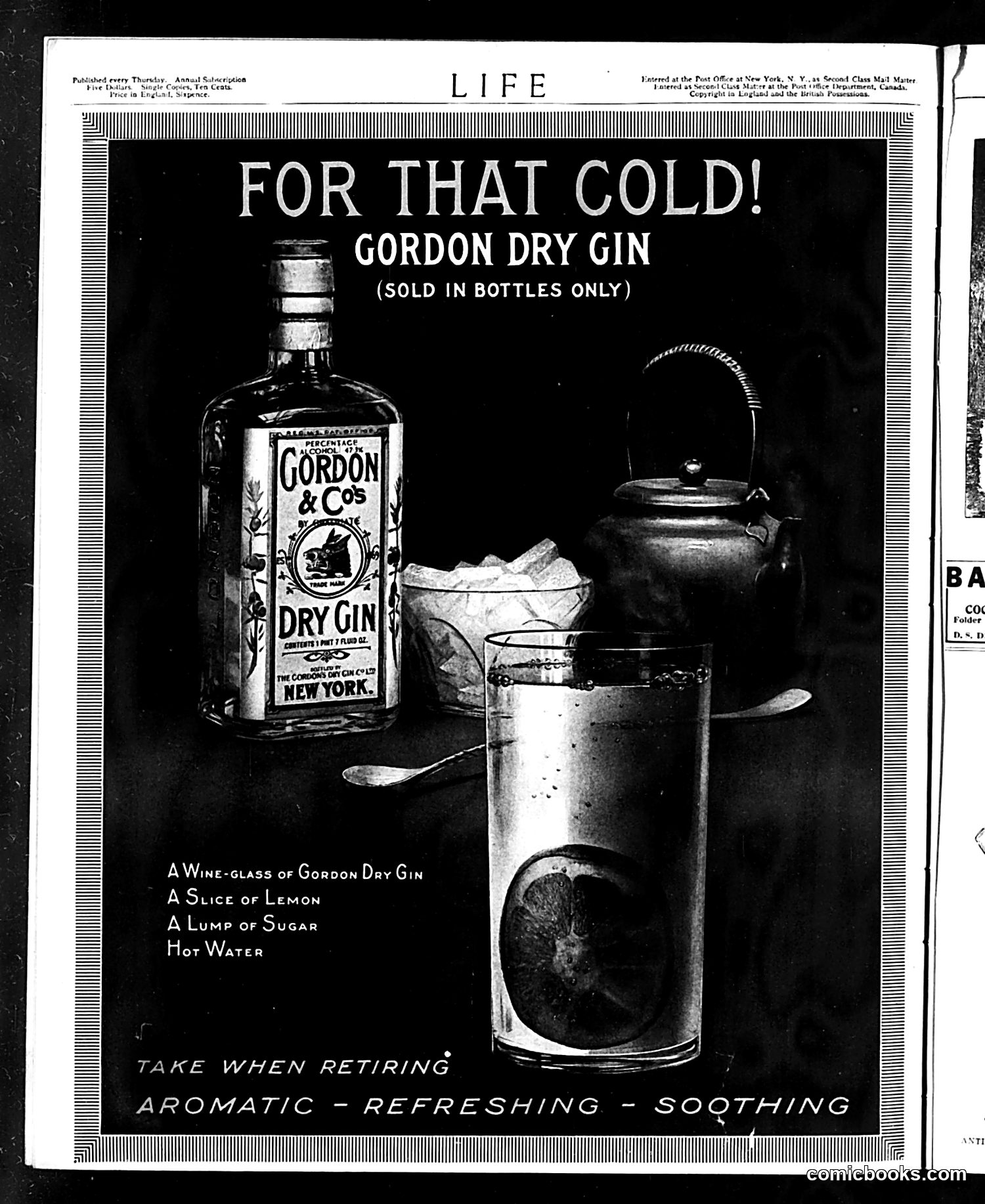
This is a **commercial advertisement**, not political satire. It promotes Gordon Dry Gin as a remedy "for that cold," positioning alcohol as medicinal—a common advertising strategy during Prohibition-era America when such claims helped market spirits legally. The ad prescribes a "hot toddy" preparation: gin, lemon slice, sugar, and hot water, labeled "aromatic—refreshing—soothing" and to be "taken when retiring." This reflects a pre-modern medical view where alcohol was marketed as having therapeutic properties. The stark black-and-white imagery—bottle, steaming glass, kettle—emphasizes the warming, restorative ritual. The phrase "sold in bottles only" suggests regulatory compliance, as bottled spirits had different legal treatment than bulk alcohol during this period.
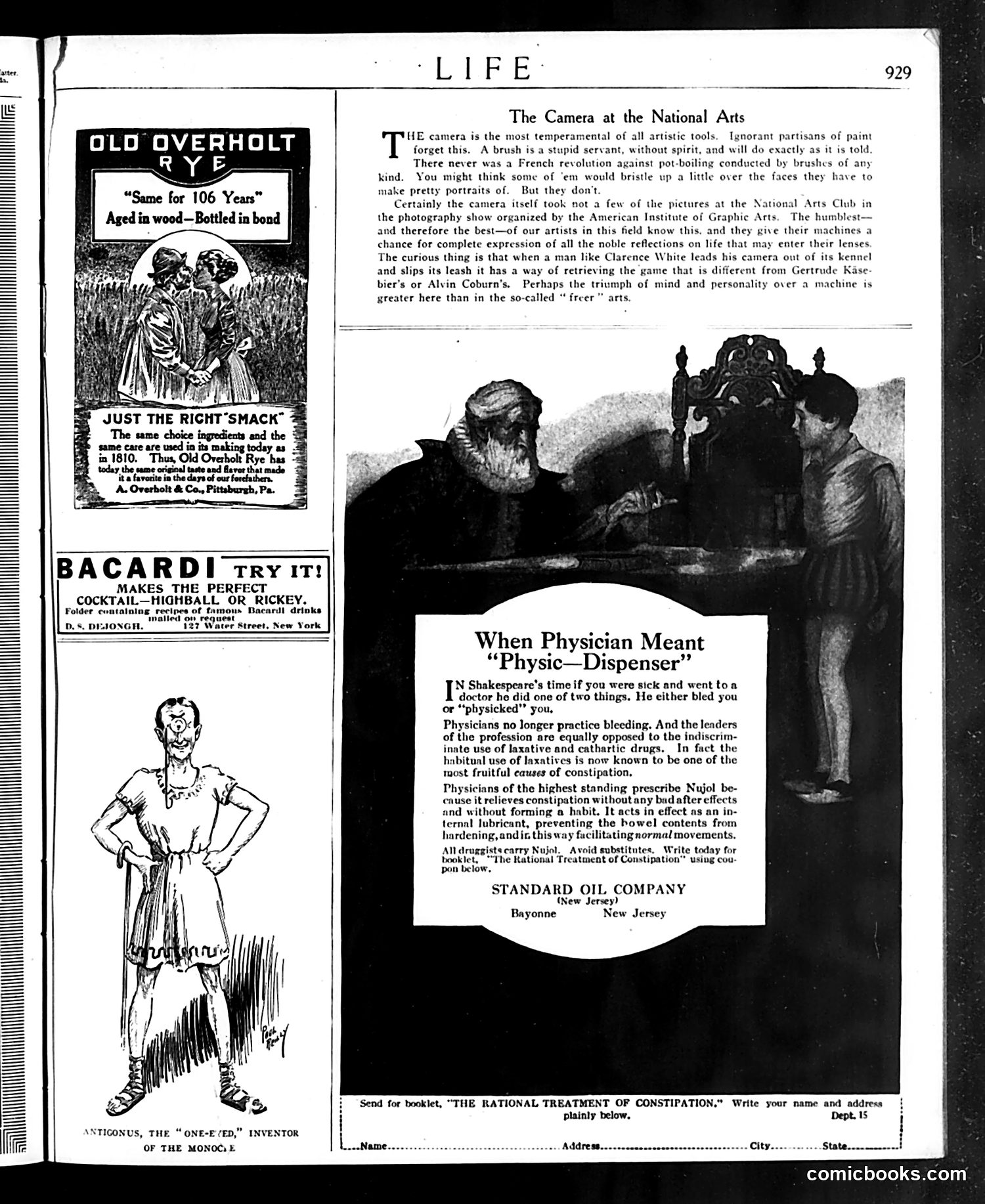
This page is primarily **advertising** for period products (Overholt Rye whiskey, Bacardi rum, and Standard Oil Company's Nujol laxative). The cartoon titled "Antigonus, the 'One-Eyed' Inventor of the Monocle" shows a caricatured figure with exaggerated features—likely satirizing vanity or pretension. The single eye and monocle reference suggests mockery of affectation. The main article "The Camera at the National Arts" discusses photography's role in art, comparing cameras to human artists. It notes photographer Clarence White's technical skill. "When Physician Meant 'Physic-Dispenser'" discusses historical medical practice, explaining that physicians once prescribed laxatives and bloodletting. The text advocates for modern, more discriminate pharmaceutical use—positioning Nujol as a rational alternative. The page reflects early 20th-century attitudes toward modernization and advertising-driven editorial content.
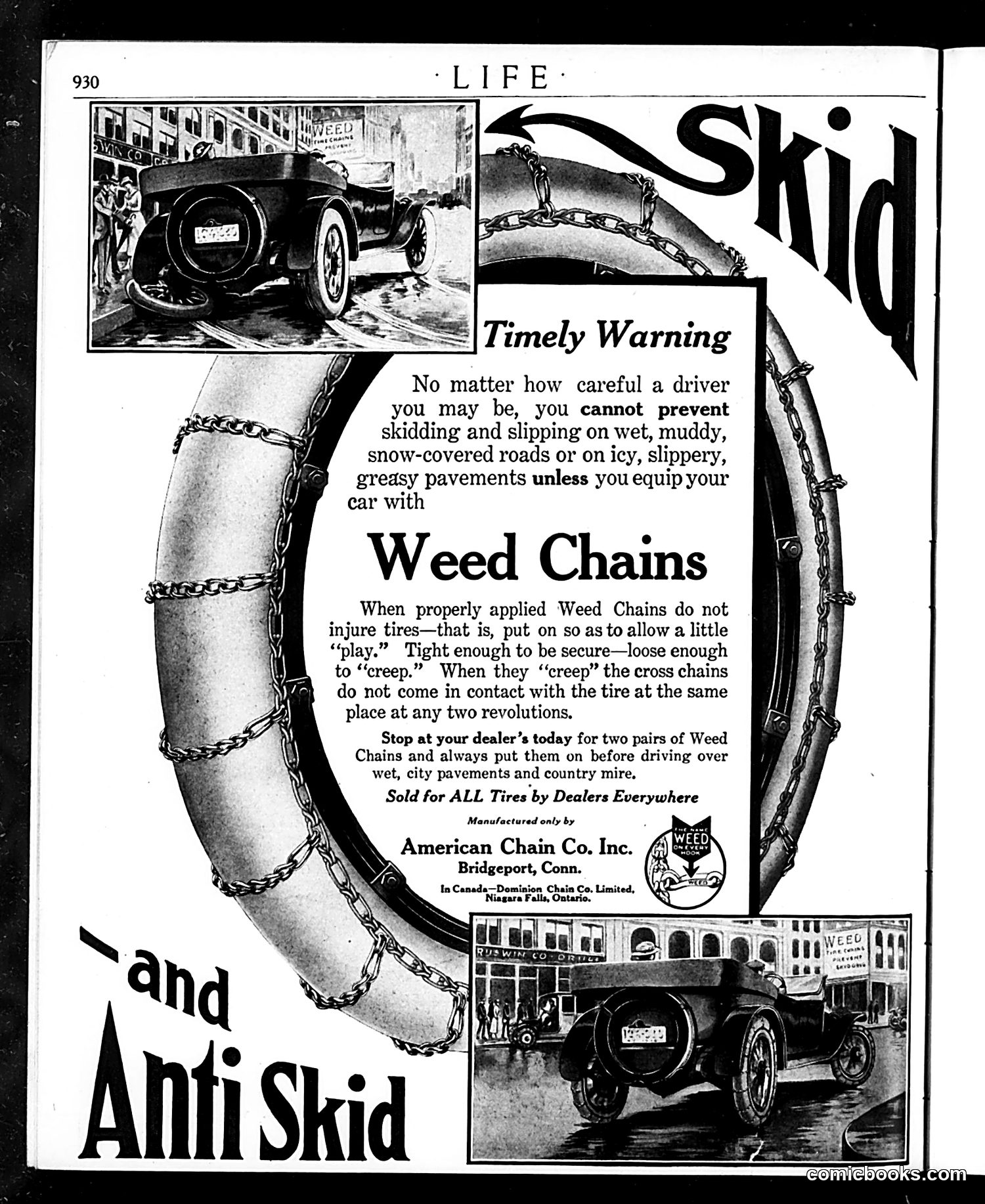
This is **not satire or political commentary**—it's a straightforward product advertisement from an era (likely 1920s-1930s based on the vehicle styles) when tire chains were essential winter safety equipment. The ad promotes "Weed Chains," manufactured by American Chain Co. Inc. in Bridgeport, Connecticut. The large central image shows chains wrapped around a tire. Two photographs display vintage automobiles equipped with the chains for traction on snow and ice. The "Timely Warning" headline warns drivers that careful driving alone cannot prevent skidding on wet or icy roads—only proper tire chains can. The ad recommends purchasing two pairs before winter driving. This represents practical consumer advice from a pre-modern-tire-technology era.
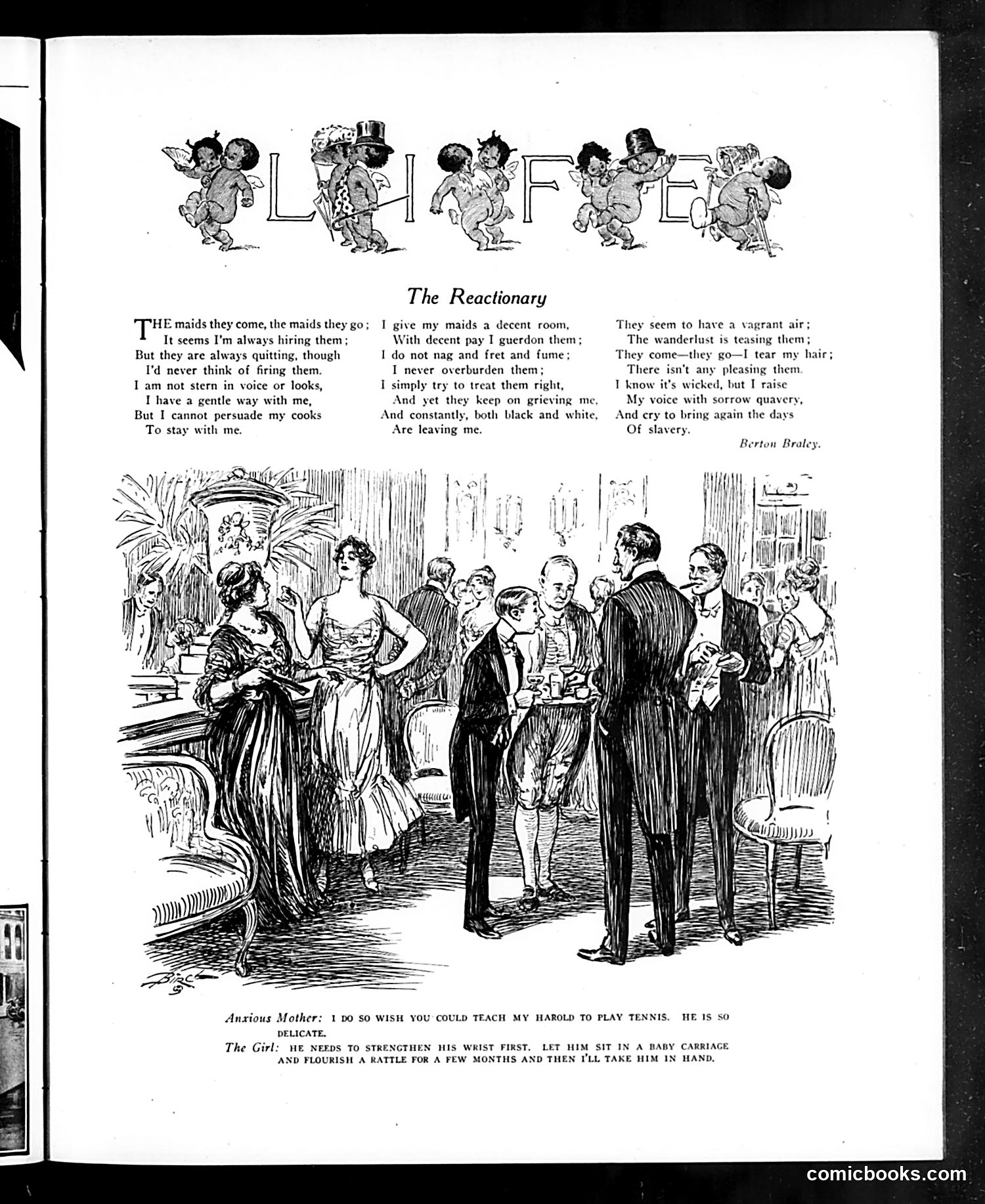
The top cartoon spells "LIFE" using illustrated figures representing maids departing their employers. The poem "The Reactionary" by Berton Bradley accompanies this, presenting an employer's lament: maids constantly leave despite being treated decently with good rooms and pay. The employer cannot understand their departures. The bottom illustration depicts a social gathering where an "Anxious Mother" and "The Girl" discuss a boy named Harold. The mother wants him taught tennis; the girl responds that he needs to strengthen his wrist first through months in a baby carriage before she'll "take him in hand." Together, these pieces satirize rigid, old-fashioned attitudes—the employer's confusion about workers' desires for freedom, and the mother's controlling approach to child-rearing—mocking those resistant to modern social changes.
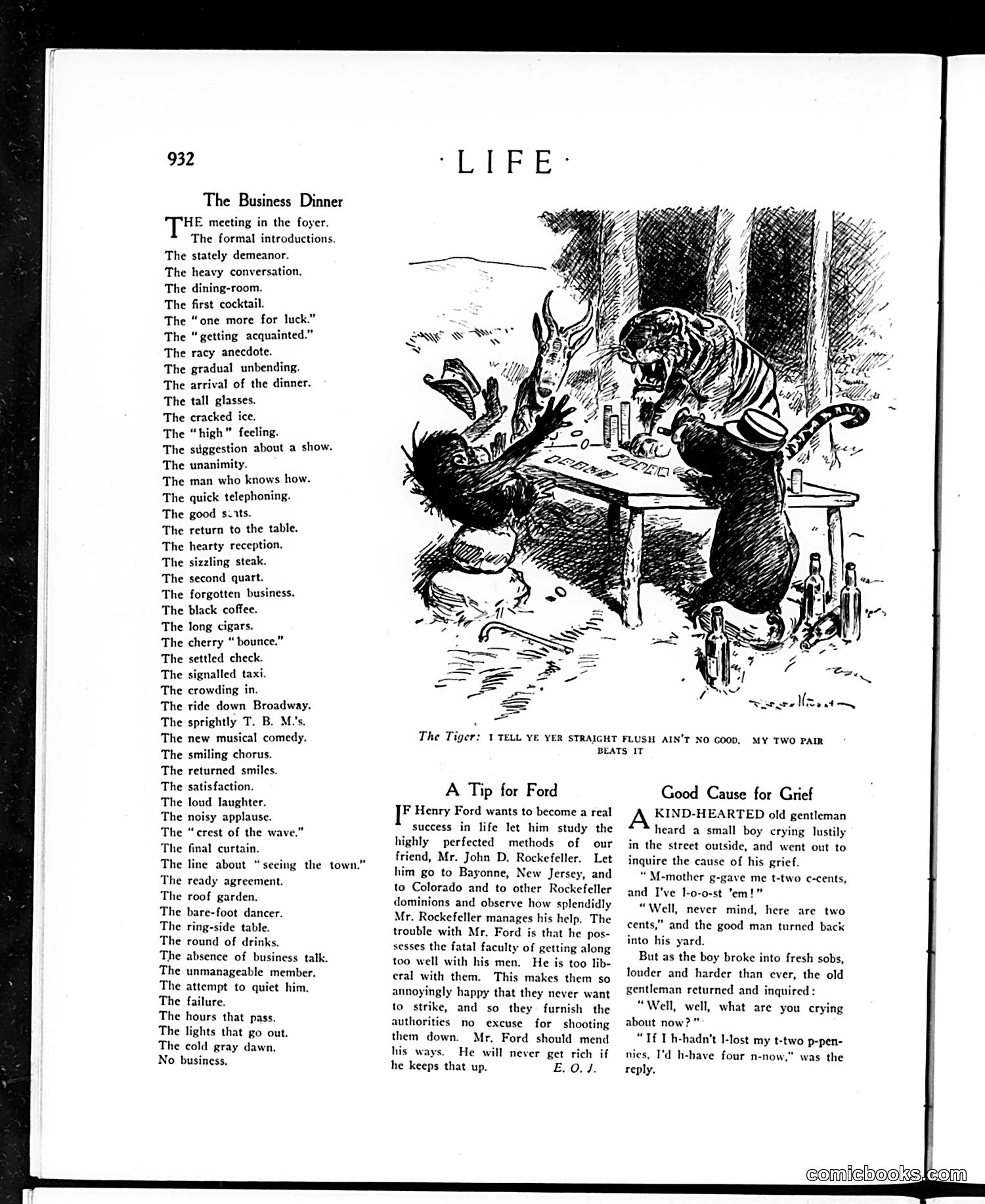
The main cartoon depicts two anthropomorphic tigers engaged in what appears to be a poker or card game at a table, with the caption: "I tell ye yer straight flush ain't no good. My two pair beats it." This is satirical commentary on business dealings or financial negotiations—the tigers represent ruthless businessmen or competitors. The joke plays on the idea that in ruthless commerce, rules are flexible and the stronger party (here, both figures are equally threatening) can claim victory through sheer force rather than actual merit. The "straight flush" losing to "two pair" symbolizes how legitimate advantage gets overruled by negotiating power or deception in business. The surrounding text lists elements of "The Business Dinner," treating corporate socializing as theater with predictable, formulaic steps.
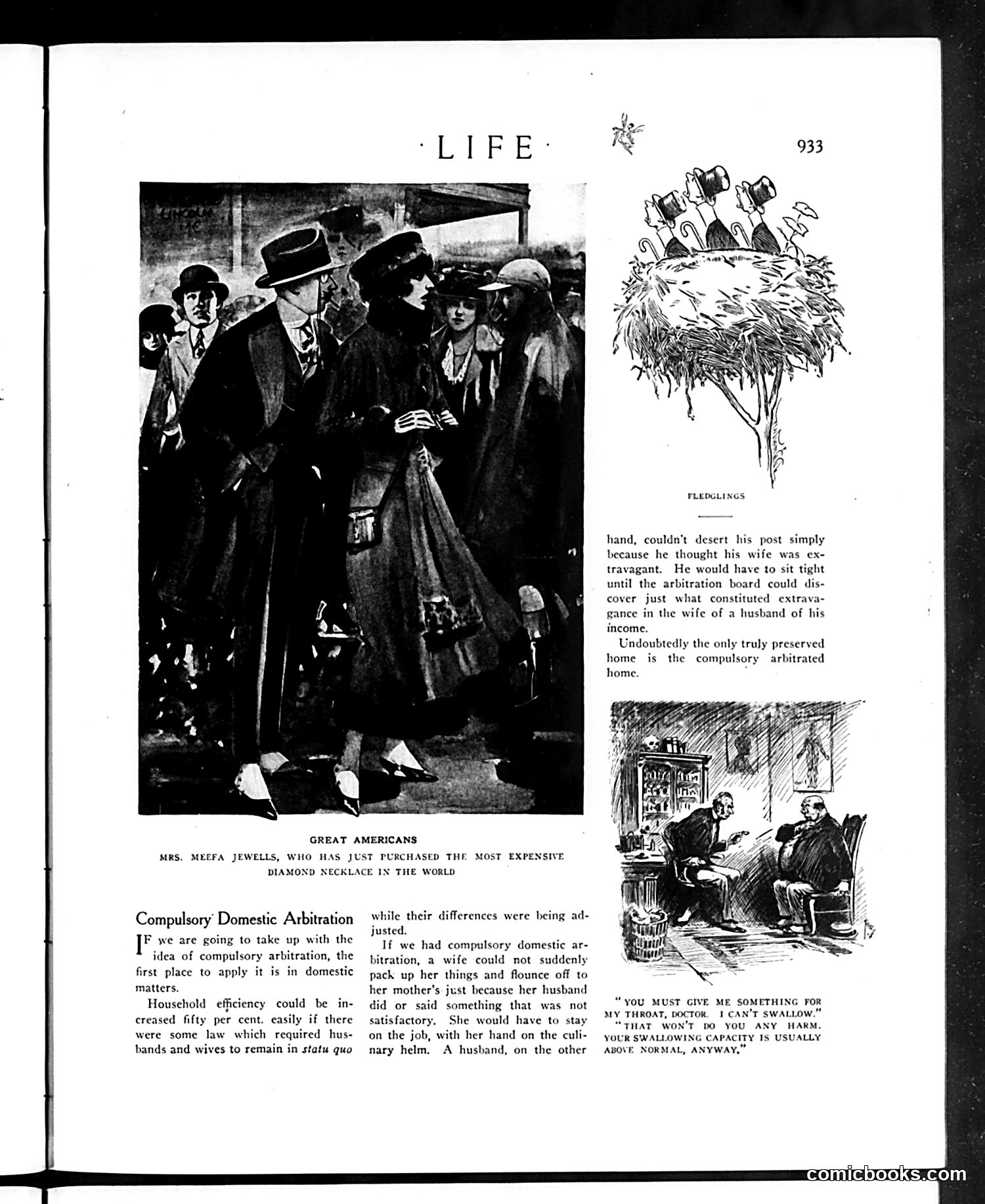
**Top photograph:** Shows Mrs. Meefa Jewells displaying "the most expensive diamond necklace in the world." The image captures well-dressed early 20th-century figures in formal attire, likely illustrating wealth and social status. **Main article: "Compulsory Domestic Arbitration"** This satirizes proposed legislation requiring husbands and wives to submit marital disputes to arbitration rather than separate. The author argues this would increase household efficiency by 50% if enforced. The piece mocks the absurdity of legally mandating spouses remain together during disagreements—suggesting wives couldn't simply leave if husbands were unsatisfactory, and husbands couldn't escape "the culinary helm." **Bottom cartoon:** A doctor tells a patient his throat problem isn't serious; the patient's "swallowing capacity is usually above normal anyway"—a crude joke about something unspecified.
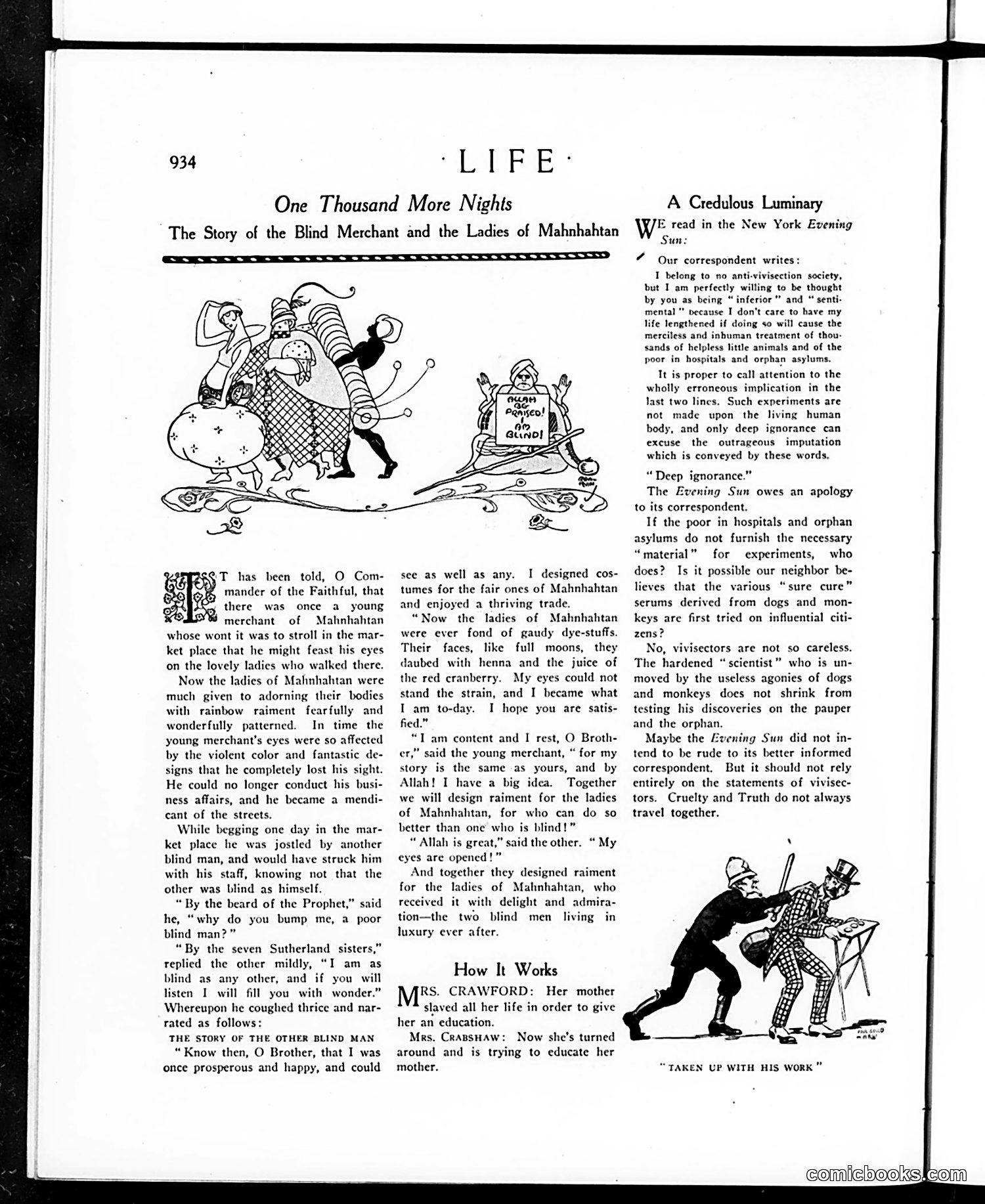
This page satirizes vivisection (animal testing) through a fable titled "One Thousand More Nights: The Story of the Blind Merchant and the Ladies of Manhattan." The main illustration depicts two blind men designing colorful "rainment" (clothing) for Manhattan society women. The accompanying editorial sidebar, titled "A Credulous Luminary," critiques the *New York Evening Sun* for endorsing animal experimentation without acknowledging ethical concerns. The satire argues that vivisectionists rely on "deep ignorance" to justify testing on "helpless little animals" in hospitals and asylums. The cartoon's fantastical premise—blind men creating fashion—serves as a metaphor for society accepting harmful practices based on blind faith rather than moral scrutiny. The "How It Works" section mocks credulous acceptance of dubious claims, using Mrs. Crawford's education efforts as counterpoint to scientific recklessness.
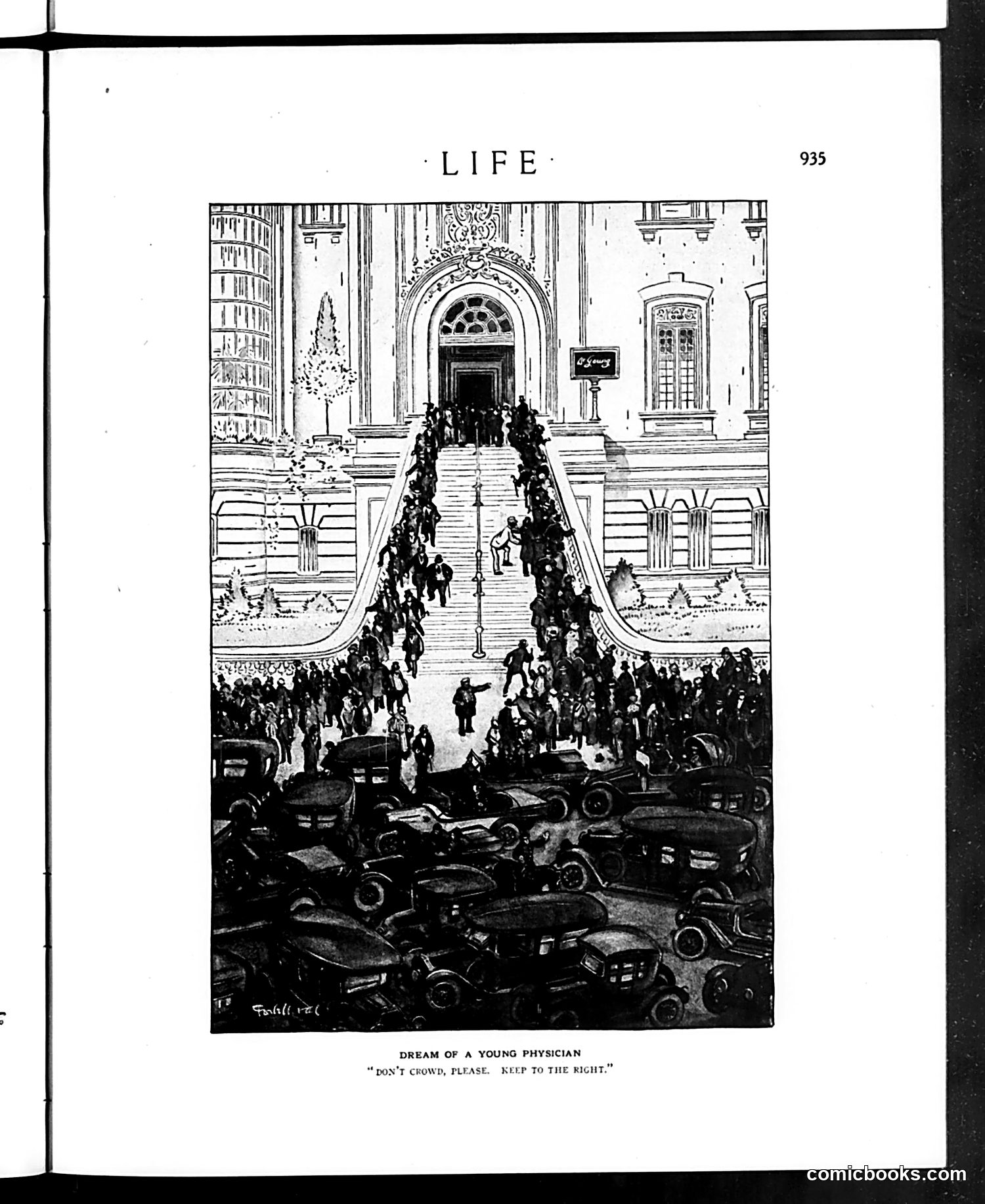
This satirical cartoon depicts a physician's fantasy of navigating through massive crowds and automobiles to reach a grand public building (likely a hospital or medical institution). The caption "Don't crowd, please. Keep to the right" suggests ironic commentary—the physician imagines giving crowd-control instructions despite being overwhelmed by throngs of people and vehicles below. The satire likely critiques the overwhelming demand for medical services, the chaos of urban medical practice, or perhaps the ego of physicians who imagine themselves directing crowds. The contrast between the orderly, classical architecture above and the chaotic mass of vehicles and people below emphasizes the disconnect between professional aspiration and reality. The cartoon pokes fun at physicians' grandiose self-importance.
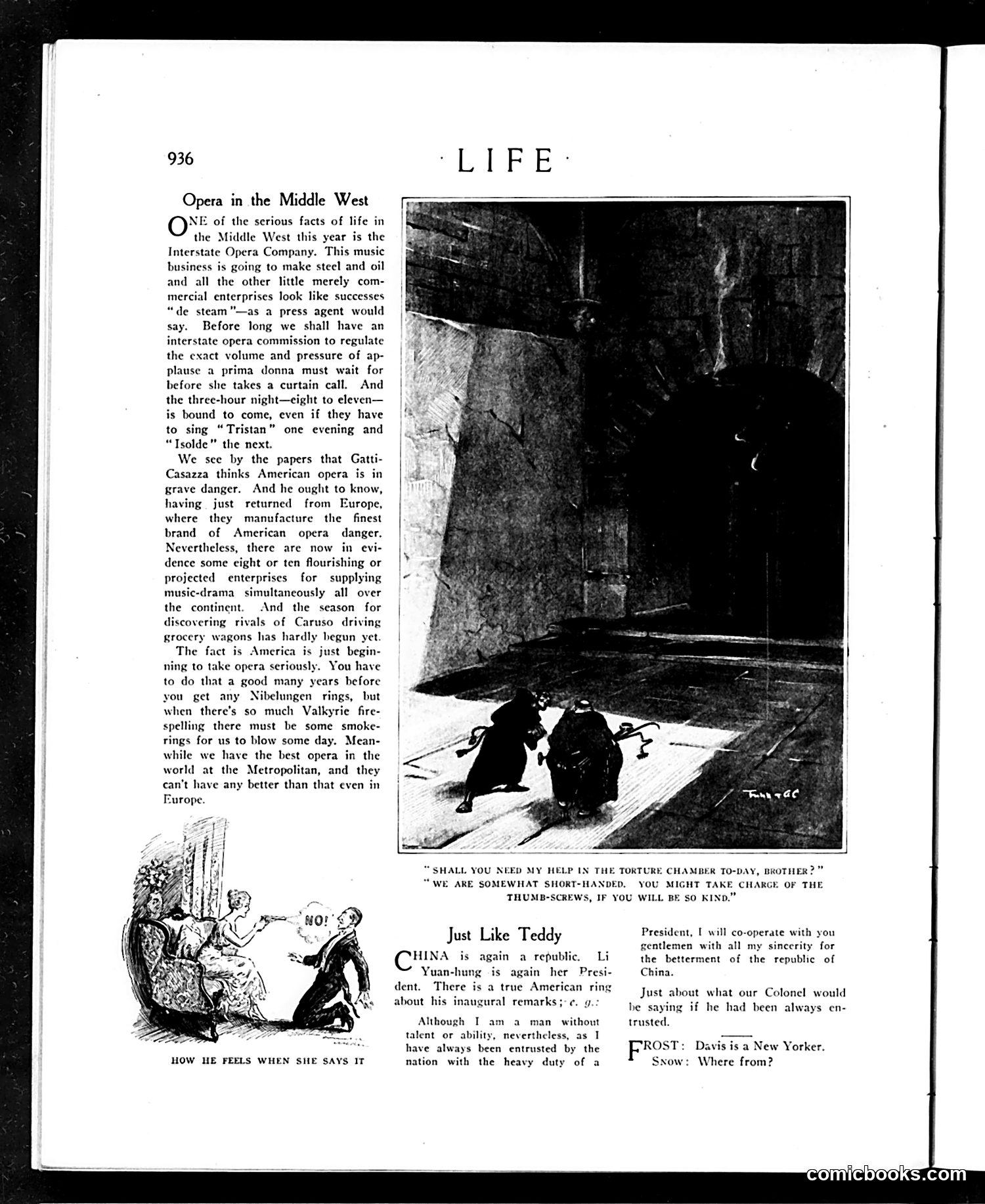
The page contains two distinct pieces: **"Opera in the Middle West"** (top): Commentary on the Interstate Opera Company's emergence, mocking how American commerce treats opera like any industrial enterprise. The satirist suggests opera will soon be regulated like steel production—a humorous critique of American materialism overwhelming European cultural refinement. **"Just Like Teddy"** (bottom): A political cartoon depicting Li Yuan-hung, China's new president following the republic's establishment. The figure kneeling before him represents someone seeking approval. The satire compares Li's assumption of power to Theodore Roosevelt's leadership style—suggesting American political influence or that Li is imitating Roosevelt's decisive approach. The caption's exchange about trustworthiness implies skepticism about the new Chinese government's stability.
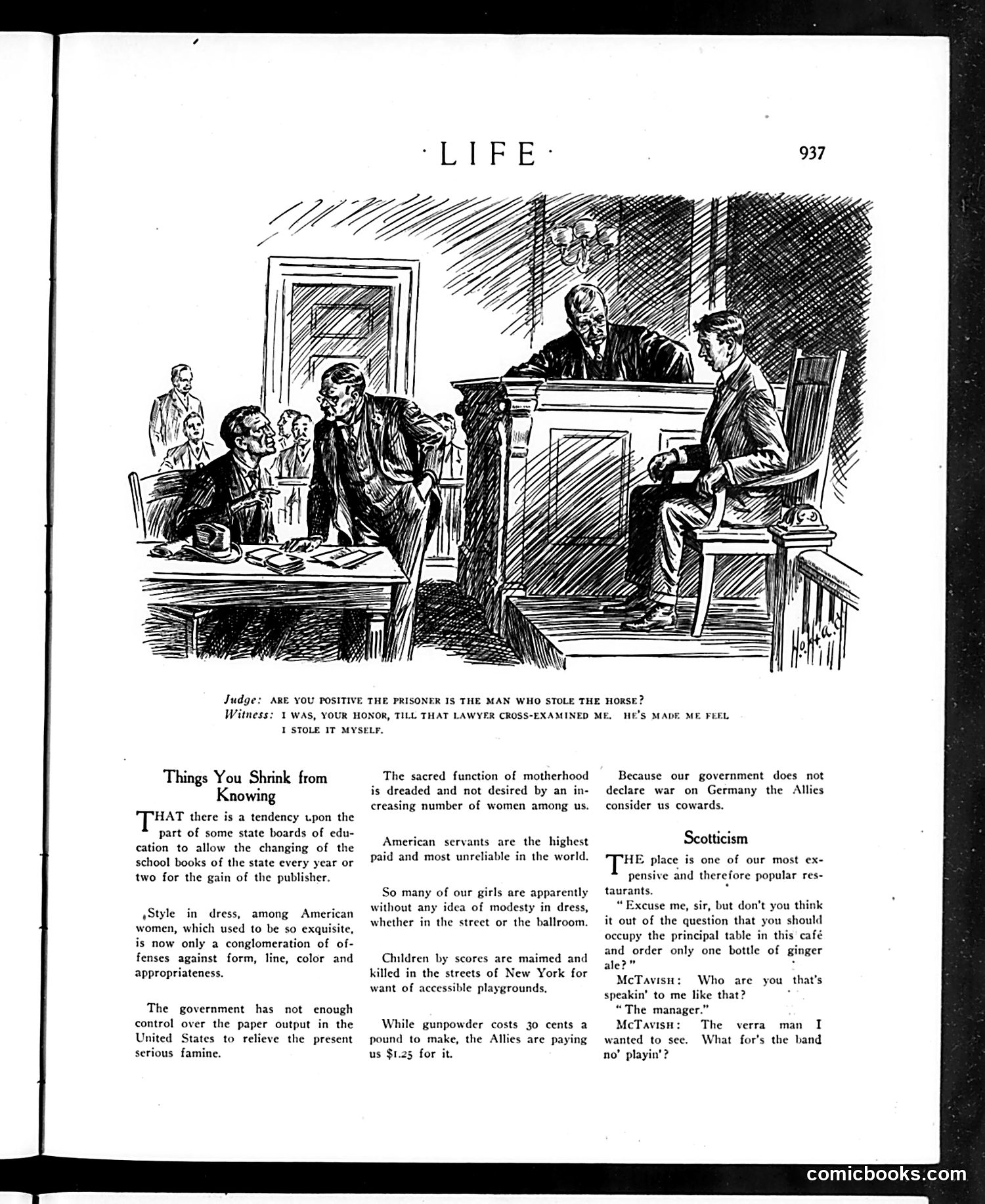
The cartoon depicts a courtroom scene where a witness testifies about stolen horses. When the judge asks if the prisoner is the thief, the witness admits: "I was, your honor. Till that lawyer cross-examined me. He's made me feel I stole it myself." **The joke:** This satirizes lawyers' courtroom tactics—their skill at aggressive cross-examination is so effective (or manipulative) that it confuses witnesses into doubting their own testimony and guilt/innocence. The humor turns on the absurdity that a clever attorney can make an honest witness feel criminally responsible through rhetorical pressure alone, regardless of actual facts. The accompanying text discusses unrelated social issues: changing school curricula, women's fashion modesty, American servant wages, and wartime supply costs.
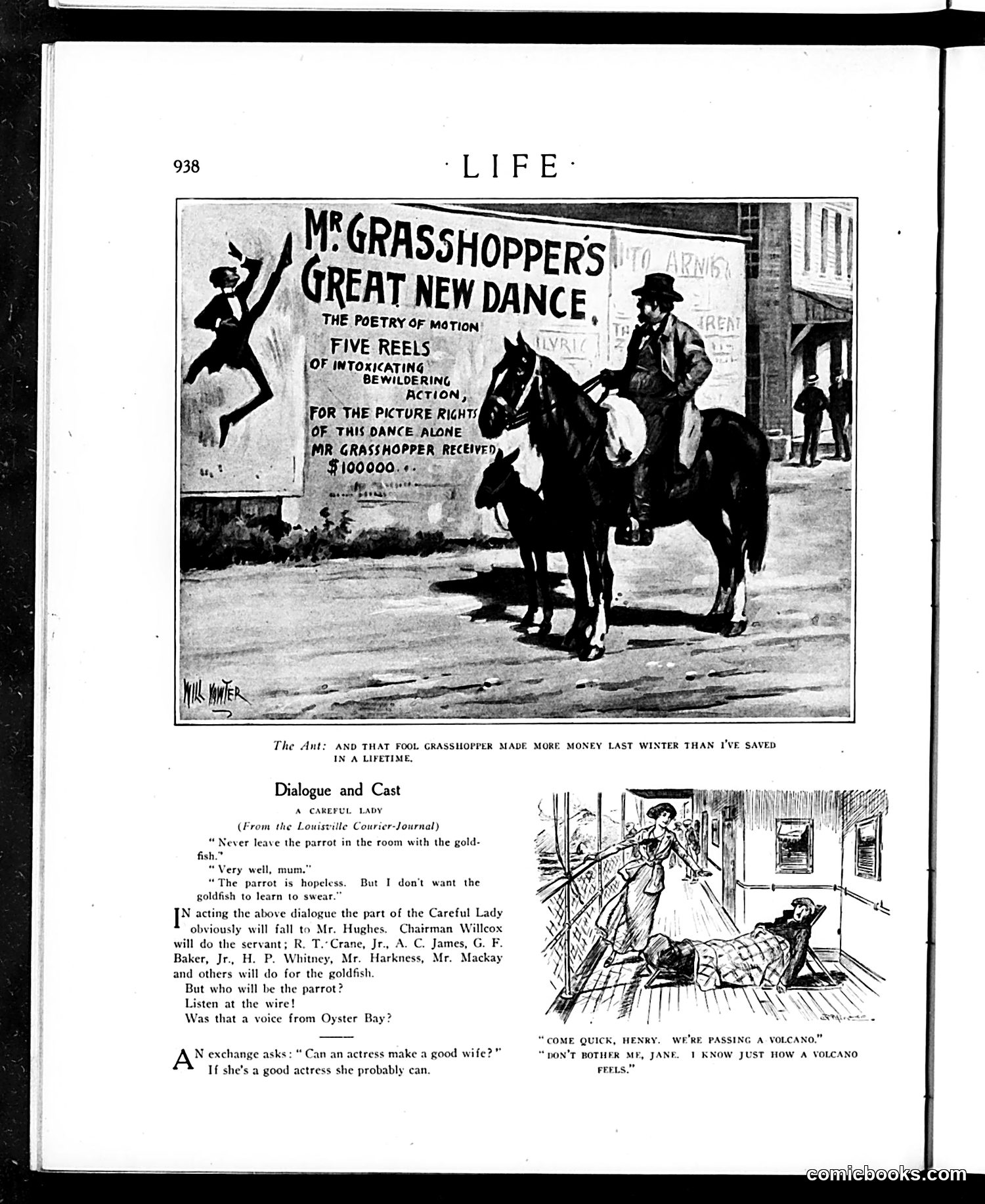
This page satirizes early silent film economics and celebrity culture. The top image advertises "Mr. Grasshopper's Great New Dance"—a film where the title character supposedly earned $100,000 for dance rights alone. The satire targets the absurdly inflated salaries and hype surrounding silent film stars and productions during the 1910s-1920s boom. Below is a separate humor piece titled "Dialogue and Cast" featuring a "Careful Lady" who warns against leaving a parrot with a goldfish. The joke plays on the parrot's tendency to swear—a common comedic trope of the era. The sketch appears to mock theatrical casting conventions and domestic mishaps, with accompanying illustrations of interior scenes. Both sections exemplify Life magazine's satirical approach to contemporary entertainment and society.
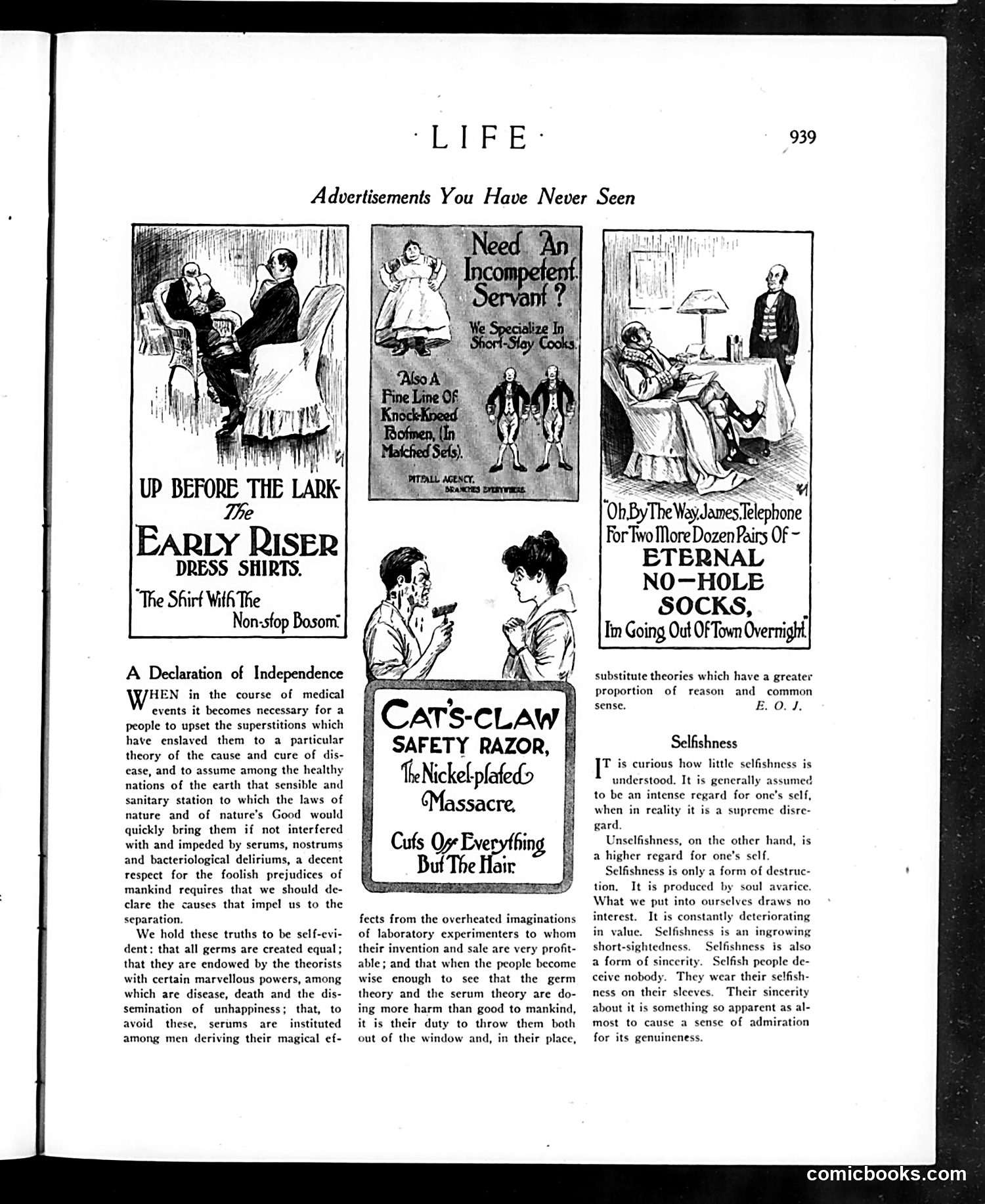
This page consists primarily of **vintage advertisements** from the early 20th century, presented as humorous fake ads titled "Advertisements You Have Never Seen." The satirical ads mock contemporary products and social conventions: - **"Early Riser Dress Shirts"** jokes about men's fashion - **"Incompetent Servant"** ad satirizes domestic help shortages - **"Eternal No-Hole Socks"** humorously addresses a common complaint about hosiery - **"Cat's-Claw Safety Razor"** pokes fun at shaving products The page also includes a serious editorial piece titled **"A Declaration of Independence"** that critiques germ theory and medical superstitions, arguing against unnecessary medical interventions. Below that is a brief essay on **"Selfishness,"** discussing how self-regard differs from genuine selflessness. The humor relies on exaggerated period advertising tropes and domestic frustrations familiar to contemporary readers.
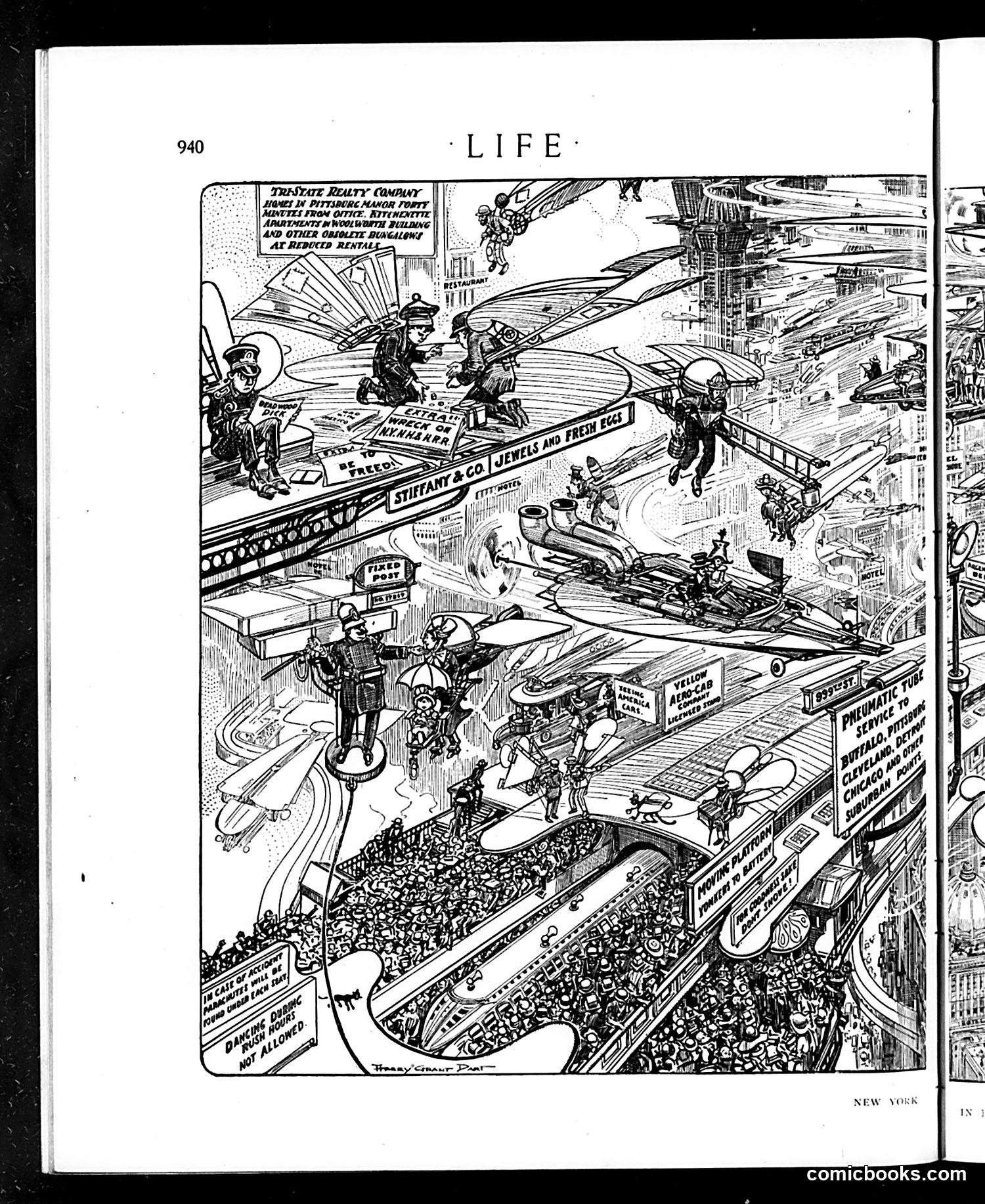
This is a satirical illustration depicting a futuristic aerial city, likely from the early 20th century. The image shows fantastical flying vehicles, airships, and elevated transportation systems populated by well-dressed figures navigating an imaginary metropolis. The satire appears to mock utopian visions of technological progress and urban development. Various business signs and advertisements are visible throughout—including references to "Stiffany & Co." (likely parodying Tiffany & Co.) and other commercial establishments—suggesting commentary on how commercialism would pervade even imaginary future societies. The crowded, chaotic nature of the scene, with numerous vehicles and people in close proximity, may satirize anxieties about overpopulation and urban congestion. The overall effect is humorous exaggeration of contemporary predictions about technological advancement and city life.
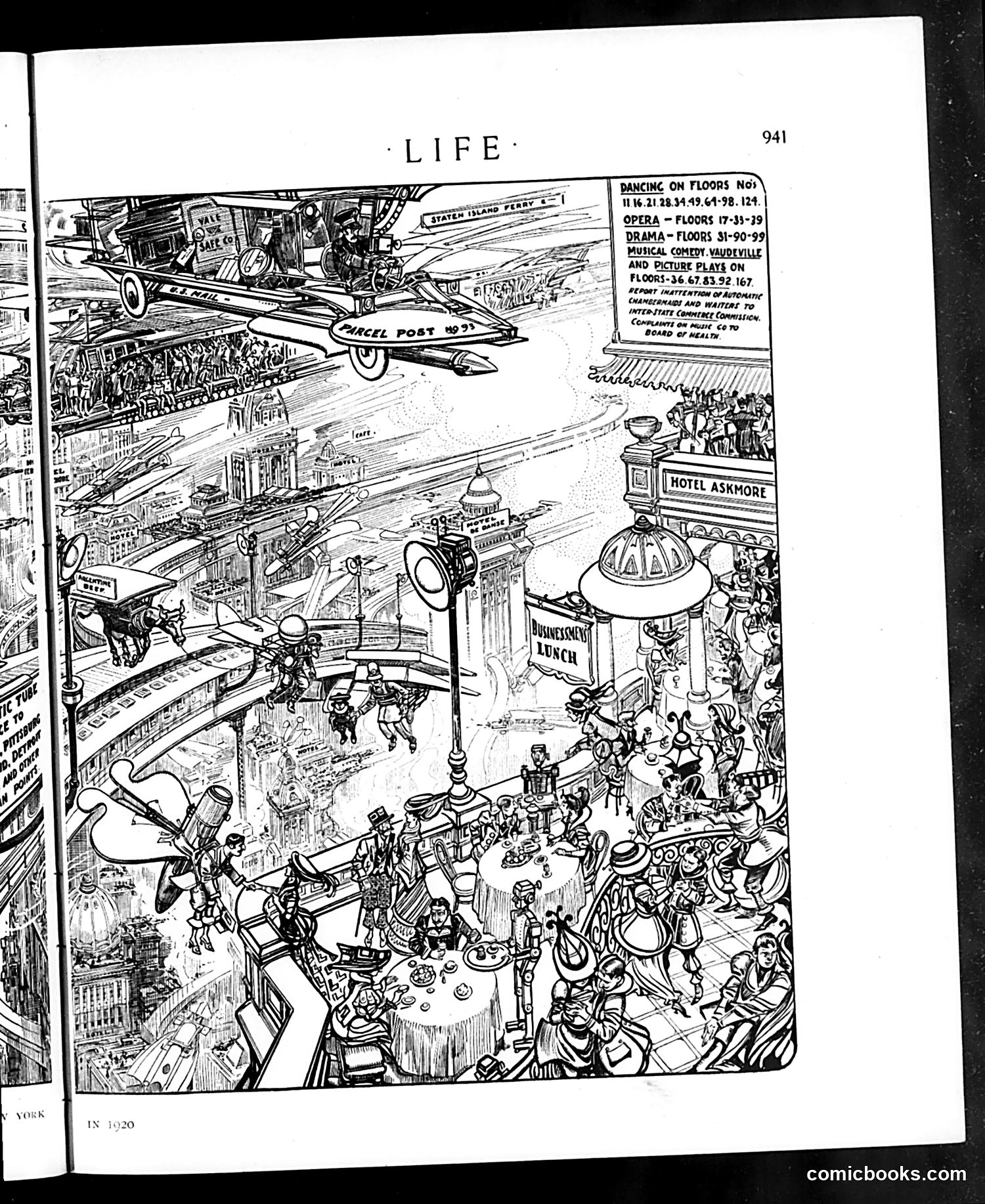
This is a densely detailed architectural bird's-eye view illustration of what appears to be a futuristic or imagined New York City scene, showing multiple levels of transportation and activity. The image depicts: - **Upper level**: An airplane marked "STATEN ISLAND FERRY" and "AIR PORT No 21" - **Middle sections**: Multi-story buildings including "HOTEL ASKMORE" and "BUSINESSMEN'S LUNCH" - **Ground level**: Crowds of people, automobiles, pedestrians engaged in various activities The satirical point appears to mock urban congestion, technological progress, and modern life's complexity—showing transportation stacked vertically (planes, cars, people) in an impossibly crowded cityscape. This likely critiques 1920s American urbanization, commercialism, and the overwhelming nature of modern metropolitan life. The dense, chaotic composition emphasizes social satire rather than celebration of progress.
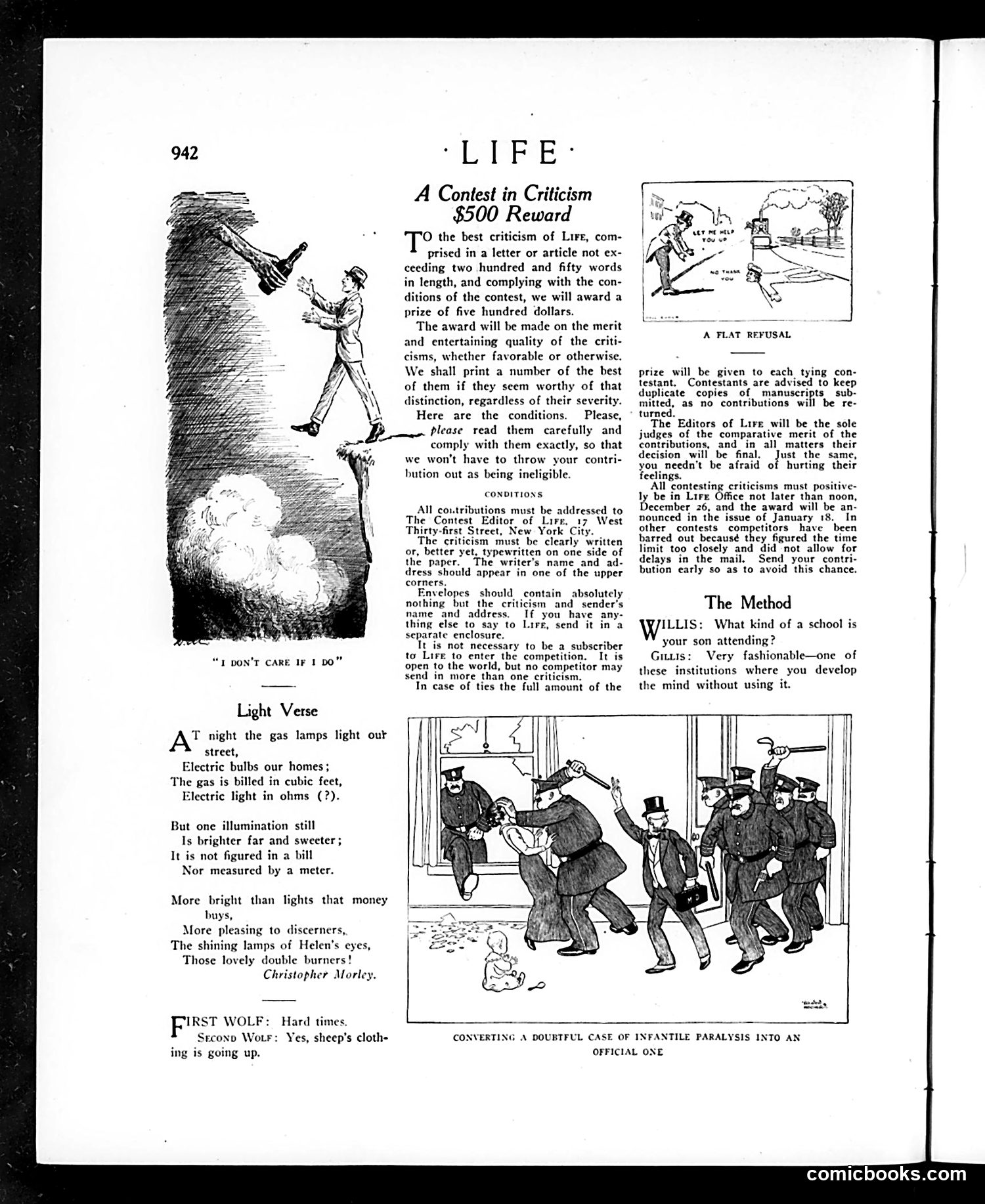
This page from *Life* magazine contains several satirical pieces: **"A Flat Refusal"** (top right cartoon): Shows officials aggressively converting a dubious case of infantile paralysis into an "official" diagnosis. The satire targets bureaucratic overreach—the implication being that government agencies inflate or manufacture official cases for statistical or funding purposes, prioritizing paperwork over genuine medical assessment. **"Light Verse"** by Christopher Morley playfully contrasts modern utility billing (gas measured in cubic feet, electricity in ohms) with romantic "illumination"—a woman's eyes. It's gentle, flirtatious humor. **The Wolf dialogue** is a one-liner about economic hardship: hard times mean even sheep's clothing (traditionally cheap material) is becoming expensive. **The contest announcement** is straightforward—*Life* solicits reader criticism for $500. **"The Method"** jokes about fashionable schools that claim to develop students' minds "without using it"—mocking pretentious educational institutions offering style over substance. The page reflects early 20th-century concerns: bureaucratic inefficiency, economic anxiety, and educational fraud.
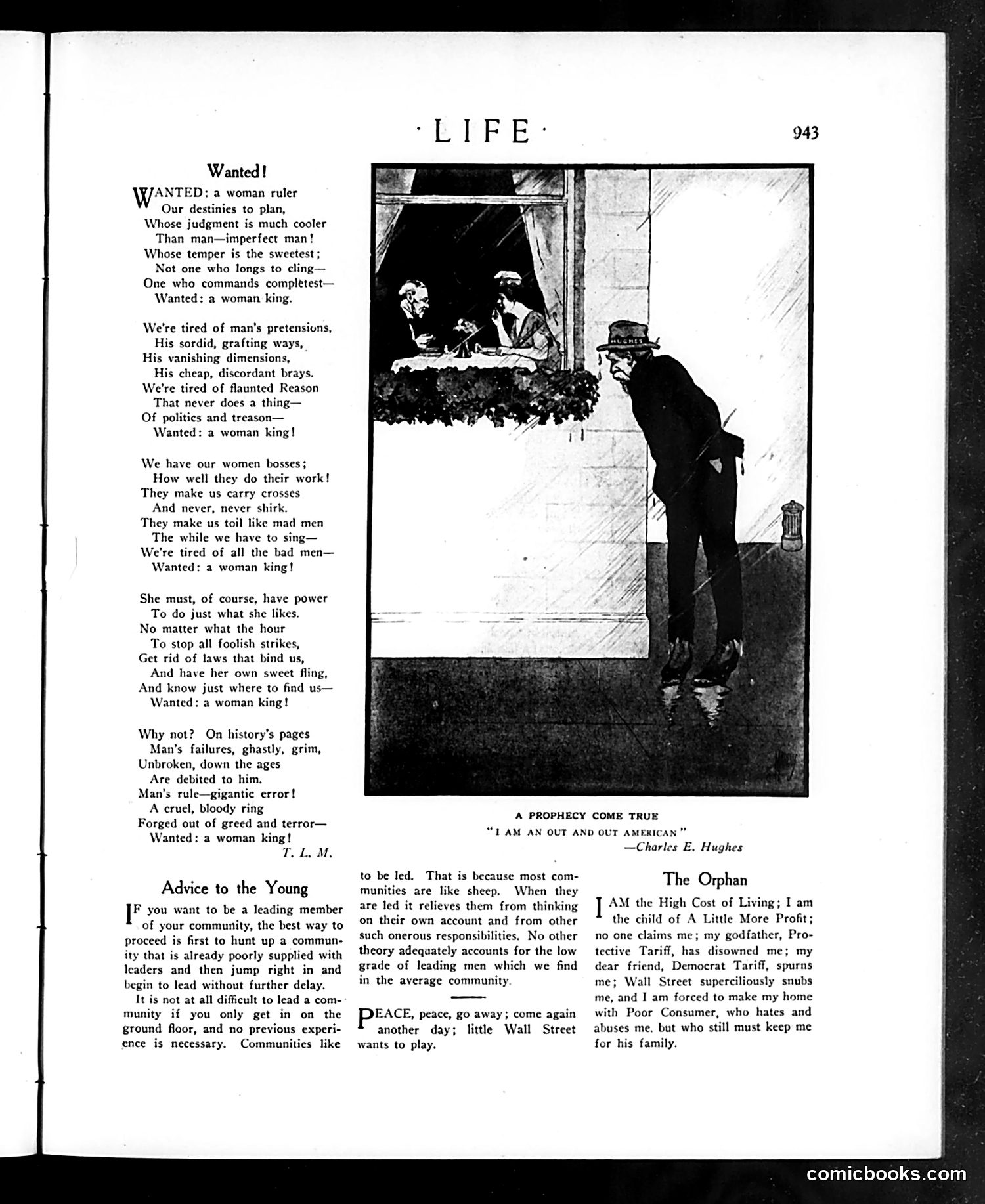
## Main Poem: "Wanted! A Woman King" This satirical poem ironically proposes female rule as a solution to male governmental failures. The speaker catalogs men's failures—corruption ("sordid, grafting ways"), ineffectual leadership ("flaunted Reason"), and historical violence ("greed and terror")—suggesting a female ruler would be superior. However, the satire cuts both ways: later stanzas reveal the poem mocks both sexes, noting that women "bosses" also burden workers while demanding they "never, never shirk." ## Illustration: "A Prophecy Come True" The image, attributed to Charles E. Hughes (likely the 1916 Republican presidential candidate), depicts two figures observing a man through a window. The caption's meaning remains unclear without additional context. ## Supporting Content The page includes practical advice on community leadership and a personified "Orphan" (the High Cost of Living)—a political metaphor claiming no party takes responsibility for inflation, blaming instead tariff policies and Wall Street. **Overall theme**: Early 20th-century American political and social critique expressed through humor.
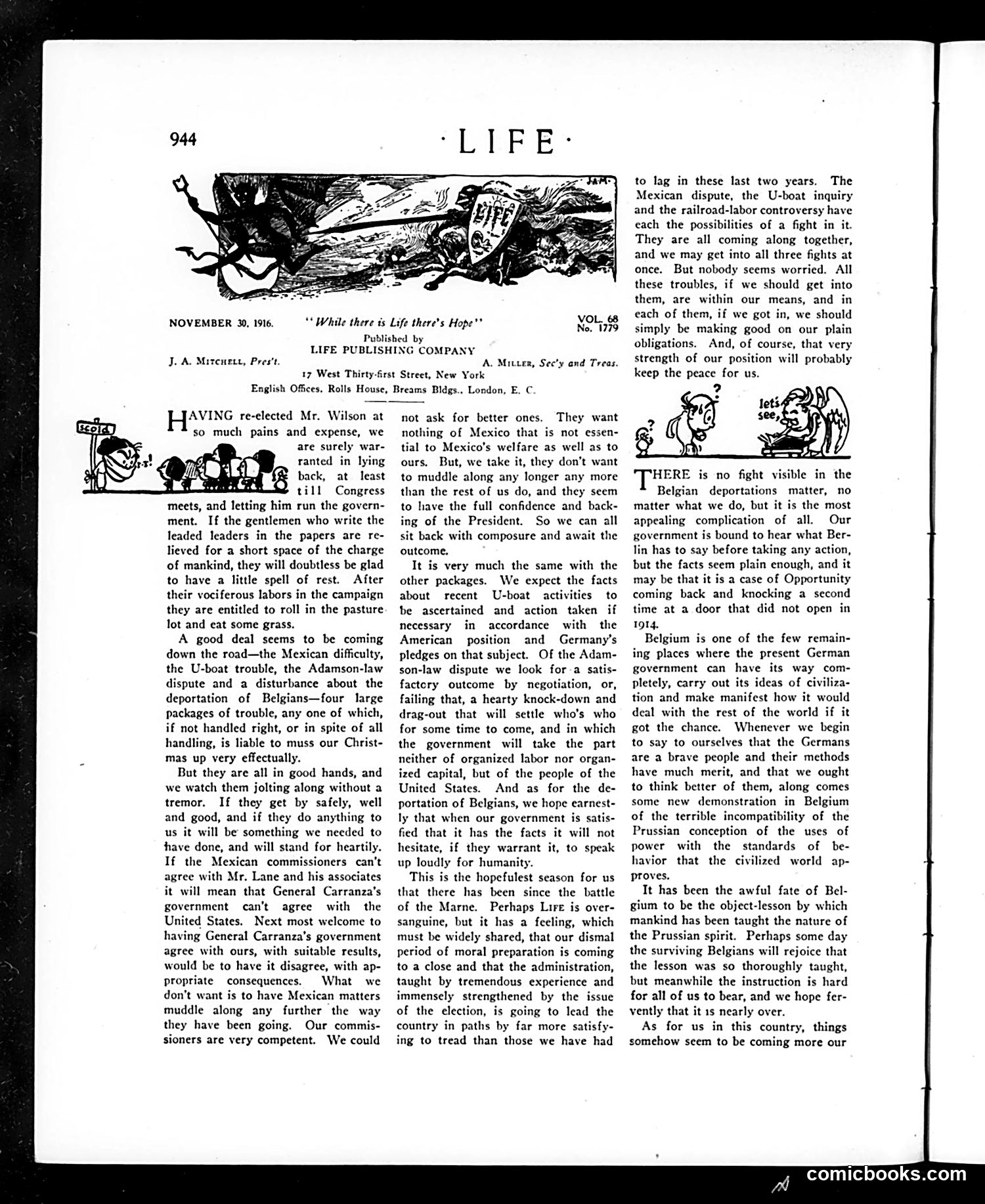
This editorial page celebrates President Wilson's reelection and urges public patience with pending crises. The small cartoon (upper left) depicts a weary voter resting after the campaign, illustrated as a simple figure lounging contentedly. The text addresses four major problems facing the administration: the Mexican situation (involving General Carranza's government), German U-boat attacks, the Adamson railroad-labor dispute, and the deportation of Belgians. The author argues these issues are "in good hands" and expresses confidence that Wilson, strengthened by his electoral victory, will resolve them decisively. The tone is notably optimistic, suggesting America has passed its "dismal period of moral preparation" since the 1914 Battle of the Marne. The editorial advocates for forceful action on all fronts while urging readers to trust the administration—a curious position given these tensions would soon push the U.S. toward World War I entry.
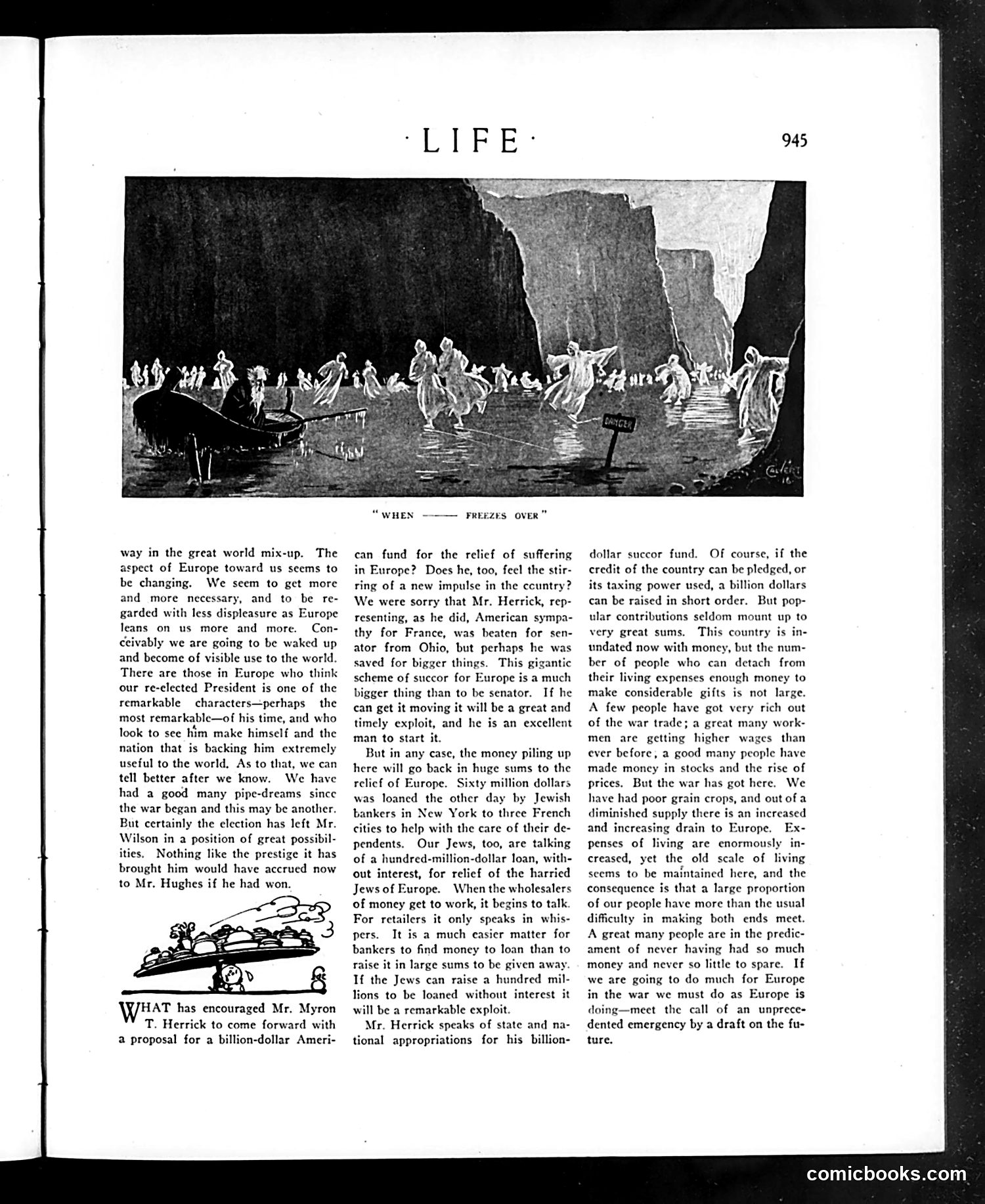
**The Cartoon:** "When ___ Freezes Over" depicts an ethereal, ghostly scene—figures in flowing robes gathered in a cavern or underworld setting. This is a visual pun on the common expression "when hell freezes over," sarcastically suggesting an impossibility. **The Context:** The article discusses Myron T. Herrick's proposal for a billion-dollar American relief fund for war-torn Europe (likely World War I era). The cartoon illustrates the author's skepticism about raising such enormous sums through voluntary public contributions. **The Satire:** While wealthy financiers and bankers can mobilize large loans, ordinary Americans—despite higher wages from wartime industry—struggle financially. The cartoonist suggests that expecting Americans to donate generously to European relief while managing increased living expenses is absurdly optimistic, hence "when hell freezes over." **Key Point:** The piece argues Americans lack both the surplus wealth and the cultural motivation for massive voluntary charity, despite wartime prosperity benefiting some sectors.
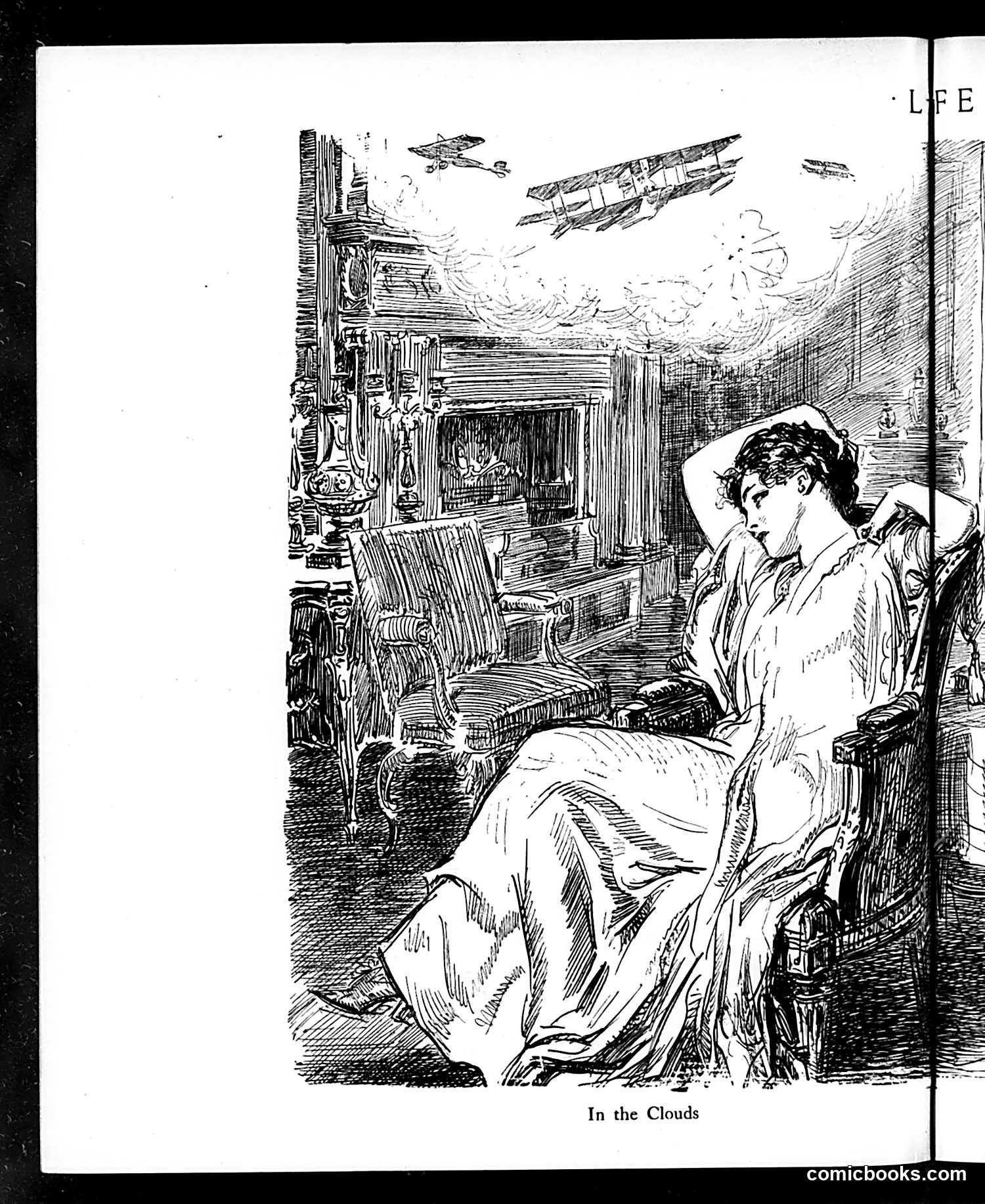
This illustration depicts a woman in an elegant interior, gazing upward in a dreamy, contemplative pose. The title "In the Clouds" suggests she is lost in thought or daydreaming. In the sky visible through the window, airships or aircraft appear—a reference to early aviation technology that was novel and captured public imagination in the early 20th century. The satire likely mocks romantic idealization or escapism—the woman's wistful expression contrasted with her mundane domestic setting. The "clouds" may represent both literal aircraft (marvels of modern technology) and figurative dreams/fantasies. This reflects Life magazine's typical satire of upper-class leisure and the gap between romantic imagination and everyday reality.
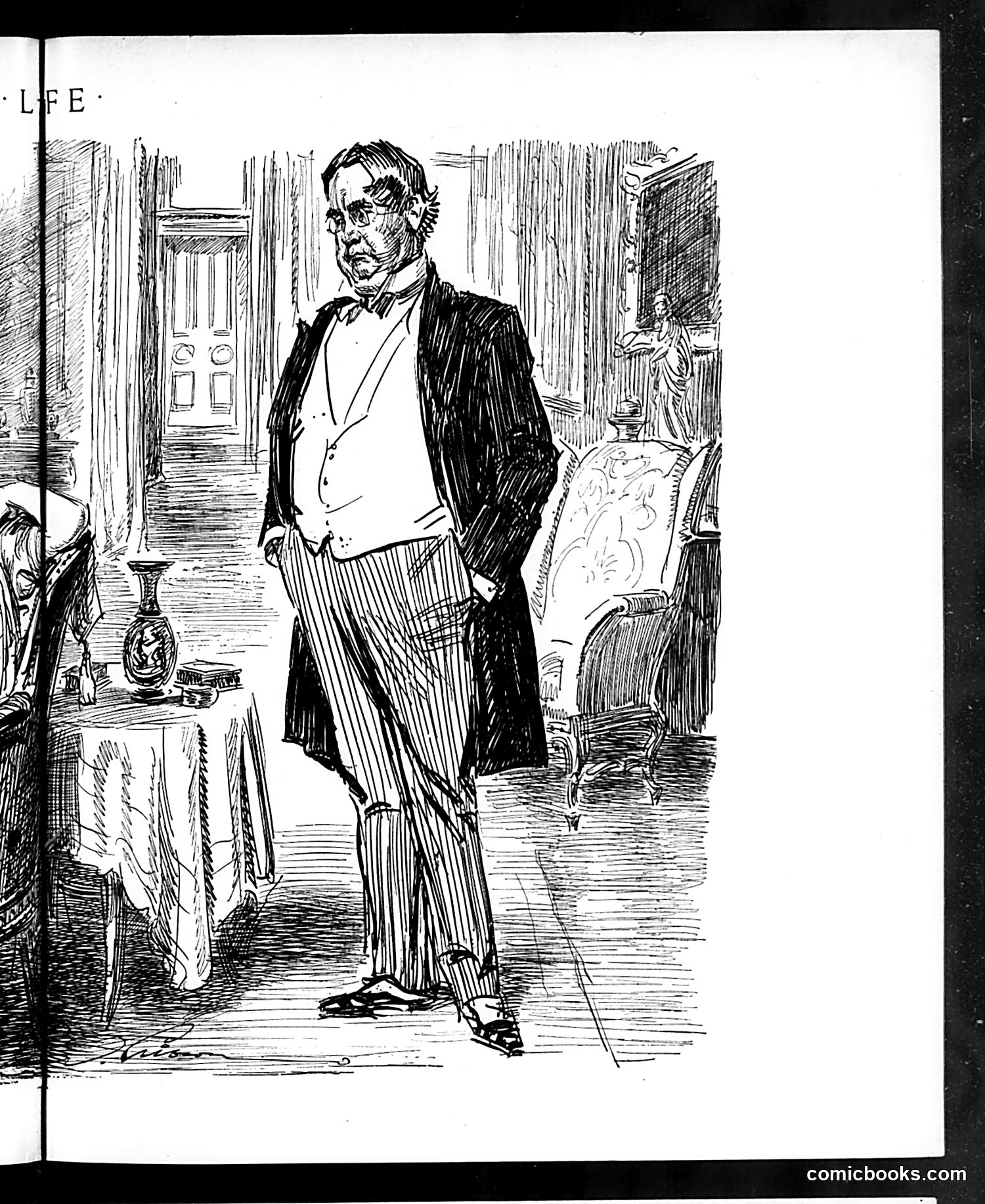
I can see this is a black and white sketch from Life magazine showing a well-dressed man in formal attire (tuxedo and striped trousers) standing in what appears to be an elegant interior setting with period furniture. The drawing style is characteristic of early-to-mid 20th century satirical illustration. However, the OCR text provided only contains "comicbooks.com," which appears to be a watermark rather than actual article or caption content from the original page. Without the original caption, headline, or accompanying text that would explain who this figure represents and what social or political point the cartoon makes, I cannot reliably interpret the satire or identify the specific subject being caricatured. To properly explain this cartoon's meaning to a modern reader, I would need the actual article text or caption that accompanied this illustration.
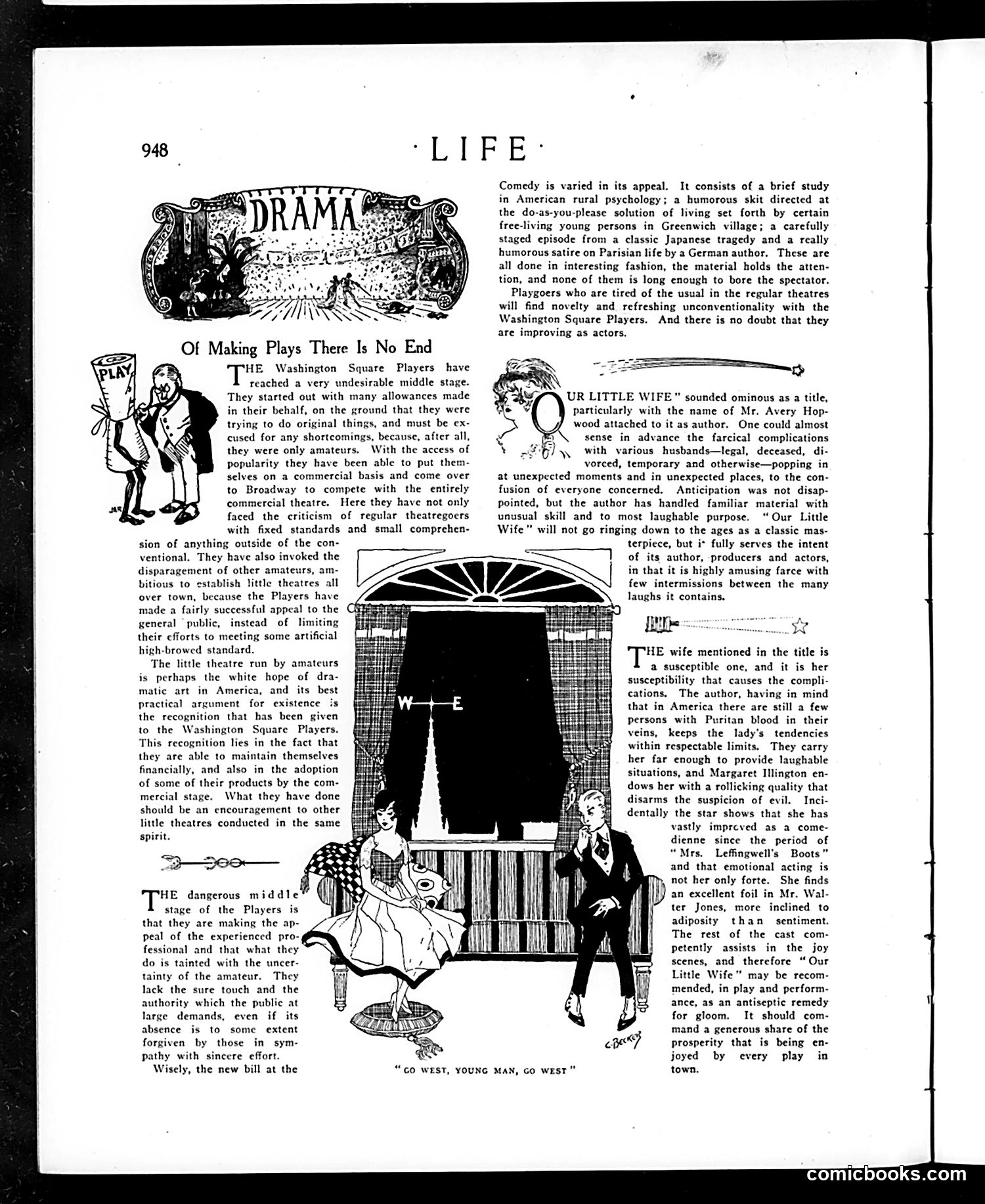
This page reviews the **Washington Square Players**, an amateur theater group that achieved unexpected commercial success on Broadway. The critic discusses their "dangerous middle stage"—they've transitioned from charming amateurs to semi-professionals, but lack the polish of established theaters. The piece argues this is actually valuable: their success proves that experimental, non-commercial theater can appeal to general audiences, encouraging other amateur theater groups. The page also reviews **"Our Little Wife,"** a farce by Avery Hopwood featuring a susceptible wife and comedic confusion with multiple husbands. The critic praises the author's skill in handling familiar farcical material while keeping the protagonist's behavior within acceptable moral bounds—suggesting American audiences still contained "Puritan" sensibilities that needed respecting. The cartoons illustrate theatrical themes, including one showing two figures labeled "W" and "E," likely representing characters from the reviewed plays.
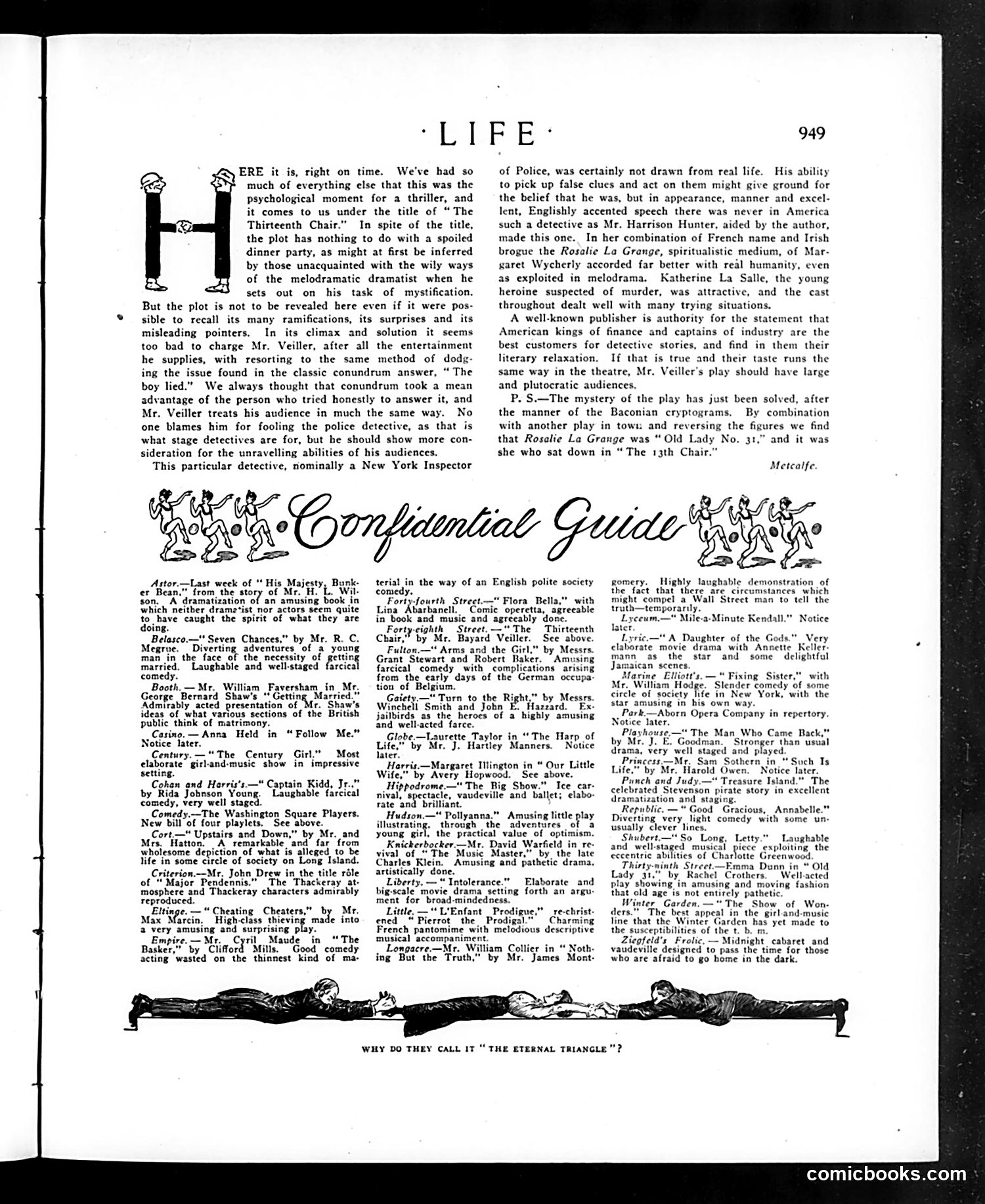
This is a theater review page from *Life* magazine. The main article critiques a thriller play titled "The Thirteenth Chair," written by Mr. Veiller and starring actor Harrison Hunter as a New York police inspector. The reviewer praises the production's entertainment value but criticizes the plot's resolution, arguing Veiller unfairly tricks the audience with a contrived solution—comparing it to a dishonest riddle. The reviewer notes the detective character is unrealistic (too competent, with an implausibly English accent for an American), though other performers like Margaret Wycherly (as a spiritualistic medium) feel more authentic. The lower section is a "Confidential Guide" listing brief reviews of current Broadway productions, including shows at the Astor, Belasco, and other theaters. The cartoon at the bottom appears to be a visual gag about "The Eternal Triangle"—a contemporary theatrical genre trope—though the specific joke is unclear from the image alone.
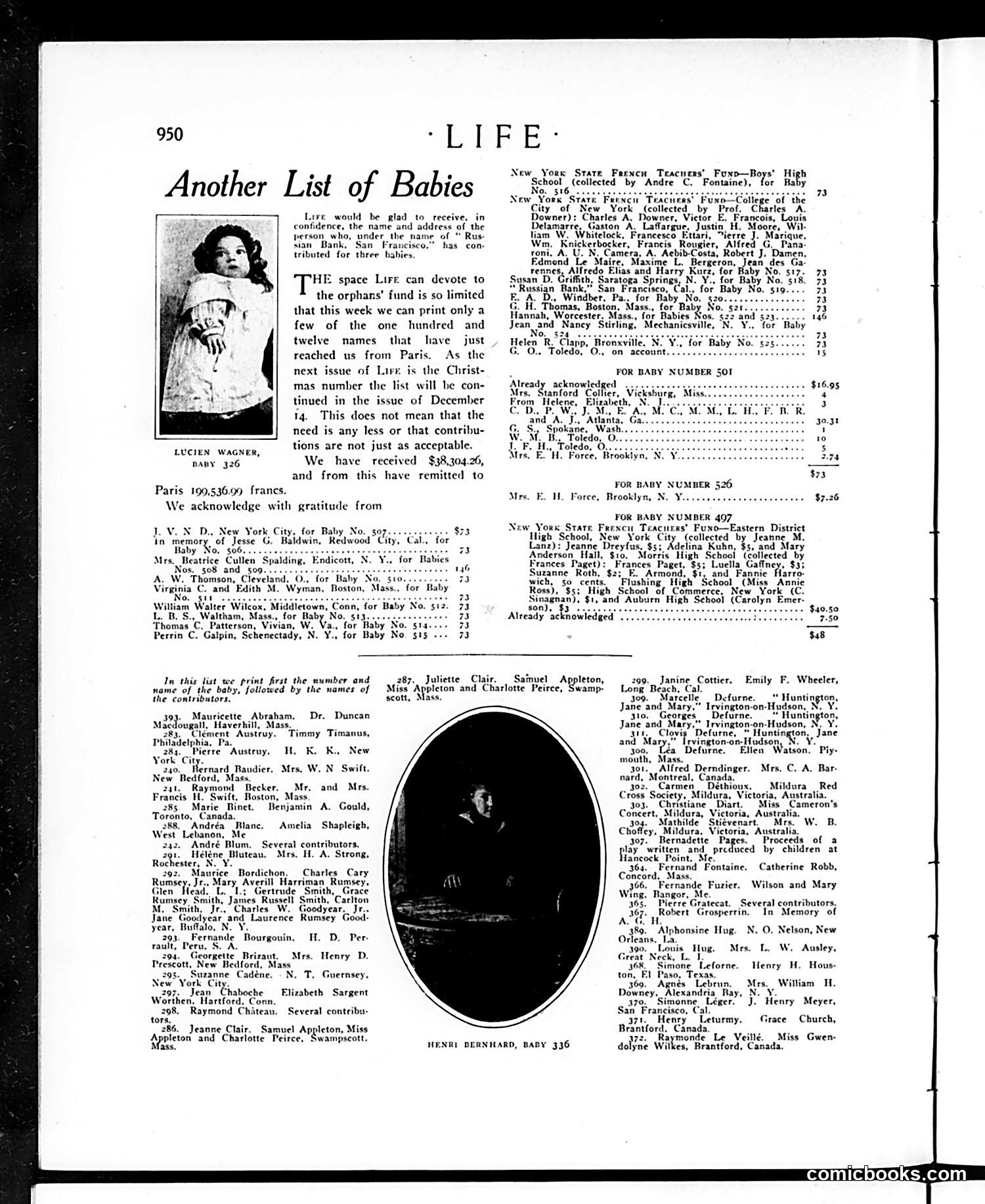
This page documents contributions to an **orphans' relief fund** supporting French children, likely established after World War I. The magazine is publishing donor names and the babies they're sponsoring, identified only by number (Baby No. 326, 501, etc.) rather than individual names. The central photograph shows **Henri Bernhard, Baby 336** — one of the French orphans being supported through this charitable initiative. The bulk of the page lists **hundreds of American donors** from across the country (New York, Pennsylvania, Massachusetts, California, etc.), many organized through institutional contributors like the New York State French Teachers' Fund and various high schools. Donors ranged from individuals to organized groups, with contributions tracked by amount remitted to Paris (199,536.99 francs mentioned). **The satire**: The opening note requests identification of a "Russian Bank" contributor — likely a humorous reference to either an ironic pseudonym or perhaps a play on banking/financial institutions. The extensive lists and careful accounting emphasize both American generosity and the mechanical nature of charitable giving during the post-war relief period.
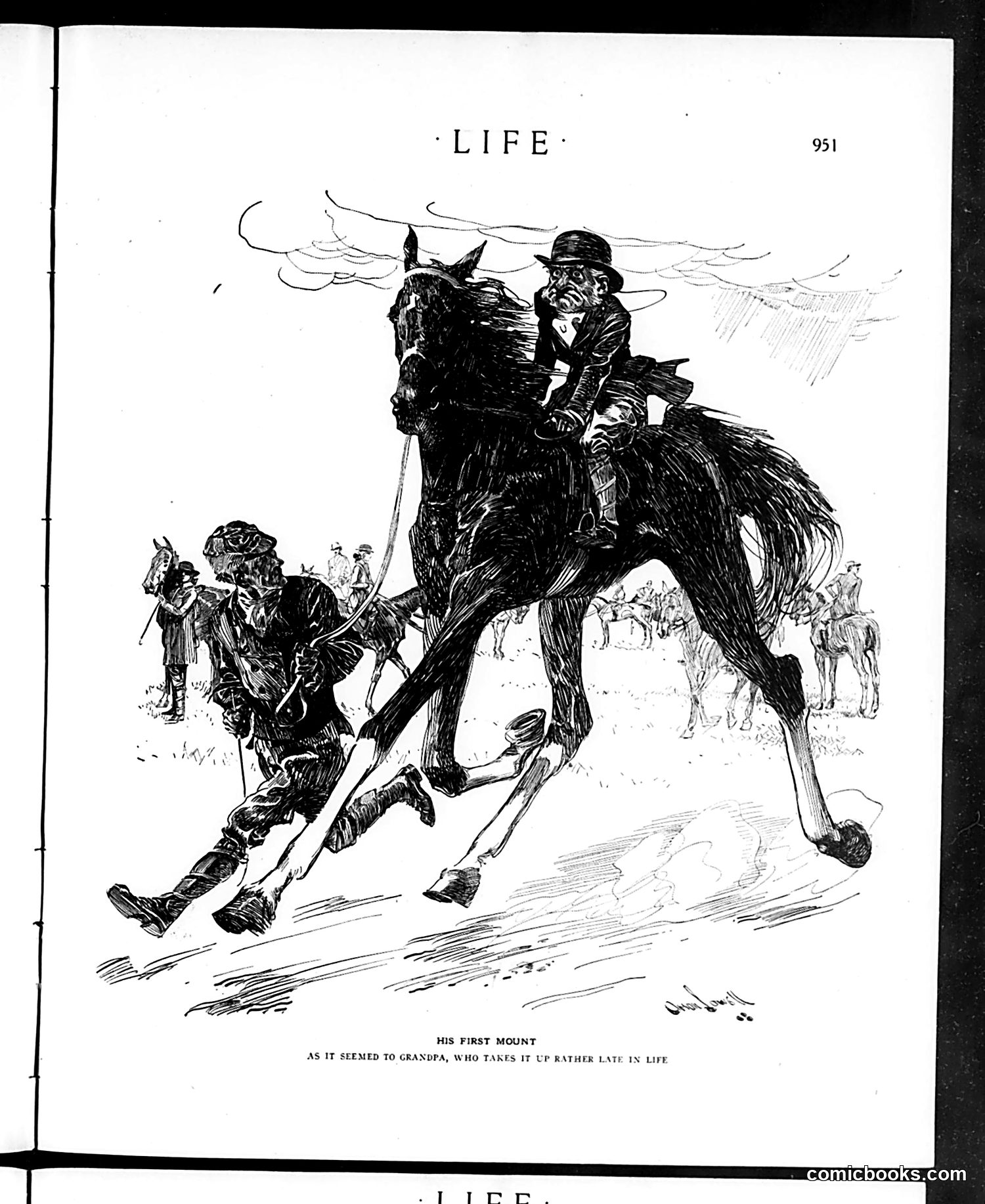
This cartoon satirizes an elderly man ("Grandpa") attempting to ride a camel for the first time later in life. The image shows him precariously mounted on a visibly agitated camel, which is rearing and bucking while handlers below struggle to control the animal. Other figures and animals appear in the background, suggesting a public setting—possibly a zoo, circus, or tourist destination. The humor derives from the incongruity of an old man undertaking an unfamiliar and physically demanding activity. The exaggerated distress of both rider and beast emphasizes the difficulty and absurdity of the situation. The caption suggests this represents a comical life milestone—an elderly person's first experience with something new and challenging, played for comedic effect through the physical chaos depicted.
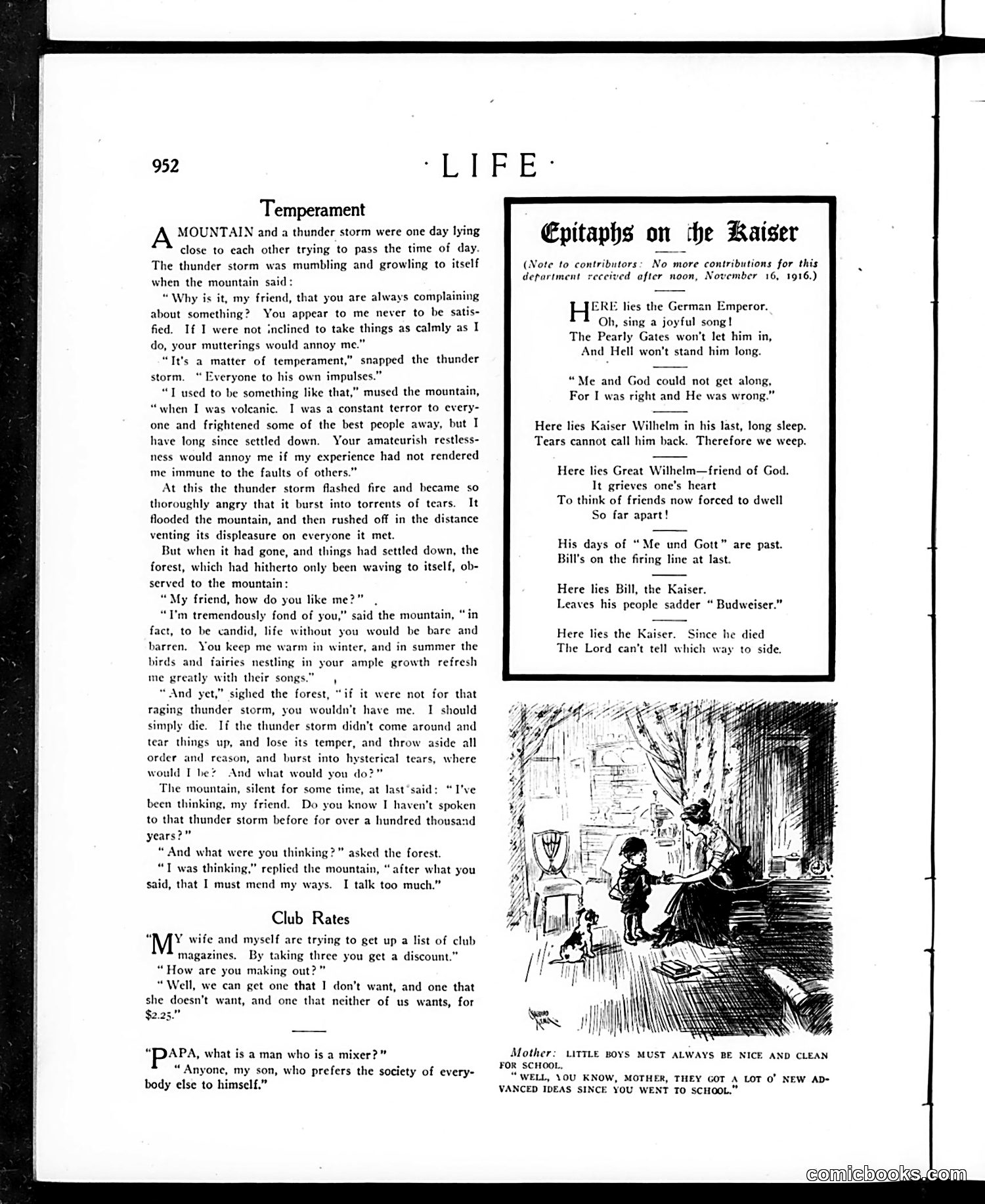
This page from Life magazine contains three satirical pieces: **"Temperament"** is an Aesop's fable-style parable. A complaining thunder storm and a calm mountain discuss personality types. The forest reveals the storm's chaos actually sustains it—suggesting that even disagreeable temperaments serve a purpose. The moral critiques excessive self-satisfaction and validates emotional expression. **"Epitaphs on the Kaiser"** is a collection of mock obituaries for German Emperor Wilhelm II, with a November 16, 1916 deadline note. These darkly comic verses celebrate his death, mock his relationship with God ("Me and God could not get along"), and include a crude pun comparing him to "Budweiser" beer (playing on German associations). This reflects American anti-German sentiment during World War I. **"Club Rates"** and the **mixer joke** are brief, unrelated humorous anecdotes about subscription services and social types—standard Life filler content. The illustration shows a mother scolding a schoolboy about cleanliness and modern ideas, accompanying the text below about children's education.
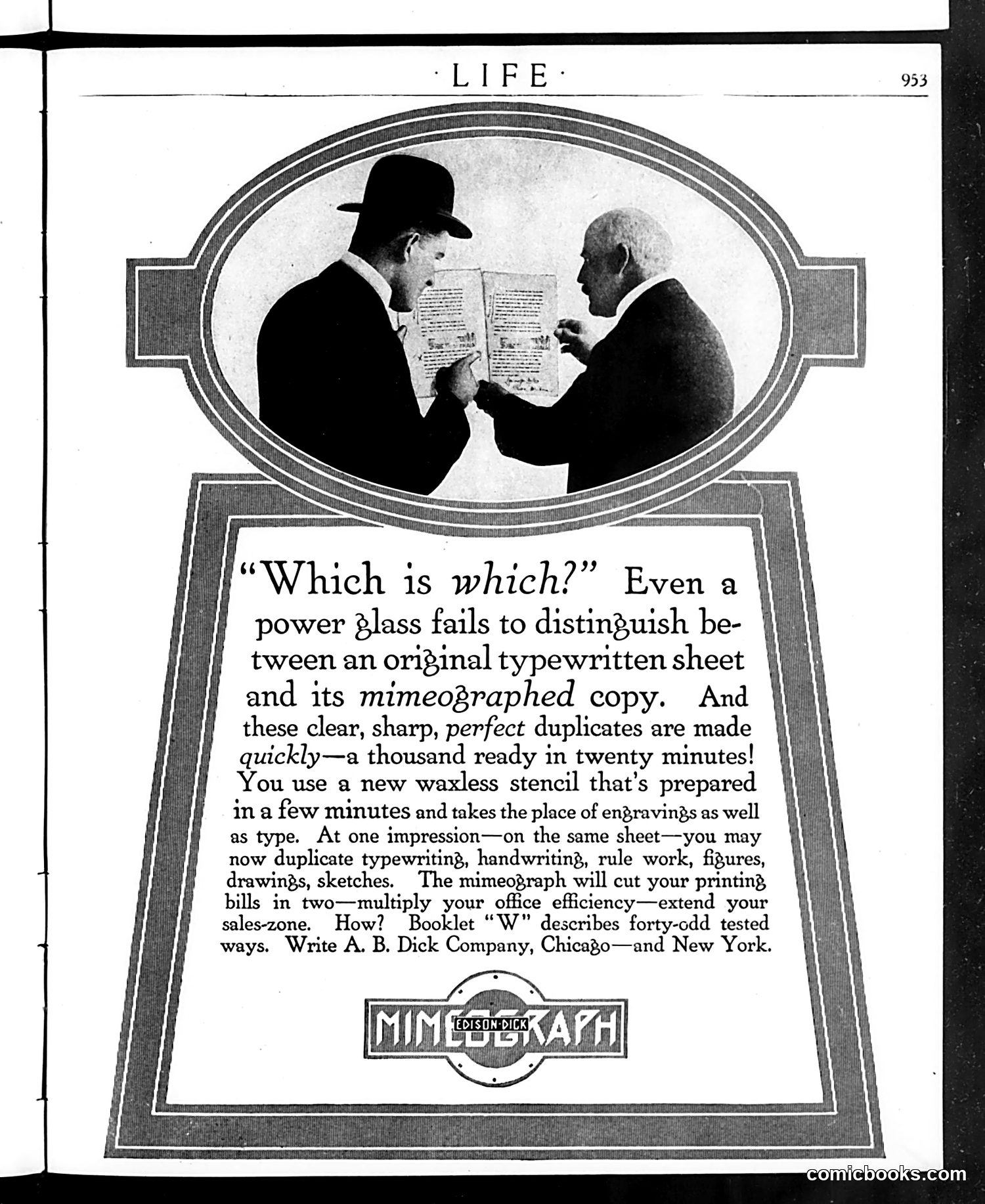
This is a **product advertisement** for the mimeograph machine, manufactured by A.B. Dick Company. The page contains no political satire or caricature. The image shows two businessmen examining identical documents, illustrating the ad's central claim: mimeographed copies are so perfect that even careful inspection cannot distinguish them from original typewritten sheets. This was a genuine selling point in the early 20th century. The advertisement emphasizes practical office benefits—speed ("a thousand ready in twenty minutes"), cost reduction ("cut your printing bills in two"), and versatility (copying typewriting, handwriting, drawings, etc.). The "power glass" reference suggests using a magnifying glass to verify copy quality. For modern readers: the mimeograph was revolutionary office technology before photocopiers existed. This ad markets it as a time- and money-saving innovation for business efficiency—analogous to how companies today advertise digital document management tools.
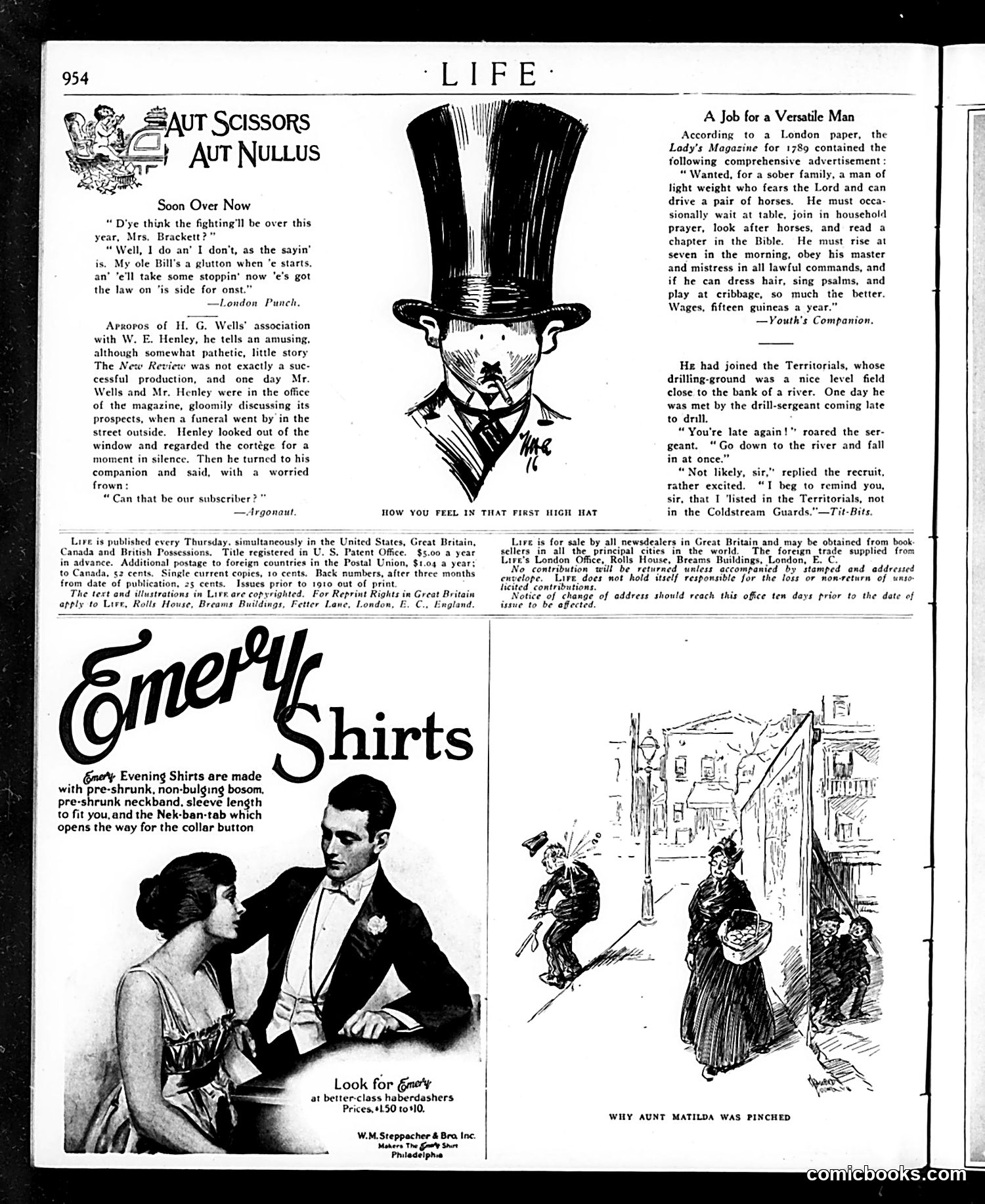
This page contains three humorous anecdotes and advertisements typical of early 20th-century Life magazine: **"Soon Over Now"**: A London Punch piece where Mrs. Brackett jokes that her husband "Bill" won't stop fighting now that "the law on 'is side"—likely a WWI reference about military conscription or justified warfare. **H.G. Wells Anecdote**: A melancholic joke where Wells and Henley, observing a funeral procession outside their failing magazine office, quip darkly about whether it's their last subscriber—satirizing the magazine's poor circulation. **Bottom cartoons**: Include a period job advertisement from 1789 listing absurdly demanding servant requirements (religious devotion, horsemanship, hairdressing, psalm-singing), and a Territorials recruitment joke about a recruit misunderstanding orders. The Emery Shirts advertisement and top hat illustration are standard period advertising. The overall tone reflects Life's satirical approach to contemporary social anxieties, publishing challenges, and class-based humor.
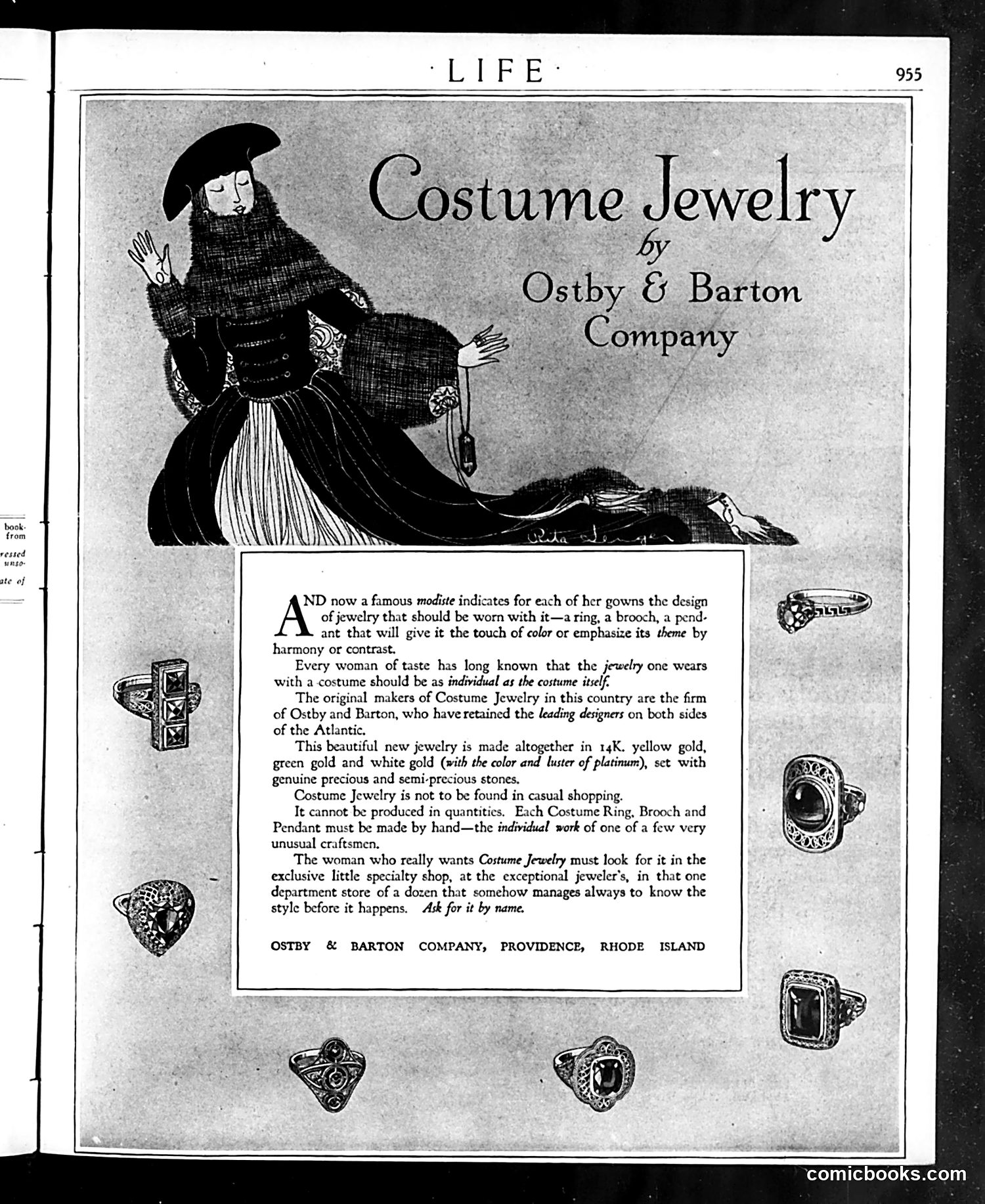
This is not a cartoon or satire—it's a **luxury advertisement** for Ostby & Barton Company's costume jewelry, published in *Life* magazine. The page features an elegant illustration of a fashionable woman in haute couture (a "modiste" or fashion designer) to establish prestige. The ad claims that Ostby & Barton pioneered costume jewelry in America and that each piece is handcrafted from real gold and gemstones—positioning it as luxury goods, not cheap imitation jewelry. Key sales pitch: costume jewelry should be as "individual" as the outfit itself, available only at exclusive specialty shops, and purchased by name. The strategically placed jewelry photographs showcase the product's sophistication. The term "costume jewelry" meant fine, specially-commissioned pieces for specific outfits—quite different from today's meaning (affordable fashion jewelry). This appeals to wealthy readers who could afford bespoke accessories.
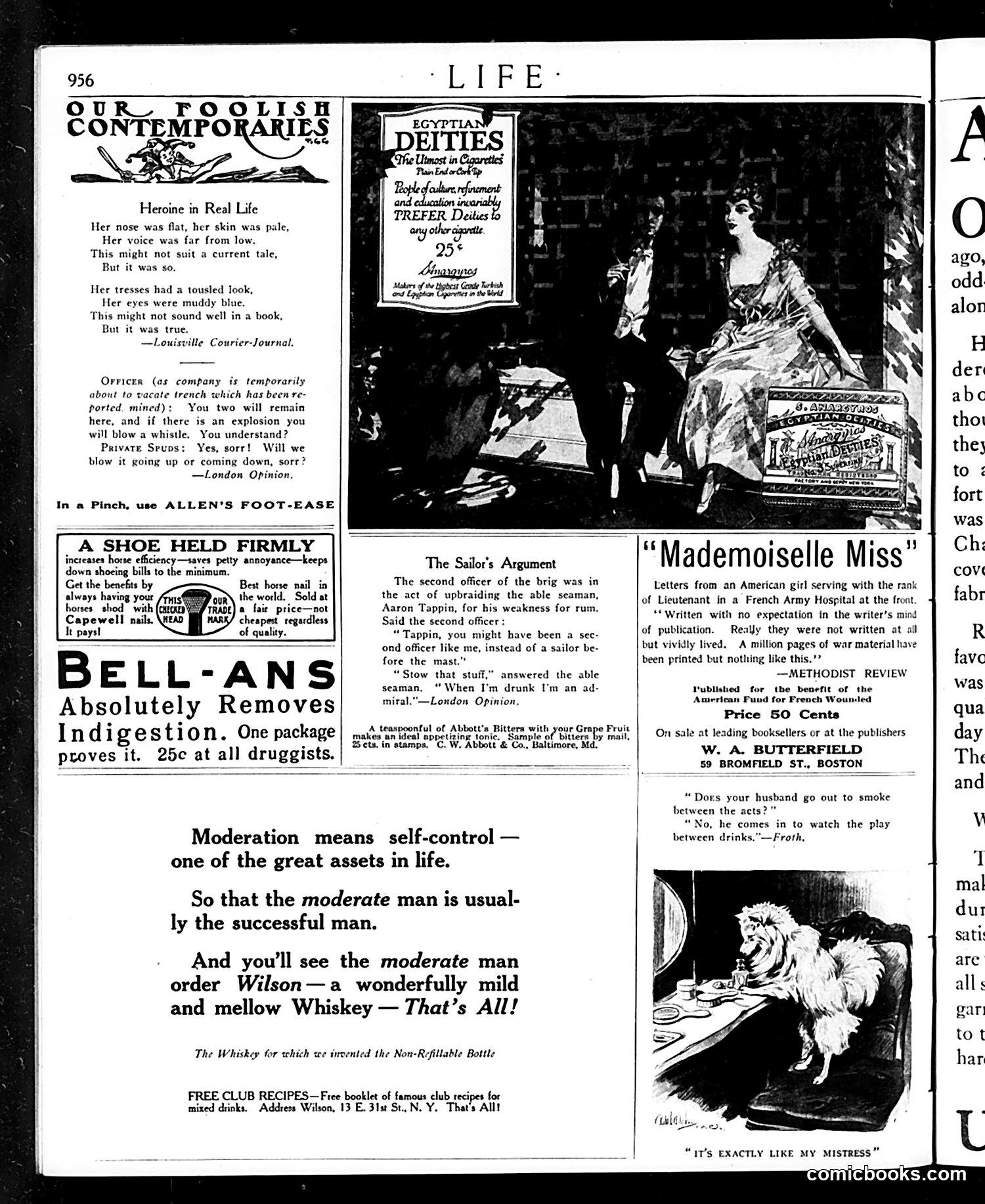
This page from Life magazine contains multiple satirical vignettes and advertisements typical of early 20th-century American humor. **"Heroine in Real Life"** mocks literary romance conventions by contrasting idealized heroines with unglamorous reality—flat noses, pale skin, tousled hair, "muddy blue" eyes. The satire suggests novels present false beauty standards. **"The Sailor's Argument"** presents a class-based joke: an officer lectures the seaman Tappin about moral improvement, but Tappin's rejoinder—that drunkenness elevates him to admiral rank—inverts the hierarchy through absurdist humor, mocking both pretension and drunkenness. **"Mademoiselle Miss"** advertises a wartime memoir by an American woman serving in a French hospital, targeting patriotic sentiment during WWI. The advertisements (Bell-Ans indigestion remedy, Wilson whiskey, horse nails, foot powder) represent typical magazine monetization. The whiskey ad's "moderation" pitch is ironic given Prohibition-era sensibilities. The cartoon with the dog at a table captioned "It's Exactly Like My Mistress" is a crude domestic joke about infidelity.
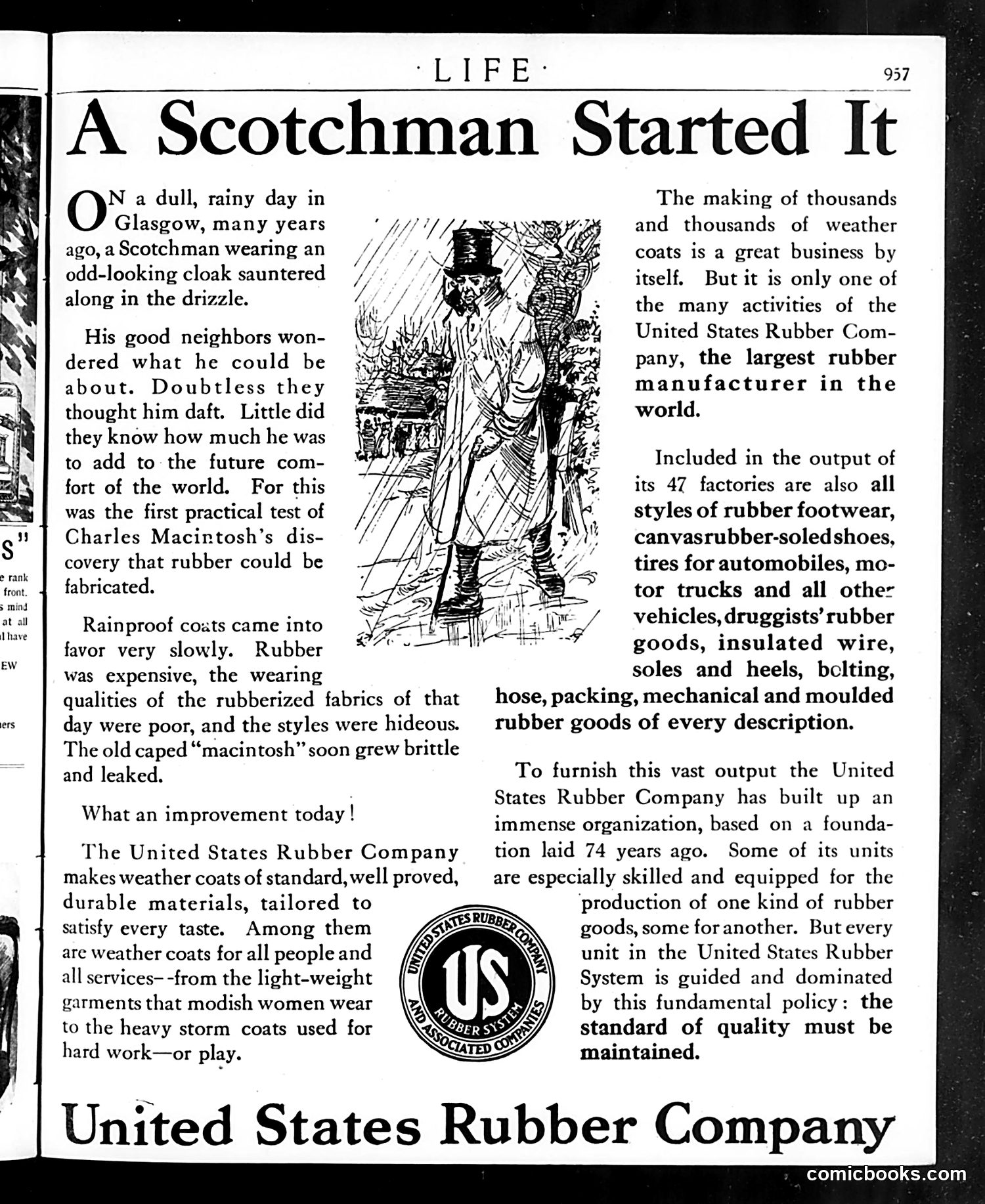
This is primarily **corporate advertising** for United States Rubber Company, not satire. The "cartoon" is a single illustration showing a Scottish man in early rainwear trudging through rain—depicting Charles Macintosh, the historical inventor of waterproofed fabric (the "macintosh" coat). The page uses light humor to frame a product narrative: it contrasts the early, poor-quality rubber coats (brittle, leaky, unfashionable) that Macintosh pioneered with modern U.S. Rubber Company products—superior weather coats tailored for all uses. The implicit message is progress through American manufacturing: what began as a daft-seeming Scottish invention has been perfected by American industry into reliable, stylish goods across 47 factories. The company logo appears mid-text, cementing this as branded content celebrating industrial achievement rather than satirical commentary.
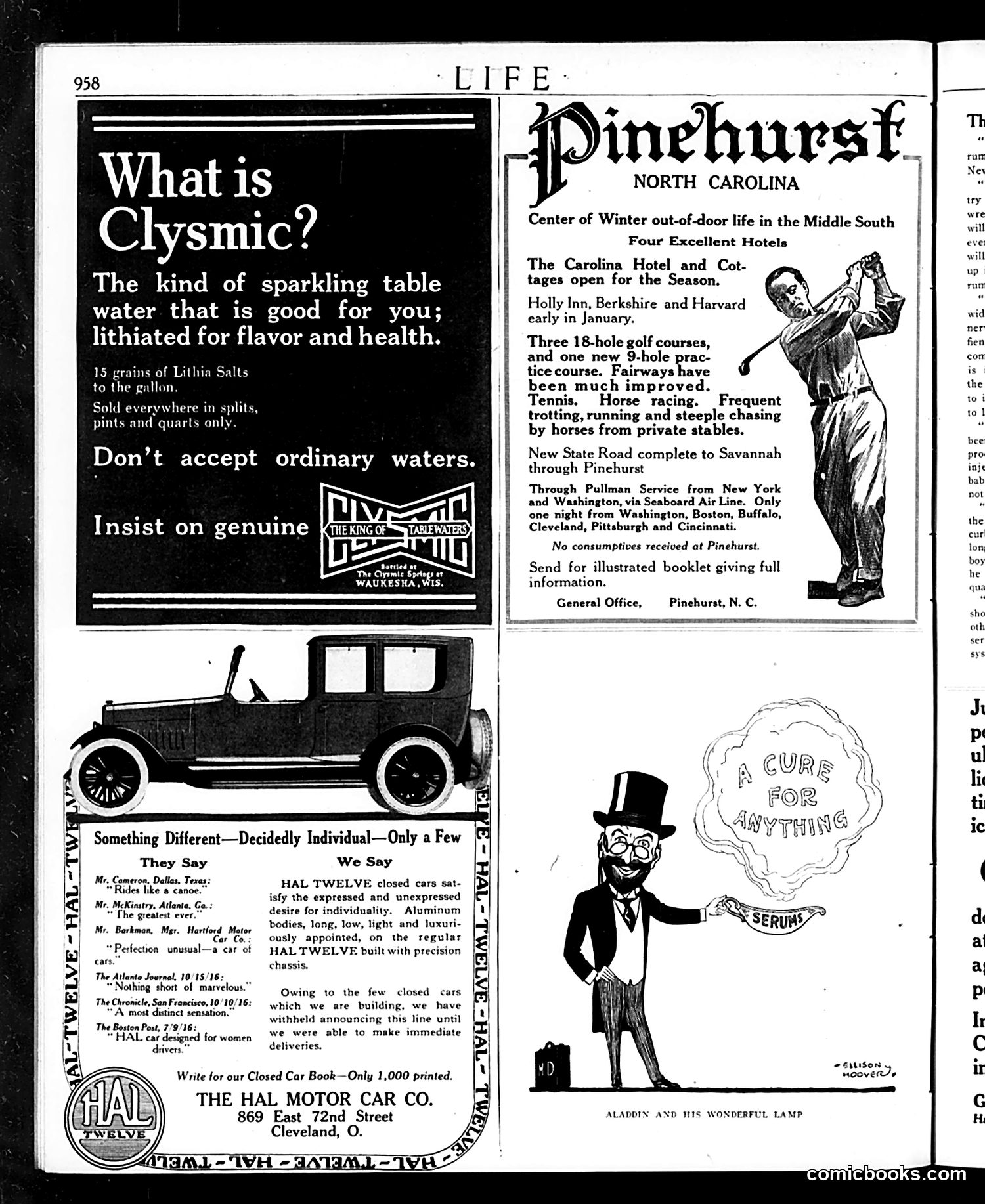
This page is primarily **advertising** for luxury goods and leisure destinations, with minimal satirical content. ## Main Advertisements: **Clysmic Water**: Promotes a "lithiated" sparkling table water marketed as healthful—typical early 20th-century patent medicine claims (lithium salts were trendy health additives then). **Pinehurst, North Carolina**: Resort advertisement emphasizing winter sports and leisure for wealthy travelers—golf, horse racing, tennis. **HAL Twelve Motor Car**: Luxury automobile ad featuring testimonials claiming exclusivity and precision engineering. The appeal is individuality and refinement for the wealthy. **Aladdin's Lamp Cartoon**: The small illustration labeled "Aladdin and His Wonderful Lamp" appears to be a generic genie/wish-fulfillment image—likely accompanying a patent medicine ad ("A Cure for Anything"), playing on magical thinking about cure-alls. The page reflects **Gilded Age consumer culture**: targeting affluent readers with expensive automobiles, resort vacations, and dubious health products. The satire, if present, is gentle mockery of wealthy aspirations rather than sharp political commentary.
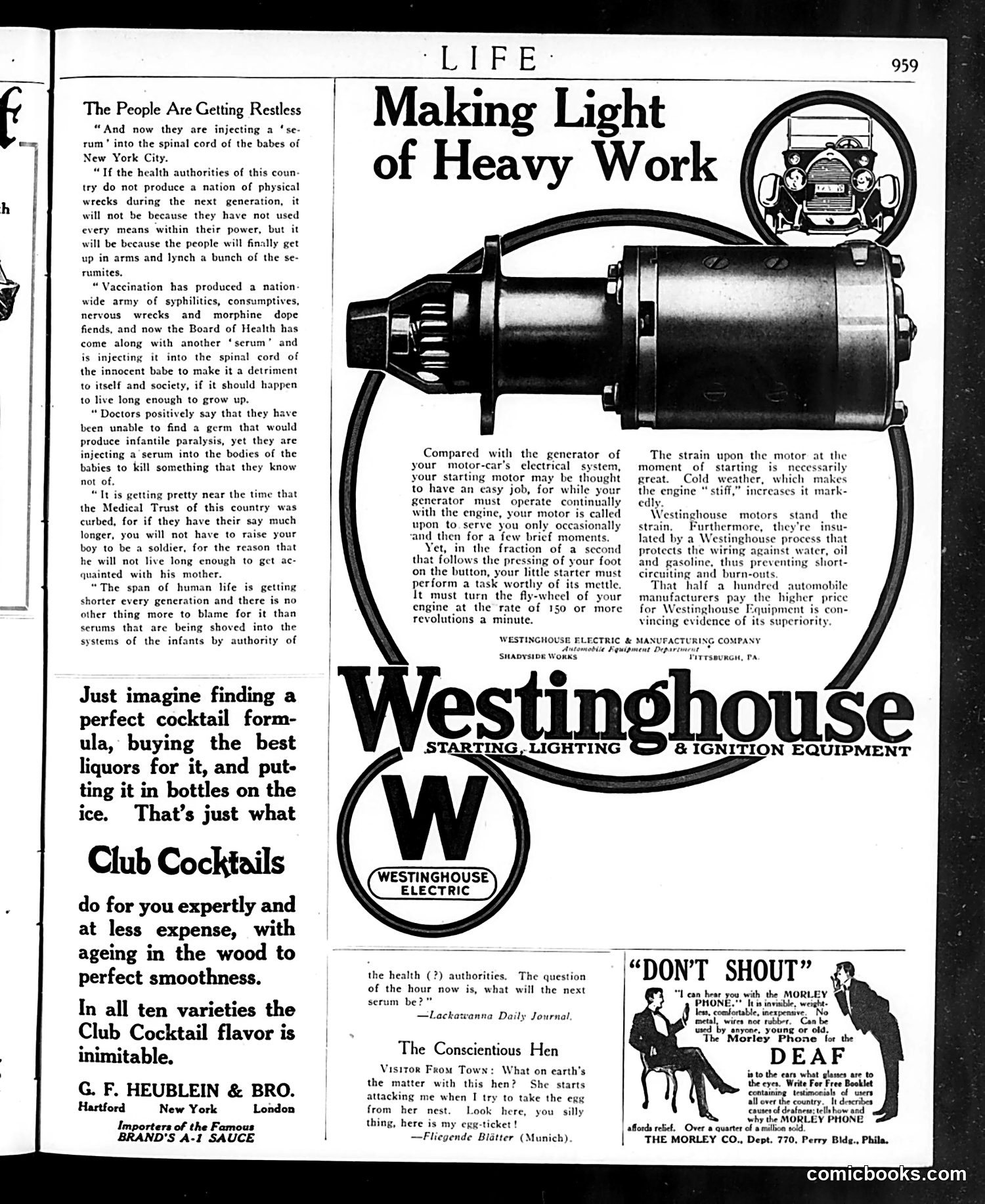
This page contains three distinct elements: **Main Advertisement**: A Westinghouse Electric ad promoting motor-starting equipment, using technical specifications to convince buyers of product reliability and durability. **Anti-Vaccination Editorial** (left column): A caustic opinion piece attacking public health authorities for mandatory vaccination and serum injection programs. The author claims these medical interventions cause syphilis, consumption, and other diseases, and argues they harm infants. This reflects early-20th-century anti-vaccination sentiment—a fringe view even then, contradicted by vaccination's public health benefits. **Humor Sections**: Two brief comic items: one about a hen protecting her eggs using an "egg-ticket" (satirizing bureaucratic absurdity), and an advertisement for the "Morley Phone," a hearing device for deaf people. **Context**: This page exemplifies Life magazine's mix of serious critique, medical skepticism, advertising, and light humor typical of the era. The anti-vaccination screed represents discredited pseudoscience that unfortunately resurfaces periodically.
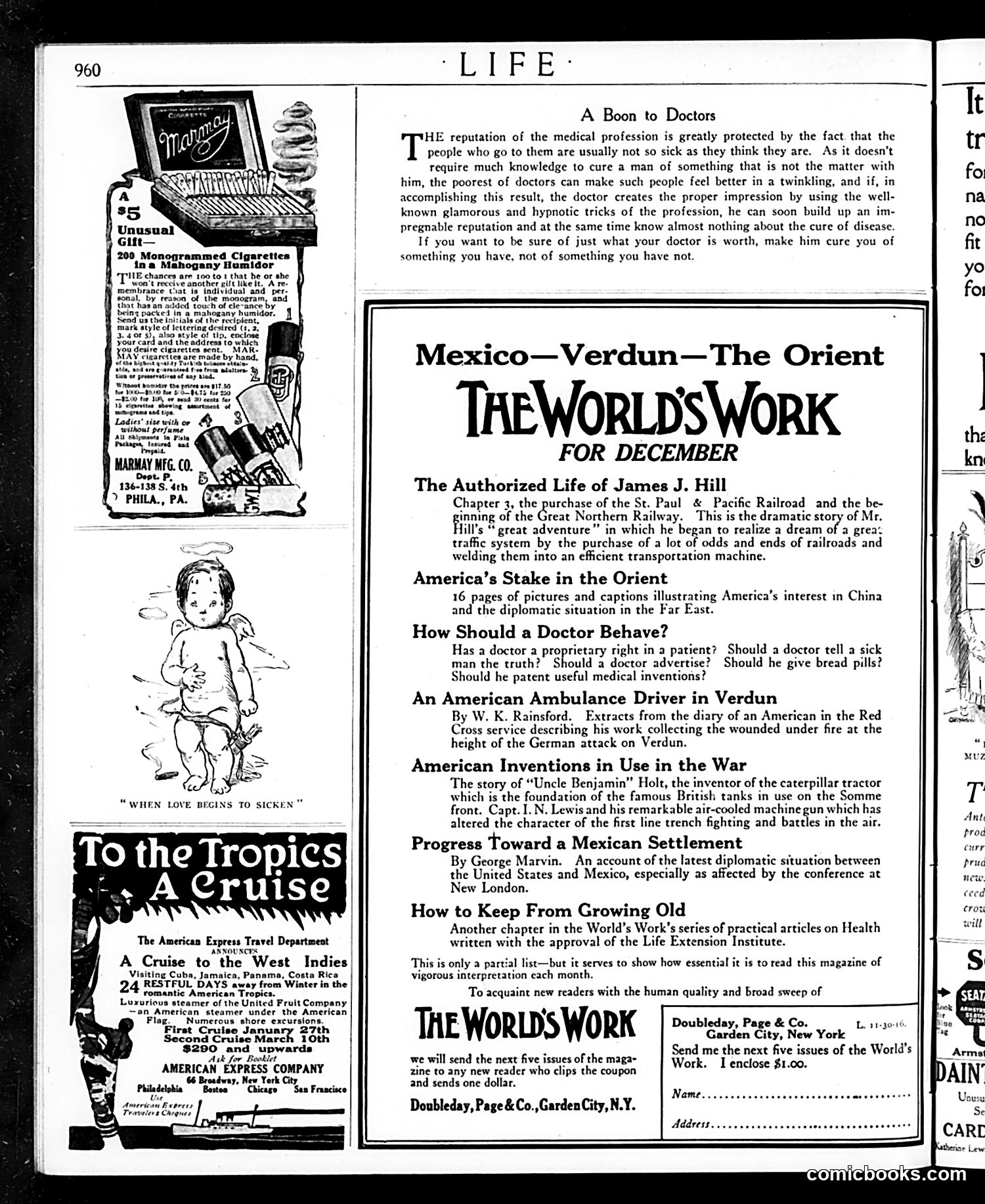
This page mixes advertising with editorial content from *Life* magazine (circa 1916, based on World War I references). **The Satirical Article "A Boon to Doctors"** mocks the medical profession's reputation. It argues doctors succeed not through genuine skill but through patients' placebo effect—people imagine they're sicker than they are, so minimal treatment appears effective. The satire suggests doctors exploit this psychology through theatrical "glamorous and hypnotic tricks" to build undeserved reputations while knowing little about actual disease cure. The punchline advises testing a doctor by having him cure something you *actually* have, not an imaginary ailment. **The Cartoon "When Love Begins to Sicken"** (lower left) shows a cherubic infant amid scattered objects—likely depicting love's decay or deterioration in humorous visual form, though the exact reference is unclear without fuller context. **Other Content** includes travel advertisements and promotional material for *The World's Work* magazine, covering period topics: James J. Hill's railroad ventures, American interests in China, World War I (Verdun ambulance service, military inventions), and U.S.-Mexico diplomacy.
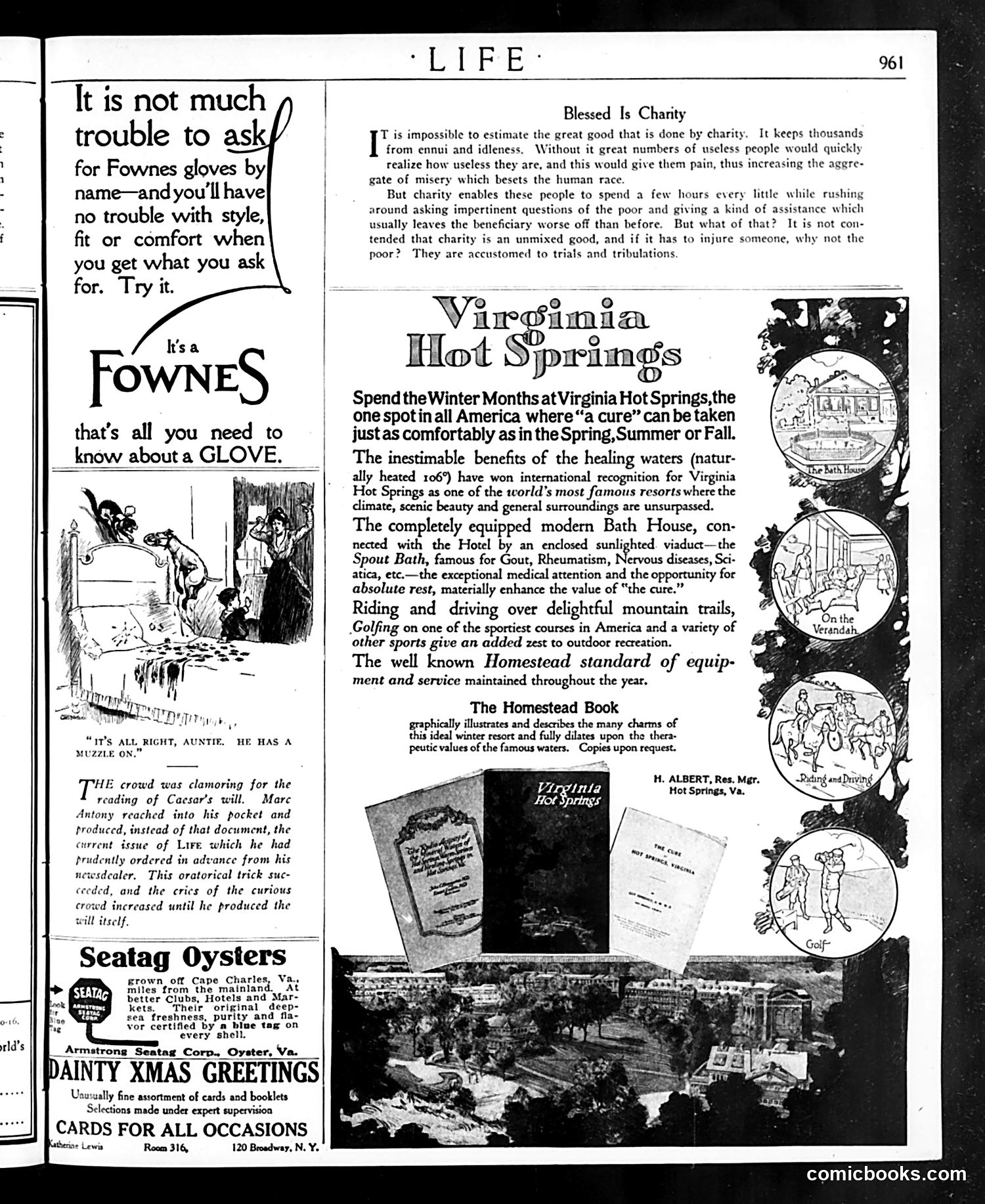
This page contains multiple advertisements and satirical content typical of early 20th-century Life magazine. **"Blessed Is Charity"** is a biting satirical essay mocking charitable work. It argues that charity, while appearing virtuous, actually benefits the wealthy more than the poor—allowing idle rich people to feel purpose by "asking impertinent questions" of the poor, while leaving beneficiaries "worse off than before." The satire suggests the poor are "accustomed to trials" anyway, so injury from charity matters little. This reflects Progressive-era criticism of condescending charity versus systemic reform. **The Fownes Gloves advertisement** uses a humorous anecdote about Caesar's will—Marc Antony supposedly distracted a crowd demanding the will's reading by offering them the current Life magazine instead. The joke: Life's content is so engaging it rivals ancient Rome's greatest political drama. The page also advertises Virginia Hot Springs resort, Seatag Oysters, and Christmas cards—typical period advertisements. The overall tone is characteristic of Life's satirical approach to social issues and consumer culture.
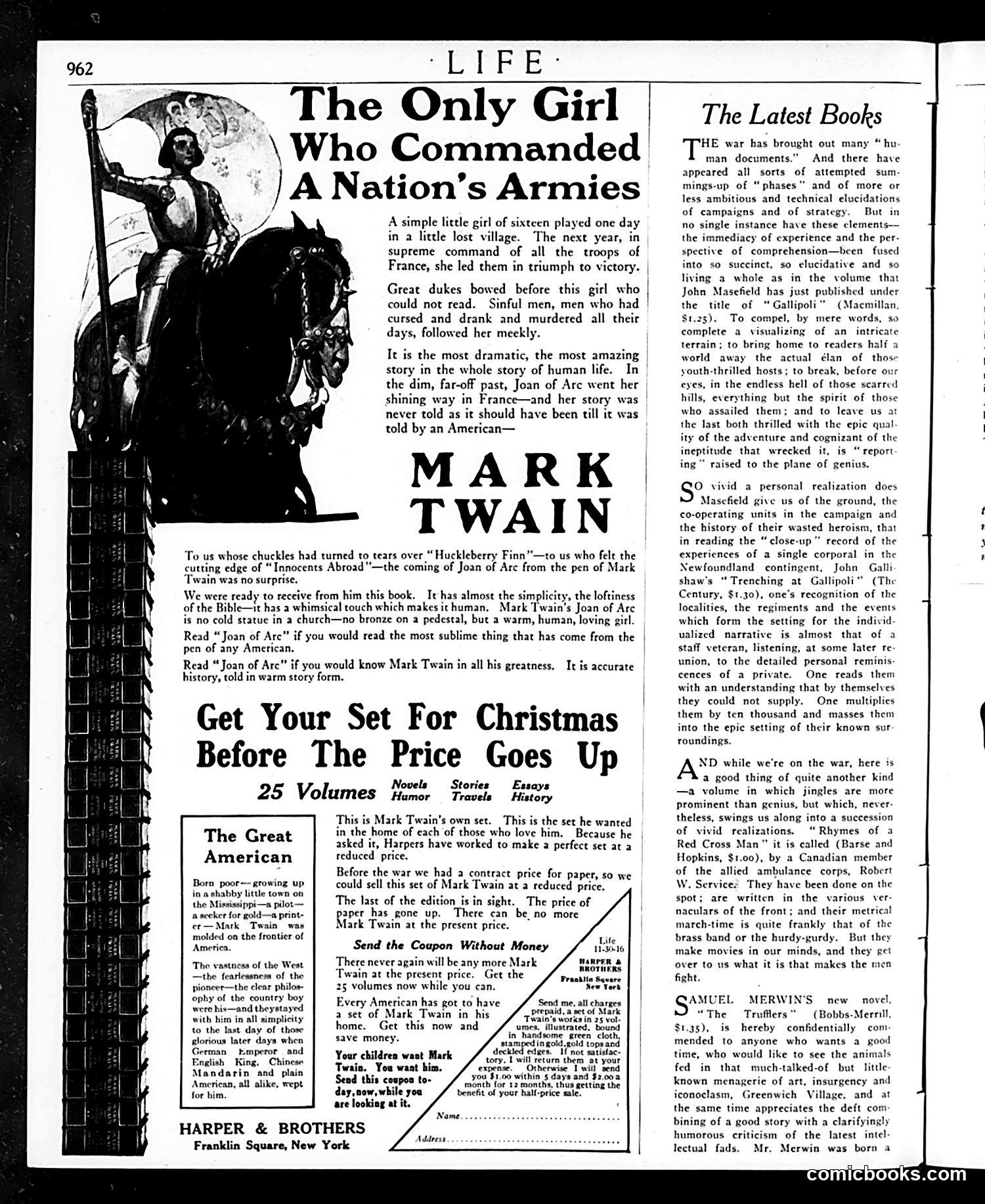
This page is primarily **advertising for Mark Twain's complete works**, disguised as editorial content and book review. The large illustration depicts **Joan of Arc on horseback**—a reference to Twain's 1896 biographical novel "Personal Recollections of Joan of Arc." The accompanying text promotes this book as Twain's masterwork, calling it sublime and historically accurate. The advertisement emphasizes Twain's American frontier origins ("born poor," "shabby little town on the Mississippi") to establish him as an authentically American voice—a common marketing strategy of the era. The sales pitch is urgent: the final edition is "in sight," paper prices have risen post-war, so readers should buy the complete 25-volume set "before the price goes up." This creates artificial scarcity to drive purchases. The page uses celebrity endorsement and emotional appeal ("German Emperor and English King...all alike, wept for him") rather than straightforward advertising. The book review section on the right appears coincidentally timed to reinforce the product promotion—a common publishing practice.
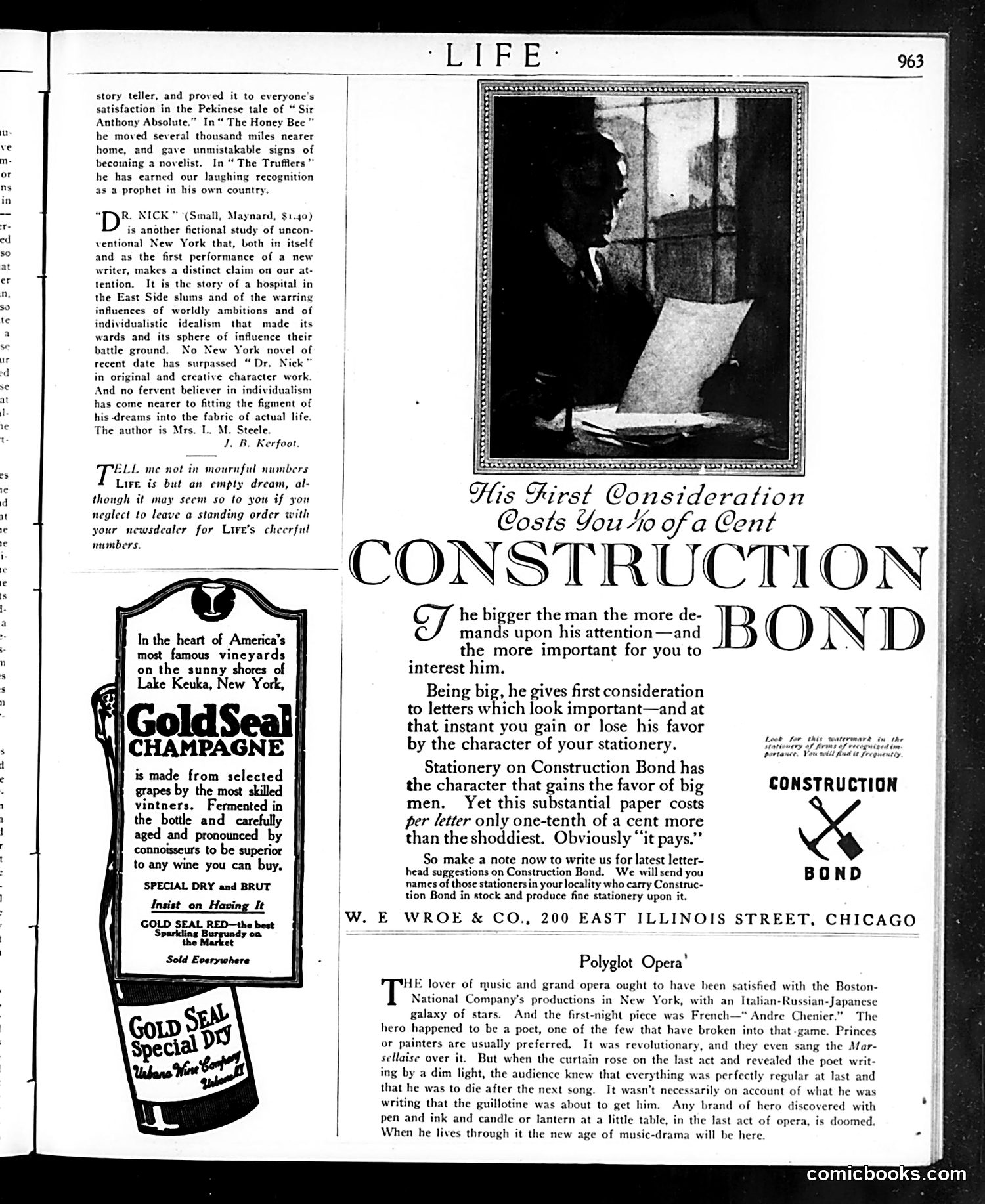
This page contains **book reviews and advertisements** rather than political cartoons. The reviews discuss three novels: works by an unnamed author (praised for "Sir Anthony Absolute" and "The Trufilers") and "Dr. Nick" by Mrs. L.M. Steele, set in East Side NYC hospitals exploring ambition versus idealism. The main advertisement promotes **Construction Bond stationery**, arguing that expensive-looking letterhead impresses important men at minimal extra cost (one-tenth of a cent per letter). The pitch exploits class anxiety: appearance matters in business correspondence. A **Gold Seal Champagne ad** appears lower left. The final piece, "Polyglot Opera," is a humorous essay mocking operatic conventions—specifically that poets always die by guillotine in the final act, regardless of plot. The author notes this predictable trope as a sign opera hasn't yet entered "the new age of music-drama." The page reflects early 20th-century American magazine culture: literary criticism, consumer marketing targeting businessmen, and satirical social commentary on entertainment.
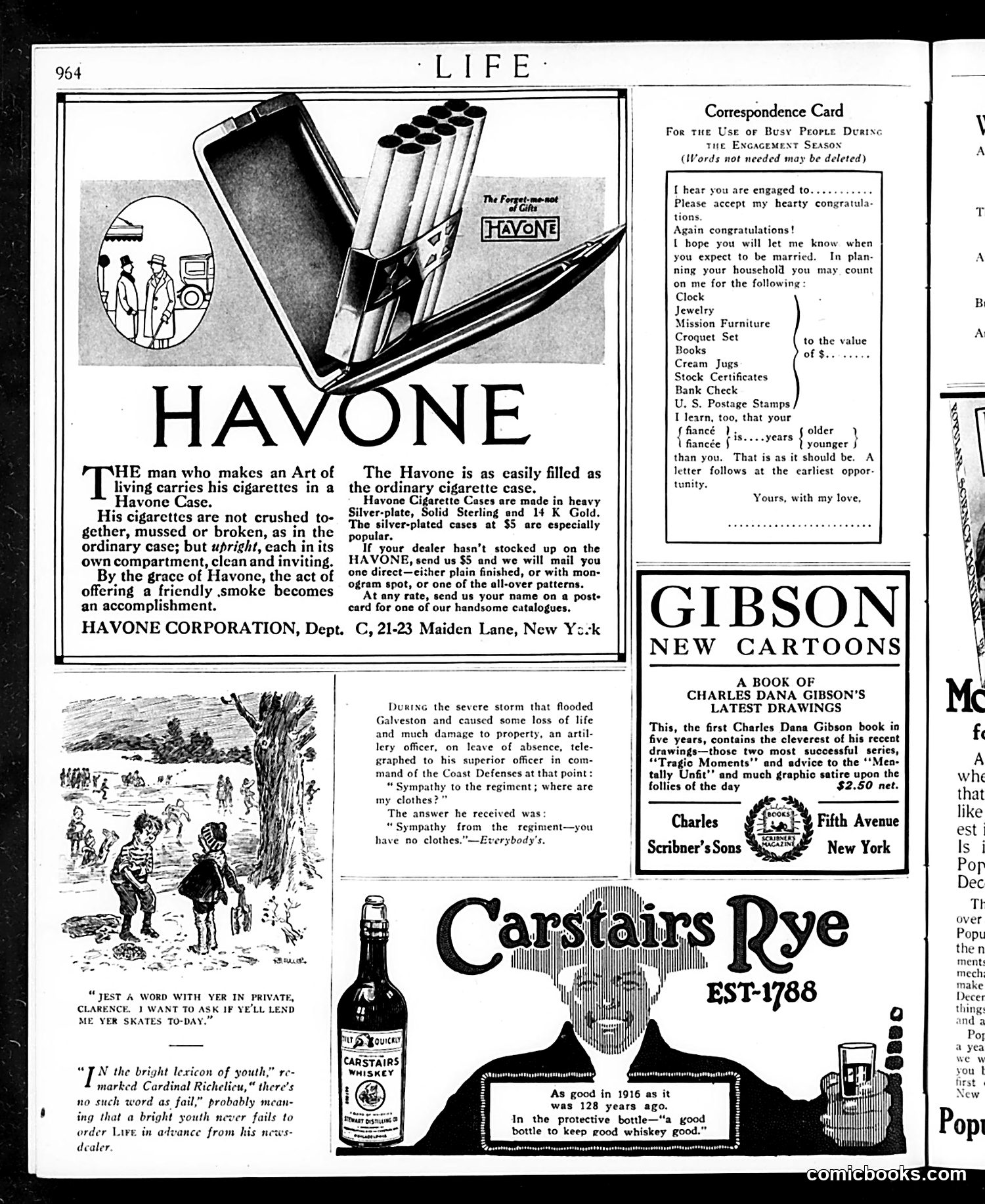
This Life magazine page (page 954) is primarily **advertising and filler content**, not political satire. The main advertisements are: 1. **Havone Cigarette Cases** — luxury accessories for well-to-do smokers, emphasizing that properly organized cigarettes represent refinement and social grace. 2. **Gibson's New Cartoons** — promoting Charles Dana Gibson's book of social satire drawings (Gibson was Life's signature cartoonist). 3. **Carstairs Rye Whiskey** — establishing brand continuity since 1788. The cartoon content includes two small humorous anecdotes: one about a youth asking to borrow skates (referencing a Richelieu quote about "no such word as fail"), and another WWI-era military joke about a soldier requesting sympathy and clothing after flood damage. The **engagement correspondence card** is satirical filler—a template for wealthy engagements, humorously listing gift suggestions (stocks, bank checks, furniture) with the assumption that wealthy families would announce engagements formally. Overall, this reflects **1910s consumer culture** and upper-class social conventions rather than political commentary.
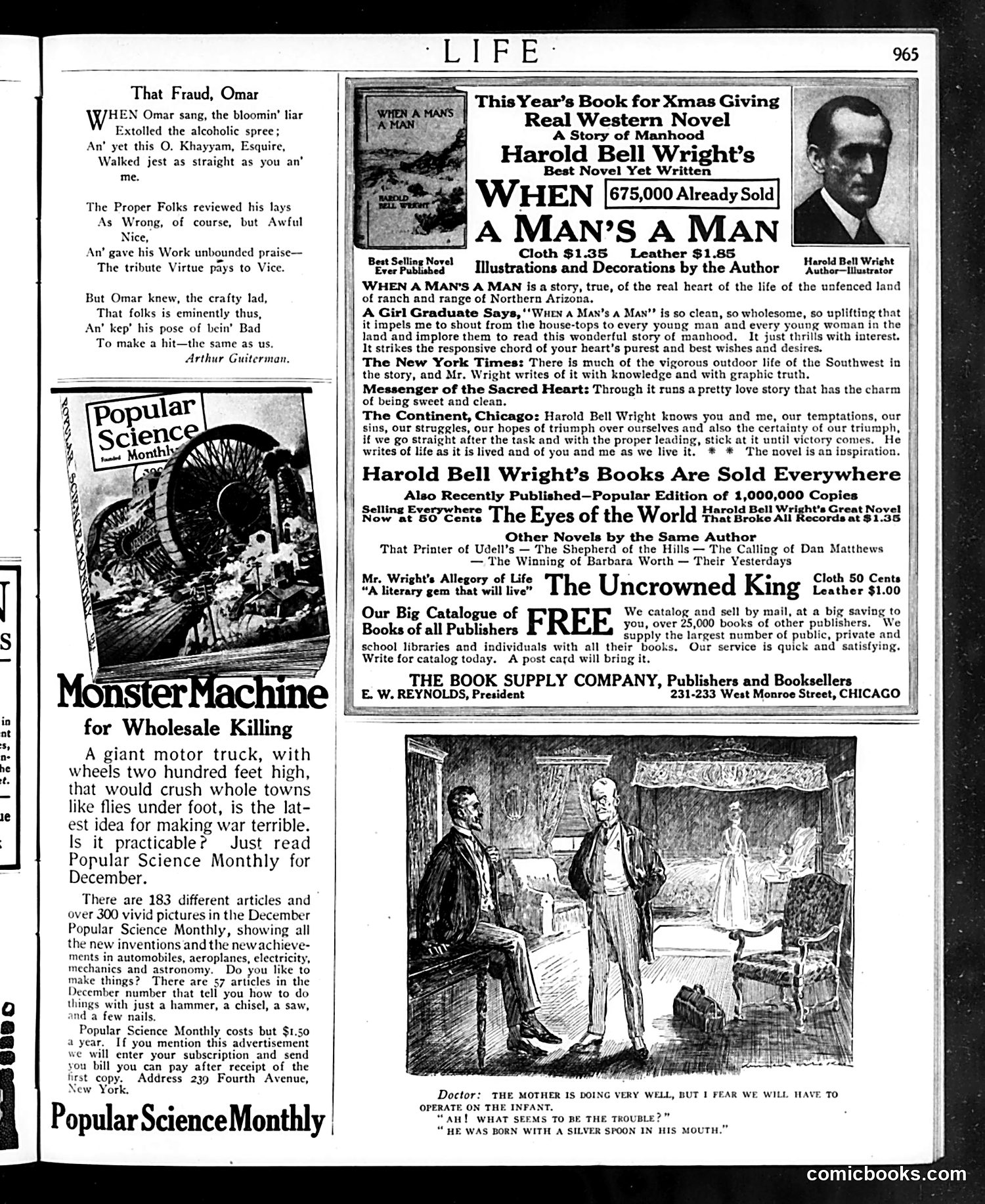
This poem by Arthur Guiterman satirizes the romantic image of Omar Khayyam, the Persian poet famous for celebrating wine and hedonism in *The Rubaiyat*. The joke: Khayyam preached excess while living temperately ("walked jest as straight as you an' me"), yet respectable society praised his work as "Awful Nice" despite its immoral subject matter—rewarding vice with virtue's approval. Guiterman's point is about hypocrisy: Khayyam deliberately cultivated a bad-boy persona to gain attention ("kep' his pose of bein' Bad / To make a hit"), and society ate it up. The satire mocks both the poet's calculated image and the public's contradictory eagerness to celebrate transgressive literature while maintaining moral pretense—a common critique of Gilded Age cultural attitudes.
This is an advertisement for *Everybody's Magazine*'s December issue, promoting upcoming articles and serials to readers of *Life* magazine. The page advertises five features: an exposé on actor Douglas Fairbanks' movie stunts by George Creel; Sir Arthur Conan Doyle's account of WWI's Battle of Ypres; O.K. Davis's interview with Japanese Count Okuma about Japan's intentions in China (using the dated idiom "a bull in a china shop" to suggest Japan as a threat); Booth Tarkington's serial fiction featuring character Lucius Brutus Allen; and Ernest Poole's serial "His Family," praised as an authentic romance of American life. The silhouette image on the right appears to be Douglas Fairbanks in a characteristic acrobatic pose, illustrating the Creel article's focus on his physical exploits and whether they're genuinely performed. The overall tone positions *Everybody's* as serious and timely, addressing both entertainment and contemporary geopolitical concerns.
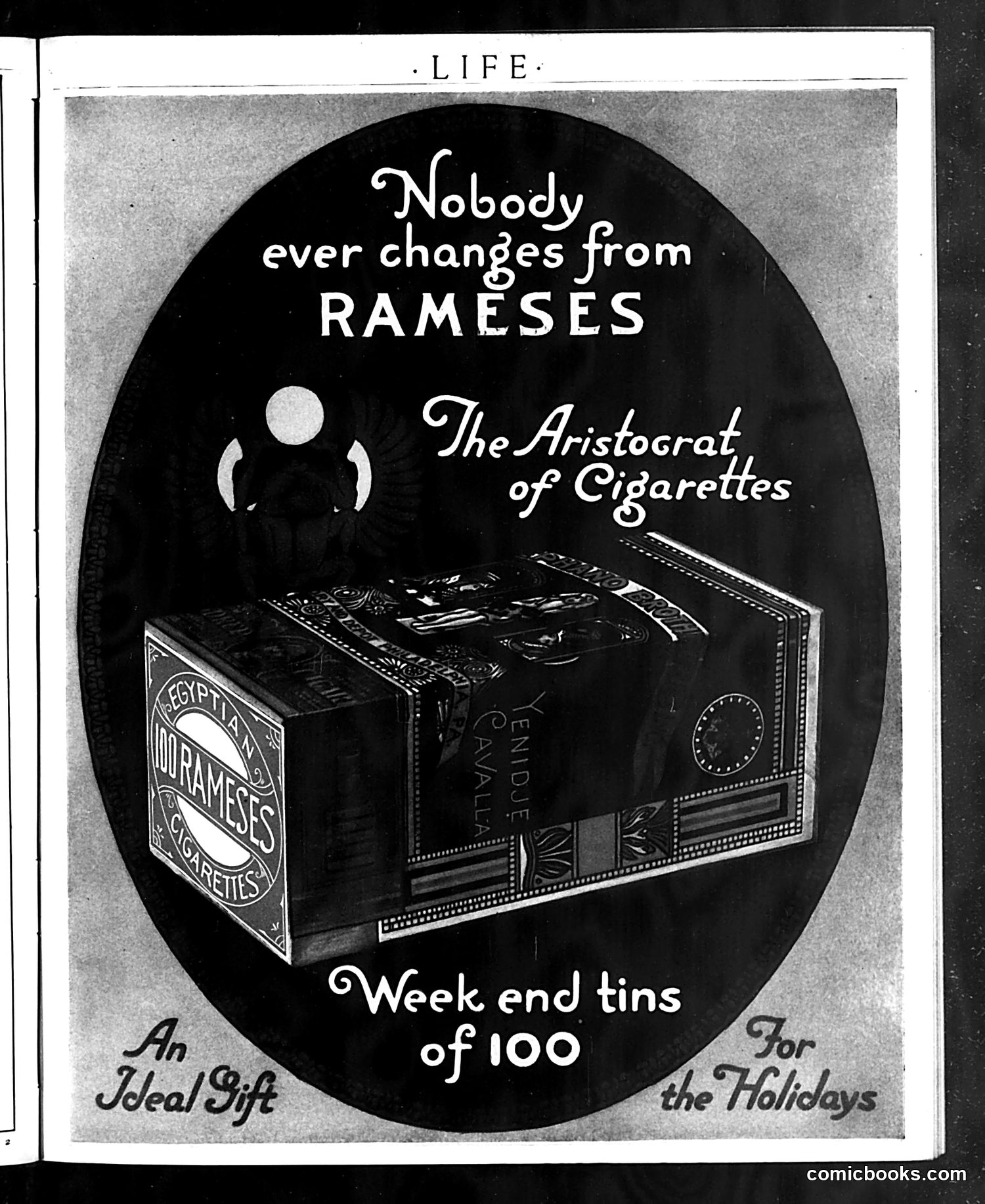
This is a **cigarette advertisement**, not satire or political commentary. It promotes Rameses brand cigarettes, showing an ornate tin package. The ad's tagline—"Nobody ever changes from Rameses"—is a straightforward marketing claim asserting brand loyalty. The reference to "Rameses" (the Egyptian pharaoh) invokes notions of timelessness and aristocracy, reinforced by the subtitle "The Aristocrat of Cigarettes." The decorative language ("An Ideal Gift / For the Holidays") and "Week end tins of 100" indicate this is a holiday gift advertisement, likely from the 1920s-1930s based on design style. There is no political satire here—merely period commercial advertising using Egyptian imagery and luxury framing to market tobacco products.
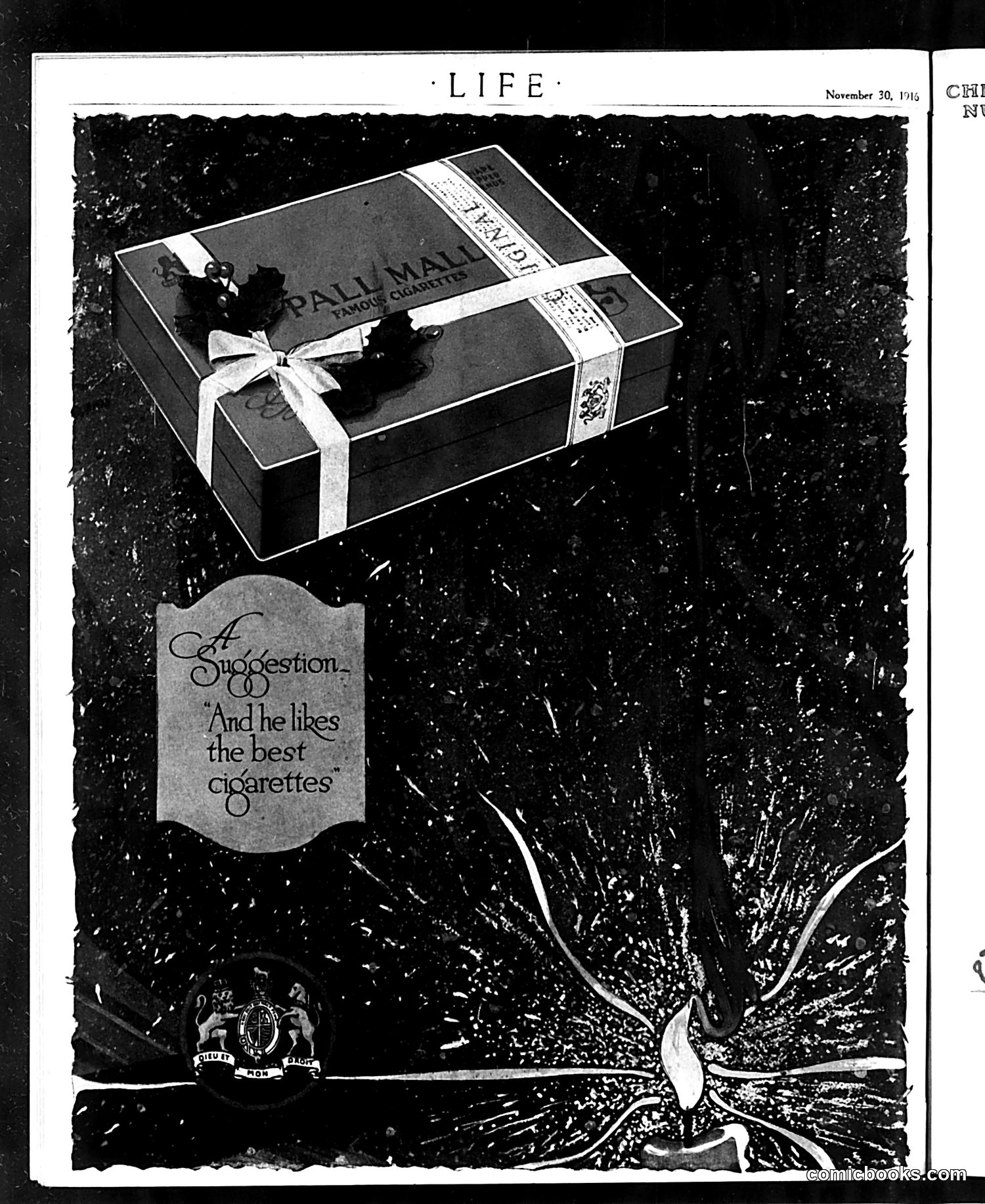
This is a **cigarette advertisement** for Pall Mall brand, published in Life magazine on November 30, 1916. The ad features an elegant gift box of Pall Mall cigarettes tied with a ribbon, photographed against a dark background with decorative foliage. The accompanying text reads: "Suggestion: 'And he likes the best cigarettes'"—positioning Pall Mall as an appropriate gift suggestion for the holiday season, implying that discerning men prefer this brand. This is **not political satire or commentary**. It's straightforward commercial advertising typical of early 20th-century magazines, when cigarette ads were commonplace and unregulated. The "suggestion" framing appeals to gift-givers seeking to please male recipients with a premium product.