
Life, 1916-11-30 · page 8 of 42
Life — November 30, 1916 — page 8: what you’re looking at
What you’re looking at
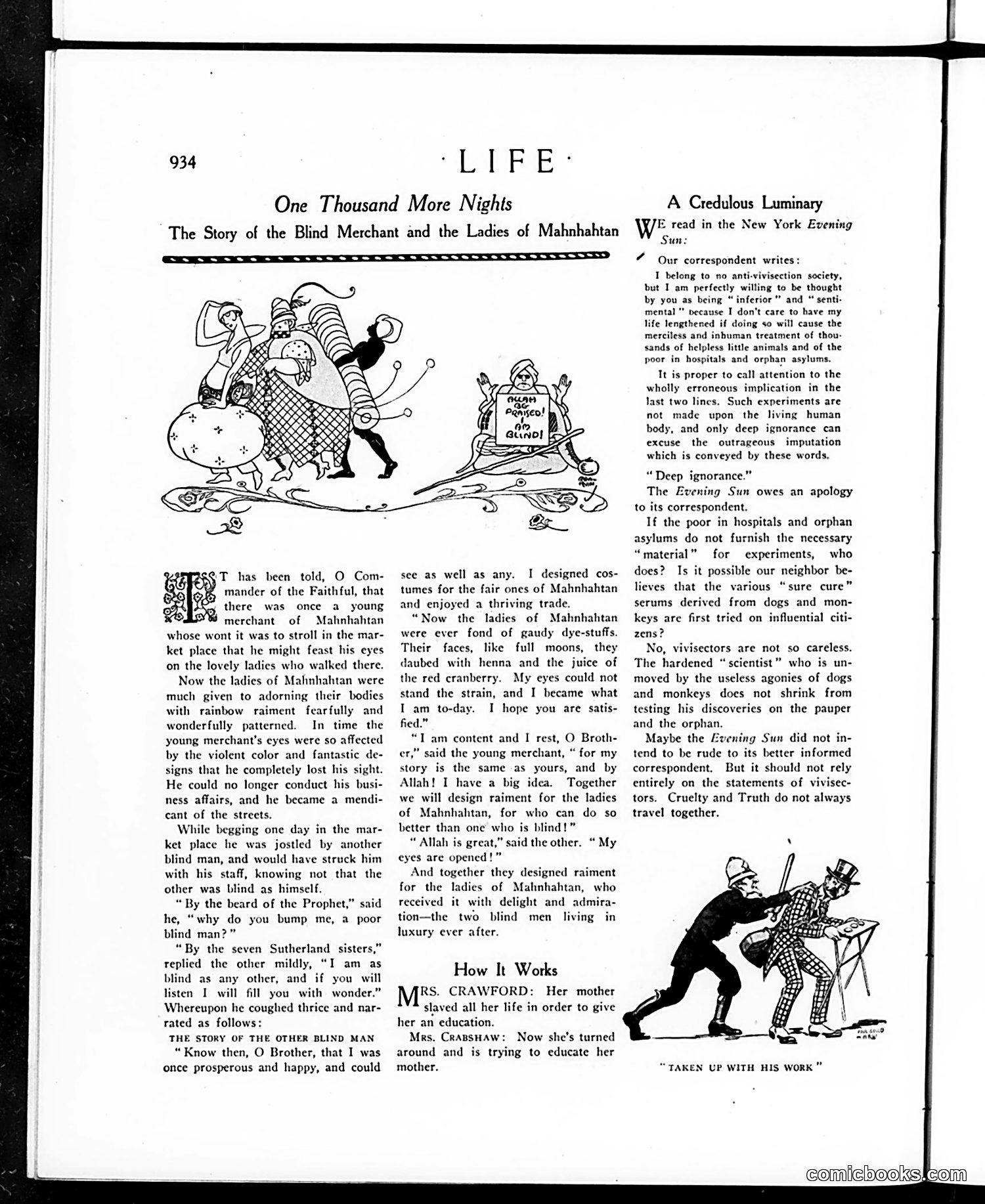
This page satirizes vivisection (animal testing) through a fable titled "One Thousand More Nights: The Story of the Blind Merchant and the Ladies of Manhattan." The main illustration depicts two blind men designing colorful "rainment" (clothing) for Manhattan society women. The accompanying editorial sidebar, titled "A Credulous Luminary," critiques the *New York Evening Sun* for endorsing animal experimentation without acknowledging ethical concerns. The satire argues that vivisectionists rely on "deep ignorance" to justify testing on "helpless little animals" in hospitals and asylums. The cartoon's fantastical premise—blind men creating fashion—serves as a metaphor for society accepting harmful practices based on blind faith rather than moral scrutiny. The "How It Works" section mocks credulous acceptance of dubious claims, using Mrs. Crawford's education efforts as counterpoint to scientific recklessness.
📄 Transcribed text from this page (OCR, searchable)
Machine-transcribed from the original scan — historical spelling and the odd misread are preserved.
T has been told, O Com- mander of the Faithful, that there was once a young merchant of © Mahnhahtan whose wont it was to stroll in the mar- ket place that he might feast his eyes on the lovely ladies who walked there. Now the ladies of Mahnhahtan were much given to adorning their bodies with rainbow raiment fearfully and wonderfully patterned. In time the young merchant's eyes were so affected by the violent color and fantastic de- signs that he completely lost his sight. He could no longer conduct his busi- ness affairs, and he became a mendi- cant of the streets. While begging one day in the mar- ket place he was jostled by another blind man, and would have struck him with his staff, knowing not that the other was blind as himself. “ By the beard of the Prophet,” said he, “why do you bump me, a poor blind man?” “By the seven Sutherland sisters,” replied the other mildly, “I am as blind as any other, and if you will listen I will fill) you with wonder.” Whereupon he coughed thrice and nar- rated as follows: THE STORY OF THE OTHER BLIND MAN “Know then, O Brother, that I was once prosperous and happy, and could “EAE? One Thousand More Nights The Story of the Blind Merchant and the Ladies of Mahnhahtan see as well as any. I designed cos- tumes for the fair ones of Mahnhahtan and enjoyed a thriving trade. “Now the ladies of Mahnhahtan were ever fond of gaudy dye-stuffs. Their faces, like full moons, they daubed with henna and the juice of the red cranberry. My eyes could not stand the strain, and I became what I am to-day. I hope you are satis- fied.” “Iam content and I rest, O Broth- er,” said the young merchant, “ for my story is the same as yours, and by Allah! I have a big idea. Together we will design raiment for the ladies of Mahnhahtan, for who can do so better than one who is blind!” “ Allah is great,” said the other. eyes are opened!” And together they designed raiment for the ladies of Mahnhahtan, who received it with delight and admira- tion—the two blind men living in luxury ever after. My How It Works RS. CRAWFORD: Her mother slaved all her life in order to give her an education. Mrs. CrassHaw: Now she’s turned around and is trying to educate her mother. A Credulous Luminary WE read in the New York Evening Sun: 7 Our correspondent writes: I belong to no anti-vivisection society, but I am perfectly willing to be thought by you as being “ inferior” and “ senti- mental " pecause I don't care to have my life lengthened if doing so will cause the merciless and inhuman treatment of thou- sands of helpless little animals and of the poor in hospitals and orphan asylums. It is proper to call attention to the wholly erroneous implication in the last two lines. Such experiments are not made upon the living human body, and only deep ignorance can excuse the outrageous imputation which is conveyed by these words. “Deep ignorance.” The Evening Sun owes an apology to its correspondent. If the poor in hospitals and orphan asylums do not furnish the necessary “material” for experiments, who does? Is it possible our neighbor be- lieves that the various “sure cure” serums derived from dogs and mon- keys are first tried on influential ci zens? No, vivisectors are not so careless. The hardened “scientist” who is un- moved by the useless agonies of dogs and monkeys docs not shrink from testing his discoveries on the pauper and the orphan. Maybe the ening Sun did not in- tend to be rude to its better informed correspondent. But it should not rely entirely on the statements of vivisec- tors. Cruelty and Truth do not always travel together. “TAKEN UP WITH HIS WORK” comlichookskeom