
Life, 1916-11-30 · page 23 of 42
Life — November 30, 1916 — page 23: what you’re looking at
What you’re looking at
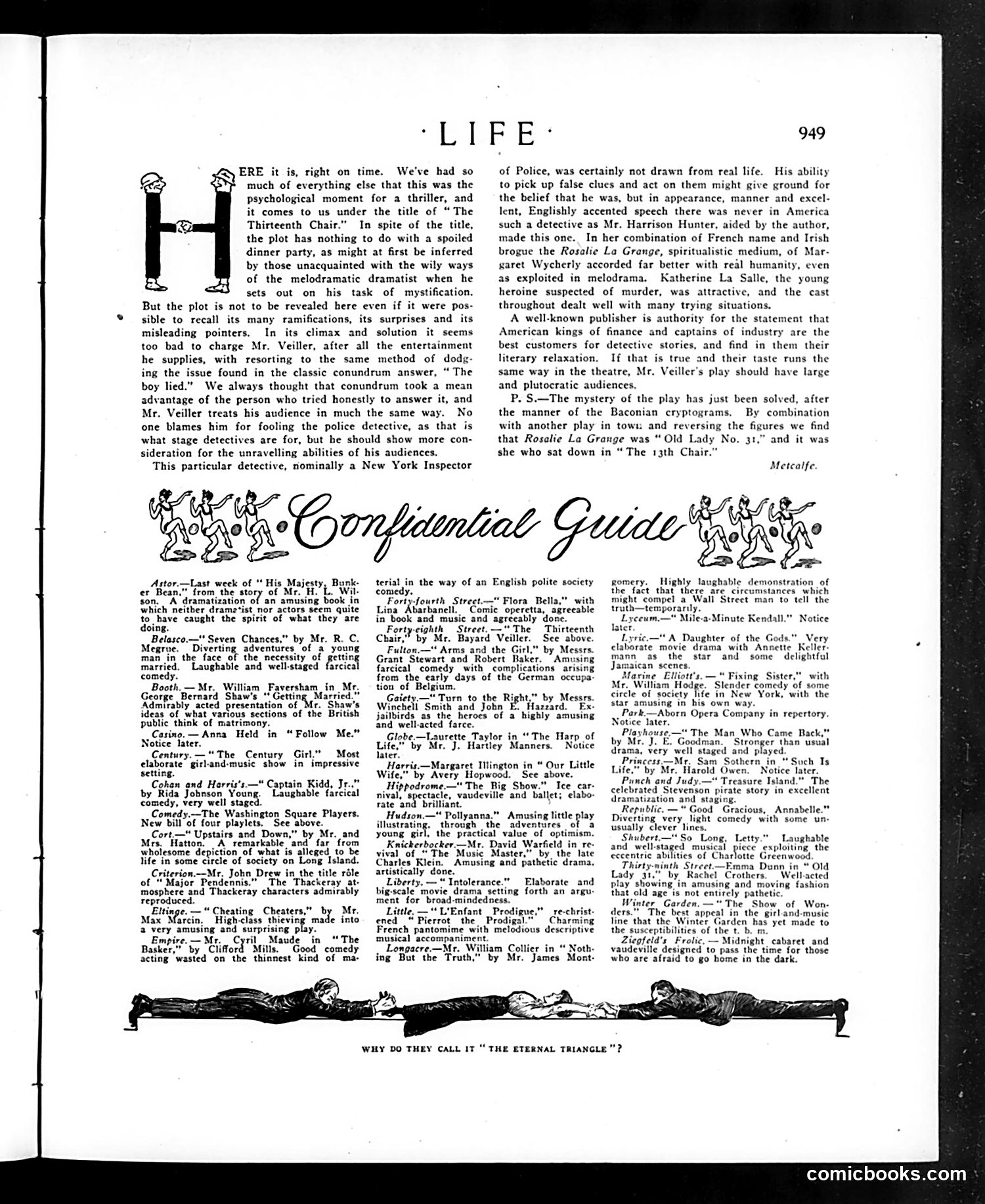
This is a theater review page from *Life* magazine. The main article critiques a thriller play titled "The Thirteenth Chair," written by Mr. Veiller and starring actor Harrison Hunter as a New York police inspector. The reviewer praises the production's entertainment value but criticizes the plot's resolution, arguing Veiller unfairly tricks the audience with a contrived solution—comparing it to a dishonest riddle. The reviewer notes the detective character is unrealistic (too competent, with an implausibly English accent for an American), though other performers like Margaret Wycherly (as a spiritualistic medium) feel more authentic. The lower section is a "Confidential Guide" listing brief reviews of current Broadway productions, including shows at the Astor, Belasco, and other theaters. The cartoon at the bottom appears to be a visual gag about "The Eternal Triangle"—a contemporary theatrical genre trope—though the specific joke is unclear from the image alone.
📄 Transcribed text from this page (OCR, searchable)
Machine-transcribed from the original scan — historical spelling and the odd misread are preserved.
“LIFE: ERE it is, right on time. We've had so much of everything else that this was the psychological moment for a thriller, and it comes to us under the title of “The Thirteenth Chair.” In spite of the title, the plot has nothing to do with a spoiled dinner party, as might at first be inferred by those unacquainted with the wily ways of the melodramatic dramatist when he sets out on his task of mystification. But the plot is not to be revealed here even if it were pos- sible to recall its many ramifications, its surprises and its misleading pointers, In its climax and solution it seems too bad to charge Mr. Veiller, after all the entertainment he supplies, with resorting to the same method of dodg- ing the issue found in the classic conundrum answer, “ The boy lied.” We always thought that conundrum took a mean advantage of the person who tried honestly to answer it, and Mr. Veiller treats his audience in much the same way. No one blames him for fooling the police detective, as that is what stage detectives are for, but he should show more con- sideration for the unravelling abilities of his audiences. This particular detective, nominally a New York Inspector 949 of Police, was certainly not drawn from real life. His ability to pick up false clues and act on them might give ground for the belief that he was, but in appearance, manner and excel- lent, Englishly accented speech there was never in America such a detective as Mr. Harrison Hunter, aided by the author, made this one. In her combination of French name and Irish brogue the Rosalie La Grange, spiritualistic medium, of Mar- garet Wycherly accorded far better with real humanity, even as exploited in melodrama. Katherine La Salle, the young heroine suspected of murder, was attractive, and the cast throughout dealt well with many trying situations. A well-known publisher is authority for the statement that American kings of finance and captains of industry are the best customers for detective stories, and find in them their literary relaxation. If that is true and their taste runs the same way in the theatre, Mr. Veiller’s play should have large and plutocratic audiences. P. S.—The mystery of the play has just been solved, after the manner of the Baconian cryptograms. By combination with another play in town: and reversing the figures we find that Rosalie La Grange was “Old Lady No. 31,” and it was she who sat down in “ The 13th Chair. Metcalfe. LE Conpotat Gute 85 Astor.—Last week of His Majesty, Bunk- er Bean,” from the story of Mr. H. L. Wil- son, A dramatization of an amusing book in which neither drame‘ist nor actors seem quite to have caught the spirit of what they are doing. Belasco.—"" Seven Chances,” by Mr. R. C. Mearye. | Diverting. adventures, of 'a\ you man in the face of the necessity of gettin married. Laughable and well-staged comedy. Booth.— Mr. William Faversham in M George Bernard Shaw's “ Getting Married.” Admirably acted presentation of Mr. Shaw's ideas of what various sections of the British public think of matrimony. Casino. — Anna Held in “Follow Me.” Notice later. Century. — “The Century Girl.” Most elaborate girl-and-music show in impressive setting. Cokan and Harris's.—“ Captain Kidd, Jr. by Rida Johnson Young. Laughable farcic comedy, very well staged. Comedy.—The Washington Square Players. New bill of four playlets. See above. Cort.—" Upstairs and Down,’ Mrs. Hatton. A remarkable wholesome depiction of what is alleged to be life in some circle of society on Long Island. Criterion.--Mr. John, Drew in the title réle of “Major Pendennis.” The Thackeray at- mosphere and Thackeray characters admirably reproduced. Eltinge. —“ Cheating Cheaters,” by Mr. Max Marcin, High-class thieving made into a very amusing and surprising play. ire. —Mr._ Cyril, Maude in “The by Clifford Mills. Good comedy acting ‘wasted on the thinnest kind of ma- farcical terial in the way of an English polite society comedy, Forty-fourth Street." Flora Bella,” with Lina Abarbaneli, Comic operetta, agreeable in book and music and agreeably done. Forty-eighth Street. —" The Thirteenth Chair,” by Mr. Bayard Veiller. See above, Fulton.—* Arms and the Girl,” by Messrs. Grant Stewart and Robert Baker. Amusing farcical comedy with complications arising from the early days of the German occupa: tion of Belgium. Gaiety —“ Turn to the Right.” by Messrs Winchell Smith and Jobn E. Hazzard. Ex- jailbirds as the heroes of a highly amusing and well-acted farce. —Laurette Taylor in “The Harp of by Mr. J. Hartley Manners. Notice Harris.—Margaret Illington in “ Our Little Wife,” by Avery Hopwood. See above. Hippodrome.—" The Big Show.” Ice car- nival, sj vaudeville and ballet; elabo- rate and brilliant. Hudson.—" Pollyann: illustrating. Amusing little play through the adventures of a young girl, the practical value of optimism. Knickerbocker—Mr. David Warfield in re- vival of The Music Master,” by. the late Charles Klein. Amusing and pathetic drama, artistically done. Liberty. —“ Intolerance.” Elaborate and big-scale movie drama setting forth an argu: ment for broad-mindedness. Little, —“L'Enfant Prodigue,” _re-christ- ened “Pierrot the Prodigal." Charming French pantomime with melodious descriptive musical accompaniment Longacre.—Mr. William Collier in “ Noth- ing But the Truth," by Mr. James Mont- gomery. Highly laughable demonstration of the fact that there are circumstances which might compel a Wall Street man to tell the truth—temporarily. Lyceum.—" Mile-a-Minute Kendall.” } later Lyric.—"" A Daughter of the Gods." Very elaborate movie drama with Annette Keller mann as the star and some delightful Jamaican scenes. Marine Elliott's. —" Fixing Sister," with Mr. William Hodge. Slender comedy of some circle of society life in New York, with the star amusing in his own way. _Park.—Aborn Opera Company in repertory. Notice later. Playhouse, tice “The Man_Who Came Back,” by Mr. J. E. Goodman. Stronger than usual drama, very well staged and played. Princess—Mr. Sam Sothern in "Such Is Life,” by Mr. Harold Owen. Notice later. Punch and Judy.— Treasure Island." The celebrated Stevenson pirate story in excellent dramatization and staging. Republic. —“ Good Gracious, Annabelle.” Diverting very, light comedy with some un- usually clever lines. Shubert—" So Long, Letty." Laughable and well-staged musical Rise, exploiting the eccentric abilities of Charlotte Greenwood. Thirty-ninth Street—Emma Dunn in “ Old Lady 31.” by Rachel Crothers. _Well-acted play showing in amusing and moving fashion that old age is not entirely pathetic. Winter Garden. —"The Show of Won- ders."" The best appeal in the girland-music that the Winter Garden has yet made to the susceptibilities of the t. b. m. Zicgfeld's Frolic. — Midnight cabaret and vaudeville designed to pass the time for those who are afraid to go home in the dark. WHY DO THEY CALL IT “ THE ETERNAL TRIANGLE"? comicbooks.com