
Life, 1916-11-30 · page 22 of 42
Life — November 30, 1916 — page 22: what you’re looking at
What you’re looking at
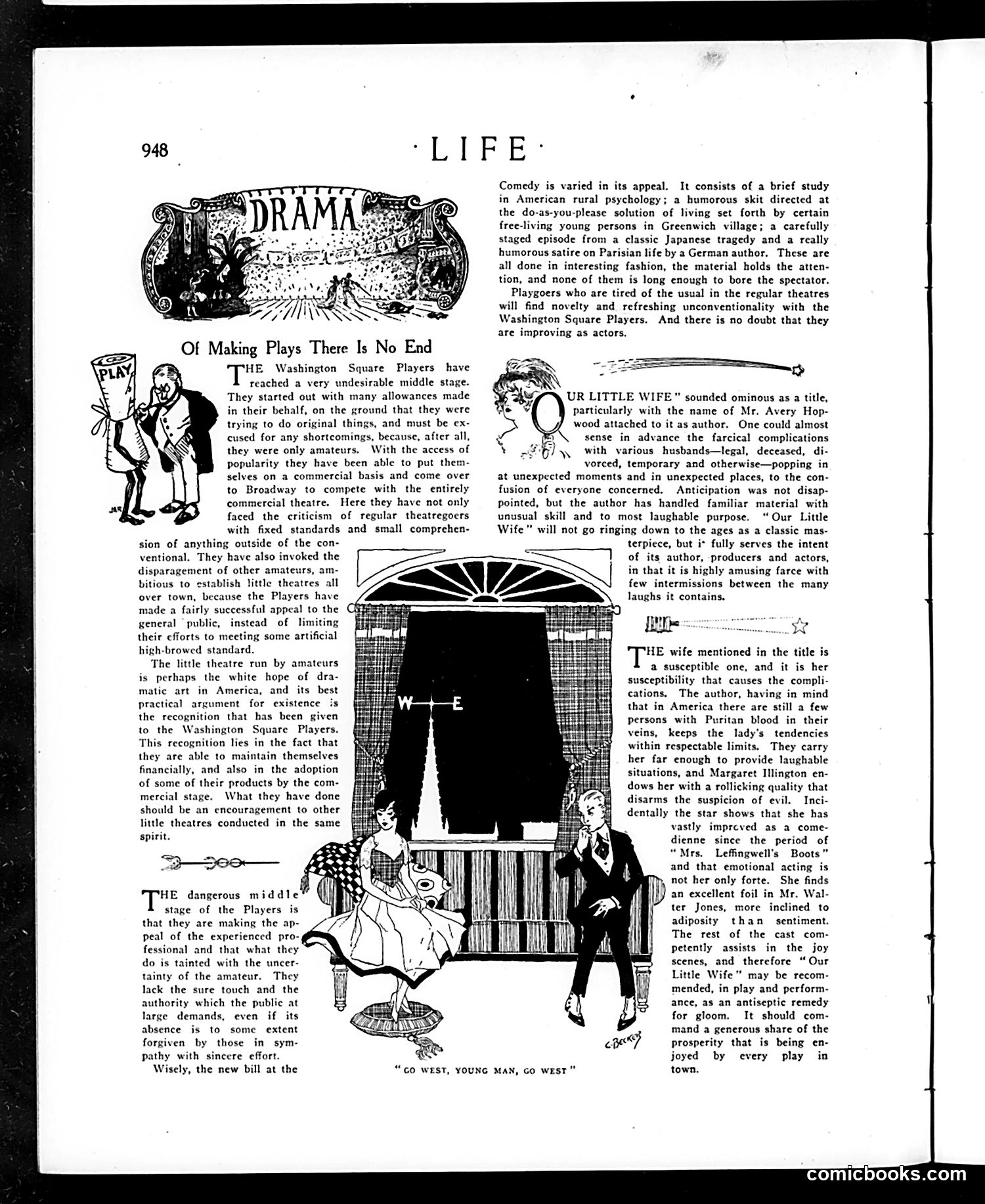
This page reviews the **Washington Square Players**, an amateur theater group that achieved unexpected commercial success on Broadway. The critic discusses their "dangerous middle stage"—they've transitioned from charming amateurs to semi-professionals, but lack the polish of established theaters. The piece argues this is actually valuable: their success proves that experimental, non-commercial theater can appeal to general audiences, encouraging other amateur theater groups. The page also reviews **"Our Little Wife,"** a farce by Avery Hopwood featuring a susceptible wife and comedic confusion with multiple husbands. The critic praises the author's skill in handling familiar farcical material while keeping the protagonist's behavior within acceptable moral bounds—suggesting American audiences still contained "Puritan" sensibilities that needed respecting. The cartoons illustrate theatrical themes, including one showing two figures labeled "W" and "E," likely representing characters from the reviewed plays.
📄 Transcribed text from this page (OCR, searchable)
Machine-transcribed from the original scan — historical spelling and the odd misread are preserved.
*LIFE* Of Making Plays There Is No End HE Washington Square Players have reached a very undesirable middle stage. They started out with many allowances made in their behalf, on the ground that they were trying to do original things, and must be ex- cused for any shortcomings, because, after all, they were only amateurs. With the access of popularity they have been able to put them- selves on a commercial basis and come over to Broadway to compete with the entirely commercial theatre. Here they have not only faced the criticism of regular theatregoers with fixed standards and small comprehen- sion of anything outside of the con- ventional. They have also invoked the disparagement of other amateurs, am- bitious to establish little theatres all over town, because the Players have made a fairly successful appeal to the general ‘public, instead of limiting their efforts to meeting some artificial high-browed standard. ‘The little theatre run by amateurs is perhaps the white hope of dra- matic art in America, and its best practical argument for existence is the recognition that has been given to the Washington Square Players. This recognition lies in the fact that they are able to maintain themselves financially, and also in the adoption of some of their products by the com- mercial stage. What they have done should be an encouragement to other little theatres conducted in the same spirit. HE dangerous middle stage of the Players is that they are making the ap- peal of the experienced pro- fessional and that what they do is tainted with the uncer- tainty of the amateur. They lack the sure touch and the authority which the public at large demands, even if its absence is to some extent forgiven by those in sym- pathy with sincere effort. Comedy is varied in its appeal. It consists of a brief study in American rural psychology; a humorous skit directed at the do-as-you-please solution of living set forth by certain free-living young persons in Greenwich village; a carefully staged episode from a classic Japanese tragedy and a really humorous satire on Parisian life by a German author. These are all done in interesting fashion, the material holds the atten- tion, and none of them is long enough to bore the spectator. Playgoers who are tired of the usual in the regular theatres will find novelty and refreshing unconventionality with the Washington Square Players. And there is no doubt that they are improving as actors. SSS UR LITTLE WIFE” sounded ominous as a title, particularly with the name of Mr. Avery Hop- wood attached to it as author. One could almost sense in advance the farcical complications \\ With various husbands—legal, deceased, di- vorced, temporary and otherwise—popping in at unexpected moments and in unexpected places, to the con- fusion of everyone concerned. Anticipation was not disap- pointed, but the author has handled familiar material with unusual skill and to most laughable purpose. “Our Little Wife" will not go ringing down to the ages as a classic mas- terpiece, but i* fully serves the intent of its author, producers and actors, in that it is highly amusing farce with few intermissions between the many laughs it contains, 'HE wife mentioned in the title is a susceptible one, and it is her susceptibility that causes the compli- cations, The author, having in mind that in America there are still a few Persons with Puritan blood in their veins, keeps the lady’s tendencies within respectable limits, They carry her far enough to provide laughable situations, and Margaret Ilington en- dows her with a rollicking quality that disarms the suspicion of evil. Inci- dentally the star shows that she has vastly impreved as a come- dienne since the period of “Mrs. Leffingwell’s Boots and that emotional acting is not her only forte. She finds an excellent foil in Mr. Wal- ter Jones, more inclined to adiposity than sentiment. The rest of the cast com- petently assists in the joy scenes, and therefore “ Our Little Wife” may be recom- mended, in play and perform- ance, as an antiseptic remedy for gloom. It should com- mand a generous share of the prosperity that is being en- joyed by every play in Wisely, the new bill at the “GO WEST, YOUNG MAN, Go WEST” town, comicbooks.com