
Life, 1916-11-30 · page 37 of 42
Life — November 30, 1916 — page 37: what you’re looking at
What you’re looking at
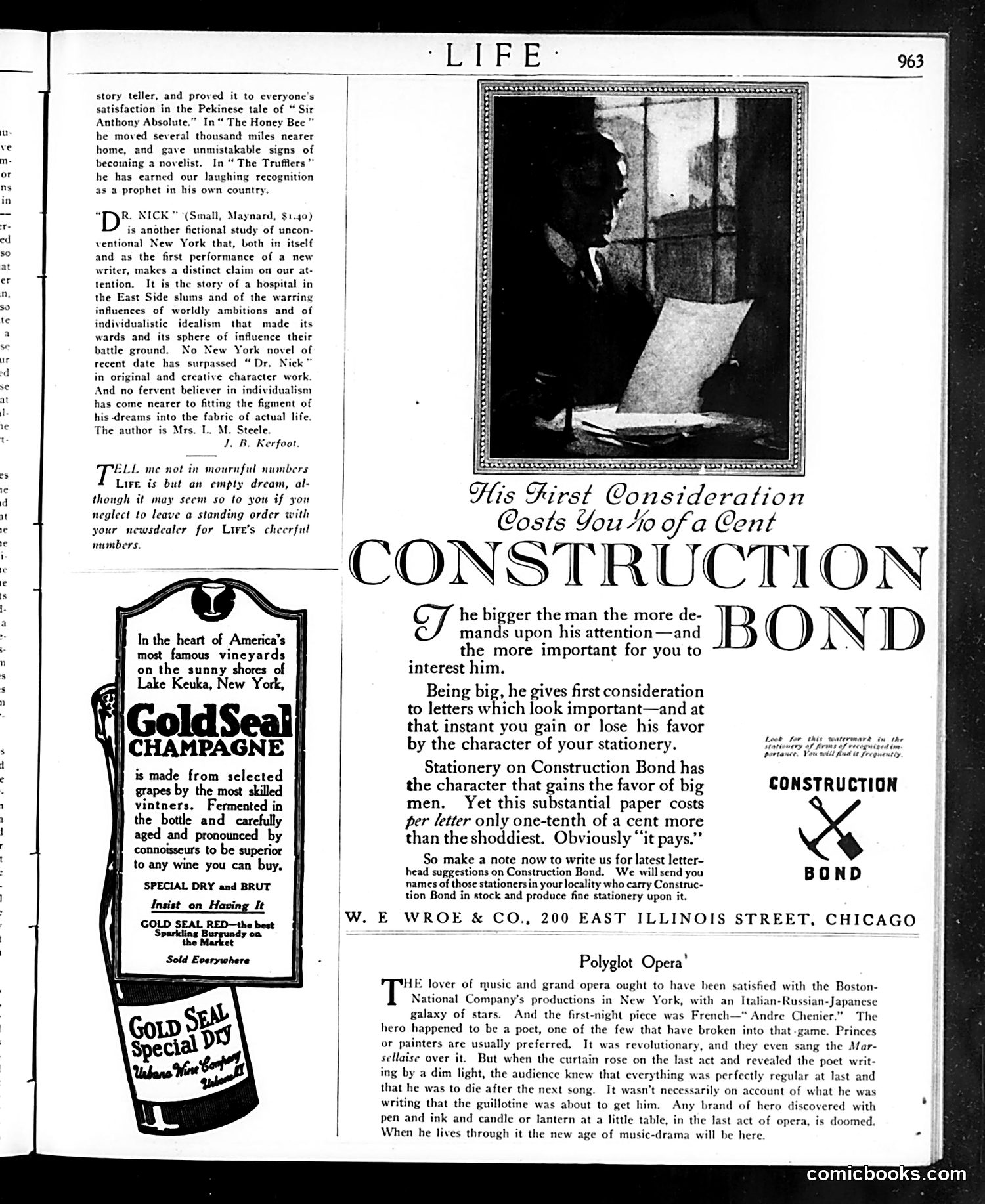
This page contains **book reviews and advertisements** rather than political cartoons. The reviews discuss three novels: works by an unnamed author (praised for "Sir Anthony Absolute" and "The Trufilers") and "Dr. Nick" by Mrs. L.M. Steele, set in East Side NYC hospitals exploring ambition versus idealism. The main advertisement promotes **Construction Bond stationery**, arguing that expensive-looking letterhead impresses important men at minimal extra cost (one-tenth of a cent per letter). The pitch exploits class anxiety: appearance matters in business correspondence. A **Gold Seal Champagne ad** appears lower left. The final piece, "Polyglot Opera," is a humorous essay mocking operatic conventions—specifically that poets always die by guillotine in the final act, regardless of plot. The author notes this predictable trope as a sign opera hasn't yet entered "the new age of music-drama." The page reflects early 20th-century American magazine culture: literary criticism, consumer marketing targeting businessmen, and satirical social commentary on entertainment.
📄 Transcribed text from this page (OCR, searchable)
Machine-transcribed from the original scan — historical spelling and the odd misread are preserved.
story teller, and proved it to everyone's satisfaction in the Pekinese tale of “ Sir Anthony Absolute.” In “ The Honey Bee ” he moved several thousand miles nearer home, and gave unmistakable signs of becoming a novelist. In “ The Trufilers he has earned our laughing recognition as a prophet in his own country. R. NICK” (Small, Maynard, $1.40) is another fictional study of uncon- ventional New York that, Loth in itself and as the first performance of a new makes a distinct claim on our at- It is the story of a hospital in the East Side slums and of the warring influences of worldly ambitions and of individualistic idealism that made its wards and its sphere of influence their battle ground. No New York novel of recent date has surpassed “Dr. Nick” in original and creative character work. And no fervent believer in individualism has come nearer to fitting the figment of his dreams into the fabric of actual life. The author is Mrs. L. M. Steele. J. B. Kerfoot. ELL me not in mournful numbers Live is but mply dream, al- thoigh i. aiay seem 60 19 300 if-sou | His Fi, = @o 2287 'deration neglect to leave a standing order with @osts You 4 Ao of g ofa Cent your newsdealer for Lrre’s cheerful “CONSTRUCTION : / he bigger the man the more de- Inthe heart of America’s | mands upon his attention—and most famous vineyards the more important for you to . on the sunny shores of interest him. Lake Keuka, New York, Being big, he gives first consideration to letters which look important—and at that instant you gain or lose his favor hc je this eatpmar ta on CHAMPAGNE | by the character of your stationery. ates of ayo rctenstt i Stationery on Construction Bond has Be om salaried the character that gains the favor of big CONSTRUCTION vintners. Fermented in men. Yet this substantial paper costs the bottle and carefully per letter only one-tenth of a cent more aged and Pronounced by than the shoddiest. Obviously “‘it pays.’”” econeusene® lobe sree So make a note now to write us for latest letter- y wine you can buy. head suggestions on Construction Bond. Wee will send you BOND SPECIAL DRY and BRUT | names of those stationersin your locality who carry Construc- tion Bond in stock and produce fine stationery upon it. Insist_on_ Having It . A 6 > COLD SEALRED—the bet f W. E WROE & CO., 200 EAST ILLINOIS STREET, CHICAGO Polyglot Opera’ lover of music and grand opera ought to have been satisfied with the Boston- ional Company's productions in New York, with an Italian-Russian-Japanese galaxy of stars. And the first-night piece was French—* Andre Chenier.” The hero happened to be a poet, one of the few that have broken into that-game. Princes or painters are usually preferred, It was revolutionary, and they even sang the Mar- sellaise over it. But when the curtain rose on the last act and revealed the poet writ ing by a dim light, the audience knew that everything was perfectly regular at last and that he was to die after the next song. It wasn't nece: ‘ily on account of what he was writing that the guillotine was about to get him. Any brand of hero discovered with pen and ink and candle or lantern at a little table, in the last act of opera, is doomed. When he lives through it the new age of music-drama will be here. comicbooks.com