
Life, 1916-11-30 · page 6 of 42
Life — November 30, 1916 — page 6: what you’re looking at
What you’re looking at
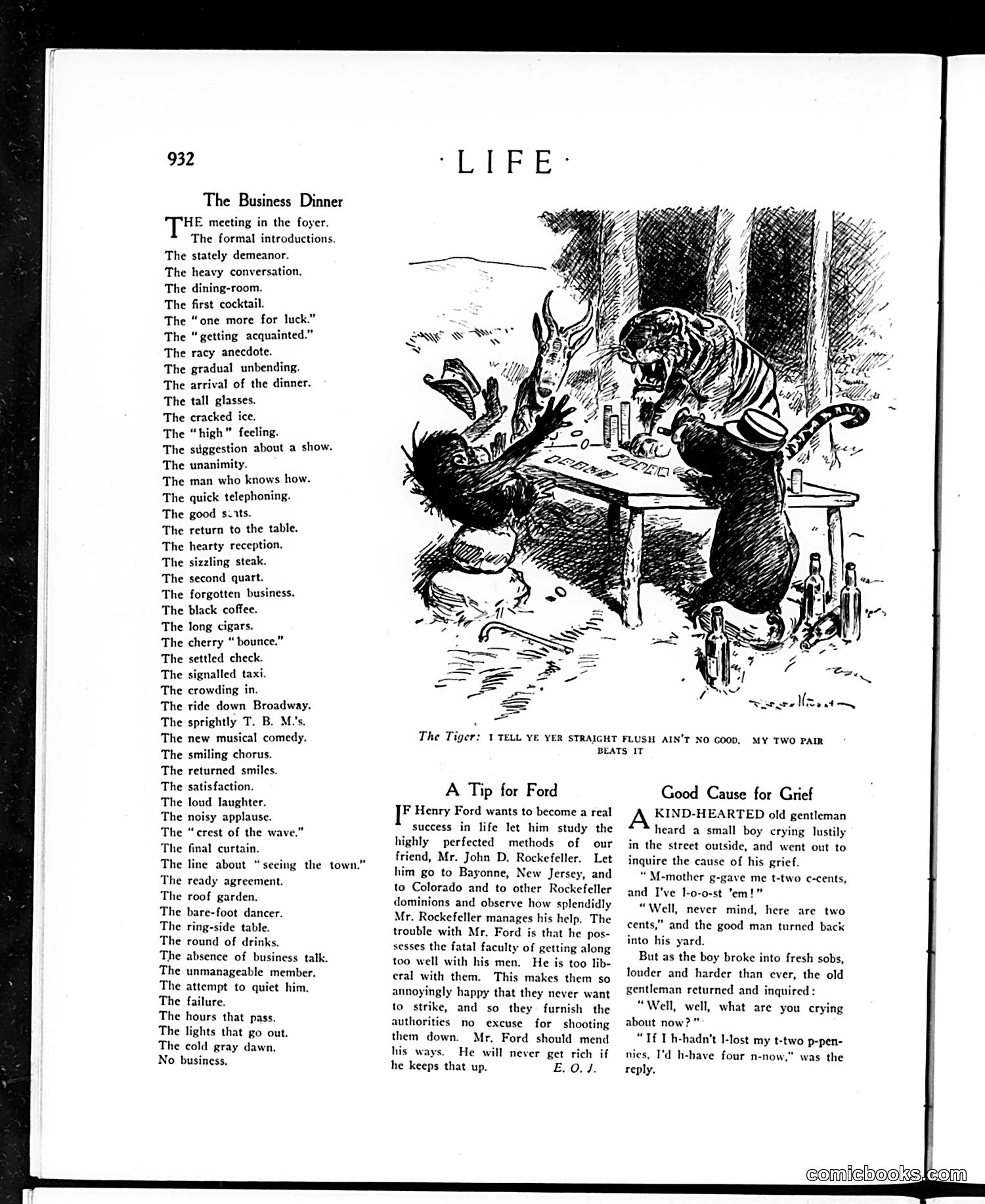
The main cartoon depicts two anthropomorphic tigers engaged in what appears to be a poker or card game at a table, with the caption: "I tell ye yer straight flush ain't no good. My two pair beats it." This is satirical commentary on business dealings or financial negotiations—the tigers represent ruthless businessmen or competitors. The joke plays on the idea that in ruthless commerce, rules are flexible and the stronger party (here, both figures are equally threatening) can claim victory through sheer force rather than actual merit. The "straight flush" losing to "two pair" symbolizes how legitimate advantage gets overruled by negotiating power or deception in business. The surrounding text lists elements of "The Business Dinner," treating corporate socializing as theater with predictable, formulaic steps.
📄 Transcribed text from this page (OCR, searchable)
Machine-transcribed from the original scan — historical spelling and the odd misread are preserved.
932 The Business Dinner HE meeting in the foyer. The formal introductions. The stately demeanor. The heavy conversation. The dining-room. The first cocktail. The “one more for luck.” The “getting acquainted.” The racy anecdote. The gradual unbending. The arrival of the dinner. The tall glasses. The cracked ice. The “high” feeling. The suggestion about a show. The unanimity. The man who knows how. The quick telephoning. The good s-1ts. The return to the table. The hearty reception. The sizzling steak. The second quart. The forgotten business. The black coffee. The long cigars. The cherry “ bounce.” The settled check. The signalled taxi. The crowding in. The ride down Broadway. The sprightly T. B. M.'s. The new musical comedy. The smiling chorus. The returned smiles. The satisfaction. The loud laughter. The noisy applause. The “crest of the wave.” The final curtain. The line about “seeing the town.” The ready agreement. The roof garden. The bare-foot dancer. The ring-side table. The round of drinks. The absence of business talk. The unmanageable member. The attempt to quiet him. The failure. The hours that pass. The lights that go out. The cold gray dawn. No business. ky The Tiger: 1 TELL YE YER STRAIGHT FLUSH AIN'T NO GOOD. MY TWO PAIR BEATS IT A Tip for Ford F Henry Ford wants to become a real success in life let him study the highly perfected methods of our friend, Mr. John D. Rockefeller. Let him go to Bayonne, New Jersey, and to Colorado and to other Rockefeller dominions and observe how splendidly Mr. Rockefeller manages his help. The trouble with Mr. Ford is that he pos- sesses the fatal faculty of getting along too well with his men. He is too lib- eral with them. This makes them so annoyingly happy that they never want to strike, and so they furnish the authorities no excuse for shooting them down. Mr. Ford should mend his ways. He will never get rich if he keeps that up. E. 0. J. Good Cause for Grief A KIND-HEARTED old gentleman heard a small boy crying lustily in the street outside, and went out to inquire the cause of his grief. “M-mother g-gave me t-two c-cents, and I've I-o-o-st ’em!” “Well, never mind, here are two cents,” and the good man turned back into his yard. But as the boy broke into fresh sobs, louder and harder than ever, the old gentleman returned and inquired : “Well, well, what are you crying about now?” “Tf Th-hadn’t I-lost my t-two p-pen- nies, I'd h-have four n-now,” was the reply. comichooks, seer leet {o) ri