
Life, 1916-11-30 · page 19 of 42
Life — November 30, 1916 — page 19: what you’re looking at
What you’re looking at
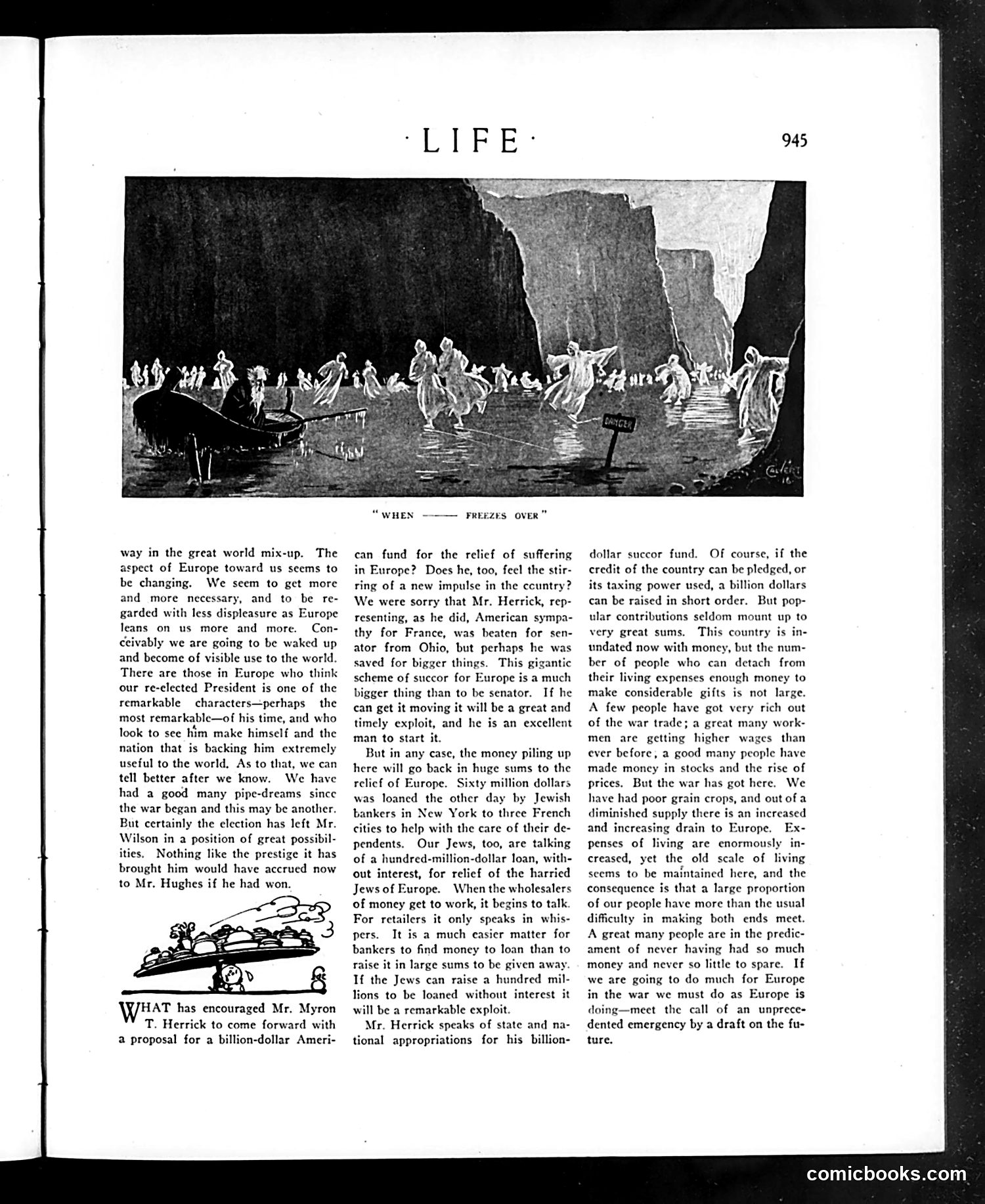
**The Cartoon:** "When ___ Freezes Over" depicts an ethereal, ghostly scene—figures in flowing robes gathered in a cavern or underworld setting. This is a visual pun on the common expression "when hell freezes over," sarcastically suggesting an impossibility. **The Context:** The article discusses Myron T. Herrick's proposal for a billion-dollar American relief fund for war-torn Europe (likely World War I era). The cartoon illustrates the author's skepticism about raising such enormous sums through voluntary public contributions. **The Satire:** While wealthy financiers and bankers can mobilize large loans, ordinary Americans—despite higher wages from wartime industry—struggle financially. The cartoonist suggests that expecting Americans to donate generously to European relief while managing increased living expenses is absurdly optimistic, hence "when hell freezes over." **Key Point:** The piece argues Americans lack both the surplus wealth and the cultural motivation for massive voluntary charity, despite wartime prosperity benefiting some sectors.
📄 Transcribed text from this page (OCR, searchable)
Machine-transcribed from the original scan — historical spelling and the odd misread are preserved.
way in the great world mix-up. The aspect of Europe toward us seems to be changing. We seem to get more and more necessary, and to be re- garded with less displeasure as Europe leans on us more and more. Con- ceivably we are going to be waked up and become of visible use to the world. There are those in Europe who think our re-elected President is one of the remarkable characters—perhaps the most remarkable—of his time, and who look to see him make himself and the nation that is backing him extremely useful to the world, As to that, we can tell better after we know. We have had a good many pipe-dreams since the war began and this may be another. But certainly the election has left Mr. Wilson in a position of great possibil- ities. Nothing like the prestige it has brought him would have accrued now to Mr. Hughes if he had won. WHat has encouraged Mr. Myron T. Herrick to come forward with a proposal for a billion-dollar Ameri- Ww aaa “WHEN -—— FREEZES OVER” can fund for the relief of suffering in Europe? Does he, too, feel the stir- ring of a new impulse in the ccuntry? We were sorry that Mr. Herrick, rep- resenting, as he did, American sympa- thy for France, was beaten for sen- ator from Ohio, but perhaps he saved for bigger things. This gigantic scheme of succor for Europe is a much bigger thing than to be senator. If he can get it moving it will be a great and timely exploit, and he is an excellent man to start But in any case, the money piling up here will go back in huge sums to the relicf of Europe. Sixty million dollars was loaned the other day by Jewish bankers in New York to three French cities to help with the care of their de- pendents. Our Jews, too, are talking of a hundred-million-dollar loan, with- out interest, for relief of the harried Jews of Europe. When the wholesalers of money get to work, it begins to talk For retailers it only speaks in whis- pers. It is a much easier matter for bankers to find money to loan than to raise it in large sums to be given away. If the Jews can raise a hundred mil- lions to be loaned without interest it will be a remarkable exploit. Mr. Herrick speaks of state and na- tional appropriations for his billion- dollar succor fund. Of course, if the credit of the country can be pledged, or its taxing power used, a billion dollars can be raised in short order. But pop- ular contributions seldom mount up to very great sums. This country is in- undated now with money, but the num- ber of people who can detach from their living expenses enough money to make considerable gifts is not large. A few people have got very rich out of the war trade; a great many work- men are getting higher wages than ever before, a good many people have made moncy in stocks and the rise of prices, But the war has got here. We have had poor grain crops, and out of a diminished supply there is an increased and increasing drain to Europe. Ex- penses of living are enormously in- creased, yet the old scale of living seems to be maintained here, and the consequence is that a large proportion of our people have more than the usual difficulty in making both ends meet. A great many people are in the predic- ament of never having had so much money and never so little to spare. If we are going to do much for Europe in the war we must do as Europe is doing—meet the call of an unprece- dented emergency by a draft on the fu- ture. comicbooks.co