
Life, 1916-11-30 · page 18 of 42
Life — November 30, 1916 — page 18: what you’re looking at
What you’re looking at
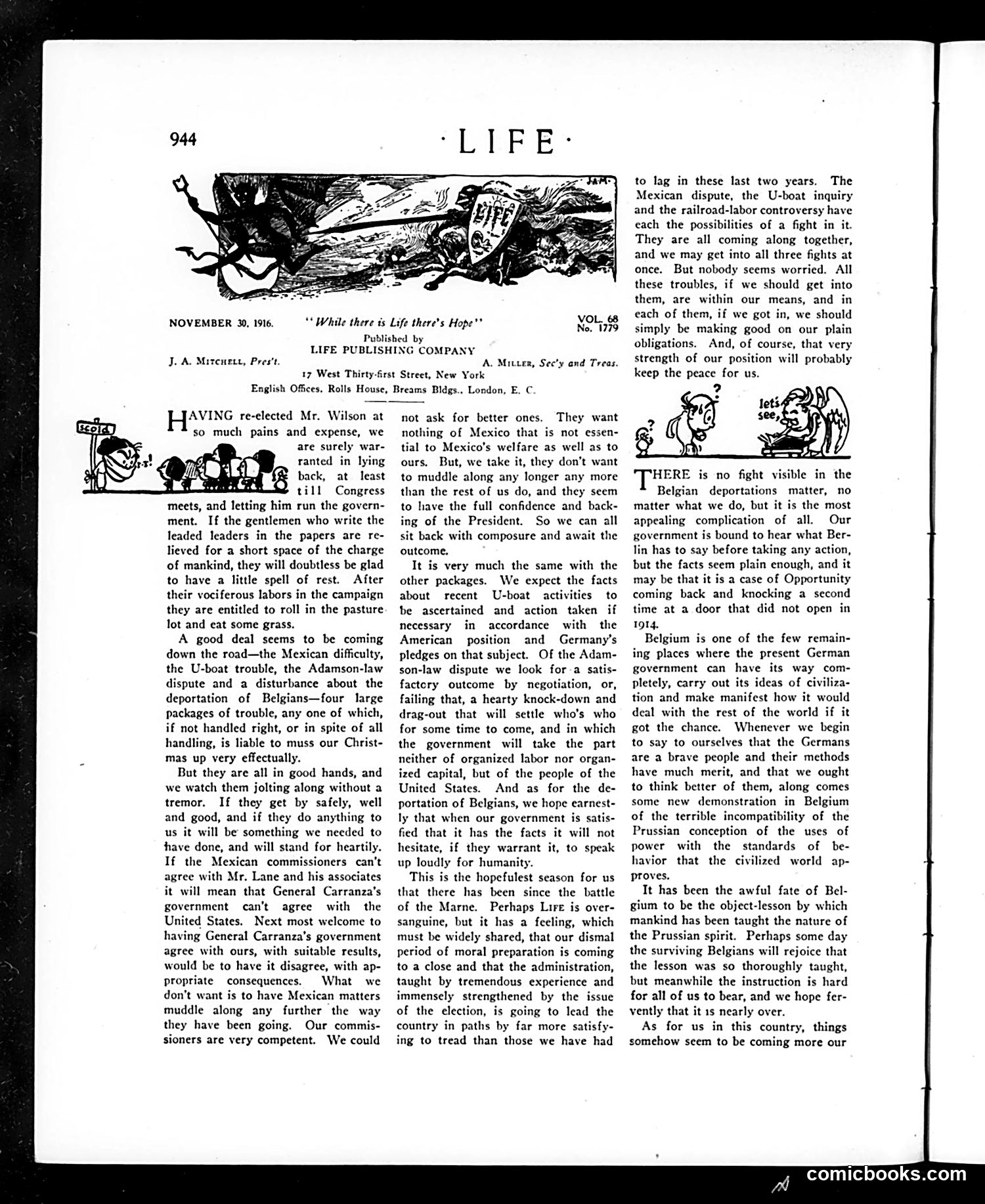
This editorial page celebrates President Wilson's reelection and urges public patience with pending crises. The small cartoon (upper left) depicts a weary voter resting after the campaign, illustrated as a simple figure lounging contentedly. The text addresses four major problems facing the administration: the Mexican situation (involving General Carranza's government), German U-boat attacks, the Adamson railroad-labor dispute, and the deportation of Belgians. The author argues these issues are "in good hands" and expresses confidence that Wilson, strengthened by his electoral victory, will resolve them decisively. The tone is notably optimistic, suggesting America has passed its "dismal period of moral preparation" since the 1914 Battle of the Marne. The editorial advocates for forceful action on all fronts while urging readers to trust the administration—a curious position given these tensions would soon push the U.S. toward World War I entry.
📄 Transcribed text from this page (OCR, searchable)
Machine-transcribed from the original scan — historical spelling and the odd misread are preserved.
NOVEMBER 30, 1916. “* While there ts Life there's Hope" Published by LIFE PUBLISH! J. A. Mircnett, Pres’t. COMPANY A. Mitten, Sec’y and Treas. 17 West Thirty-first Street, New York English Offices, Rolls House, Breams Bldgs. London, E. C. AVING re-elected Mr. Wilson at so much pains and expense, we are surely war- ranted in lying back, at least till Congress meets, and letting him run the govern- ment. If the gentlemen who write the leaded leaders in the papers are re- lieved for a short space of the charge of mankind, they will doubtless be glad to have a little spell of rest. After their vociferous labors in the campaign they are entitled to roll in the pasture lot and eat some grass. A good deal seems to be coming down the road—the Mexican difficulty, the U-boat trouble, the Adamson-law dispute and a disturbance about the deportation of Belgians—four large packages of trouble, any one of which, if not handled right, or in spite of all handling, is liable to muss our Christ- mas up very effectually. But they are all in good hands, and we watch them jolting along without a tremor. If they get by safely, well and good, and if they do anything to us it will be something we needed to have done, and will stand for heartily. If the Mexican commissioners can't agree with Mr, Lane and his associates it will mean that General Carranza’s government can’t agree with the United States. Next most welcome to having General Carranza’s government agree with ours, with suitable results, would be to have it disagree, with ap- propriate consequences. What we don’t want is to have Mexican matters muddle along any further the way they have been going. Our commis- sioners are very competent. We could not ask for better ones. They want nothing of Mexico that is not essen- tial to Mexico’s welfare as well as to ours. But, we take it, they don’t want to muddle along any longer any more than the rest of us do, and they seem to have the full confidence and back- ing of the President. So we can all sit back with composure and await the outcome, It is very much the same with the other packages. We expect the facts about recent U-boat activities to be ascertained and action taken if necessary in accordance with the American position and Germany’s pledges on that subject. Of the Adam- son-law dispute we look for-a satis- factery outcome by negotiation, or, failing that, a hearty knock-down and drag-out that will settle who's who for some time to come, and in which the government will take the part neither of organized labor nor organ- ized capital, but of the people of the United States. And as for the de- portation of Belgians, we hope earnest- ly that when our government is satis- fied that it has the facts it will not hesitate, if they warrant it, to speak up loudly for humanity. This is the hopefulest season for us that there has been since the battle of the Marne. Perhaps Lire is over- sanguine, but it has a feeling, which must be widely shared, that our dismal period of moral preparation is coming to a close and that the administration, taught by tremendous experience and immensely strengthened by the issue of the election, is going to lead the country in paths by far more satisfy- ing to tread than those we have had to lag in these last two years. The Mexican dispute, the U-boat inquiry and the railroad-labor controversy have cach the possibilities of a fight in it. They are all coming along together, and we may get into all three fights at once. But nobody seems worried. All these troubles, if we should get into them, are within our means, and in each of them, if we got in, we should simply be making good on our plain obligations. And, of course, that very strength of our position will probably keep the peace for us. rTRERE is no fight visible in the Belgian deportations matter, no matter what we do, but it is the most appealing complication of all. Our government is bound to hear what Ber- lin has to say before taking any action, but the facts seem plain enough, and it may be that it is a case of Opportunity coming back and knocking a second time at a door that did not open in T1914. Belgium is one of the few remain- ing places where the present German government can have its way com- pletely, carry out its ideas of civiliza- tion and make manifest how it would deal with the rest of the world if it got the chance. Whenever we begin to say to ourselves that the Germans are a brave people and their methods have much merit, and that we ought to think better of them, along comes some new demonstration in Belgium of the terrible incompatibility of the Prussian conception of the uses of power with the standards of be- havior that the civilized world ap- Proves, It has been the awful fate of Bel- gium to be the object-lesson by which mankind has been taught the nature of the Prussian spirit. Perhaps some day the surviving Belgians will rejoice that the lesson was so thoroughly taught, but meanwhile the instruction is hard for all of us to bear, and we hope fer- vently that it 1s nearly over. As for us in this country, things somehow seem to be coming more our A comicbooks.com