
A complete issue · 44 pages · 1916
Life — October 12, 1916
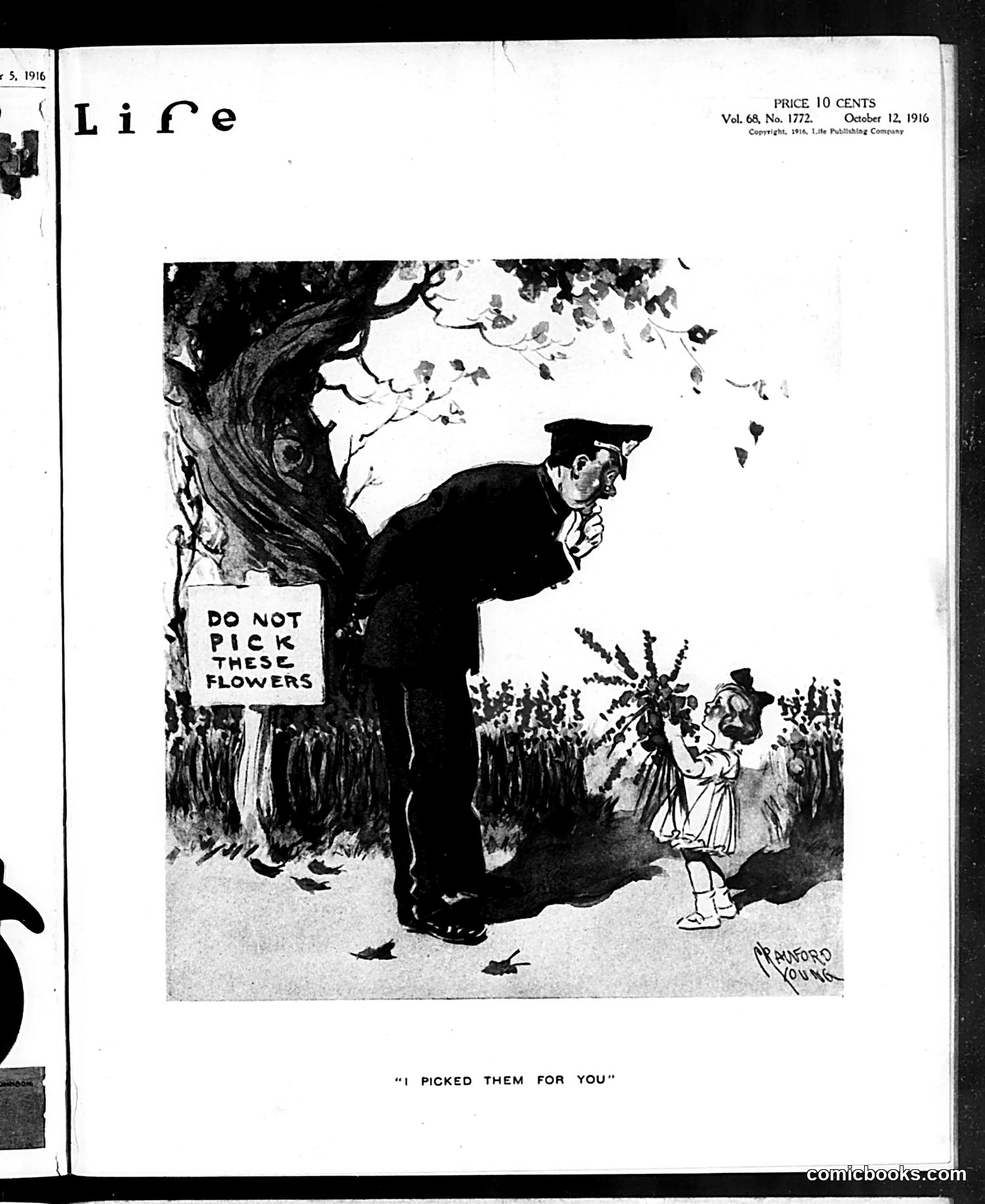
This 1916 *Life* cartoon satirizes paternal authority and rule-breaking. A stern, formally-dressed man (likely representing a father or authority figure) confronts a young girl holding flowers, standing beside a tree with a "DO NOT PICK THESE FLOWERS" sign. The humor derives from the contradiction between the authority's stated rules and his actions: he has picked flowers despite his own prohibition, then presents them to the child—undermining his authority through his own hypocrisy. The girl's pleased expression suggests she's receiving a reward for behavior he technically forbade. This reflects early-20th-century commentary on parental inconsistency and the gap between rules adults impose on children versus rules they follow themselves—a timeless domestic satire.
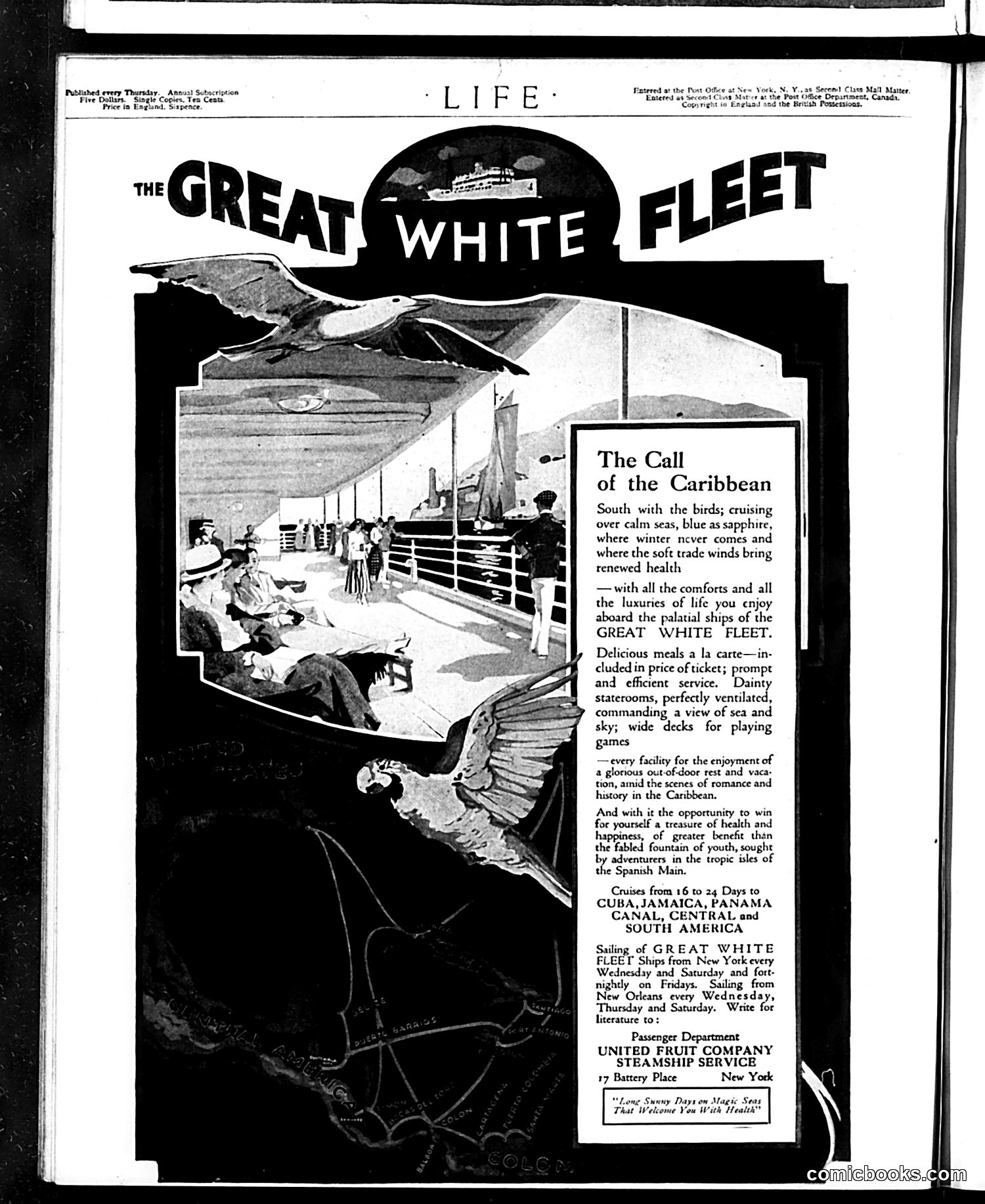
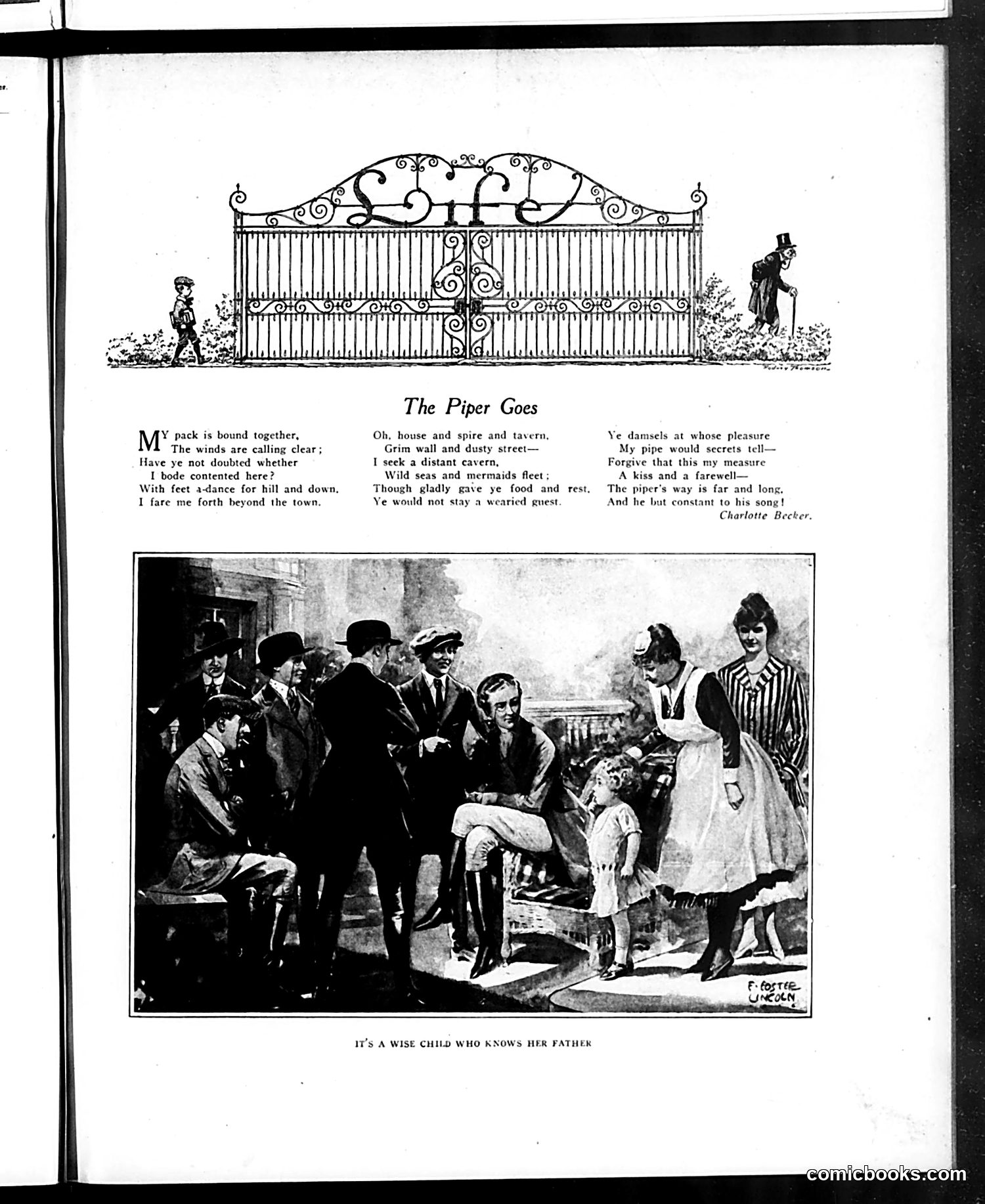
This page presents a poem by Charlotte Becker titled "The Piper Goes," accompanied by two illustrations about departure and wandering. The top illustration shows an ornate gate with small figures on either side, depicting someone leaving through a grand entrance. The bottom illustration, captioned "It's a Wise Child Who Knows Her Father," shows a child being presented to a gathering of well-dressed men and women. The composition suggests a poignant social commentary—likely about illegitimacy or paternity uncertainty, common satirical targets in early 20th-century Life magazine. The child appears to be introduced to a crowd rather than a known father, making the caption's irony pointed: the "wise" child understands that identifying one's father may be impossible or complicated in society.
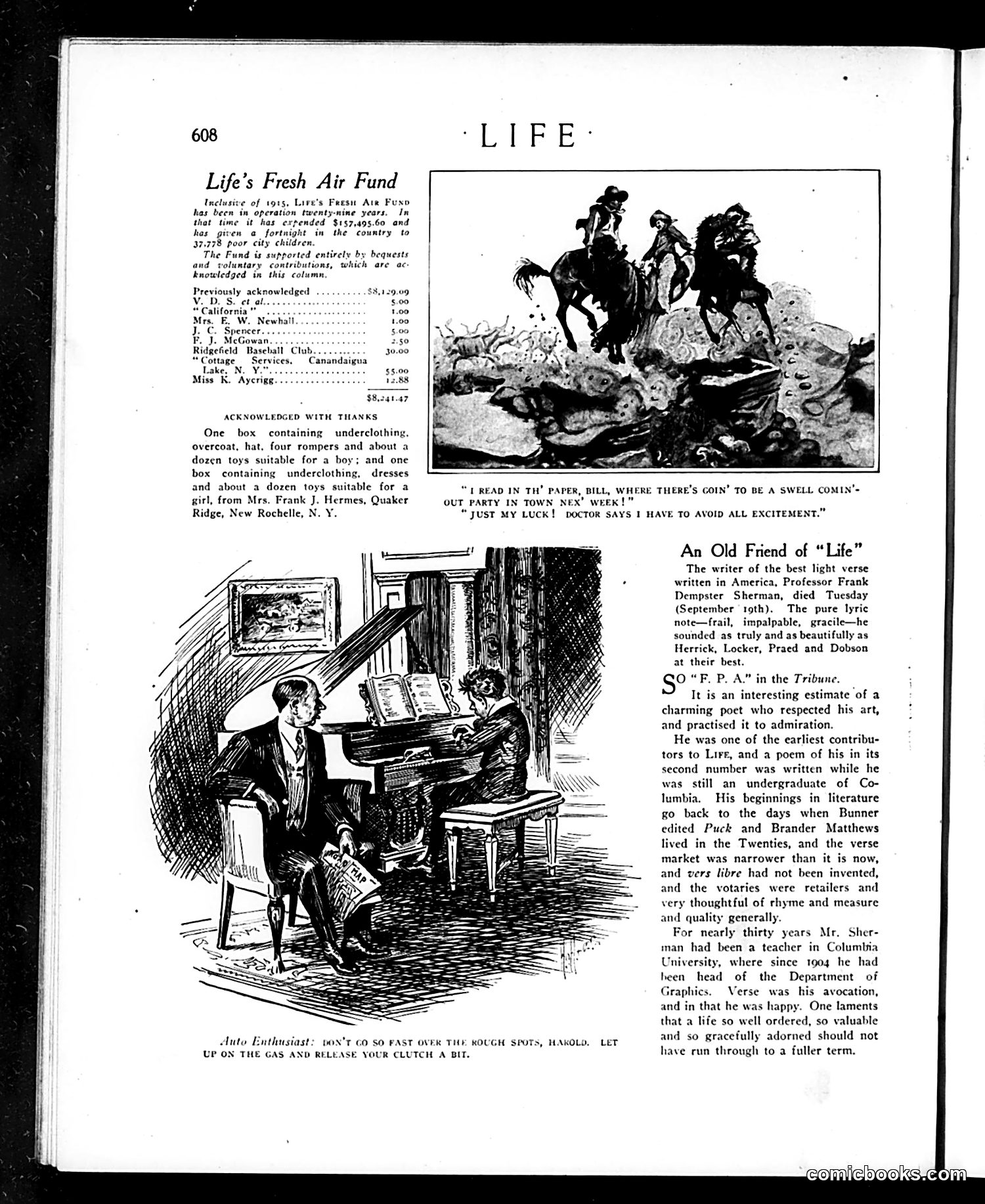
**Top Illustration:** A humorous cartoon depicting people reacting to news of a social event. The caption quotes someone reading about an upcoming "swell comin'-out party" and mentions doctor's orders to avoid excitement—likely satirizing the social pretensions of upper-class debutante balls and the irony of someone being medically advised against excitement while social events demand emotional engagement. **Bottom Section:** An obituary-style tribute to Frank Dempster Sherman, described as "the writer of the best light verse written in America." The piece praises his lyrical poetry and his long career teaching at Columbia University since 1894, noting he was "happy" in his vocation. This appears to be a sincere memorial rather than satire.
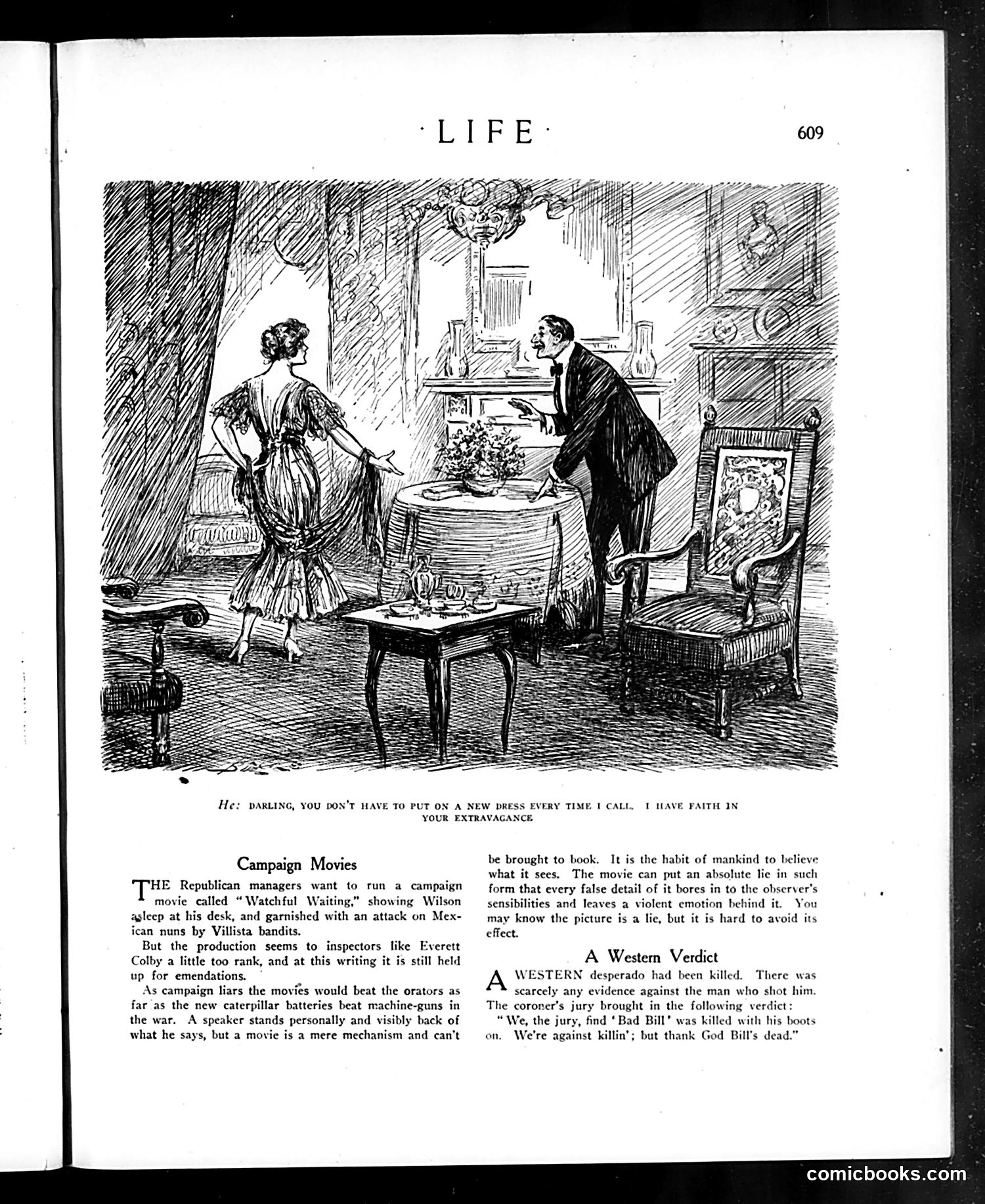
The cartoon illustrates a domestic scene with caption: "He: Darling, you don't have to put on a new dress every time I call. I have faith in your extravagance." This is a humor piece about courtship/relationship dynamics, likely from the early 20th century. The man's comment is paradoxical—he claims to have "faith in her extravagance" while ostensibly objecting to her frequent dress changes. The joke appears to mock male hypocrisy: men simultaneously complain about women's spending habits while enabling or expecting fashionable appearance. The accompanying text discusses campaign movies, particularly a Republican film called "Watchful Waiting," and critiques propaganda films' effectiveness compared to live speakers, plus a brief anecdote about a Western outlaw ("Bad Bill").
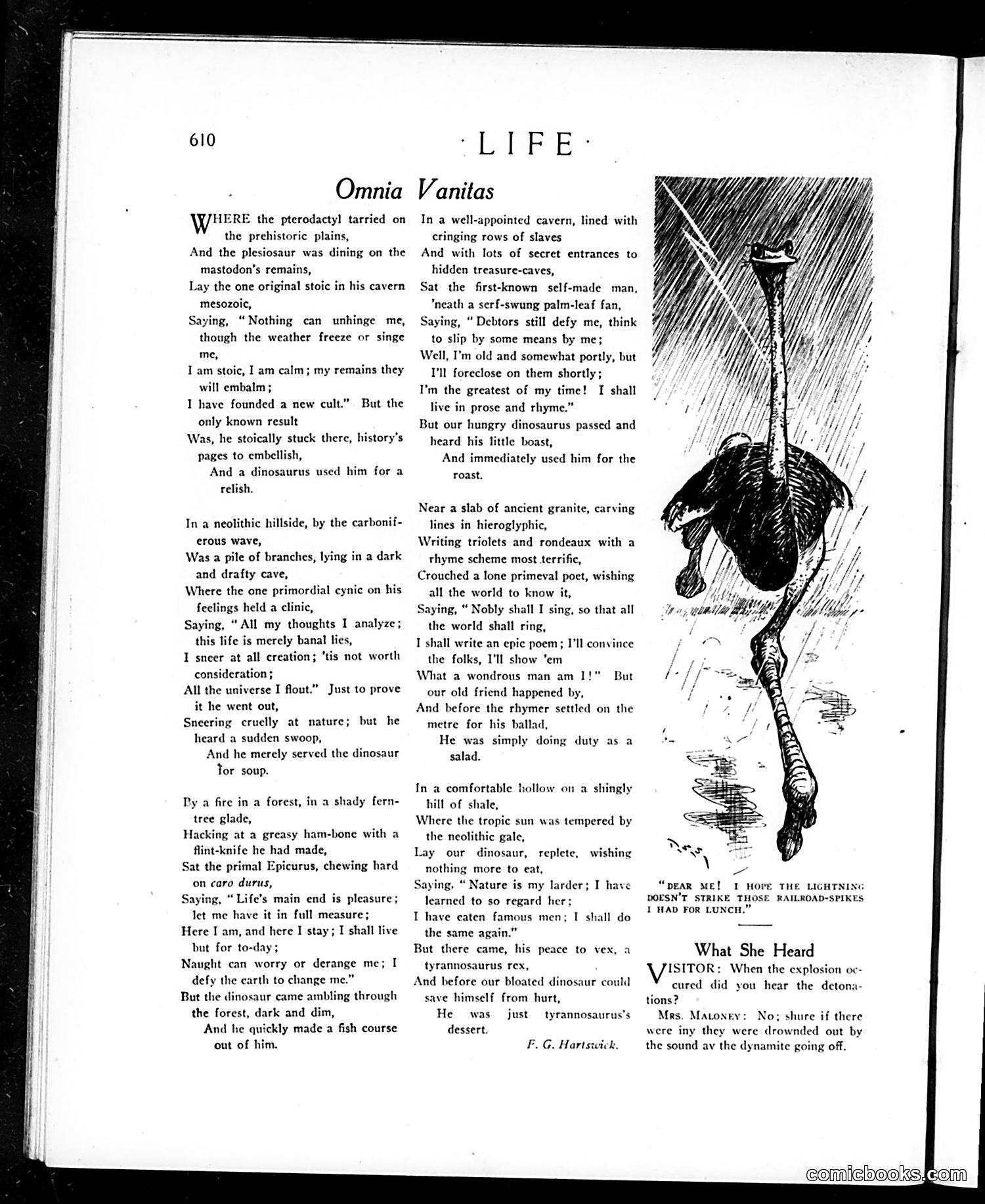
This page contains a humorous poem titled "Omnia Vanitas" (Latin: "All is Vanity") by F.G. Hartwick, accompanied by an illustration of a hanged ostrich. The poem satirizes human pretension through a narrative featuring prehistoric dinosaurs and early humans. It mocks various character types: a stoic philosopher, a self-made man, and an aspiring poet—all ultimately reduced to insignificance. The hanged ostrich illustration serves as dark visual commentary on the poem's theme that all ambitions and achievements are ultimately futile. The page concludes with a brief dialogue titled "What She Heard," where a visitor asks Mrs. Maloney about hearing detonations, likely referencing industrial explosions—a topical urban hazard of the period. The overall message critiques human vanity and the illusion of progress.
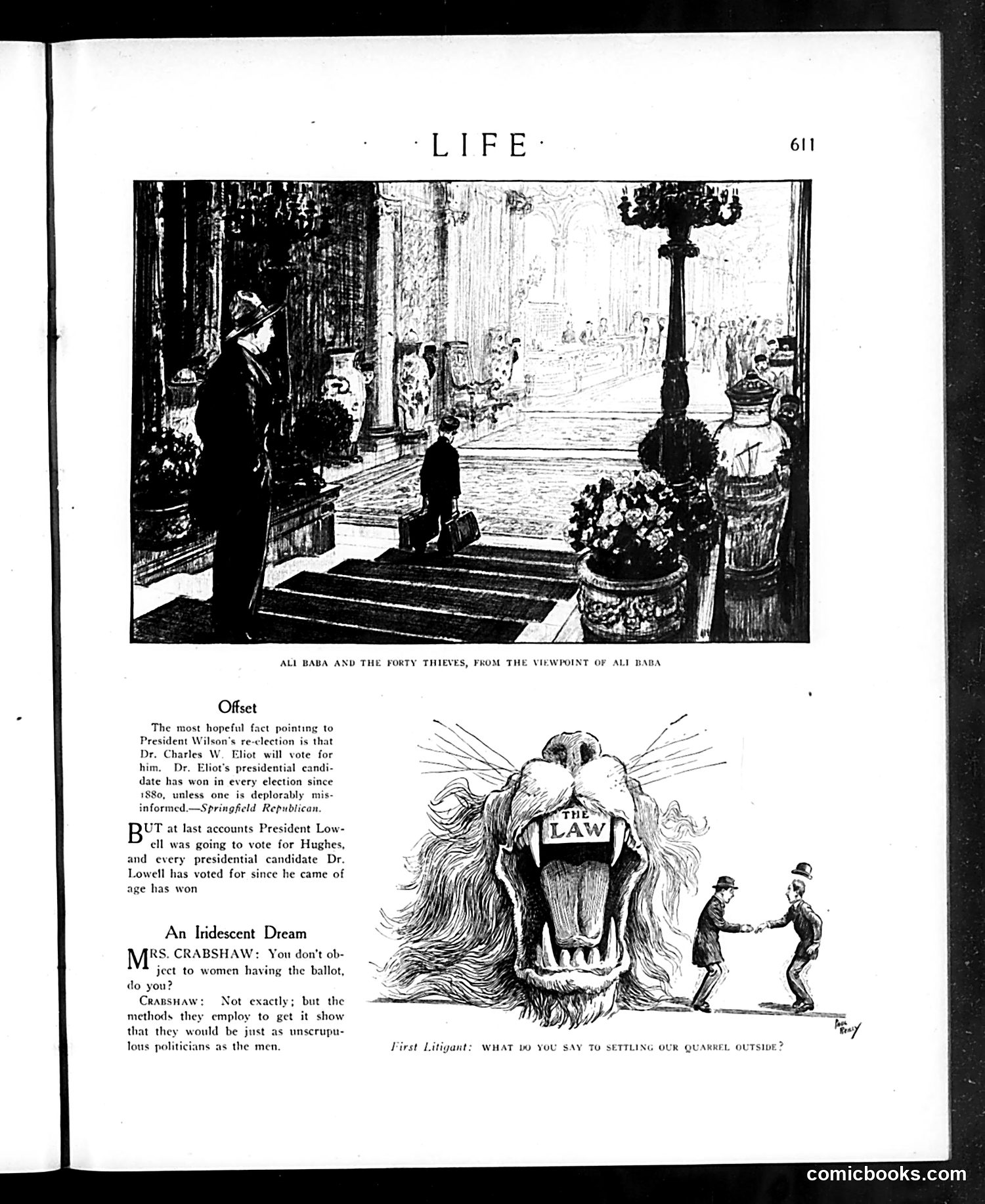
**Top Image:** An illustration titled "Ali Baba and the Forty Thieves, from the Viewpoint of Ali Baba" depicts an ornate palace or marketplace scene, likely a classical reference to the Arabian Nights tale. **Political Content:** Two brief items discuss voting patterns. "Offset" notes that Dr. Charles W. Eliot will vote for Hughes (likely referring to the 1916 presidential election), while President Lowell consistently votes Democratic since 1880. "An Indecent Dream" features dialogue between Mrs. Crabshaw and Crabshaw debating women's suffrage and voting methods—implying women might be as "unscrupulous" as male politicians. **Political Cartoon:** A fierce lion labeled "The Law" confronts two small men (labeled "First Litigant"), suggesting the law's intimidating power over ordinary citizens attempting legal disputes.
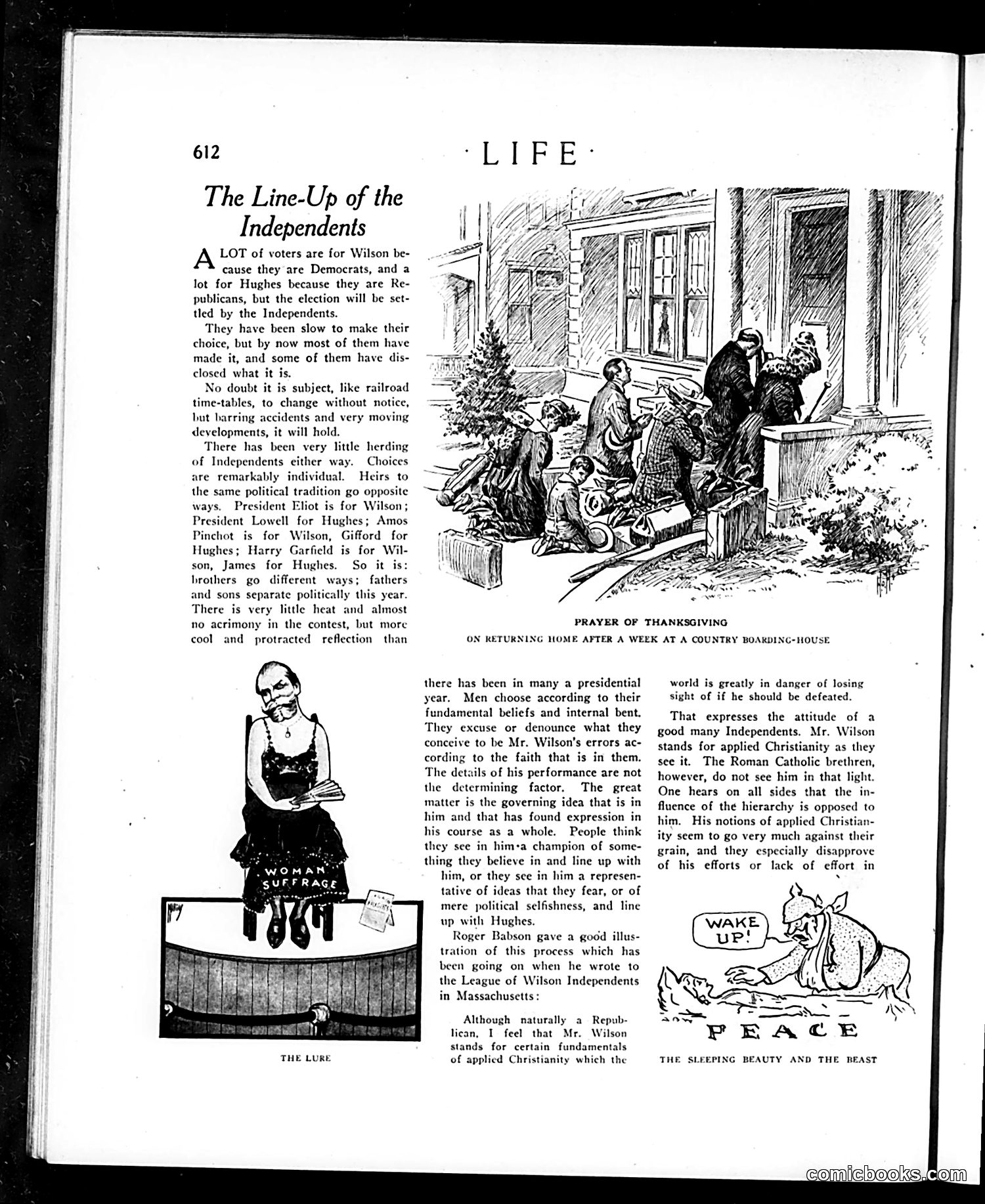
This page discusses the 1912 presidential election's "Independents"—voters torn between Wilson (Democrat), Hughes (Republican), and Roosevelt (Progressive/Bull Moose party candidate, though not named here). **"The Lure" cartoon** depicts a woman labeled "Woman Suffrage" as bait in a trap, suggesting Independents are being lured by promises of women's voting rights. **"The Sleeping Beauty and the Beast"** appears to satirize political awakening or warns of danger if progressivism ("beauty") sleeps while conservatism ("beast") lurks. The text notes that Independents choose based on personal conviction rather than party loyalty, making this election unpredictable. The piece suggests Wilson's applied Christianity appeals to some voters while alienating Catholic readers who oppose his policies.
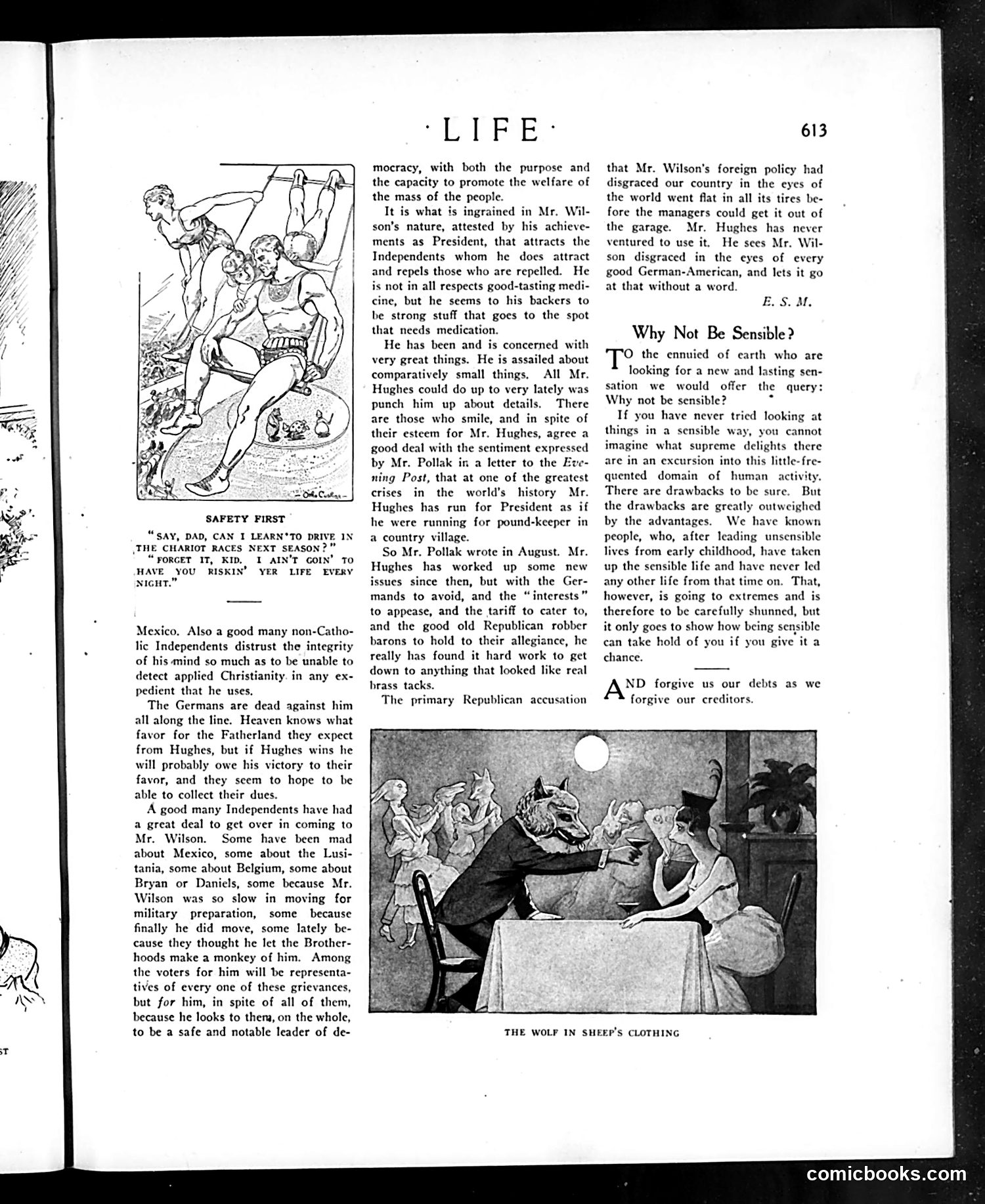
**Top Cartoon ("Safety First"):** This depicts a child asking their father to learn to drive a chariot next year, promising to be safe. The satire criticizes reckless political leadership—likely President Wilson—by comparing dangerous driving to dangerous governance. The caption suggests Wilson's foreign policy decisions (possibly regarding military preparedness or WWI involvement) endangered the nation like an unsafe driver endangers passengers. **Bottom Cartoon ("The Wolf in Sheep's Clothing"):** Shows a predatory figure disguised as something benign, a classical fable reference. The text references Mr. Hughes and Republicans accusing Wilson of deception regarding foreign policy and military readiness. The satire suggests hidden dangers lurk beneath official reassurances about national safety and preparedness. Both cartoons mock Wilson's leadership credibility during a period of international crisis.
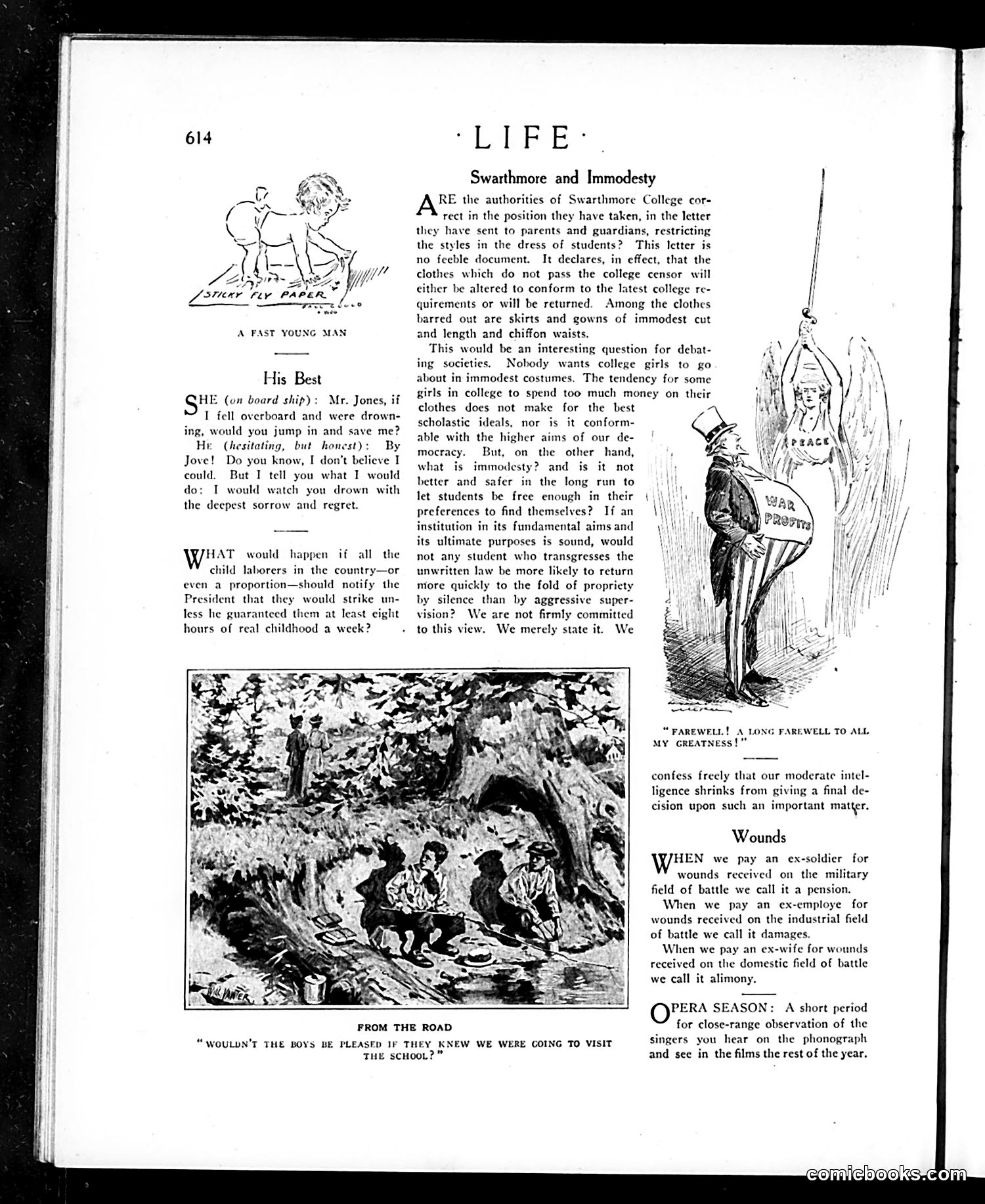
This page contains social commentary pieces rather than political cartoons. The main content critiques **Swarthmore College's dress code restrictions** for female students. The article argues against the college's censorship of "immodest" clothing styles, questioning whether such restrictions align with democratic principles and educational freedom. A secondary piece titled "Wounds" uses wordplay to critique inconsistent government policy: soldiers receive "pensions" for battle injuries, industrial workers receive "damages," but domestic workers receive "alimony"—highlighting discriminatory treatment. The illustrations include a satirical drawing of a young man and a period scene showing people gathered outdoors. These support the articles' themes of social critique regarding authority, class, and institutional hypocrisy prevalent in early 20th-century American life.
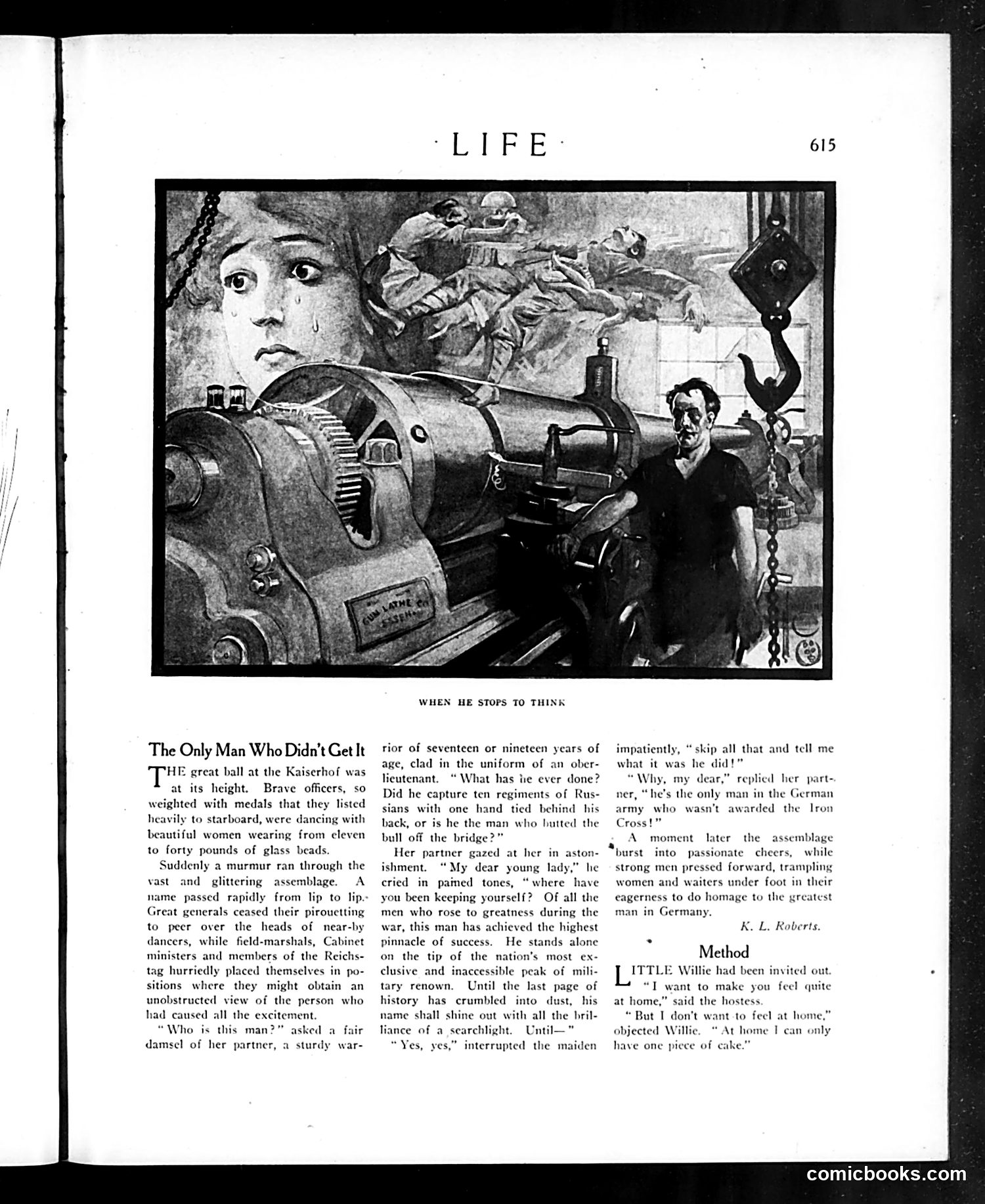
This Life magazine page contains two separate pieces of satirical fiction: **"The Only Man Who Didn't Get It"** depicts a German military ball during WWI. The illustration shows industrial machinery and a young officer. The story mocks a German soldier as "the only man in the German army who wasn't awarded the Iron Cross"—satirizing Germany's apparently indiscriminate awarding of military honors. The joke suggests that even mediocre officers received decorations, making the honor meaningless. The text references capturing regiments and destroying bridges, typical WWI combat claims. **"Method"** is a brief humorous dialogue about a hostess's cake, unrelated to the first piece. The magazine's wartime content reflects American attitudes toward German military culture and bureaucracy during or shortly after World War I.
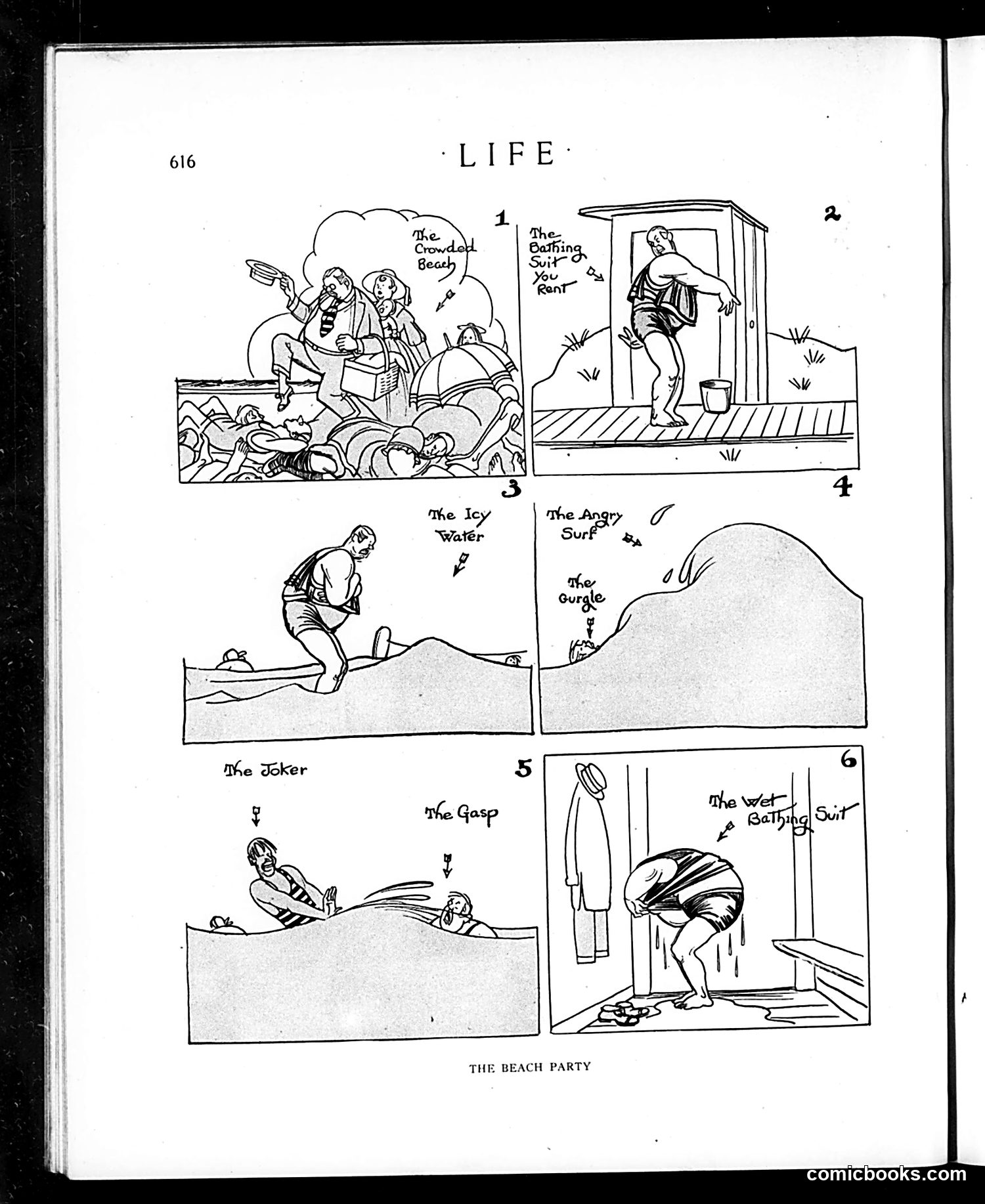
This is a six-panel comic strip depicting humorous situations at a beach. The panels show: 1. "The Golden Beach" - people relaxing 2. "The Bathing Suit of Yore" - someone in old-fashioned bathing attire 3. "The Icy Water" - a man wading into cold water 4. "The Angry Surf" and "The Gurgle" - swimming mishaps 5. "The Joker" and "The Gasp" - someone playing a prank in the water 6. "The Wet Bathing Suit" - someone dripping wet indoors The humor relies on physical comedy and exaggerated reactions to common beach experiences—cold water, old-fashioned swimwear, rough waves, and practical jokes. This appears to be general entertainment satire about beach culture rather than political commentary.
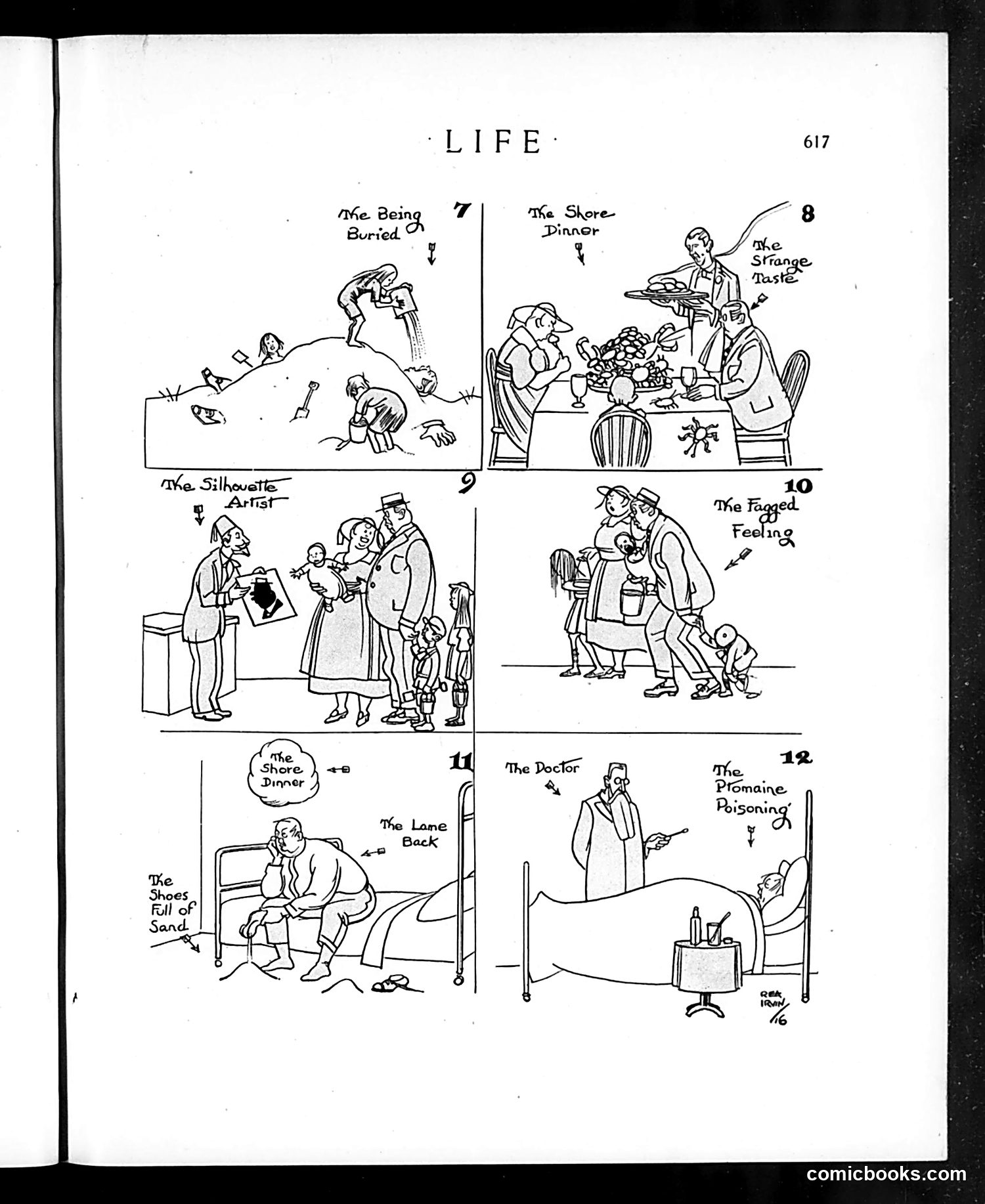
This page presents a humorous visual sequence depicting various unpleasant life experiences. Each numbered panel illustrates a relatable social awkwardness or discomfort: - Panel 7: "The Being Buried" shows people digging - Panel 8: "The Shore Dinner" depicts an uncomfortable meal - Panel 9: "The Silhouette Artist" shows a street performer - Panel 10: "The Fagged Feeling" portrays exhausted adults with children - Panel 11: "The Lone Back" and "The Shoes Full of Sand" reference beach-related irritations - Panel 12: "The Doctor" and "The Ptomaine Poisoning" show medical/food-poisoning consequences The cartoons satirize mundane middle-class social situations and physical discomforts—beach trips, formal dinners, street entertainers, and minor illnesses. The humor derives from depicting universally recognizable but typically unspoken annoyances and embarrassments that genteel society experiences. This reflects Life's characteristic focus on satirizing everyday American life and social pretensions.
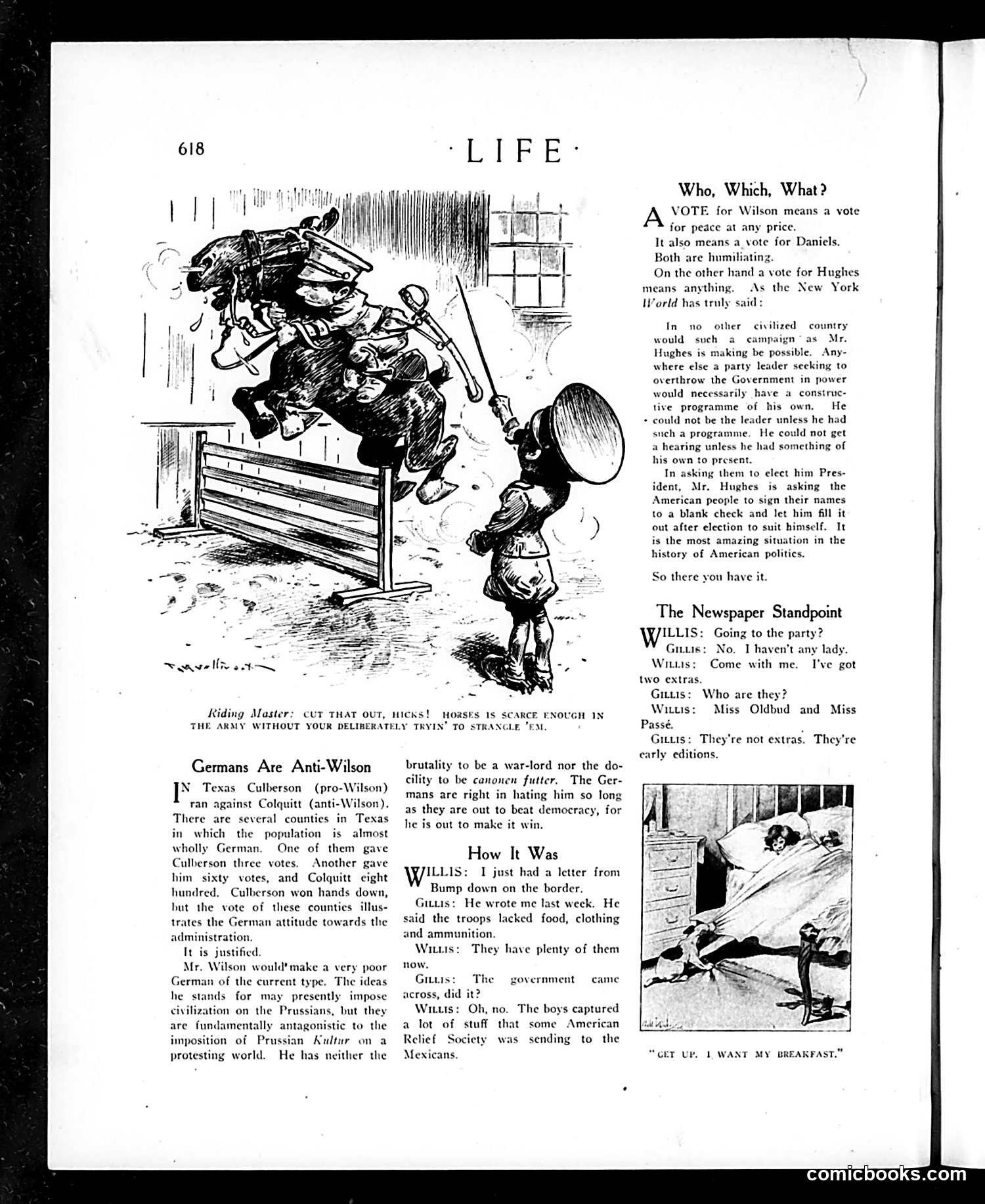
This page satirizes the 1916 U.S. presidential campaign. The main cartoon depicts a figure (likely representing the electorate or American democracy) being thrown from a bucking horse labeled "HORSES IS SCARCE ENOUGH IN THE ARMY WITHOUT YOUR DELIBERATELY TRYIN' TO STRANGE 'EM." The satire critiques Charles Evans Hughes's presidential challenge to incumbent Woodrow Wilson. The text below ("Germans Are Anti-Wilson") suggests Hughes's campaign attracted German-American voters opposing Wilson's policies. The cartoon ridicules the chaotic nature of Hughes's campaign strategy—he's asking voters to essentially sign blank checks for his unspecified political platform, making him an unreliable "riding master" for the nation's horse. The other content includes typical magazine humor sections.
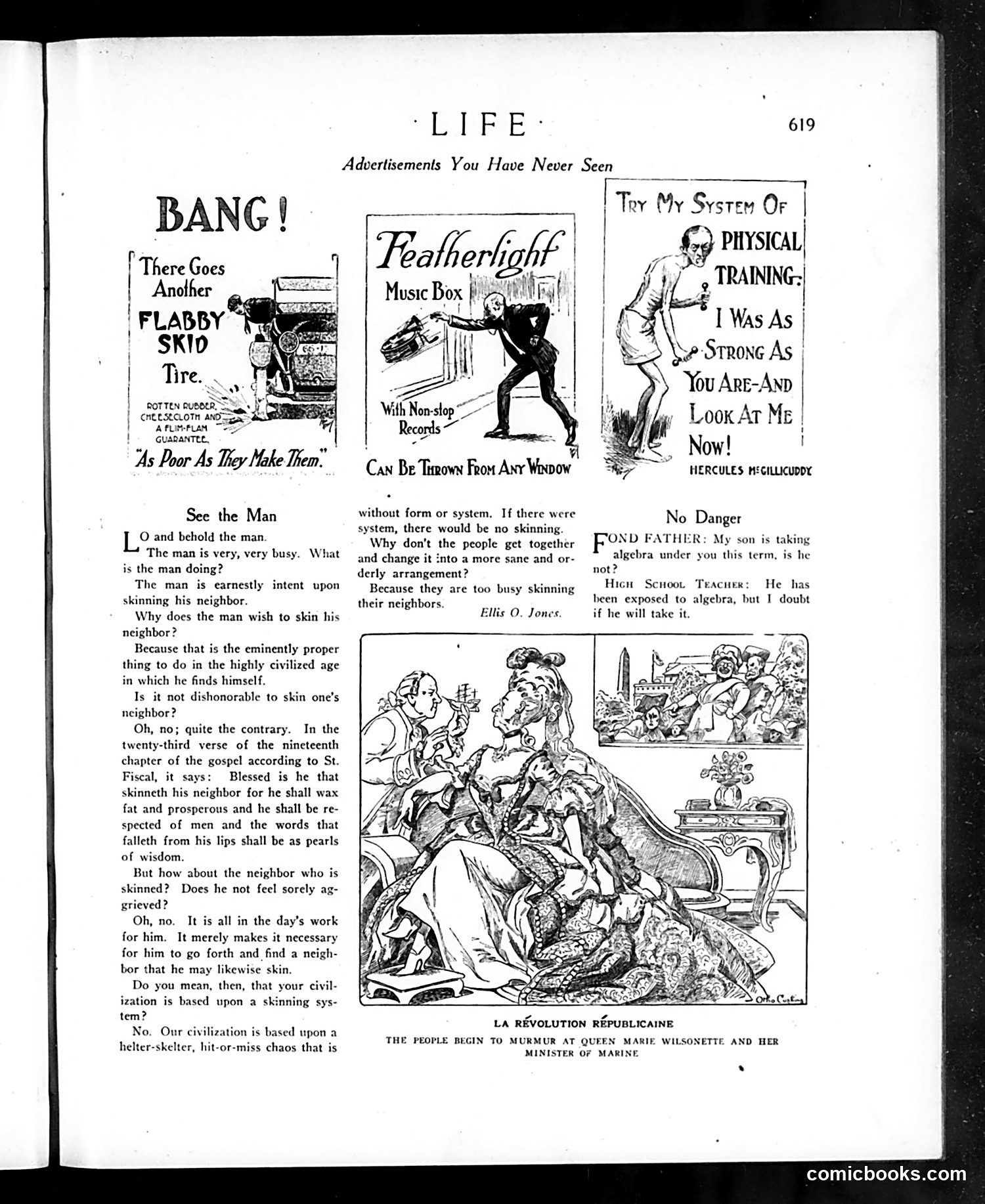
This cartoon depicts the French Revolution, specifically the period of upheaval against Queen Marie Antoinette and her minister. The caption states: "The people begin to murmur at Queen Marie Antoinette and her Minister of Marine." The image shows aristocratic figures in period dress being confronted or threatened by common people, illustrated through the chaotic gathering and body language. The "murmuring" referenced suggests growing public discontent and revolutionary sentiment among the masses. The accompanying text on the page ("See the Man") discusses broader philosophical questions about social systems and civilization, appearing to comment on whether orderly systems or natural chaos better serve society—likely meant to relate conceptually to the revolutionary upheaval depicted in the cartoon below.
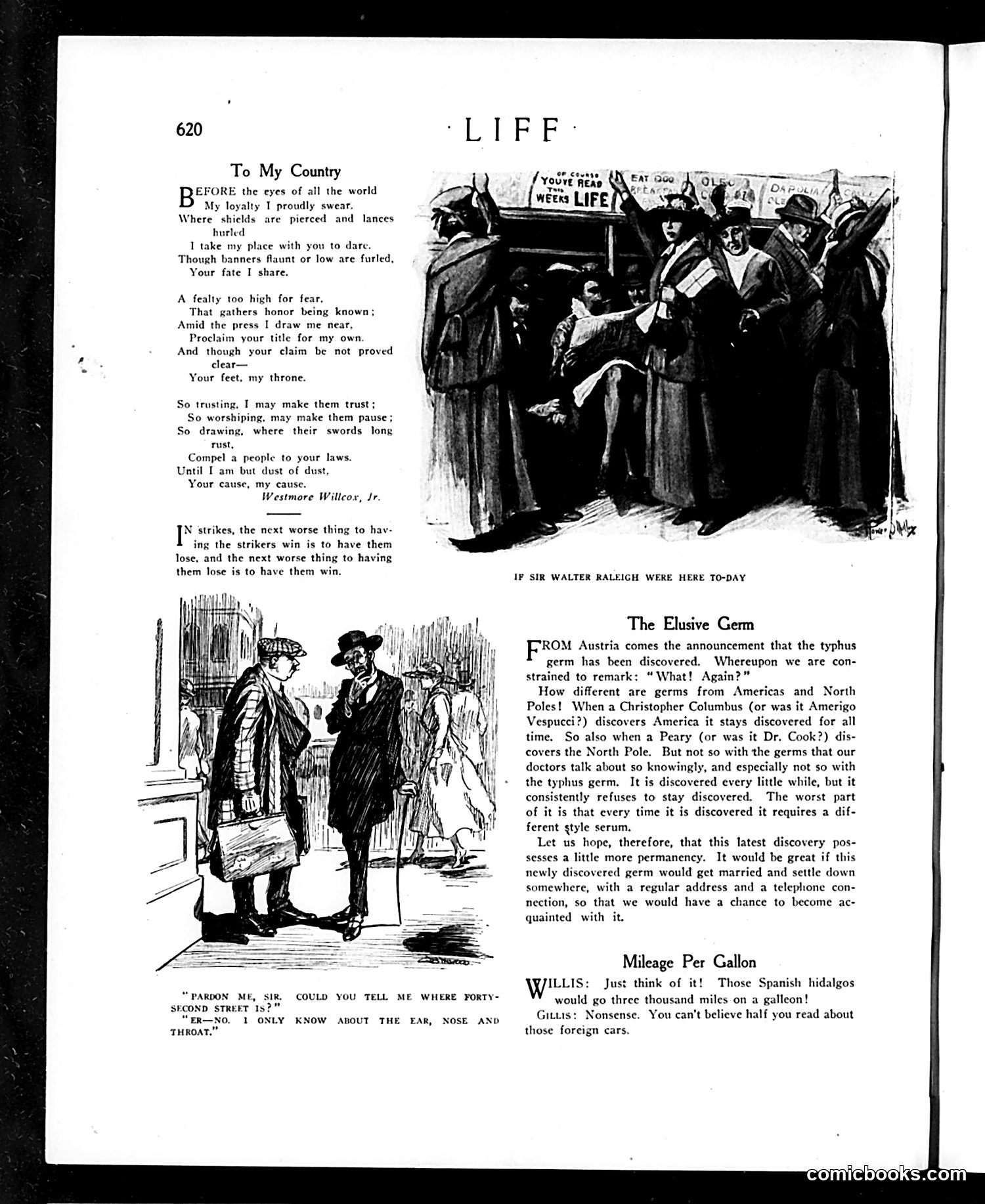
This page contains satirical commentary on several topics relevant to the WWI era: **"To My Country"** is a patriotic poem by Westmore Willcox, Jr., declaring loyalty to one's nation regardless of circumstance. **The street-direction cartoon** depicts a confused pedestrian asking directions, with the caption humorously suggesting the person only knows about ears, noses, and throats—appearing to mock those with limited knowledge or expertise. **"The Elusive Germ"** satirizes medical science's repeated "discoveries" of the typhus germ. The piece mocks doctors for repeatedly claiming to discover it while unable to keep consistent treatments, contrasting this unfavorably with permanent geographical discoveries like Columbus finding America. The satire suggests frustration with medical incompetence or overstated claims. **"Mileage Per Gallon"** is a dialogue joke: Willis mentions Spanish "hidalgos" traveling three thousand miles on a "galleon" (ships). Gillis misinterprets this as discussion of foreign automobiles, dismissing exaggerated foreign car claims as unbelievable—a play on homophone confusion and skepticism toward foreign technology claims.
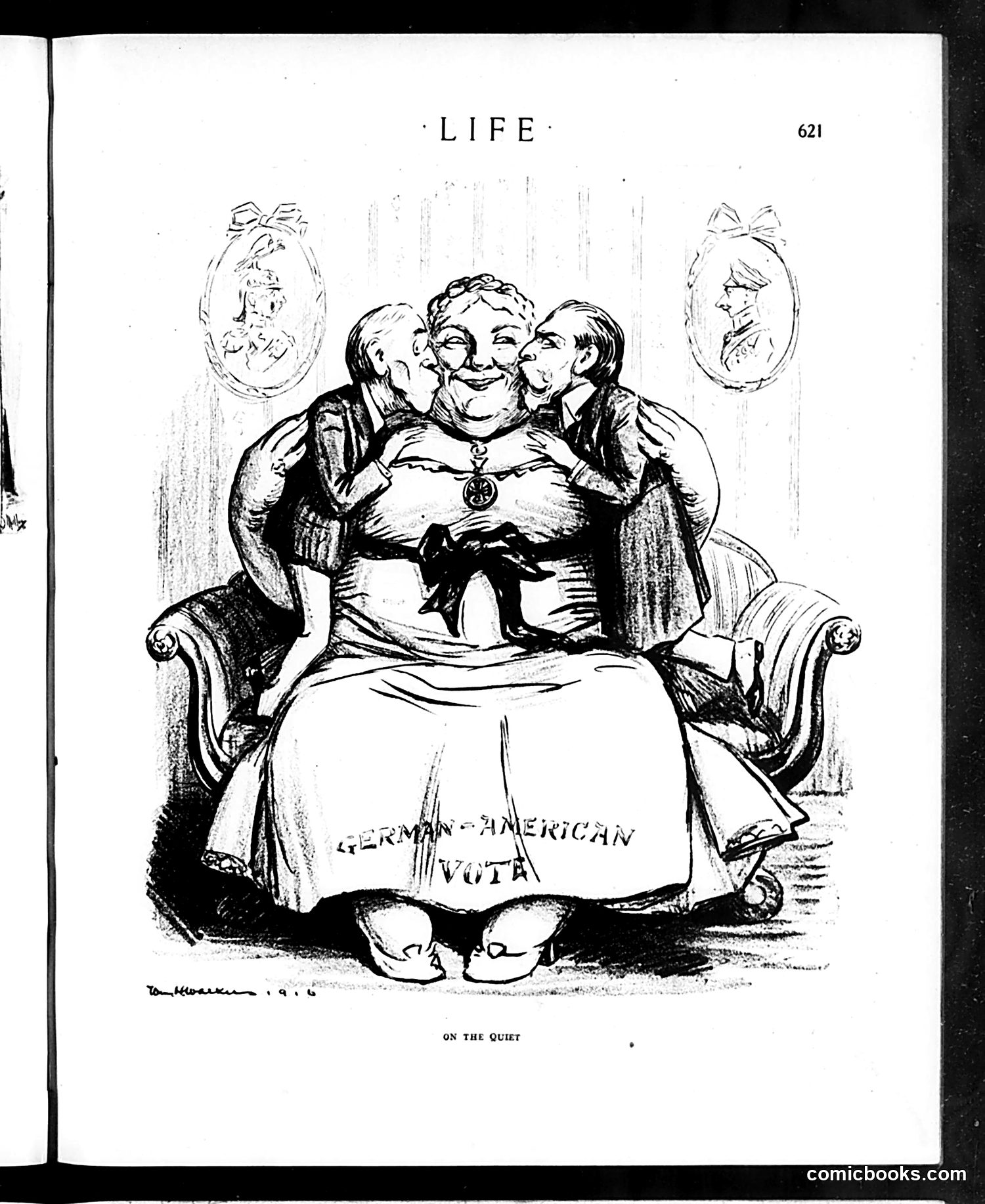
This political cartoon satirizes the "German-American Vote"—visible on the figure's lap blanket. The central portly woman represents German-American voters, being courted and kissed by two men (likely political candidates or parties competing for their support). The two portrait medallions above suggest competing interests or factions. The cartoon's title, "On the Quiet," suggests this courting happens discretely or hypocritically—candidates publicly distance themselves from certain positions while privately appealing to German-American voters. This likely references the sensitive political position of German-Americans during or around World War I, when their loyalties were questioned and both parties sought their electoral support while the U.S. had complicated relations with Germany.
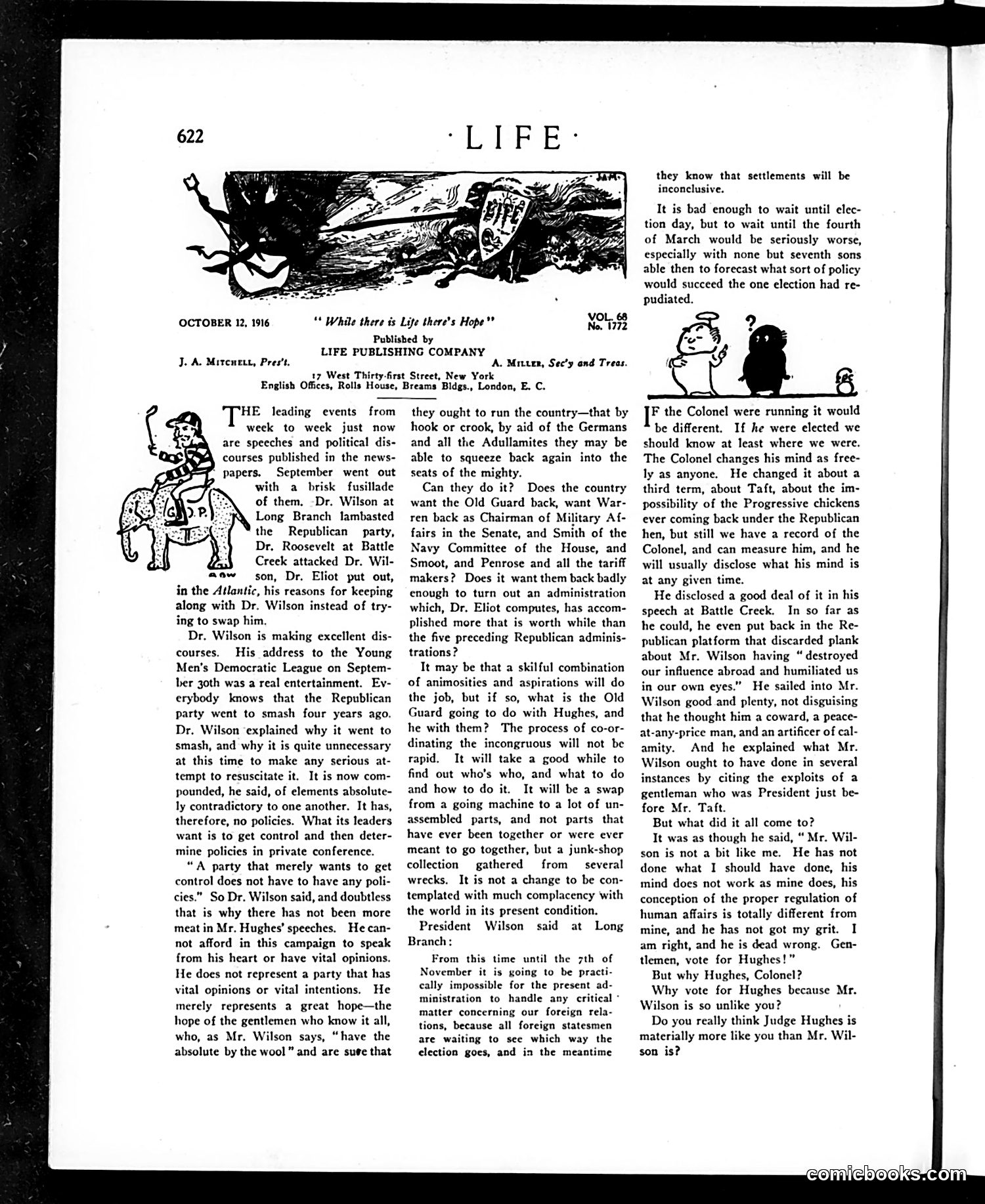
This page contains Wilson administration political commentary during the 1916 presidential election. The text attacks the Republican Party (depicted as a disorganized "junk-shop collection") and its nominee, Charles Evans Hughes, contrasting them with President Wilson's coherent leadership. The article argues Republicans represent only the desire for power without policy substance—the "Old Guard" (conservative Republican establishment figures like Penrose and Smoot) seeking to reclaim control. Hughes is portrayed as merely representing their hopes rather than having independent convictions. Wilson's position: waiting until March 1917 for a potential Republican transition would dangerously delay foreign policy decisions during WWI (implied by references to "the Germans" and foreign statesmen). The satire suggests Hughes is an empty vessel for Republican ambitions, while Wilson offers continuity and decisive leadership during an international crisis.
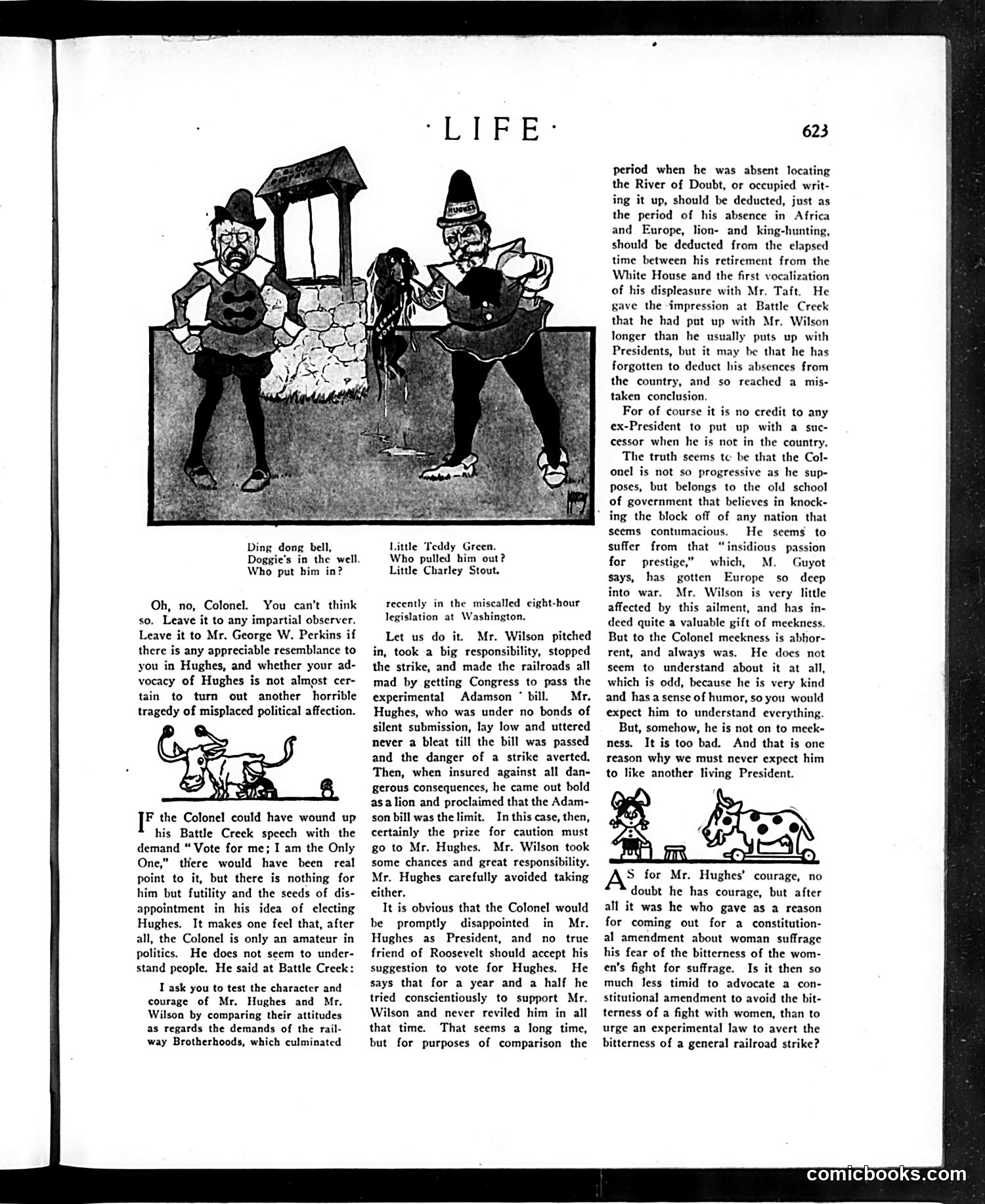
This page satirizes **Theodore Roosevelt's** (the "Colonel") endorsement of **Charles Evans Hughes** for president against the incumbent **Woodrow Wilson** in what appears to be the 1916 election. The top cartoon depicts two figures at a well, referencing the nursery rhyme "Ding Dong Bell"—a visual metaphor for Roosevelt's political maneuvering. The text criticizes Roosevelt for: 1. **Hypocrisy on labor issues**: Wilson actively resolved the railroad workers' strike through the Adamson Bill; Hughes only supported it safely *after* the danger passed. Yet Roosevelt praises Hughes's "caution." 2. **Selective memory**: The author notes Roosevelt conveniently forgets his lengthy absences (African hunts, the River of Doubt expedition) when claiming he tolerated Wilson longer than previous presidents. 3. **Temperamental unfitness**: Roosevelt belongs to an aggressive, old-school government philosophy valuing "prestige" over meekness—the very traits that dragged Europe into war. The satire suggests Roosevelt's endorsement stems from personal pique, not principle, making him an unreliable political judge.
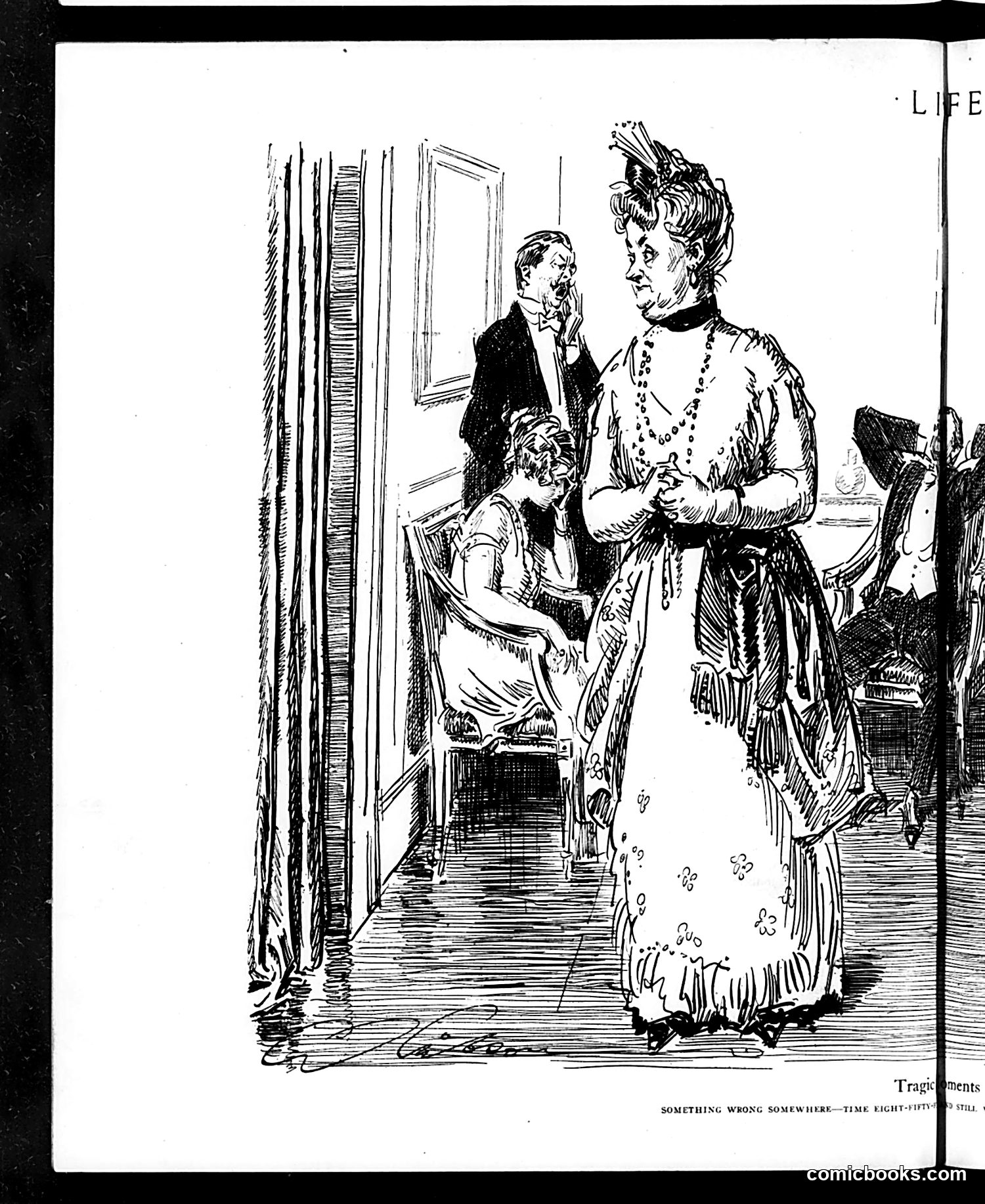
This is a satirical cartoon from *Life* magazine titled "Something Wrong Somewhere—Time Eight o'Fifty." The image shows a domestic interior scene with three figures: a woman seated, a man standing behind her, and another woman standing to the right wearing an elaborate dress with jewelry and an ornate upswept hairstyle. The caption suggests a social awkwardness or impropriety—"something wrong somewhere." The satire likely critiques either marital discord or an uncomfortable social situation involving the well-dressed woman's presence. The specific reference to "8:50" (presumably a time of evening) and the formal dress suggest this depicts a social gaffe or scandal. However, without additional context about the specific historical moment or recognizable caricatured figures, the precise target of the satire remains unclear.
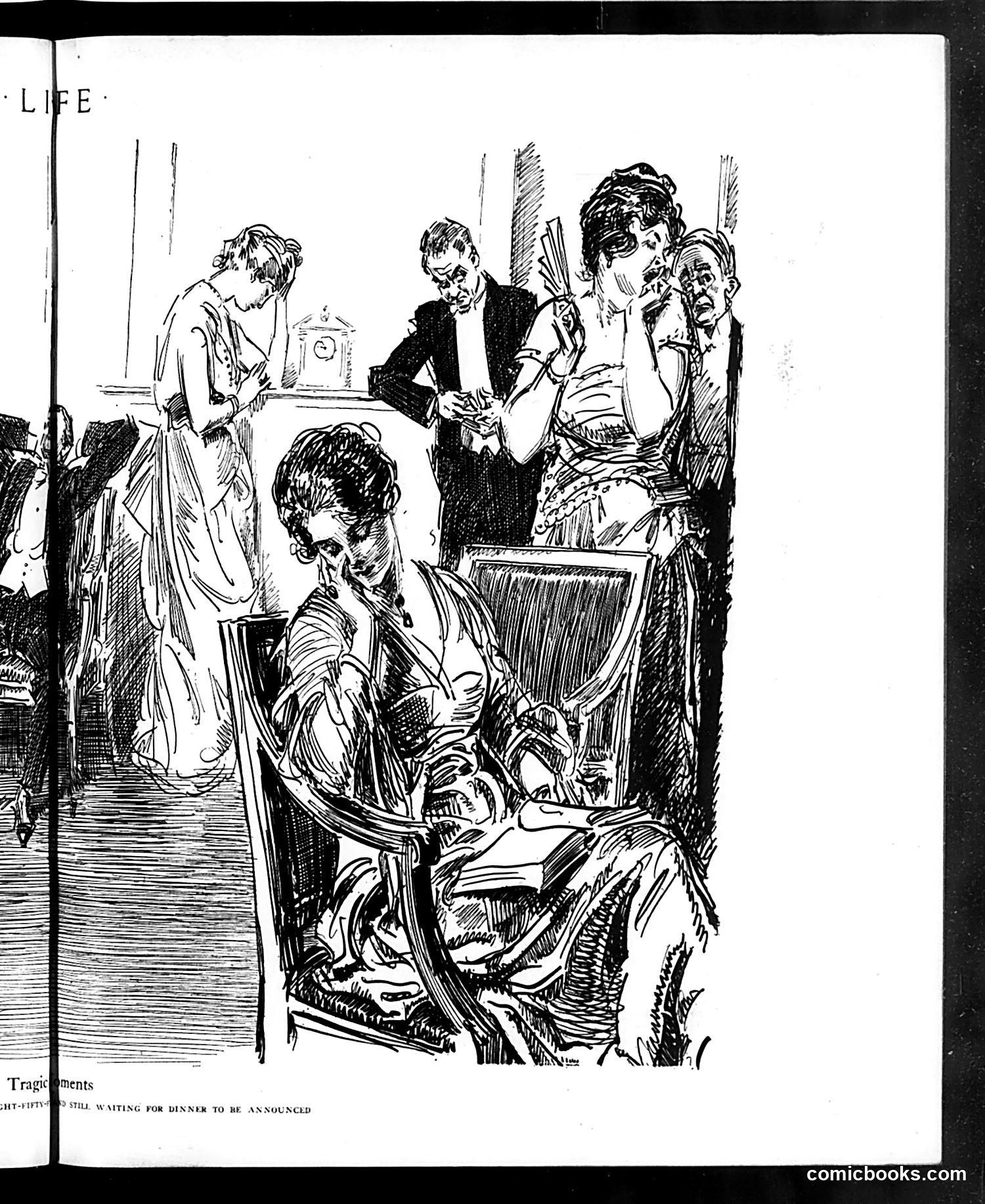
This is a sketch titled "Still Waiting for Dinner to Be Announced" from Life magazine's "Tragic Ments" section. The cartoon depicts an upper-class social gathering where well-dressed guests—men in formal attire and women in elaborate gowns—stand awkwardly in what appears to be a drawing room. The satire targets the pretension and tedium of formal dinner-party etiquette, specifically the social convention of waiting for an official announcement before dining. The guests' postures and expressions suggest mounting impatience and discomfort with this ritualistic delay. The joke satirizes how rigid social conventions create uncomfortable, artificial situations among the wealthy classes, making a simple meal unnecessarily complicated through excessive formality.
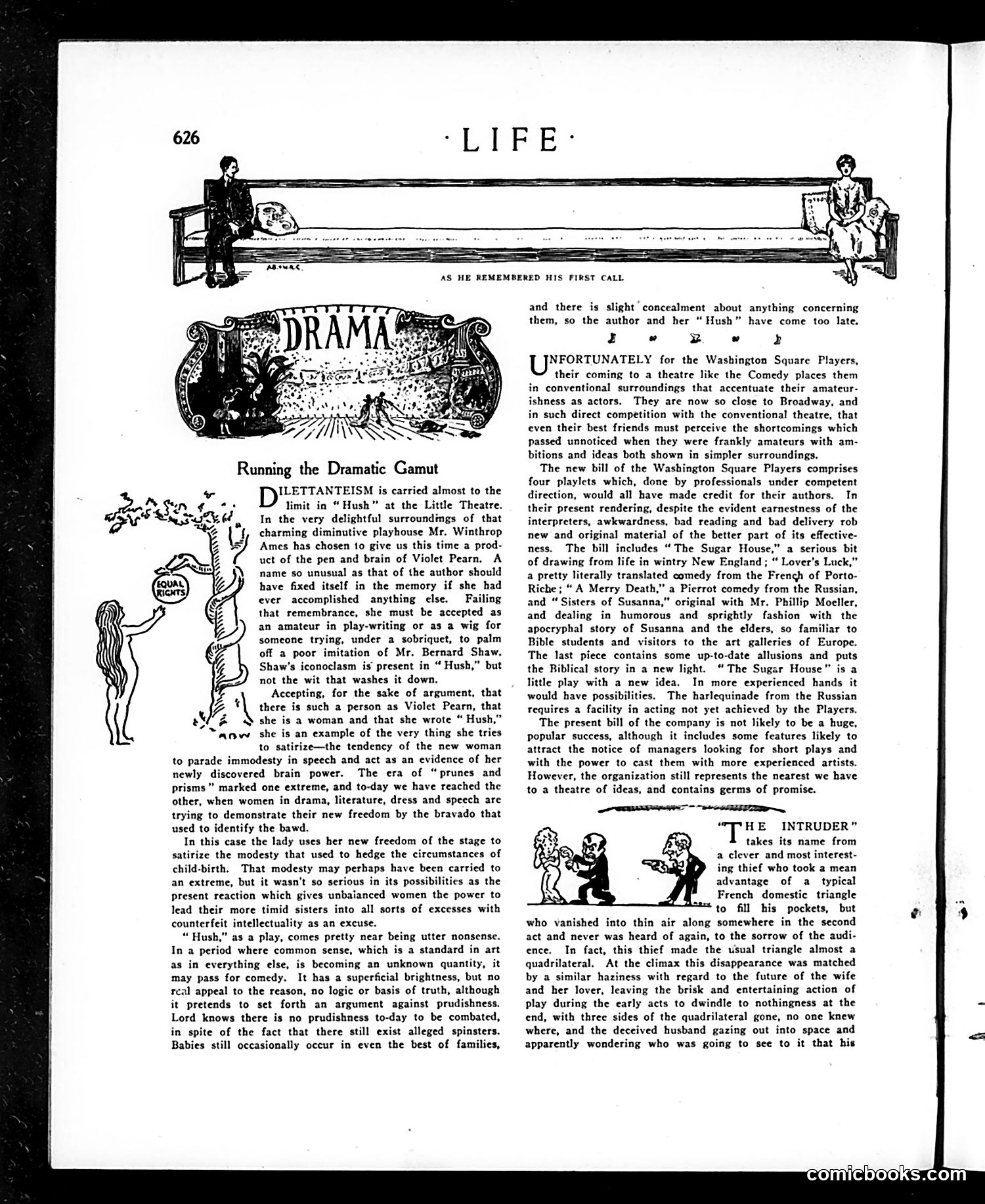
This page contains two separate theater reviews from Life magazine's drama section. **"Hush" at the Little Theatre:** The critic reviews a play by Violet Pearn, produced by Winthrop Ames. The satire targets the play itself and its author. The reviewer argues that "Hush" attempts to mock prudishness but fails because modern society has already abandoned modesty—particularly regarding childbirth. The critic suggests Pearn exemplifies the very thing she satirizes: the "new woman" using shocking speech and behavior as evidence of intellectual liberation. The review is scathing, calling the play "utter nonsense" lacking logic or real appeal, dismissing it as superficially clever but fundamentally empty. **Washington Square Players:** This review is more sympathetic but critical. The Players, now performing in a conventional Broadway-adjacent venue, appear amateurish compared to professional competition. Their earnestness cannot overcome awkward acting and poor delivery, undermining otherwise original material in their four-play bill.
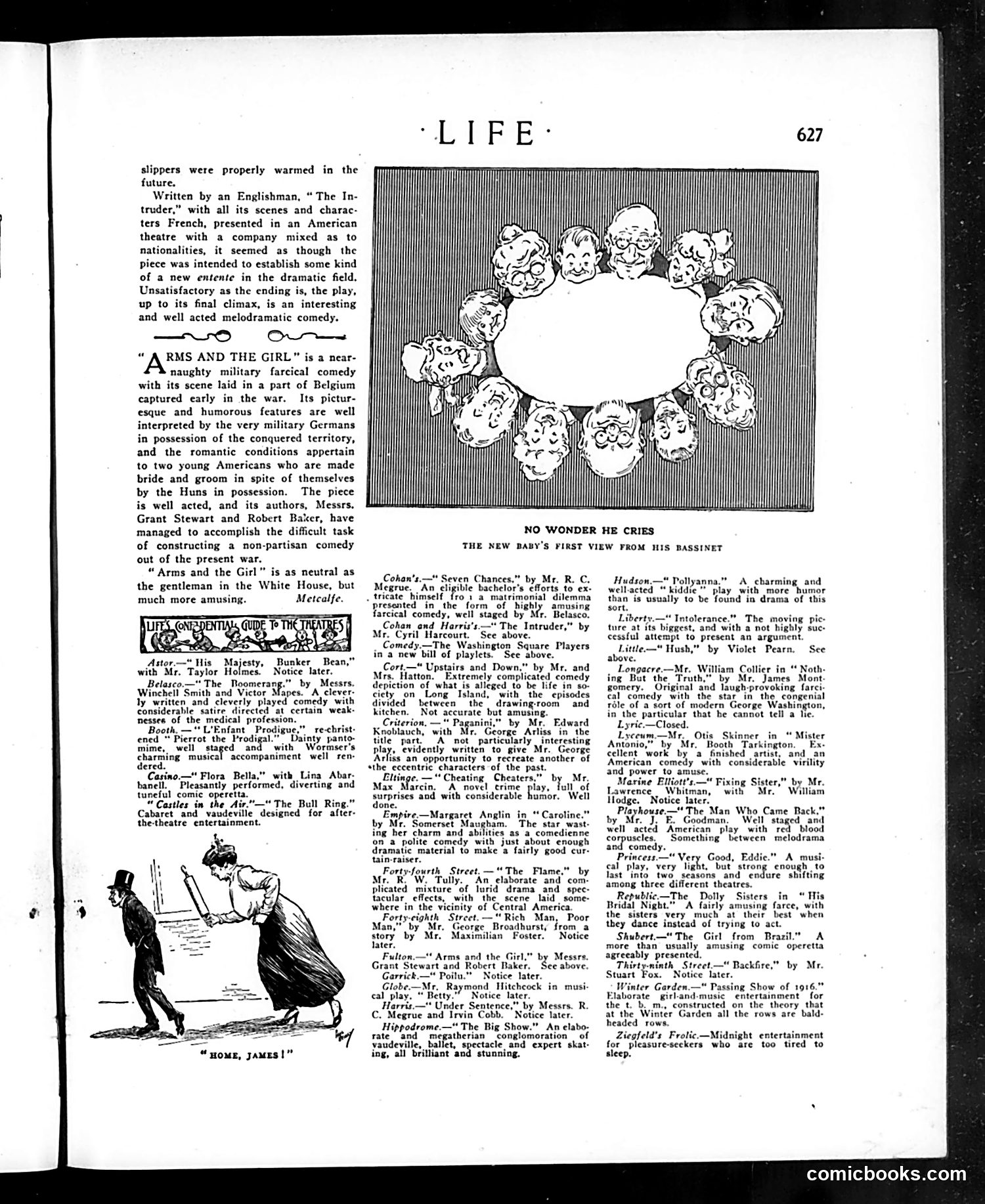
This page from *Life* magazine contains theater reviews and a satirical cartoon titled "No Wonder He Cries: The New Baby's First View from His Bassinet." The cartoon depicts an infant's perspective looking out at a circle of adult faces peering down into a crib—the adults appear grotesque and exaggerated from the baby's ground-level viewpoint. The joke satirizes how newborns must perceive the well-meaning adults cooing at them: their distorted, looming faces seem monstrous rather than endearing. This plays on the common experience of relatives and visitors gathering to admire a newborn while making exaggerated facial expressions. The accompanying text consists entirely of theater reviews describing various Broadway productions of the era (circa 1915), including "*Arms and the Girl*" (a WWI-themed military farce) and other comedies and dramatic pieces. The reviews use period theatrical terminology and discuss plot, staging, and performances. The cartoon's humor relies on the contrast between sentimentality (how adults think babies experience their attention) and reality (how genuinely unsettling those same faces appear from below).
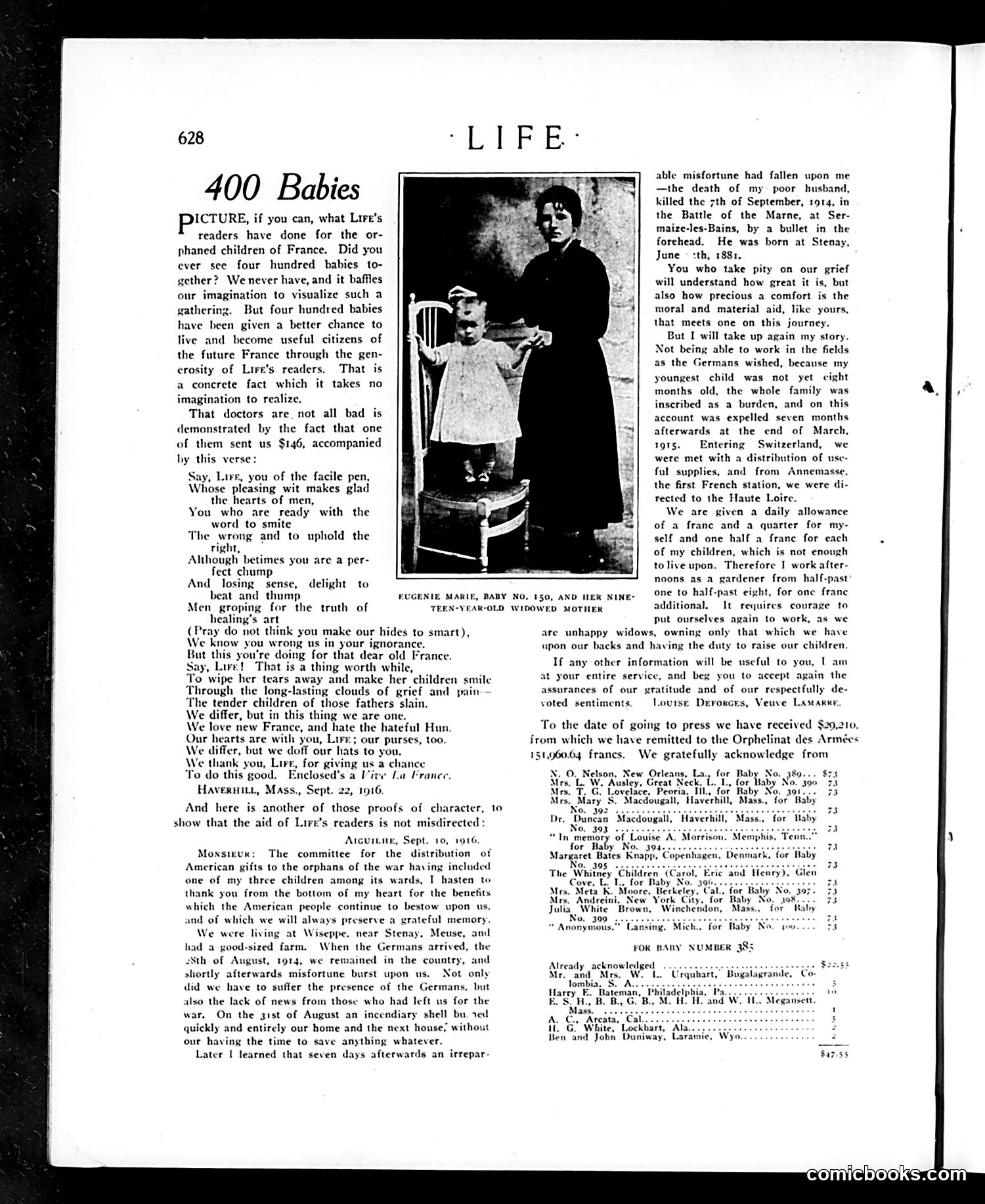
This page documents Life magazine's fundraising campaign for French war orphans during World War I. The main text celebrates readers' generosity in supporting 400 orphaned children, presenting two testimonial letters from French widows whose husbands died in combat (one at the Battle of the Marne in 1914). The accompanying photograph shows "Eugenie Marie, Baby No. 150, and Her Nineteen-Year-Old Widowed Mother"—a visual embodiment of the campaign's focus. The verse from a physician-donor praises Life for using "wit" to support France against "the hateful Hun" (Germans), framing the magazine's satirical mission as morally purposeful. The letters detail hardship: lost homes to German bombardment, forced expulsion, subsistence allowances insufficient for survival, mothers working as gardeners. This was Life's concrete evidence that American charitable giving directly addressed genuine wartime suffering among French civilians and children.
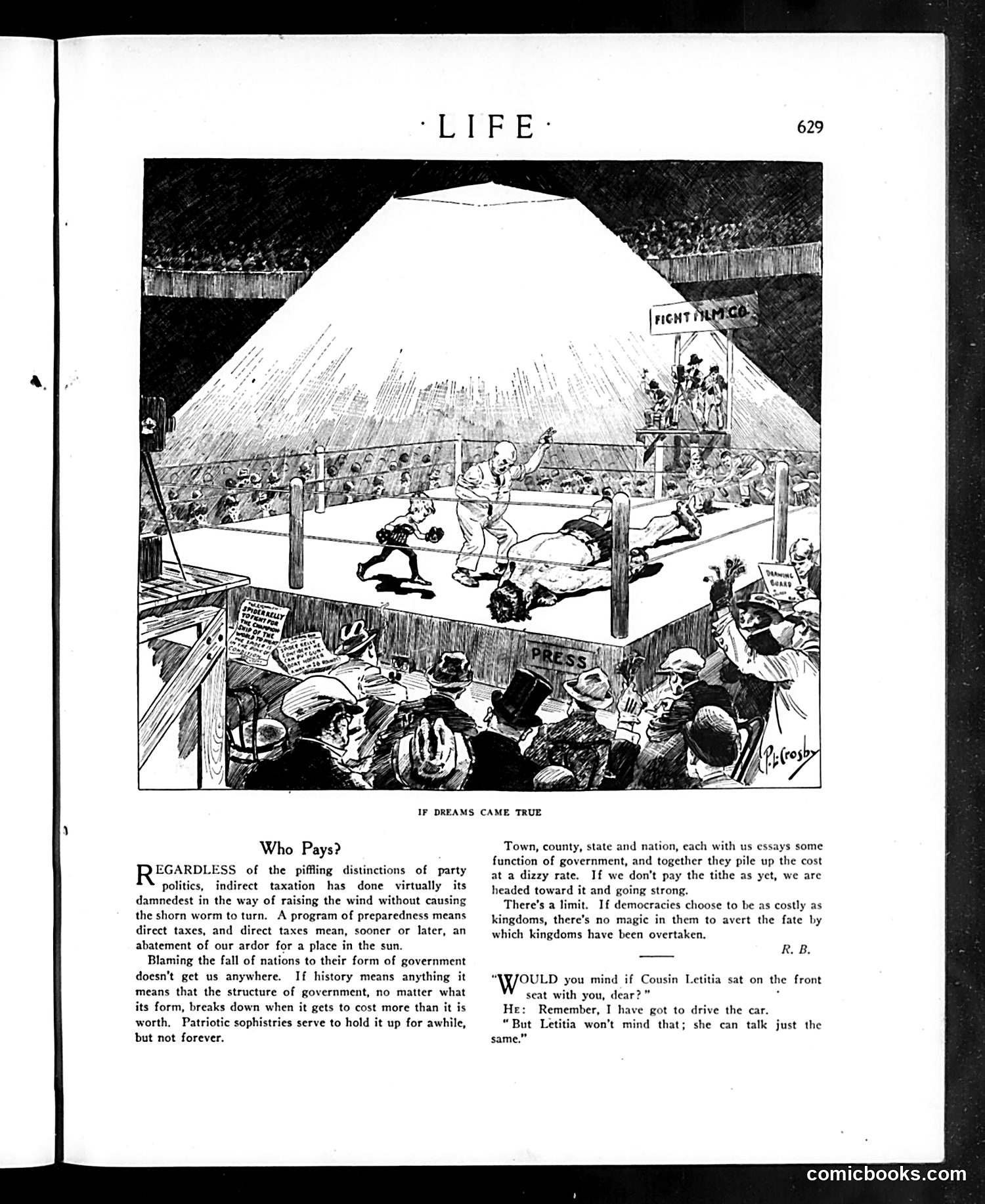
The main illustration depicts a circus scene—a boxing match under a spotlight—satirizing American government spending. The cartoon critiques how multiple layers of taxation (town, county, state, federal) accumulate without public complaint, like spectators passively watching a performance. The accompanying essay argues that governments collapse when costs exceed their worth, regardless of whether they're democracies or monarchies. The author warns that America's expanding tax burden for "preparedness" (likely military spending) will eventually provoke resistance, just as history shows kingdoms have fallen under similar fiscal strain. The small dialogue joke at bottom is unrelated—a domestic humor piece about a woman who talks incessantly. The satire's point: American citizens tolerate escalating government costs as entertainment tolerates spectators, but this cannot continue indefinitely. Taxation, not governmental *form*, determines a state's survival.
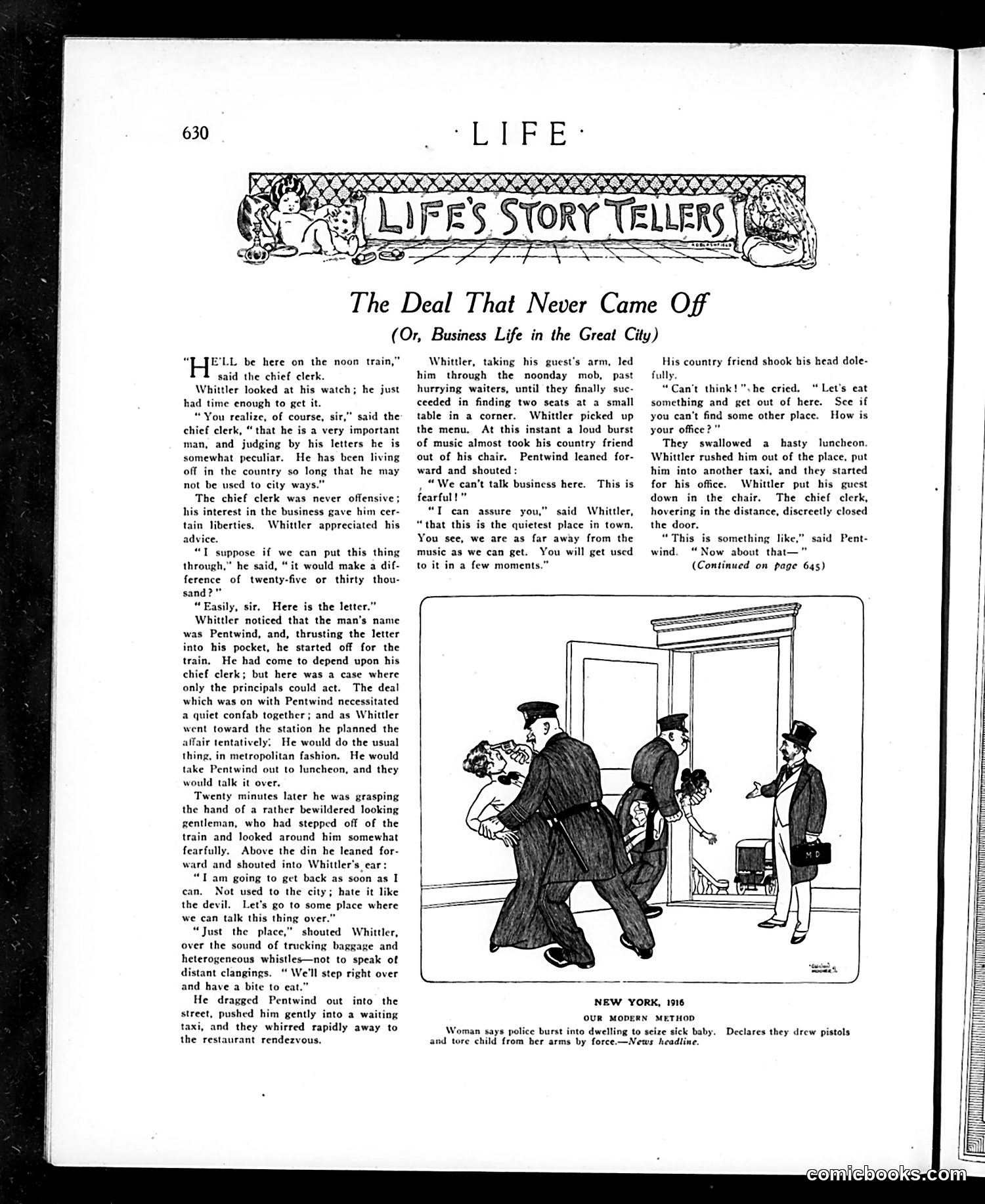
This story satirizes the chaos of conducting business in New York City circa 1916. Whittler, a metropolitan businessman, attempts to negotiate an important $25,000-30,000 deal with Pentwind, a country gentleman visiting the city. The satire hinges on the contrast between urban and rural sensibilities. Pentwind, unaccustomed to city life, finds the supposedly "quiet" restaurant impossibly loud and chaotic—full of music, noise, and commotion—making serious conversation impossible. Only when they retreat to Whittler's office can Pentwind finally conduct business. The joke exposes how "metropolitan fashion" (taking clients to fancy restaurants for business discussions) is actually impractical and counterproductive in the loud, bustling reality of modern city life. The caption cartoon below depicts police forcibly separating a woman from her child, exemplifying another aspect of harsh "modern methods" in the city. The story mocks both urban pretense and the city's inhospitable conditions.
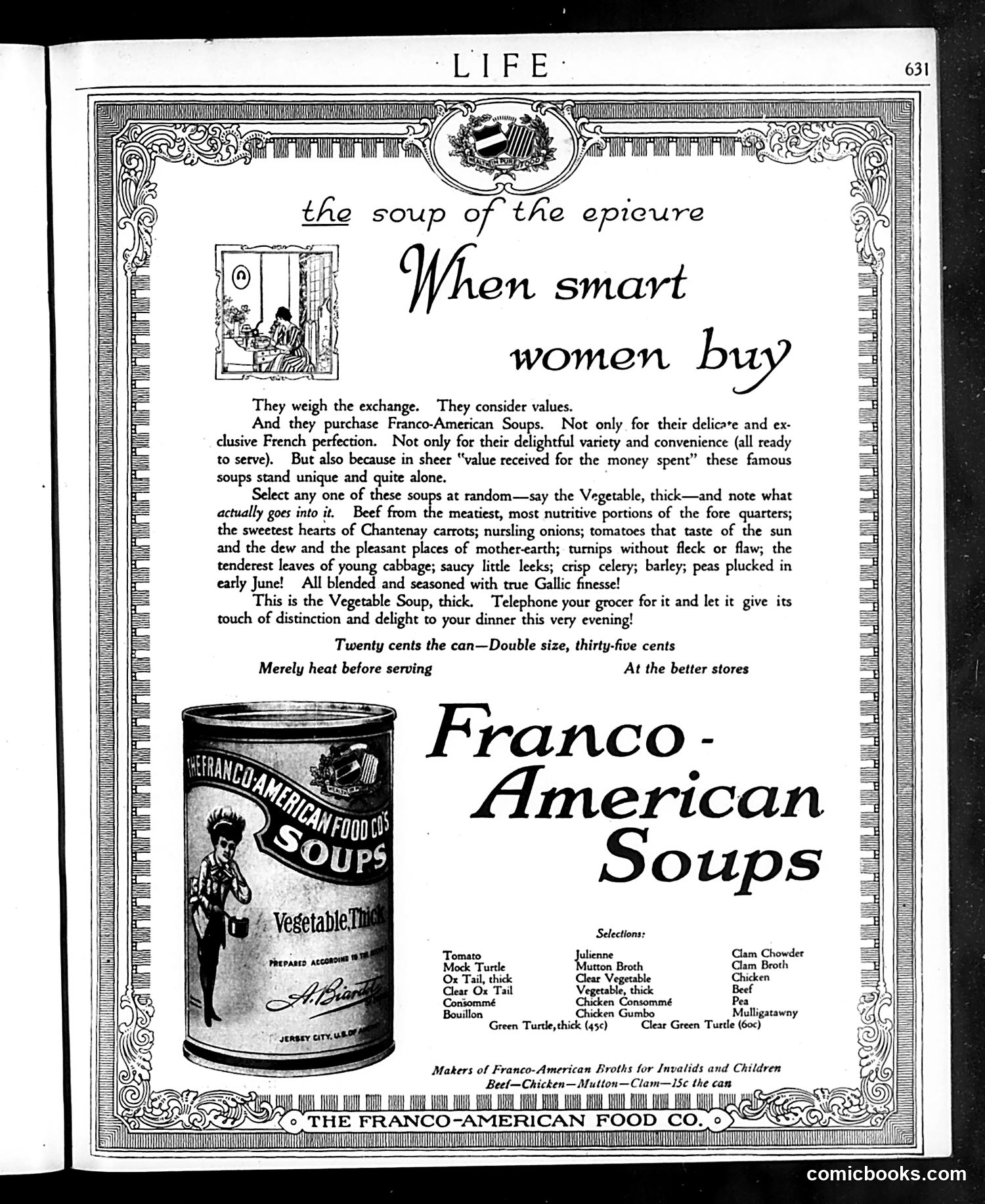
This is a **full-page advertisement**, not political satire. It promotes Franco-American brand canned soups to early 20th-century women consumers. The ad appeals to "smart women" by emphasizing **value and quality ingredients**—naming specific vegetables like Chantenay carrots and claiming "true Gallic finesse," positioning the product as refined and economical. The text contrasts with modern advertising by heavily detailing ingredient sourcing, suggesting consumers of that era valued transparency about food content (likely due to contemporary food-safety concerns following muckraking journalism about the meat industry). The small illustration shows a woman serving soup, reinforcing the domestic sphere. At 20 cents per can (35 cents for double size), the soup targets middle-class housewives seeking convenience—"all ready to serve"—without sacrificing perceived quality or elegance. The ad reflects period attitudes about feminine purchasing power and home economics.
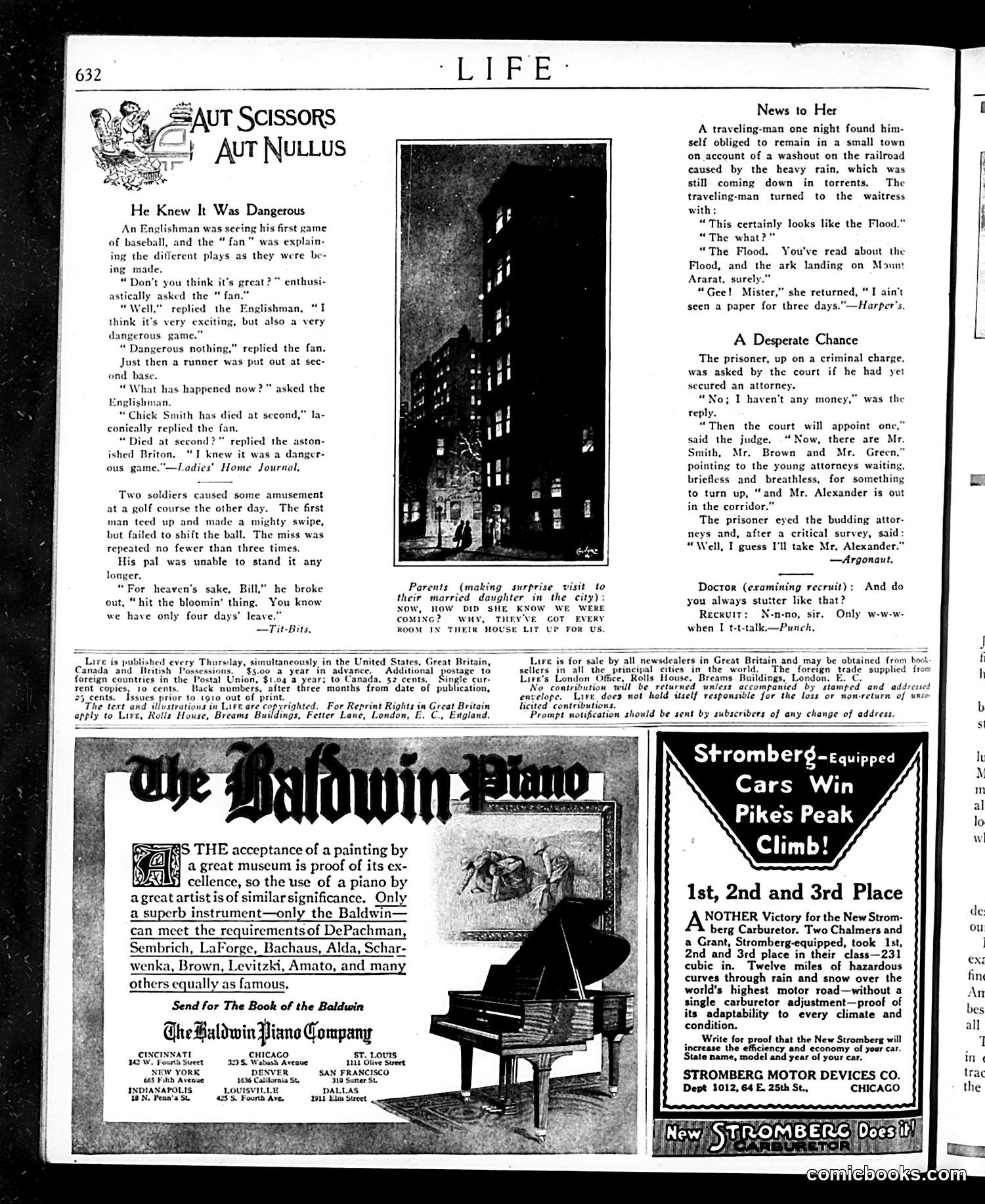
This page contains several brief comic anecdotes typical of Life's satirical humor: **"He Knew It Was Dangerous"** mocks a British visitor's misunderstanding of baseball terminology. When told a runner "died at second" (was out), the Englishman takes it literally, concluding baseball is genuinely lethal. The joke plays on the cultural divide between American slang and British formality. **"A Desperate Chance"** satirizes the legal system's appointment of inexperienced attorneys. A poor defendant, given choice between three desperate young lawyers, selects one "out in the corridor"—implying even an absent lawyer seems preferable to the waiting options. It critiques how poverty affects legal representation. **Other brief jokes** include soldiers on limited leave and a recruit's stammer. The page also contains advertisements for Baldwin pianos and Stromberg automobiles, typical of 1920s Life magazine content. The humor relies on wordplay, cultural misunderstanding, and social commentary on class and institutional failure—characteristic of period satirical journalism.
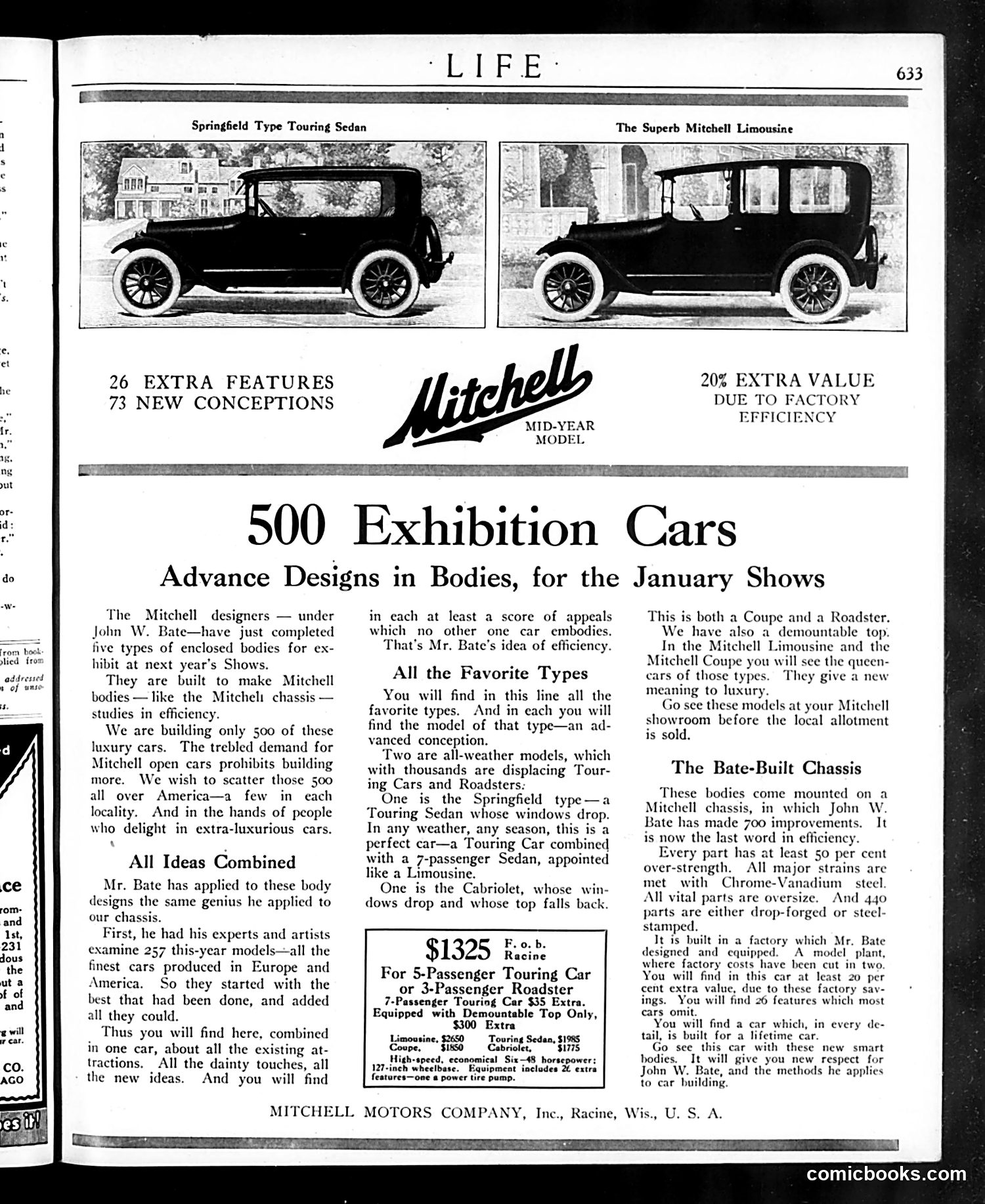
This is **not a cartoon or satire**—it's a straightforward automobile advertisement from Life magazine's advertising section. The page promotes Mitchell Motors' "mid-year model" cars, featuring five new enclosed body designs by engineer John W. Bate. The ad emphasizes efficiency and luxury, claiming Bate studied 257 existing car models worldwide before designing these vehicles. Key selling points include: - Limited production (500 cars total) - 26 extra features and 73 design innovations - Various body styles (Touring Sedan, Limousine, Cabriolet, Coupe) - A chassis with "700 improvements" and chrome-vanadium steel construction - Prices ranging from $1,325 to $2,680 The rhetoric reflects 1920s automotive marketing: emphasis on efficiency, strength, luxury, and American manufacturing superiority. Two car silhouettes at the top show the Springfield Touring Sedan and Superb Mitchell Limousine models. This represents early automotive industry competition before market consolidation.
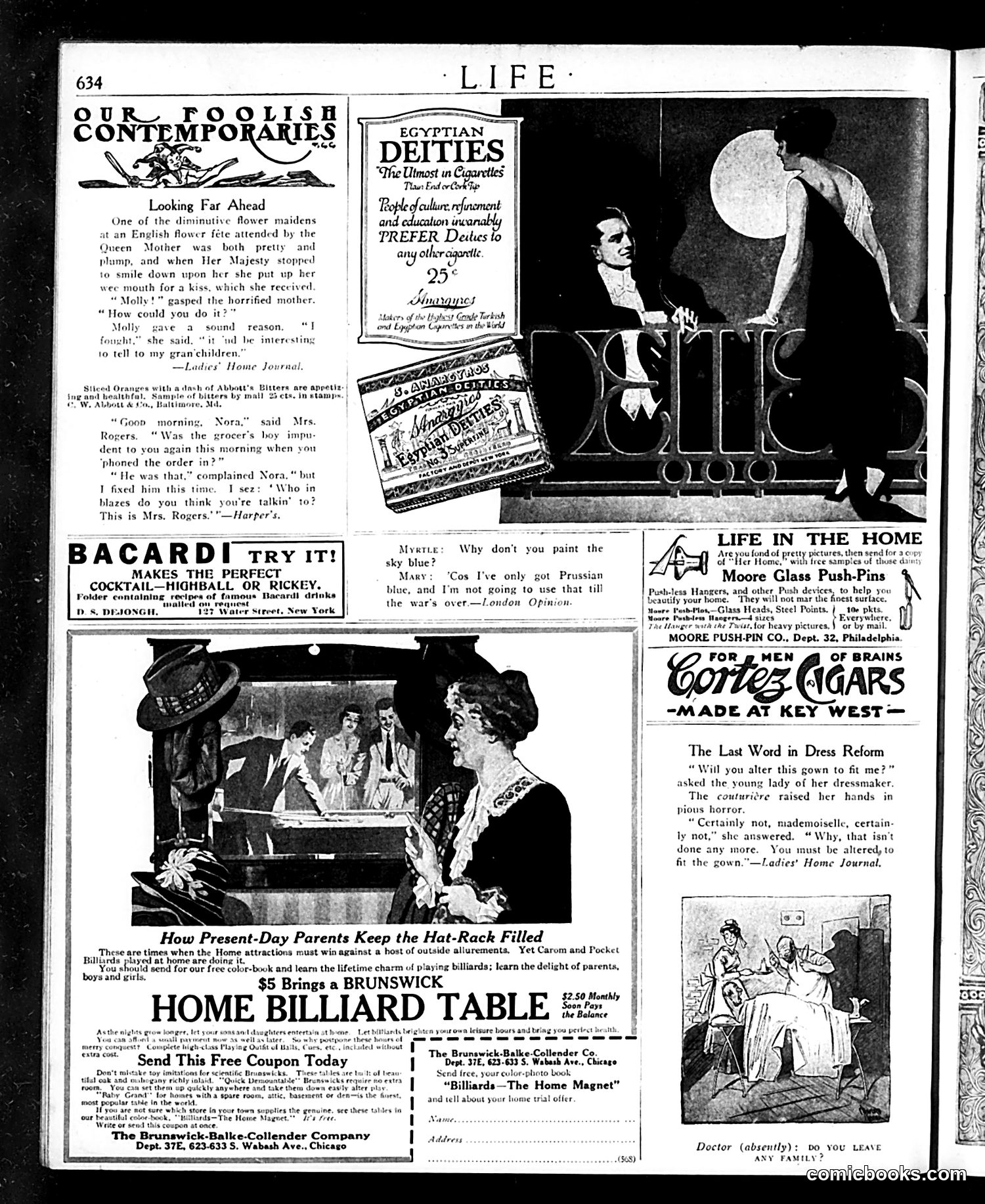
This is primarily an **advertising and humor page** from Life magazine, circa early 1900s. The content consists mostly of commercial advertisements interspersed with brief satirical jokes and observations. The main cartoon depicts **"How Present-Day Parents Keep the Hat-Rack Filled,"** illustrating a social concern: parents struggle to keep children entertained at home against competing outside attractions. The solution advertised is a Brunswick billiard table, positioned as a "home magnet" to retain family interest. The scattered jokes mock contemporary social conventions: a child's boldness in kissing royalty, a servant girl's sass toward a grocer's boy, an artist's complaint about paint supplies, and a dressmaker's dismissal of dress reform—insisting the wearer must alter herself to fit the garment, not vice versa. The "Egyptian Deities" cigarette ad and other product placements reflect period marketing. The page reflects early-20th-century anxieties about **leisure, parental authority, and social hierarchy**, though presented through light humor rather than serious satire.
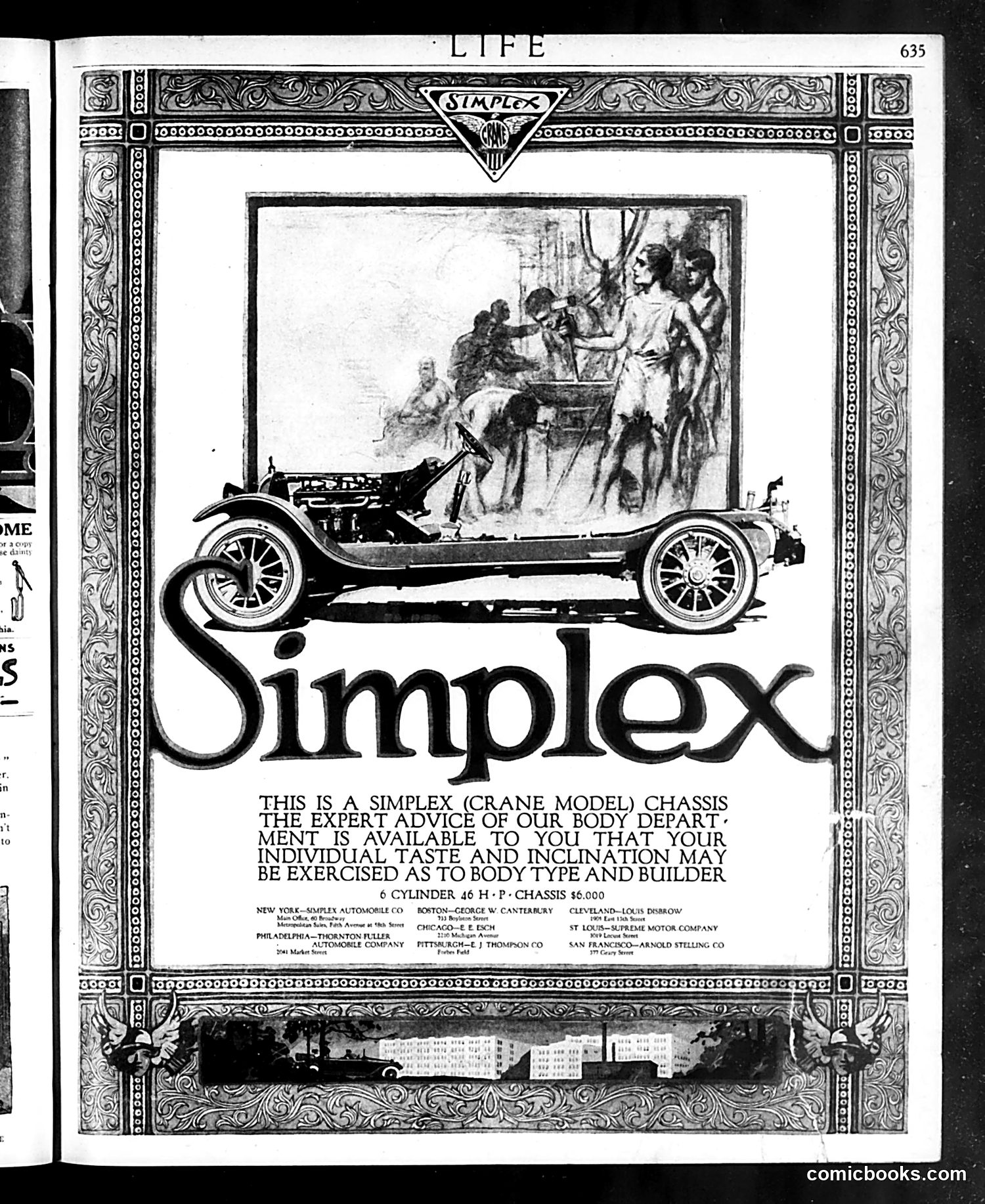
This is primarily a **car advertisement**, not political satire. It promotes the Simplex automobile (Crane Model), a luxury chassis priced at $6,000—a substantial sum in the early 1900s. The decorative illustration above the car depicts classical or mythological figures, likely suggesting elegance and sophistication to appeal to wealthy buyers. The ad emphasizes that purchasers can customize their vehicle's body type through the manufacturer's body department, positioning this as a premium feature for discerning customers with individual taste. The ornate decorative border reinforces the luxury market positioning. This appears in *Life* magazine, which during this era mixed satirical content with upscale advertising targeting educated, affluent readers—the demographic most likely to afford a $6,000 automobile.
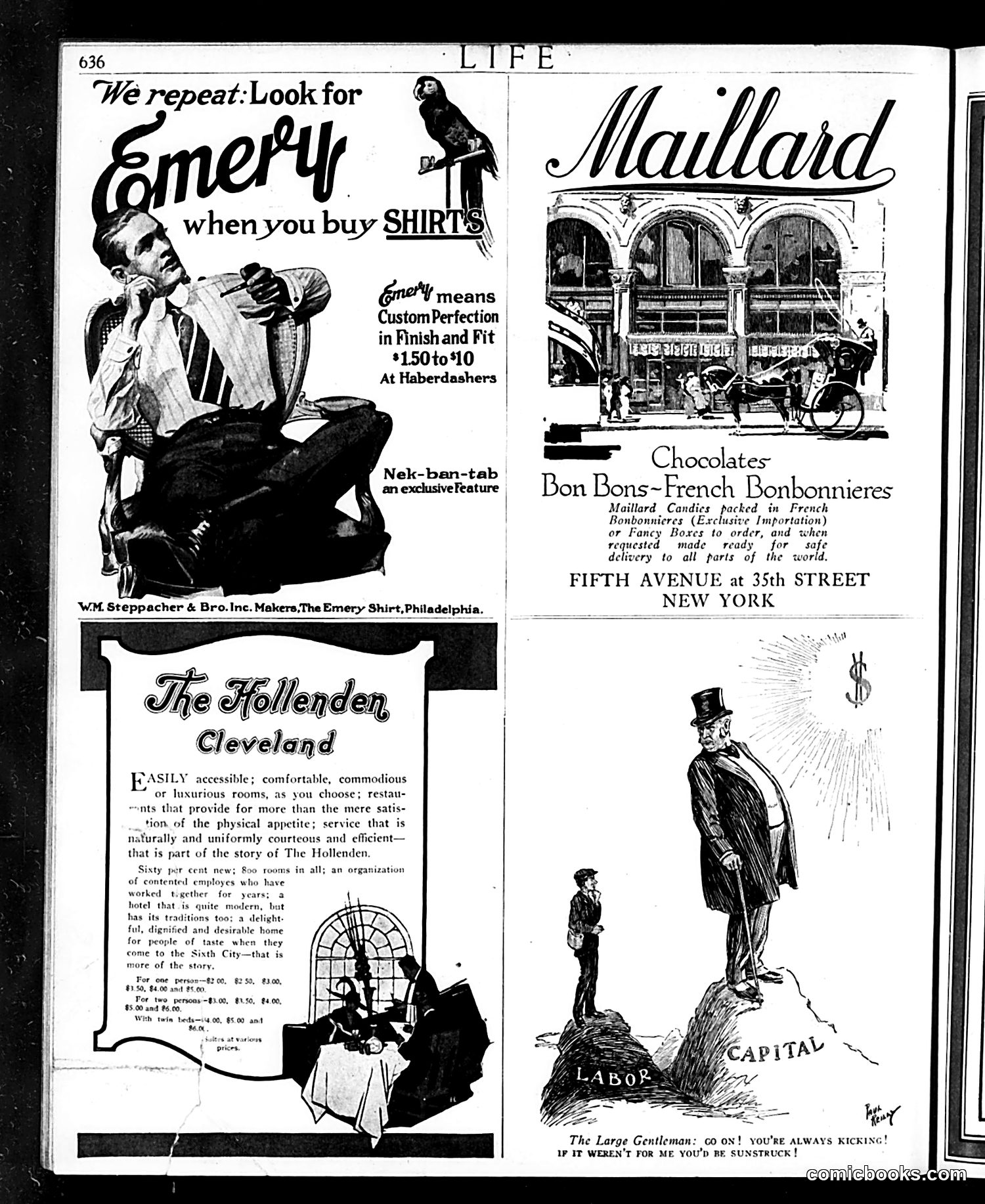
This page is primarily **advertising**, with one political cartoon at bottom right. **The Cartoon**: Titled "Labor" and "Capital," it depicts a large gentleman in a top hat standing atop a mountain labeled "Capital," speaking down to a smaller laborer below on "Labor." The caption reads: "Go on! You're always kicking! If it weren't for me you'd be sunstruck!" **The Satire**: This is social commentary on class relations and labor disputes. Capital personifies itself as the benevolent protector of Labor, dismissing workers' complaints ("kicking") as ingratitude. The joke—from Capital's perspective—is that workers should be grateful for employment rather than demanding better conditions. The cartoon likely reflects early 20th-century labor tensions: strikes, unionization efforts, and capitalist arguments that workers benefited from their employers' existence. **Modern Context**: Modern readers should recognize this as representing the exploitative logic workers rejected: the notion that mere employment constituted adequate compensation for grievances about wages, hours, or safety. The remaining page consists of advertisements for shirts, a Cleveland hotel, and French chocolates.
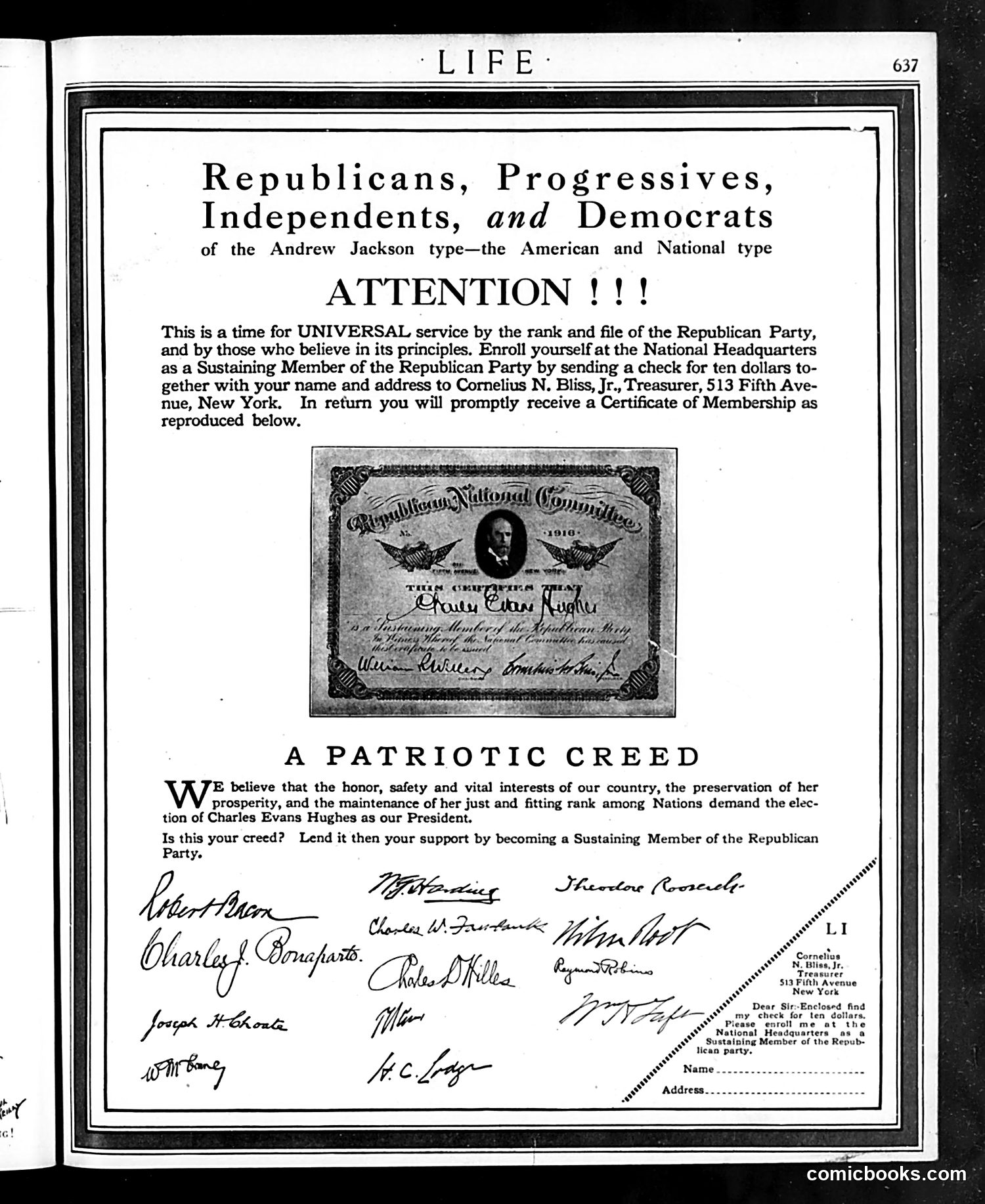
This is a **Republican Party fundraising appeal**, not a cartoon. It's a 1916 campaign solicitation for Charles Evans Hughes's presidential run against incumbent Woodrow Wilson. The page features: - A call to enroll as a "Sustaining Member" by sending $10 to party treasurer Cornelius N. Bliss Jr. - A membership certificate specimen with Hughes's portrait - A "Patriotic Creed" asserting that Hughes's election is necessary for national honor and safety - Signatures from prominent Republicans endorsing the appeal The satire (if Life intended any) lies in the earnest, grandiose framing of partisan politics as patriotic duty—essentially asking readers to pay for their own political conviction. The broad appeal to "Republicans, Progressives, Independents, and Democrats of the Andrew Jackson type" suggests desperation to unite a fractured right-leaning coalition against Wilson's Democrats.
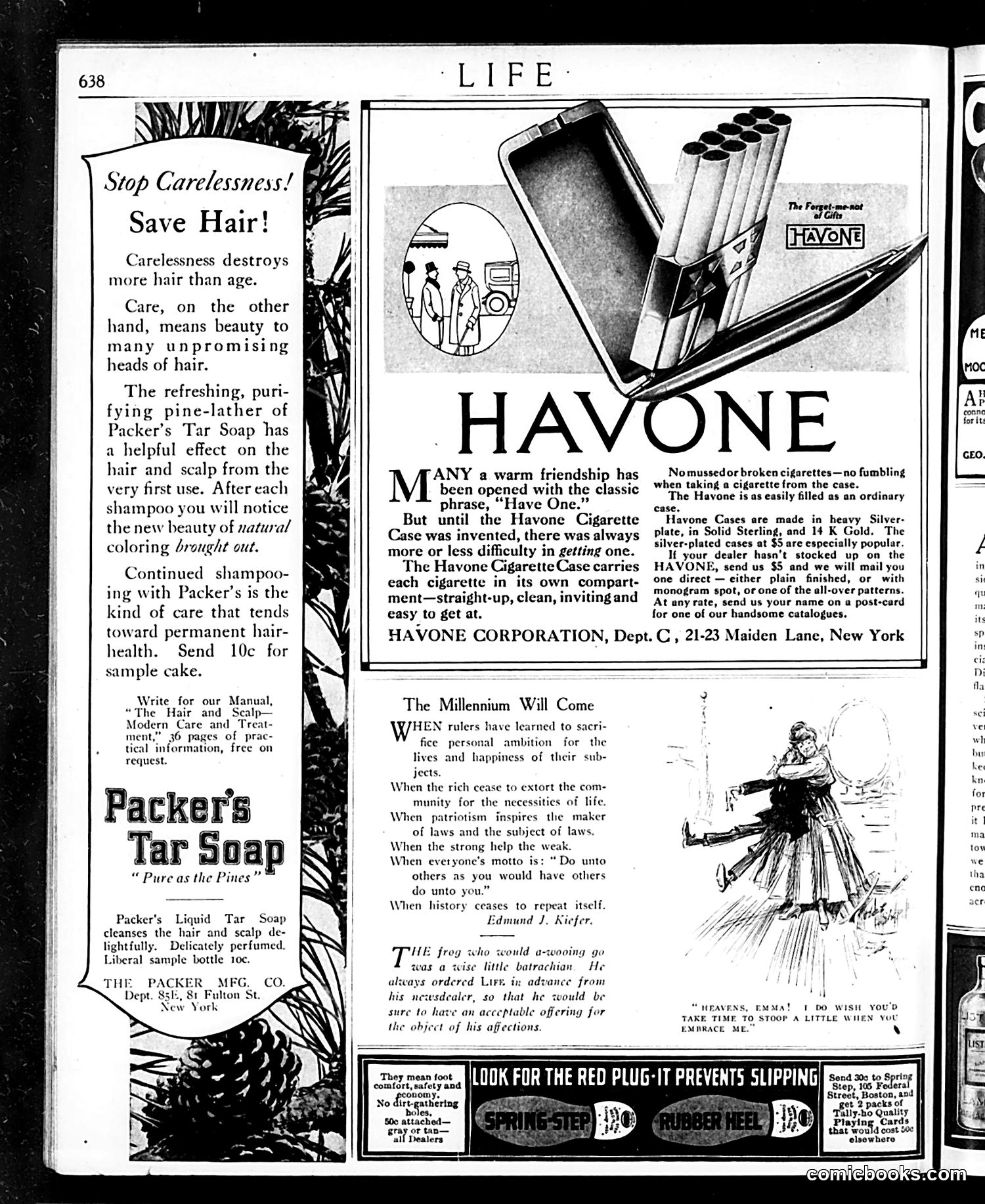
This page is primarily **advertising** with minimal editorial content. The main advertisements are: 1. **Packer's Tar Soap**: A hair care product claiming to prevent hair loss through proper shampooing. The pitch targets vanity—"carelessness destroys more hair than age," but proper care brings out "natural coloring." 2. **Havone Cigarette Case**: A luxury silver or gold case designed to present cigarettes elegantly. The copy plays on social etiquette—the phrase "Have one?" was a common friendly gesture, but previously awkward to execute neatly. This product solves that problem. 3. **Philosophical poem** by Edmund J. Kiefer titled "The Millennium Will Come": Idealistic verse about when rulers serve subjects, the rich stop exploiting society, and the golden rule prevails—satirizing the gap between Christian ideals and actual human behavior. 4. **Small cartoon**: A frog courting a female frog, having subscribed to *Life* magazine in advance as a courtship gift—a whimsical endorsement of the magazine itself. The page reflects early 20th-century consumer culture and genteel social conventions.
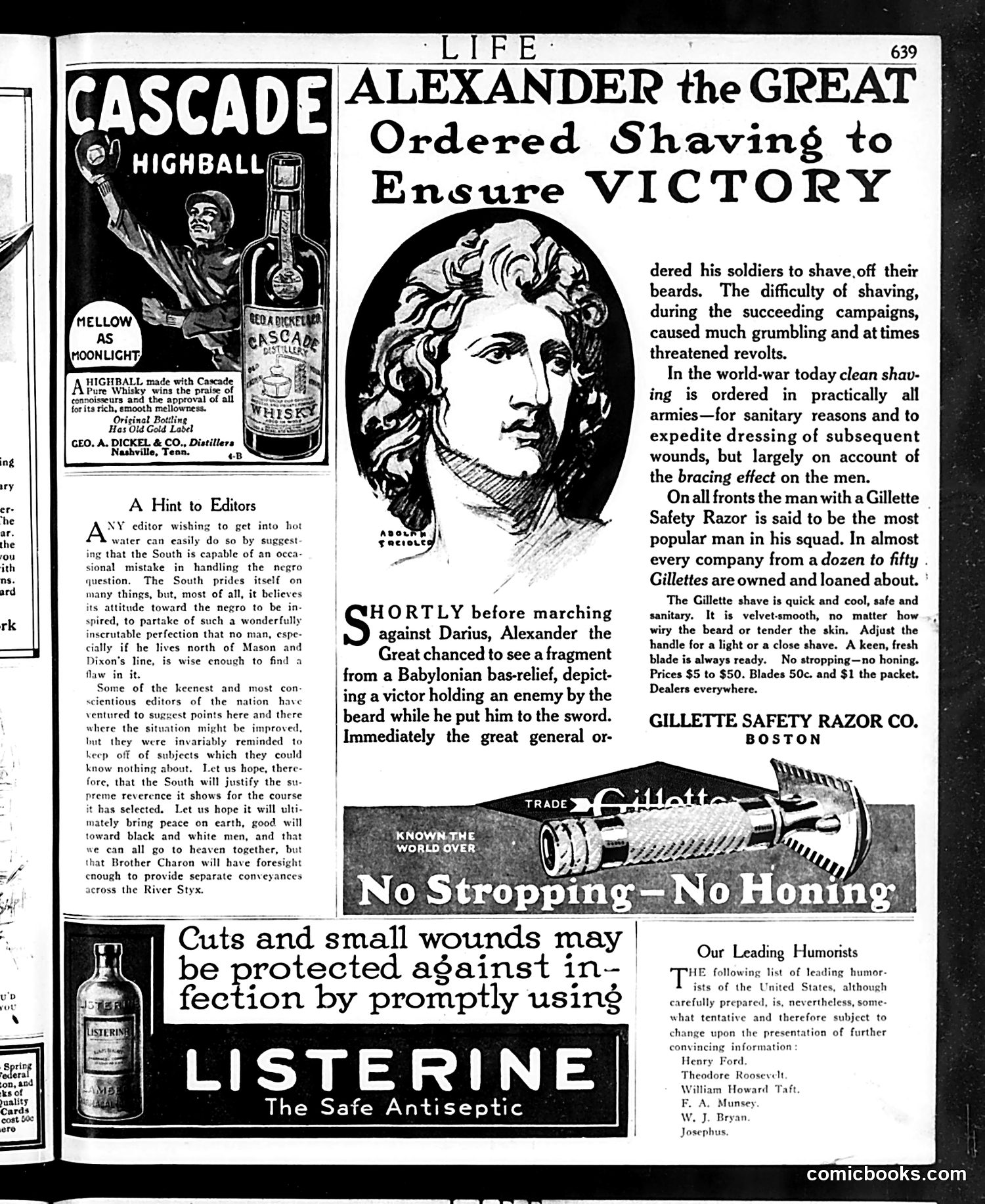
This page contains satirical commentary alongside period advertisements, typical of Life's format. **"A Hint to Editors"** (left column) is the main satire—a biting critique of Southern defensiveness about racial issues. The author sarcastically suggests that Northern editors who question the South's "handling of the negro question" face fierce backlash. The sarcasm builds to absurdity: hoping Southern racial policies will "ultimately bring peace" and that segregation will persist even in the afterlife ("separate conveyances across the River Styx"). This mocks Southern claims of infallible racial wisdom. **The Alexander the Great advertisement** (right) uses historical anecdote to sell Gillette razors, claiming clean-shaven soldiers fight better—a WWI-era marketing angle. **"Our Leading Humorists"** lists public figures (Theodore Roosevelt, William Howard Taft, Josephus) as humorists, likely ironic given their serious political roles. The page reflects Life's satirical stance against Southern racial attitudes during the Progressive Era.
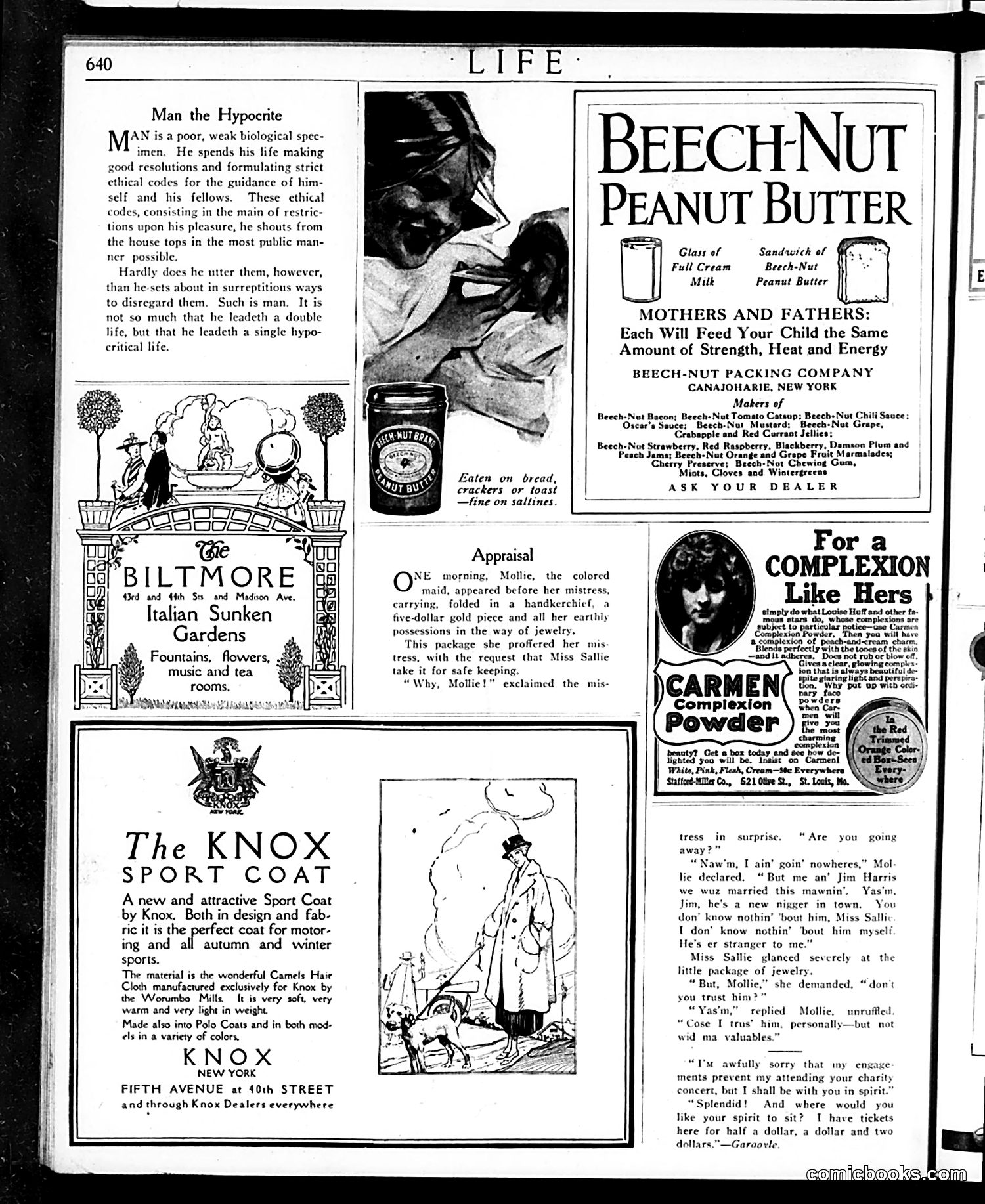
This page combines a satirical essay with period advertising. The essay critiques male hypocrisy: men publicly proclaim strict ethical codes while privately disregarding them, living a "single hypocrite" life rather than an honest double life. The advertisements reflect early 20th-century consumer culture—Beech-Nut peanut butter marketed to parents, Carmen Complexion Powder for women seeking "complexions like hers," the Knox Sport Coat, and the Biltmore restaurant. These ads use aspirational messaging and celebrity endorsement (Louise Hoff appears referenced in the powder ad). The page also includes a short story, "Appraisal," featuring a Black maid named Mollie whose dialect humor centers on her trusting her new husband "personally" but not with valuables—a joke exploiting period racial stereotypes. The closing cartoon joke involves tickets priced by quality. The content reflects 1920s attitudes: advertising's manipulative appeal, racial caricature as entertainment, and satirical commentary on middle-class moral pretense.
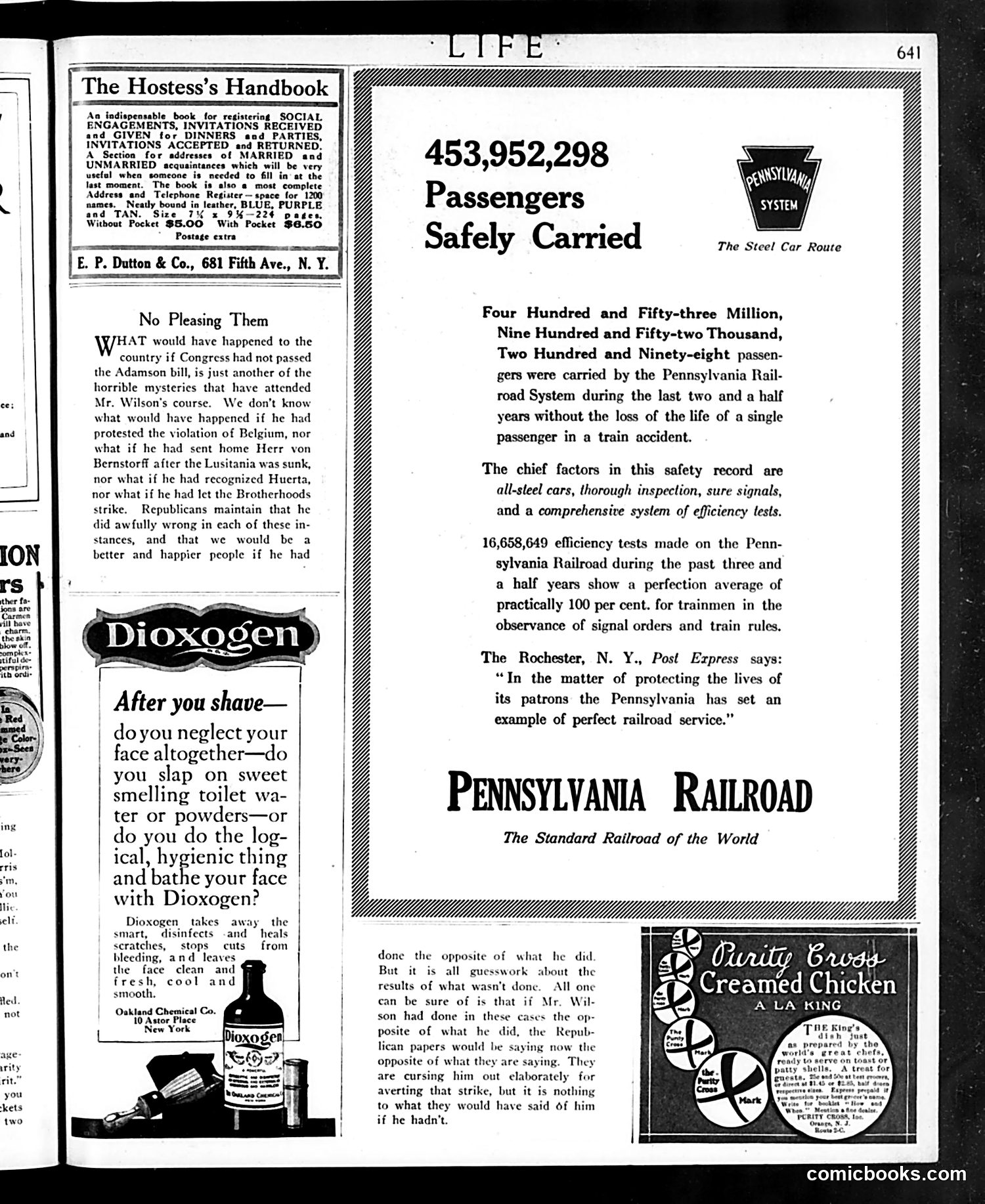
This page is primarily **advertising and editorial content**, not a political cartoon. The main article, "No Pleasing Them," is **political satire criticizing President Wilson**. It lists hypothetical scenarios—the Adamson bill (a 1916 labor law), Belgium's violation, the Lusitania sinking, Huerta's recognition, and the Brotherhoods strike—arguing that Republicans attacked Wilson regardless of his actual choices. The satire's point: Wilson's critics would have condemned him either way, so their complaints are meaningless. The page's advertisements include: - **The Hostess's Handbook** (social etiquette guide) - **Dioxogen** (aftershave/disinfectant) - **Pennsylvania Railroad** (safety advertisement claiming 453 million passengers safely carried) - **Purity Brand Creamed Chicken** The railroad ad appears positioned to humorously contrast with the Wilson critique—corporate boasting about flawless records while the editorial mocks impossible political standards.
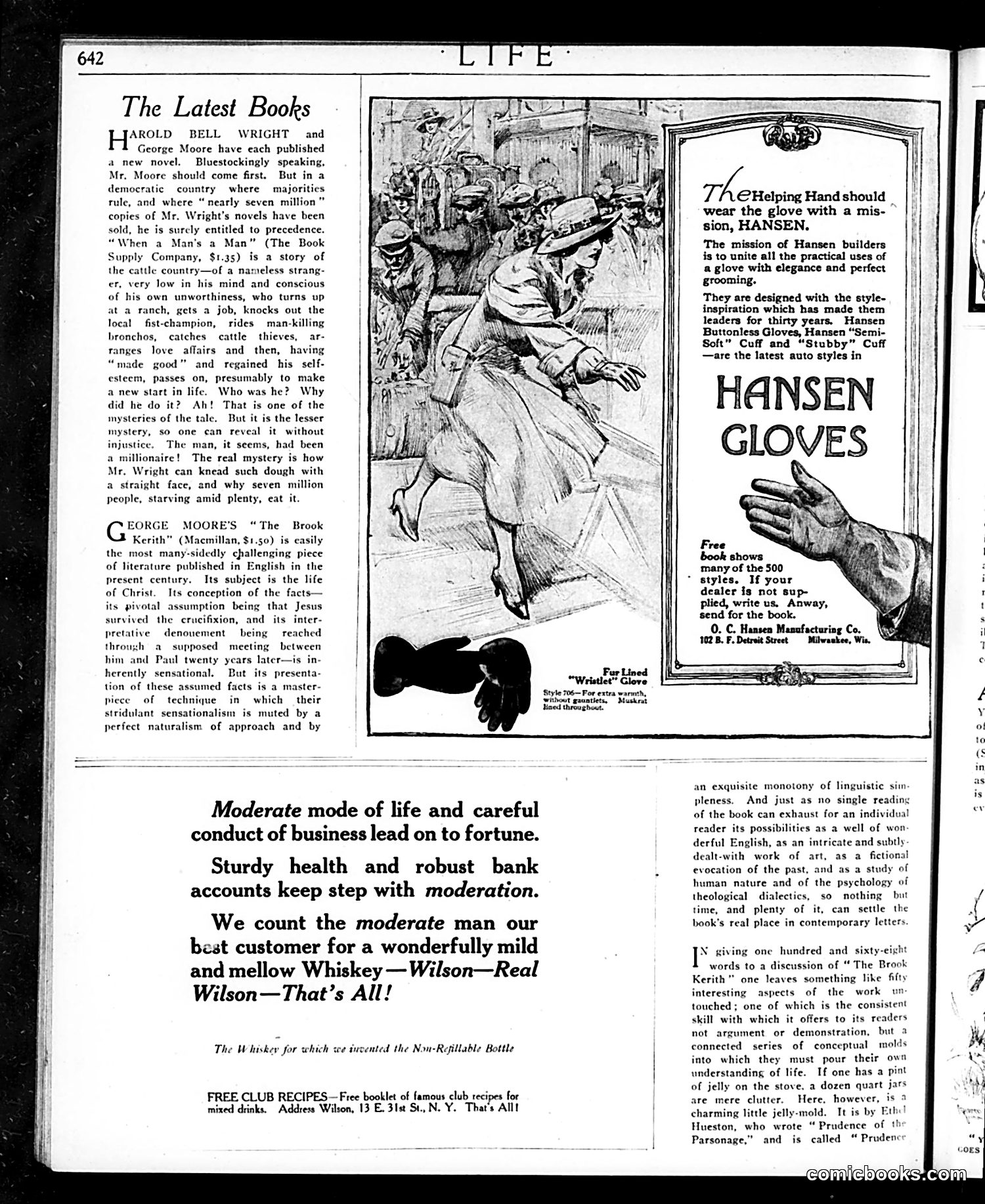
This page combines book reviews with period advertisements, lacking overt political cartoons. **Book Reviews Section:** The page reviews two novels: Harold Bell Wright's "When a Man's a Man" (a Western romance) and George Moore's "The Brook Kerith" (about Christ surviving crucifixion). The critic dismisses Wright's work as populist drivel—seven million copies sold despite the protagonist's implausible journey from nameless drifter to revealed millionaire. Moore's novel receives serious literary analysis, praised for its technical sophistication despite sensational subject matter. **Advertisements:** Hansen Gloves and Wilson Whiskey ads occupy prominent space. The Wilson ad sardonically promotes "moderation" and the "moderate man," likely satirizing Prohibition-era hypocrisy by advertising whiskey while preaching temperance. **Overall Context:** The page reflects early 20th-century literary snobbery—dismissing popular fiction while elevating experimental, challenging works. The Wilson ad's ironic tone captures the era's tension between official temperance policy and continued alcohol marketing.
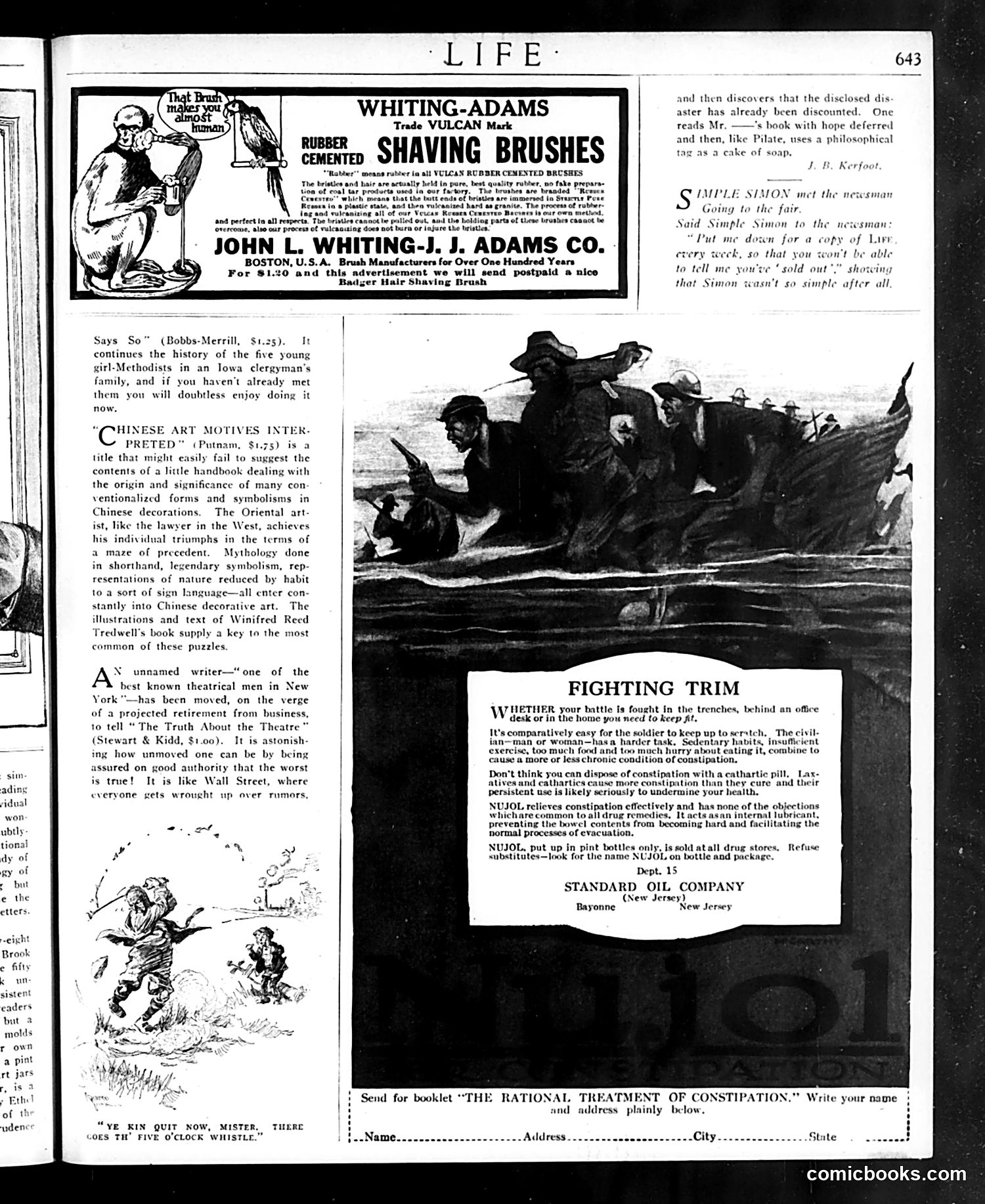
This page mixes advertisements with literary reviews and contains one small cartoon at bottom left. **The Cartoon:** A simple sketch shows a worker saying "YE KIN QUIT NOW, MISTER, THERE GOES TH' FIVE O'CLOCK WHISTLE"—a working-class character announcing end-of-shift. It's a straightforward joke about factory/manual labor routines of the era, requiring no political knowledge. **Main Content:** The page is primarily **advertising and book reviews**. Notable ads include: - Whiting-Adams shaving brushes (with an illustrated man shaving) - Nujol laxative (with detailed medical claims about constipation) - Standard Oil Company **The "Simple Simon" verse** (top right) is a brief satirical poem mocking a naive character who can't get a newspaper copy—likely social commentary on information access or gullibility, though context is limited. The page reflects early 20th-century concerns: digestive health anxieties, grooming products, and labor conditions were all prominent cultural topics of the period.
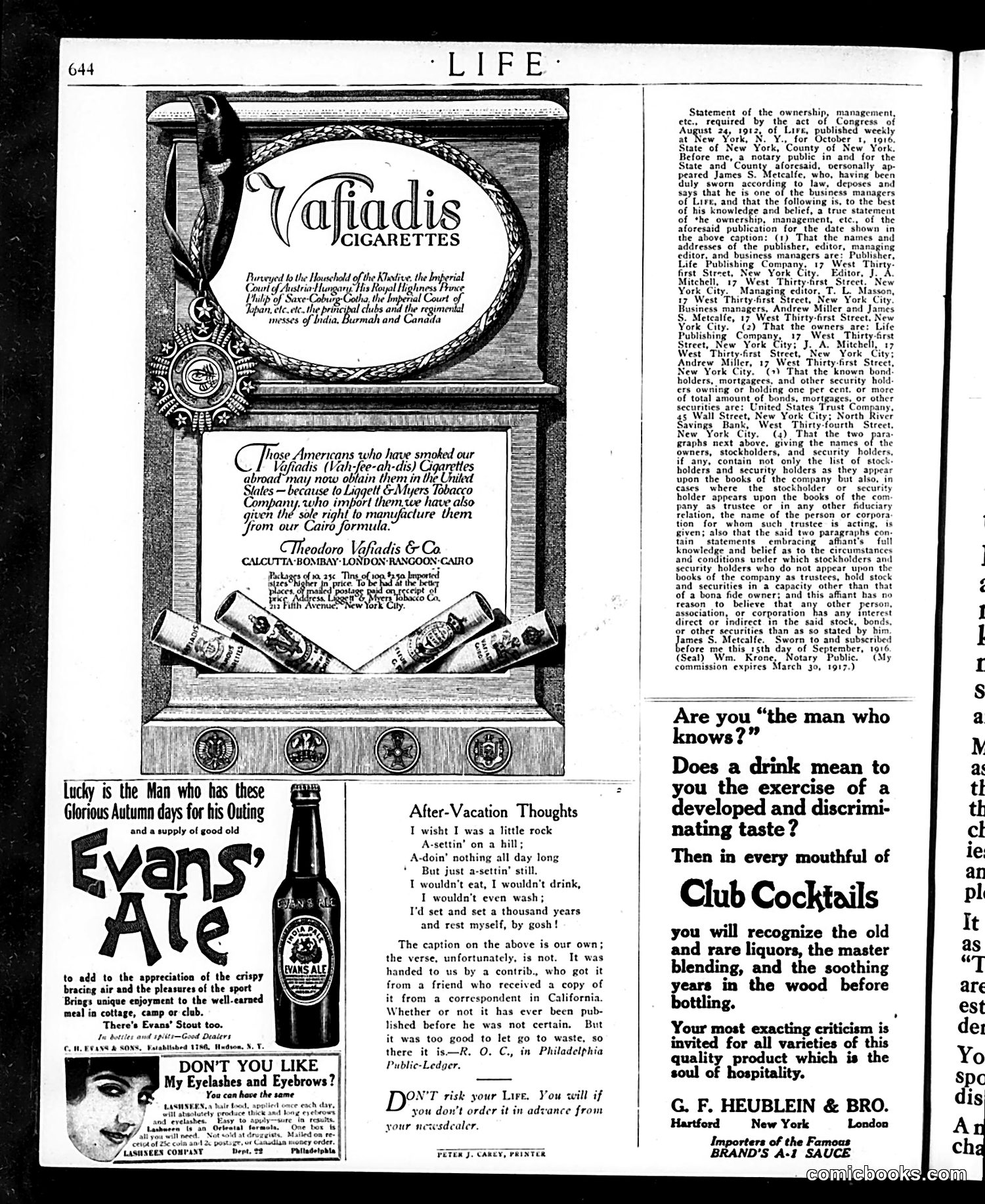
This page is primarily **advertising**, not political satire. It features luxury product advertisements typical of Life's wealthy readership: 1. **Vafiadis Cigarettes** — An upscale imported brand emphasizing royal patronage (the Khedive, Austrian Imperial Court) to appeal to aspirational American consumers. 2. **Evans' Ale** — A seasonal beverage ad celebrating autumn hunting and leisure activities for the affluent. 3. **Cosmetics ad** — Promoting false eyelashes, reflecting early 20th-century beauty trends. 4. **Club Cocktails** by G.F. Heublein & Bro. — Premium spirits advertised as markers of refined taste and "hospitality." The page also includes a nostalgic poem ("After-Vacation Thoughts") and mandatory ownership disclosure statements required by 1912 Congressional legislation. The satirical content is minimal; the page primarily reflects **consumer culture targeting upper-class readers** during the Progressive Era.
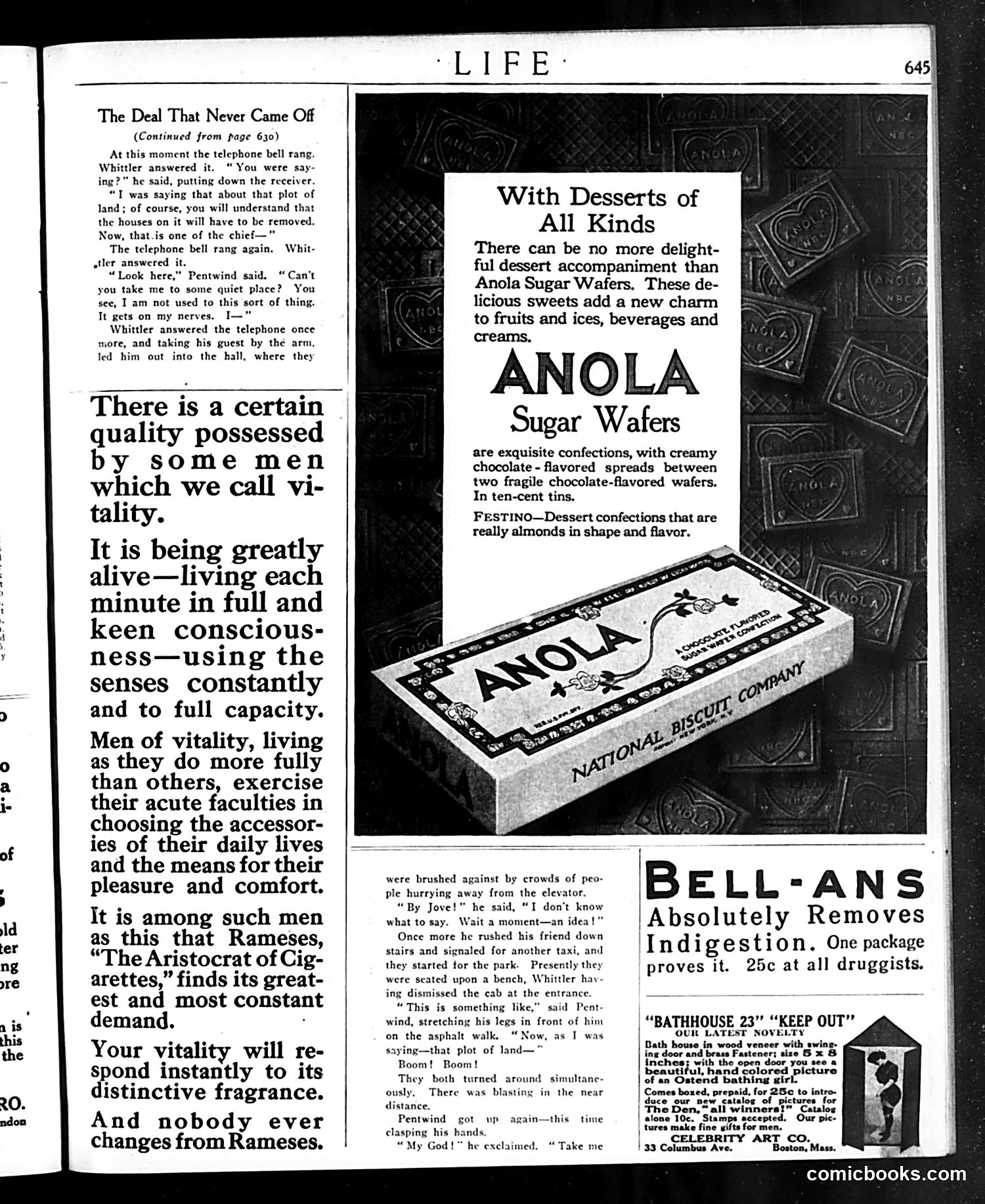
This is a humorous short story (continued from an earlier page) satirizing the difficulties of conducting business in modern urban life. The protagonist Whittler attempts to negotiate a real estate deal with a man named Pentwind, but repeatedly fails because of constant telephone interruptions—a contemporary annoyance in the 1920s-era business world. The joke escalates absurdly: Whittler keeps answering the phone, frustrating Pentwind's attempts at conversation. When they finally escape to a quiet park bench to talk, construction blasting interrupts them instead. The satire mocks both the intrusive nature of modern technology (the telephone) and urban development, suggesting that achieving peace for serious business dealings has become nearly impossible. The page is primarily this story text with period advertisements for cigarettes, candy, and novelty items.
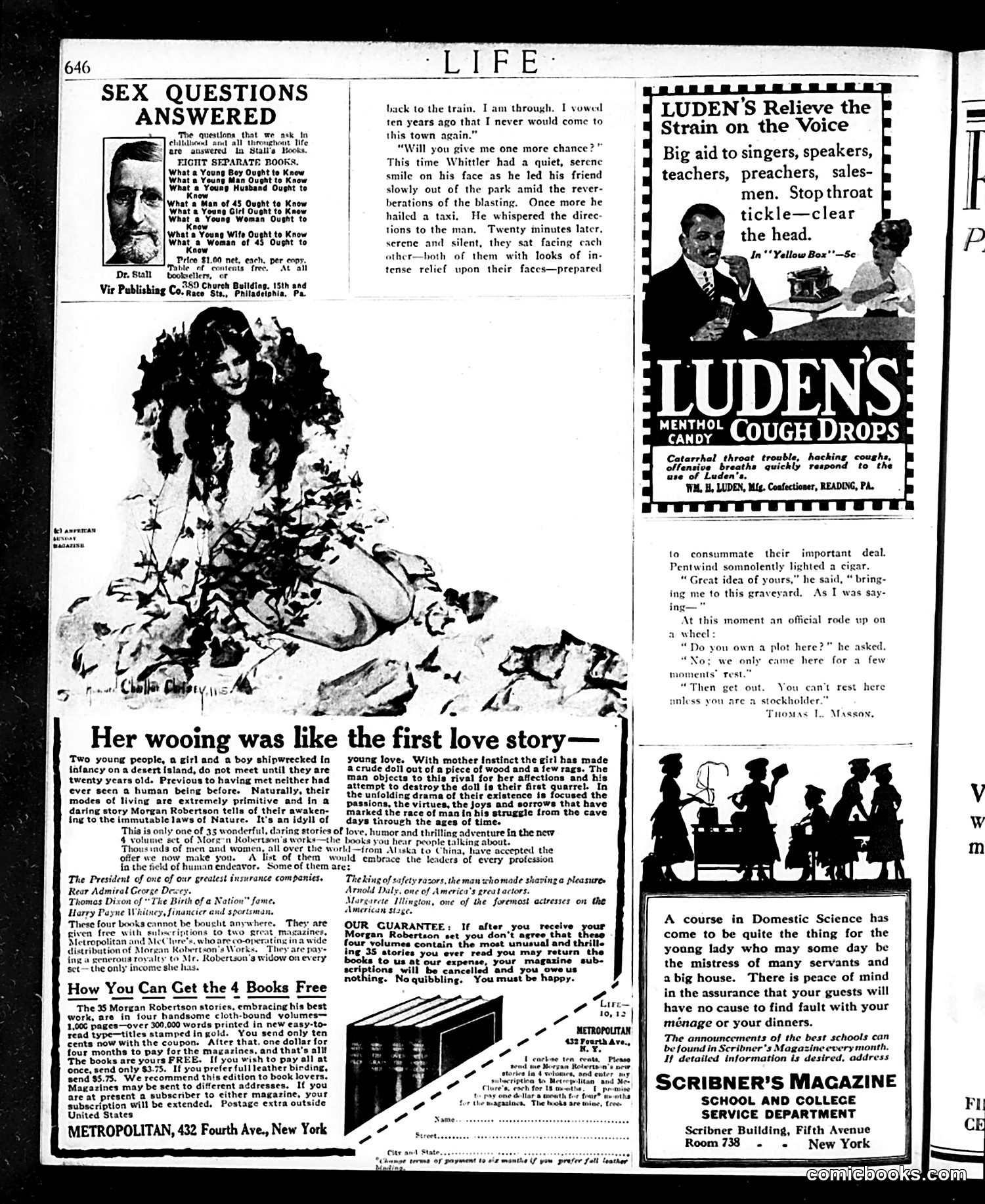
This page contains advertisements and serialized fiction rather than political cartoons. The main content is a story titled "Her wooing was like the first love story," which presents a romantic narrative about two young people raised in isolation on a desert island who meet at age twenty, experiencing primitive courtship and conflict over a doll-woman made from wood and rags. The page also advertises sex education books by Dr. Stall ("What a Young Boy Ought to Know," etc.) and promotes subscription offers to *Metropolitan* and *McClure's* magazines, claiming they provide free books including stories by Morgan Robertson. A side story by Thomas L. Masson depicts businessmen conducting a deal in a graveyard who are interrupted by a cemetery official demanding they leave unless they own a plot—apparently satirizing the commercialization of even sacred spaces. The *Luden's* cough drops advertisement appears unrelated to the editorial content.
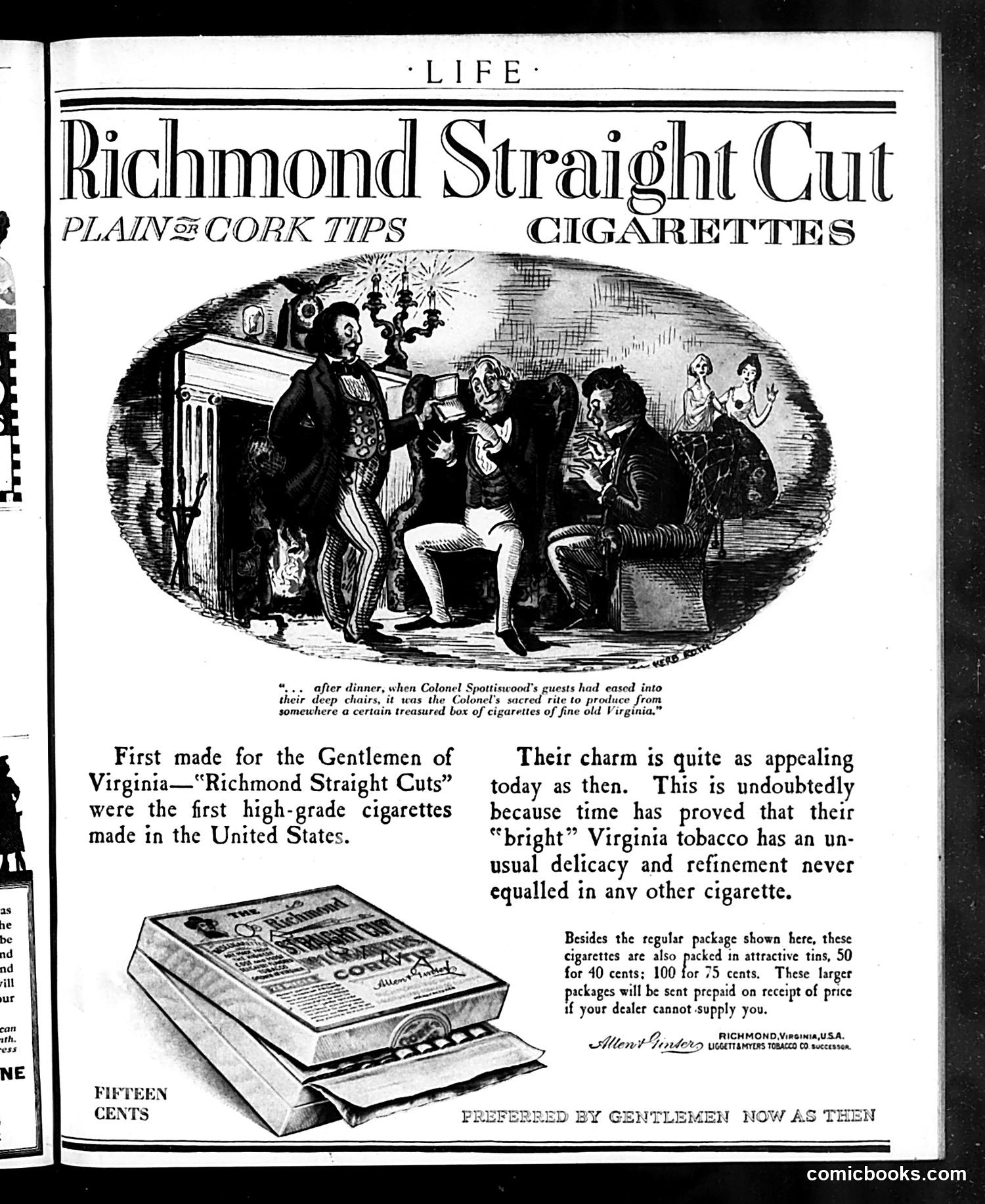
This is a **cigarette advertisement**, not political satire. It promotes Richmond Straight Cut cigarettes by invoking colonial Virginia gentility. The illustration depicts an after-dinner scene where "Colonel Spottiswood" (likely a fictional gentleman) produces a treasured box of cigarettes for his guests—establishing the product as a marker of refined, aristocratic taste. The ad claims these were "the first high-grade cigarettes made in the United States," positioning them as distinctly American yet sophisticated. The tagline "Preferred by Gentlemen Now as Then" links past prestige to present desirability. The price is fifteen cents, with bulk options available. This is pure product marketing aimed at affluent male consumers, using historical mystique and class association to sell cigarettes—a common advertising strategy of the early 20th century before cigarette regulation.
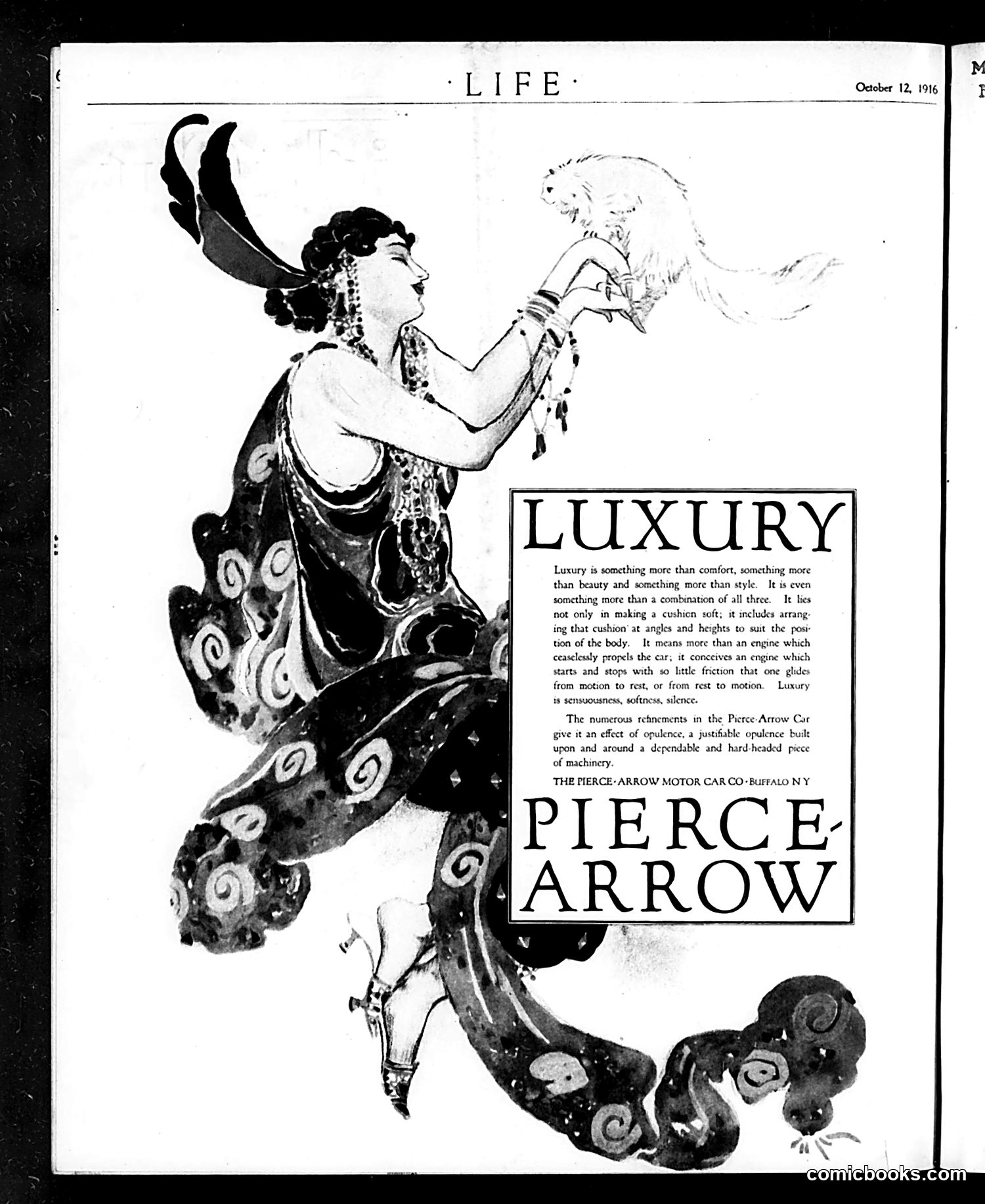
This is a **luxury car advertisement**, not political satire. The page features an elaborate illustration of an elegantly dressed woman in ornate, flowing garments holding a small dog, positioned atop decorative swirls suggesting motion and opulence. The ad promotes the **Pierce-Arrow Motor Car**, a high-end automobile manufacturer based in Buffalo, New York. The accompanying text defines "luxury" philosophically—not merely comfort or beauty, but refinement in engineering details like smooth acceleration, cushioned seating angles, and quiet operation. The imagery appeals to wealthy 1916 readers by associating the car with feminine elegance, sophistication, and sensuality. The woman's elaborate costume and jewels, combined with her graceful pose, convey status and refinement to position Pierce-Arrow as a luxury brand for the affluent. This is commercial messaging, not commentary on contemporary political or social issues.