
Life, 1916-10-12 · page 19 of 44
Life — October 12, 1916 — page 19: what you’re looking at
What you’re looking at
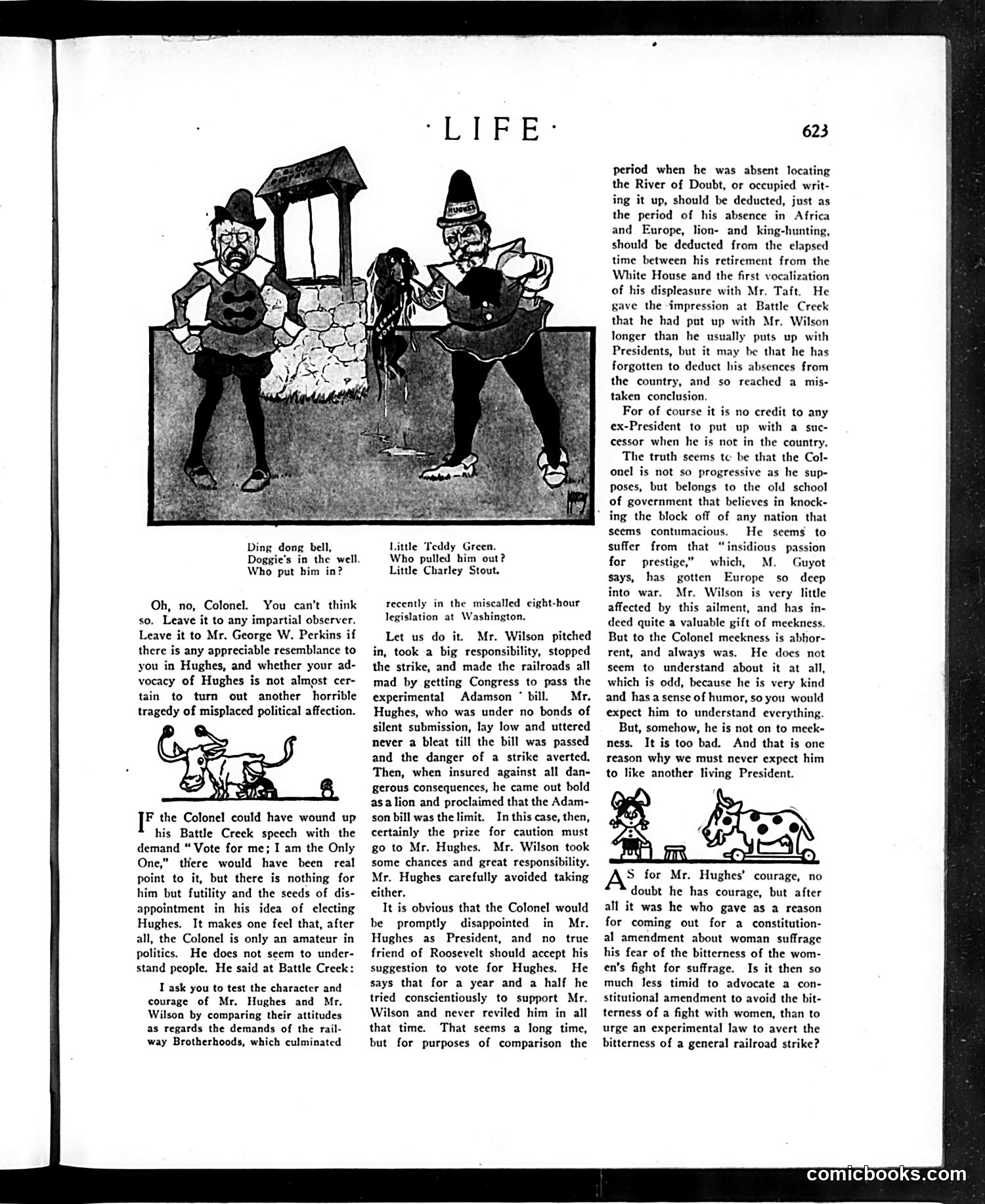
This page satirizes **Theodore Roosevelt's** (the "Colonel") endorsement of **Charles Evans Hughes** for president against the incumbent **Woodrow Wilson** in what appears to be the 1916 election. The top cartoon depicts two figures at a well, referencing the nursery rhyme "Ding Dong Bell"—a visual metaphor for Roosevelt's political maneuvering. The text criticizes Roosevelt for: 1. **Hypocrisy on labor issues**: Wilson actively resolved the railroad workers' strike through the Adamson Bill; Hughes only supported it safely *after* the danger passed. Yet Roosevelt praises Hughes's "caution." 2. **Selective memory**: The author notes Roosevelt conveniently forgets his lengthy absences (African hunts, the River of Doubt expedition) when claiming he tolerated Wilson longer than previous presidents. 3. **Temperamental unfitness**: Roosevelt belongs to an aggressive, old-school government philosophy valuing "prestige" over meekness—the very traits that dragged Europe into war. The satire suggests Roosevelt's endorsement stems from personal pique, not principle, making him an unreliable political judge.
📄 Transcribed text from this page (OCR, searchable)
Machine-transcribed from the original scan — historical spelling and the odd misread are preserved.
Ding dong bell, Doggie’s in the well Who put him in? Oh, no, Colonel. You can’t think so. Leave it to any impartial observer. Leave it to Mr. George W. Perkins if there is any appreciable resemblance to you in Hughes, and whether your ad- vocacy of Hughes is not almost cer- tain to turn out another horrible tragedy of misplaced political affection. F the Colonel could have wound up his Battle Creek speech with the demand “ Vote for me; I am the Only One,” there would have been real point to it, but there is nothing for him but futility and the seeds of dis- appointment in his idea of electing Hughes. It makes one feel that, after all, the Colonel is only an amateur in politics. He does not seem to under- stand people. He said at Battle Creek: T ask you to test the character and courage of Mr. Hughes and Mr. Wilson by comparing their attitudes as regards the demands of the rail- way Brotherhoods, which culminated Little Teddy Green. Who pulled him out? Little Charley Stout. recently in the miscalled eight-hour legislation at Washington. Let us do it. Mr. Wilson pitched in, took a big responsibility, stopped the strike, and made the railroads all mad by getting Congress to pass the experimental Adamson ° bill. = Mr. Hughes, who was under no bonds of silent submission, lay low and uttered never a bleat till the bill was passed and the danger of a strike averted. Then, when insured against all dan- gerous consequences, he came out bold asa lion and proclaimed that the Adam- son bill was the limit. In this case, then, certainly the prize for caution must go to Mr. Hughes. Mr. Wilson took some chances and great respon: Y. Mr. Hughes carefully avoided taking either. It is obvious that the Colonel would be promptly disappointed in Mr. Hughes as President, and no true friend of Roosevelt should accept his suggestion to vote for Hughes. He says that for a year and a half he tried conscientiously to support Mr. Wilson and never reviled him in all that time. That seems a long time, but for purposes of comparison the 623 period when he was absent locating the River of Doubt, or occupied writ- ing it up, should be deducted, just as the period of his absence in Africa and Europe, lion- and king-hunting, should be deducted from the elapsed time between his retirement from the White House and the first vocalization of his displeasure with Mr. Taft. He gave the impression at Battle Creek that he had put up with Mr. Wilson longer than he usually puts up with Presidents, but it may be that he has forgotten to deduct his absences from the country, and so reached a mis- taken conclusion. For of course it is no credit to any ex-President to put up with a suc- cessor when he is not in the country. The truth seems te be that the Col- onel is not so progressive as he sup- poses, but belongs to the old school of government that believes in knock- * ing the block off of any nation that seems contumacious. He seems to suffer from that “insidious passion for prestige,” which, M. Guyot says, has gotten Europe so deep into war. Mr. Wilson is very little affected by this ailment, and has in- deed quite a valuable gift of meekness. But to the Colonel meekness is abhor- rent, and always was. He does not seem to understand about it at all, which is odd, because he is very kind and hasa sense of humor, so you would expect him to understand everything. But, somehow, he is not on to meek- ness. It is too bad. And that is one reason why we must never expect him to like another living President. S for Mr. Hughes’ courage, no doubt he has courage, but after all it was he who gave as a reason for coming out for a constitution- al amendment about woman suffrage his fear of the bitterness of the wom- en’s fight for suffrage. Is it then so much less timid to advocate a con- stitutional amendment to avoid the bit- terness of a fight with women, than to urge an experimental law to avert the bitterness of a general railroad strike? comicbooks.com