
Life, 1916-10-12 · page 22 of 44
Life — October 12, 1916 — page 22: what you’re looking at
What you’re looking at
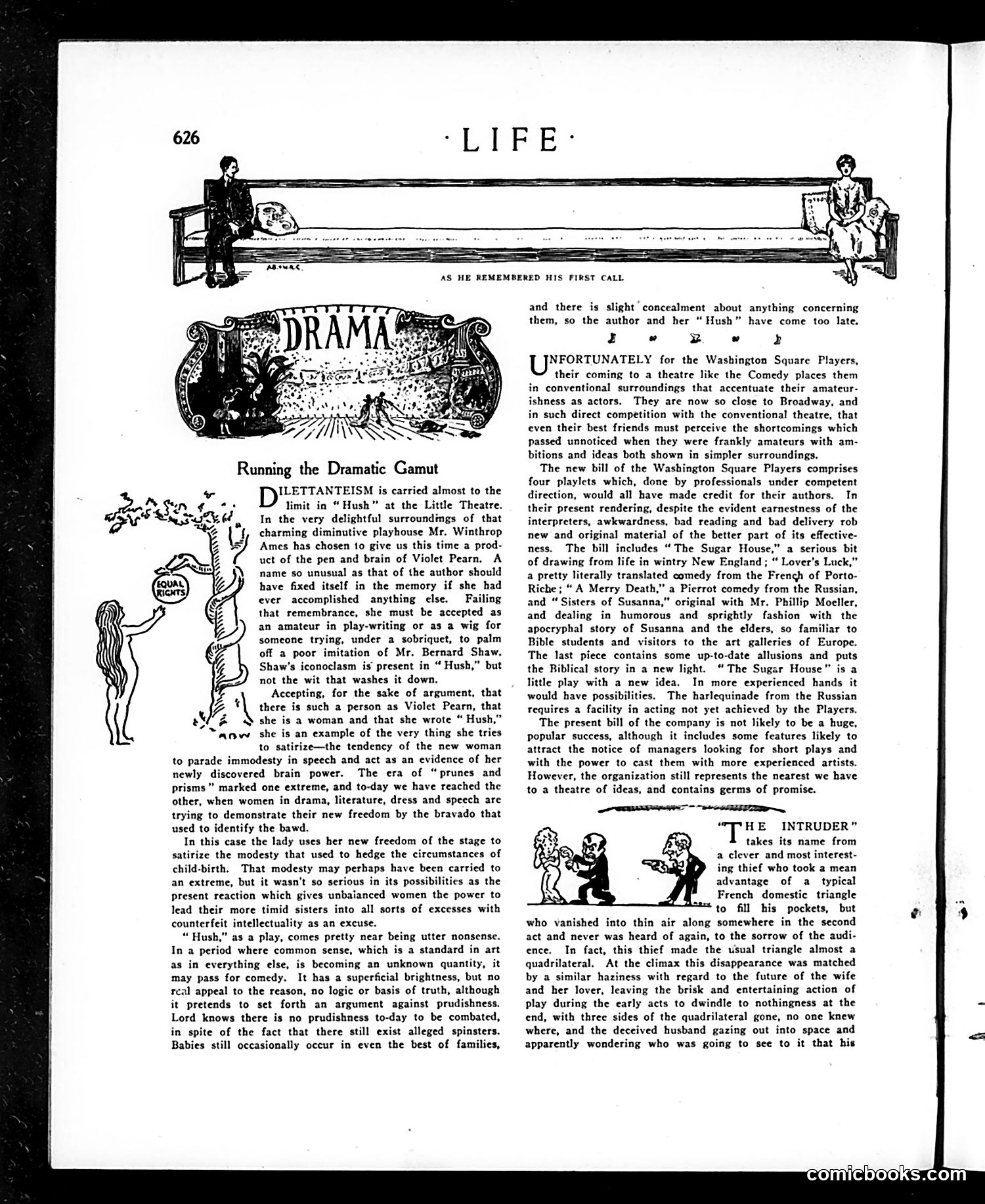
This page contains two separate theater reviews from Life magazine's drama section. **"Hush" at the Little Theatre:** The critic reviews a play by Violet Pearn, produced by Winthrop Ames. The satire targets the play itself and its author. The reviewer argues that "Hush" attempts to mock prudishness but fails because modern society has already abandoned modesty—particularly regarding childbirth. The critic suggests Pearn exemplifies the very thing she satirizes: the "new woman" using shocking speech and behavior as evidence of intellectual liberation. The review is scathing, calling the play "utter nonsense" lacking logic or real appeal, dismissing it as superficially clever but fundamentally empty. **Washington Square Players:** This review is more sympathetic but critical. The Players, now performing in a conventional Broadway-adjacent venue, appear amateurish compared to professional competition. Their earnestness cannot overcome awkward acting and poor delivery, undermining otherwise original material in their four-play bill.
📄 Transcribed text from this page (OCR, searchable)
Machine-transcribed from the original scan — historical spelling and the odd misread are preserved.
AS HE REMEMBERED HIS FIRST CALL Running the Dramatic Gamut ILETTANTEISM is carried almost to the limit in “Hush” at the Little Theatre. In the very delightful surroundings of that charming diminutive playhouse Mr. Winthrop Ames has chosen to give us this time a prod- uct of the pen and brain of Violet Pearn. A name so unusual as that of the author should have fixed itself in the memory if she had ever accomplished anything else. Failing that remembrance, she must be accepted as an amateur in play-writing or as a wig for someone trying, under a sobriquet, to palm off a poor imitation of Mr. Bernard Shaw. Shaw's iconoclasm is’ present in “ Hush,” but not the wit that washes it down. Accepting, for the sake of argument, that \ there is such a person as Violet Pearn, that ® she is a woman and that she wrote “ Hush,” anw she is an example of the very thing she tries to satirize—the tendency of the new woman to parade immodesty in speech and act as an evidence of her newly discovered brain power. The era of “prunes and prisms" marked one extreme, and to-day we have reached the other, when women in drama, literature, dress and speech are trying to demonstrate their new freedom by the bravado that used to identify the bawd. In this case the lady uses her new freedom of the stage to satirize the modesty that used to hedge the circumstances of child-birth. That modesty may perhaps have been carried to an extreme, but it wasn’t so serious in its possibilities as the present reaction which gives unbaianced women the power to lead their more timid sisters into all sorts of excesses with counterfeit intellectuality as an excuse. “ Hush,” as a play, comes pretty near being utter nonsense. In a period where common sense, which is a standard in art as in everything else, is becoming an unknown quantity, it may pass for comedy. It has a superficial brightness, but no real appeal to the reason, no logic or basis of truth, although it pretends to set forth an argument against prudishness. Lord knows there is no prudishness to-day to be combated, in spite of the fact that there still exist alleged spinsters. Babies still occasionally occur in even the best of families, and there is slight’ concealment about anything concerning them, so the author and her “Hush” have come too late. z ° pe ” 2 NFORTUNATELY for the Washington Square Players, their coming to a theatre like the Comedy places them in conventional surroundings that accentuate their amateur- ishness as actors. They are now so close to Broadway, and in such direct competition with the conventional theatre, that even their best friends must perceive the shortcomings which passed unnoticed when they were frankly amateurs with am- bitions and ideas both shown in simpler surroundings. The new bill of the Washington Square Players comprises four playlets which, done by professionals under competent direction, would all have made credit for their authors. In their present rendering, despite the evident earnestness of the interpreters, awkwardness, bad reading and bad delivery rob new and original material of the better part of its effective- ness. The bill includes “ The Sugar House,” a serious bit of drawing from life in wintry New England ; “ Lover’s Luck,” a pretty literally translated comedy from the French of Porto- Riche ; “ A Merry Death,” a Pierrot comedy from the Russian, and “Sisters of Susanna,” original with Mr. Phillip Moeller, and dealing in humorous and sprightly fashion with the apocryphal story of Susanna and the elders, so familiar to Bible students and visitors to the art galleries of Europe. The last piece contains some up-to-date allusions and puts the Biblical story in a new light. “The Sugar House” is a little play with a new idea. In more experienced hands it would have possibilities. The harlequinade from the Russian requires a facility in acting not yet achieved by the Players. The present bill of the company is not likely to be a huge, popular success, although it includes some features likely to attract the notice of managers looking for short plays and with the power to cast them with more experienced artists. However, the organization still represents the nearest we have to a theatre of ideas, and contains germs of promise. s HE INTRUDER” takes its name from a clever and most interest- ing thief who took a mean advantage of a typical French domestic triangle “to fill his pockets, but who vanished into thin air along somewhere in the second act and never was heard of again, to the sorrow of the audi- ence. In fact, this thief made the usual triangle almost a quadrilateral. At the climax this disappearance was matched by a similar haziness with regard to the future of the wife and her lover, leaving the brisk and entertaining action of play during the early acts to dwindle to nothingness at the end, with three sides of the quadrilateral gone, no one knew where, and the deceived husband gazing out into space and apparently wondering who was going to see to it that his