
Life, 1916-10-12 · page 23 of 44
Life — October 12, 1916 — page 23: what you’re looking at
What you’re looking at
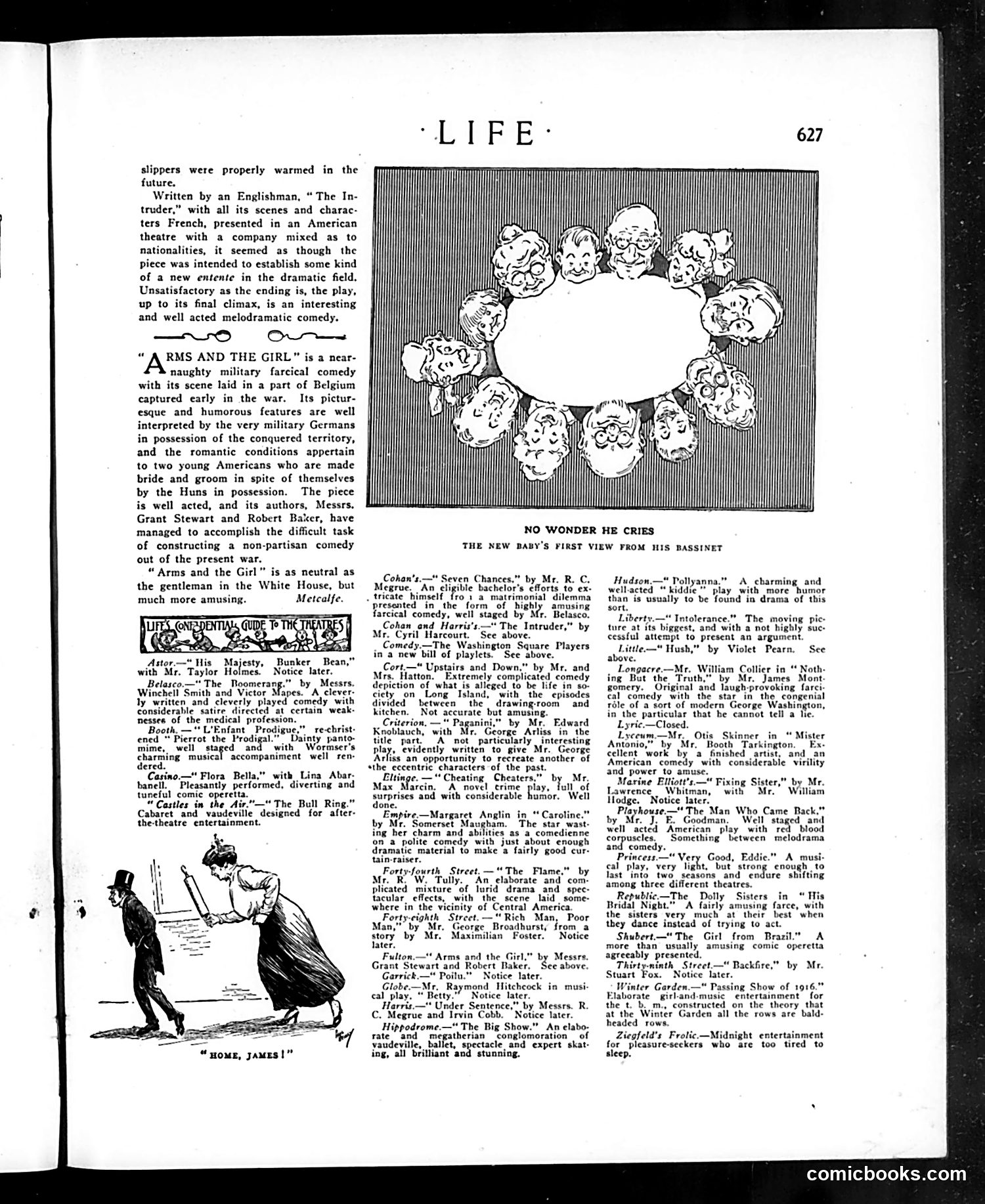
This page from *Life* magazine contains theater reviews and a satirical cartoon titled "No Wonder He Cries: The New Baby's First View from His Bassinet." The cartoon depicts an infant's perspective looking out at a circle of adult faces peering down into a crib—the adults appear grotesque and exaggerated from the baby's ground-level viewpoint. The joke satirizes how newborns must perceive the well-meaning adults cooing at them: their distorted, looming faces seem monstrous rather than endearing. This plays on the common experience of relatives and visitors gathering to admire a newborn while making exaggerated facial expressions. The accompanying text consists entirely of theater reviews describing various Broadway productions of the era (circa 1915), including "*Arms and the Girl*" (a WWI-themed military farce) and other comedies and dramatic pieces. The reviews use period theatrical terminology and discuss plot, staging, and performances. The cartoon's humor relies on the contrast between sentimentality (how adults think babies experience their attention) and reality (how genuinely unsettling those same faces appear from below).
📄 Transcribed text from this page (OCR, searchable)
Machine-transcribed from the original scan — historical spelling and the odd misread are preserved.
slippers were properly warmed in the future. Written by an Englishman, “ The In- truder,” with all its scenes and charac- ters French, presented in an American theatre with a company mixed as to nationalities, it seemed as though the piece was intended to establish some kind of a new entente in the dramatic field. Unsatisfactory as the ending is, the play, up to its final climax, is an interesting and well acted melodramatic comedy. onOSS OO 7 RMS AND THE GIRL” is a near- naughty military farcical comedy with its scene laid in a part of Belgium captured early in the war. Its pictur- esque and humorous features are well interpreted by the very military Germans in possession of the conquered territory, and the romantic conditions appertain to two young Americans who are made bride and groom in spite of themselves by the Huns in possession. The piece is well acted, and its authors, Messrs. Grant Stewart and Robert Baker, have managed to accomplish the difficult task of constructing a non-partisan comedy out of the present war. “ Arms and the Girl” is as neutral as the gentleman in the White House, but much more amusing. Metcalfe. “His Majesty, Bunker Bean,” with Mr. Taylor Holmes.’ Notice later. Belasco.—"" The Boomerang.” by Messrs. Winchell Smith and Victor Mapes. A, clever- ly written and cleverly played comedy with considerable satire directed at certain weak- nesses of the medical profession Booth. —“L'Enfant Prodigue,”__re-christ- ened“ Pierrot the Prodi Dainty panto- mime, well staged and with Wormser's charming musical accompaniment well ren- dered. Casino.—" Flora Bella,” with Lina Abar- banell. Pleasantly performed, diverting and tuneful comic opereti “Castles in the Air."—" The Bull Ring.” Cabaret and vaudeville designed for after- the-theatre entertainment. “Home, James!” . tricate himself NO WONDER HE CRIES THE NEW BABY'S FIRST VIEW FROM HIS BASSINET Cohan’s —" Seven Chances,” by Mr. R. C. Megrue. ‘An eligible bachelor’s efforts to ex: ro + a matrimonial dilemma presented in the form of highly amusing farcical comedy, well staged by Mr. Belasco, Cohan and Harris's.—" The Intruder,” by Mr, Cyril Harcourt. See above. Comedy.—The Washington Square Players in a new bill of playlets. See above. Cort—* Upstairs and Down,” by Mr. and Mrs. Hatton. Extremely complicated comedy depiction of what is alleged to be life in s0o- ciety on Long Island, with the episodes divided between the drawing-room and kitchen. Not accurate but amusing. Criterion, —" Paganini,” by Mr. Edward Knoblauch, with Mr. George Arliss in the title part. “A not particularly interesting lay, ‘evidently written to give Mr. George Arliss an opportunity to recreate another of sthe eccentric characters of the past. Eltinge. —"* Cheating Cheaters.” Max Marcin, A novel crime piay, surprises and with considerable humor. done. Empire—Margaret Anglin in ‘ Caroline.” by Mr. Somerset Maugham. The star, wast- ing her charm and abilities as a comedienne on a polite comedy with just about enough dramatic material to make a fairly good cur- tain-raiser. Forty-fourth Street. —“'The Flame," by Mr. R. W. Tully. An_ elaborate and’ com- plicated mixture of lurid drama and spec- tacular_ effects, with the, scene laid _some- where in the vicinity of Central America. Forty-eighth Strect. —“"Rich Man, Poor Man,” by Mr. George Broadhurst, from a story by Mr, Maximilian Foster. Notice later. Fulton.—* Arms and the Girl,” by Messrs. Grant Stewart and Robert Raker, See above. Garrick.—" Poilu.” Notice later. Globe—Mr, Raymond Hitchcock in musi- Betty.” Notice later. Under Sentence,” by Messrs. R. C. Megrue and Irvin Cobb. ‘Notice later. Hippodrome.—" The Big Show.” An clabo- rate and fregatherian conglomoration of vaudeville, ballet, spectacle and expert skat- ing, all brilliant and stunning. by Mr, Tot of Well Hudson.—" Pollyanna.” A. charming and well-acted “kiddie” play with more humor than is usually to be found in drama of this sort, Liberty.—" Intolerance. ing pice ture at its biggest, and with a not highly sue- cessful attempt to present an argument Little." Hush,” by Violet Pearn. above. Longacre.—Mr. Wi See * m Collier in Noth ing But the Trot Mr. James Mont gomery. O1 nd laugh-provoking farci- cal comedy with the star in the congenial réle of a sort of modern George Washington in the particular that be cannot tell a lie. Lyric.—Closed. Lyceum—Mr. Otis Skinner in “ Mister Antonio,” by Mr, Booth Tarkington. Ex: cellent work by ‘a finished artist, and an American comedy with considerable virility and power to amuse. Marine Elliott's. —" Lawrence Whitman, Hodge, Notice later. Playhouse.—" The Man Who Came Rack.” by Mr. J. E. Goodman. Well staged and well acted American play with red blood corpuscles, “Something between melodrama a Very Good, Eddie.” A musi- cal play, very lij but’ strong enough to last into two seasons and endure shifting among three different theatres. Republic—The Dolly Sisters in “ His Bridal Night.” A fairly amusing farce, with the sisters very much at their best ‘when they dance instead of trying to act. Shubert.—" The Girl from Brazil.” A more than usually amusing comic operetta agreeably presented, Thirty-ninth Street.—"' Backfire,” by Mr. Stuart Fox. Notice later. Winter Garden.—" Passing Show of 1916." Elaborate girl-and-music entertainment for the t. b. m., constructed on the theory that at the Winter Garden all the rows are bald- headed rows. Ziegfeld’s Frotic—Midnight entertainment for pleasureseckers who are too tired to sleep. ing Sister," by Mr. with Mr," William comicbooks.com