
Life, 1916-10-12 · page 18 of 44
Life — October 12, 1916 — page 18: what you’re looking at
What you’re looking at
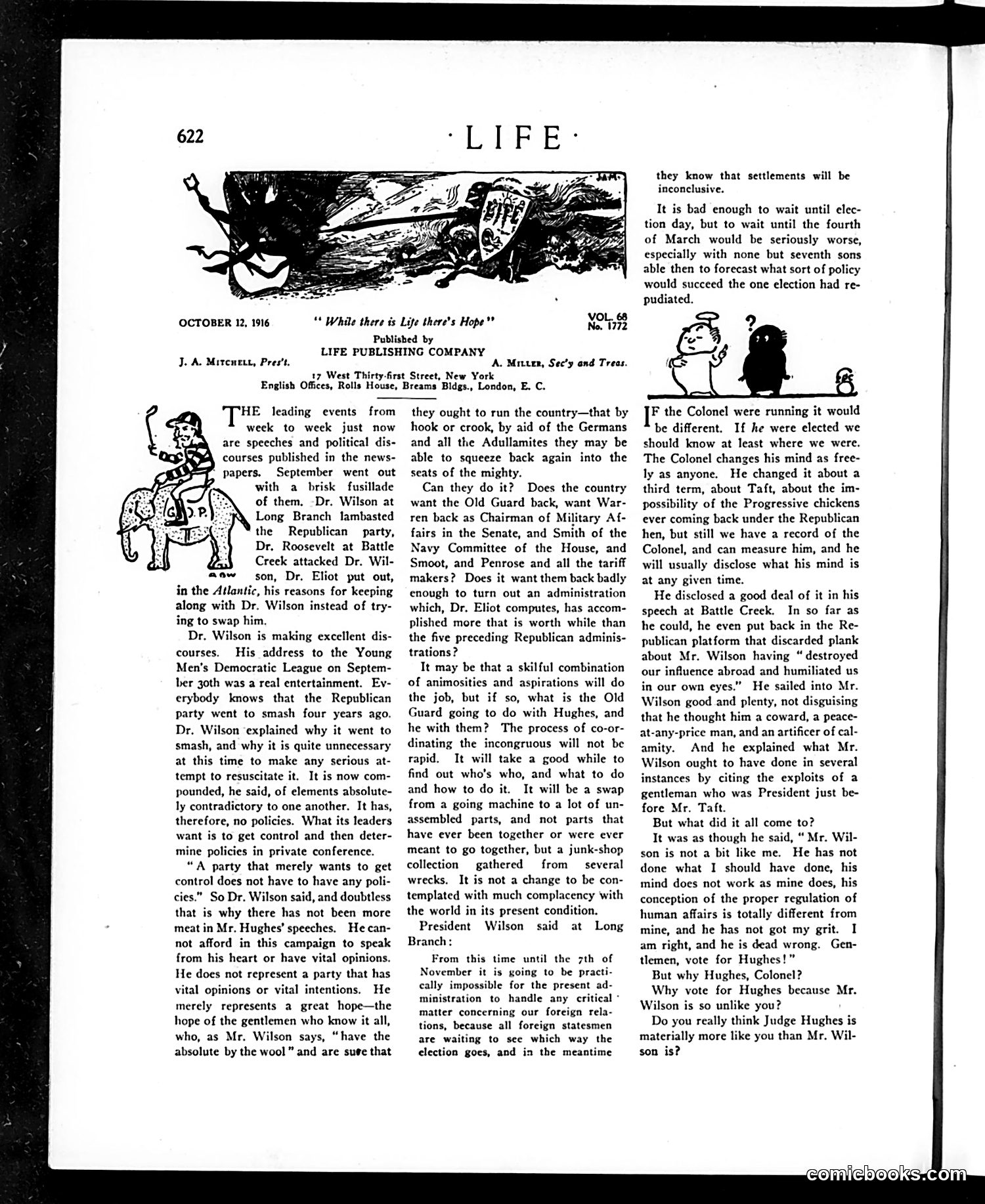
This page contains Wilson administration political commentary during the 1916 presidential election. The text attacks the Republican Party (depicted as a disorganized "junk-shop collection") and its nominee, Charles Evans Hughes, contrasting them with President Wilson's coherent leadership. The article argues Republicans represent only the desire for power without policy substance—the "Old Guard" (conservative Republican establishment figures like Penrose and Smoot) seeking to reclaim control. Hughes is portrayed as merely representing their hopes rather than having independent convictions. Wilson's position: waiting until March 1917 for a potential Republican transition would dangerously delay foreign policy decisions during WWI (implied by references to "the Germans" and foreign statesmen). The satire suggests Hughes is an empty vessel for Republican ambitions, while Wilson offers continuity and decisive leadership during an international crisis.
📄 Transcribed text from this page (OCR, searchable)
Machine-transcribed from the original scan — historical spelling and the odd misread are preserved.
OCTOBER 12, 1916 ‘* While there ts Life there's Hope"” Published by LIFE PUBLISHING COMPANY J. A. Mitcuent, Pres’t, HE leading events from week to week just now are speeches and political dis- courses published in the news- papers. September went out with a brisk fusillade of them, Dr. Wilson at Long Branch lambasted the Republican party, Dr. Roosevelt at Battle Creek attacked Dr. Wil- son, Dr. Eliot put out, in the Atlantic, his reasons for keeping along with Dr. Wilson instead of try- ing to swap him. Dr. Wilson is making excellent dis- courses. His address to the Young Men's Democratic League on Septem- ber 3oth was a real entertainment. Ev- erybody knows that the Republican party went to smash four years ago. Dr. Wilson ‘explained why it went to smash, and why it is quite unnecessary at this time to make any serious at- tempt to resuscitate it. It is now com- pounded, he said, of elements absolute- ly contradictory to one another. It has, therefore, no policies. What its leaders want is to get control and then deter- mine policies in private conference. “A party that merely wants to get control does not have to have any poli- cies.” So Dr. Wilson said, and doubtless that is why there has not been more meat in Mr. Hughes’ speeches. Hecan- not afford in this campaign to speak from his heart or have vital opinions. He does not represent a party that has vital opinions or vital intentions. He merely represents a great hope—the hope of the gentlemen who know it all, who, as Mr. Wilson says, “have the absolute by the wool” and are suee that A. Miturr, Sec’y and Treas. 17 West Thirty-first Street, New York English Offices, Rolls House, Breams Bldgs., London, E. C. they ought to run the country—that by hook or crook, by aid of the Germans and all the Adullamites they may be able to squeeze back again into the seats of the mighty. Can they do it? Does the country want the Old Guard back, want War- ren back as Chairman of Military Af- fairs in the Senate, and Smith of the Navy Committee of the House, and Smoot, and Penrose and all the tariff makers? Does it want them back badly enough to turn out an administration which, Dr, Eliot computes, has accom- plished more that is worth while than the five preceding Republican adminis- trations? It may be that a skilful combination of animosities and aspirations will do the job, but if so, what is the Old Guard going to do with Hughes, and he with them? The process of co-or- dinating the incongruous will not be rapid. It will take a good while to find out who's who, and what to do and how to do it. It will be a swap from a going machine to a lot of un- assembled parts, and not parts that have ever been together or were ever meant to go together, but a junk-shop collection gathered from several wrecks. It is not a change to be con- templated with much complacency with the world in its present condition. President Wilson said at Long Branch: From this time until the 7th of November it is going to be practi- impossible for the present ad- istration to handle any critical © matter concerning our foreign rela- tions, because all foreign statesmen are waiting to see which way the election goes, and in the meantime they know that settlements will be inconclusive. It is bad enough to wait until elec- tion day, but to wait until the fourth of March would be seriously worse, especially with none but seventh sons able then to forecast what sort of policy would succeed the one election had re- pudiated. EF the Colonel were running it would be different. If he were elected we should know at least where we were. The Colonel changes his mind as free- ly as anyone. He changed it about a third term, about Taft, about the im- possibility of the Progressive chickens ever coming back under the Republican hen, but still we have a record of the Colonel, and can measure him, and he will usually disclose what his mind is at any given time. He disclosed a good deal of it in his speech at Battle Creek. In so far as he could, he even put back in the Re- publican platform that discarded plank about Mr. Wilson having “ destroyed our influence abroad and humiliated us in our own eyes.” He sailed into Mr. Wilson good and plenty, not disguising that he thought him a coward, a peace- at-any-price man, and an artificer of cal- amity. And he explained what Mr. Wilson ought to have done in several instances by citing the exploits of a gentleman who was President just be- fore Mr. Taft. But what did it all come to? It was as though he said, “ Mr. Wil- son is not a bit like me. He has not done what I should have done, his mind does not work as mine does, his conception of the proper regulation of human affairs is totally different from mine, and he has not got my grit. I am right, and he is dead wrong. Gen- tlemen, vote for Hughes!” But why Hughes, Colonel? Why vote for Hughes because Mr. Wilson is so unlike you? Do you really think Judge Hughes is materially more like you than Mr. Wil- son is?