
Life, 1916-10-12 · page 10 of 44
Life — October 12, 1916 — page 10: what you’re looking at
What you’re looking at
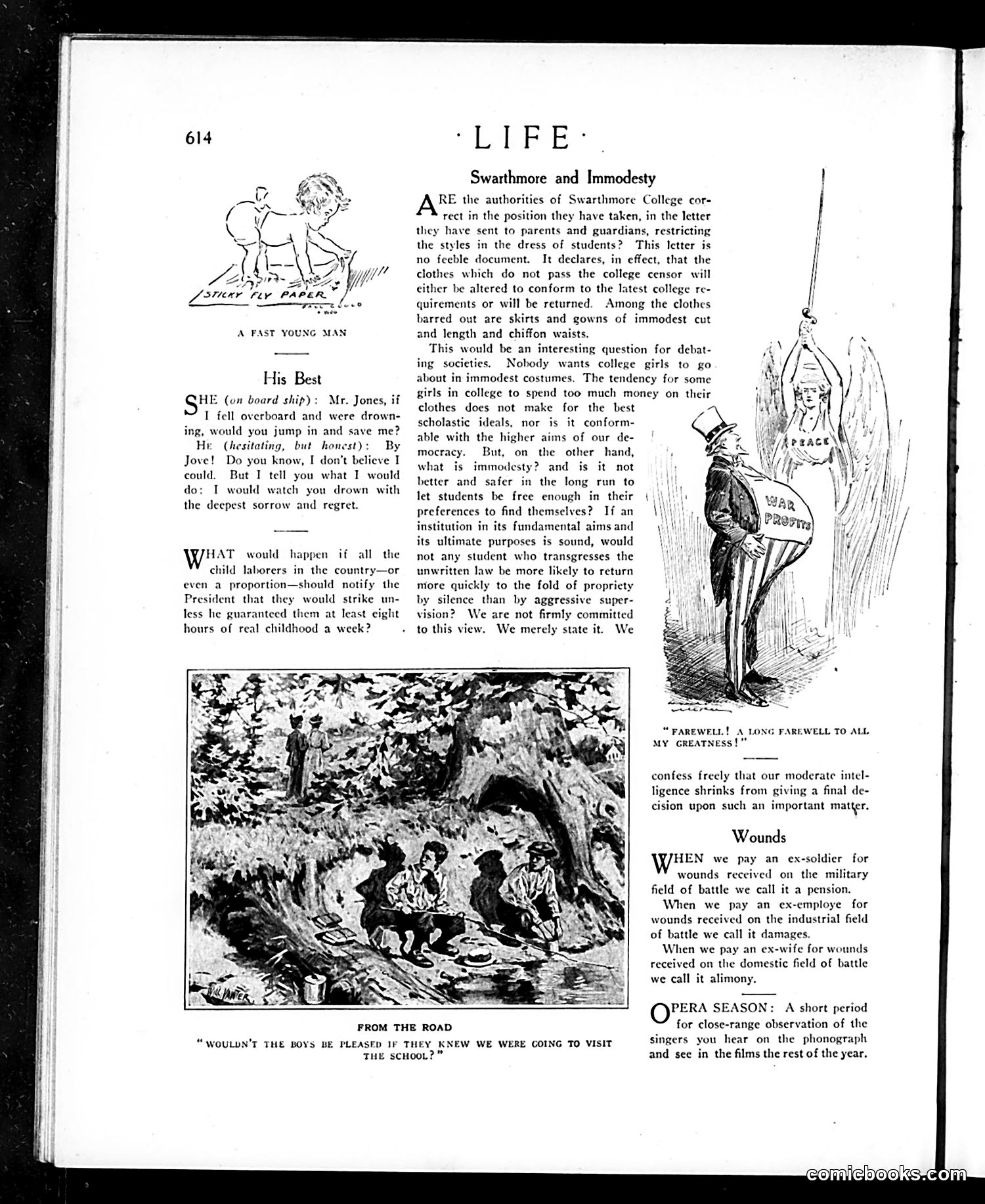
This page contains social commentary pieces rather than political cartoons. The main content critiques **Swarthmore College's dress code restrictions** for female students. The article argues against the college's censorship of "immodest" clothing styles, questioning whether such restrictions align with democratic principles and educational freedom. A secondary piece titled "Wounds" uses wordplay to critique inconsistent government policy: soldiers receive "pensions" for battle injuries, industrial workers receive "damages," but domestic workers receive "alimony"—highlighting discriminatory treatment. The illustrations include a satirical drawing of a young man and a period scene showing people gathered outdoors. These support the articles' themes of social critique regarding authority, class, and institutional hypocrisy prevalent in early 20th-century American life.
📄 Transcribed text from this page (OCR, searchable)
Machine-transcribed from the original scan — historical spelling and the odd misread are preserved.
JSTERY Fly PAPER A FAST YOUNG MAN His Best HE (on board ship): Mr. Jones, if I fell overboard and were drown- ing, would you jump in and save me? He (hesitating, but honest): By Jove! Do you know, I don't believe I could. But I tell you what I would do: I would watch you drown with the deepest sorrow and regret. HAT would happen if all the child laborers in the country—or even a proportion—should notify the President that they would strike un- less he guaranteed them at least eight hours of real childhood a week? ‘LUPE-, Swarthmore and Immodesty RE the authorities of Swarthmore College cor- rect in the position they have taken, in the letter they have sent to parents and guardian This letter is It declares, in effect, that the the styles in the dress of students? no feeble document. restricting clothes which do not pass the college censor will cither be altered to conform to the latest college re- quirements or will be returned. Among the clothes barred out are skirts and gowns of immodest cut and length and chiffon waists. This would be an interesting question for debat- ing societies. Nobody wants college girls to go about in immodest costumes. The tendency for some girls in college to spend too much money on their clothes does not make for the best scholastic ideals, nor is it conform- able with the higher aims of our de- mocracy. But, on the other hand, what is immodesty? and is it not better and safer in the long run to let students be free enough in their preferences to find themselves? If an institution in its fundamental aims and its ultimate purposes is sound, would not any student who transgresses the unwritten law be more likely to return more quickly to the fold of propricty by silence than by aggressive super- vision? We are not firmly committed to this view. We merely state it. We FROM THE ROAD “WOULDN'T THE BOYS BE PLEASED IF THEY KX EW WE WERE GOING TO VISIT THE SCHOOL?” “ FAREWELL! MY GREATN! A LONG FAREWELL TO ALL te confess freely that our moderate intel- ligence shrinks from giving a final de- cision upon such an important matter. Wounds HEN we pay an ex-soldier for wounds received on the military field of battle we call it a pension. When we pay an ex-employe for wounds received on the industrial field of battle we call it damages. When we pay an ex-wife for wounds received on the domestic field of battle we call it alimony. PERA SEASON: A short period for close-range observation of the singers you hear on the phonograph and sec in the films the rest of the year,