
A complete issue · 44 pages · 1916
Life — July 20, 1916
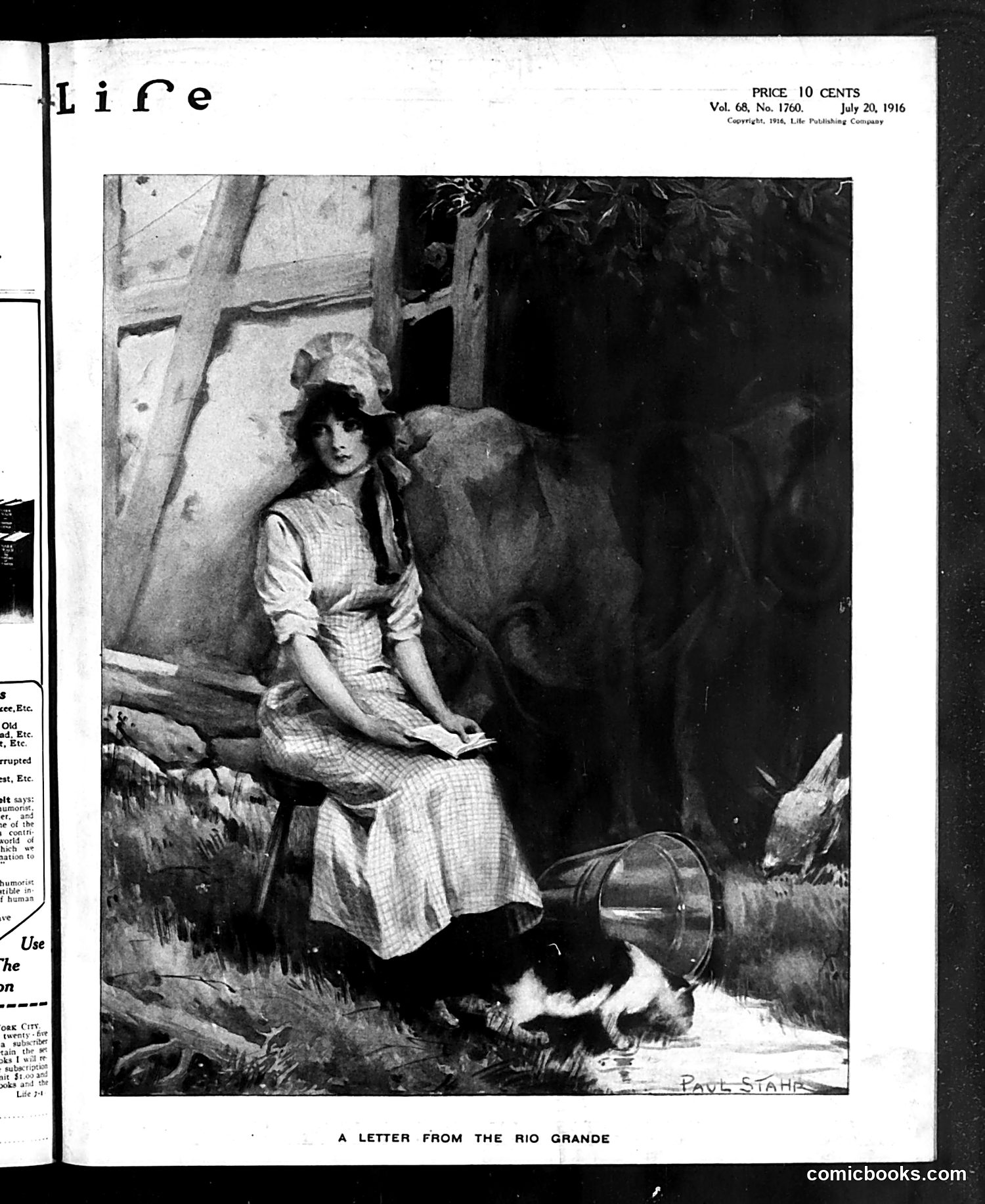
This Life magazine cover from July 20, 1916 depicts a woman milking a cow near a rustic structure, with the title "A Letter from the Rio Grande." The photograph is credited to Paul Staars. The Rio Grande reference likely alludes to the Mexican-American border region. In 1916, this area was a hotspot of tension due to Pancho Villa's cross-border raids into the American Southwest earlier that year. The domestic, peaceful scene—a woman performing farm work—appears intended to contrast with or comment on the border conflict and instability of the period. The image suggests American frontier resilience or normalcy amid regional turmoil, though the exact satirical intent remains unclear without accompanying article text.
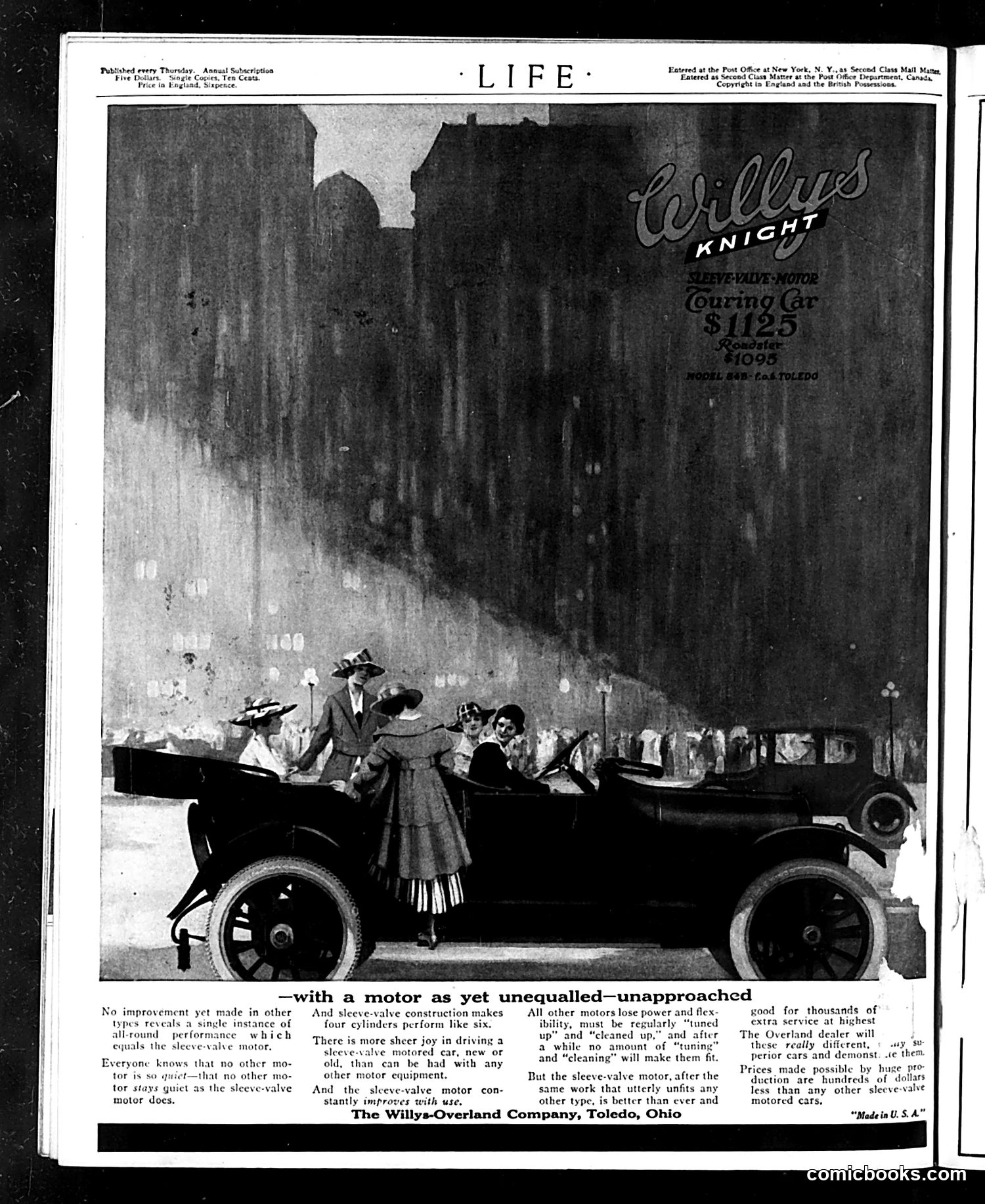
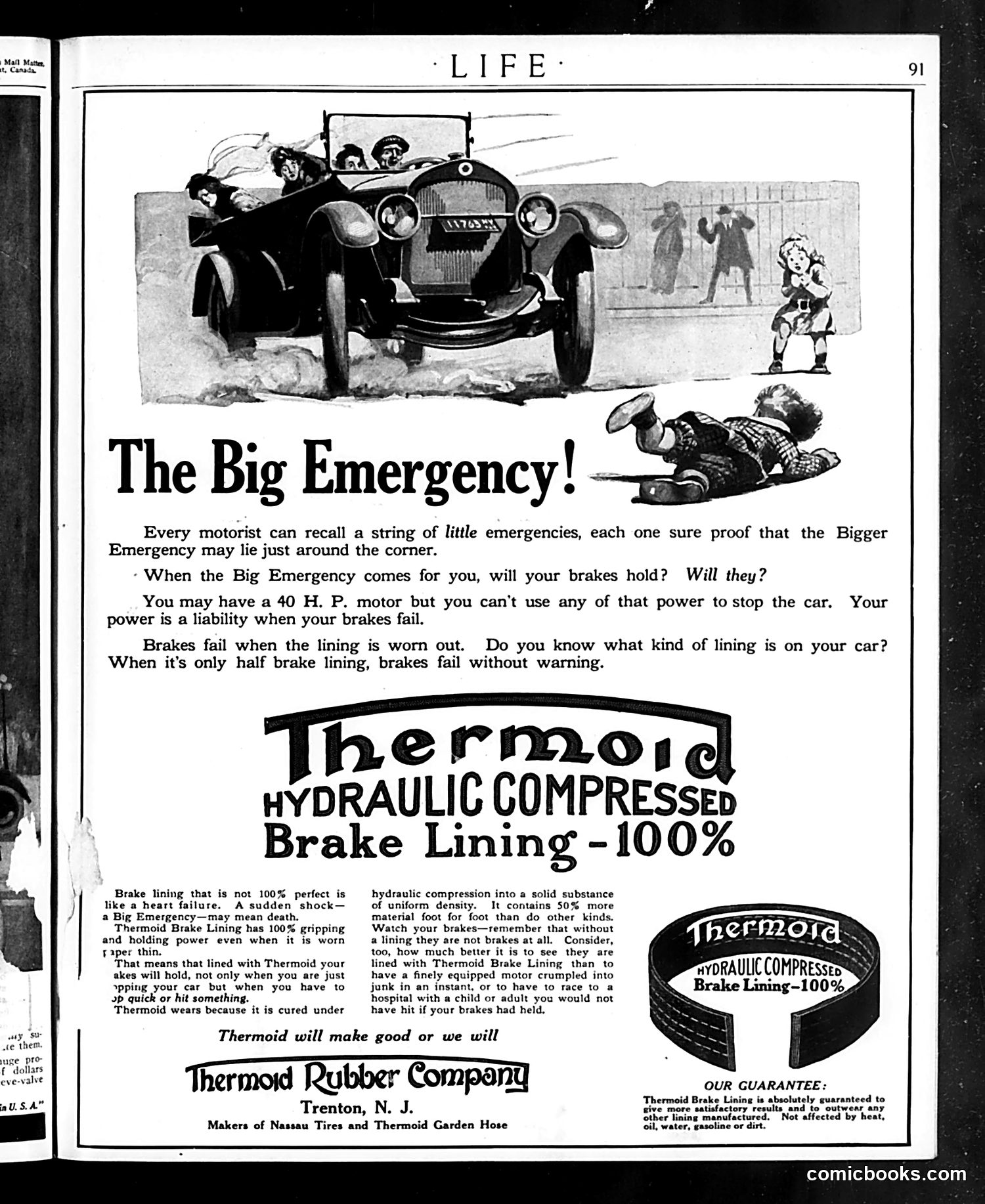
This page is **primarily an advertisement**, not satire or political commentary. It's a Thermoid Rubber Company ad for brake linings, appearing in Life magazine (page 91). The illustration depicts a dramatic traffic emergency: an overloaded automobile swerves to avoid pedestrians and a child in the street. The ad's message uses this scenario to promote safety—specifically, Thermoid's "Hydraulic Compressed Brake Lining-100%." The text argues that powerful engines are useless without reliable brakes, and that brake failure occurs when lining wears. The ad emphasizes Thermoid's superior brake lining composition and makes a guarantee: "Thermoid will make good or we will." This is vintage advertising leveraging public safety concerns to sell automotive products.
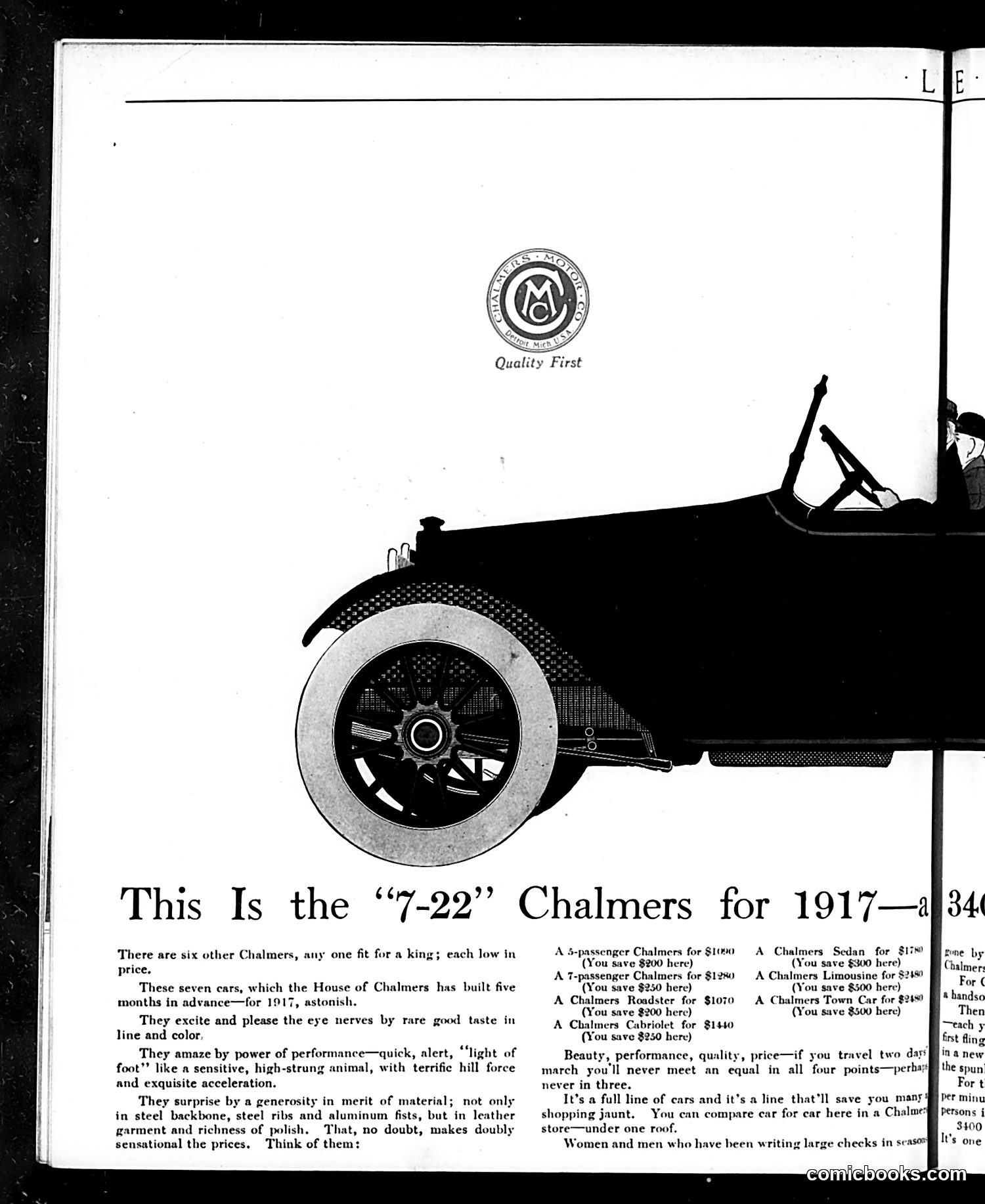
This page is **primarily an advertisement**, not political satire. It promotes the Chalmers automobile company's "7-22" model for 1917, featuring the company's "Quality First" logo. The image shows a side-view silhouette of an open-top touring car with a distinctive large wheel and steering mechanism visible. The accompanying text emphasizes the car's aesthetic and performance qualities—describing it as "quick, alert, 'light of foot'" with "terrific hill force and exquisite acceleration." The advertisement mentions six other Chalmers models available at various price points, positioning Chalmers as an upscale automotive manufacturer offering quality across multiple price ranges. This represents standard automotive advertising from the 1917 era, not editorial content or political commentary.
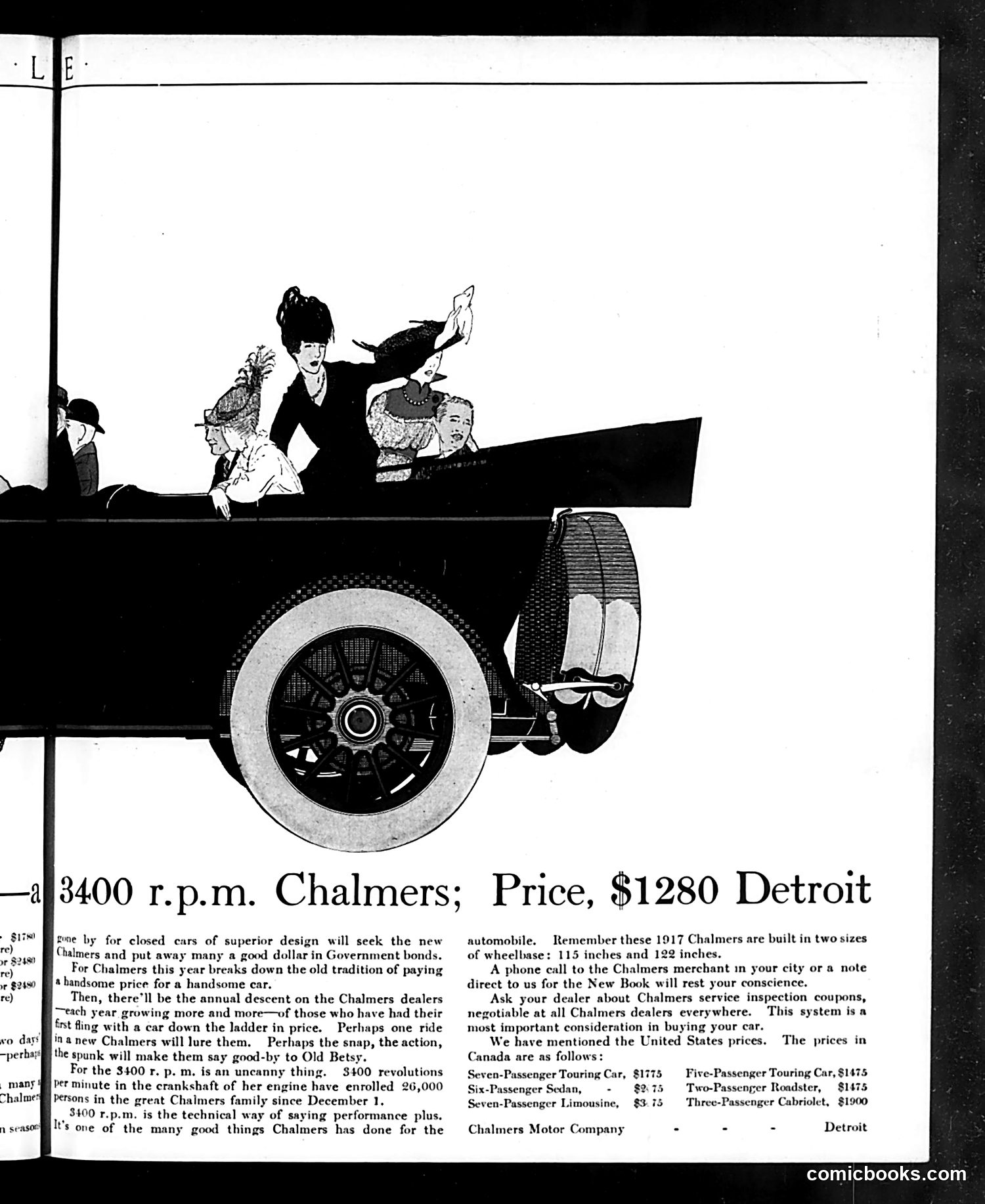
This is primarily a **Chalmers automobile advertisement**, not a political cartoon. It depicts a 1917 Chalmers motorcar priced at $1,280 in Detroit, shown in a humorous illustration of well-dressed passengers in an open-air vehicle. The accompanying text uses satire to market the car by referencing World War I: it suggests buyers of "closed cars of superior design" should purchase Chalmers instead, implying they could use savings to buy government war bonds. The ad jokes about the car's performance (3,400 r.p.m.) and attempts to create aspirational appeal through elegant passengers and sophisticated styling. The text includes Canadian pricing and mentions the car comes in two wheelbase sizes. This is commercial advertising using patriotic and humorous appeals rather than political commentary.
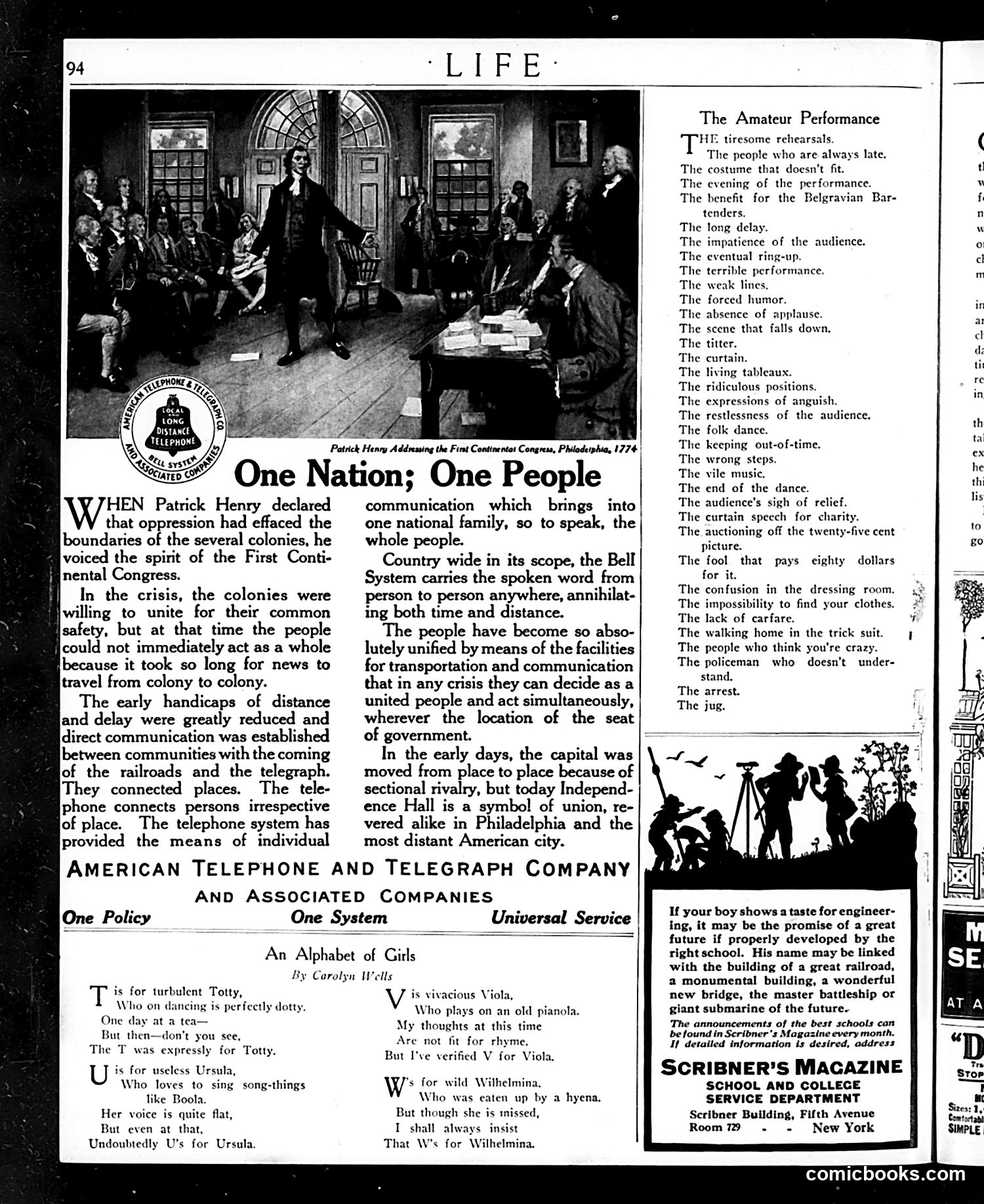
**Main Content:** This page features an advertisement for American Telephone and Telegraph Company, with a historical illustration showing "Patrick Henry Addressing the First Continental Congress, Philadelphia, 1776." The ad uses early American unity as a metaphor for how telecommunications connects the nation—suggesting that just as the colonies needed communication to unite during the Revolution, modern Americans need the telephone system for national cohesion. **Sidebar Humor:** "The Amateur Performance" lists comic frustrations of amateur theatrical productions (late rehearsals, poor costumes, weak lines), while "An Alphabet of Girls" contains humorous verses about women with alliterative names. The page primarily serves as corporate advertising disguised as patriotic historical content, appealing to readers' national pride while promoting commercial services.
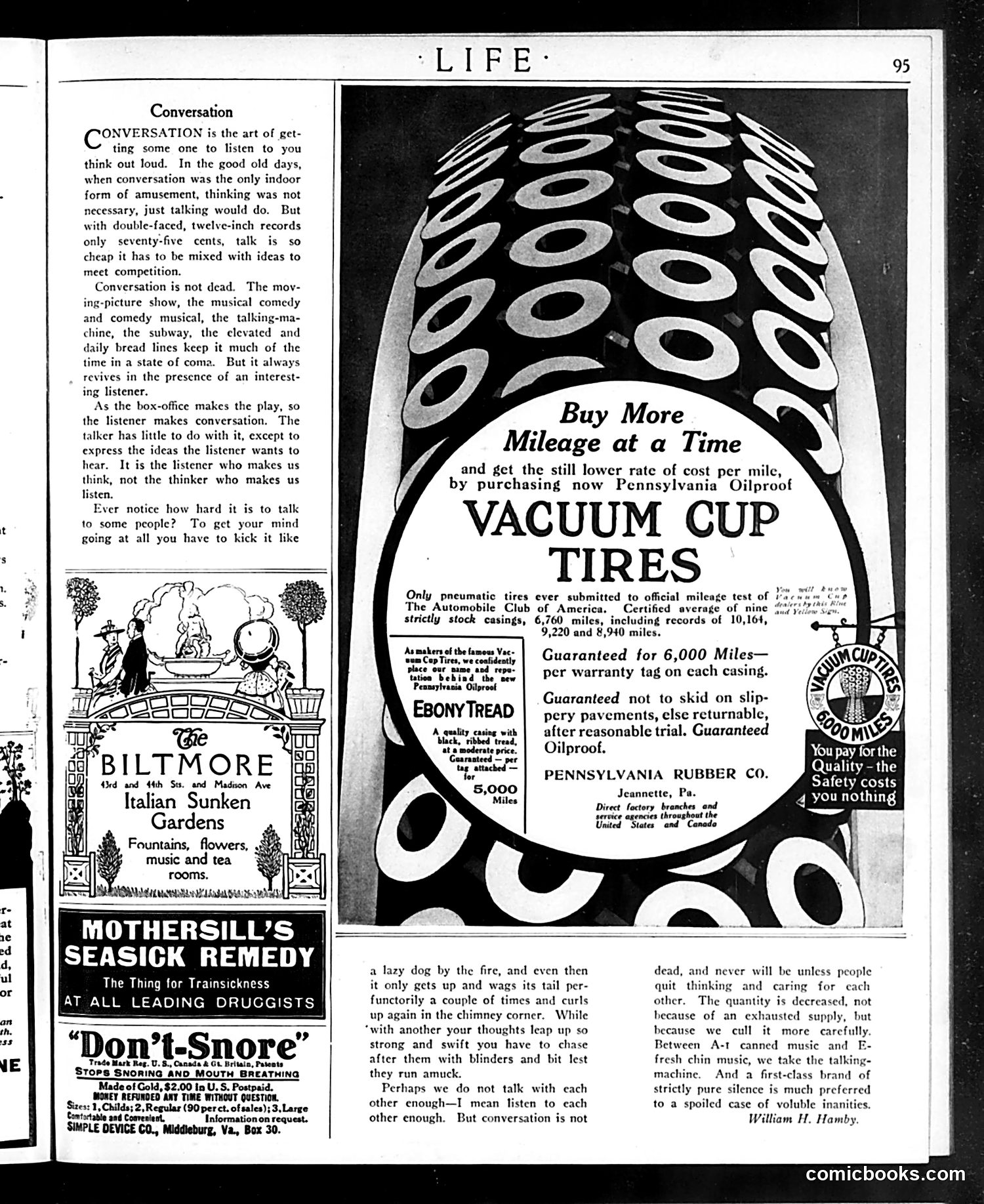
This is primarily **an advertising page** (page 95 of Life magazine) with a substantial article on "Conversation" on the left side. The main advertisement features **Pennsylvania Oilproof Vacuum Cup Tires**, shown as a large stylized tire with dramatic diagonal lines suggesting speed and modern design. The ad emphasizes durability (6,000-mile guarantee) and safety, reflecting early automotive industry competition. Below are three smaller ads: **Biltmore Italian Supper Gardens** (a dining venue), **Mothersill's Seasick Remedy**, and **"Don't-Snore"** (a device to stop snoring). The "Conversation" article critiques how people struggle to listen—arguing that genuine conversation requires an attentive listener, not just a talker. It references competing entertainment (moving pictures, records, music machines) that made conversation seem less necessary, though it remains vital.
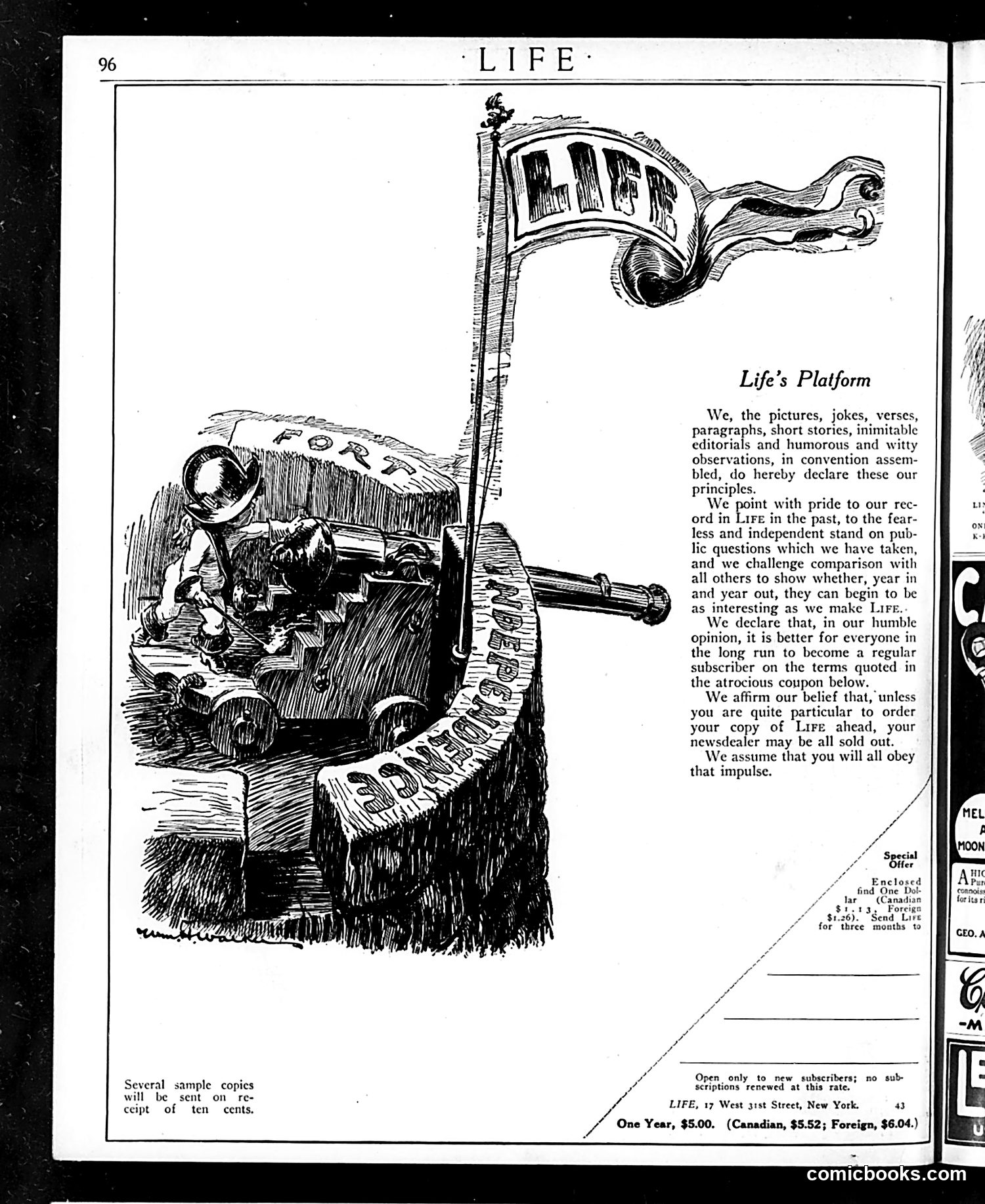
This page is primarily a **subscription advertisement and editorial manifesto** for *Life* magazine rather than a political cartoon. The illustration shows a sailor or military figure standing in what appears to be a ship's crow's nest or observation post, holding a telescope and flying a "LIFE" flag. The accompanying text declares the magazine's editorial principles: they publish pictures, jokes, verses, and humorous observations with pride in their "fearless and independent stand on public questions." They challenge competitors to match their quality and encourage subscriptions. The sailor imagery likely suggests Life takes an active, vigilant stance in observing and commenting on current affairs. The page includes subscription rates ($5 annually in the US, higher for Canada and foreign) and notes that sample copies are available for ten cents.
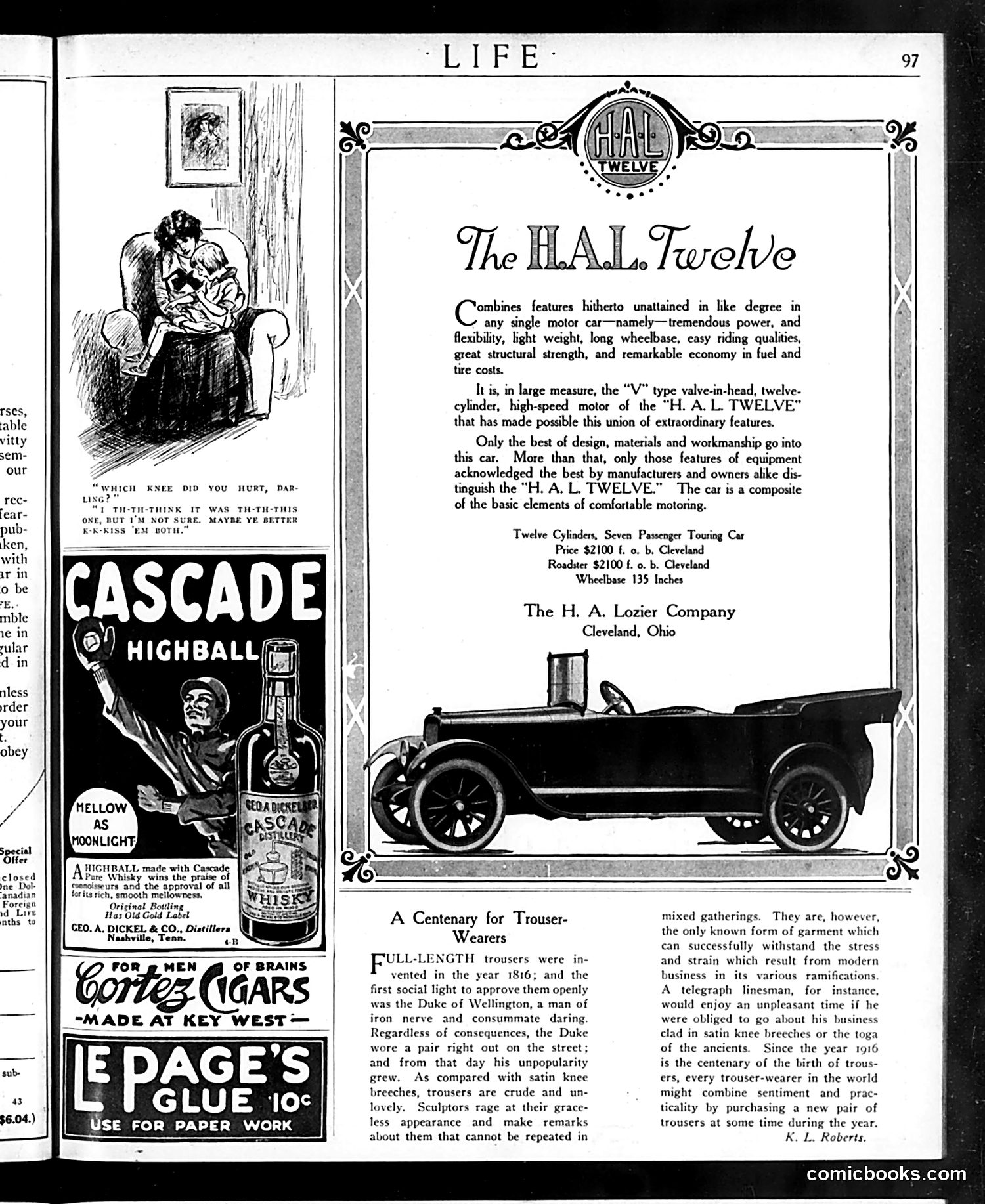
This is primarily an **advertising page** from Life magazine (page 97). The main content is a large advertisement for the **H.A.L. Twelve automobile**, made by The H. A. Lozier Company of Cleveland, Ohio. The ad emphasizes the car's engineering features—its twelve-cylinder, high-speed V-type valve-in-head motor—positioning it as a luxury vehicle combining power, flexibility, and economy. The page also contains several smaller vintage advertisements: **Cascade Highball whisky**, **Cortez Cigars** ("for men of brains"), and **Le Page's Glue**. On the left is an illustration with dialogue ("Which knee did you hurt, darling?"), likely from a humorous story or comic feature, though the full context isn't visible on this page.
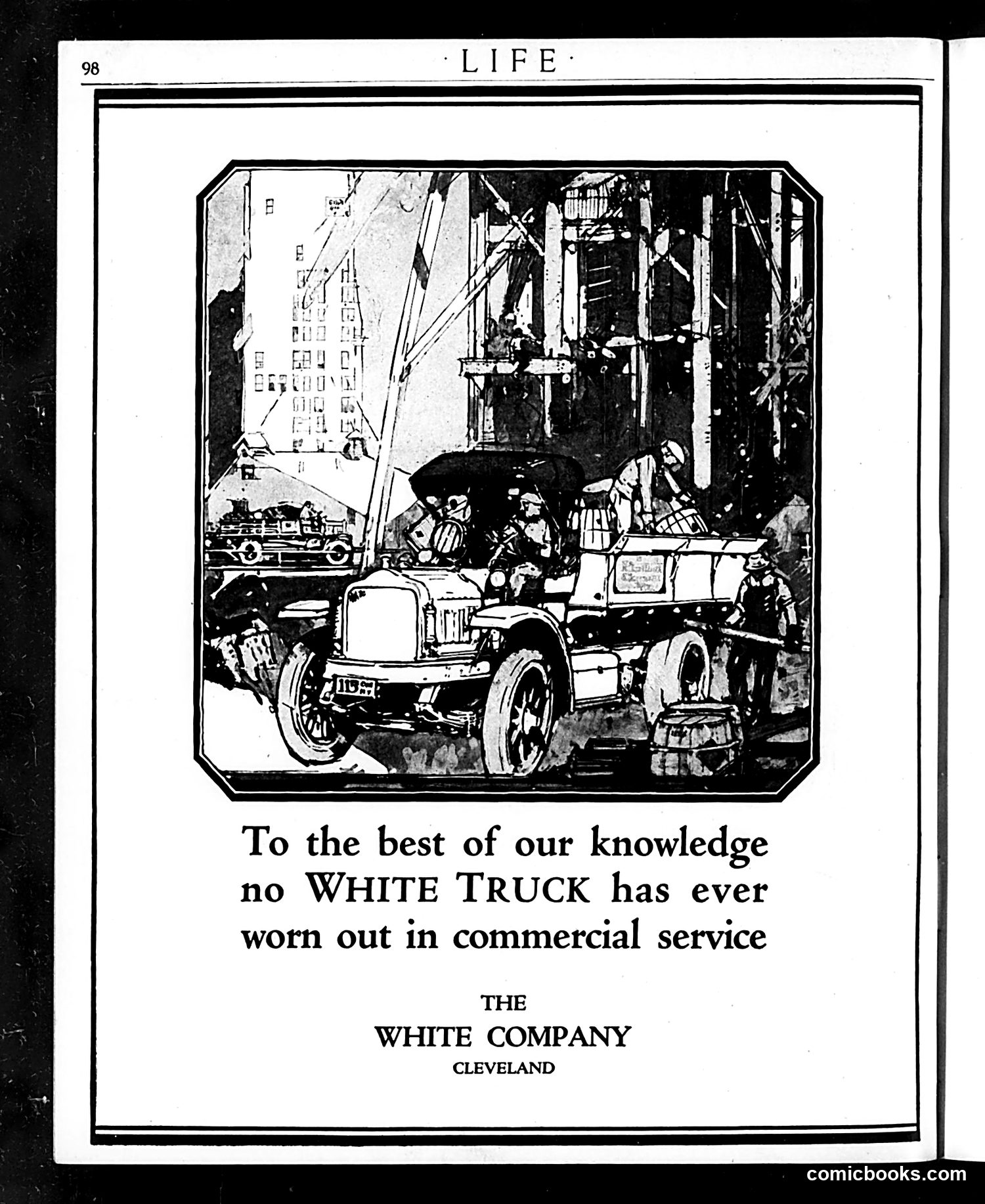
This is a straightforward advertisement, not satire. The White Company of Cleveland is promoting their commercial trucks with the claim: "To the best of our knowledge no WHITE TRUCK has ever worn out in commercial service." The image shows an early 20th-century truck in an urban street scene with pedestrians and buildings. The ad's assertion about trucks never wearing out is a bold durability claim typical of vintage advertising—essentially promising that White trucks are built to last indefinitely under commercial use. There is no political cartoon, caricature, or satire present on this page. It's a product advertisement emphasizing reliability and longevity, which were key selling points for commercial vehicles during this era.
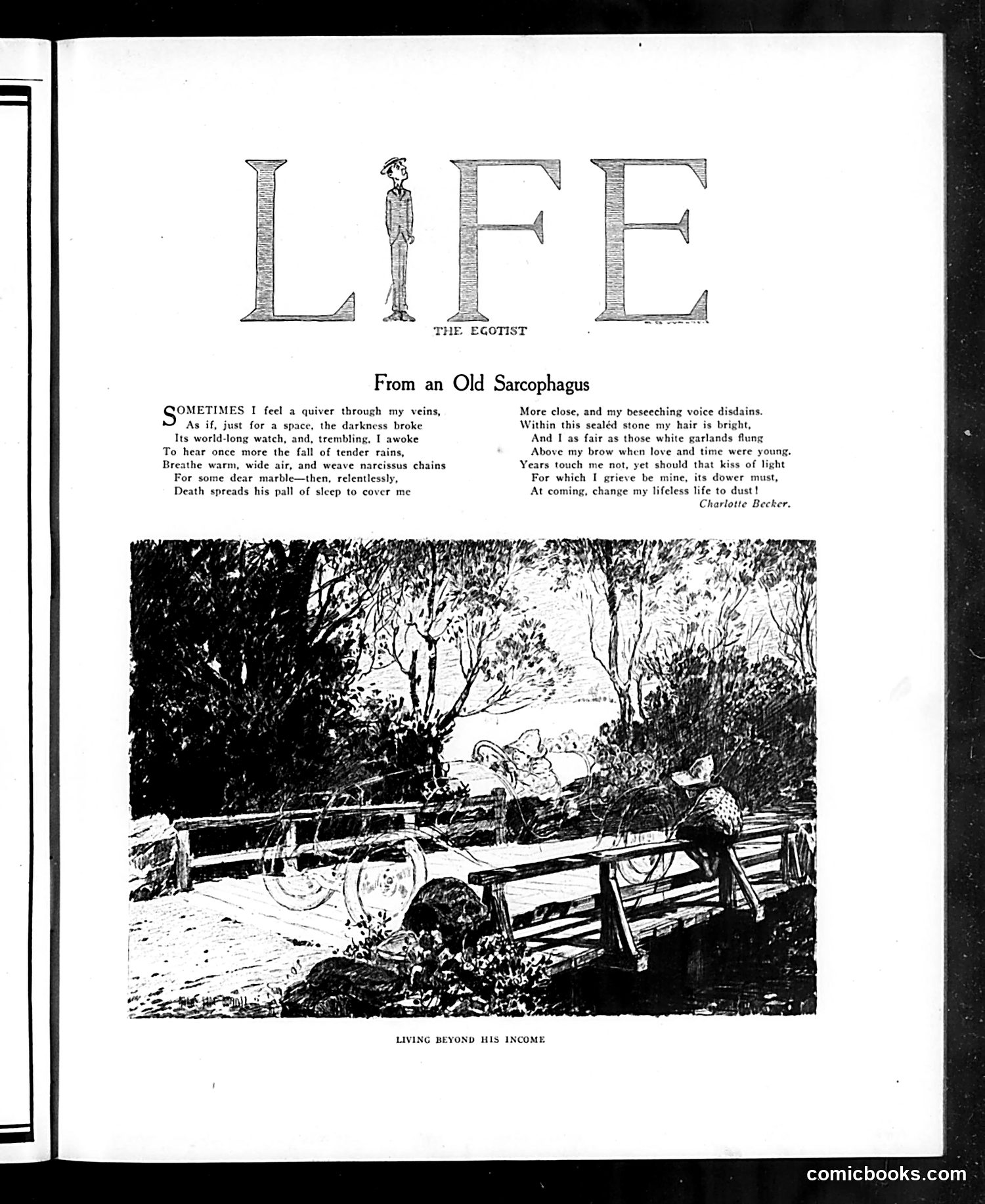
This page satirizes self-centered materialism through a poem by Charlotte Becker titled "The Egotist." The illustration shows a well-dressed man relaxing by a rural stream while his horse waits nearby, captioned "Living Beyond His Income." The satire targets wealthy individuals who maintain expensive lifestyles despite financial limitations. The poem expresses the speaker's desire to escape mortality through sensory pleasures—rain, warmth, marble—suggesting how the egotist seeks comfort and immortality through material indulgence rather than meaningful living. The juxtaposition of the leisured gentleman with the caption "Living Beyond His Income" directly mocks this contradiction: appearing prosperous while financially unsustainable. This reflects early 20th-century American concerns about conspicuous consumption and economic excess among the upper classes.
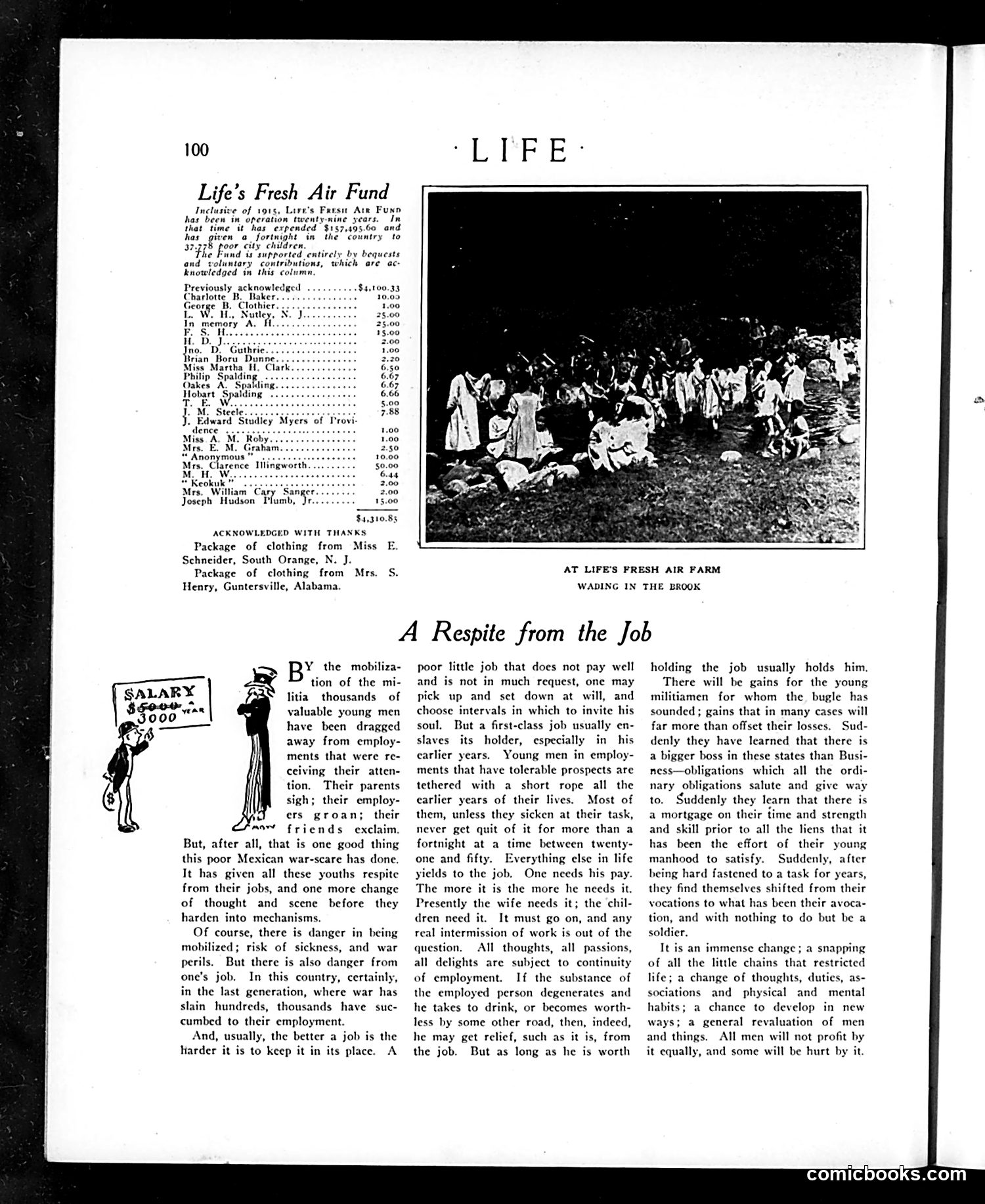
This page contains an article titled "A Respite from the Job" discussing young men's employment during wartime mobilization. The accompanying cartoon shows a figure labeled with a salary sign ($5000, then crossed out to $3000), illustrating wage cuts or employment concerns. The article argues that despite wartime job demands, young men benefit from occasional breaks. It acknowledges the "danger" of mobilization while suggesting that maintaining employment—however demanding—is preferable to unemployment. The piece advocates for work-life balance, noting that relief from constant labor allows workers to "develop in new ways." The tone reflects post-WWI American anxieties about employment stability and the tension between economic necessity and worker welfare.
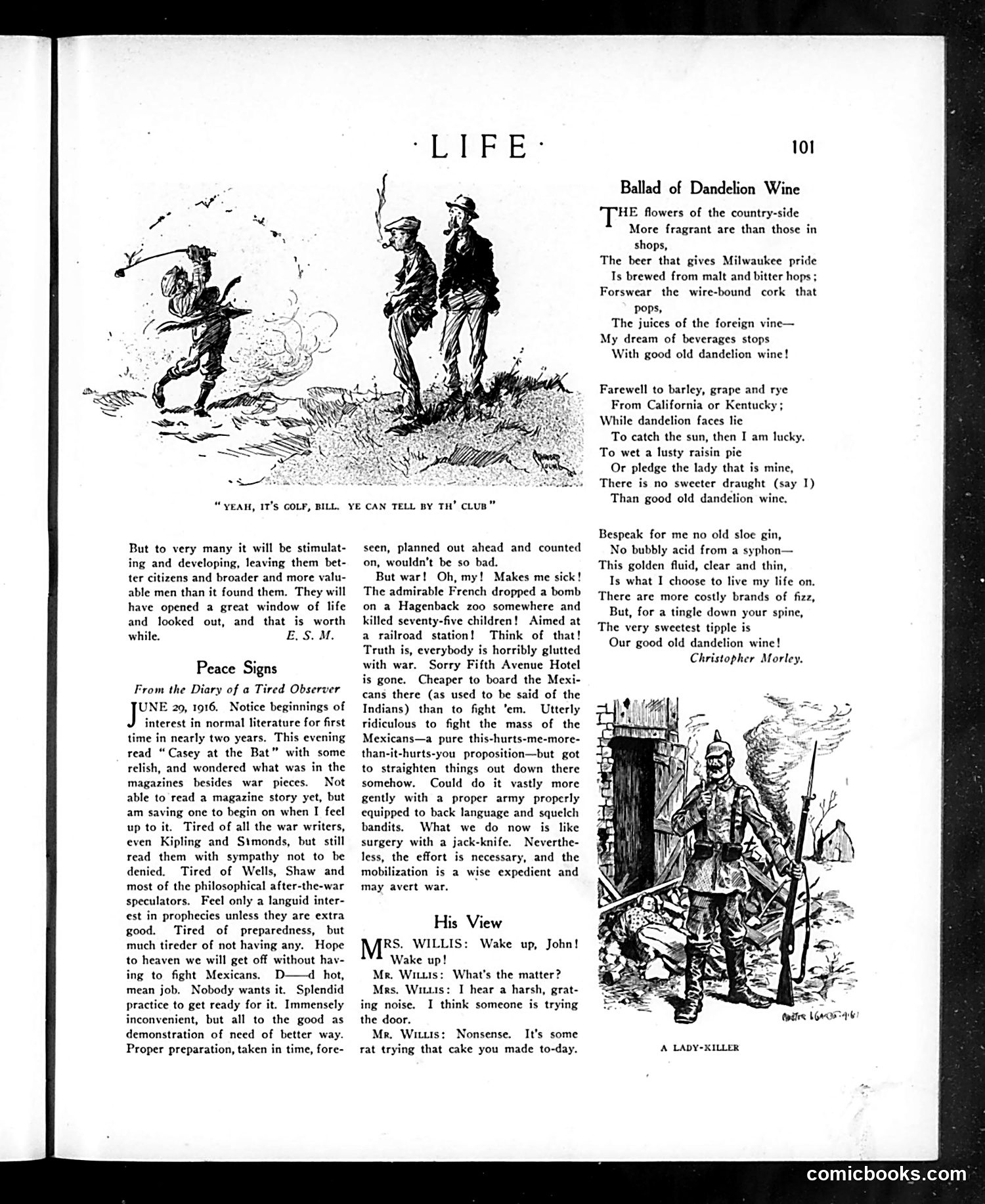
This page contains three distinct pieces reflecting 1916 American anxieties: 1. **"Peace Signs"** - Commentary mocking Americans' war weariness and inconsistent priorities. The author criticizes readers fatigued by war coverage while simultaneously dismissing serious literature as insufficiently entertaining. 2. **"Ballad of Dandelion Wine"** - A poem celebrating homemade dandelion wine as superior to commercial beverages. Given WWI context, this likely reflects nostalgia for simpler times and criticism of commercial culture's priorities during wartime. 3. **"His View"** - A dialogue between Mr. and Mrs. Willis about domestic disturbance, illustrated by a sketch titled "A Lady-Killer," suggesting satirical commentary on marital relations or domestic life. The cartoons employ gentle satire targeting American cultural priorities and home-front attitudes during the Great War period.
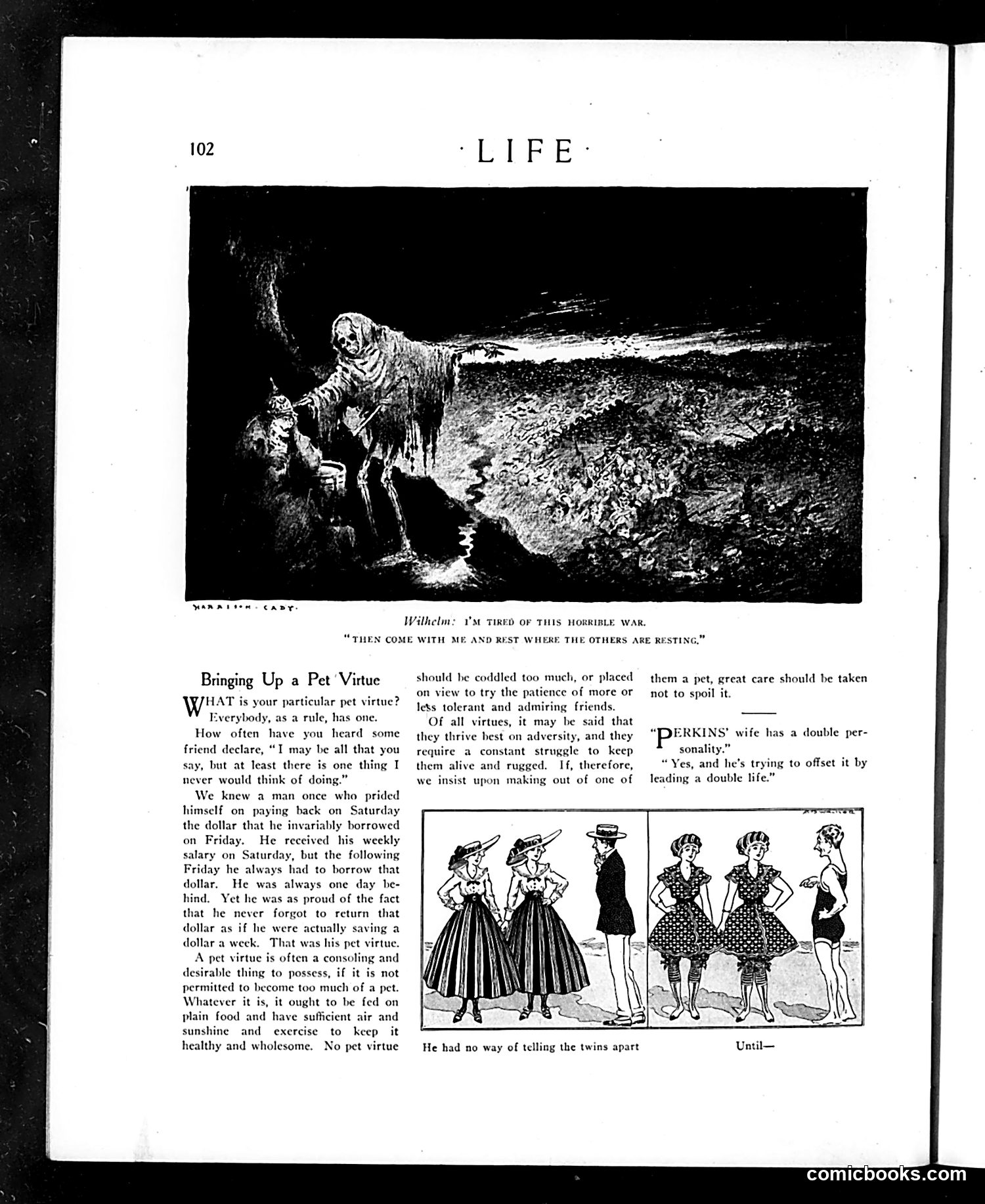
This page from *Life* magazine addresses "pet virtues"—desirable character traits people cultivate. The top illustration (titled "Wilhelm: I'm Tired of This Horrible War") appears to reference World War I, showing a weary figure, likely representing Kaiser Wilhelm II, suggesting even warmongers tire of conflict. The main article argues that virtues shouldn't become excessive or burdensome. It uses a humorous example of a man who prides himself on repaying a borrowed dollar weekly—treating penny-pinching as virtue, missing the actual point of frugality. The lower cartoon about Perkins' "double personality" jokes about maintaining contradictory virtues simultaneously. The final illustration shows difficulty distinguishing between twin girls, humorously suggesting that virtue can become so exaggerated it becomes indistinguishable from its opposite.
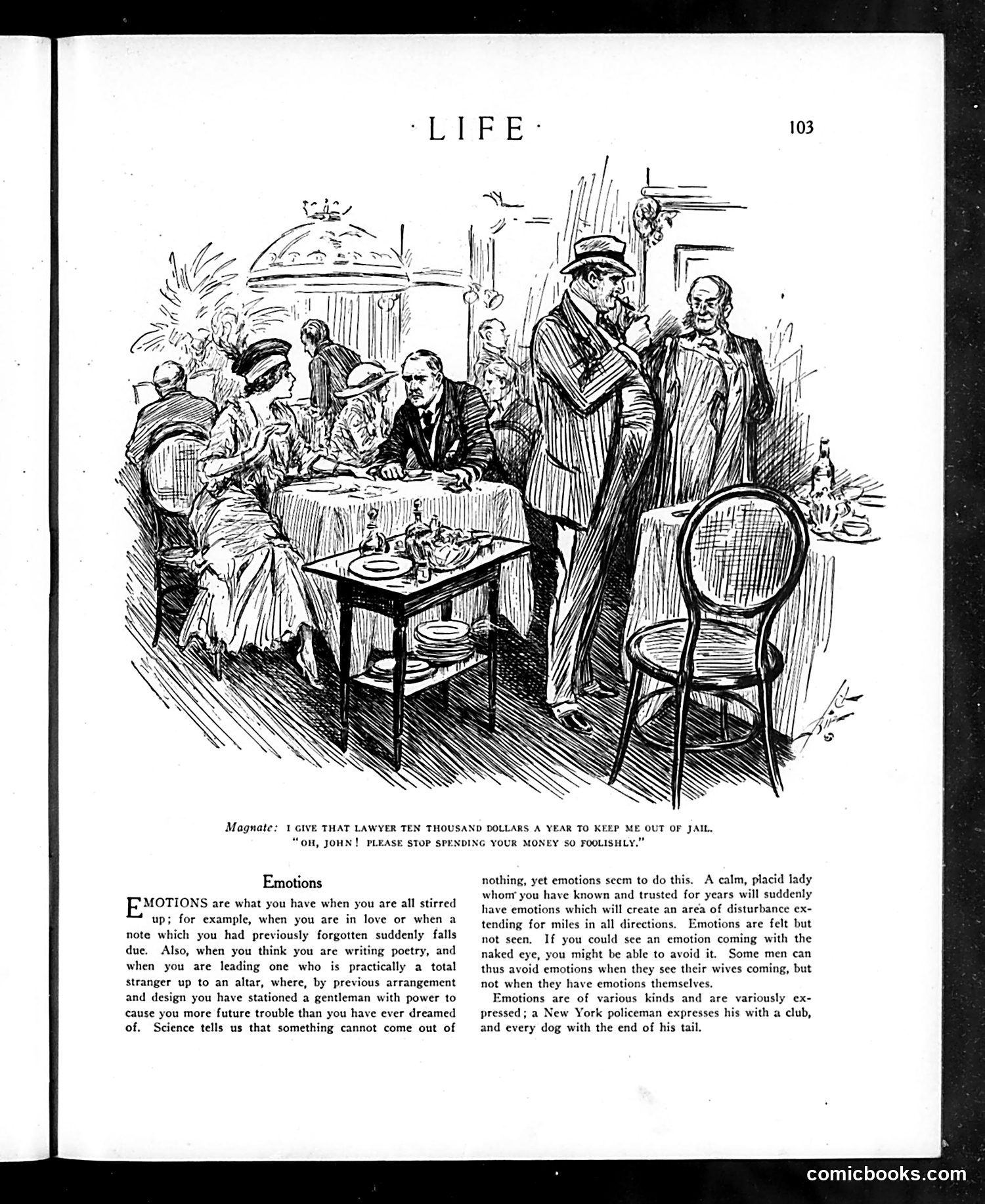
**The Cartoon:** This satirical cartoon depicts a social gathering where a magistrate (identified by his judicial appearance) sits at a table while well-dressed men in suits converse around him. The caption reads: "I GIVE THAT LAWYER TEN THOUSAND DOLLARS A YEAR TO KEEP ME OUT OF JAIL. 'OH, JOHN! PLEASE STOP SPENDING YOUR MONEY SO FOOLISHLY.'" **The Satire:** The joke mocks the hypocrisy of wealthy individuals who maintain expensive lawyers to protect them from legal consequences, while their spouses criticize their extravagant spending. It satirizes the notion that the wealthy can essentially "buy" legal immunity through retainer fees—a pointed commentary on class-based justice where money determines legal protection. **Social Context:** This reflects turn-of-the-century concerns about wealthy elites operating above the law through legal maneuvering and financial means.
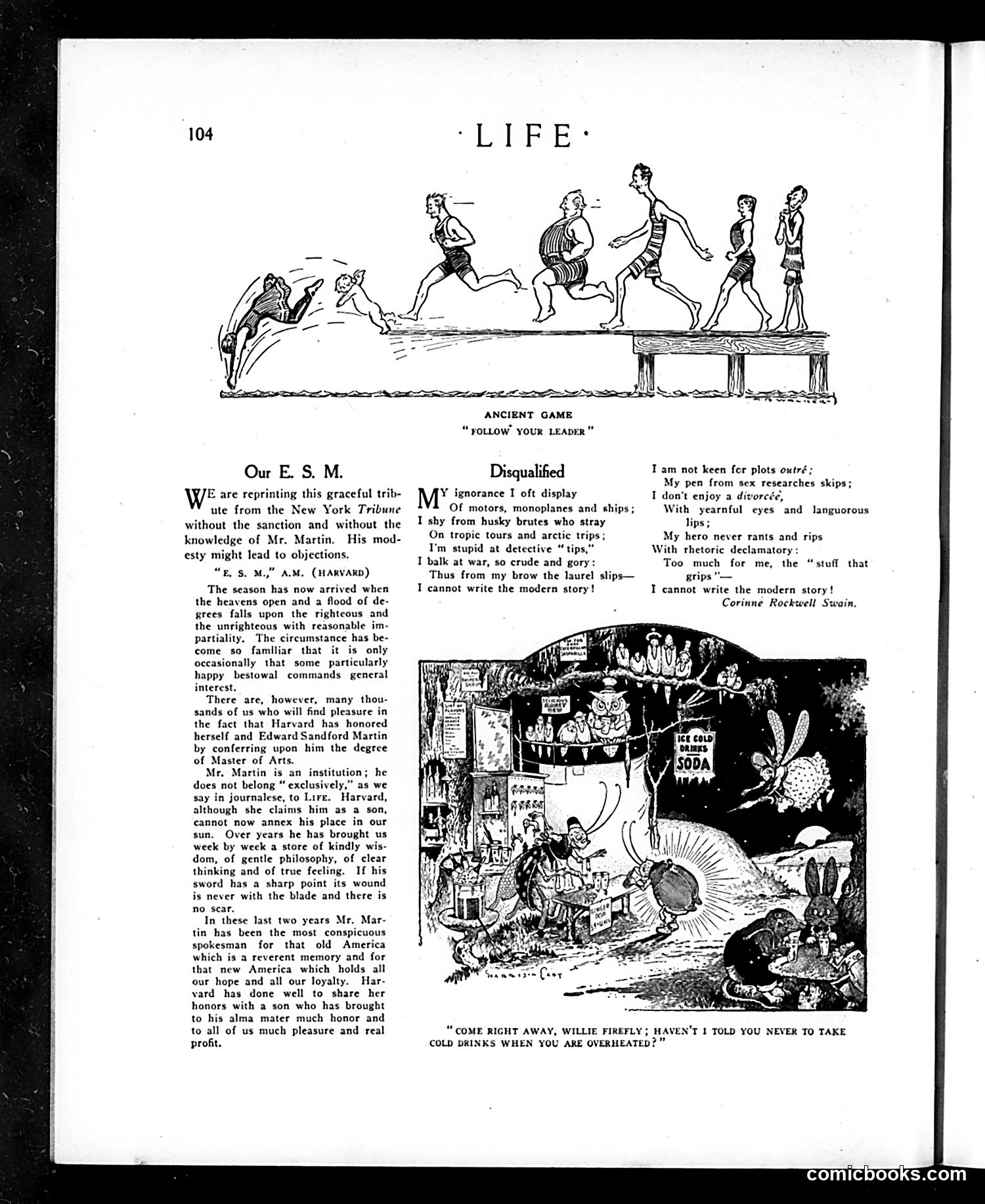
**Main Content:** The page honors Edward Sandford Martin, editor of *Life* magazine, upon receiving a Master of Arts degree from Harvard. The tribute praises Martin as an institution providing "kindly wisdom" and "gentle philosophy" to readers over many years, and credits him as a spokesman for both traditional and progressive American values. **Cartoons:** 1. **"Follow Your Leader"** (top): An ancient game illustration showing children in a line following a leader—likely satirizing conformity or herd behavior, though the specific contemporary reference is unclear. 2. **Street scene cartoon** (bottom): Shows children at an ice cream stand, with a child being warned not to drink cold beverages when overheated—a practical health joke about parental concern. **Poem "Disqualified"** by Corinne Rockwell Swain mocks modern literature trends (motor cars, aviation, war, detective stories, sexual content, divorce) that the author cannot or will not write about, expressing inability to produce "the modern story." The page reflects early 20th-century anxieties about modern sensationalism in fiction.
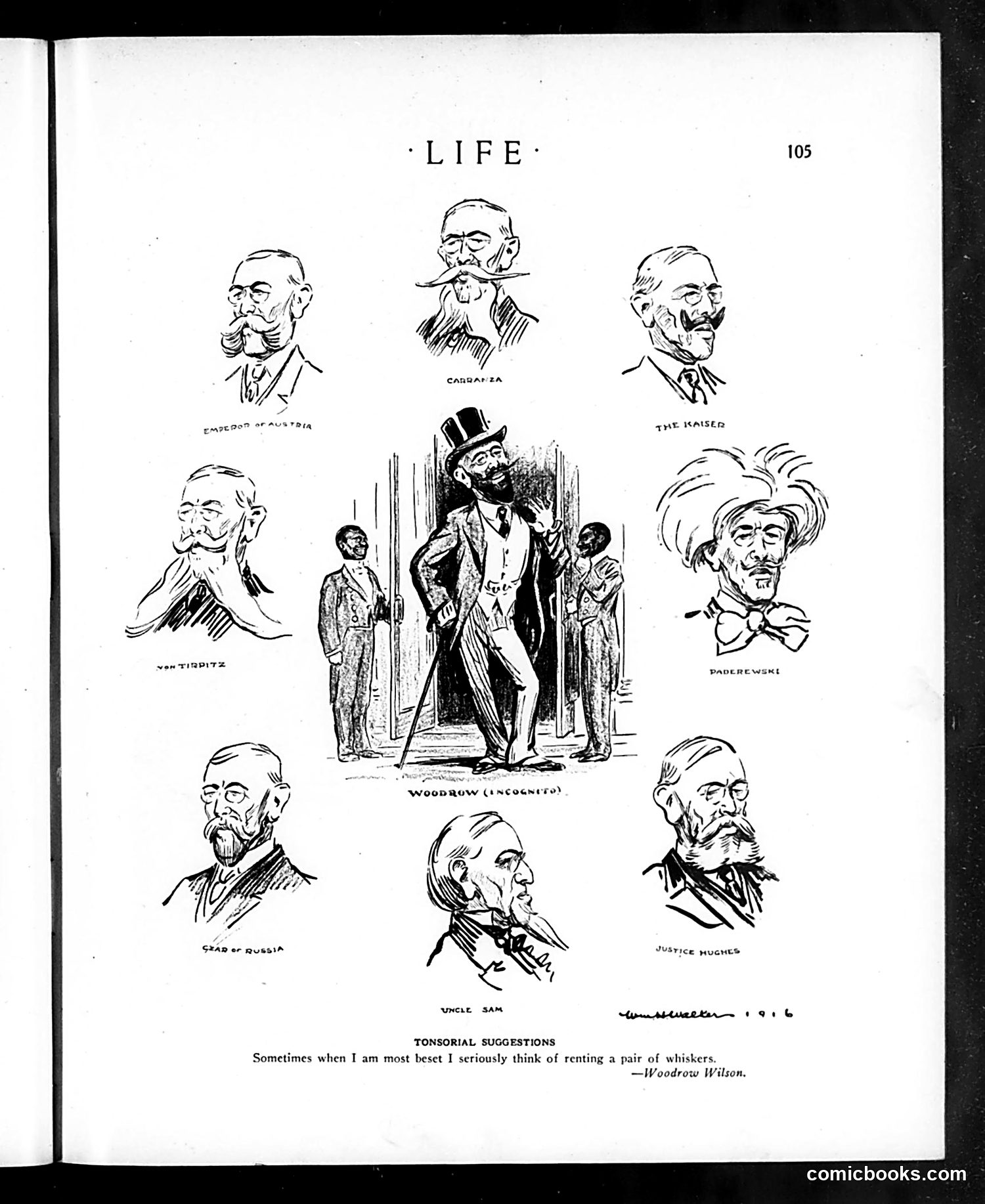
This 1916 Life magazine page presents caricatured heads of prominent world leaders arranged around a central figure labeled "Woodrow (Incognito)" wearing a top hat and false whiskers. The surrounding figures are identified as the Emperor of Austria, Czar (of Russia), The Kaiser, Van Tidditz, Paderewski, Czar of Russia, Uncle Sam, and Justice Hughes. The satire references Woodrow Wilson's quote about wanting to "rent a pair of whiskers" when troubled—suggesting he'd like to disguise himself among other leaders. The joke implies Wilson felt beset by international pressures (WWI was ongoing in 1916, though America hadn't yet entered). The cartoon humorously suggests that donning false whiskers would let him hide among Europe's bearded autocrats, satirizing both Wilson's predicament and the distinctive facial hair styles of contemporary world leaders.
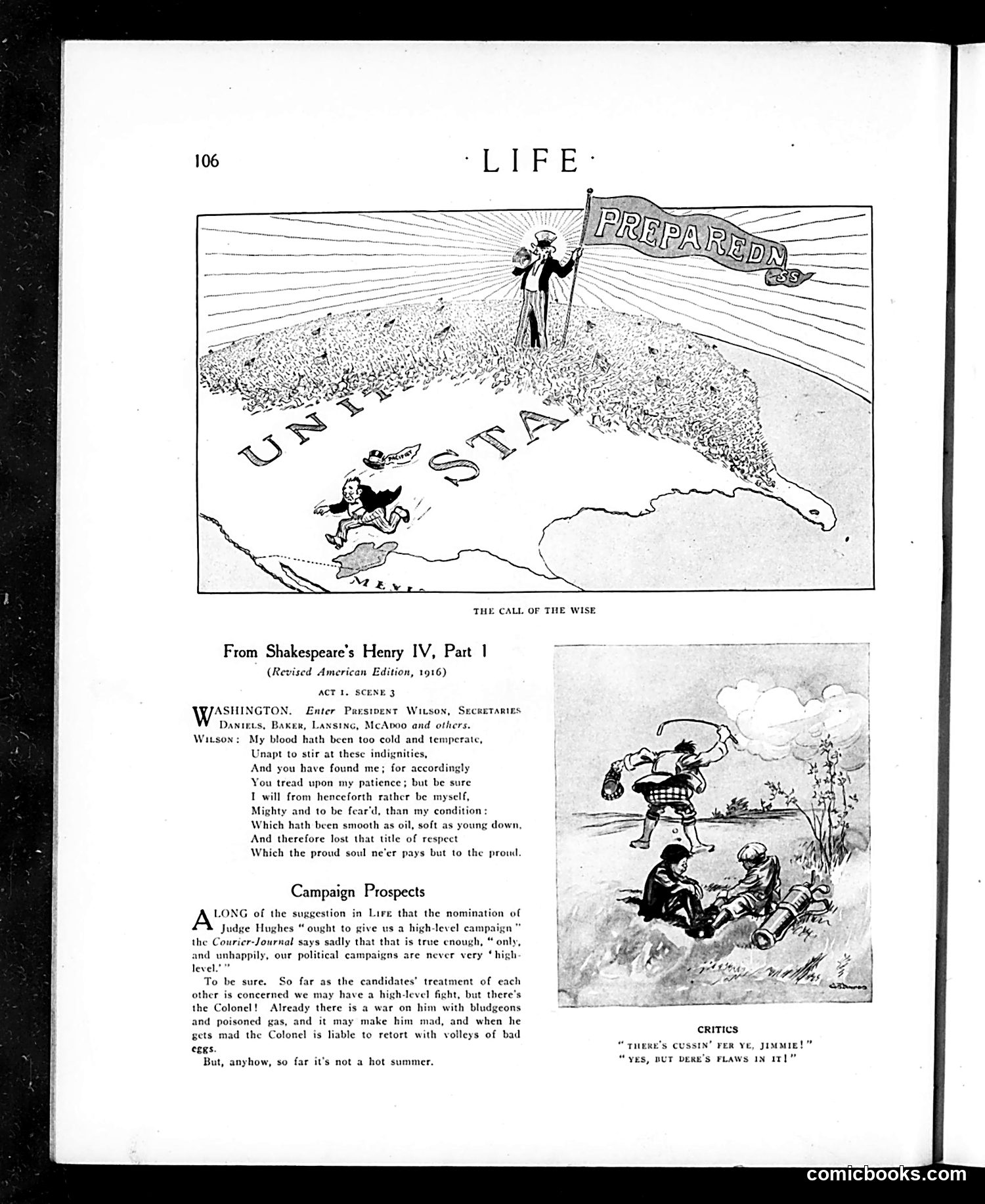
This *Life* magazine page (1916) uses Shakespeare's *Henry IV* to satirize President Wilson's political temperament. The top cartoon shows Wilson as a figure standing in a barren landscape labeled "UNITE[D] STA[TES]," with "PREPARED[NESS]" in the sky—referencing heated 1916 debates over American military preparedness before WWI entry. The text presents Wilson's lines about being "too cold and temperate" and needing to become "Mighty and to be fear'd"—mocking his reputation for cautious diplomacy while pressured by interventionists. Below, "Campaign Prospects" discusses Judge Hughes's nomination (Republican candidate, 1916) and warns that Theodore Roosevelt ("the Colonel") will attack Hughes viciously with "bludgeons and poisoned gas," predicting the Colonel will retaliate with "volleys of bad eggs." This reflects Roosevelt's notorious combativeness in politics. The small cartoon shows two figures arguing, labeled "CRITICS," capturing the nasty tone expected in the 1916 campaign.
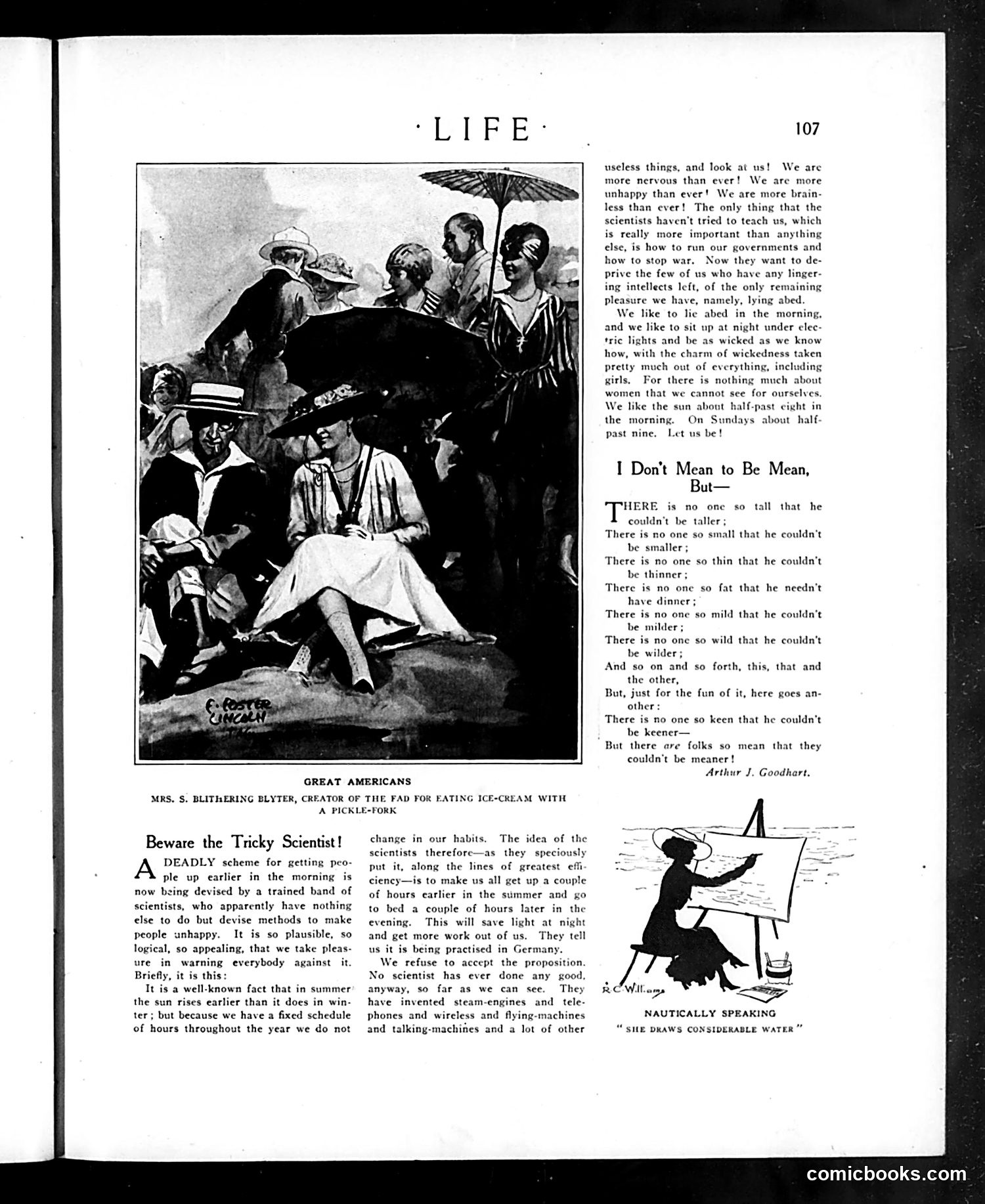
This page contains three distinct satirical pieces: **"Great Americans" Cartoon**: Mocks a frivolous social fad by crediting "Mrs. S. Blithering Blyter" as the originator of eating ice-cream with a pickle-fork—absurdist humor about meaningless etiquette trends. **"Beware the Tricky Scientist!"**: Satirizes proposed daylight-saving time (appears to reference German practice). The author argues scientists create useless inventions (steam engines, wireless, flying machines) while failing at important problems like government and war. The piece defends the simple pleasure of lying in bed—mocking both scientific "efficiency" and the loss of personal freedom to scheduling. **"I Don't Mean to Be Mean, But—"**: A humorous poem by Arthur J. Goodhart using repetitive structure to assert everyone has room for improvement, culminating in the punchline that some people are genuinely irredeemable in meanness. **"Nautically Speaking" Cartoon**: A maritime pun caption ("She draws considerable water") accompanying a sketch of a woman fishing. The page exemplifies *Life*'s blend of social commentary, gentle mockery of modern conveniences, and light wordplay.
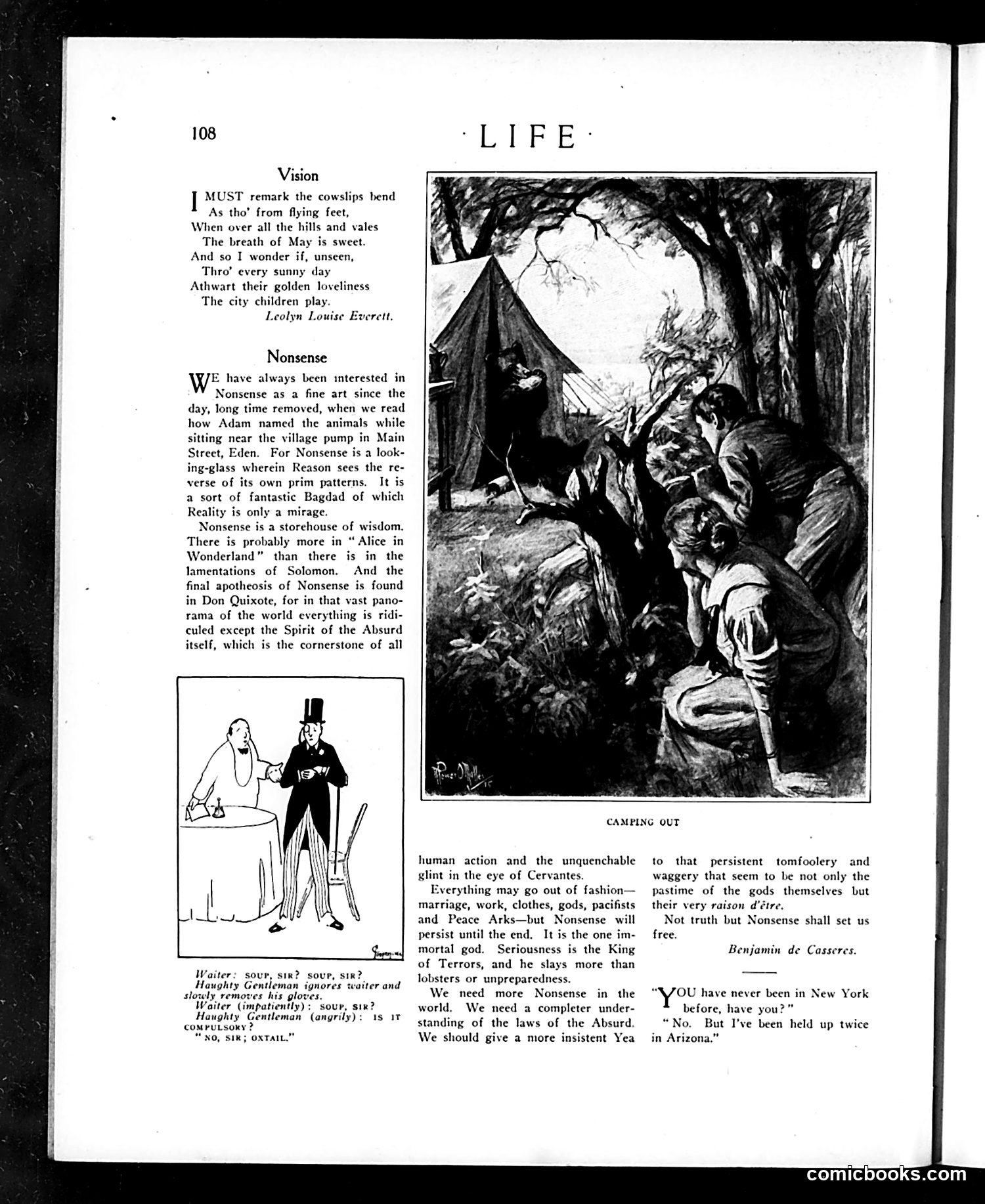
This page contains two distinct elements: **The Small Cartoon (bottom left):** A satirical sketch of class pretension. A haughty gentleman ignores a waiter's question about soup ("sour, six?"), instead slowly removing his gloves in an affected manner. When finally answering, he pompously corrects the waiter—it's "oxtail," not soup. The joke mocks upper-class affectation and the gentleman's condescending treatment of working-class service staff. **The Essays:** The page features two philosophical pieces: "Vision" (poetry about city children and May) and "Nonsense" (an essay praising nonsense as superior to seriousness, citing *Alice in Wonderland* and *Don Quixote* as examples of wisdom). The final anecdote—a New Yorker claiming to have been "held up twice in Arizona"—exemplifies the absurdist humor being celebrated: an absurd boast that deflates Eastern pretension through Western exaggeration. The page overall champions irrationality and humor as antidotes to stifling convention.
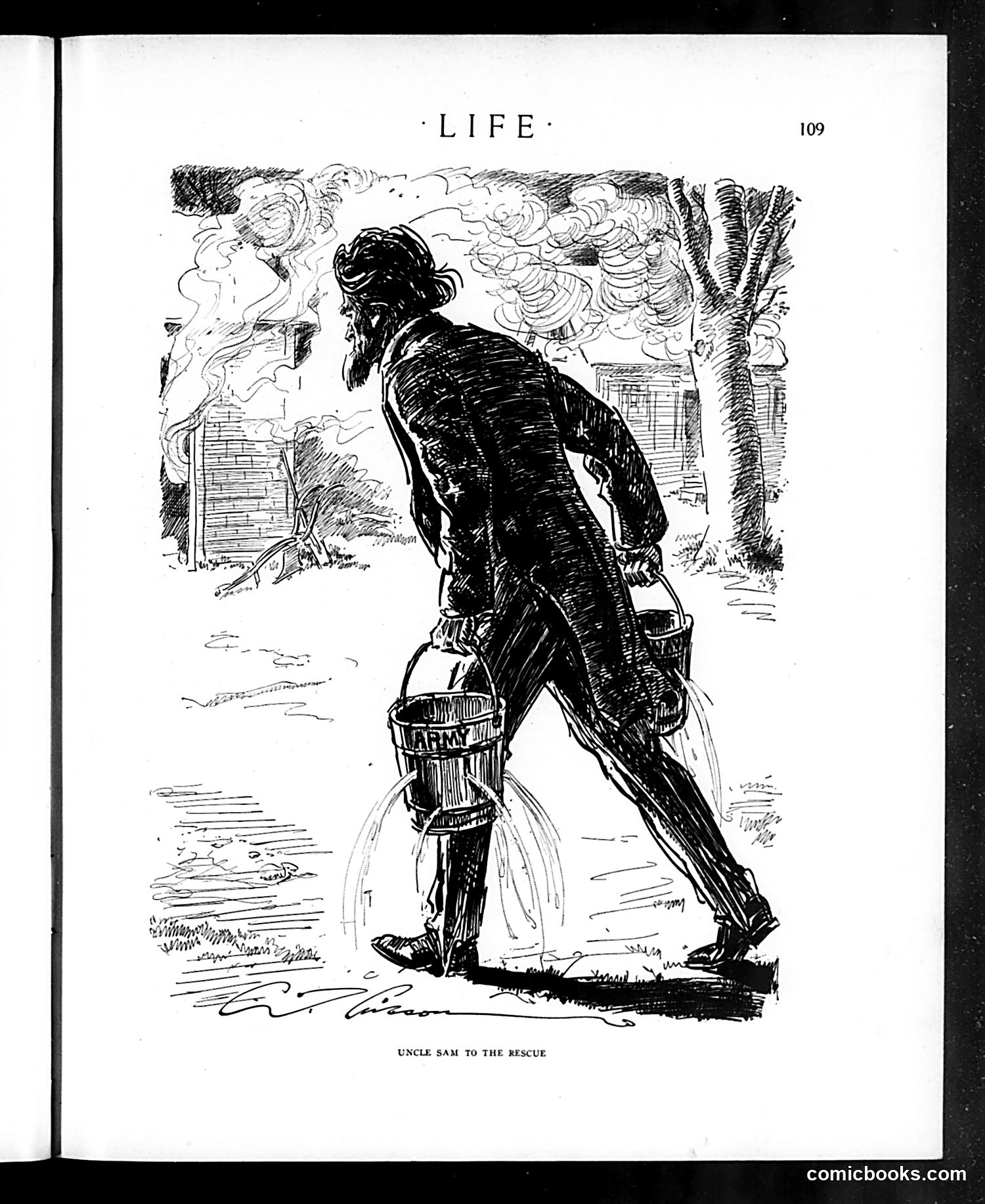
This political cartoon depicts Uncle Sam (the bearded figure in dark suit and star-emblazoned armband) carrying a large bucket labeled "ARMY." He strides toward a burning building in the background, suggesting an urgent rescue mission. The cartoon likely comments on American military intervention or mobilization during a crisis—possibly World War I era, given the style and Uncle Sam's prominent "ARMY" identification. The satire suggests the United States is being called upon as a rescuer, though without additional context clues on this page, the specific crisis being referenced remains unclear. The dramatic composition emphasizes Uncle Sam's role as national protector responding to emergency.
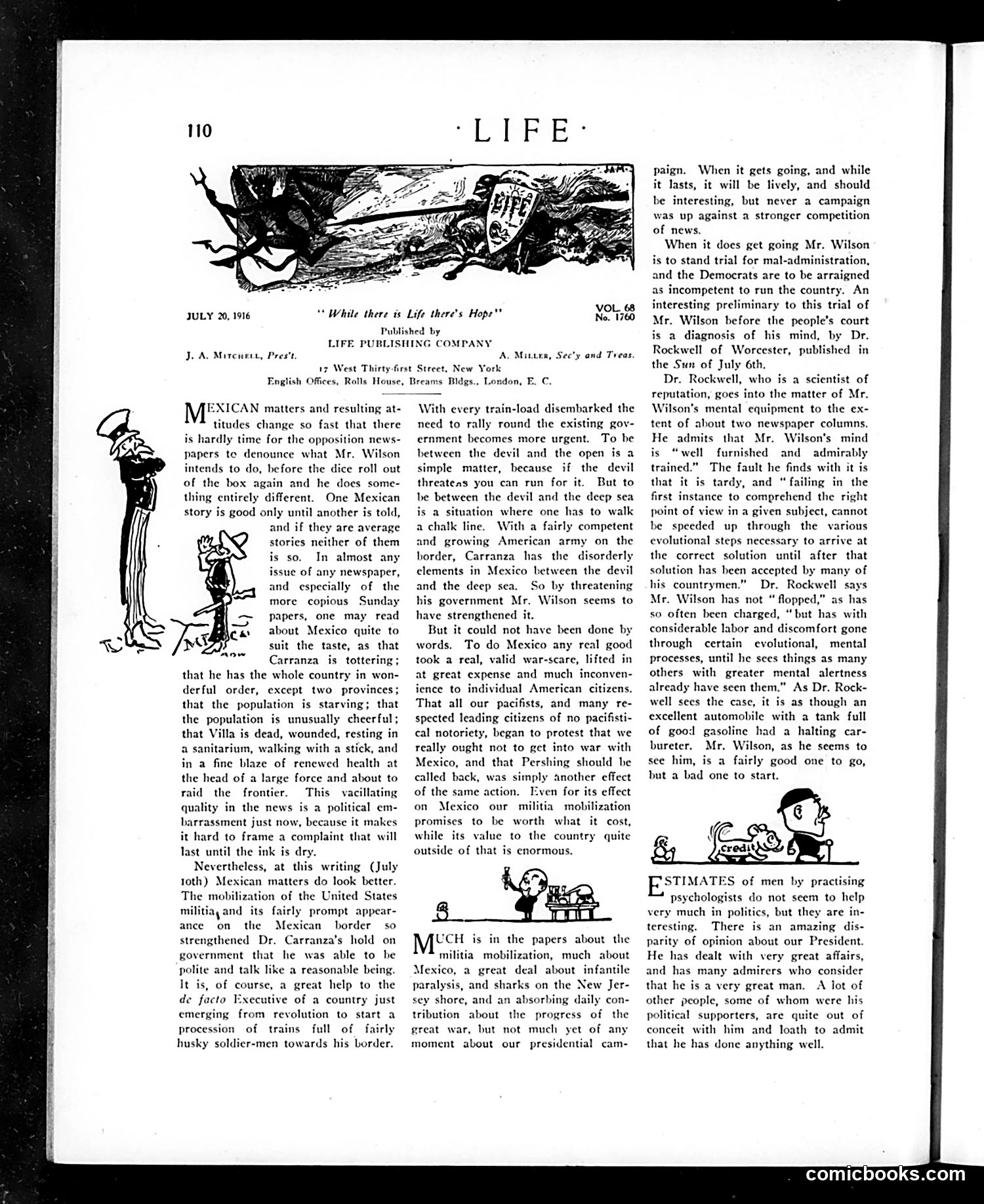
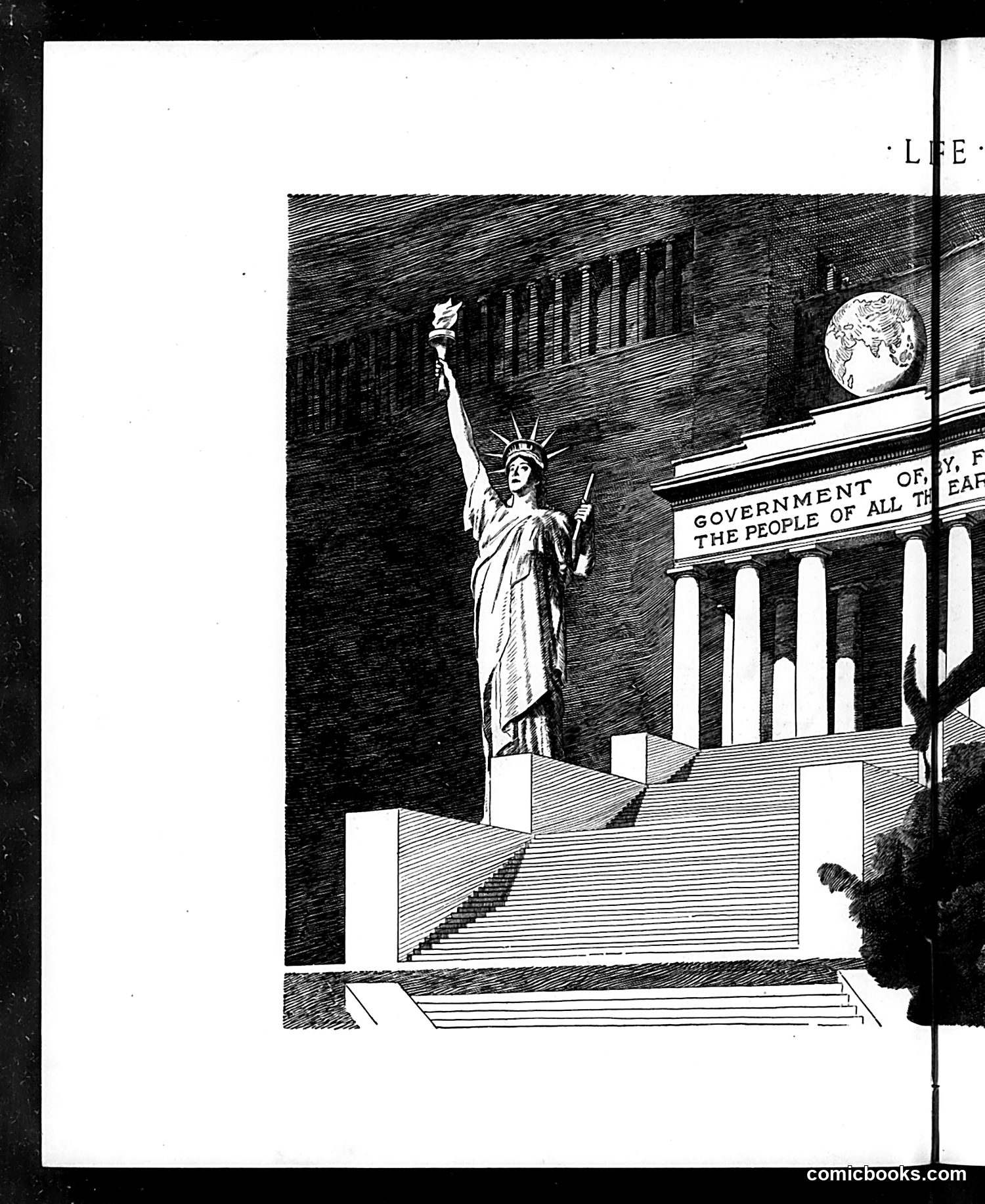
This editorial page discusses the chaotic Mexican situation and President Wilson's response. The main argument: Wilson's militia mobilization on the Mexican border—ostensibly threatening war—paradoxically *strengthened* the Mexican government under Carranza by forcing disorderly elements to rally against external danger. The cartoons (appearing as decorative marginalia) likely mock the absurdity and rapid reversals of Mexican news coverage: stories contradict themselves daily, making it impossible for opposition newspapers to sustain consistent criticism of Wilson's policies. The text also notes Wilson faces upcoming trial for "mal-administration" in the presidential campaign, but Mexico dominates news coverage, overshadowing domestic politics. The author argues that despite pacifist protests against military mobilization, the show of force provided real diplomatic benefit—demonstrating how military posturing can achieve political goals without actual war.
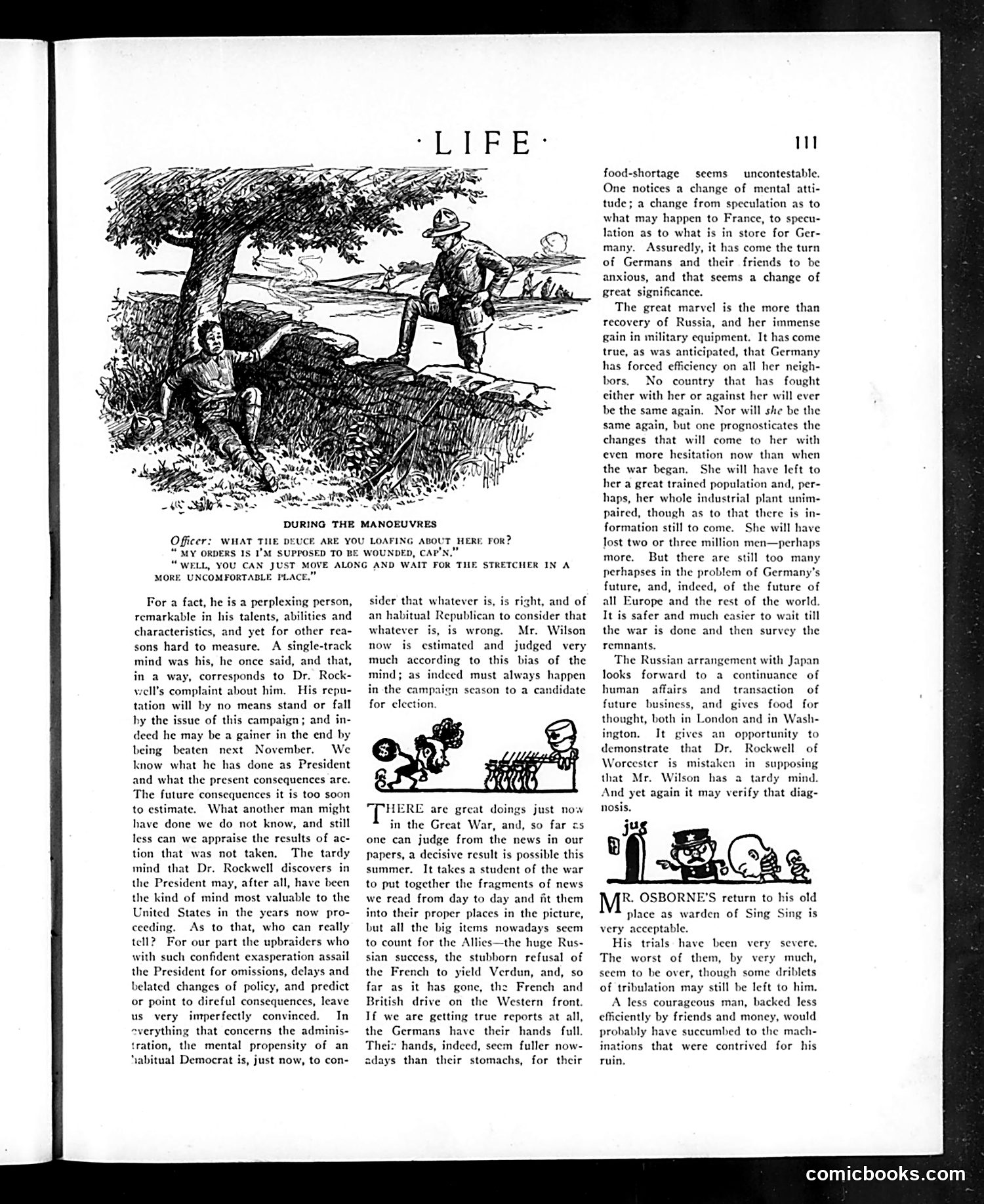
This is a patriotic illustration rather than political satire. It depicts the Statue of Liberty standing triumphantly atop a classical government building with prominent columns. The banner reads "GOVERNMENT OF THE PEOPLE OF ALL THE..." (text cut off, but clearly referencing Lincoln's Gettysburg Address phrase "of the people, by the people, for the people"). The image appears celebratory of American democracy and institutional government. A globe is visible in the upper right. The engraving style and "LIFE" magazine header suggest this dates to the early-to-mid 20th century, likely commemorating American governmental ideals rather than mocking them. Without additional context or satirical elements visible, this seems straightforward patriotic imagery rather than critical commentary.
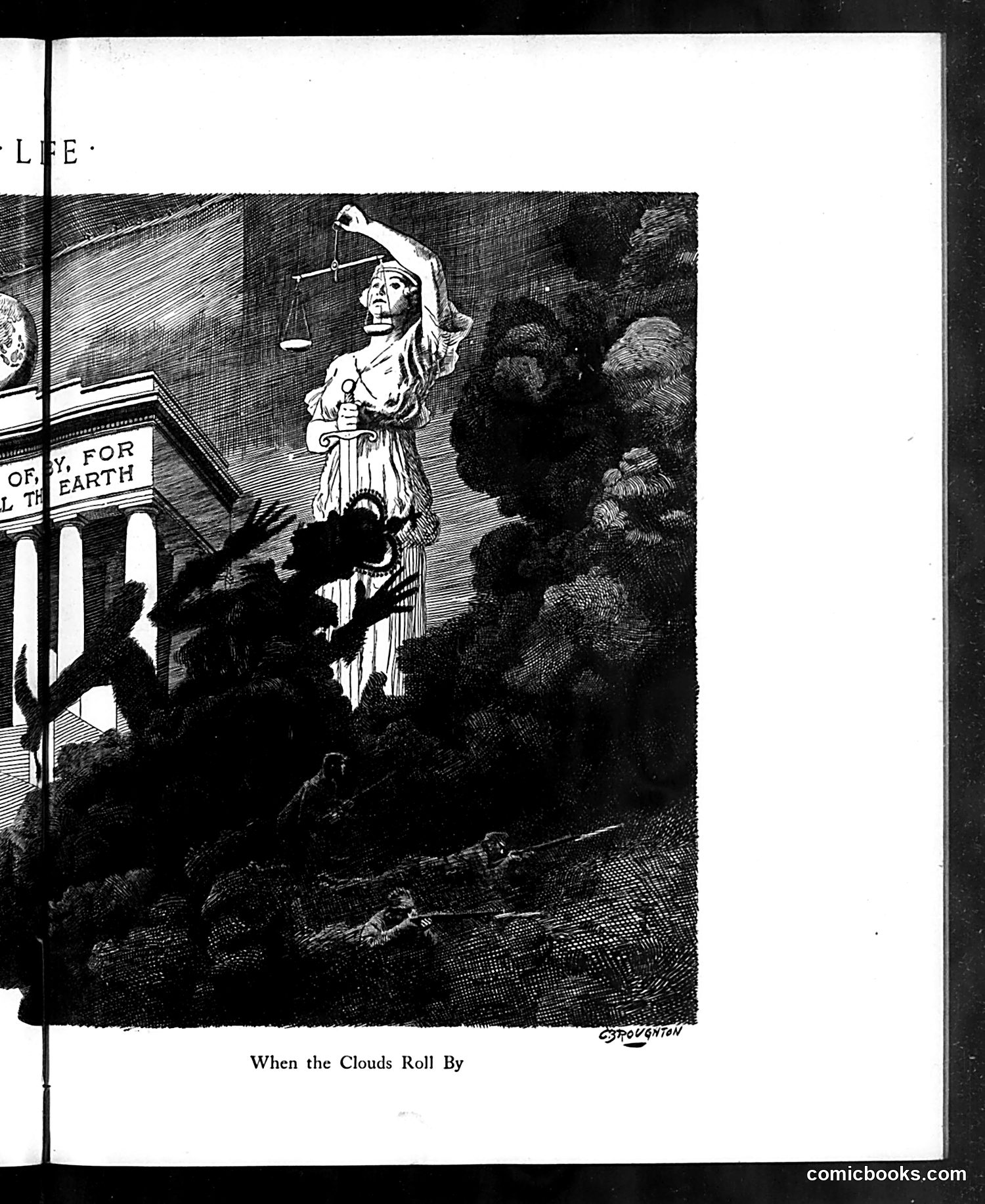
This engraving depicts Lady Justice (identifiable by her scales and classical robes) standing elevated on a pedestal, gazing upward with hope. Below her, silhouetted figures—appearing to represent common people or citizens—look toward her with raised arms in supplication or prayer. The title "When the Clouds Roll By" suggests optimism about justice prevailing once difficult times pass. The composition contrasts the illuminated figure of Justice above with the dark masses below, implying faith that justice will ultimately triumph over present darkness or injustice. Without additional context or date information visible, the specific historical moment referenced remains unclear, though the imagery suggests hope for judicial fairness during a troubled period.
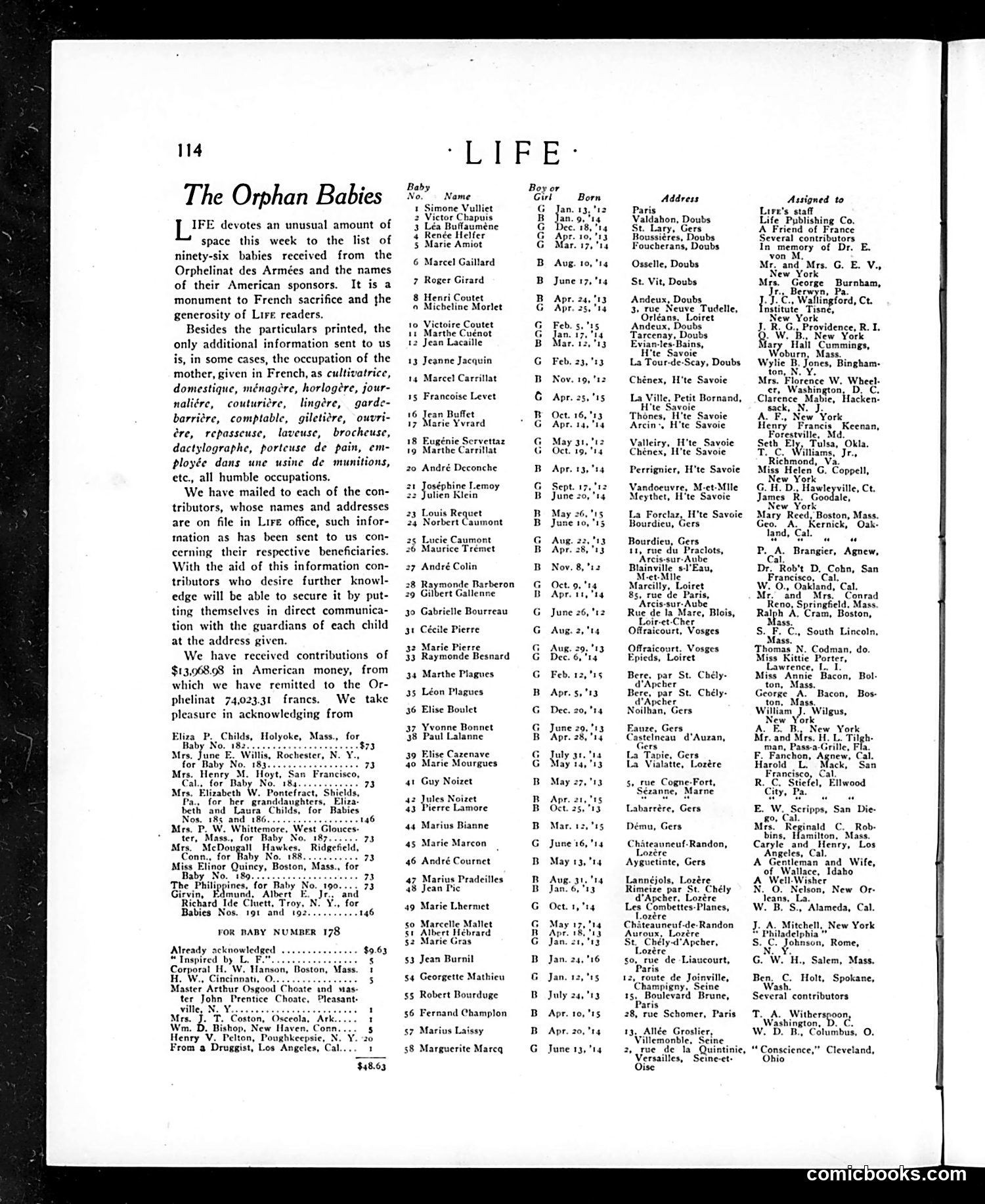
This page documents a philanthropic campaign by *Life* magazine to support French war orphans from the Orphelinat des Armées (Army Orphanage). The magazine devoted unusual editorial space to list 58 babies and their American sponsors—a public acknowledgment of both French sacrifice and American generosity. The context is World War I: these children lost parents to the war. *Life* solicited donations from American readers, ultimately raising $13,068.98 (converted to 74,023.31 francs). The page lists contributors' names and amounts donated, transforming charitable giving into a public record of civic virtue. The opening text emphasizes the mothers' "humble occupations" (listed in French: seamstresses, laundresses, factory workers, etc.), appealing to American readers' sympathy. This was a common early-20th-century fundraising strategy: pairing human interest stories with measurable results and public recognition to encourage continued donations.
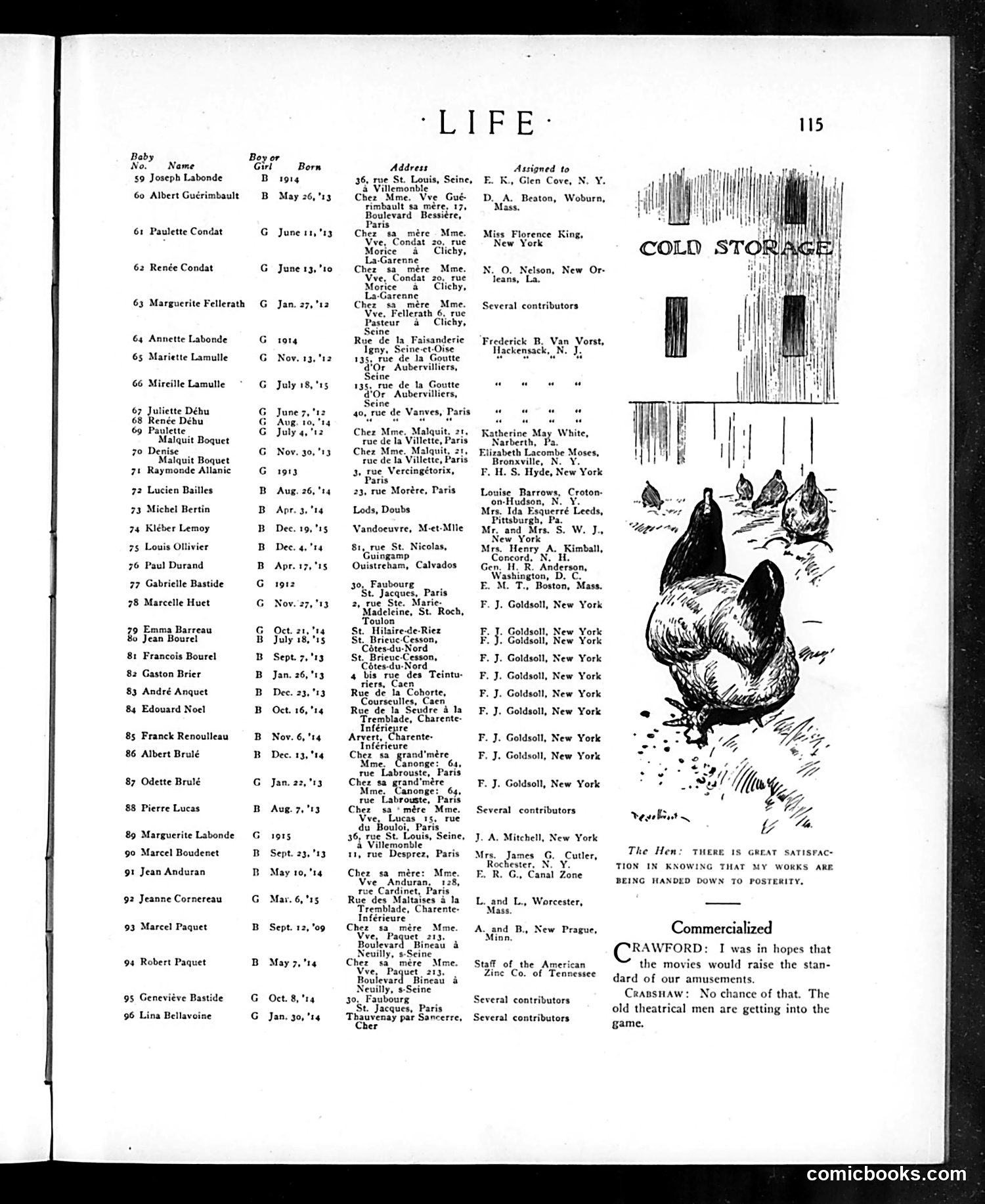
This page is primarily a **registry or roster**, not a satirical cartoon page. It lists French children with their birth dates, addresses in France, and American families assigned to care for them—a war relief program during World War I. The cartoon titled **"Cold Storage"** depicts hens, illustrating a brief exchange below it. A character named "Crabshaw" dismisses the idea that movies would improve theatrical entertainment, claiming "old theatrical men are getting into the game." The **"Commercialized"** section mocks a character named Crawford, who boasts that his works will be "handed down to posterity," only to be told there's "no chance of that." This satirizes artistic pretension and the disconnect between artists' self-importance and commercial reality. The page primarily documents a humanitarian effort—likely placing French war orphans or children with American families during WWI—rather than presenting political satire. The cartoons are incidental commentary on American entertainment and artistic vanity.
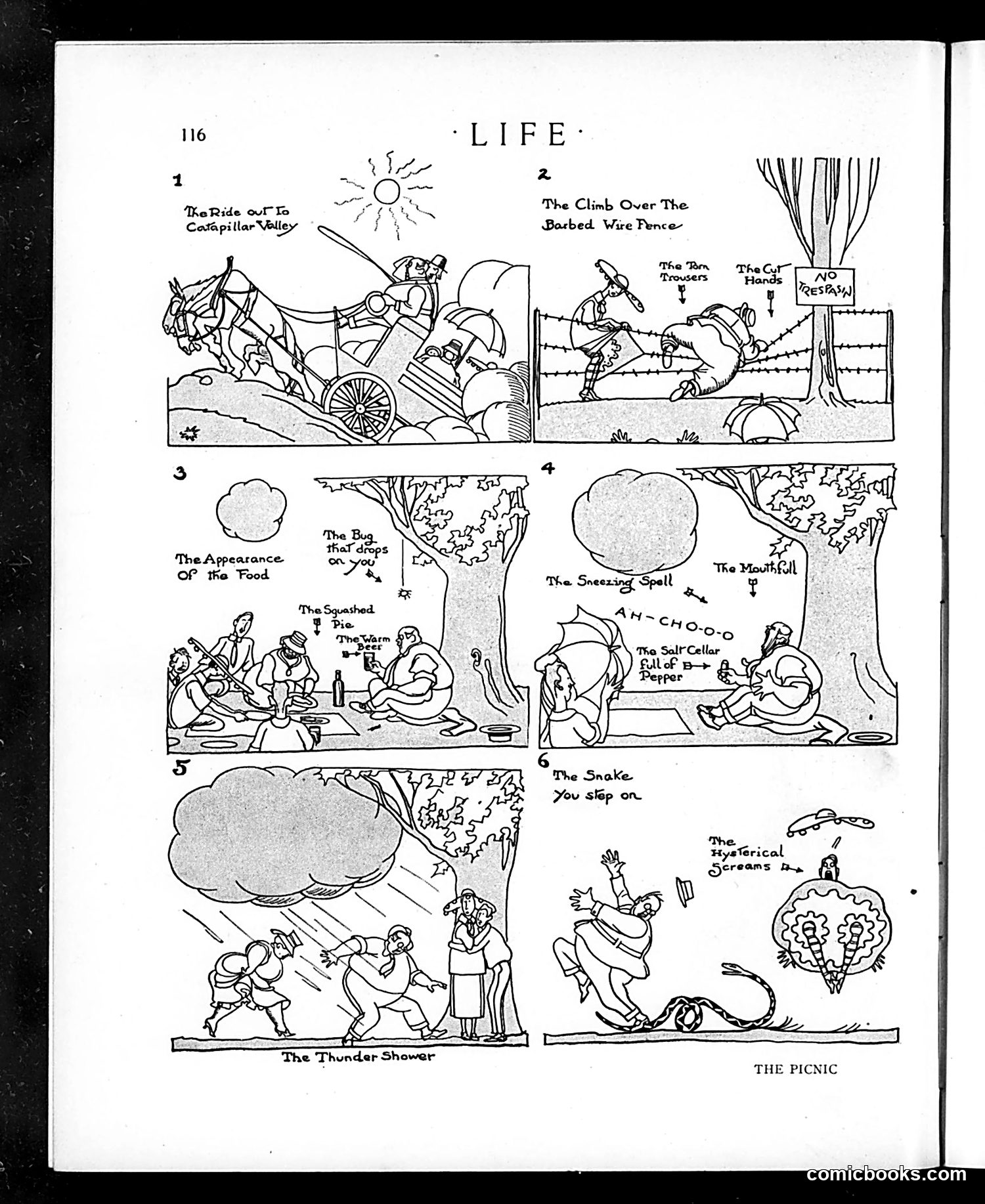
This is a six-panel comic strip depicting misadventures during a countryside picnic. The humor relies on a series of escalating catastrophes befalling the picnickers: 1. A chaotic carriage ride 2. Climbing over a barbed-wire fence (resulting in torn clothing) 3. Finding spoiled food at the picnic site 4. Encountering bugs and sneezing fits 5. A thunderstorm soaking everyone 6. Stepping on a snake, causing hysteria The satire targets the genteel middle-class aspiration for "nature outings"—a popular leisure activity of the era. Rather than the romantic pastoral experience promised, the outing devolves into physical discomfort, property damage, and humiliation. The joke is fundamentally about the gap between Victorian ideals of wholesome country recreation and messy reality.
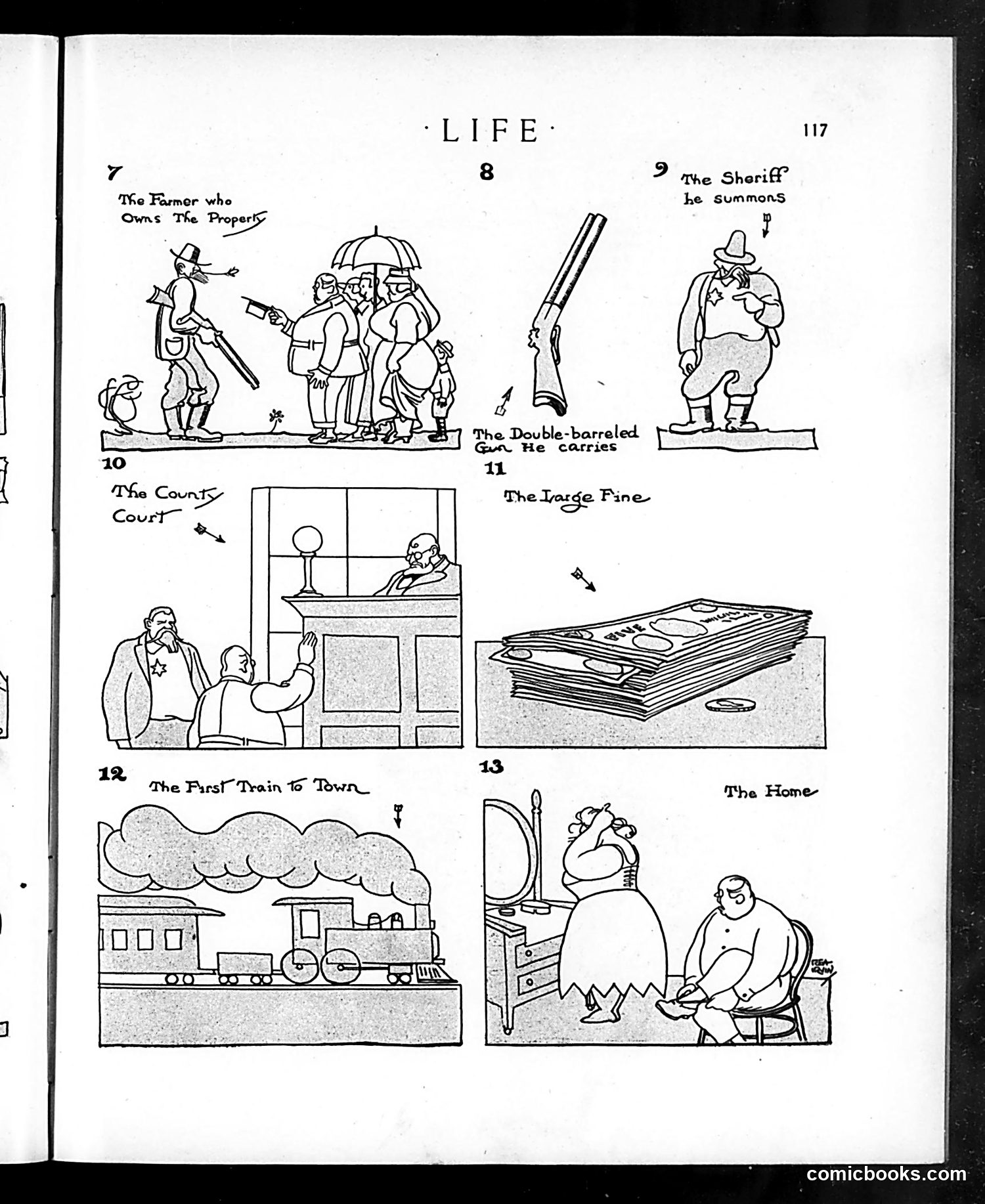
This page presents numbered cartoon vignettes satirizing American rural and small-town life. The sketches mock stereotypical figures: **#7**: A farmer defending his property with exaggerated gestures **#8-9**: Rural characters in rain, and a sheriff being summoned **#10**: A county courtroom scene with authority figures **#11**: A double-barreled gun, emphasizing rural weaponry **#12**: "The First Train to Town"—depicting the arrival of modernity to rural areas **#13**: "The Home"—domestic life, showing a couple in their bedroom The satire targets rural simplicity, legal informality, and resistance to modern change. The cartoons appear to contrast unsophisticated country life with urban sophistication, using exaggerated physicality and crude settings to suggest backwardness. This reflects early-20th-century urban magazines' condescension toward rural America.
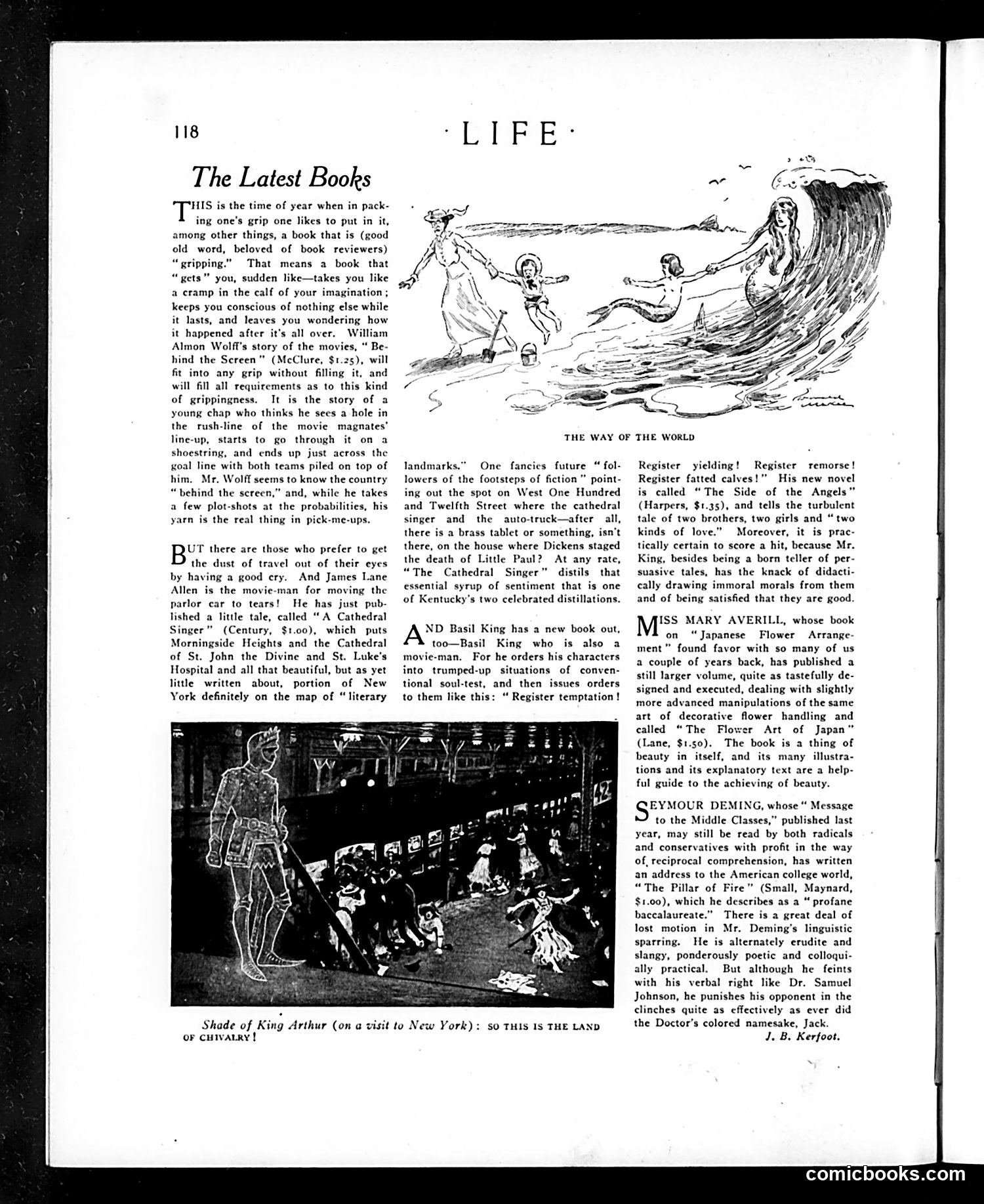
This is a book review column, not a political cartoon. The main illustration—captioned "Shade of King Arthur (on a visit to New York): SO THIS IS THE LAND OF CHIVALRY!"—is a satirical cartoon showing King Arthur observing modern New York life. The joke is straightforward: King Arthur, legendary symbol of chivalry and medieval honor, visits contemporary New York and finds it decidedly *un*-chivalrous. The contrast between his expectations (courtly behavior, nobility, honor) and harsh urban reality creates the satire. The illustration depicts a crowded, rough urban scene that would shock someone from an idealized past. The column itself reviews contemporary novels, mostly by writers connected to cinema (William Almon Wolff, James Lane Allen, Basil King). The reviews are lighthearted and somewhat mocking of sentimental plots about moral temptation and redemption.
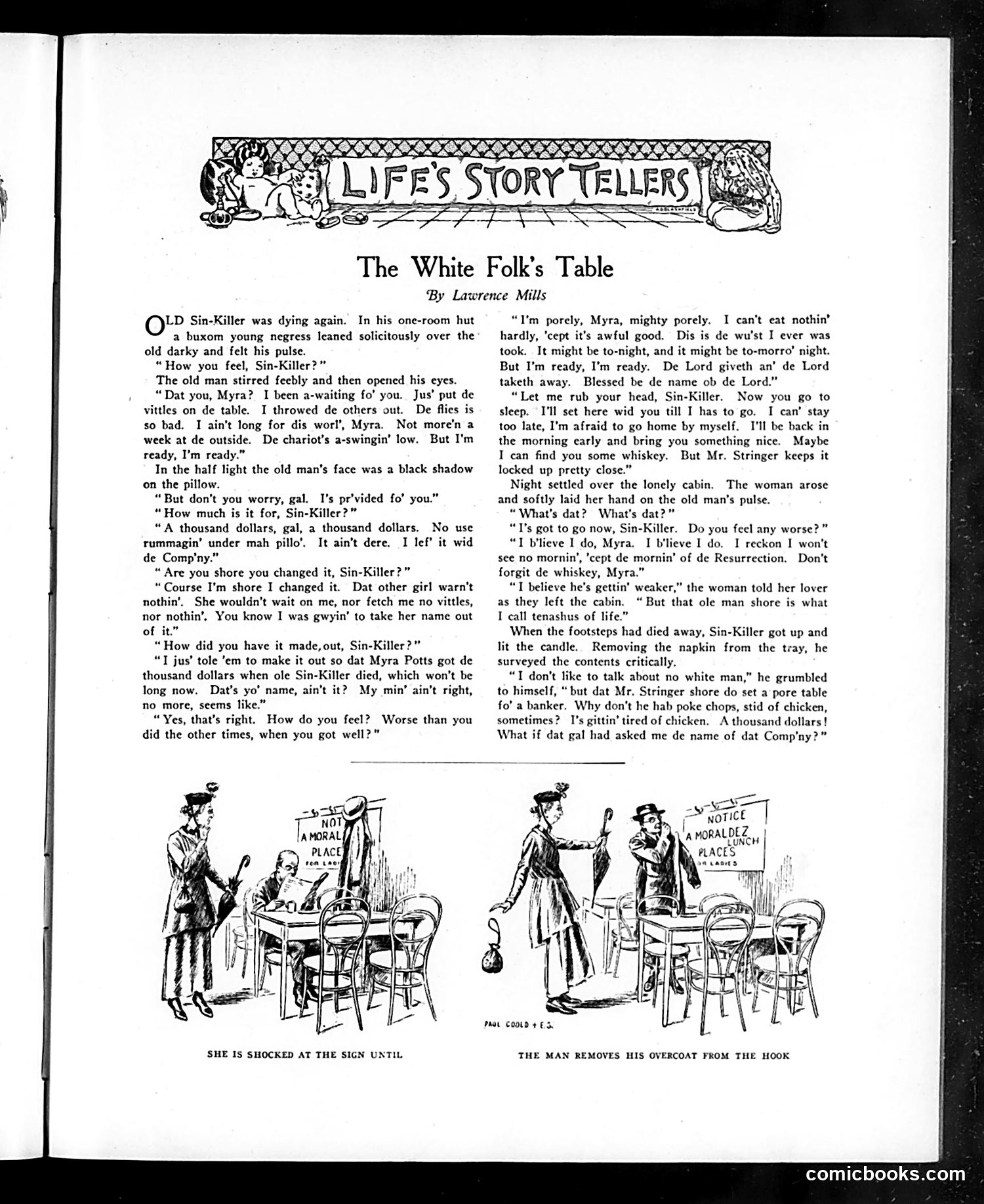
This story satirizes racial exploitation and financial deception in the Jim Crow South. Sin-Killer, an elderly Black man, believes he's dying and tells his caregiver Myra that he's left her $1,000 through "the Company"—apparently his employer, a banker named Mr. Stringer. The twist: Sin-Killer isn't actually dying. Once Myra leaves, he gets up and eats a meager meal, complaining that Mr. Stringer (the white banker) serves poor food despite his wealth. The final irony—"What if dat gal had asked me de name of dat Comp'ny?"—suggests the money may not actually exist or be properly documented. The two illustrations show a woman shocked by a segregation notice at a restaurant, then a man removing his coat, likely depicting racial discrimination and social restrictions of the era. The satire targets both the exploitation of Black workers and the precariousness of their economic survival under white control.
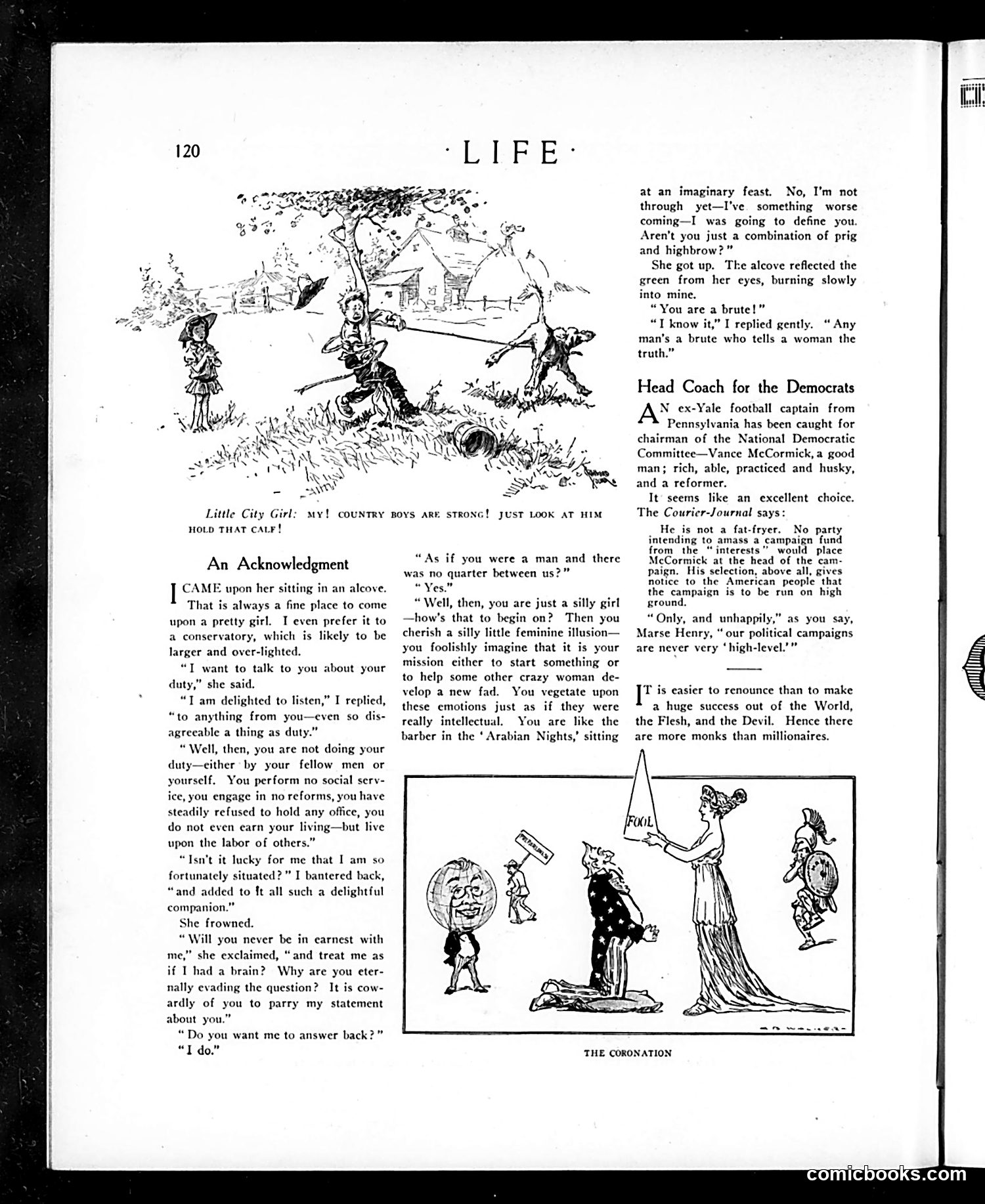
This page contains two satirical pieces: **"An Acknowledgment"**: A dialogue between a man and woman where he defends his idle, leisurely lifestyle against her moral criticism about duty and social service. He retorts by calling her a "silly girl" with romantic illusions about reform work, comparing her to a character from *Arabian Nights* daydreaming at an imaginary feast. The satire targets both wealthy idlers who shirk responsibility and idealistic women reformers of the Progressive Era. **"Head Coach for the Democrats"**: Commentary on Vance McCormick's appointment as chairman of the Democratic National Committee. McCormick, an ex-Yale football captain from Pennsylvania, is praised as a "reformer" who won't be corrupted by wealthy "interests." The piece sarcastically notes that while he represents "high ground" principles, American political campaigns rarely achieve such ideals—implying most politicians accept corrupt funding. The cartoon "The Coronation" (bottom) appears to be political satire, though its specific reference is unclear from context alone.
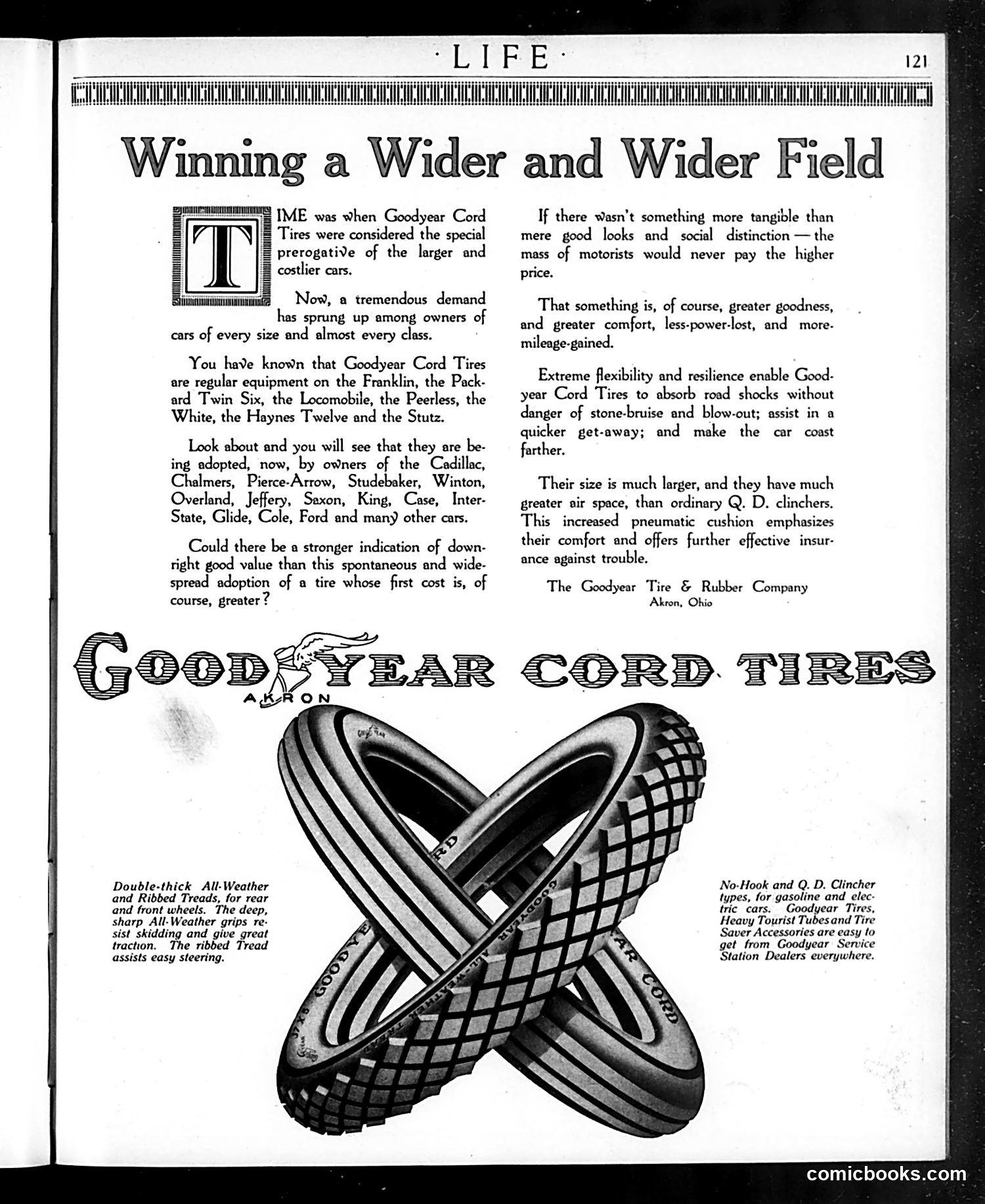
The page promotes Goodyear Cord Tires' expanding market reach. The text notes that these premium tires were once exclusive to luxury cars (Packard, Locomobile, Stutz) but are now being adopted by middle-class vehicles (Ford, Studebaker, Overland). The ad argues this widespread adoption proves the tires' superior value—greater comfort, durability, and mileage—rather than mere social prestige. The visual shows four tires arranged in an X pattern, displaying different tread designs for various driving conditions. This reflects early-1920s automotive democratization: as car ownership expanded beyond the wealthy, aftermarket upgrades became status symbols accessible to average motorists. The ad positions Goodyear as transcending class divisions through genuine quality.
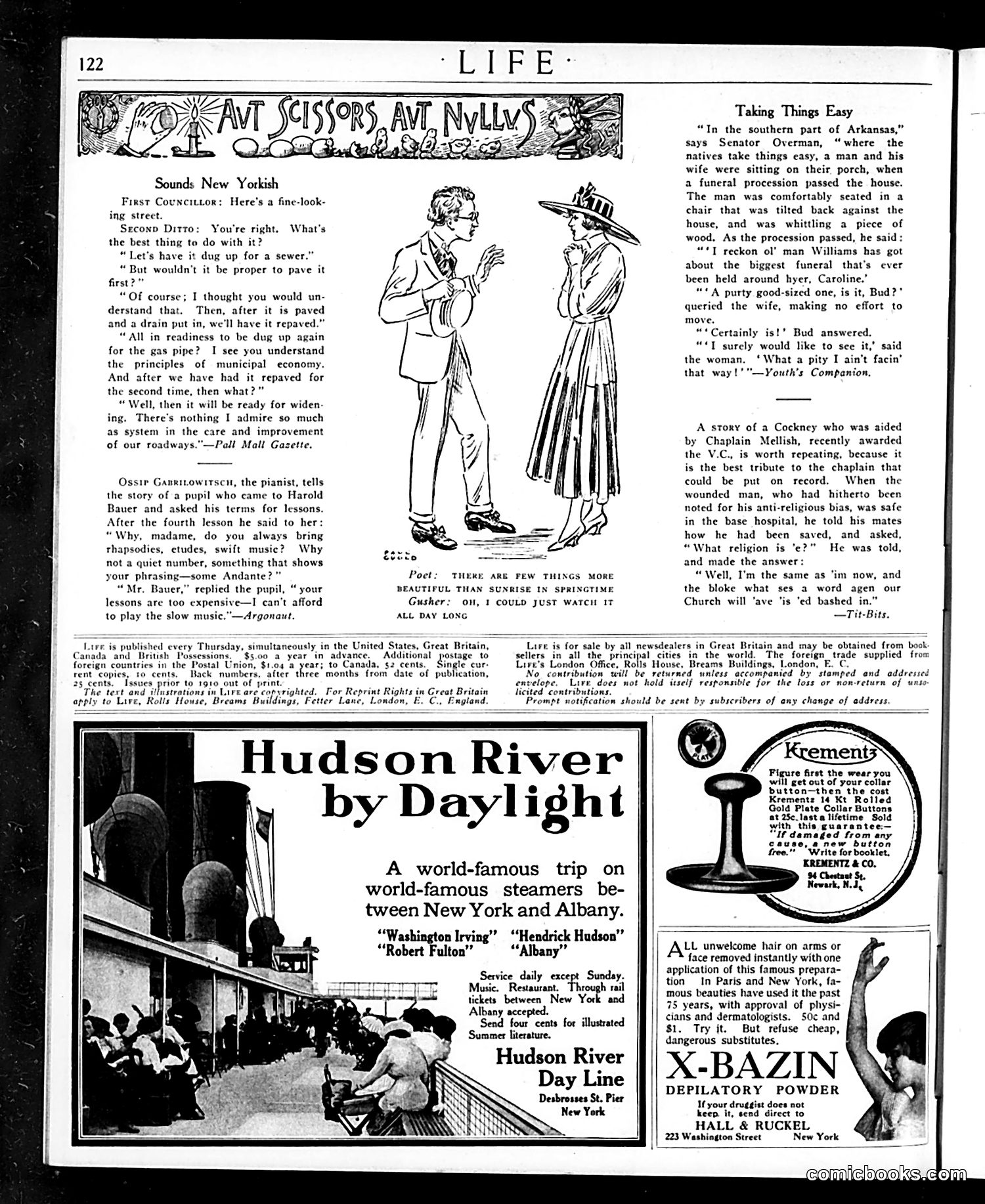
This page contains three separate humorous pieces typical of early 20th-century American satire: **"Sounds New Yorkish"** depicts two city councilors discussing street maintenance with absurd circular logic—pave a street, dig it up for sewers, repave it, dig it up for gas pipes, then widen it. The joke satirizes municipal inefficiency and wasteful government spending through repetitive, pointless cycles of work. **The piano lesson anecdote** mocks a student's inability to afford "slow music" lessons due to expense, suggesting economic desperation forces even cultural pursuits toward rushed, showy performances rather than refined technique. **"Taking Things Easy"** presents Southern rural laziness through dialect humor, where a woman won't even turn to watch a funeral procession, finding the effort unnecessary. The page is primarily **advertising** (Hudson River steamships, X-Bazin depilatory, Krementz collar buttons), with these satirical pieces interspersed—typical Life magazine format of the era blending humor with commercial content.
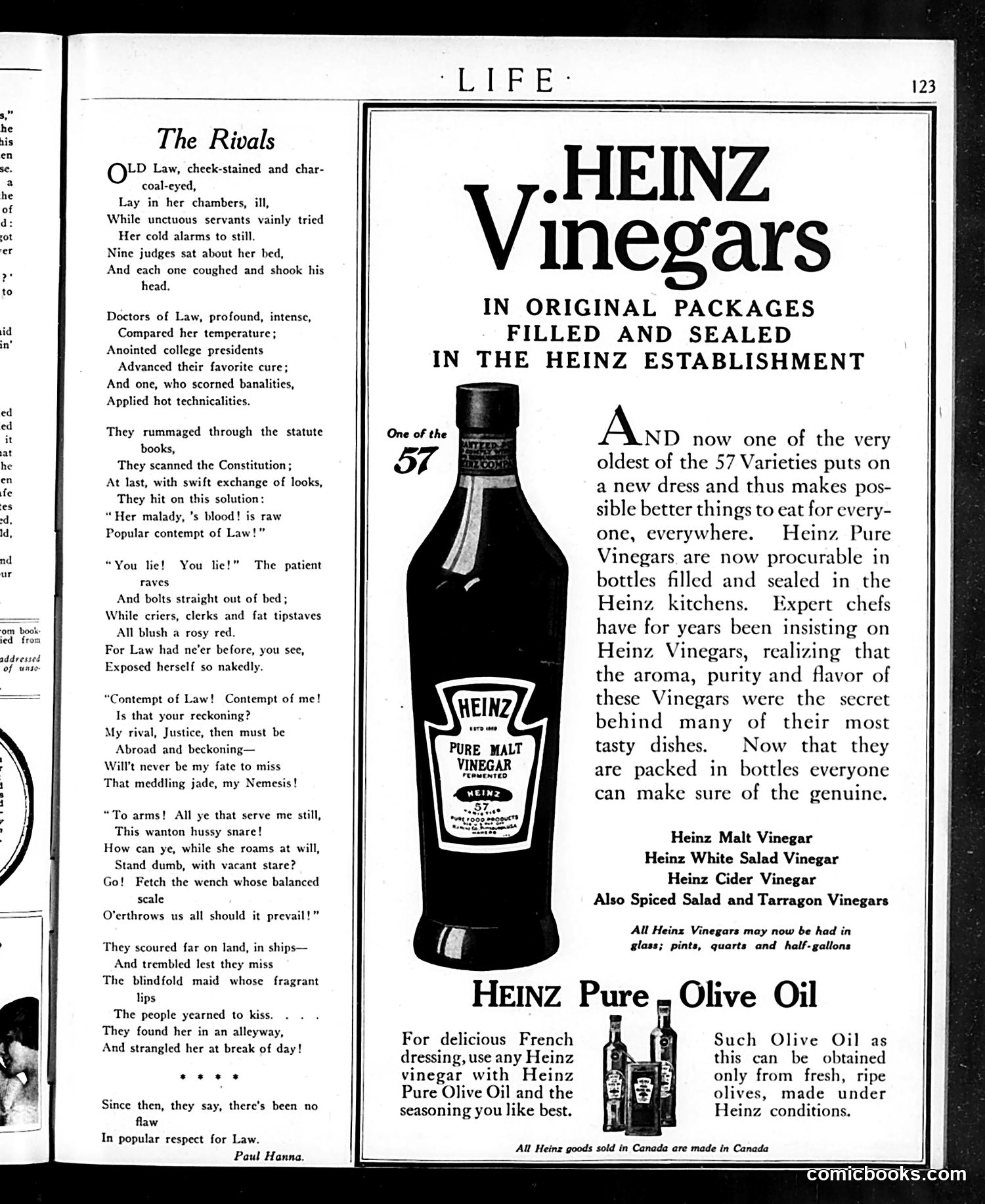
The left page contains a satirical poem by Paul Hanna allegorizing the relationship between Law (personified as a sickly woman) and Justice (the "blindfold maid"). **The allegory's point:** Law is portrayed as corrupt and dying from "popular contempt," while Justice—supposedly her rival—represents something purer. The poem suggests that legal institutions have become disconnected from true justice. In a darkly ironic twist, the judges and officials "strangle" Justice to restore faith in Law itself, implying that authorities suppress genuine justice to protect the legal system's legitimacy. **Historical context:** This reflects early 20th-century American skepticism toward legal institutions—concerns about whether laws served justice or merely institutional power. The poem satirizes both legal corruption and the public's dimming faith in courts. **Right page:** Advertisement for Heinz vinegars—unrelated content typical of *Life* magazine's mix of satire and commercial ads.
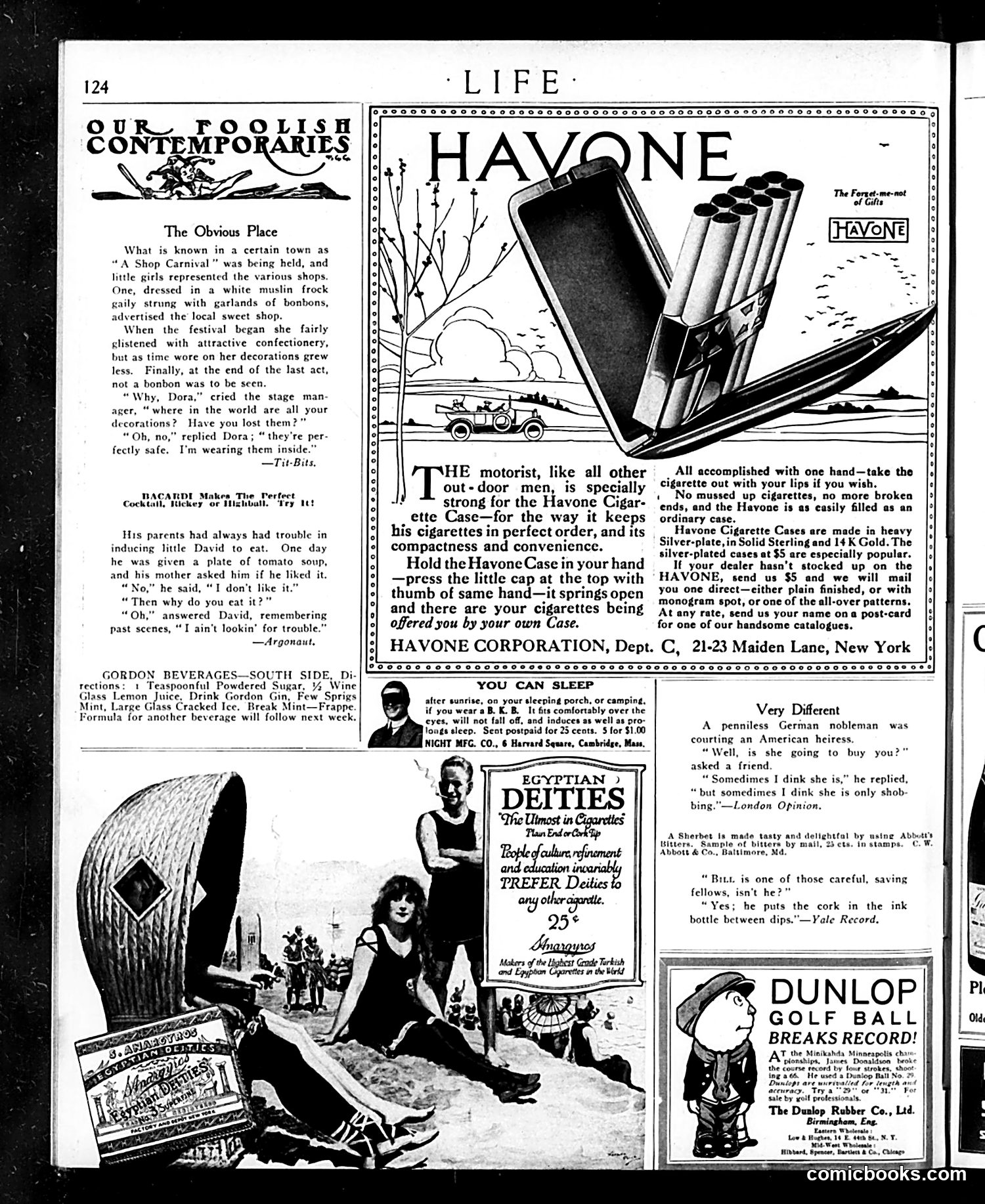
This page from Life magazine (a satirical publication) contains primarily **advertisements and brief humorous anecdotes**, rather than political cartoons. The main content includes: **"Our Foolish Contemporaries"** — short joke column featuring anecdotes about human behavior (a child eating soup reluctantly, a girl eating her costume decorations). **Large advertisements** for: - **Havone Cigarette Cases** — promoting a convenient one-handed cigarette dispenser for motorists - **Gordon Beverages** — cocktail recipe - **Egyptian Deities cigarettes** - **Dunlop Golf Balls** — claiming a distance record - **Sleep aids and other products** **Small social humor pieces** including a joke about a German nobleman courting an American heiress (playing on stereotypes of impoverished European nobility seeking wealthy American wives). The page reflects early 20th-century consumer culture and social attitudes rather than sharp political satire. It's primarily a vehicle for advertising luxury goods to affluent readers.
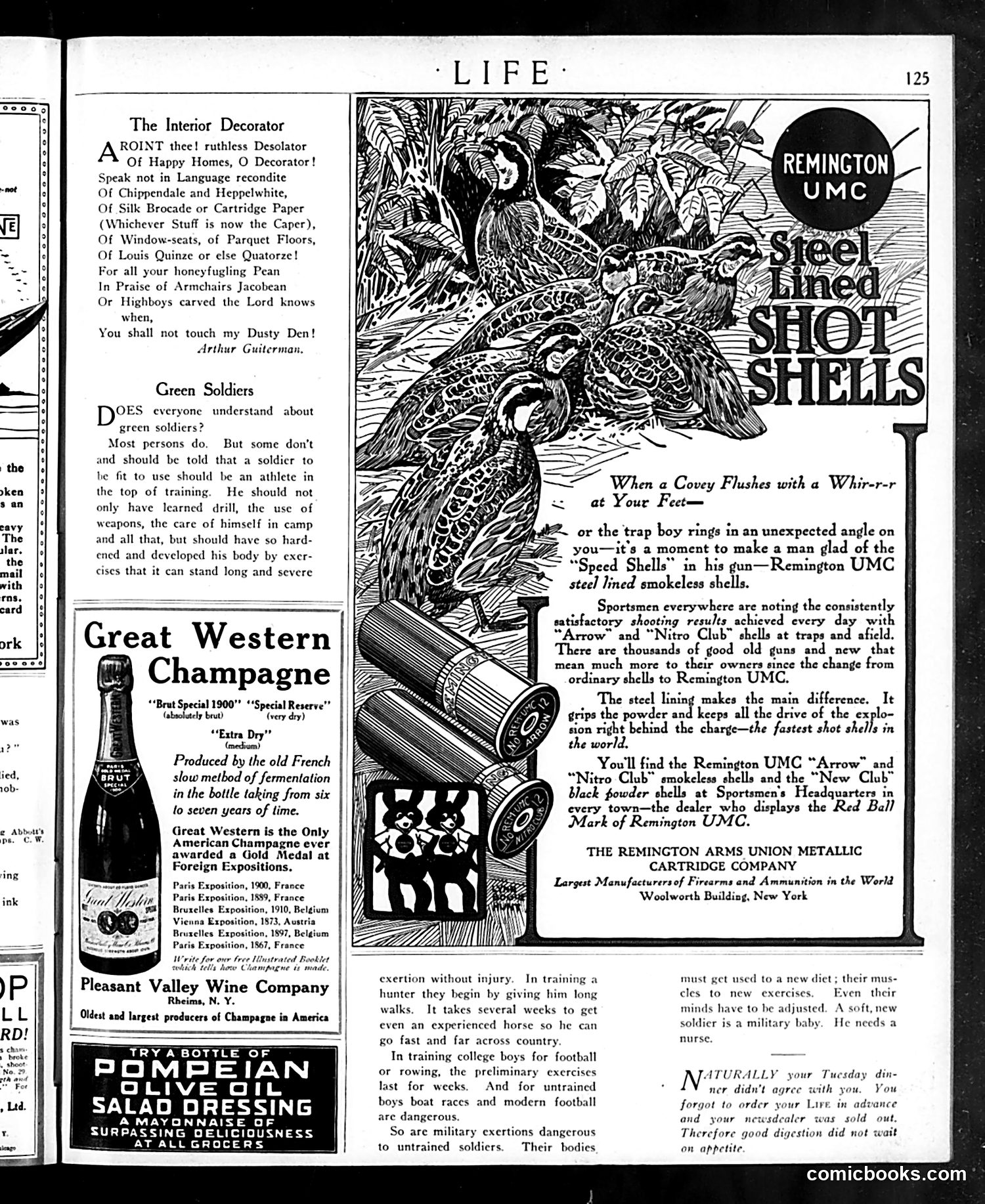
This page contains three distinct elements: **"The Interior Decorator"** - A humorous poem by Arthur Guiterman mocking pretentious interior decorators who use obscure design terminology (Chippendale, Heppelwhite, Louis Quinze). The speaker refuses to let such a decorator touch his "Dusty Den," satirizing both the decorators' affected language and the speaker's resistance to fashionable home improvement trends. **"Green Soldiers"** - An editorial piece explaining that soldiers require rigorous athletic training before combat duty, comparing their conditioning needs to those of racehorses and college athletes. This appears to address military preparedness concerns, likely from the pre-World War I era. **Advertisements** - The page is heavily devoted to ads: Great Western Champagne, Pleasant Valley Wine Company, Pompeian Salad Dressing, and Remington UMC shotgun shells. These represent typical early-20th-century *Life* magazine advertising aimed at middle- and upper-class readers. The satirical content is light domestic humor rather than political commentary.
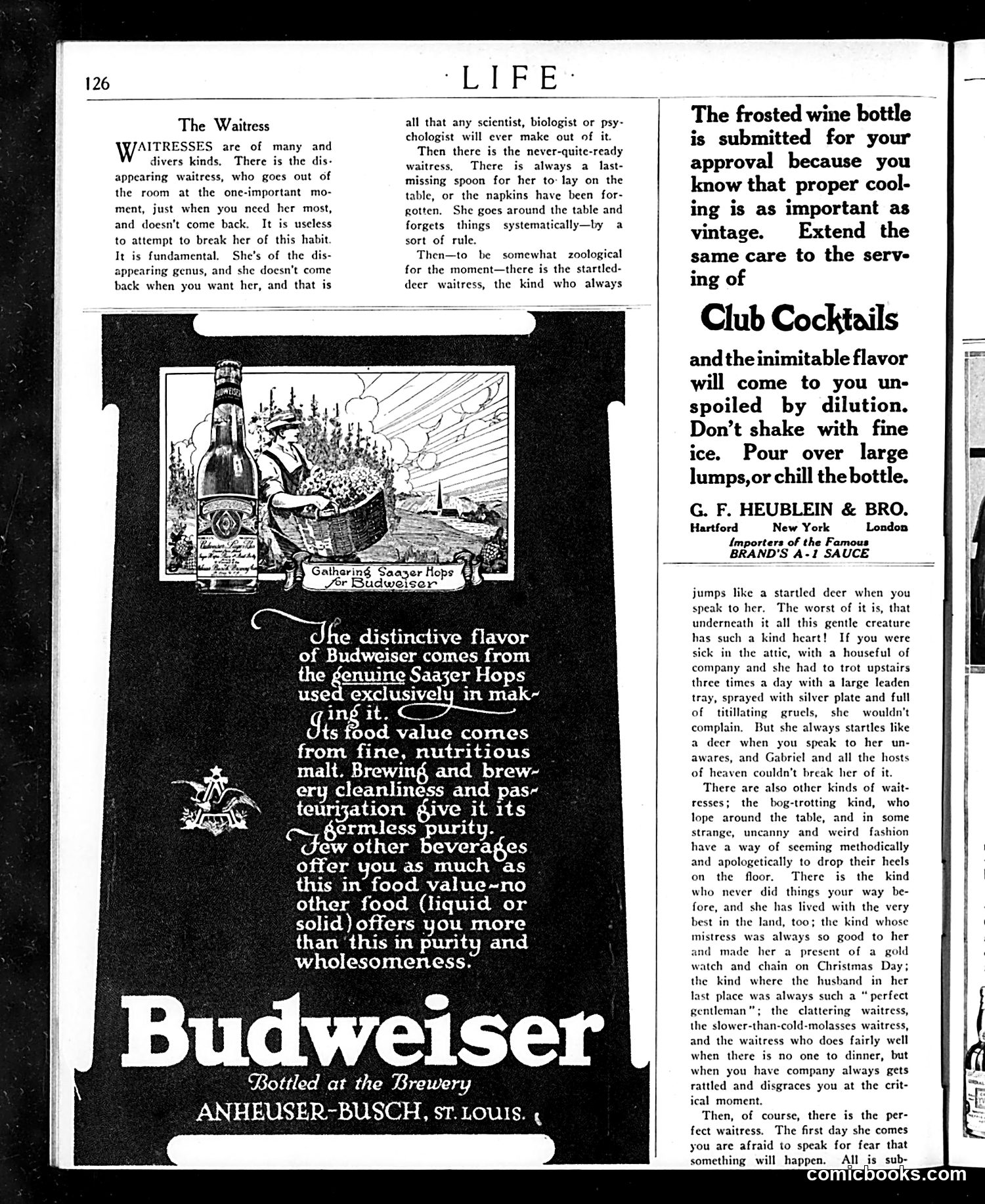
This page contains a humorous essay titled "The Waitress" that catalogs different types of waitresses by their behavioral quirks and personalities. The author uses mock-scientific language ("zoological," "genus") to classify waitresses into archetypal categories: the disappearing waitress, the forgetful one, the startled-deer type (who jumps nervously when spoken to), the overly-familiar kind who mentions her previous "better" employers, the clumsy chatterer, and the slow-moving variety who becomes flustered with company present. The piece concludes with a reference to the "perfect waitress," suggesting an ideal is theoretically possible but practically rare. The tone is gently satirical rather than mean-spirited—the author acknowledges these women's good hearts beneath their behavioral flaws. The page is primarily advertising (Budweiser beer, Club Cocktails), typical of *Life* magazine's format during this era.
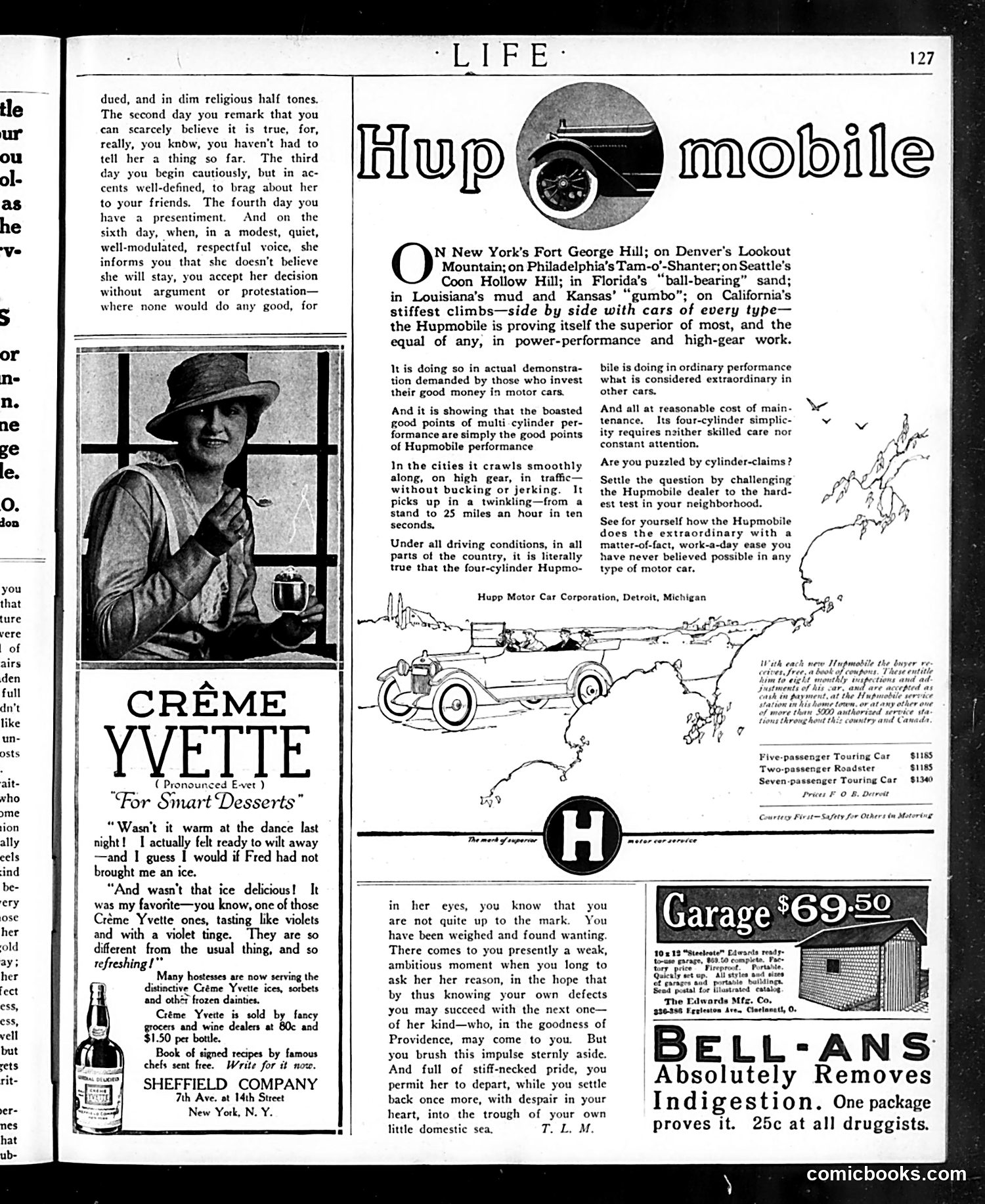
This page primarily contains **advertisements** rather than political satire. The main content includes: 1. **Hupmobile automobile ad**: Showcases a four-cylinder car's performance across American landscapes (Denver, Philadelphia, Florida, Kansas), emphasizing reliability and affordability compared to multi-cylinder competitors. This reflects early 1900s automotive marketing—positioning simpler engineering as superior value. 2. **Crème Yvette ice cream ad**: Features a romantic scenario about a woman appreciating violet-flavored frozen dessert at a dance, targeting middle-class consumers seeking "smart" refined goods. 3. **Editorial content** (left): A satirical piece about courtship, describing a man's changing attitude toward a potential domestic worker or romantic interest over six days—from skepticism to pride to resignation when she leaves. The page reflects **1920s consumer culture**, targeting affluent readers with luxury goods (imported ice cream, automobiles) while the editorial mocks romantic pretension. There's no identifiable political cartoon or specific caricature.
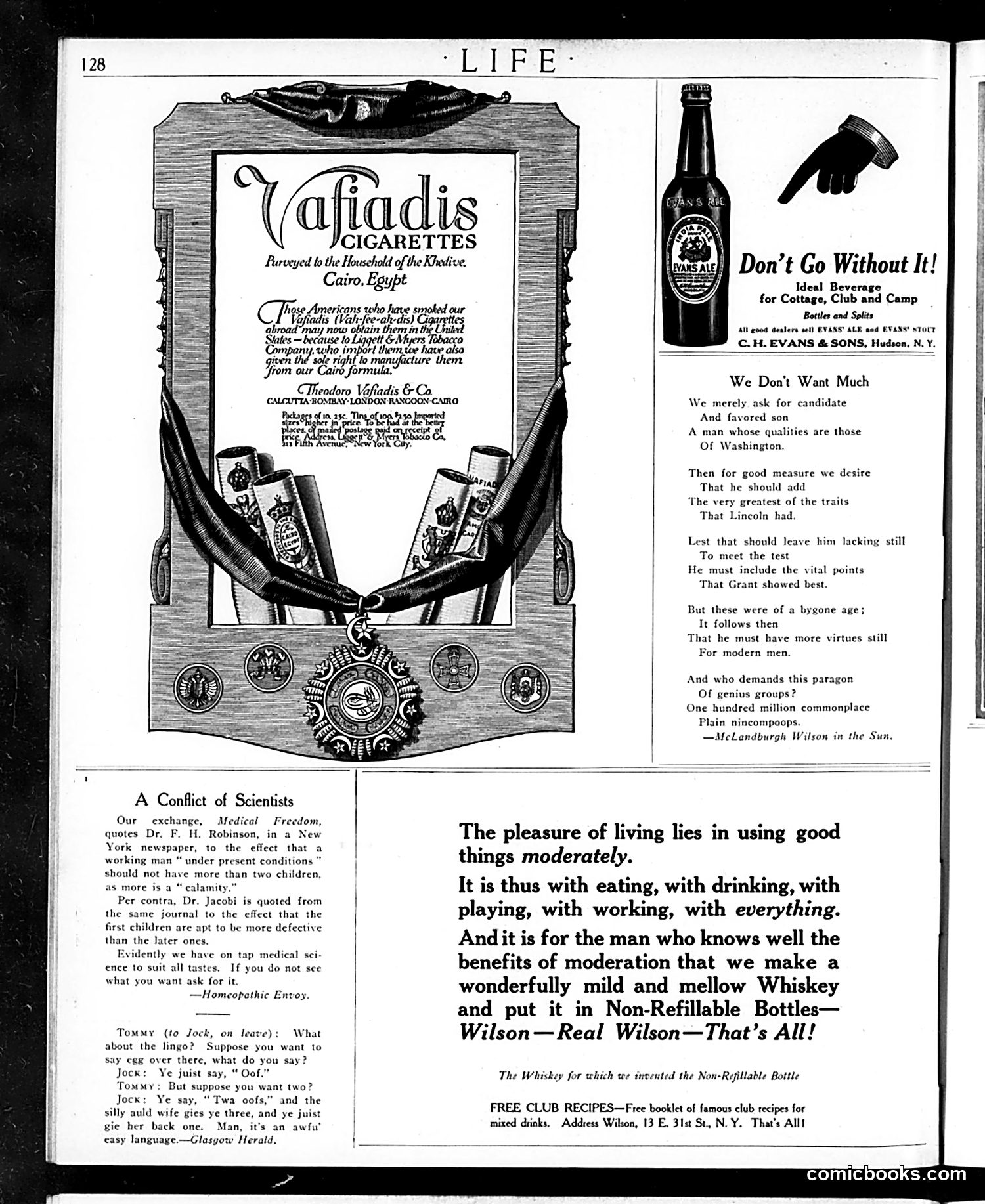
This page contains **advertisements and satirical content** typical of early 20th-century American humor magazine. **Key content:** 1. **Vafiadis Cigarettes ad**: Markets Egyptian cigarettes to American smokers, claiming exclusive supply rights and exotic prestige ("Purveyed to the Household of the Khedive"). 2. **Evans Ale advertisement**: Promotes beer as ideal for social settings. 3. **"A Conflict of Scientists"**: Satirizes contradictory medical advice—one doctor claims working men shouldn't have more than two children; another contradicts him about which children are defective. The joke mocks medical "expertise" lacking consensus. 4. **"We Don't Want Much"**: A poem sarcastically listing impossible ideal presidential candidate qualities (Washington's virtue, Lincoln's traits, Grant's abilities), concluding that "one hundred million commonplace plain nincompoops" demand this parody. Satirizes unrealistic voter expectations. 5. **Wilson Whiskey ad**: Emphasizes moderation and promotes non-refillable bottles (likely for hygiene/quality control). The page reflects early-1900s consumer culture and political commentary.
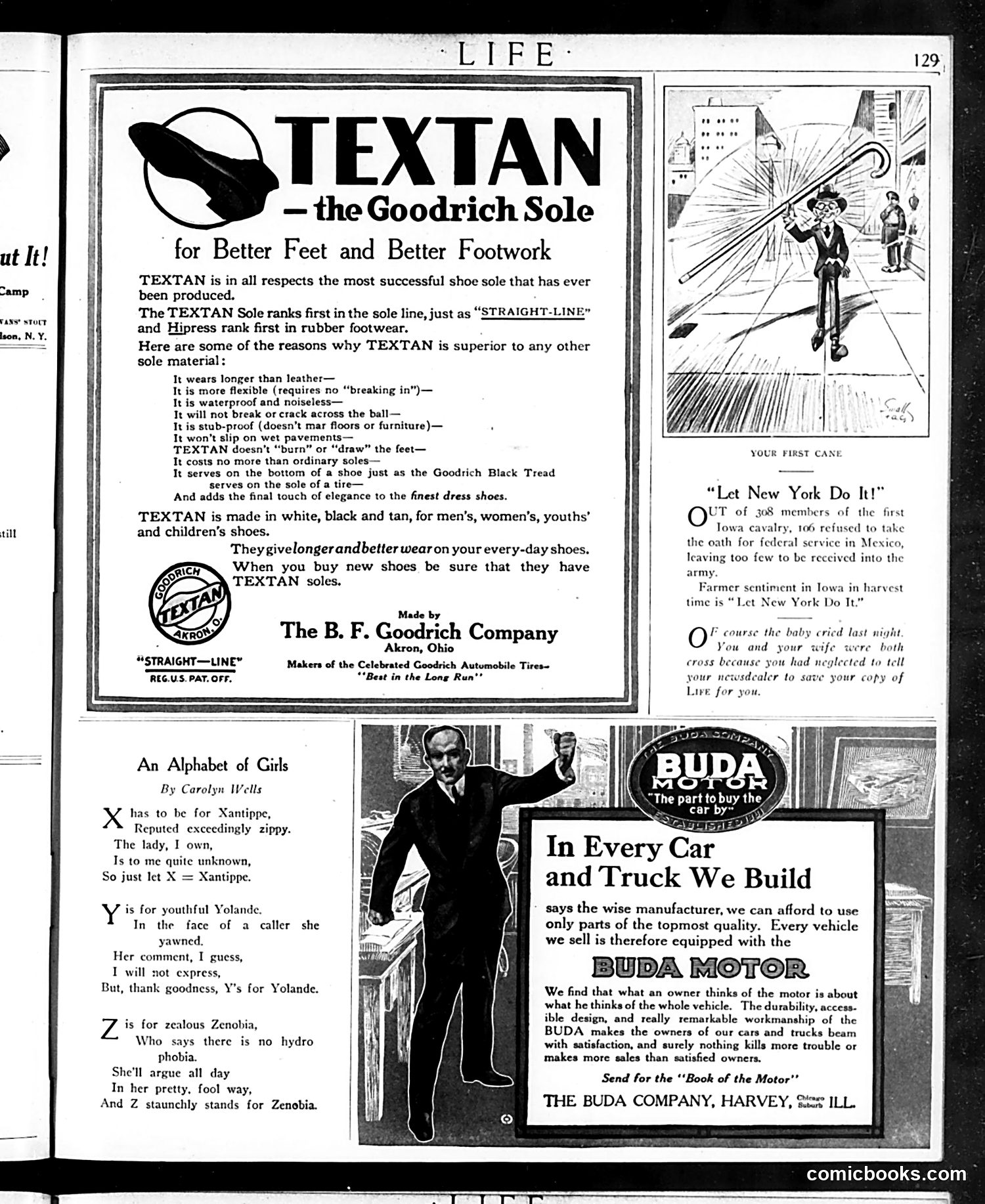
This page is primarily **advertising** rather than political satire. It contains: 1. **TEXTAN Shoe Sole ad** (top): Goodrich Company promotes their synthetic rubber shoe sole as superior to leather, emphasizing durability, waterproofing, and cost-effectiveness for everyday wear. 2. **"Your First Cane" section** (right): A brief humorous piece about Iowa farmers refusing federal service in Mexico during harvest season, with the satirical sentiment "Let New York Do It"—a joke about rural reluctance to leave during critical agricultural periods. 3. **"An Alphabet of Girls"** (bottom left): Light verse by Carolyn Wells offering playful character sketches using female names (Xantippe, Yolande, Zenobia), typical of period humor magazines. 4. **BUDA Motor ad** (bottom right): Automotive advertisement emphasizing quality components and customer satisfaction. The page reflects early 20th-century magazine format: mixed commercial and entertainment content without clear separation.
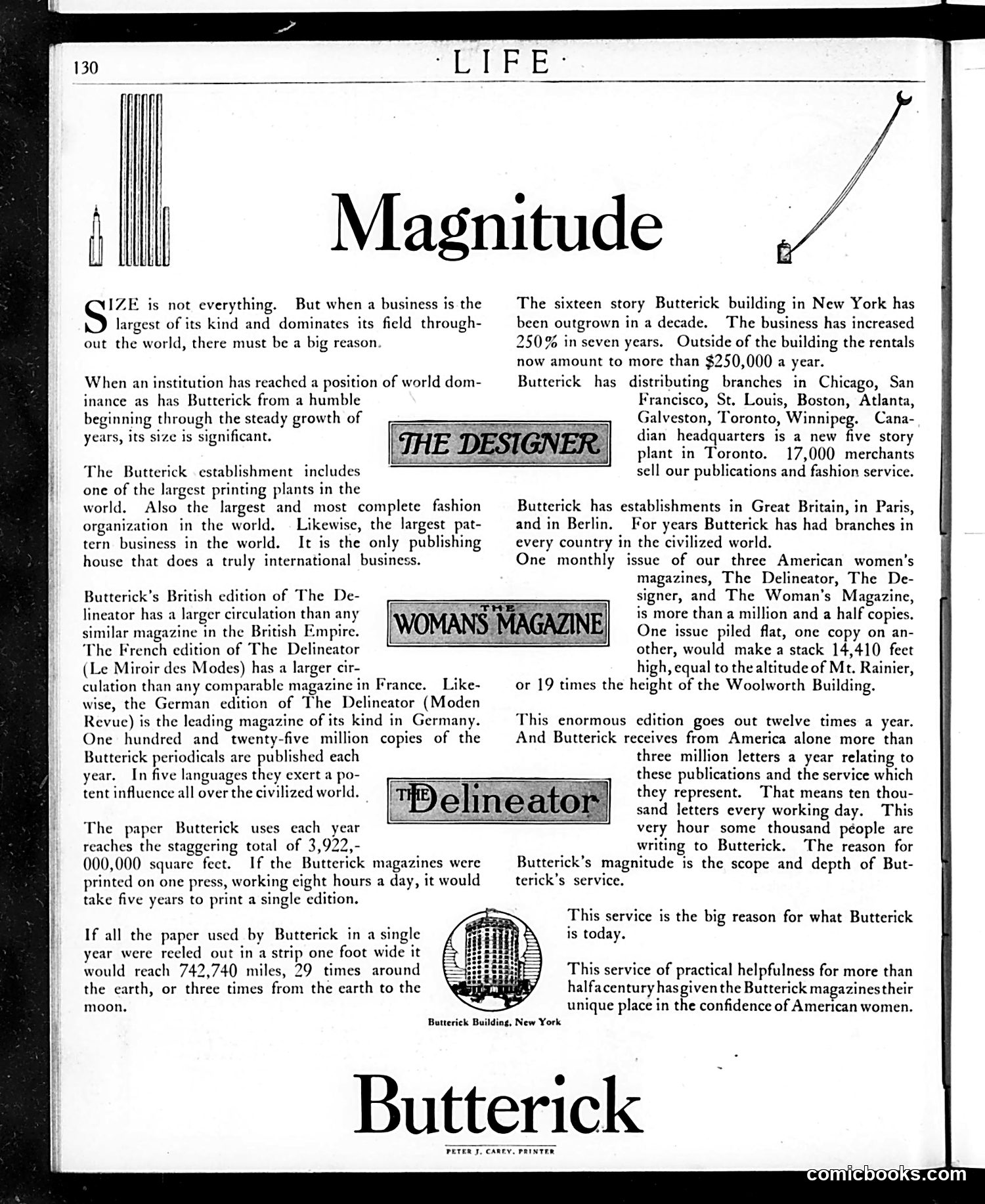
This is **advertising**, not satire or political commentary. It's a full-page Butterick company advertisement celebrating the massive scale of their publishing and fashion-pattern business. **What Butterick was:** A dominant publisher of women's magazines (*The Delineator*, *The Designer*, *The Woman's Magazine*) and sewing patterns sold through thousands of retailers. **The "point":** To impress readers with sheer magnitude—125 million copies published yearly in five languages, distributed globally, receiving three million letters annually from customers. The page uses astonishing statistics (paper reaching to the moon, stacks as tall as Mt. Rainier) to demonstrate Butterick's unmatched scale and influence. **For modern readers:** This reflects early-1900s American corporate pride in size and international dominance. The emphasis on women's magazines gaining "confidence" suggests how these publications positioned themselves as trusted advisors to female readers. The graphic design (with small logos for the three magazines) reinforces brand recognition. This is corporate propaganda celebrating industrial success and global reach.
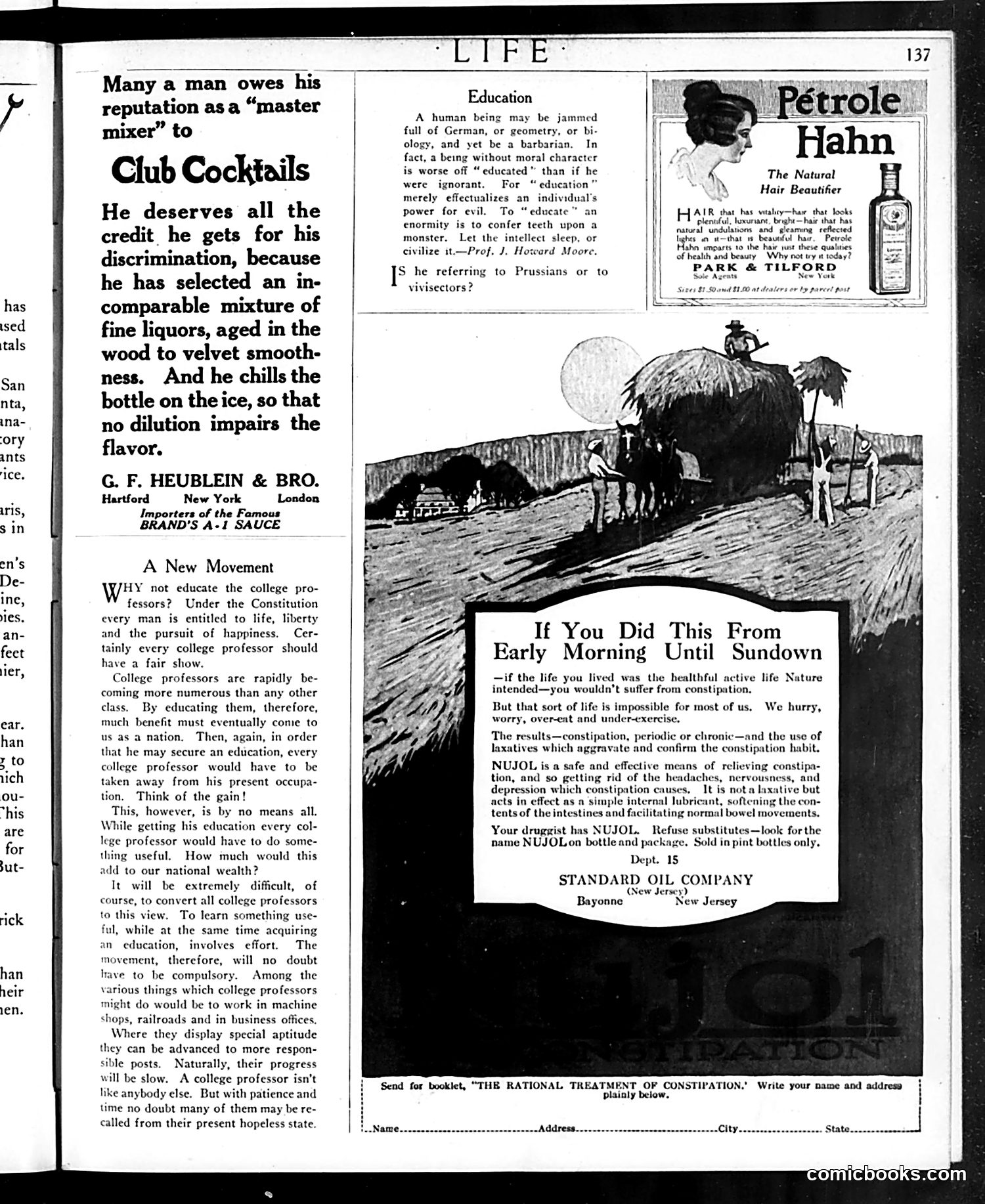
This page contains satirical commentary and advertisements from *Life* magazine (circa 1920s based on style). **The satire:** The article "A New Movement" mockingly proposes that college professors should be compelled to work in factories, shops, and railroads while simultaneously obtaining education—claiming this would benefit the nation economically. The satire critiques both the impracticality of this scheme and likely reflects post-WWI anxieties about intellectuals' usefulness to society. The author sarcastically notes professors "aren't like anybody else" and would progress slowly. **The advertisements:** The page includes ads for cocktails (Heublein & Bros.), hair beautifier (Petrole Hahn), and Nujol laxative. These are straightforward period advertising with no satirical intent. **The "Education" section:** A brief philosophical note questioning whether education without moral character is valuable, possibly referencing German militarism ("Prussians") or vivisection—suggesting concerns about misused knowledge. The page is primarily a mix of satire and commercial advertising typical of *Life*'s format.
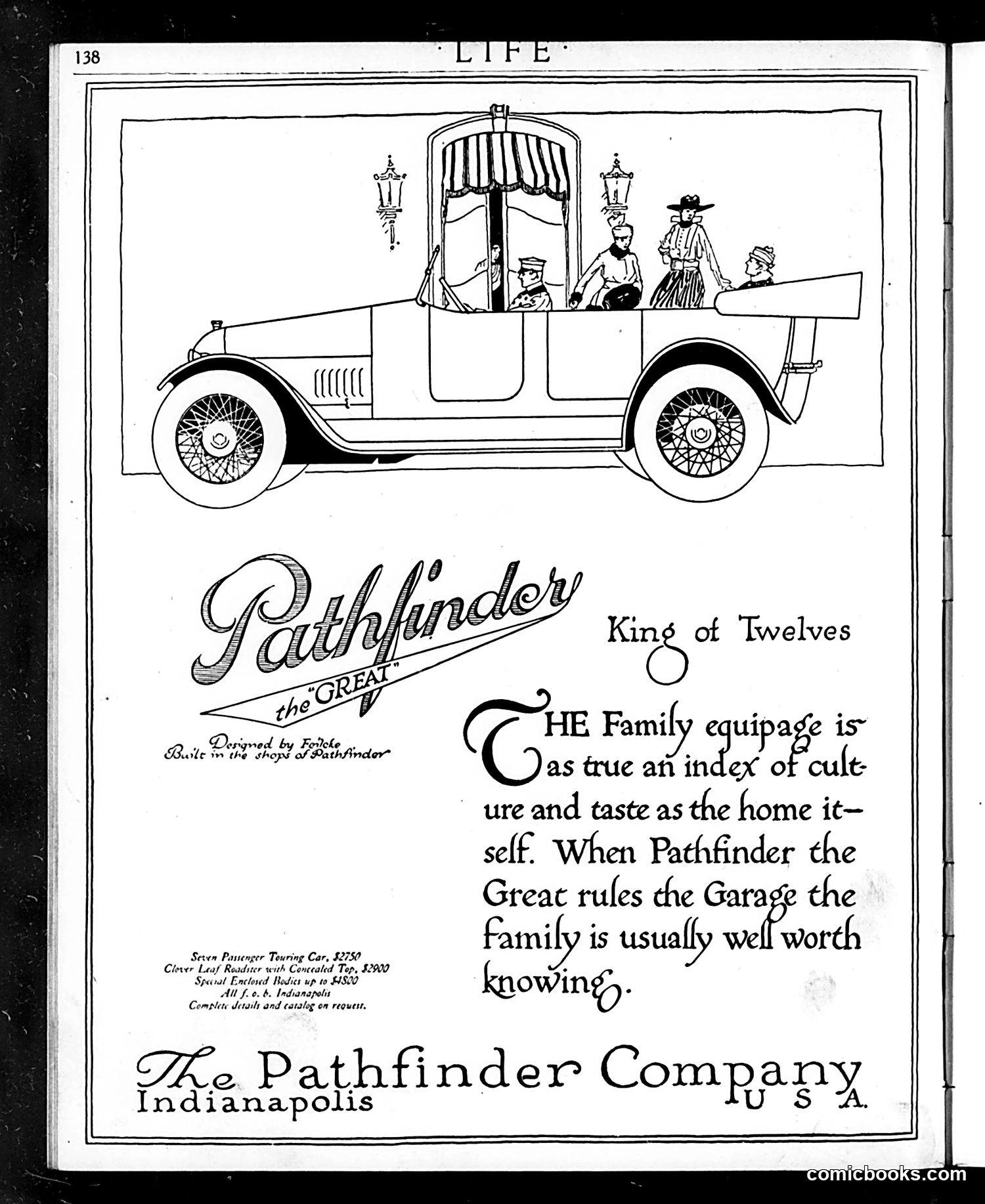
This is an **advertisement**, not political satire. It promotes the Pathfinder automobile, a "Seven Passenger Touring Car" manufactured by the Pathfinder Company in Indianapolis. The ad uses social commentary as marketing strategy: it claims that a family's choice of car reflects their "culture and taste" as much as their home does. The illustration shows an elegant family in formal dress riding in the open-air touring car, implying that owning a Pathfinder signals refinement and social standing. The tagline "King of Twelves" references the car's engine specification. The copy suggests that families who own Pathfinders are "usually well worth knowing"—a coded appeal to status-conscious buyers of the early automotive era, when car ownership was a luxury good that demonstrated wealth and taste.