
Life, 1916-07-20 · page 12 of 44
Life — July 20, 1916 — page 12: what you’re looking at
What you’re looking at
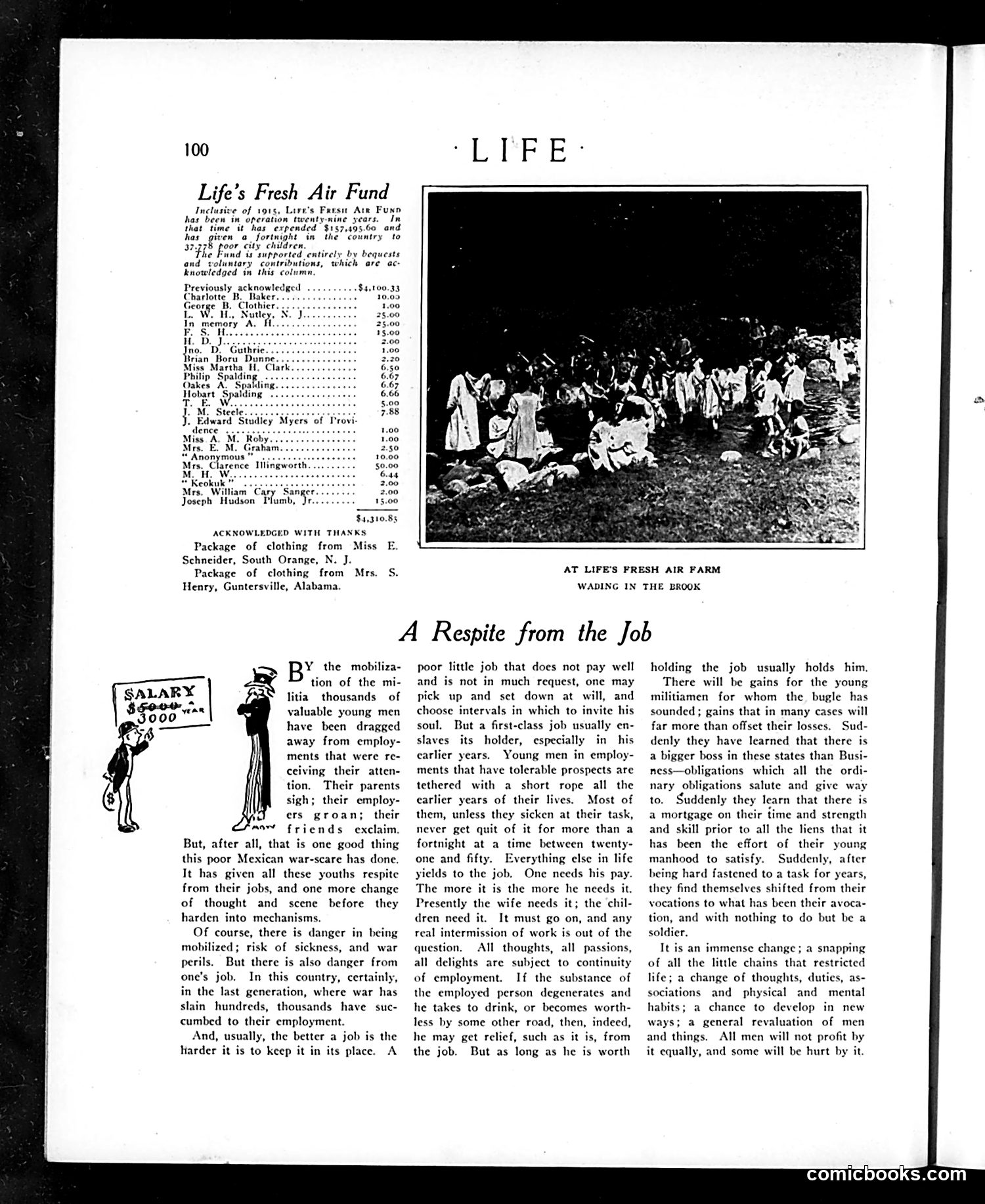
This page contains an article titled "A Respite from the Job" discussing young men's employment during wartime mobilization. The accompanying cartoon shows a figure labeled with a salary sign ($5000, then crossed out to $3000), illustrating wage cuts or employment concerns. The article argues that despite wartime job demands, young men benefit from occasional breaks. It acknowledges the "danger" of mobilization while suggesting that maintaining employment—however demanding—is preferable to unemployment. The piece advocates for work-life balance, noting that relief from constant labor allows workers to "develop in new ways." The tone reflects post-WWI American anxieties about employment stability and the tension between economic necessity and worker welfare.
📄 Transcribed text from this page (OCR, searchable)
Machine-transcribed from the original scan — historical spelling and the odd misread are preserved.
100 Life’s Fresh Air Fund Inclusive of 1915, Lire’s Farsi Ate Fuxn has been in operation twenty-nine years. In that time it has expended $187,493.60. and has given a fortnight in the ‘country to 37.278 poor city children, The Fund is supported entirely by bequests and toluntery contributions, which are ac- Knowledged in this column Previously acknowledged ..... Charlotte B. Baker: ceeeas George B. Clothier = LW. M., Nutley, Ns J. ++ $4,100.33 i 10.09 1.00 In memory A. FS. He Jpo. DB.“ Guthrie. Brian Boru Dunne. Miss Martha H, Clark. Philip Spalding .. Oakes AL SI Anonymous”... Mrs. Clarence Mlingworth. M.H. W.. Keokuk otis 2 William ‘Cary ‘Sanger. Joseph Hudson Plumb, Jr. ACKNOWLEDGED WITH THANKS Package of clothing from Miss Schneider, South Orange, N. J. Package of clothing from Mrs. S. Henry, Guntersville, Alabama. A Y the mobiliza- tion of the mi- litia. thousands of valuable young men have been dragged away from employ- ments that were re- ceiving their atten- tion. Their parents sigh; their employ- a ers groan; their mow friends exclaim. But, after all, that is one good thing this poor Mexican war-scare has done. It has given all these youths respite from their jobs, and one more change of thought and scene before they harden into mechanisms. Of course, there is danger in being mobilized; risk of sickness, and war perils. But there is also danger from one’s job. In this country, certainly, in the last generation, where war has slain hundreds, thousands have suc- cumbed to their employment. And, usually, the better a job is the Harder it is to keep it in its place. A > = AT LIFE’S FRESH AIR FARM WADING N THE BROOK Respite from the Job holding the job usually holds him. There will be gains for the young militiamen for whom the bugle has sounded ; gains that in many cases will poor little job that does not pay well and is not in much request, one may pick up and set down at will, and choose intervals in which to invite his soul. But a first-class job usually en- slaves its holder, especially in his carlier years. Young men in employ- ments that have tolerable prospects are tethered with a short rope all the earlier years of their lives. Most of them, unless they sicken at their task, never get quit of it for more than a fortnight at a time between twenty- one and fifty. Everything else in life yields to the job. One needs his pay. The more it is the more he needs it. Presently the wife needs it; the chil- dren need it. It must go on, and any real intermission of work is out of the question. All. thoughts, all passions, all delights are subject to continuity of employment. If the substance of the employed person degenerates and he takes to drink, or becomes worth- less by some other road, then, indeed, he may get relief, such as it is, from the job. But as long as he is worth far more than offset their losses. Sud- denly they have learned that there is a bigger boss in these states than Busi- ness—obligations which all the ordi- nary obligations salute and give way to. Suddenly they learn that there is a mortgage on their time and strength and skill prior to all the liens that it has been the effort of their young manhood to satisfy. Suddenly, after being hard fastened to a task for years, they find themselves shifted from their vocations to what has been their avoca- tion, and with nothing to do but be a soldier. It is an immense change ; a snapping of all the little chains that restricted life; a change of thoughts, duties, as- sociations and physical and mental habits; a chance to develop in new ways; a general revaluation of men and things. All men will not profit by it equally, and some will be hurt by it. comicbooks.com