
Life, 1916-07-20 · page 30 of 44
Life — July 20, 1916 — page 30: what you’re looking at
What you’re looking at
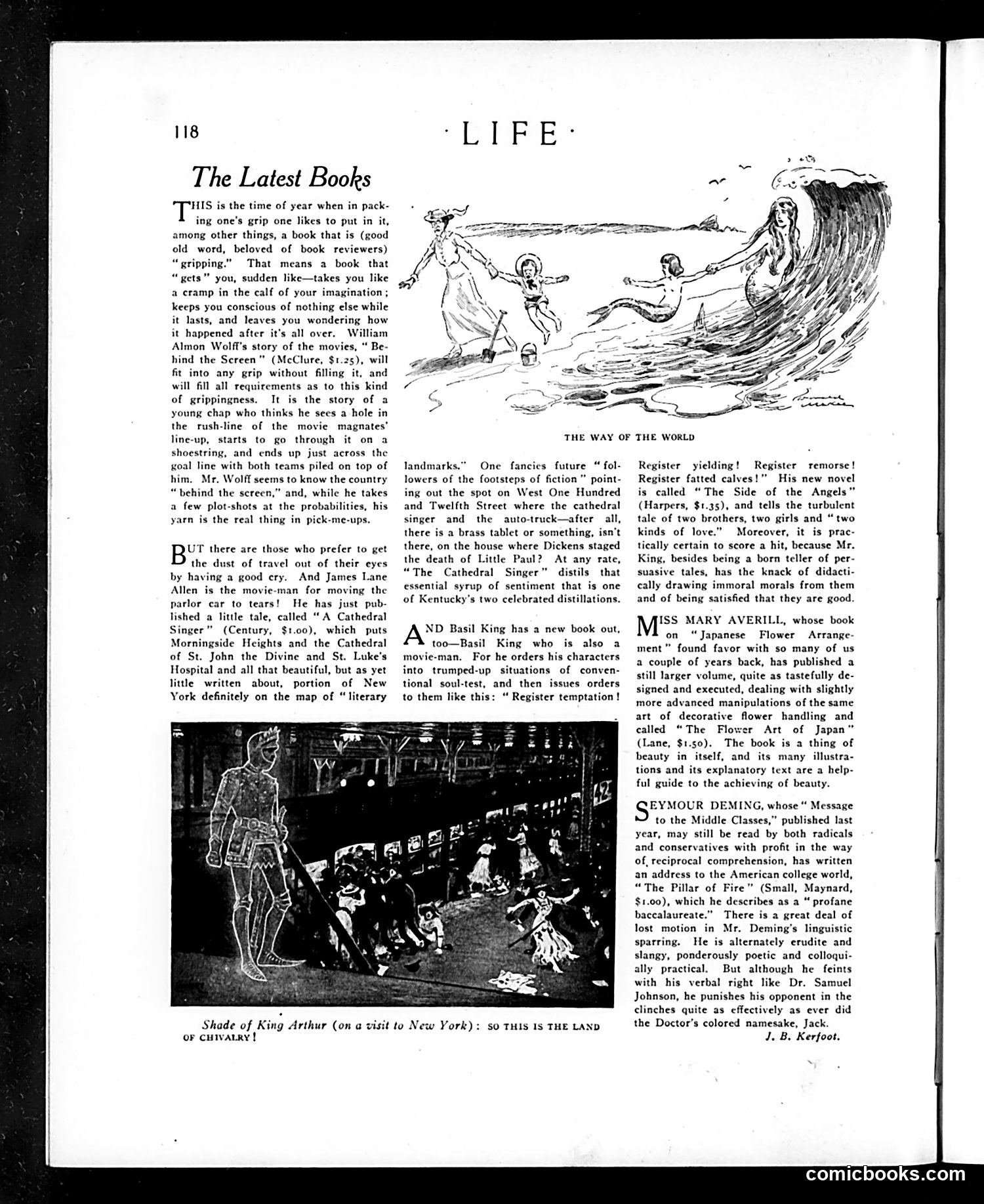
This is a book review column, not a political cartoon. The main illustration—captioned "Shade of King Arthur (on a visit to New York): SO THIS IS THE LAND OF CHIVALRY!"—is a satirical cartoon showing King Arthur observing modern New York life. The joke is straightforward: King Arthur, legendary symbol of chivalry and medieval honor, visits contemporary New York and finds it decidedly *un*-chivalrous. The contrast between his expectations (courtly behavior, nobility, honor) and harsh urban reality creates the satire. The illustration depicts a crowded, rough urban scene that would shock someone from an idealized past. The column itself reviews contemporary novels, mostly by writers connected to cinema (William Almon Wolff, James Lane Allen, Basil King). The reviews are lighthearted and somewhat mocking of sentimental plots about moral temptation and redemption.
📄 Transcribed text from this page (OCR, searchable)
Machine-transcribed from the original scan — historical spelling and the odd misread are preserved.
118 The Latest Books HIS is the time of year when in pack- ing one’s grip one likes to put in it, among other things, a book that is (good old word, beloved of book reviewers) “gripping.” That means a book that “gets” you, sudden like—takes you like a cramp in the calf of your imagination ; keeps you conscious of nothing else while it lasts, and leaves you wondering how it happened after it's all over. William Almon Wolft’s story of the movies, “ Be- hind the Screen (McClure, $1.25), will fit into any grip without filling it, and will fill all requirements as to this kind of grippingness. It is the story of a young chap who thinks he sees a hole in the rush-line of the movie magnates’ line-up, starts to go through it on a shoestring, and ends up just across the goal line with both teams piled on top of him. Mr. Wolff seems to know the country “behind the screen,” and, while he takes a few plot-shots at the probabilities, his yarn is the real thing in pick-me-ups. UT there are those who prefer to get the dust of travel out of their eyes by having a good ct And James Lane Allen is the movie-man for moving the parlor car to tears! He has just pub- lished a little tale, called “A Cathedral Singer” (Century, $1.00), which puts Morningside Heights and the Cathedral of St. John the Divine and St, Luke's Hospital and all that beautiful, but as yet little written about, portion New York definitely on the map of iterary THE WAY OF THE WORLD landmarks.” One fancies future “ fol- lowers of the footsteps of fiction ” point- ing out the spot on West One Hundred and Twelfth Street where the cathedral singer and the auto-truck—after all, there is a brass tablet or something, isn’t there, on the house where Dickens staged the death of Little Paul? At any rate, “The Cathedral Singer” distils that essential syrup of sentiment that is one of Kentucky's two celebrated distillations. ND Basil King has a new book out, too—Basil King who is also a movie-man. For he orders his characters into trumped-up situations of conven- tional soul-test, and then issues orders to them like this: “ Register temptation! Shade of King Arthur (on a visit to New York): so THIS 1s THE LAND OF CHIVALRY | Register yielding! Register remorse! Register fatted calves!” His new novel is called “The Side of the Angels” (Harpers, $1.35), and tells the turbulent tale of two brothers, two girls and “two kinds of love.” Moreover, it is prac- tically certain to score a hit, because Mr. King, besides being a born teller of per- suasive tales, has the knack of didacti- cally drawing immoral morals from them and of being satisfied that they are good. ISS MARY AVERILL, whose book on “Japanese Flower Arrange- ment” found favor with so many of us a couple of years back, has published a still larger volume, quite as tastefully de- signed and executed, dealing with slightly more advanced manipulations of the same art of decorative flower handling and called “The Flower Art of Japan” (Lane, $1.50). The book is a thing of beauty in itself, and its many illustra- tions and its explanatory text are a help- ful guide to the achieving of beauty. EYMOUR DEMING, whose “ Message to the Middle Classes,” published last year, may still be read by both radicals and conservatives with profit in the way of, reciprocal comprehension, has written an address to the American college world, “The Pillar of Fire” (Small, Maynard, $1.00), which he describes as a “ profane baccalaureate.” There is a great deal of lost motion in Mr. Deming’s linguistic sparring. He is alternately erudite and slangy, ponderously poetic and colloqui- ally practical. But although he feints with his verbal right like Dr. Samuel Johnson, he punishes his opponent in the clinches quite as effectively as ever did the Doctor’s colored namesake, Jack. J. B. Kerfoot. comicbooks.com