
A complete issue · 46 pages · 1916
Life — June 8, 1916
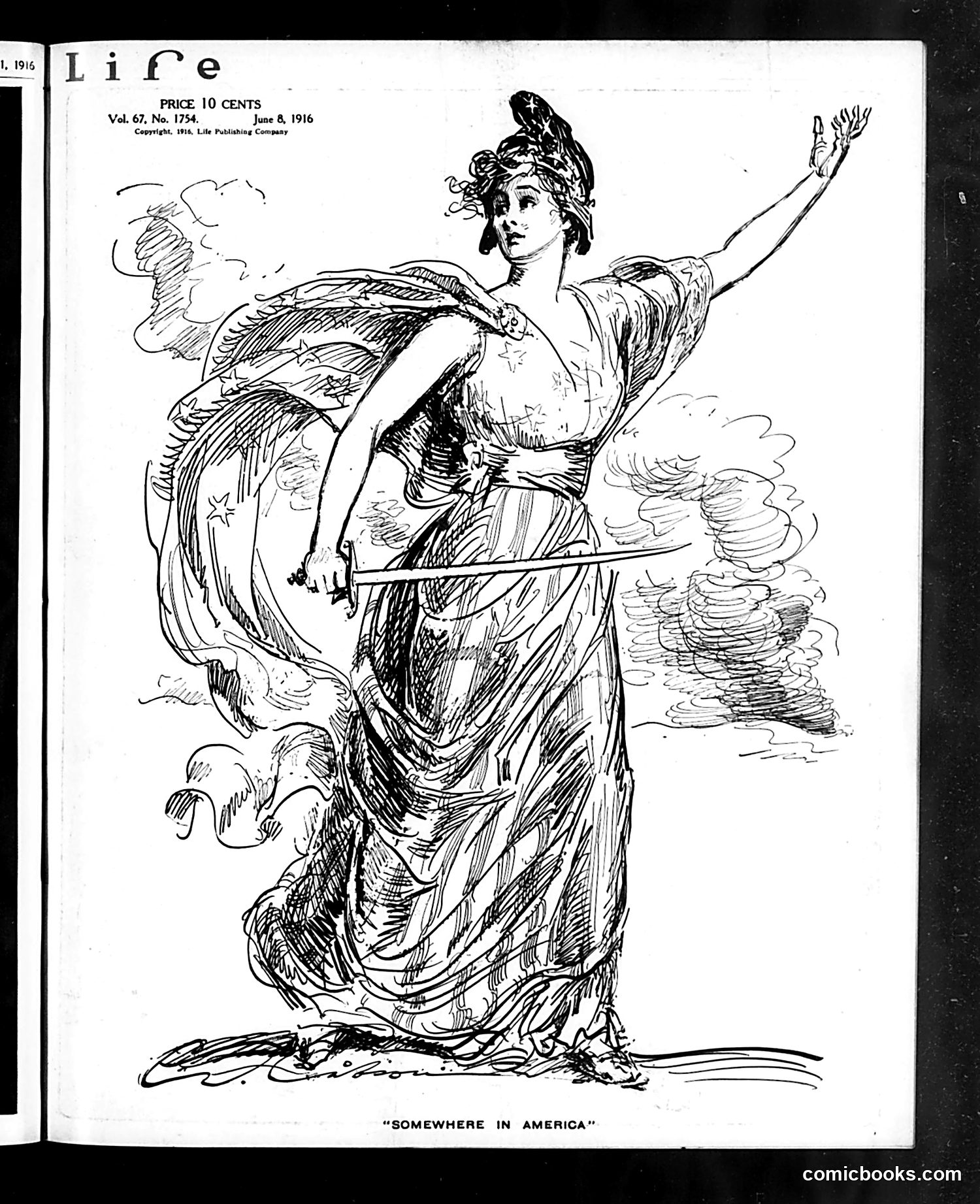
This cover illustration depicts Lady Liberty (identifiable by her classical pose, feathered headdress, and flowing robes) wielding a bow and arrow. The caption "Somewhere in America" suggests a commentary on American preparedness or military readiness. Given the 1916 date—before U.S. entry into World War I—this likely references debates over American military strength and defensive capability. Lady Liberty is shown as an armed warrior rather than her traditional peaceful pose, possibly satirizing either anxieties about American unpreparedness or arguments for increased military spending and intervention. The stars on her cloak reinforce patriotic symbolism, while her active, weaponized stance transforms the typical gentle Liberty imagery into something more martial and aggressive.
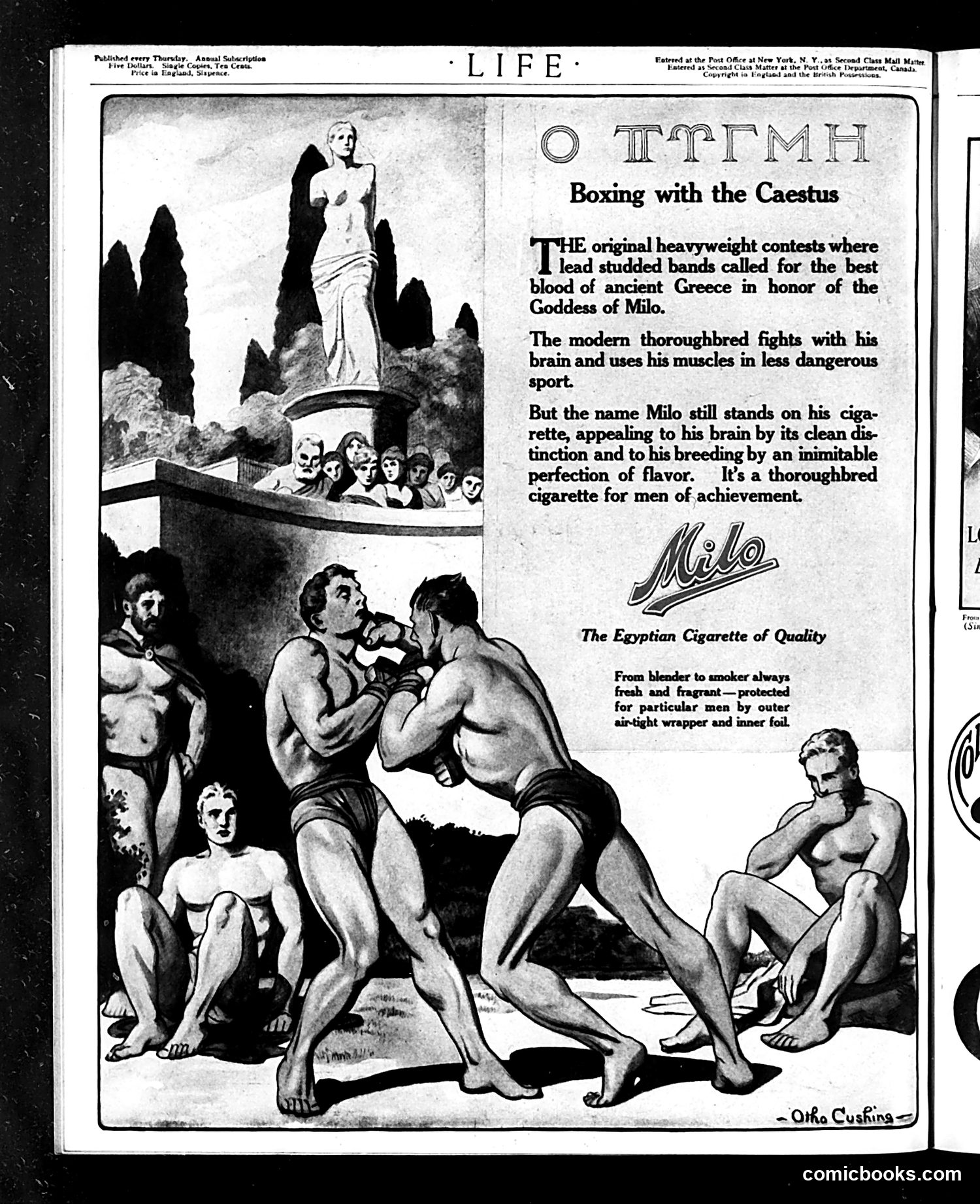
This is primarily a **Milo cigarette advertisement**, not political satire. The ad uses ancient Greece as its marketing theme, drawing a parallel between classical boxing (the "Caestus," a leather hand-wrapping used in Greek combat) and modern boxing. The advertisement's central conceit compares: - **Ancient boxers** (depicted in the illustration): brutal, dangerous sport using lead-studded bands - **Modern boxers**: more cerebral, safer sport using trained technique - **Milo cigarettes**: similarly "thoroughbred" and refined—appealing to intellectuals and men of "achievement" The statue of the Goddess of Milo presiding over the scene anchors the classical branding. This is straightforward product marketing leveraging aspirational associations with athletic prowess, sophistication, and classical culture—common advertising strategy of the era.
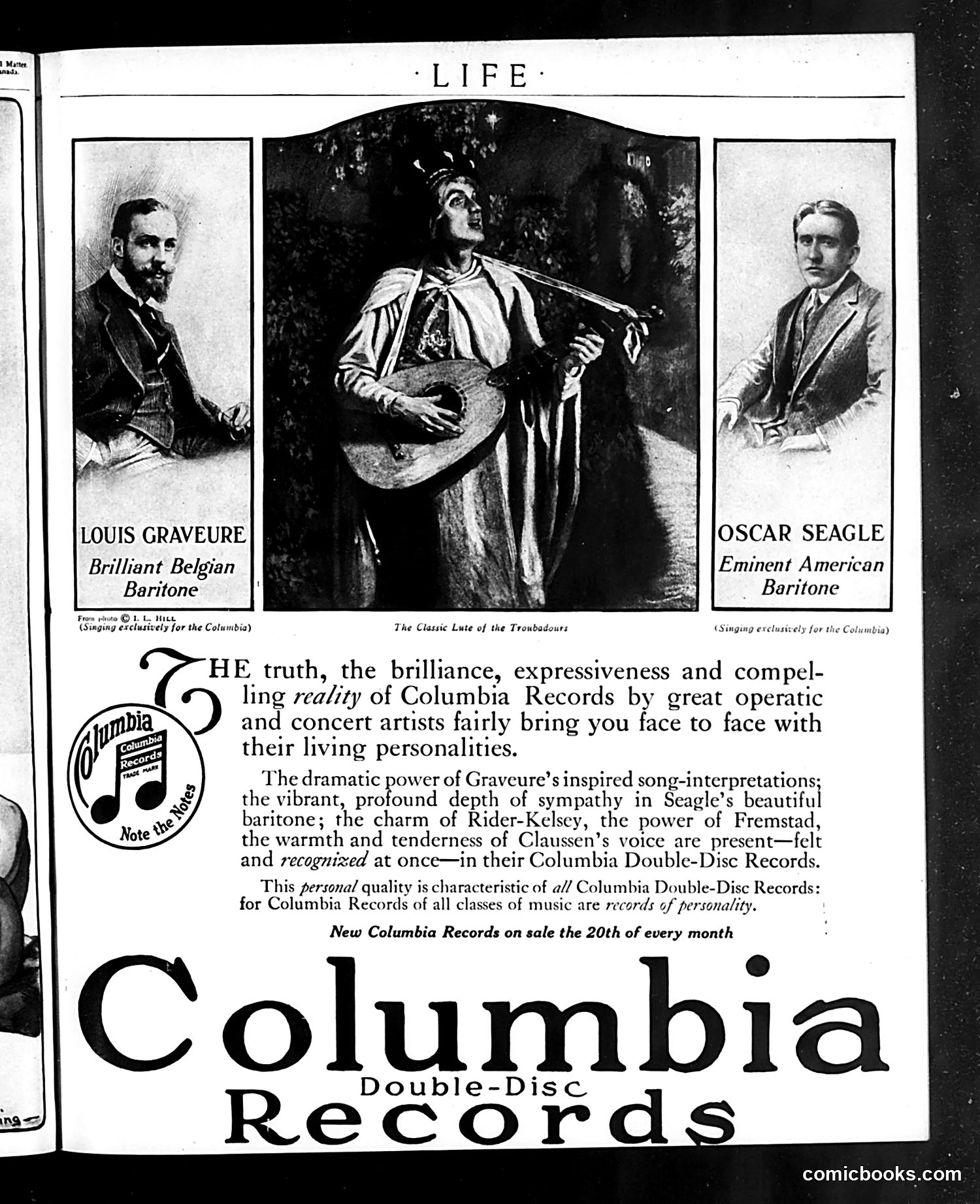
This is primarily a **Columbia Records advertisement**, not a satirical cartoon. The page features three portrait photographs of operatic baritones: - **Louis Graveure** (left), identified as a "Brilliant Belgian Baritone" - An unnamed central figure performing with a guitar, labeled "The Classic Lute of the Troubadours" - **Oscar Seagle** (right), identified as an "Eminent American Baritone" The ad promotes Columbia Double-Disc Records, emphasizing that their recordings capture the "truth, brilliance, expressiveness and compelling reality" of great operatic performers. It claims these records offer "personal quality" and bring listeners "face to face" with artists' personalities. This reflects early 20th-century classical music marketing and the emerging recording industry's pitch: authentic personal connection through technology.
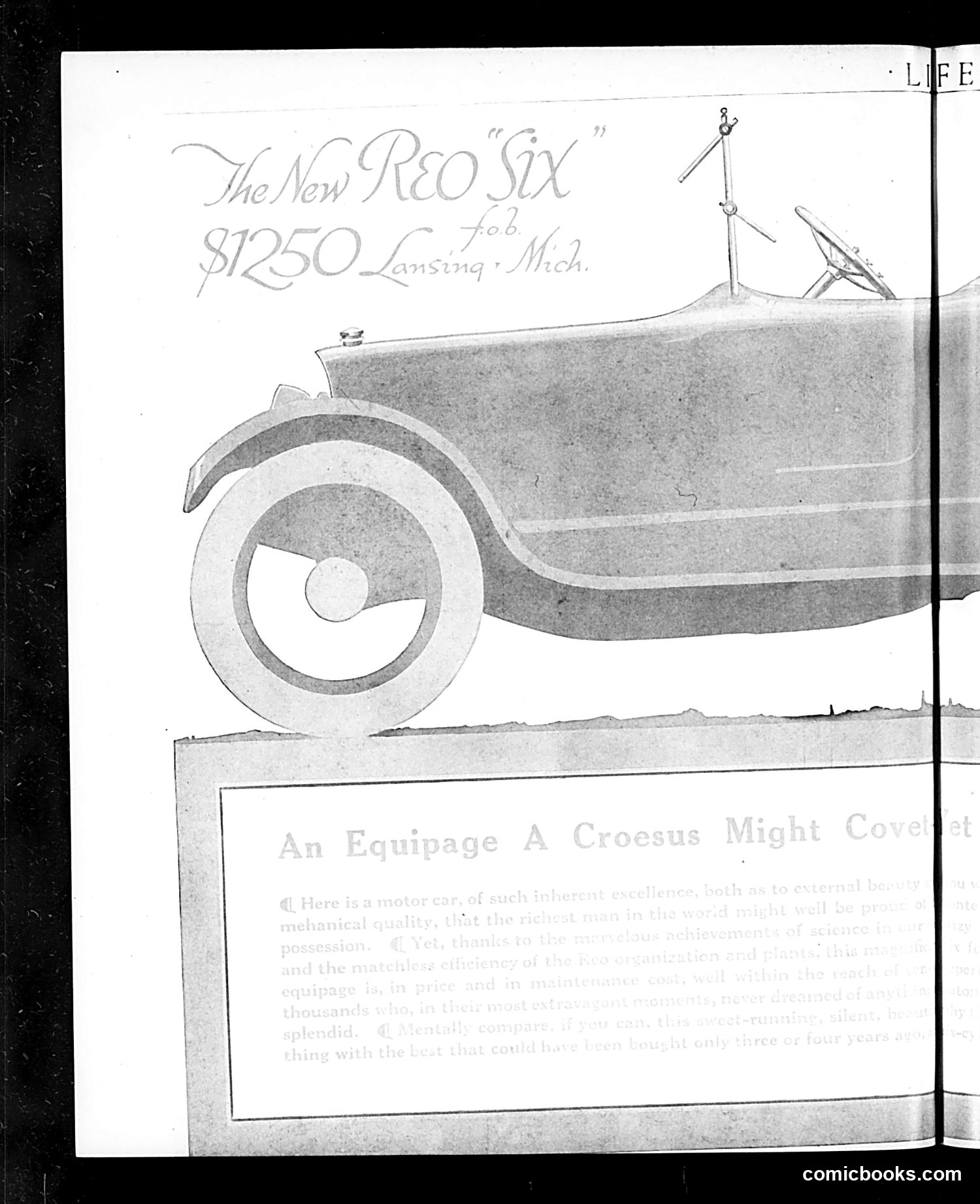
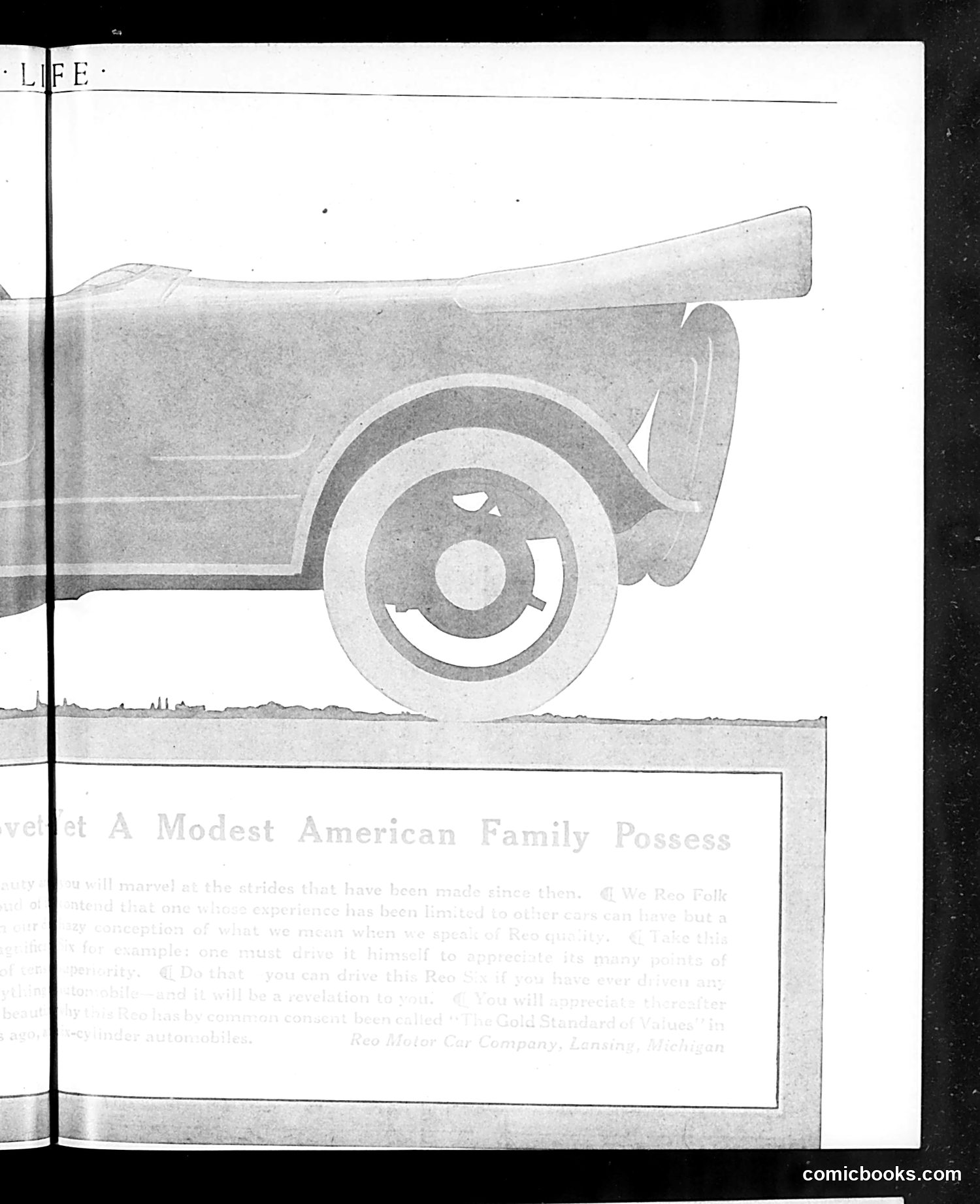
This page is primarily **advertising** for the REO Six automobile, priced at $1,250 in Lansing, Michigan. The illustration shows a stylized side view of the car, emphasizing its elegant curved lines and large wheel. The article below, titled "An Equipage A Croesus Might Covet," uses classical reference (Croesus, the fabulously wealthy ancient king) to suggest the car represents luxury and aspirational status. The text claims the REO Six combines mechanical excellence with external beauty, and emphasizes its value proposition—that this quality vehicle is affordable compared to more expensive alternatives. This is marketing copy designed to appeal to middle-class buyers seeking prestige through automobile ownership, a significant status symbol in the early 20th century.
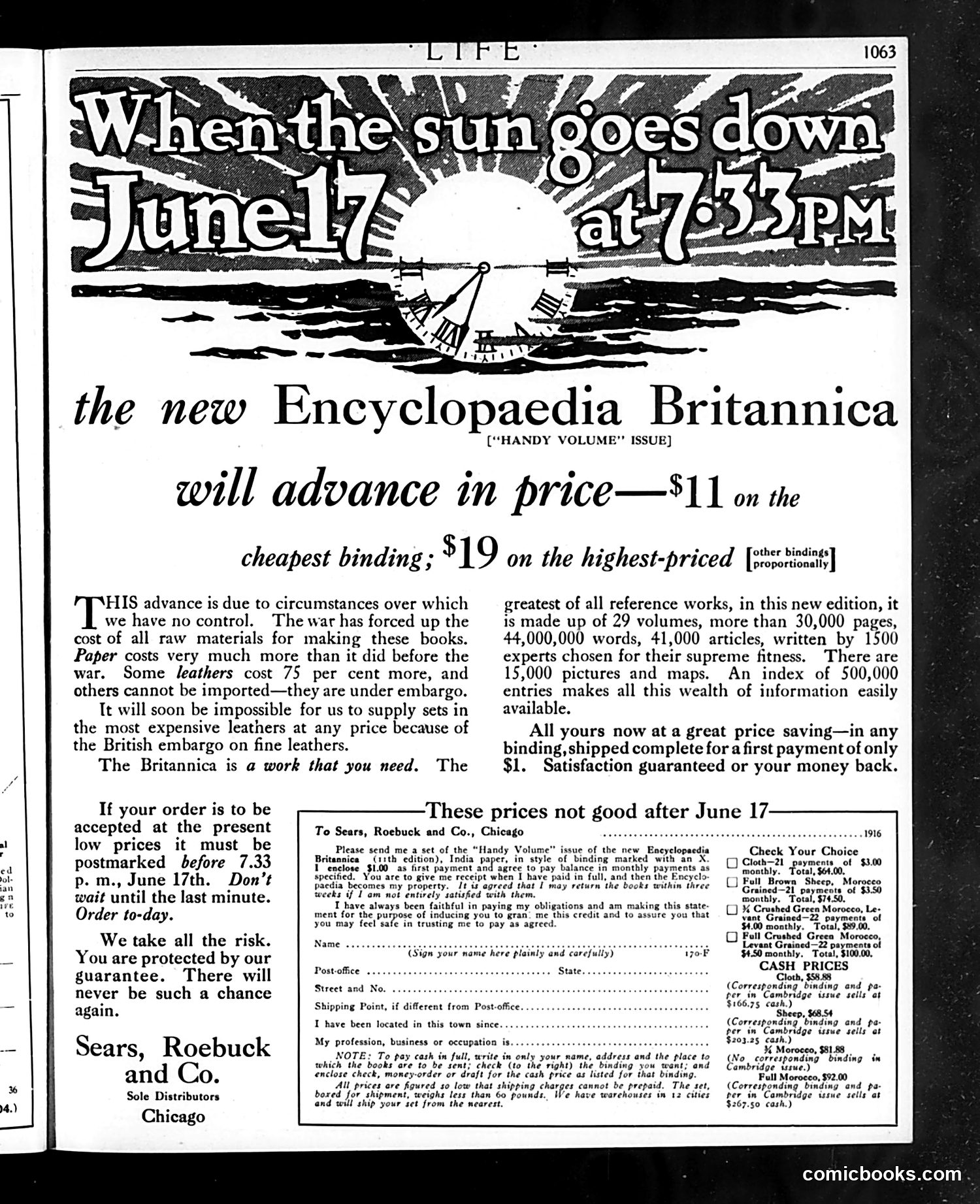
This page is primarily an advertisement for the Encyclopedia Britannica's "Handy Volume" issue, not a cartoon or satirical content. The ad uses an illustration of a sunset on June 17 to announce a price increase taking effect that date. The marketing pitch emphasizes urgency—readers must order before 7:33 p.m. on June 17 to lock in current prices ($11-$19 depending on binding). The ad attributes the price hike to wartime inflation: paper costs rose significantly, leather bindings became 75% more expensive, and some materials became impossible to import due to "the British embargo on fine leather." The copy stresses the encyclopedia's value (29 volumes, 30,000+ pages, 500,000 index entries) while leveraging scarcity and deadline pressure as sales tactics. Sears, Roebuck and Co. is listed as the sole distributor.
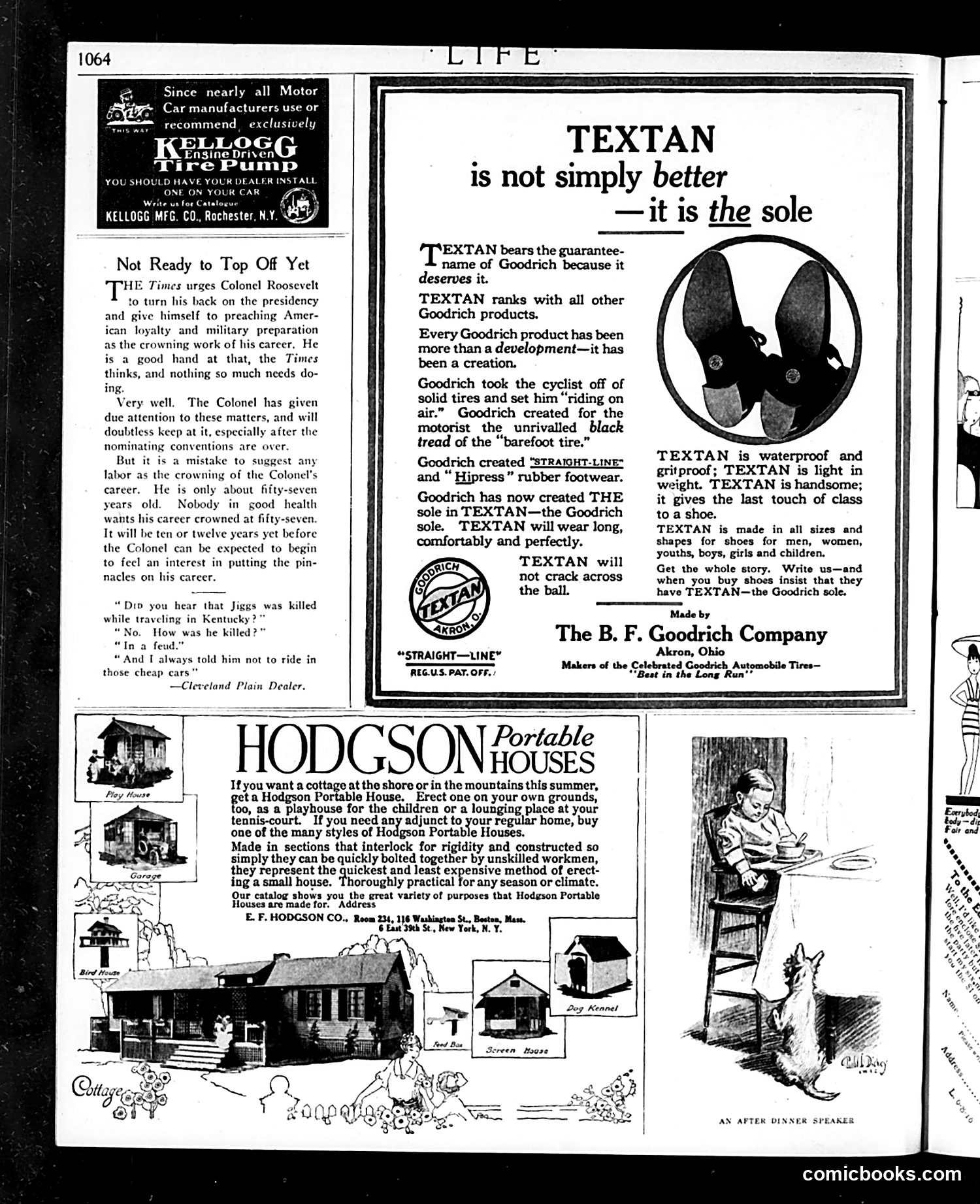
This page is primarily **advertising**, not satire or political commentary. The main advertisements are: 1. **Kellogg Flywheel** (top left): A motor car accessory ad 2. **Texan Tire** (center): The B.F. Goodrich Company promotes their "Texan" rubber sole as superior to competitors, emphasizing durability and waterproofing 3. **Hodgson Portable Houses** (bottom): Prefabricated cottage kits for seasonal or permanent use The only non-advertising content is a brief editorial section titled "Not Ready to Top Off Yet," which discusses Colonel Roosevelt's career focus and political ambitions—likely referring to Theodore Roosevelt's continued influence in 1912 politics. The page contains no political cartoons or satire—it's a standard early-20th-century magazine page mixing editorial commentary with commercial advertisements.
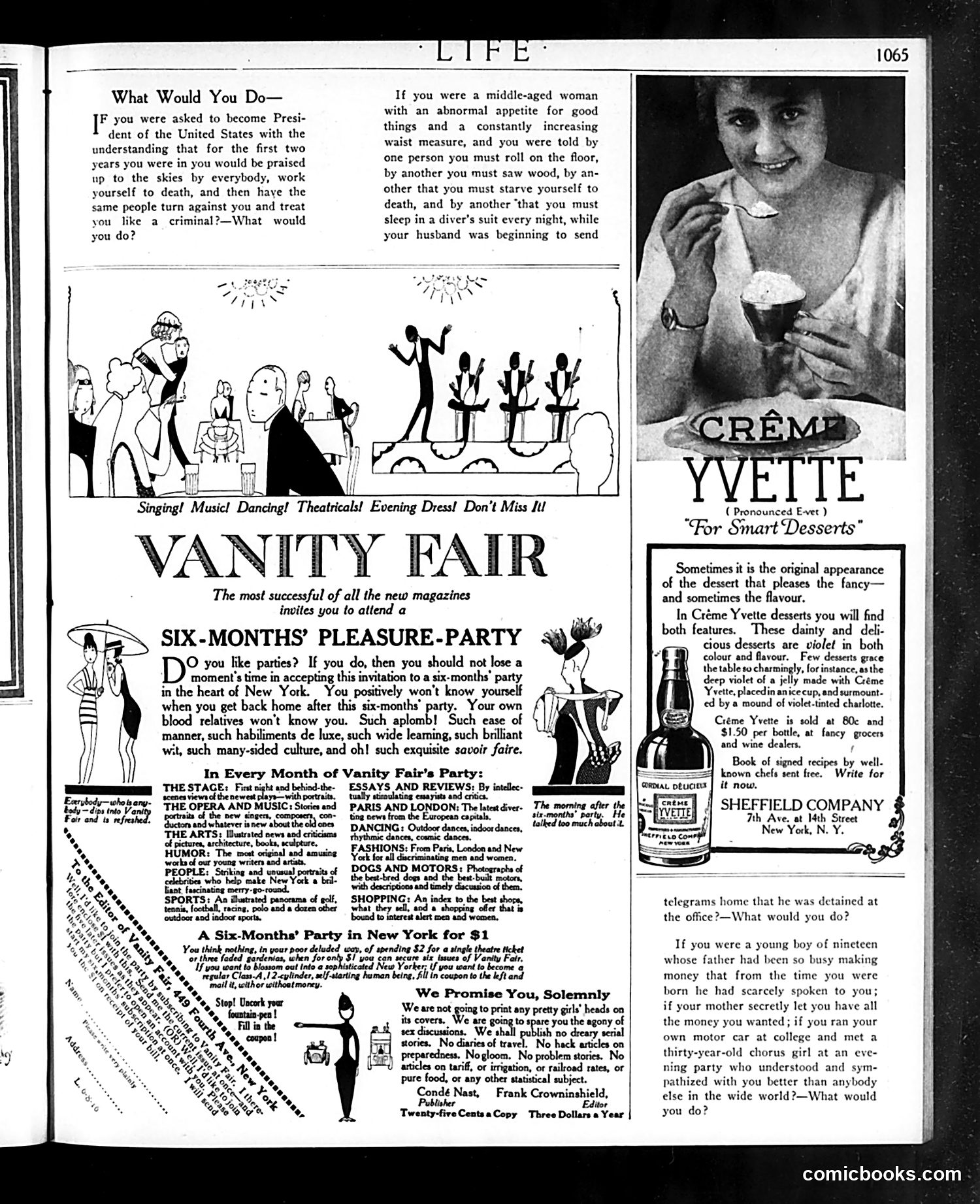
This page is primarily **advertising and social content** from Life magazine, not political satire. The main cartoon illustrates a "What Would You Do?" ethical dilemma: a hypothetical scenario where conflicting authority figures give contradictory orders (one says "saw wood," another says "starve yourself," a third says "sleep in a diver's suit"). The cartoon satirizes the absurdity of impossible demands and conflicting advice—a common Life magazine format for humorous ethical puzzles. The rest of the page advertises **Vanity Fair magazine** (promoting a "Six-Months' Pleasure Party") and **Crème Yvette** dessert product. These are straightforward advertisements rather than political commentary. The content reflects 1920s entertainment culture and consumer marketing rather than satirizing specific political figures or events.
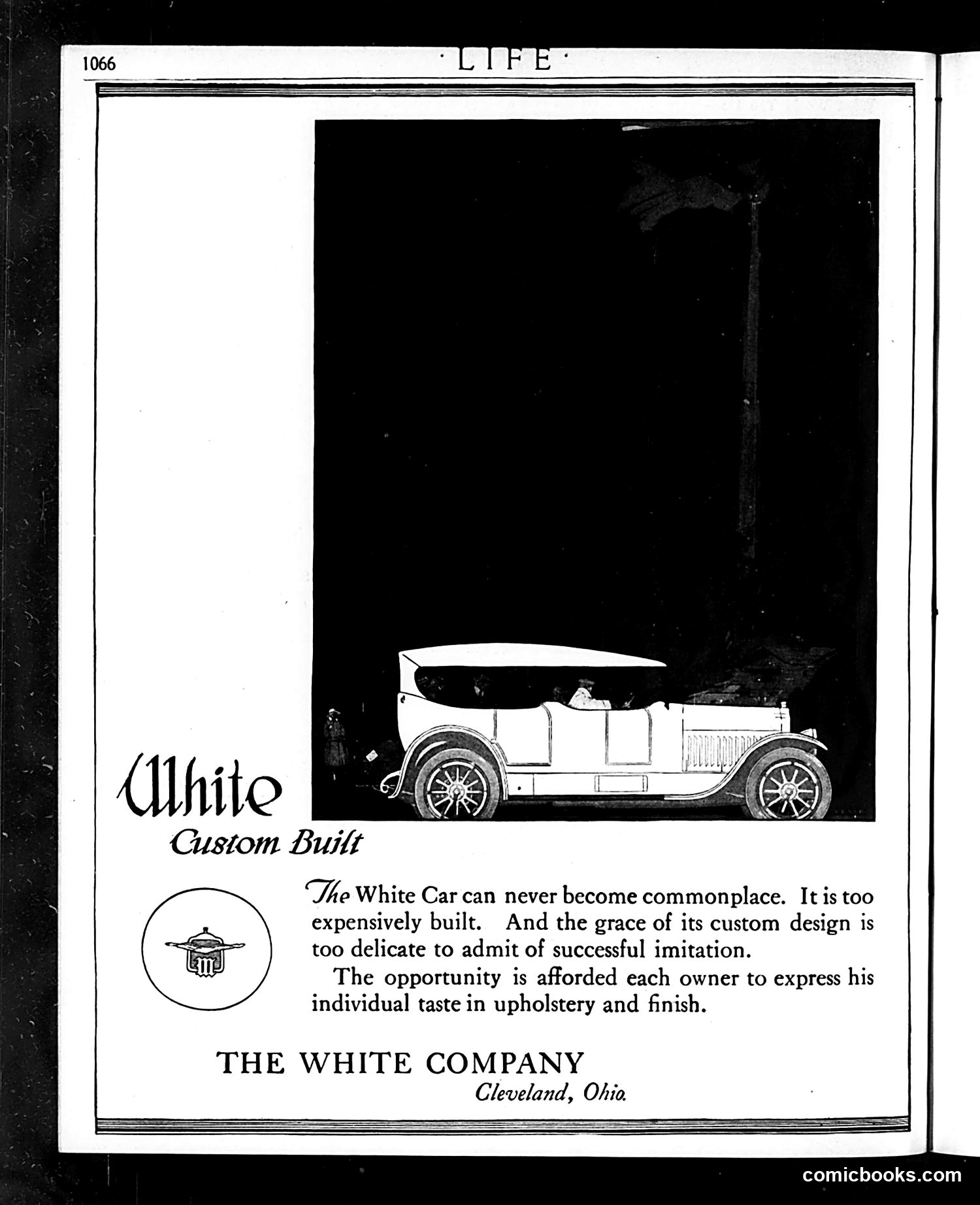
This is a **full-page advertisement**, not a cartoon or satirical content. It advertises the White Car, a custom-built automobile manufactured by The White Company in Cleveland, Ohio. The ad features an illustration of an open-air motorcar from the early automobile era (appears to be 1910s-1920s based on design). The copy emphasizes exclusivity and luxury: the White Car is positioned as expensive, non-commonplace, and featuring custom design that cannot be successfully imitated. The pitch appeals to wealthy buyers' desire for individual expression through "upholstery and finish" choices. This represents early automotive marketing targeting the affluent market segment, before cars became mass-produced consumer goods.
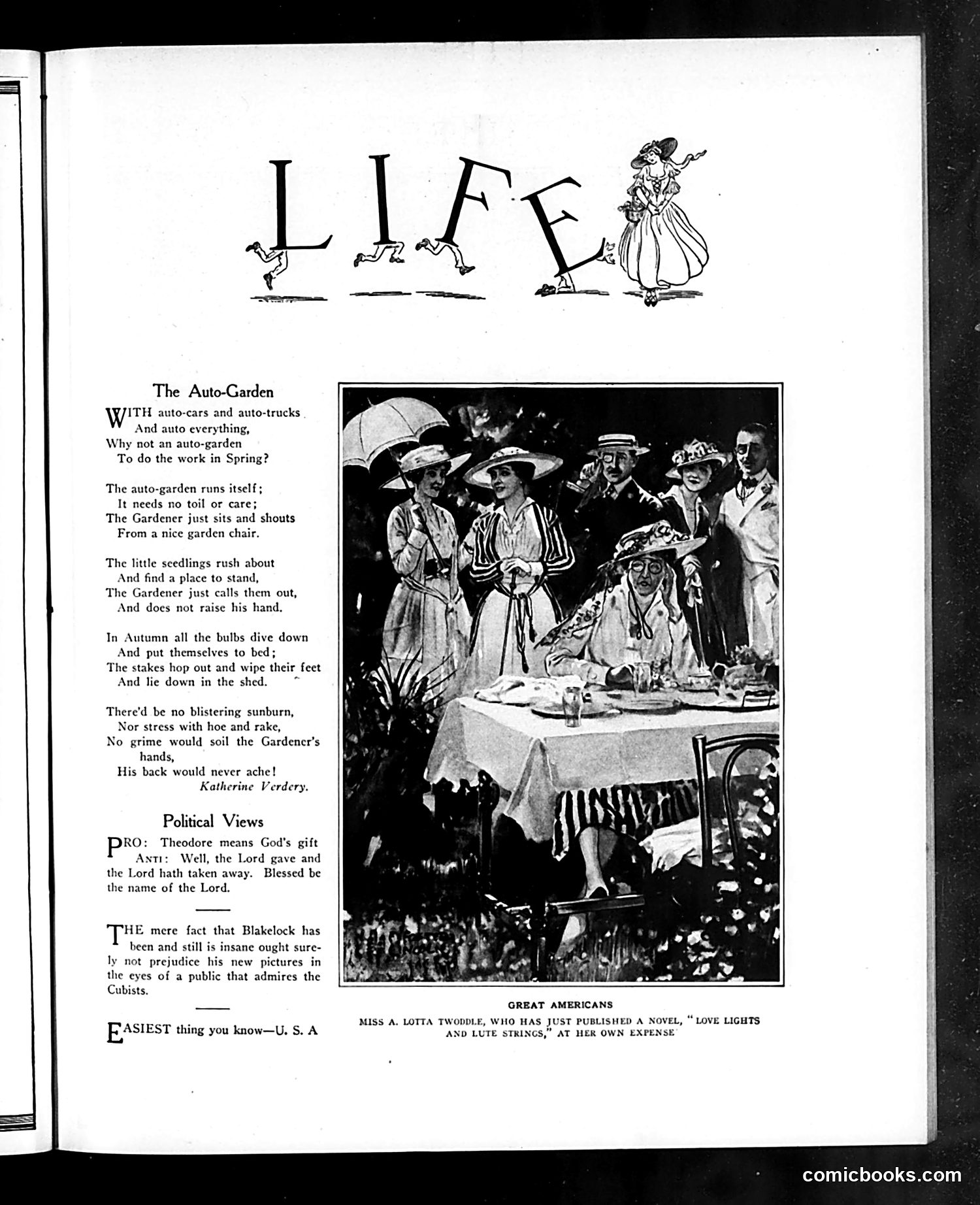
This page mixes several sections: **"The Auto-Garden"** is a humorous poem by Katherine Verdery about labor-saving garden technology—suggesting automobiles and machines do gardening work, eliminating the gardener's traditional labor. It's satirizing early 20th-century enthusiasm for mechanization and automation. **"Political Views"** presents a brief pro/anti exchange about Theodore Roosevelt, appearing to satirize partisan debate over his legacy. **The photograph** shows a social gathering labeled "Great Americans," specifically identifying Miss A. Lotta Twoddle, who has "just published a novel, 'Love Lights and Lute Strings,' at her own expense." This appears to mock self-published authors and perhaps vapid society women's literary pretensions. The overall page tone is gently satirical toward modern conveniences, politics, and amateur literary ambitions.
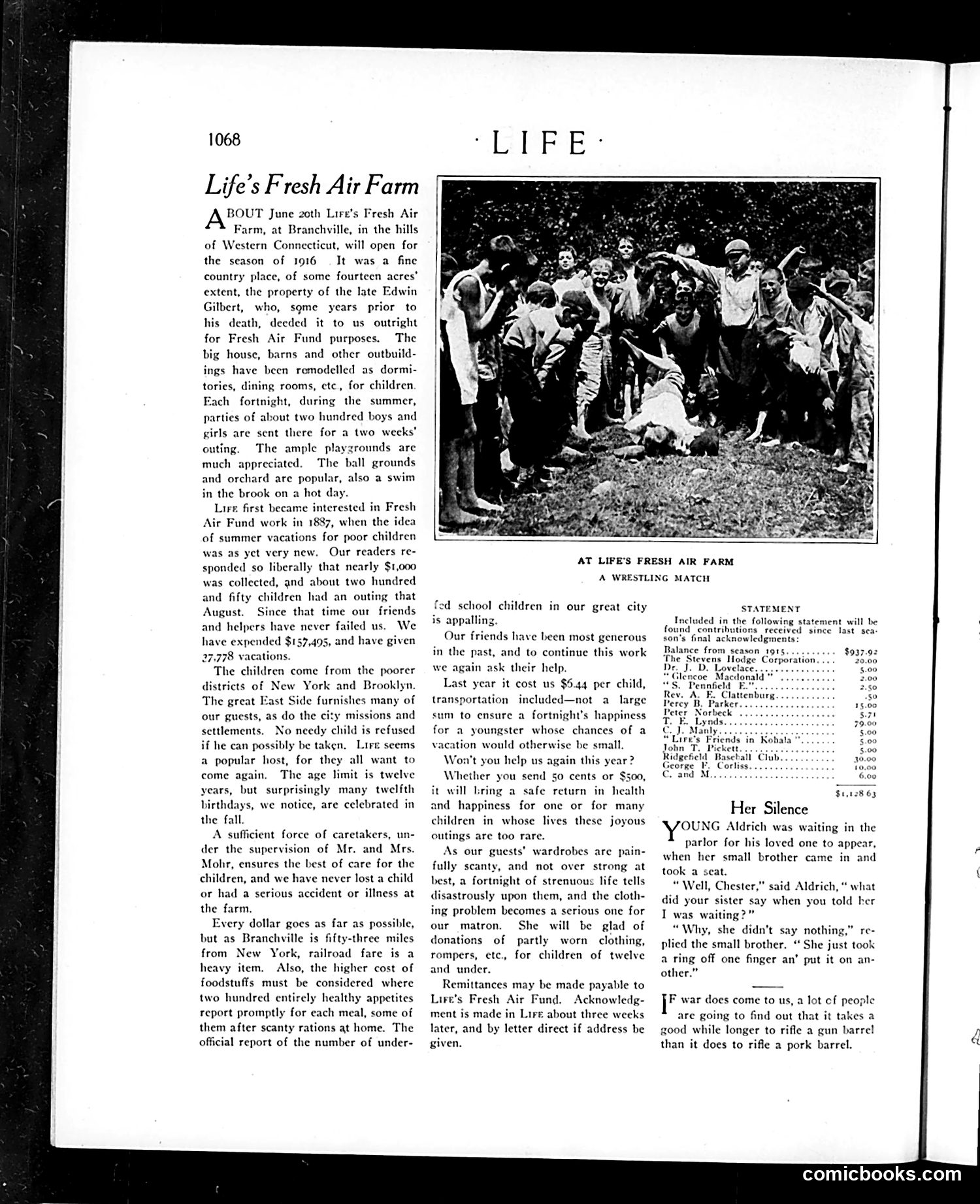
This page contains two distinct articles about charitable work: **Left side**: An article about Life's Fresh Air Farm in Brandville, Connecticut, which provided summer vacations for poor children from New York City. The text emphasizes the farm's facilities (dormitories, dining rooms, playgrounds, swimming) and notes that Life magazine had spent $157,495 supporting nearly 27,728 vacations since 1887. **Right side**: A short fictional piece titled "Her Silence" about a young woman named Aldrich awaiting her brother's return, with what appears to be mild romantic/dramatic tension in the dialogue. **The photograph** shows children at the farm during a wrestling match—a leisure activity demonstrating the wholesome recreation provided. This reflects early-20th-century philanthropic efforts by magazines to aid urban poverty through seasonal relief programs for children.
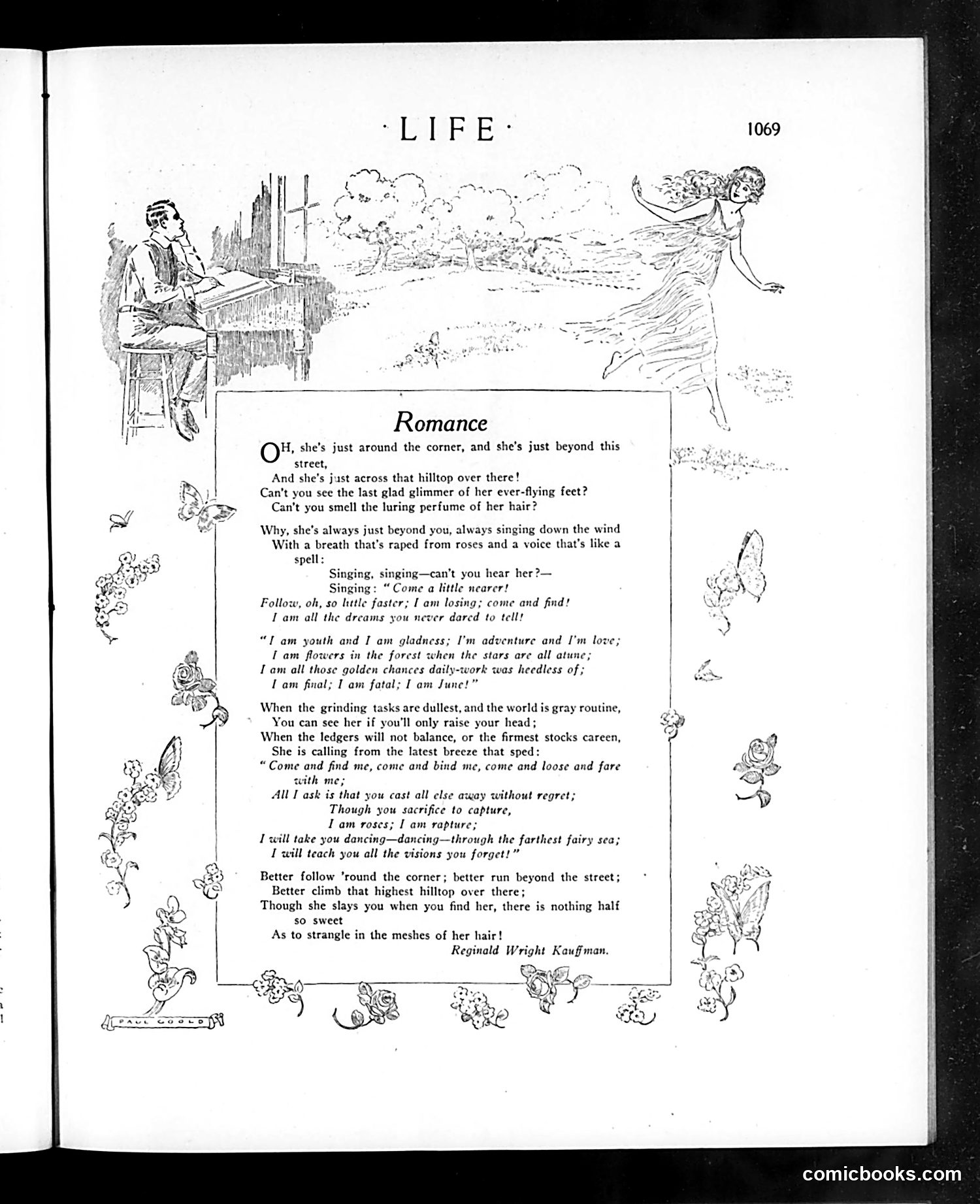
This page presents a romantic poem rather than a political cartoon. The illustrated composition features a dreamy, idealized couple: a man at left (appearing to work or write) and a ethereal woman in flowing dress floating/dancing on the right. The poem itself is whimsical fantasy—the speaker pursues an elusive, enchanting woman who is "always just beyond you." She represents an unattainable romantic ideal: singing, perfumed, offering escape from mundane reality ("grinding tasks," "ledgers," "stocks"). The satire targets romantic delusion itself: the speaker chases impossible dreams and magical promises ("dancing through the farthest fairy sea") rather than confronting actual life's dullness. It's gentle mockery of romantic escapism as a coping mechanism for ordinary dissatisfaction. The decorative floral borders reinforce the dreamy, sentimental tone.
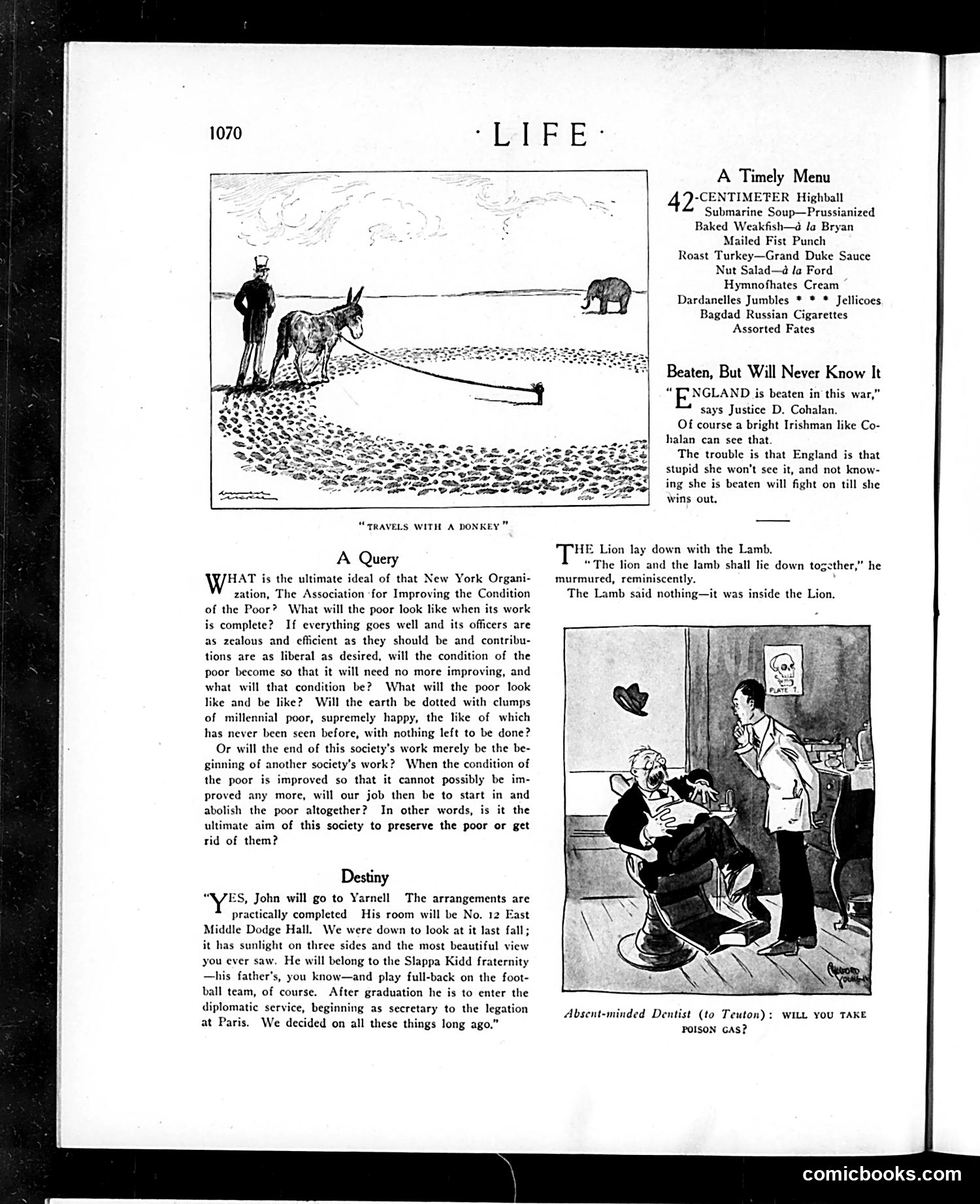
**"Travels with a Donkey"** (top illustration): Shows a man in formal dress leading a donkey across barren terrain. The caption's meaning is unclear without additional context, but appears to be a satirical commentary on some journey or endeavor. **"A Query"** (left column): Critiques the Association for Improving the Condition of the Poor, questioning whether charity work actually eliminates poverty or merely perpetuates the need for such organizations. This reflects early 20th-century debates about welfare's effectiveness. **"The Lion Lay Down with the Lamb"**: Appears to be a philosophical parable about unlikely peace or cooperation. **"Absent-minded Dentist"** (bottom right): A cartoon joke depicting a dentist about to administer poison gas instead of anesthetic—dark humor about professional mishaps. The page mixes social commentary with light humor typical of Life magazine's satirical approach.
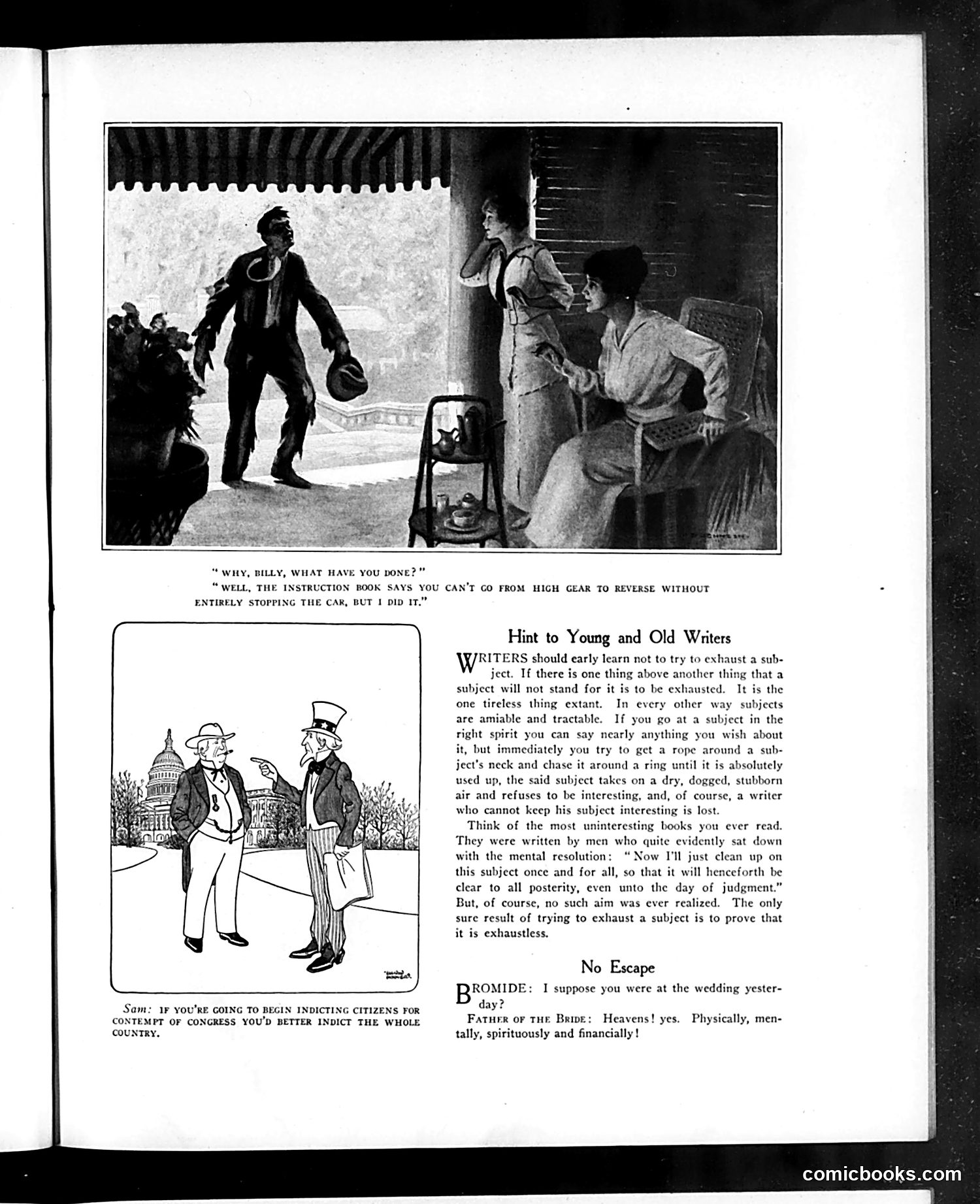
This page contains two unrelated pieces: a silent-film still with dialogue, and a "Hint to Young and Old Writers" essay. **Top image:** A man in formal attire enters a room where two women sit. The caption suggests he's violated car-operation instructions by shifting from high gear to reverse without stopping—a mechanical error presented as humorous marital/domestic conflict. The joke relies on automotive ignorance being treated as a domestic transgression. **Bottom cartoon:** Two men in top hats stand before the Capitol building. One advises indicting "citizens for contempt of congress"—satirizing political corruption or congressional unpopularity. The joke mocks either Congress's unpopularity or suggests widespread public disdain for lawmakers warrants mass prosecution. **Essay:** Advises writers against exhausting subjects, arguing that poorly-chosen topics become tedious regardless of execution.
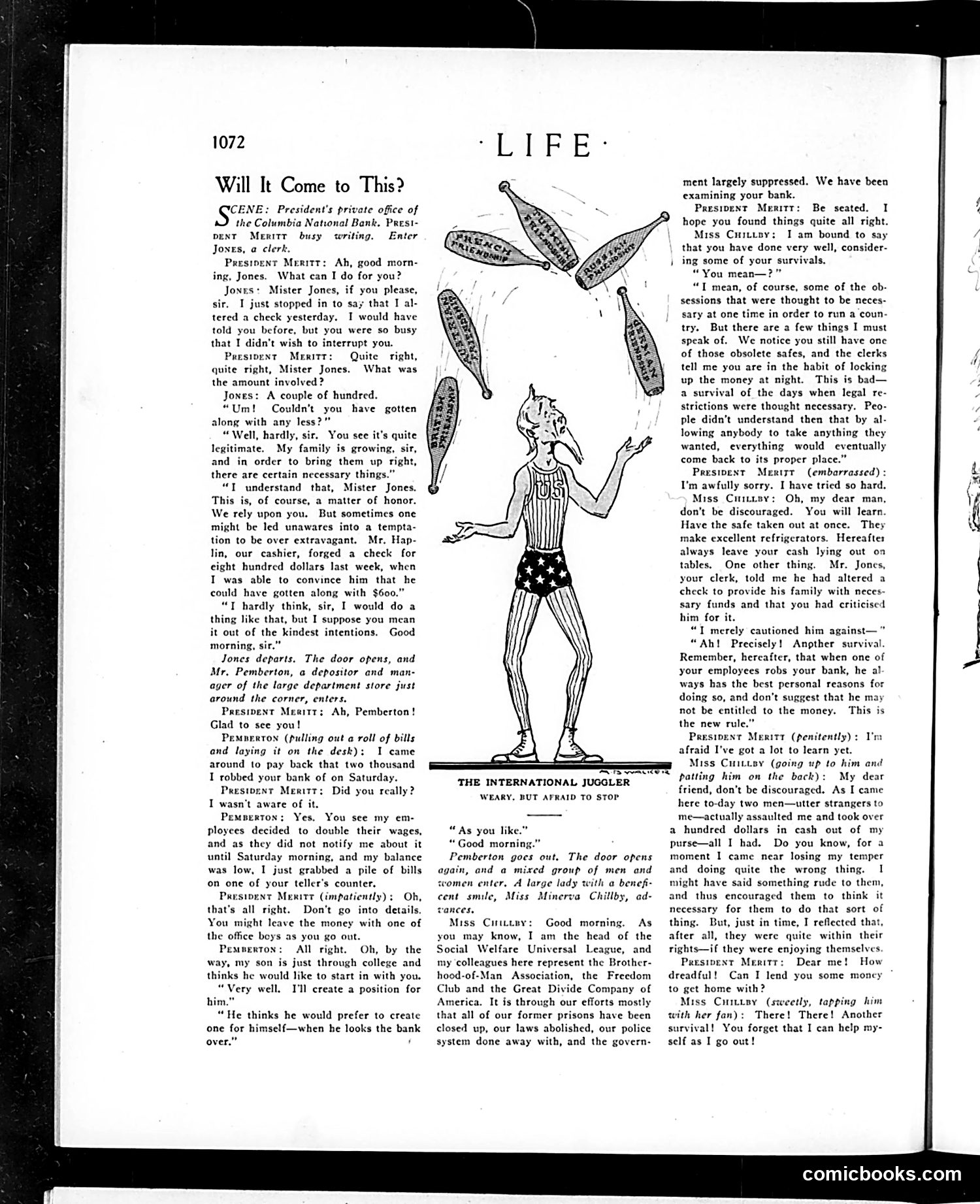
This is a satirical sketch mocking early 20th-century progressive reformers and their idealistic but impractical social policies. The cartoon presents a bank president dealing with increasingly absurd situations: a clerk admits to check fraud, a store manager confesses to theft, and a social welfare advocate (Miss Minerva Chillby) arrives to criticize him for maintaining basic security like safes and locks—calling them "obsolete" relics of a restrictive past. The satire's point: progressive activists who abolished prisons, laws, and police believe people will naturally be honest if given freedom. Yet the bank president has just witnessed multiple employees stealing. The sketch ridicules the contradiction between idealistic reform and human nature. The "International Juggler" illustration (bottom) appears related, though context is unclear from this page alone. The satire reflects contemporary anxieties about anarchist and radical reform movements gaining influence in early 1900s America.
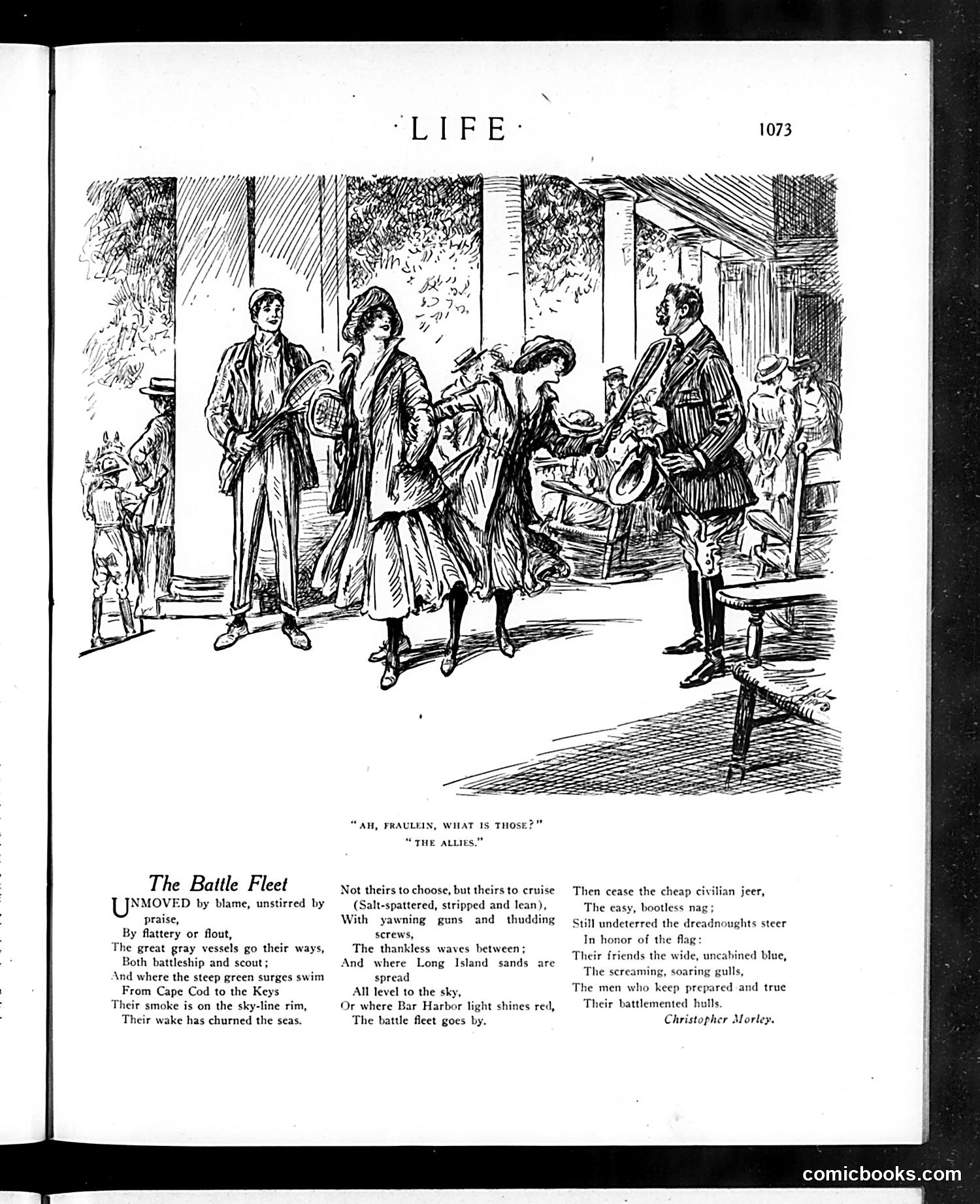
This page from *Life* magazine features a patriotic poem by Christopher Morley celebrating the American Navy during World War I. The illustration shows a German woman ("Fraulein") asking an American soldier about military figures, who identifies them as "the Allies"—referring to America's naval forces. The satirical cartoon critiques American civilian attitudes: the poem explicitly condemns "cheap civilian jeer" and "bootless nag" directed at the military, while praising the Navy's readiness and honor. The heading "The Battle Fleet" celebrates American battleships ("dreadnoughts") patrolling coastal waters from Cape Cod to the Florida Keys. This reflects wartime propaganda aimed at promoting military support and silencing domestic criticism of war efforts. The German woman's presence suggests the enemy perspective, implying Americans should unite against external threats rather than undermine their own armed forces.
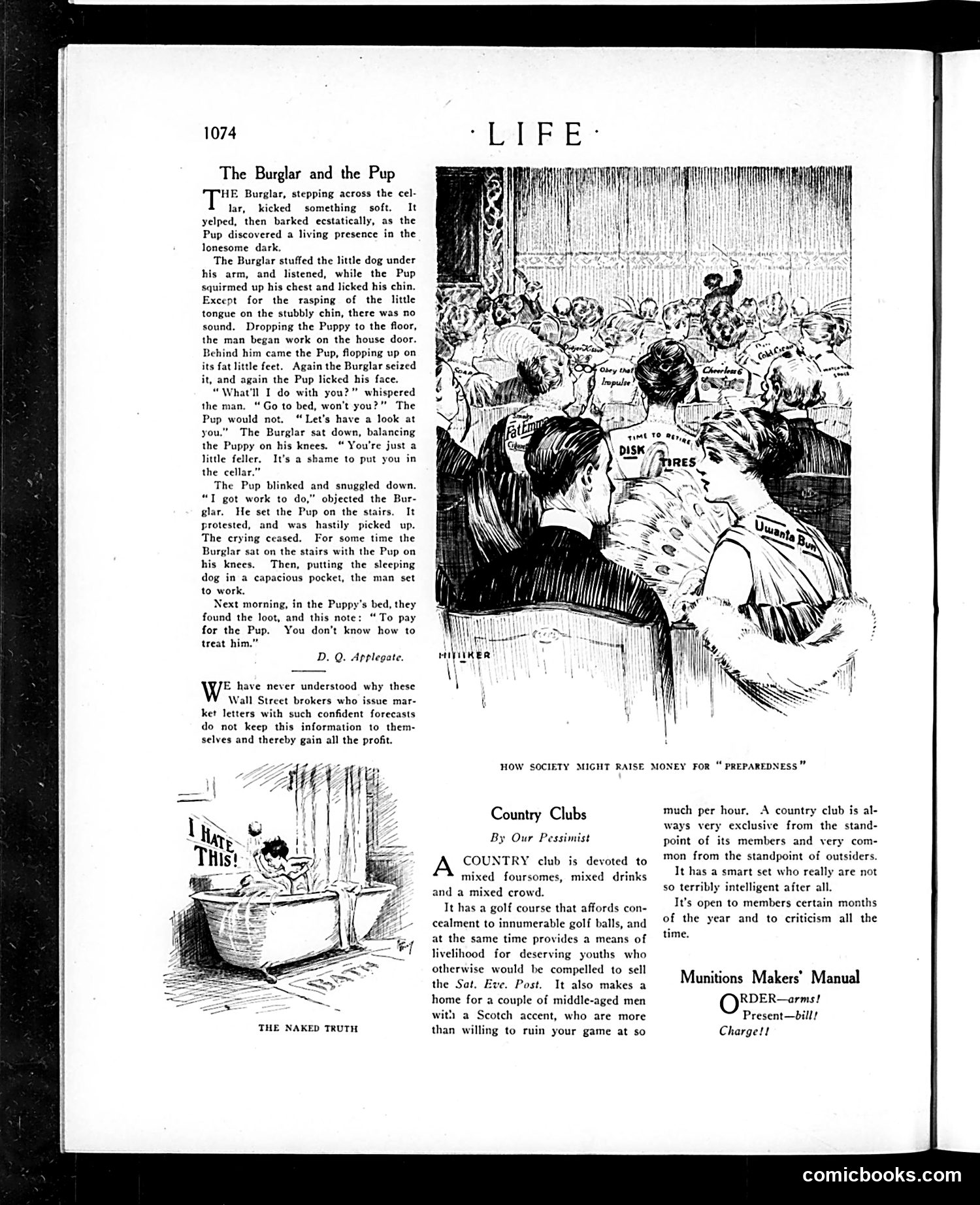
**The Main Story:** A burglar breaks into a house but encounters a puppy in the cellar. The dog's affection—licking his face, following him, seeking comfort—softens the criminal. Rather than complete the robbery, the burglar leaves payment for the puppy's care with a note: "You don't know how to treat him," implying the homeowner neglected the dog. **The Satire:** This sentimental tale illustrates a moral paradox: a criminal shows more kindness and conscience toward a living creature than the dog's own owner. It's a commentary on misplaced priorities—the homeowner has enough wealth to employ staff (implied by the house) yet fails at basic animal care. **Other Page Content:** Below the story, separate satirical pieces mock Wall Street brokers' stock forecasts, country clubs' exclusivity and mediocrity, and—in the "Munitions Makers' Manual"—the profit-driven arms industry during the pre-WWI "preparedness" movement. The overall theme: exposing hypocrisy and moral failings in respectable society.
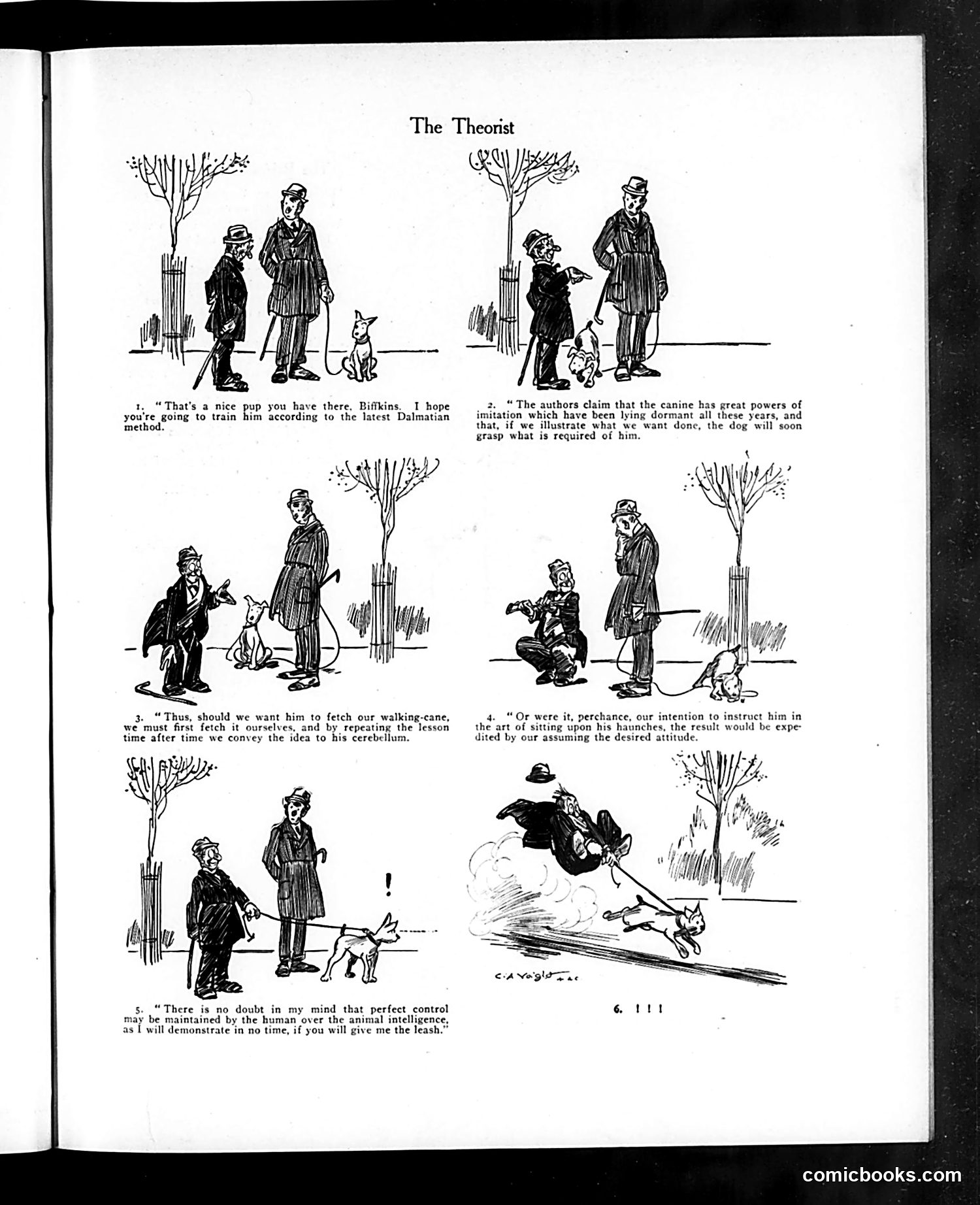
This comic mocks fashionable but absurd educational theories applied to dog training. A pompous theorist lectures his friend "Biffkins" on the "latest Dalmatian method," claiming dogs learn through imitation and that humans must demonstrate desired behaviors themselves—fetching the cane, sitting on haunches—to teach the animal. The satire targets pseudo-intellectual approaches to animal training popular in the early 20th century, where elaborate theoretical frameworks substituted for practical common sense. The theorist's verbose language ("convey the idea to his cerebellum") and confident assertions contrast sharply with the visual punchline in panel 6, where his demonstrated control completely fails—the dog pulls him sprawling into the mud. The joke: overly complicated theories often produce worse results than simple, direct methods. It mocks the era's tendency to overcomplicate instruction through fashionable intellectual frameworks.
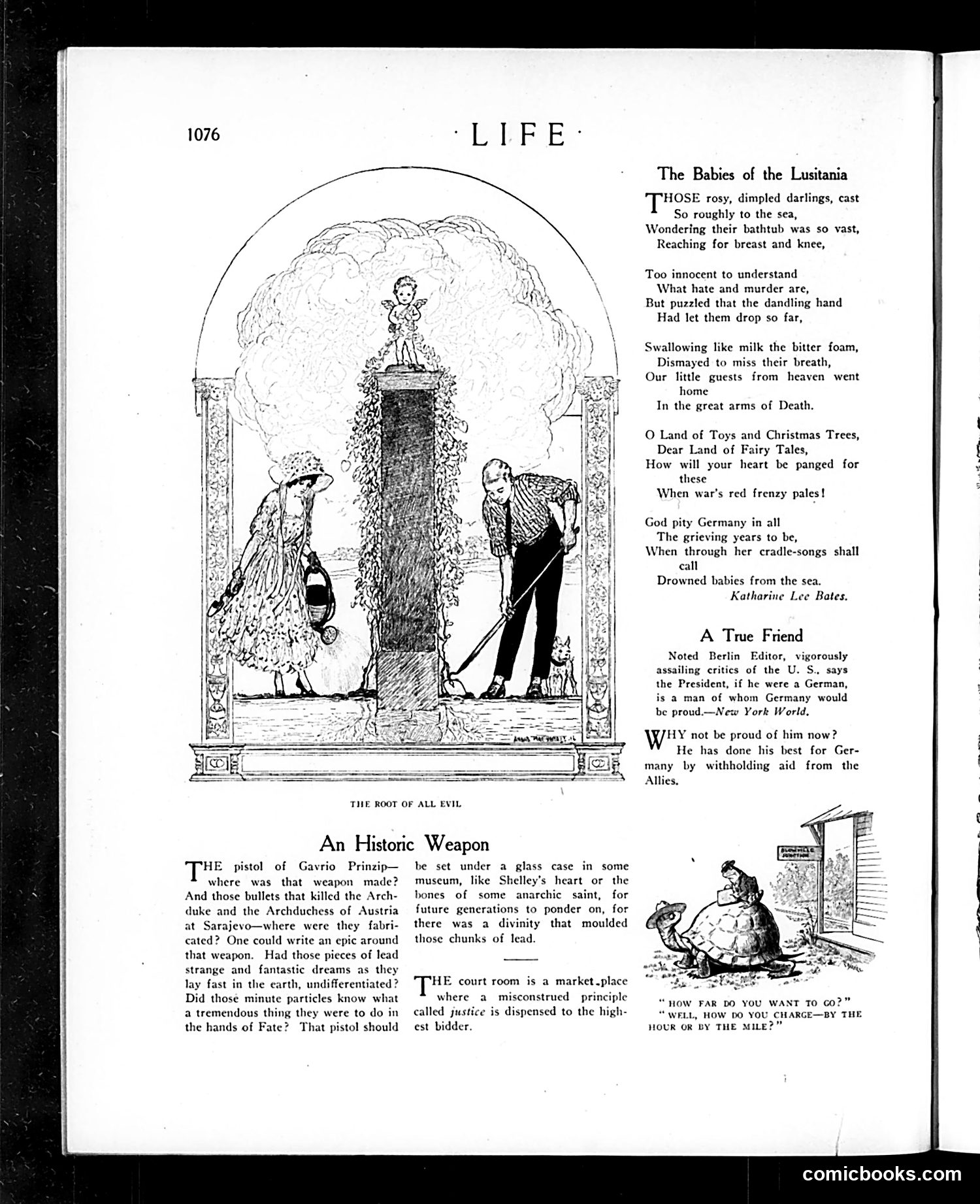
This WWI-era page contains anti-German satire responding to the 1915 Lusitania sinking. **"An Historic Weapon"** references Gavrilo Princip's assassination of Archduke Franz Ferdinand at Sarajevo (1914), which triggered WWI. The piece sardonically elevates the murder weapon to museum-worthy significance, implying Germany bears responsibility for the war's consequences. **"The Babies of the Lusitania"** is a poem by Katharine Lee Bates mourning the 1,198 civilians killed when a German U-boat torpedoed the British passenger liner. It appeals to German sentiment: future generations will hear drowned children's voices in lullabies, making Germany pay an emotional price for the atrocity. **"A True Friend"** mocks a Berlin editor praising President Wilson's neutrality as pro-German. The cartoon below shows a cab driver offering "hourly" or "mileage" rates—suggesting Wilson's aid calculations are transactional rather than principled. The overall message: Germany started the war and committed atrocities; American neutrality effectively aids German interests.
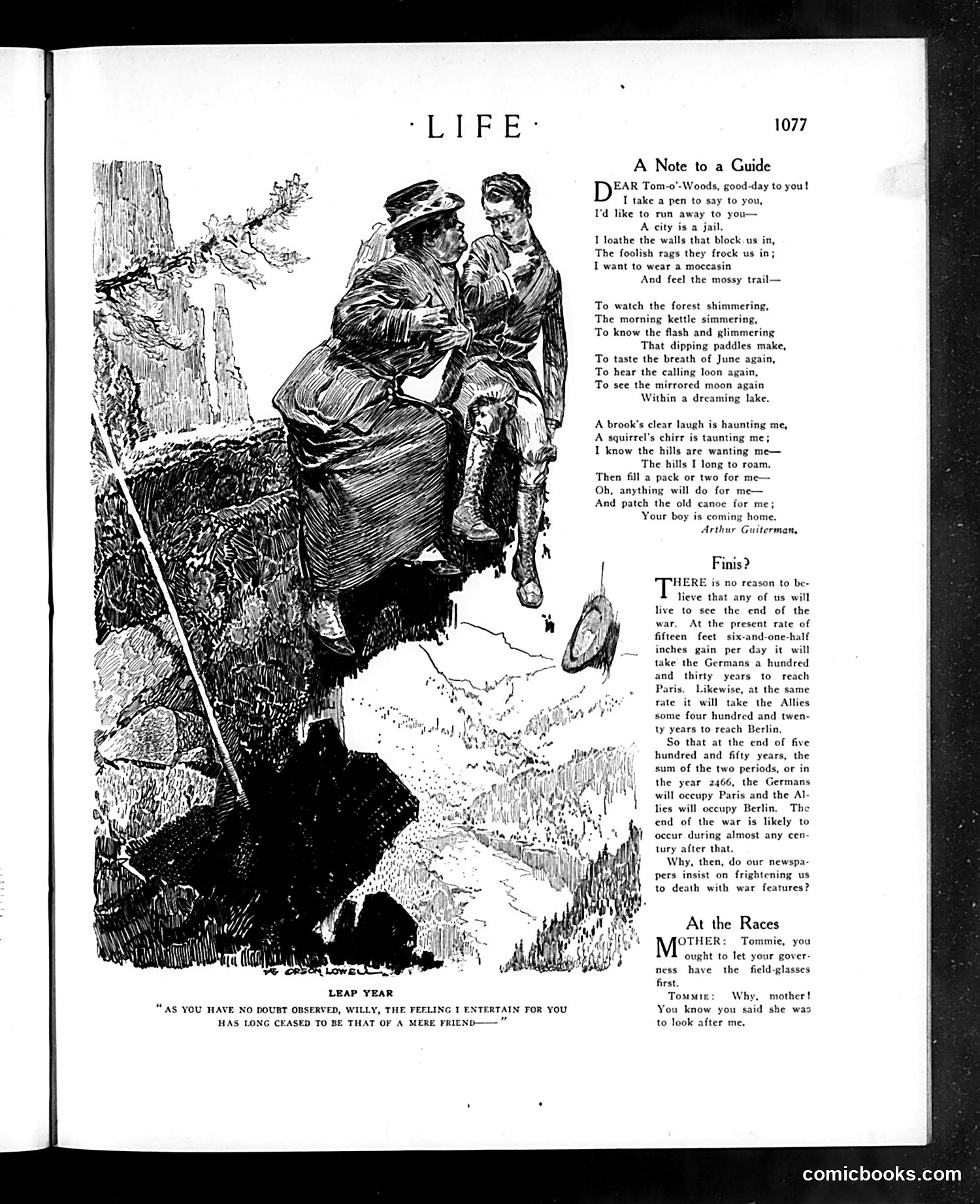
**The "Leap Year" Cartoon:** Shows a woman proposing to a man—a reference to the tradition that women can propose to men during leap years. The caption's romantic declaration ("the feeling I entertain for you has long ceased to be that of a mere friend") depicts the reversal of typical gender roles in courtship, which was humorous satire on social conventions of the era. **"A Note to a Guide":** Arthur Guiterman's poem expresses longing to escape urban life for wilderness—reflecting early 20th-century romantic idealization of nature and outdoor freedom versus industrial city constraints. **"Finis?" (on war):** This satirical piece mocks WWI's stalemate by calculating that at current trench-warfare rates of advance, the war wouldn't end for 550 years (reaching Paris in 2466). It critiques both newspapers' fear-mongering and the war's apparent futility. **"At the Races":** A brief joke about class: a mother instructs her son to let the governess use field-glasses first, since the governess is responsible for watching him—a gentle satire on upper-class social hierarchies.
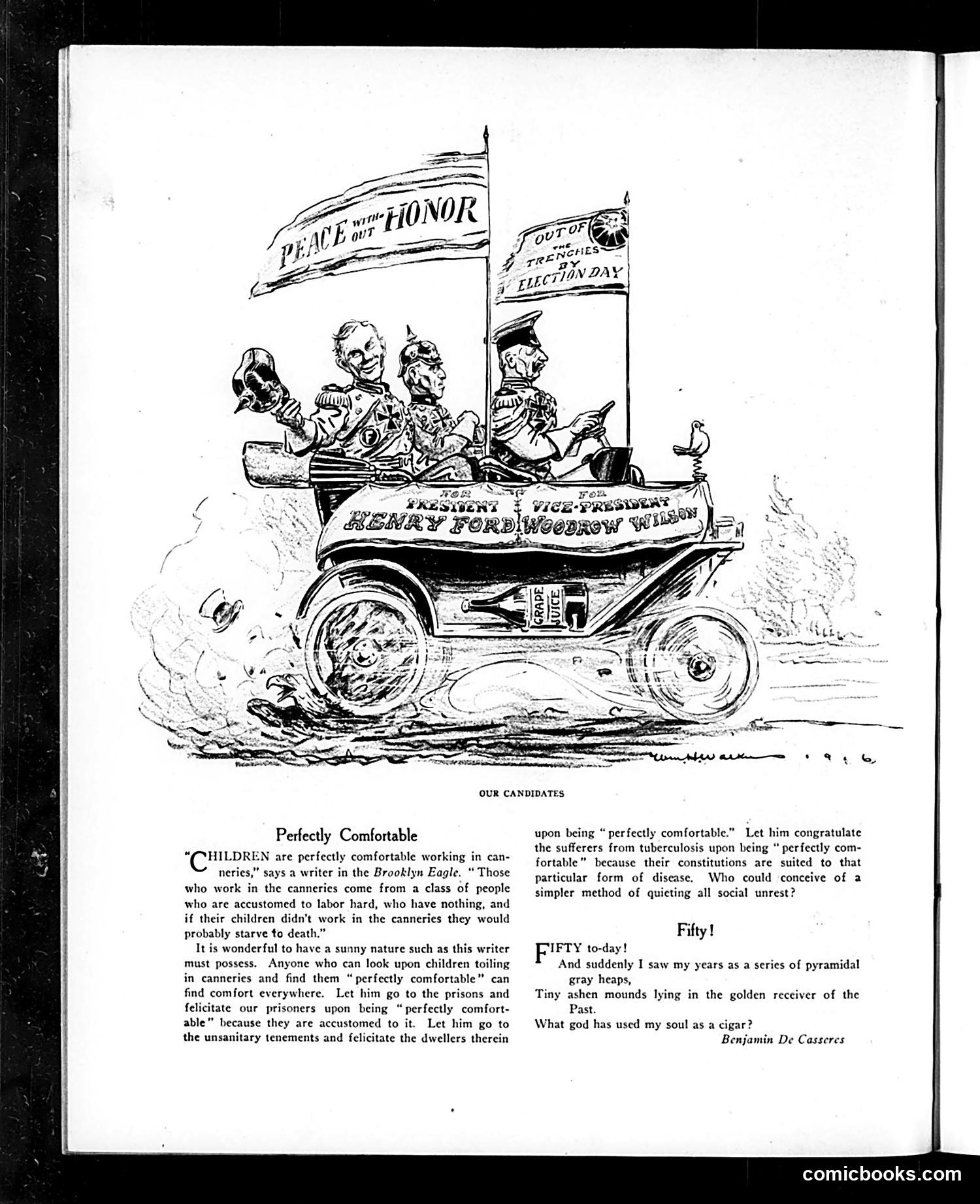
The top cartoon depicts three military/political figures in an ornate vehicle labeled "PRESIDENT, VICE-PRESIDENT" with "HENRY FORD, WOODROW WILSON" visible on the side. They sail under flags reading "PEACE OUR HONOR" and "OUT OF THE TRENCHES ELECTION DAY"—referencing Wilson's 1916 re-election campaign slogan promising to keep America out of World War I. The satire mocks this pledge as hollow: the vehicle is comically oversized and unstable, suggesting the candidates' peace promises are unsustainable. The military dress of the figures undercuts their pacifist rhetoric. Below, the article "Perfectly Comfortable" sarcastically critiques a Brooklyn Eagle writer who defended child labor in canneries as acceptable since poor children are "accustomed" to hard work. Life's editors use devastating irony—if discomfort is normalized, why not celebrate prisoners' and tuberculosis patients' suffering too? The piece attacks indifference to exploitative labor conditions masked as social realism.
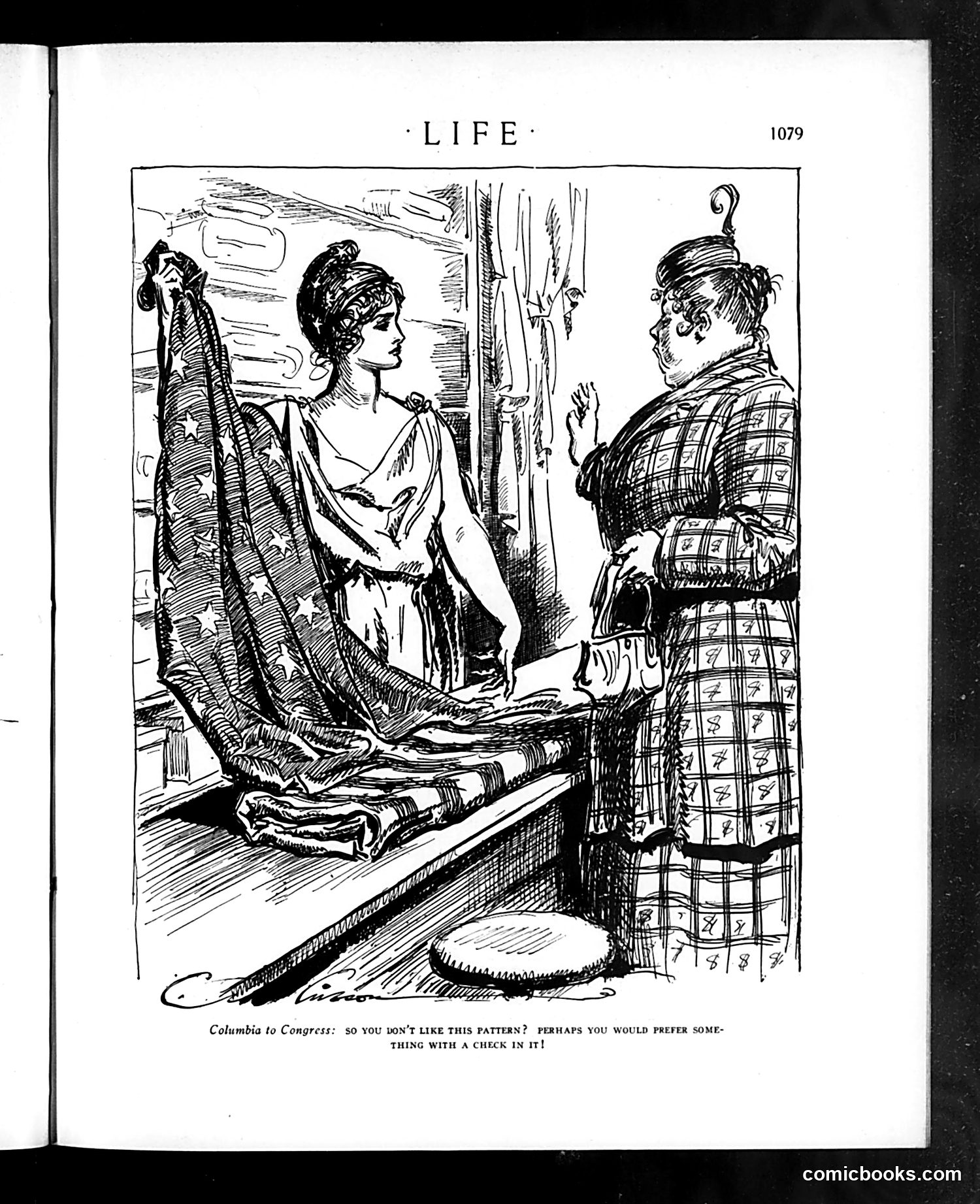
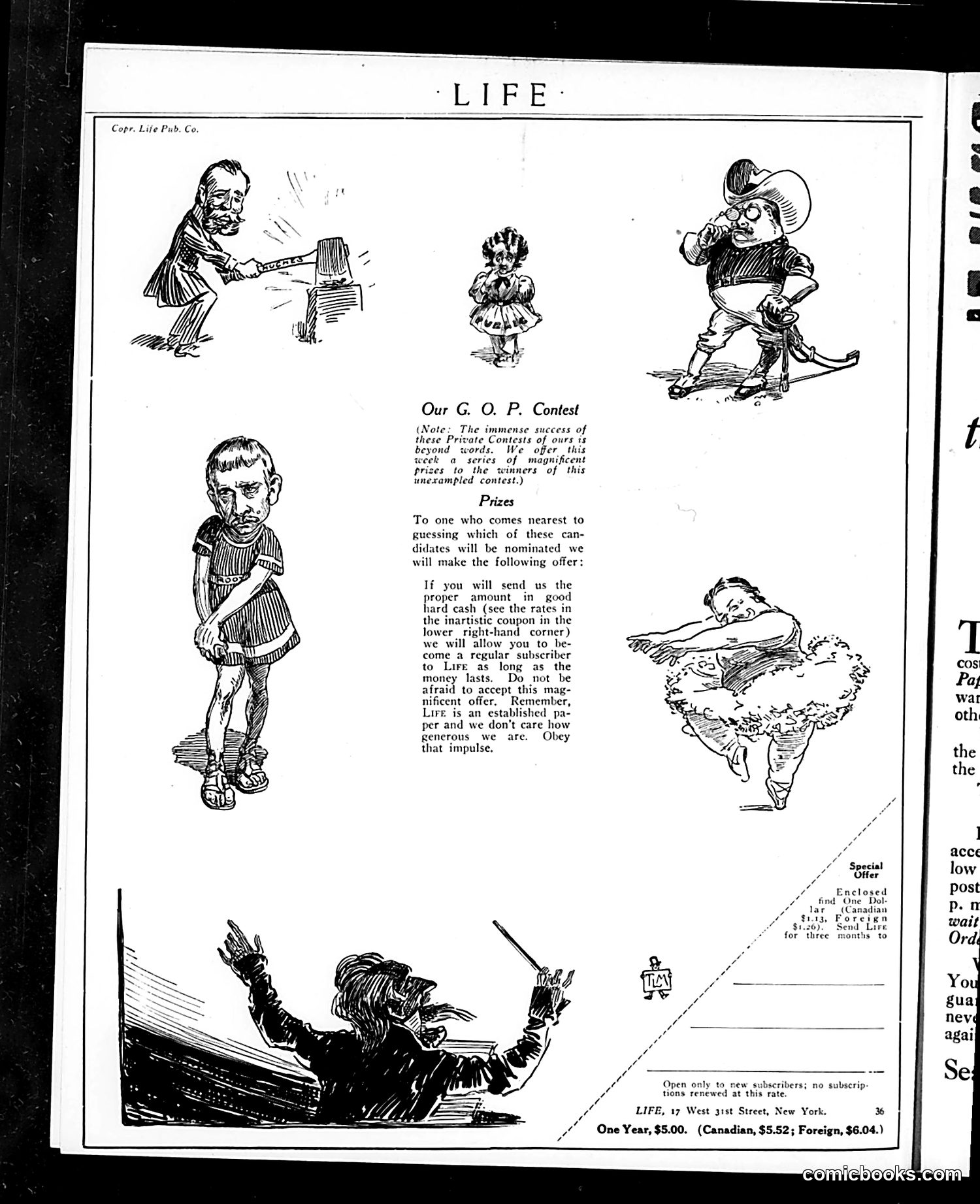
This political cartoon depicts a woman labeled "Columbia" (a personification of the United States) showing fabric patterns to a man representing Congress. Columbia holds up a striped pattern, which Congress rejects. She then sarcastically suggests an alternative "with a check in it"—a visual pun playing on "check" as both a fabric pattern and a financial instrument. The satire criticizes Congress for being corrupt or financially motivated, suggesting that lawmakers care more about personal gain ("checks"/money) than substantive policy ("patterns"). Columbia appears frustrated with Congressional priorities, implying that if they won't accept legitimate governance, perhaps they should admit their true interest in financial benefit. The cartoon mocks perceived Congressional corruption or venality.
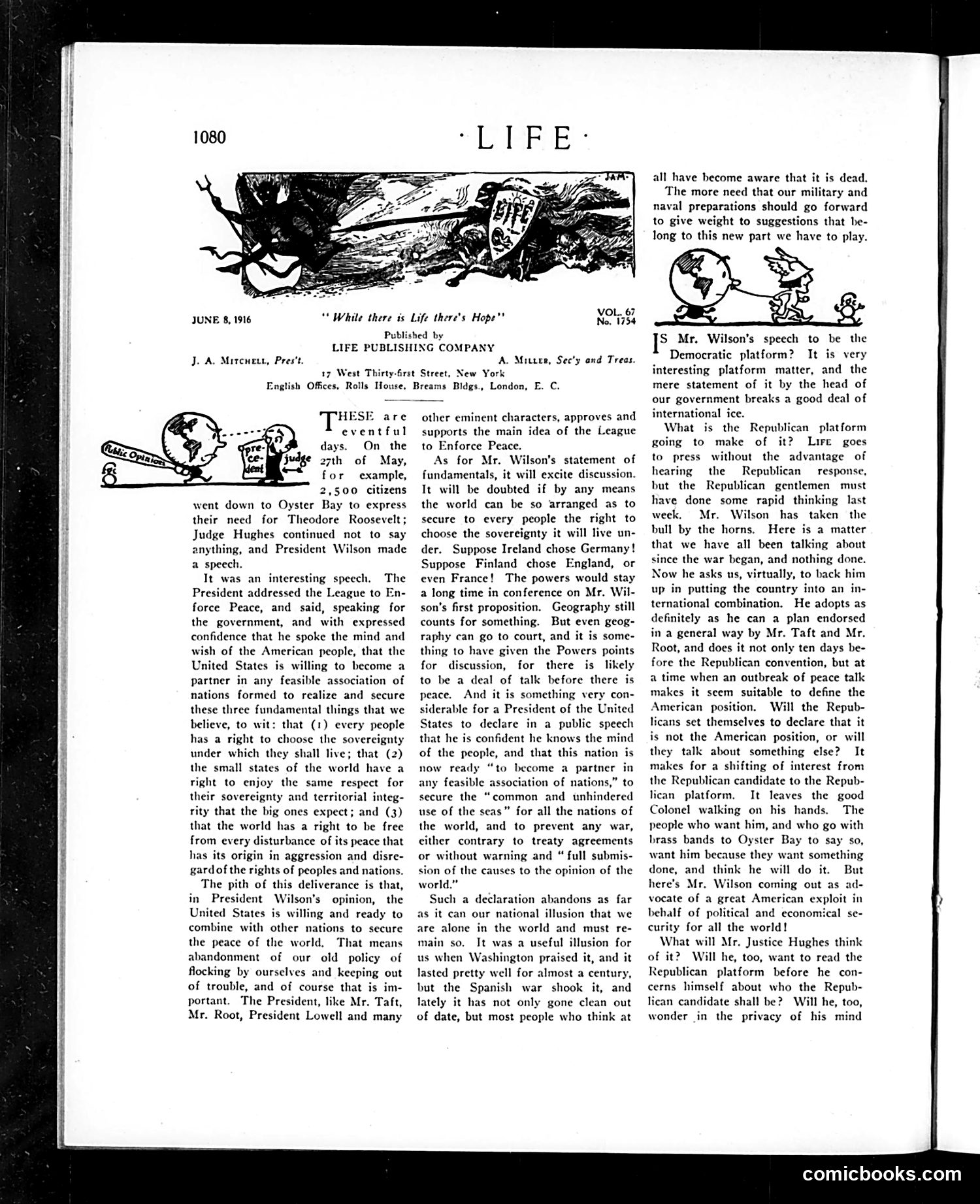
This *Life* editorial discusses President Wilson's May 27 speech to the League to Enforce Peace, which proposed America abandon isolationism and join international peacekeeping efforts—a dramatic shift from traditional U.S. policy. The piece examines Wilson's three stated principles: nations' self-determination, equal respect for small states, and freedom from aggression-caused disturbances. The author acknowledges the idealism but raises practical objections (e.g., "Suppose Ireland chose Germany!"), noting geography constrains such arrangements. The editorial frames this as potentially the Democratic platform for the 1916 election, while noting Republicans—and figures like Theodore Roosevelt (referenced at Oyster Bay), Judge Hughes, and Colonel Roosevelt—will respond. The satirical thrust: Wilson's lofty internationalism, while admirable, conflicts with real-world power politics and geographic realities that nations cannot ignore.
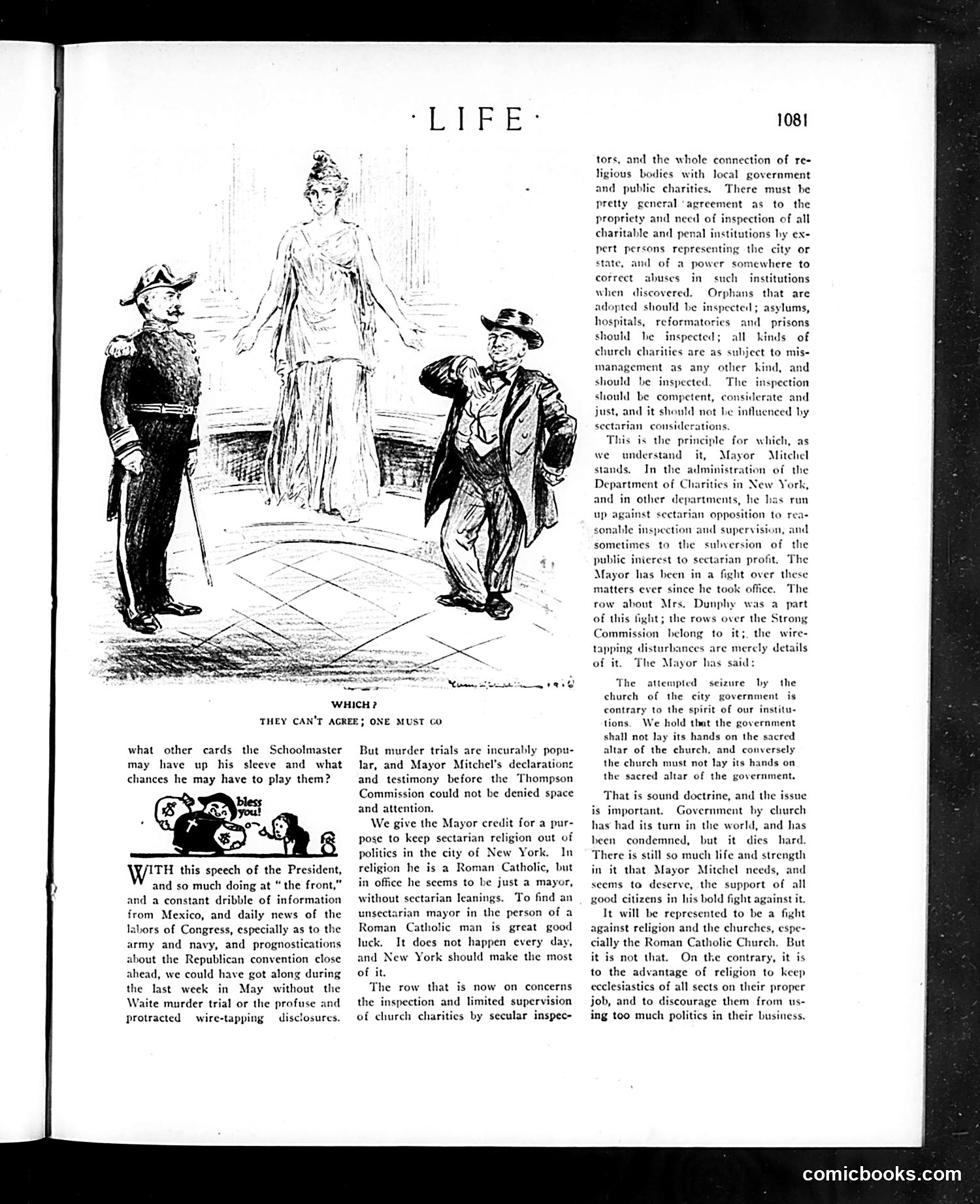
This cartoon depicts Mayor John Purroy Mitchel (center, in civilian dress) caught between two opposing figures—likely representing a military/government official (left) and a religious/church representative (right). The caption references a fundamental conflict of Mitchel's administration. The text clarifies the dispute: Mitchel championed government inspection of church-run charities and institutions (orphanages, asylums, hospitals) to prevent mismanagement, a position opposed by sectarian religious interests seeking autonomy from state oversight. The "one must go" refers to this irreconcilable conflict between secular governance accountability and religious institutional independence. Life's editorial supports Mitchel's secular inspection authority while defending his Catholic faith as irrelevant to his mayoral duties, arguing that religion should remain separate from both politics and government control.
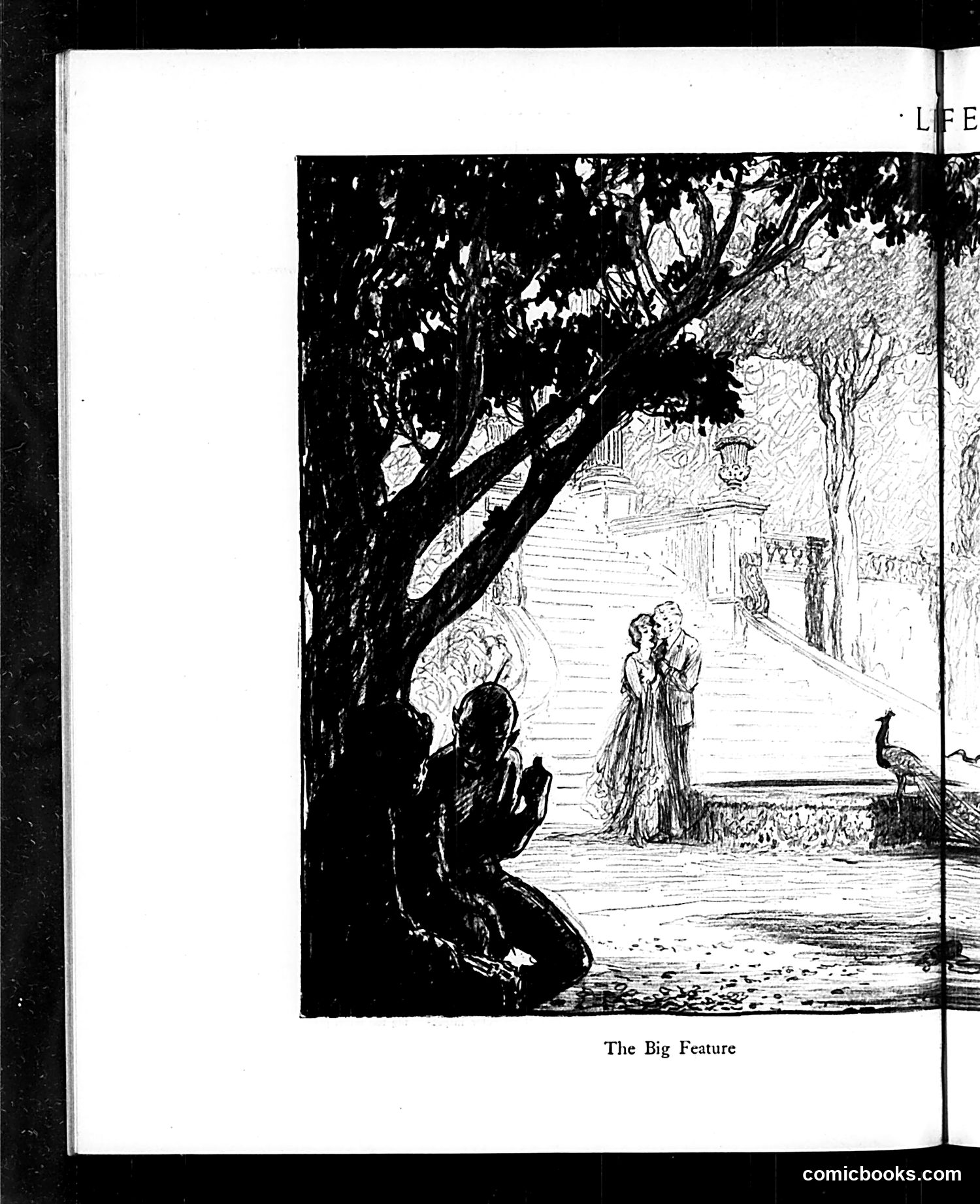
This is a black-and-white illustration titled "The Big Feature" showing a romantic scene. Two figures are silhouetted beneath a large tree on the left, while in the middle distance, two women in classical dress converse near what appears to be a seaside villa or estate. A peacock stands on the right. The scene evokes classical or mythological settings popular in early 20th-century American illustration. Without additional context from the magazine's surrounding text, the specific satirical point remains unclear—it may comment on magazine illustration conventions, romantic storytelling tropes, or social customs of the era. The "big feature" title suggests this is a prominent story illustration, likely accompanying a serialized narrative or fiction piece in Life magazine.
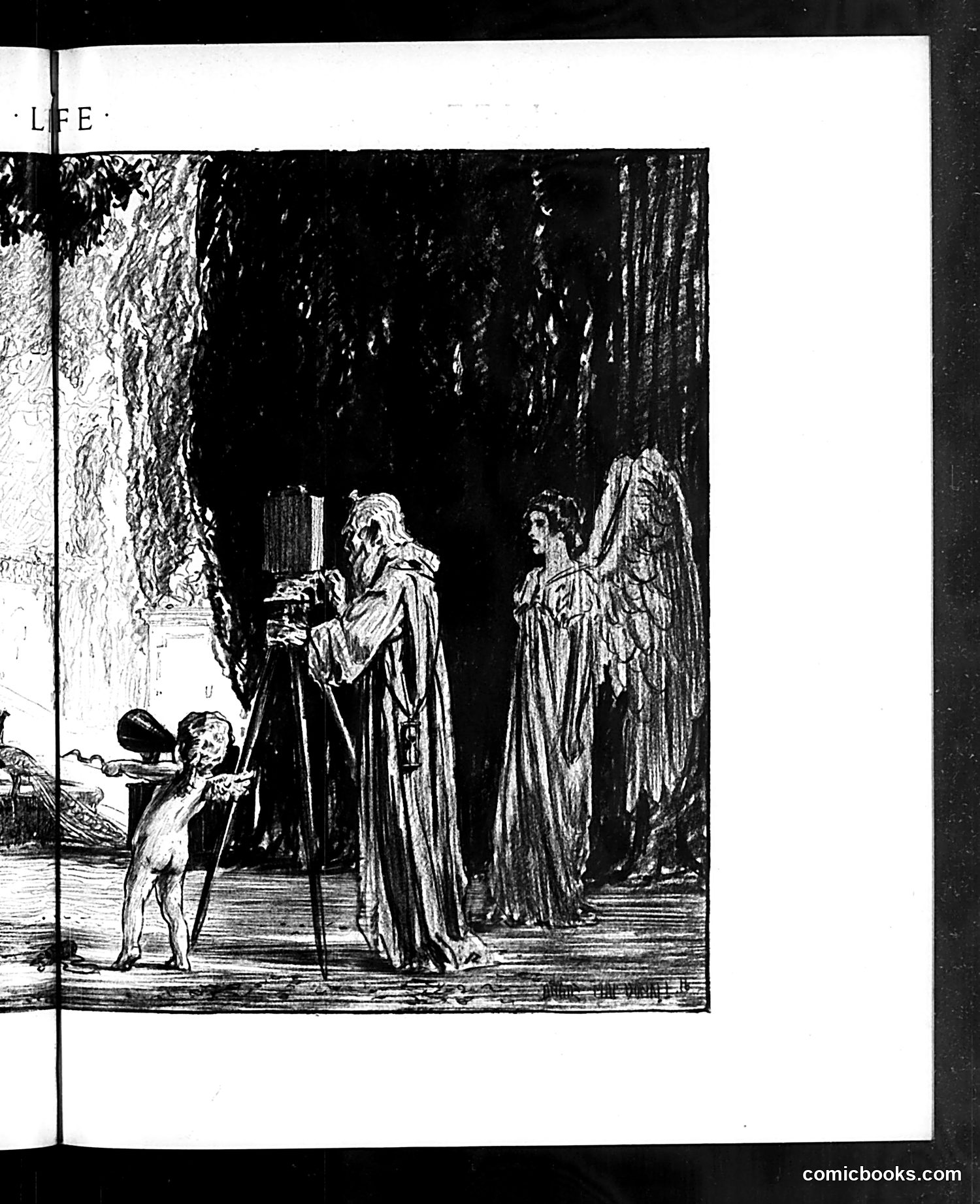
This page shows a classical engraving depicting a mythological or allegorical scene. The image displays robed figures—appearing to be classical deities or personifications—in a cave or grotto setting. A cherub or young figure sits in the foreground, while bearded and winged figures (possibly representing gods or angels) stand in discussion or deliberation. Without clearer context, captions, or title visible on this page, I cannot definitively identify the specific satirical or political content. The classical style and mythological subject matter suggest this may be illustrating a literary reference or allegorical commentary typical of *Life* magazine's sophisticated humor, but the exact meaning and contemporary references remain unclear from the image alone.
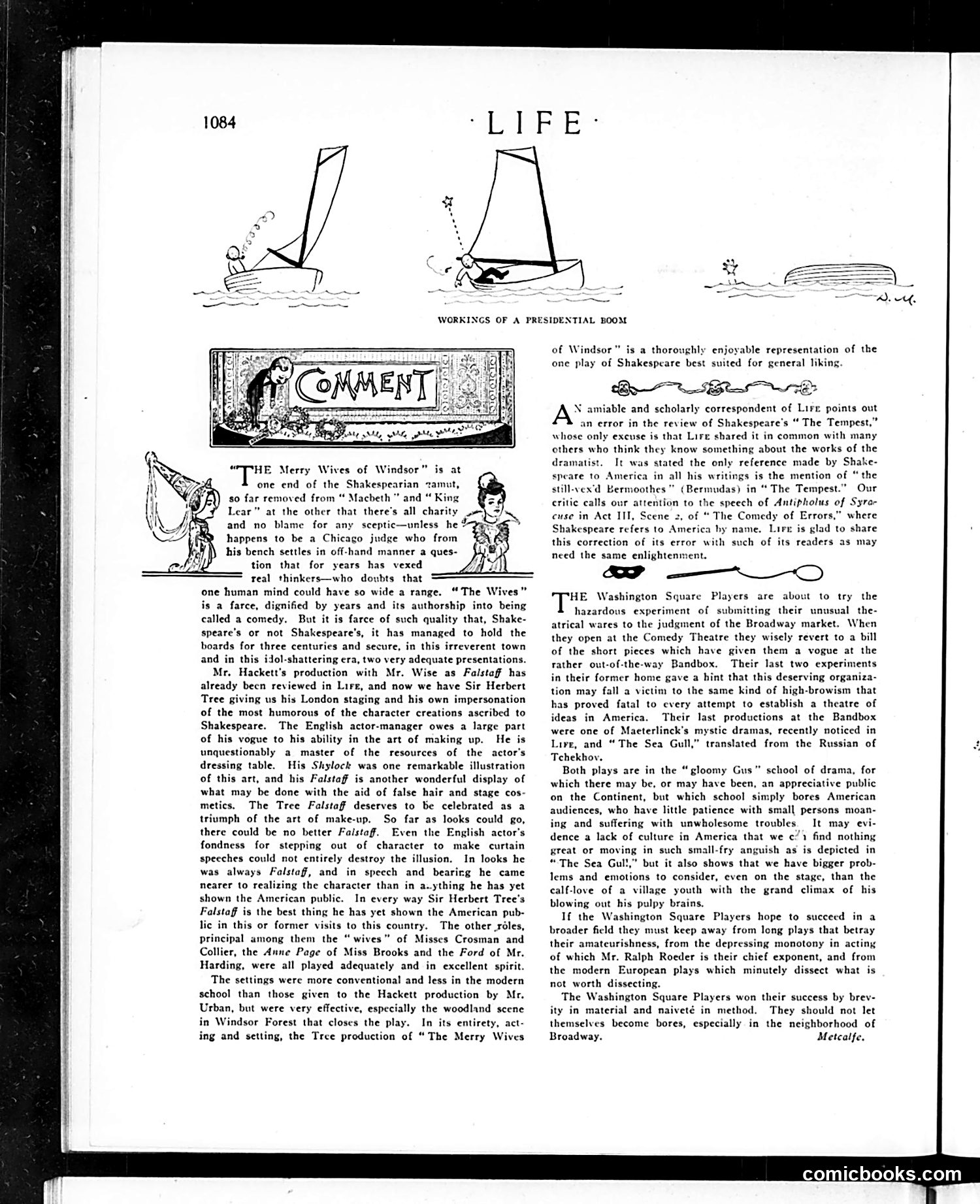
The three small cartoons at the top illustrate the phrase "presidential boom"—a political campaign gaining momentum. They show a boat progressively tipping and capsizing, with a figure being thrown into the water. The humor suggests that a presidential candidacy (the "boom") starts with optimistic fanfare but inevitably collapses spectacularly. The "COMMENT" section below reviews theatrical productions: Sir Herbert Tree's *Falstaff* in *The Merry Wives of Windsor* and discusses the Washington Square Players' experimental theater. The text corrects an earlier *Life* error about Shakespeare's references to America, acknowledging the magazine shared this mistake with other commentators. The page combines light political satire about campaign disasters with theater criticism—typical of *Life's* satirical approach to contemporary American culture and institutions.
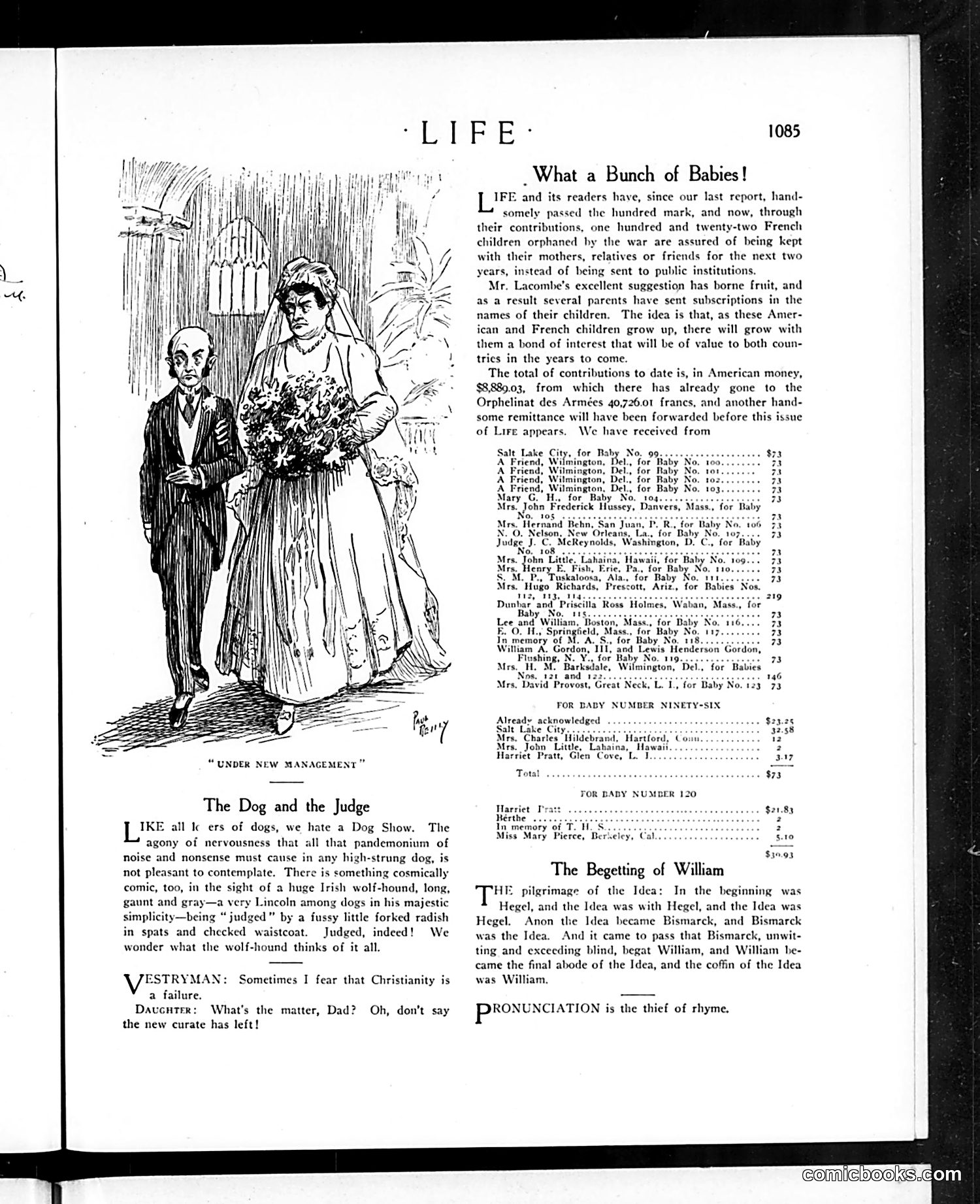
This page contains three distinct satirical pieces: **"The Dog and the Judge"** mocks dog shows as absurd spectacles where prestigious animals are evaluated by pompous judges. The humor lies in imagining a dignified Irish wolfhound being judged by a fussy, formally-dressed man—reversing natural authority. **"Under New Management"** (the illustration) appears to depict a woman replacing a man in a domestic or institutional role, likely commenting on wartime shifts in power dynamics. **"What a Bunch of Babies!"** reports on *Life* magazine's charitable fundraising campaign to support 122 French orphans from World War I. Readers adopted children by contributing money; the piece lists donors' names. This reflects early 20th-century American humanitarian efforts toward war-devastated Europe. **"The Begetting of William"** is philosophical satire mocking German intellectual influence, tracing ideas from Hegel through Bismarck to Kaiser Wilhelm II—suggesting German militarism stems from abstract Hegelian philosophy becoming embodied in the Kaiser.
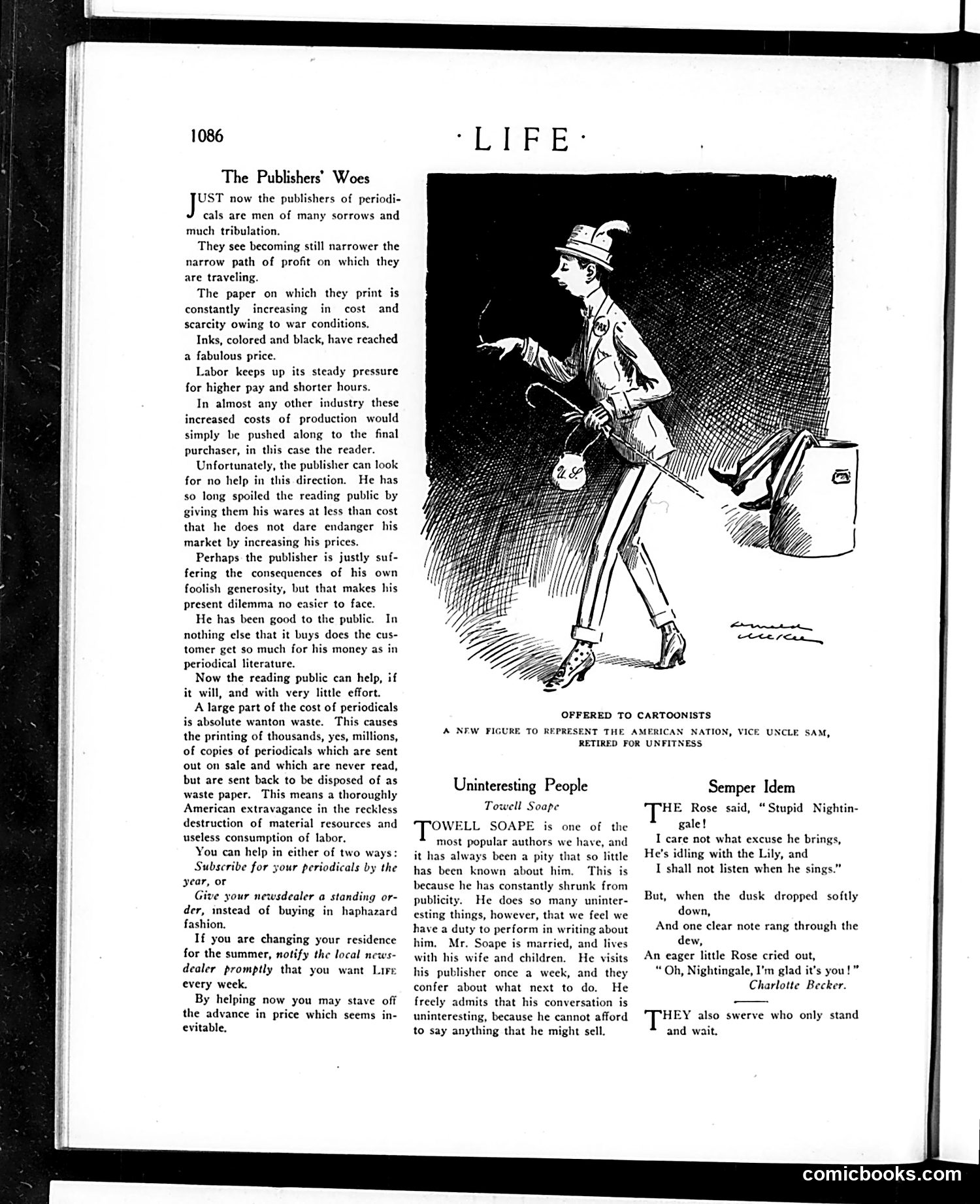
**"The Publishers' Woes"** is an editorial arguing that magazine publishers face financial crisis due to wartime scarcity and inflation (rising paper and ink costs, labor demands), yet cannot raise prices without losing readers they've conditioned to expect cheap rates. The text urges readers to subscribe annually or give standing orders to reduce waste from unsold copies—a practical appeal during what appears to be WWI-era paper shortages. **The cartoon** depicts a cheerful publisher juggling increasingly heavy costs (represented by the weighted bundle he's balancing), illustrating the precarious financial position described in the text. The page also includes two unrelated literary pieces: a humorous profile of author "Towell Soape" (likely a fictional name playing on his dull personality), and a sentimental poem "Semper Idem" by Charlotte Becker about a Rose and Nightingale reconciling at dusk. The header references seeking a new national symbol to replace Uncle Sam, though details are unclear from this excerpt.
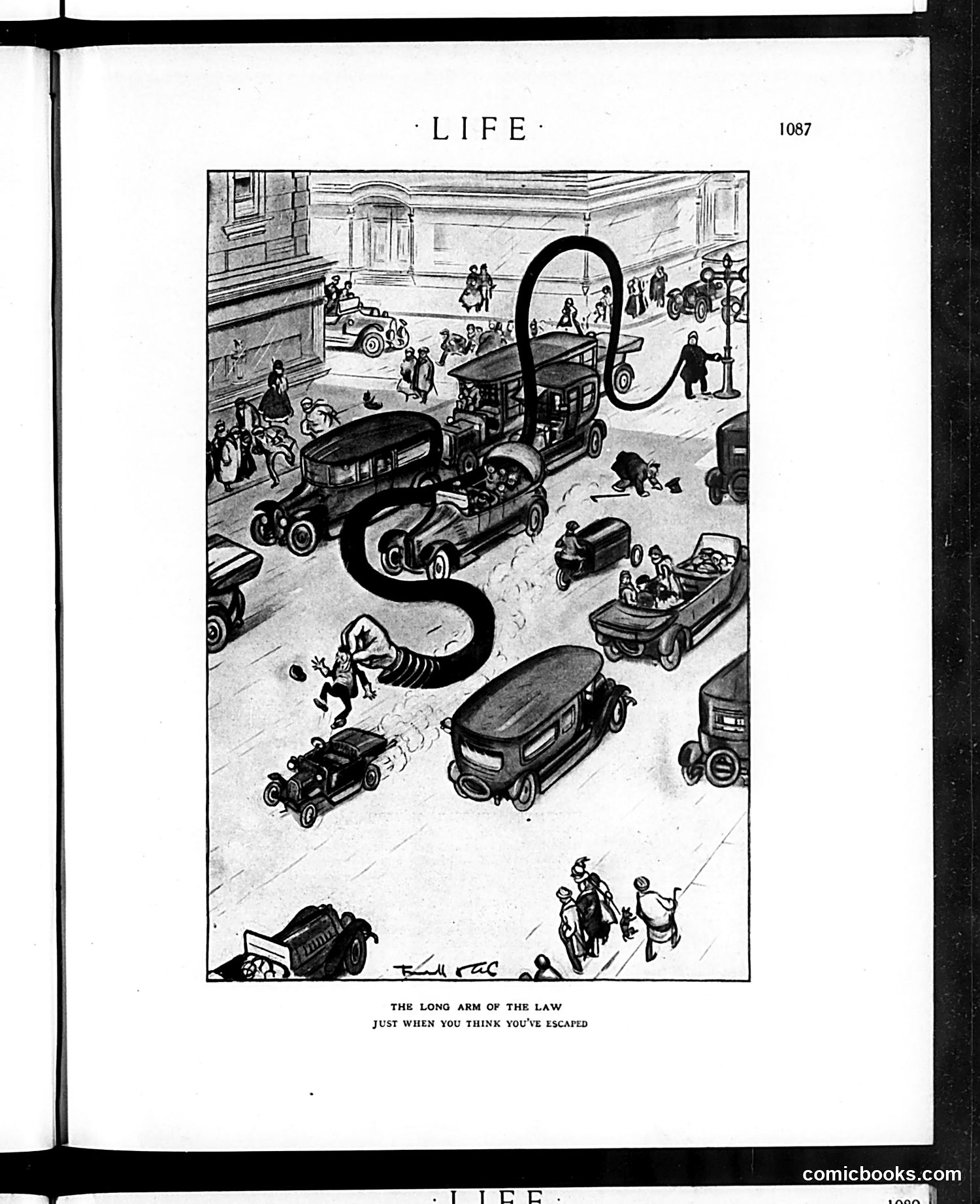
This cartoon depicts a street scene with toy/miniature cars and figures, where a large question mark shaped like a police officer's arm reaches down to snare a fleeing figure. The visual metaphor illustrates the caption's message: that law enforcement inevitably catches wrongdoers, no matter how far they believe they've escaped. The cartoon uses the "long arm of the law" idiom literally—showing a giant arm/hand symbol pursuing a criminal through an urban setting. The toy-like scale suggests this is a cautionary morality tale about inevitable justice. It's a straightforward satirical warning about the futility of evading police, using whimsical visual humor to make its point about criminal consequences.
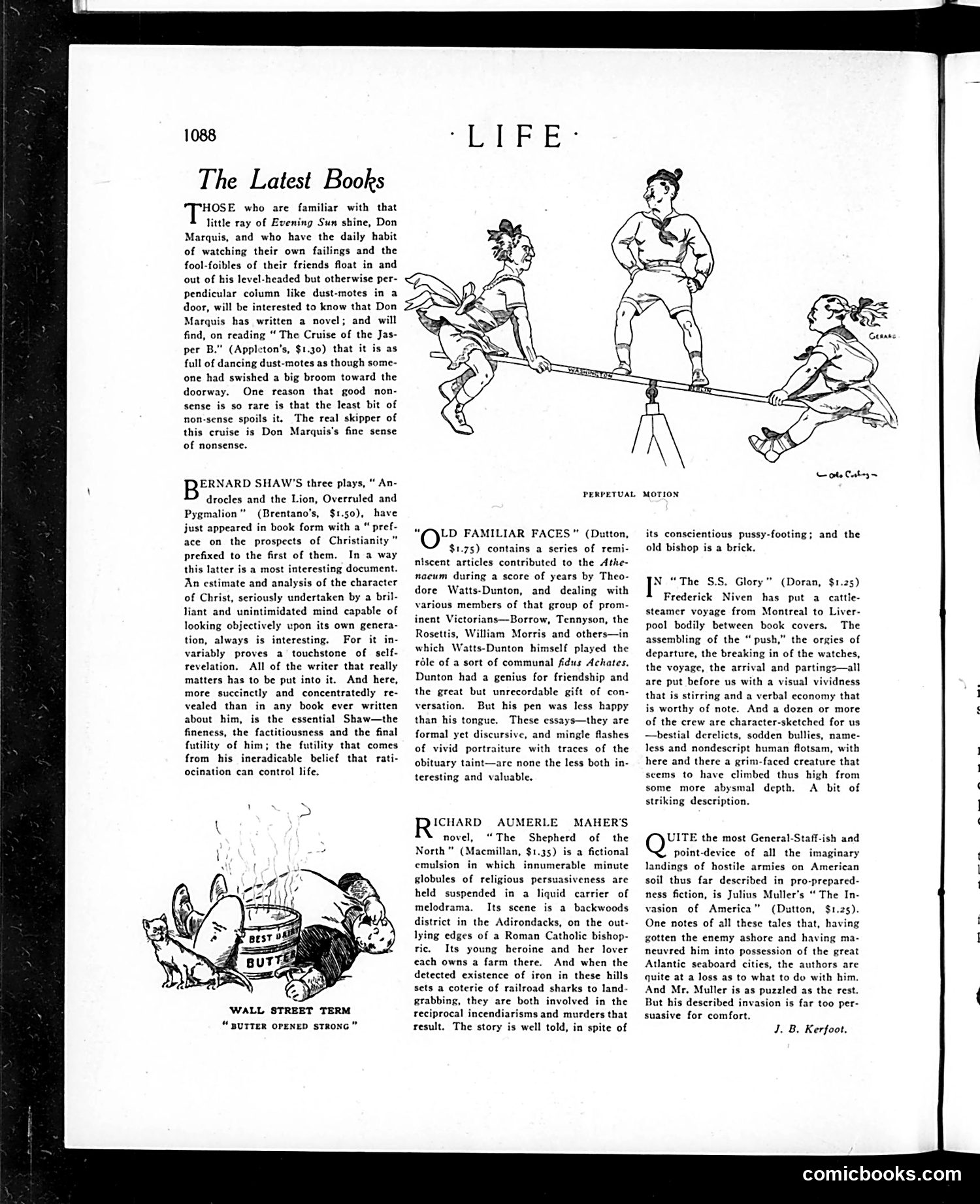
This is a book review section from *Life* magazine featuring satirical commentary on contemporary literature. The main cartoon, labeled "Perpetual Motion," depicts children on a seesaw operated by a telescope or surveying instrument—a visual pun suggesting the endless, mechanical nature of children's play. The reviews discuss Don Marquis's novel *The Cruise of the Jasper B.*, praising his "fine sense of nonsense"; Bernard Shaw's plays with a philosophical preface on Christianity, which the reviewer critiques as revealing Shaw's belief that "ratiocination can control life"; and several other contemporary works including novels by Theodore Watts-Dunton and Frederick Niven. The secondary cartoon, "Wall Street Term—'Butter Opened Strong,'" depicts butter as a commodity in financial terms, likely satirizing Wall Street's tendency to speak of food prices in market language. The page exemplifies *Life*'s role as a literary and cultural critic, combining wit with serious literary judgment.
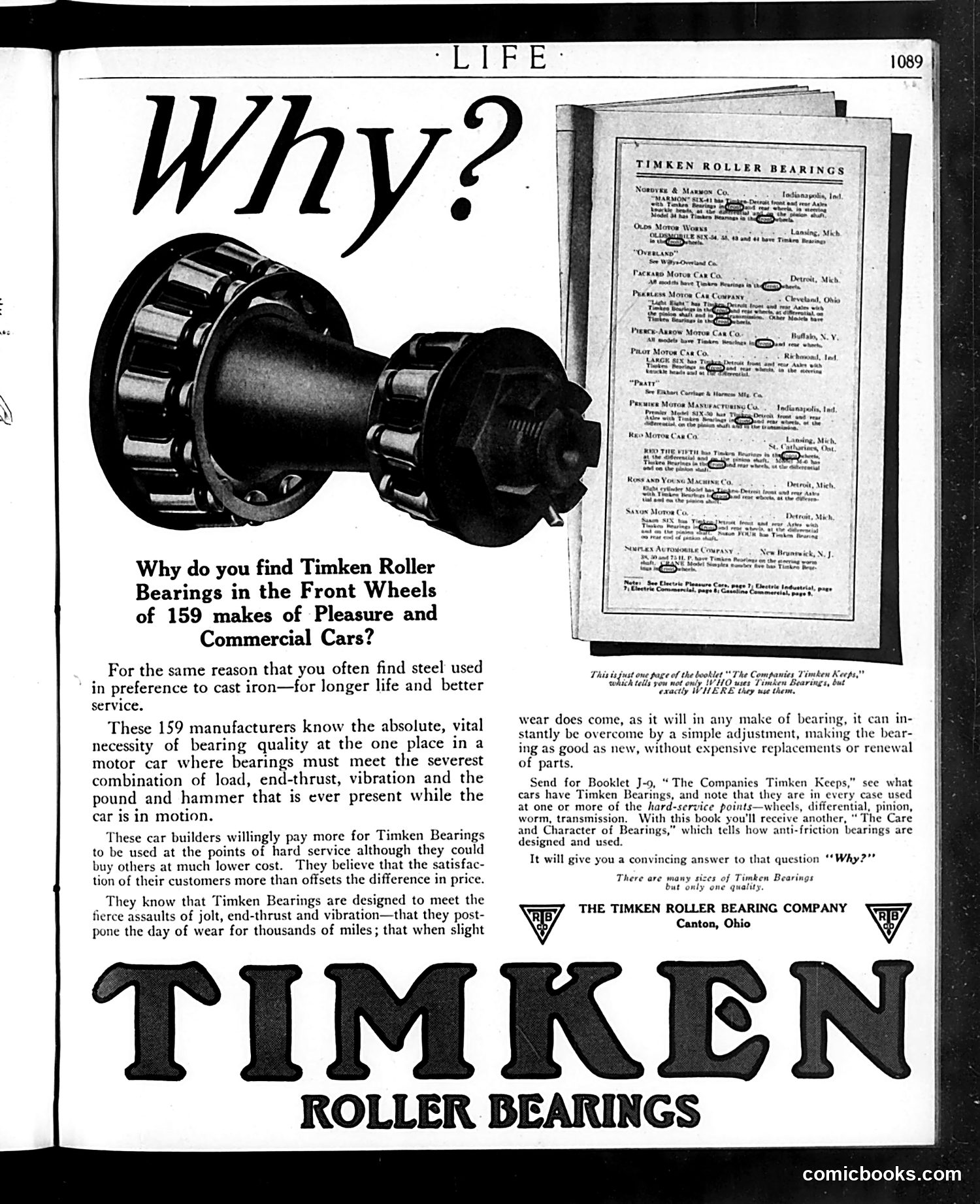
This is primarily a **product advertisement**, not political satire. The "Why?" headline poses a rhetorical question the ad then answers: 159 automobile manufacturers specify Timken Roller Bearings in front wheels because they prioritize durability and customer satisfaction over cost savings. The advertisement's argument is straightforward industrial marketing: Timken bearings withstand severe load, vibration, and stress better than alternatives, justifying their premium price. The ad emphasizes that major car manufacturers willingly pay more for quality at critical stress points (wheels, transmission, differential). The accompanying booklet and list of 159 manufacturers serves as social proof—establishing Timken's market dominance and credibility. This reflects early-20th-century advertising strategy: associating a product with prestigious brands to convince consumers of its superiority. There is **no political cartoon or satire** on this page—it's a straightforward B2B and consumer advertisement typical of *Life* magazine's revenue model during this era.
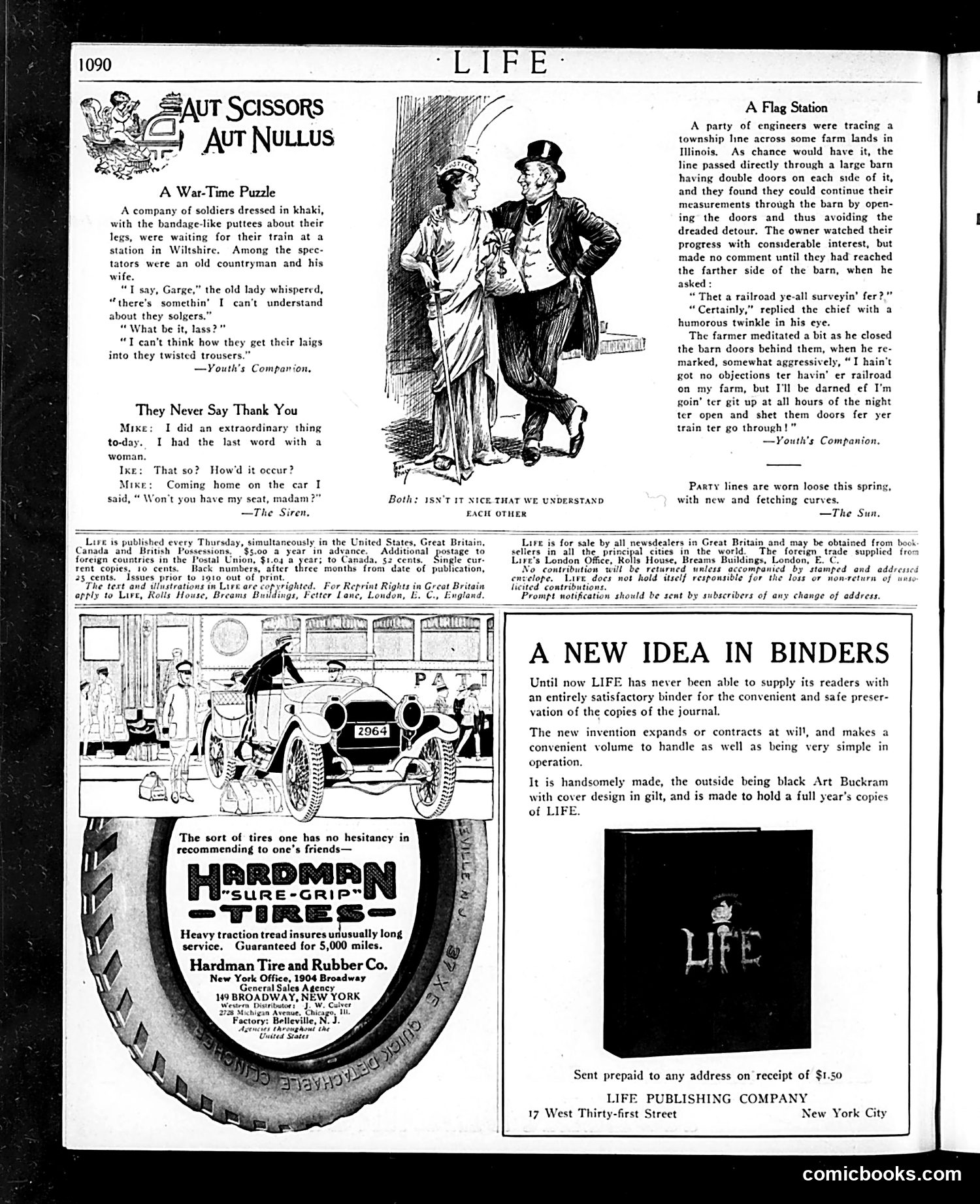
This page contains several humorous short pieces typical of Life's satirical style: **"A War-Time Puzzle"** jokes about British soldiers' puttees (leg wrappings), with an elderly countryman's wife unable to understand how soldiers get their legs into the twisted trousers—a gentle joke about generational confusion with military gear during WWI. **"They Never Say Thank You"** presents a brief exchange where Mike claims he got "the last word" with a woman after offering her his seat on a streetcar—implying women characteristically have the final say in such interactions, a common gender-relations joke of the era. **"A Flag Station"** depicts rural dialect humor: Illinois farmers encounter surveyors measuring a line through their barn and are bemused when told it's for railroad surveying, responding that they won't wake up at night to open barn doors for trains. The page also includes period advertisements (Hardman tires) and promotion for Life's new magazine binder. The humor relies on class, generational, and regional stereotypes typical of early 20th-century American magazine satire.
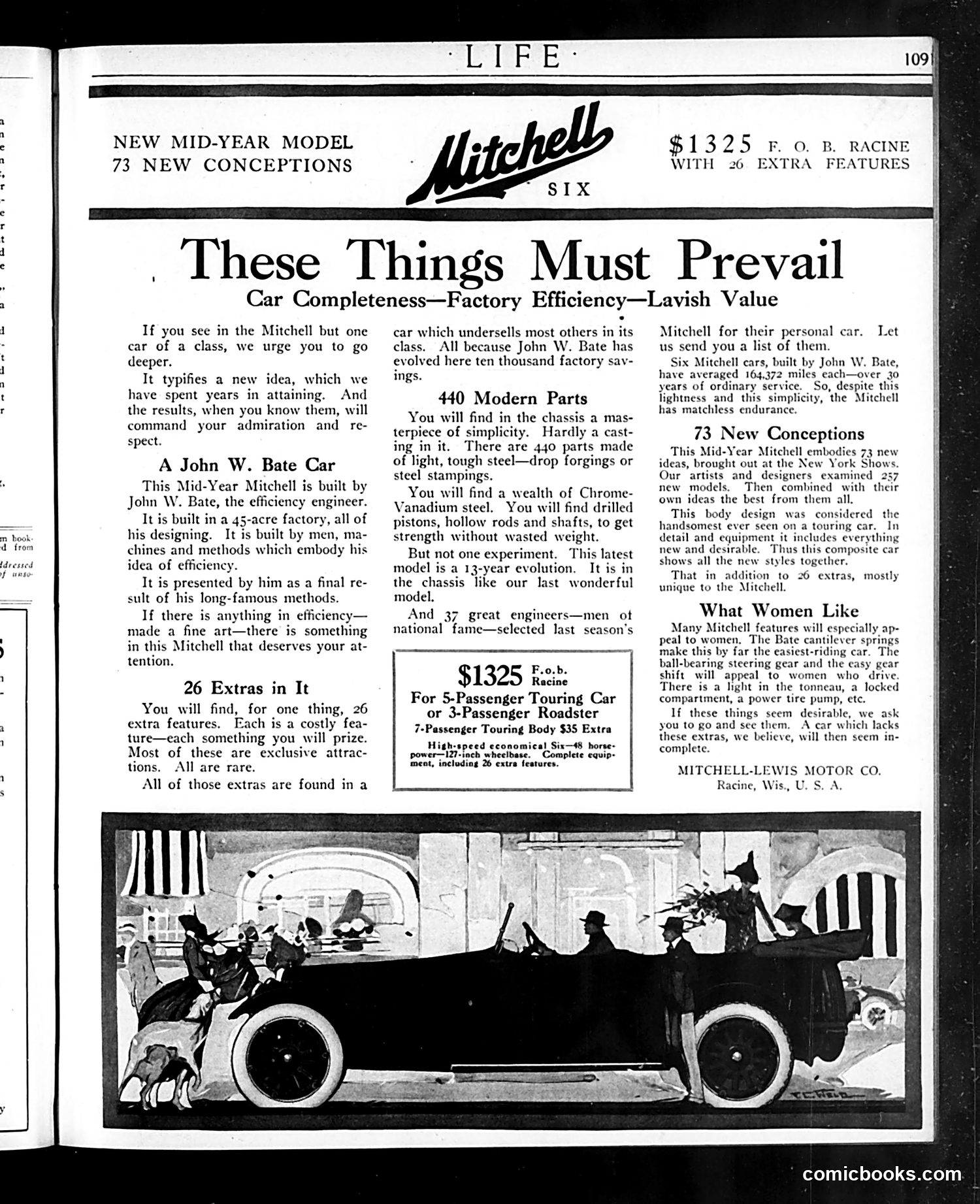
This page is primarily **advertising, not political satire**. It promotes the Mitchell Six, a mid-year automobile model priced at $1,325, manufactured by Mitchell-Lewis Motor Company in Racine, Wisconsin. The ad emphasizes factory efficiency under engineer John W. Bate's design, featuring 440 modern parts and 73 new design conceptions. It highlights 26 extra features included at a competitive price—a selling point during the 1910s automotive market. The illustration at bottom shows a touring car filled with well-dressed passengers and pedestrians, depicting the aspirational lifestyle associated with owning such a vehicle. A notable section, "What Women Like," markets specific features (easy steering, interior lighting, power tire pump) to female drivers—unusual for automotive advertising of this era, reflecting gradual shifts in women's consumer power and automobile adoption during the 1910s-1920s.
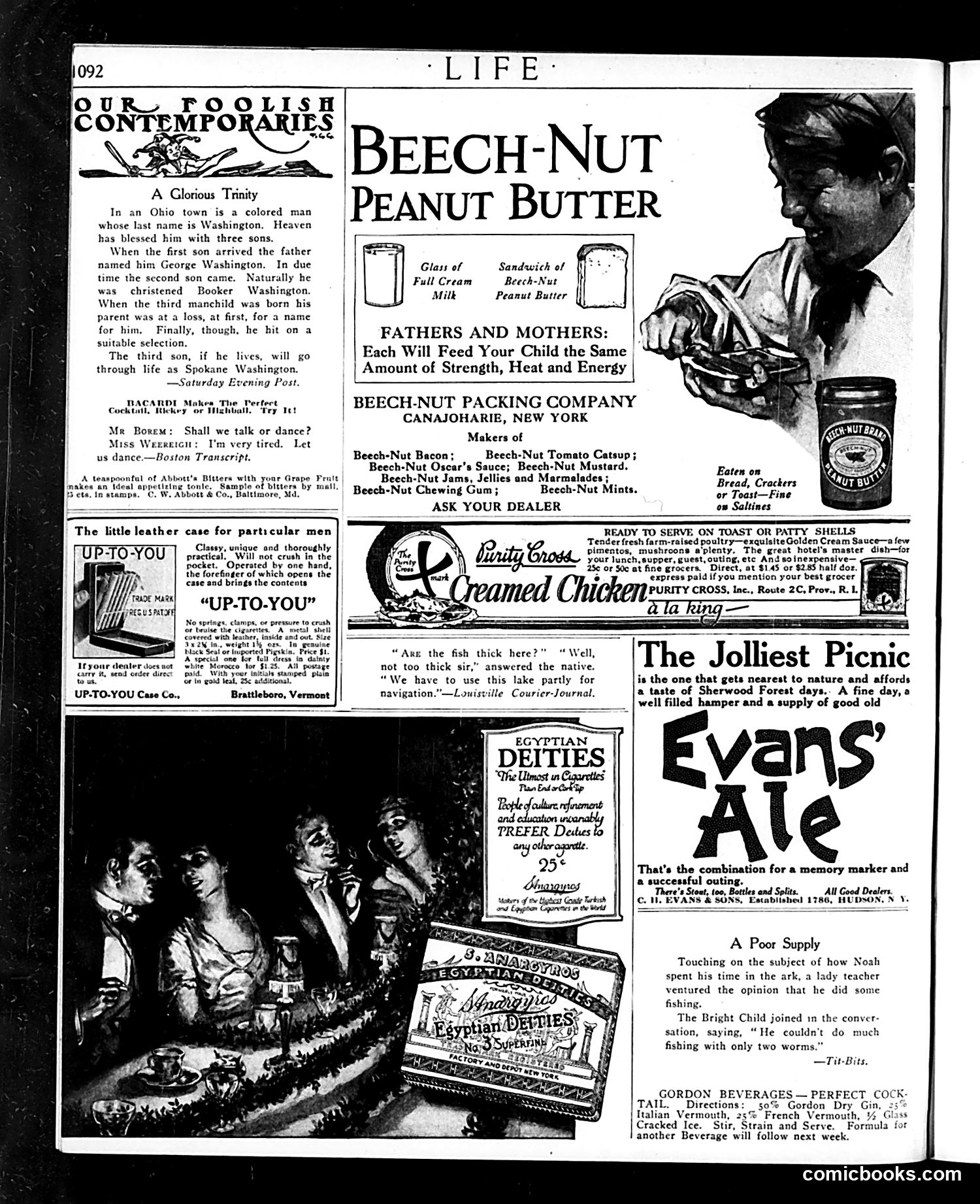
This page is primarily **advertisements and humor filler** rather than political satire. The main content includes: **"A Glorious Trinity"** — A light joke about naming conventions. An Ohio man named Washington named his three sons George Washington, Booker Washington, and Spokane Washington, playing on the tradition of naming children after famous figures and places. **Product advertisements** dominate the page: Beech-Nut Peanut Butter, UP-TO-YOU cigarette cases, Purity Cross Creamed Chicken, Evans' Ale, and Egyptian Deities cigarettes. **Small humorous anecdotes** fill space: a tired woman preferring to dance rather than talk, a fish-thick joke, and a child's wisecrack about Noah fishing with only two worms. The **Egyptian Deities cigarette ad** features a dark illustration, reflecting early 20th-century marketing imagery. This represents typical *Life* magazine content of its era—a mix of satirical humor, social commentary, and commercial advertising with no cohesive political message on this particular page.
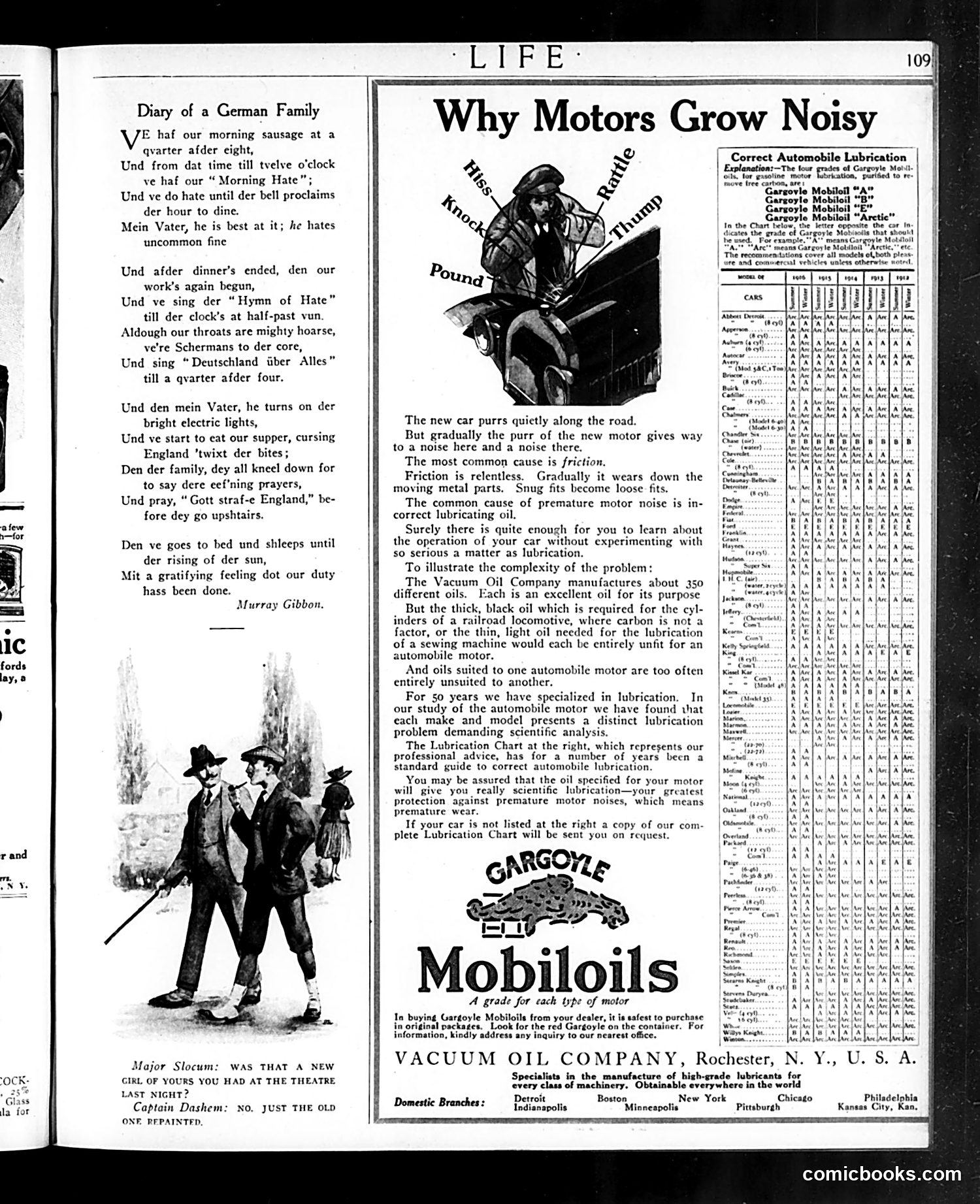
**"Diary of a German Family"** is anti-German WWI propaganda. Written in exaggerated German-accented English ("qvarter," "dey," "hass"), it mocks German daily life as consumed by hatred of England. The family's routine—morning hate, singing the "Hymn of Hate" and "Deutschland über Alles," cursing England at supper, praying "Gott strafe England"—satirizes German militarism and jingoism during the war. The humor relies on depicting Germans as mechanically obsessed with hatred, reinforcing American wartime stereotypes. **Below this** is a brief joke: Captain Dashem claims his date isn't new, "just the old one repainted"—a light romantic quip unrelated to the page's themes. **The remainder is commercial:** Gargoyle Mobiloils advertisement explaining correct automobile lubrication, with a technical chart. This occupies most of the page as straightforward product promotion, typical of Life's advertising revenue model. The page juxtaposes wartime anti-German sentiment with mundane consumer messaging.
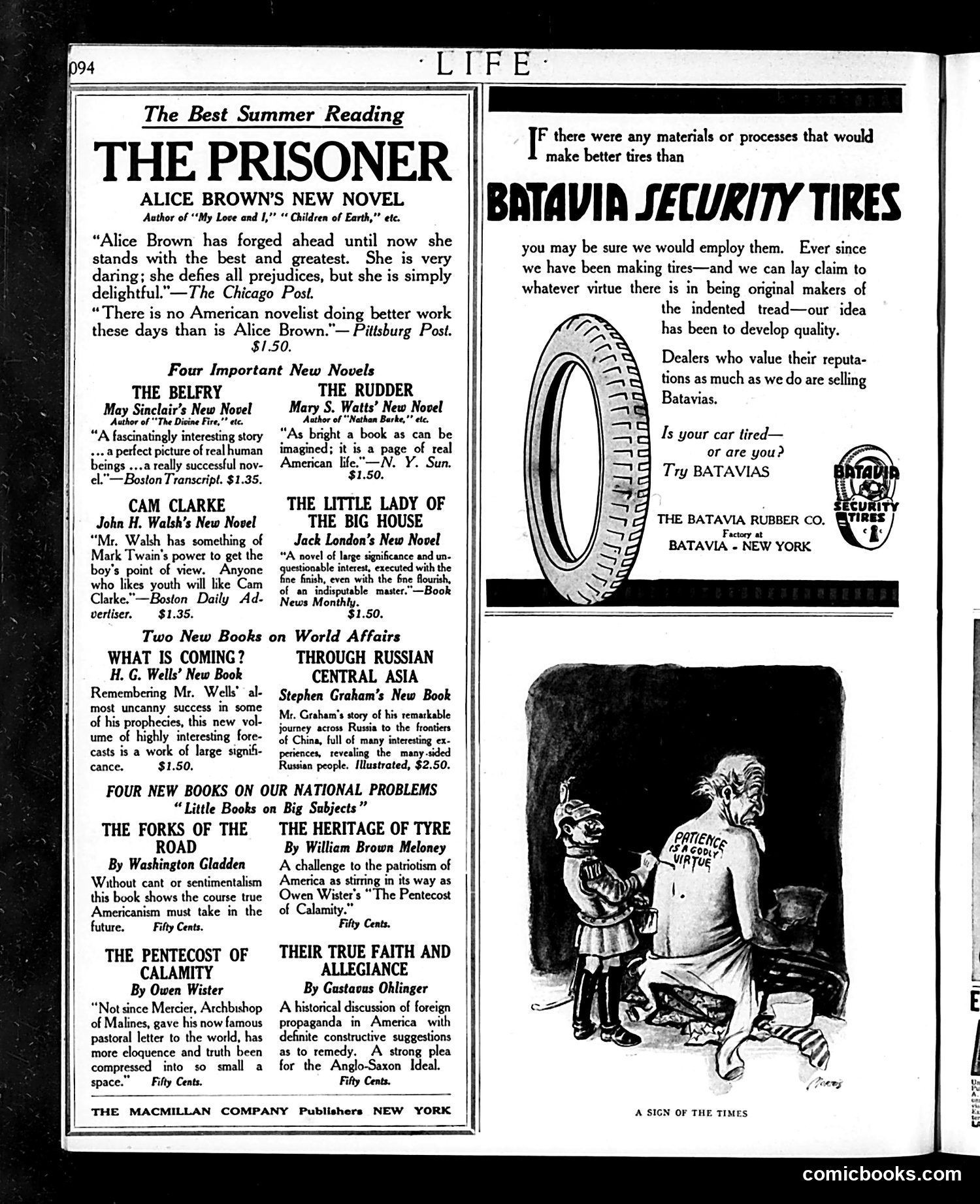
This page consists primarily of book advertisements rather than political cartoons. The left side promotes summer reading, including Alice Brown's novel *The Prisoner* and works by H.G. Wells and Jack London—contemporary literary offerings. The right side advertises Batavia Security Tires. The only cartoon appears at bottom right, titled "A Sign of the Times." It depicts a figure labeled "PATIENCE" being beaten or tormented, likely referencing American social anxieties of the World War I era. The cartoon suggests patience is being tested by contemporary events—possibly the escalating European conflict or domestic political tensions, though the specific reference is unclear without additional context. The page's juxtaposition of refined literature with commercial advertising, combined with the darker cartoon commentary, reflects Life's role as a satirical publication addressing both cultural refinement and contemporary social concerns during a period of significant national uncertainty.
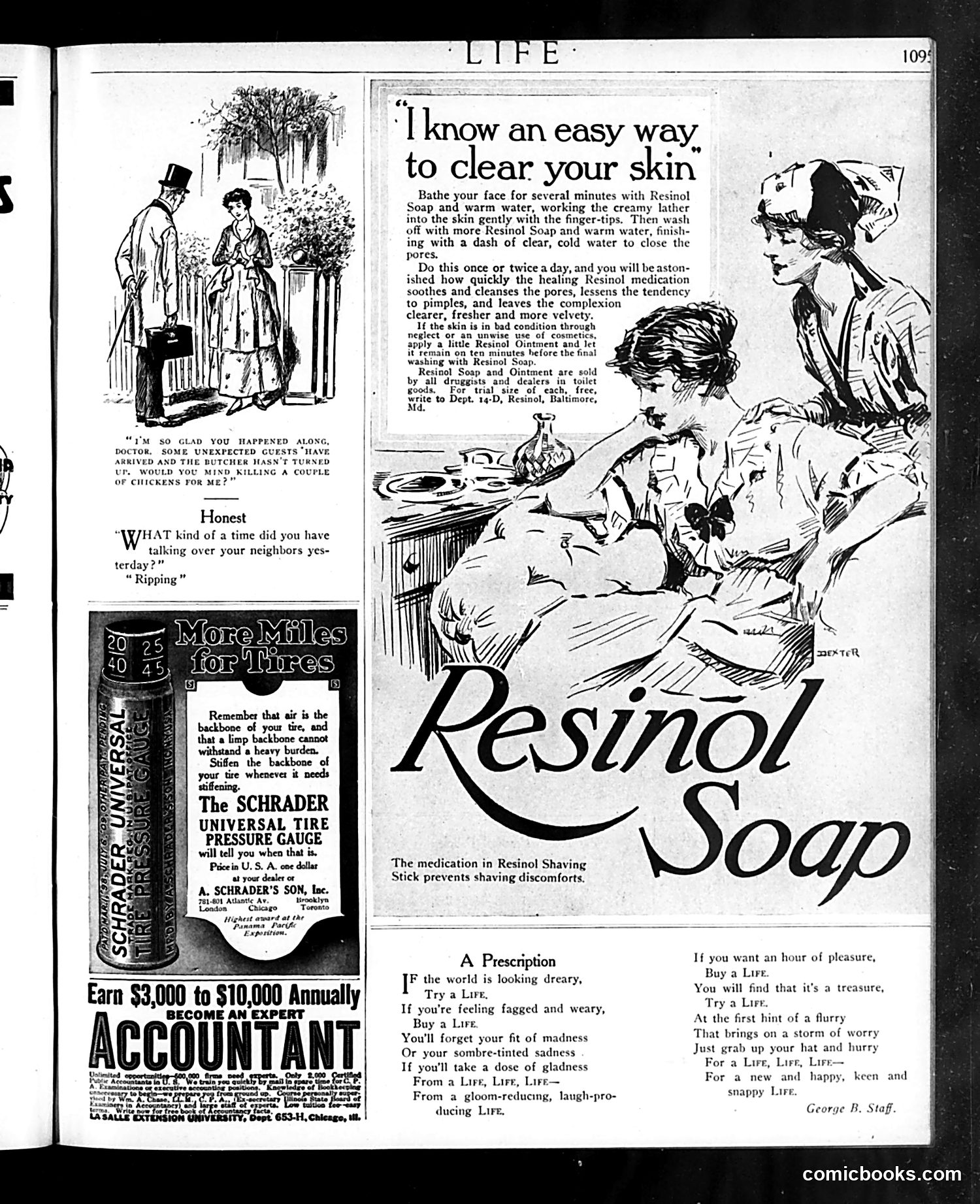
This page is primarily **advertising** with some light editorial content. The main elements: **Top cartoon**: A brief dialogue joke showing a man and woman in conversation. The woman asks about the man's day talking to neighbors, and he responds "Ripping"—period slang meaning "excellent" or "great." It's a simple social humor piece with no apparent satire. **Advertisements**: The page features ads for Resinol Soap (skincare), Schrader tire gauges, and accountancy training—typical early-20th-century consumer products. These are straightforward product pitches. **Poem**: "A Prescription" by George B. Staff recommends attending a "Lire" (appears to be an entertainment venue or show) as a cure for melancholy—positioning entertainment as therapeutic medicine. This is gentle promotional verse, not satire. The page contains **no political cartoons or sharp social commentary**—it's a standard magazine page mixing light humor with commercial messaging typical of the era.
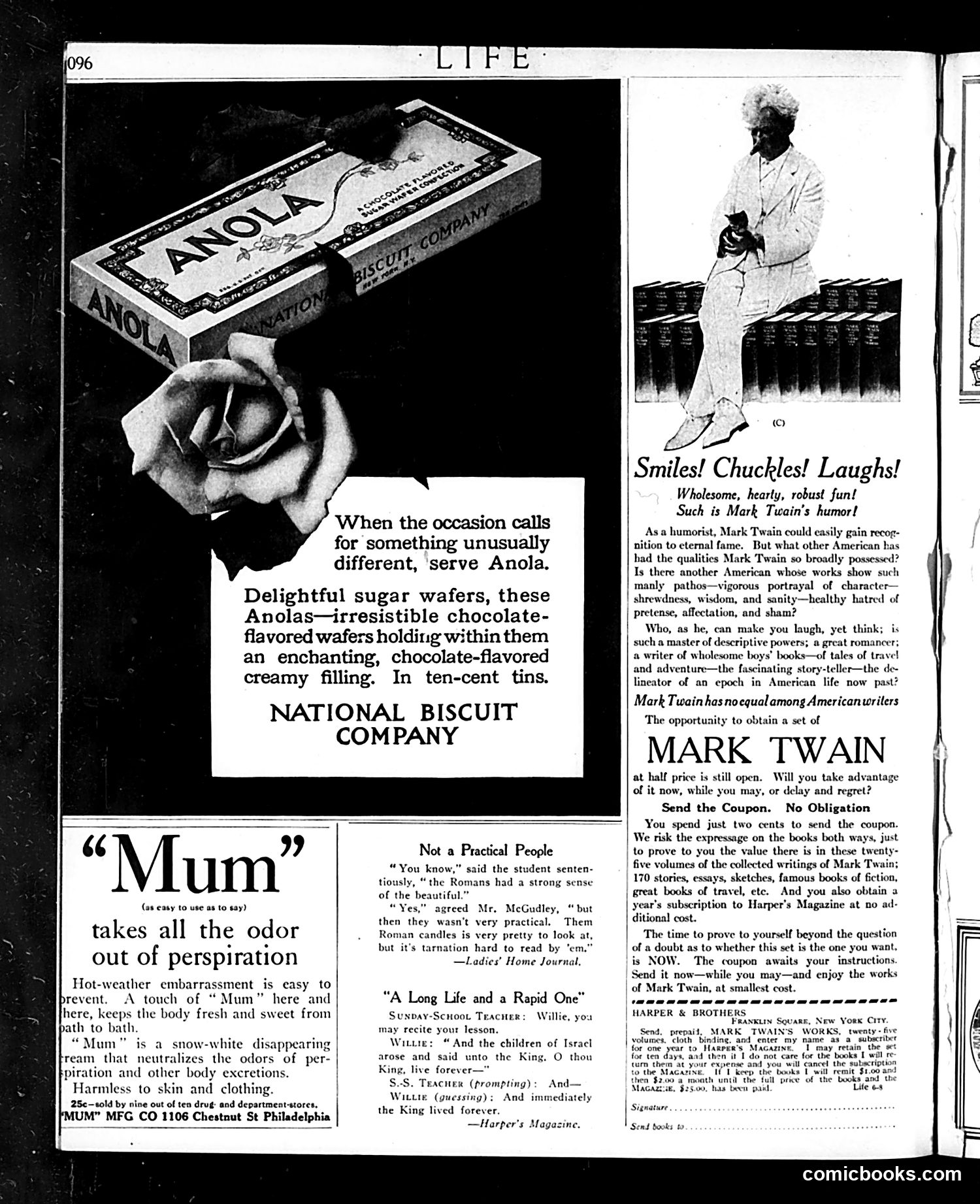
This page is primarily **advertising**, not political satire. It contains four distinct ads: 1. **Anola wafers** (National Biscuit Company)—a chocolate cookie product pitch 2. **"Mum" deodorant**—appeals to hot-weather body odor concerns with a "snow-white disappearing cream" 3. **Two brief humor pieces**: A joke about Romans valuing beauty over practicality, and a Sunday school student reciting scripture, both clipped from *Harper's Magazine* 4. **Mark Twain collected works**—the largest ad, emphasizing Twain's universal appeal as humorist, moralist, and storyteller, offering a discounted subscription bundle The Twain ad reflects early 20th-century marketing strategy: position the author as uniquely American, wholesome, and valuable, while using a "limited-time offer" coupon to drive sales. The deodorant ad reveals period concerns about social embarrassment from perspiration—a pitch that assumes this was a significant anxiety for readers. No political satire is present; this is straightforward commercial messaging.
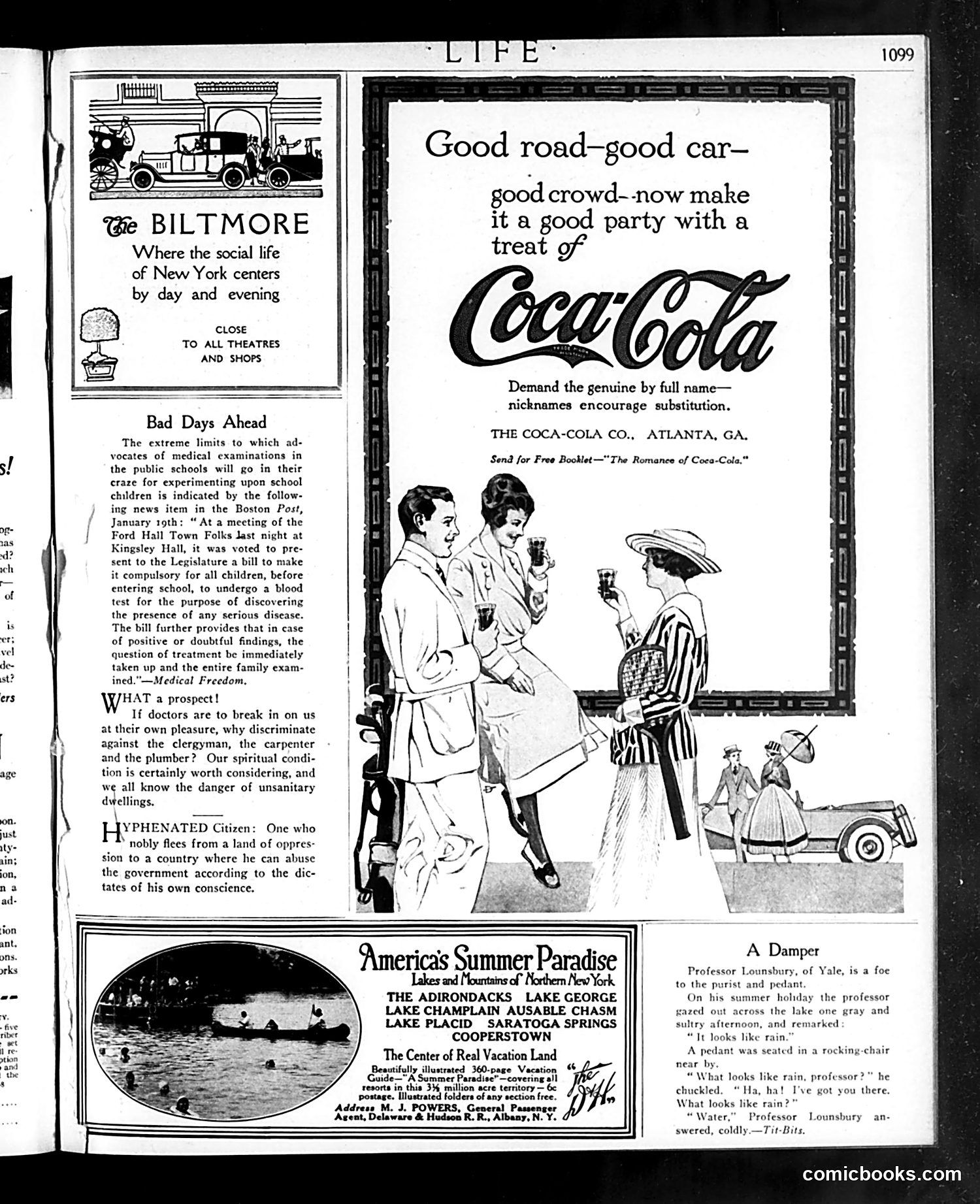
This page is primarily **advertising** rather than editorial content or satire. The dominant feature is a Coca-Cola advertisement showing well-dressed people at what appears to be a social gathering, with the slogan "Good road–good car–good crowd–now make it a good party with a treat of Coca-Cola." The left column contains two brief opinion pieces: one criticizing proposed mandatory blood tests for schoolchildren before enrollment (framed as government overreach), and another satirical definition of a "hyphenated citizen" as someone fleeing oppression only to abuse their new country's government. Below are advertisements for the Biltmore Hotel in New York and vacation destinations in Northern New York. The bottom right corner features a short humorous anecdote about Professor Lounsbury of Yale, a pedant who, when asked what "looks like rain," pedantically responds "Water"—the joke being his literal-minded, unhelpful answer.
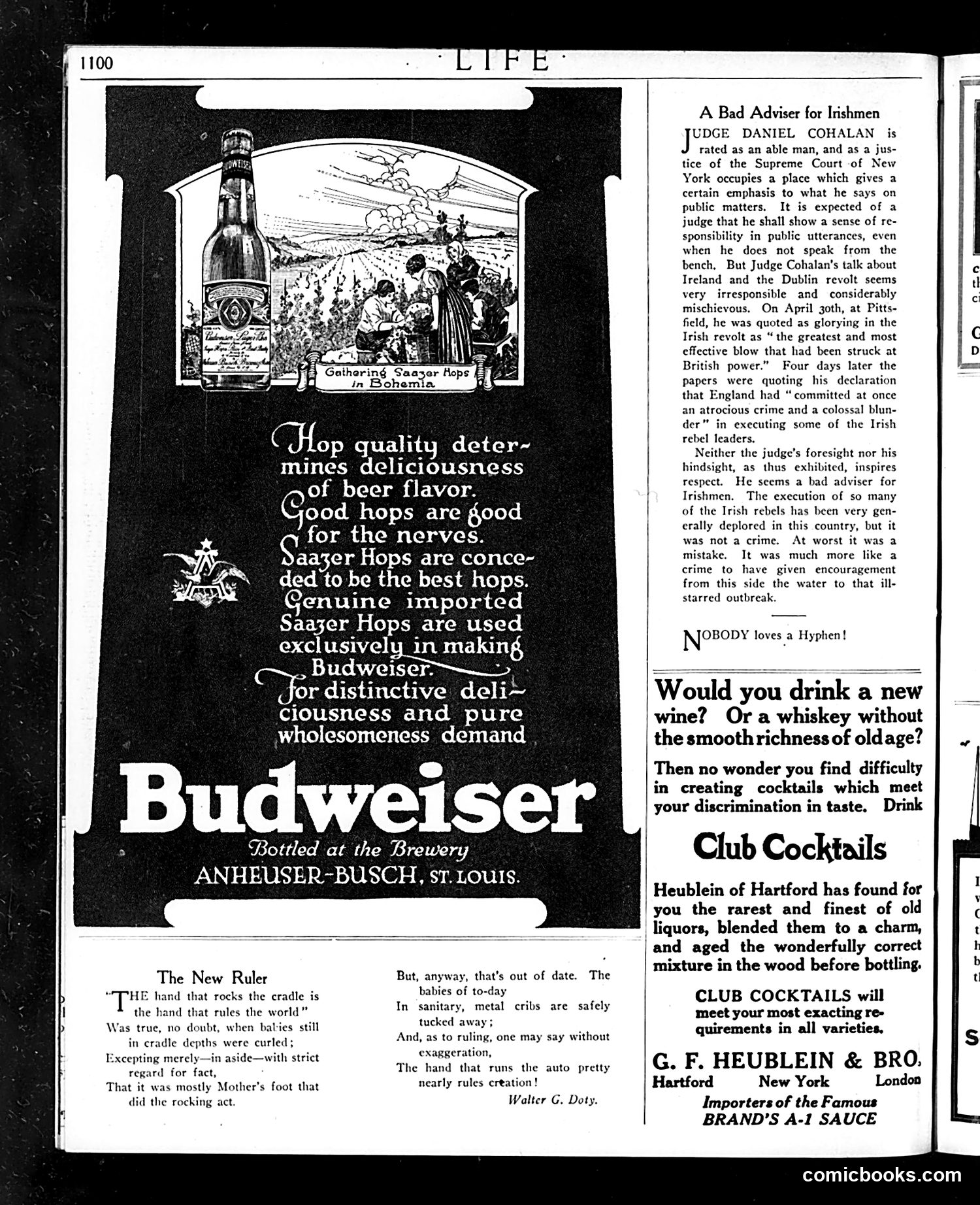
This page combines advertisements with political commentary from circa 1916. **Main Article: "A Bad Adviser for Irishmen"** Criticizes Judge Daniel Cohalan of New York's Supreme Court for publicly praising the Irish Easter Rebellion (Dublin revolt, April 1916) and condemning British executions of rebel leaders. Life argues that while the executions were regrettable, encouraging the "ill-starred outbreak" from America was worse—making Cohalan a poor adviser to Irish-Americans. The piece suggests his judicial position lends dangerous credibility to his inflammatory statements about Ireland and Britain during wartime. **"The New Ruler" Poem** A brief satirical poem by Walter G. Doty updating the saying "the hand that rocks the cradle rules the world." It argues modern mothers no longer rock cradles (replaced by sanitary metal cribs), and that automobiles—not maternal influence—now "rule creation." **Advertisements** The page is dominated by Budweiser beer and Club Cocktails ads, typical of the era's alcohol marketing before Prohibition (1920).
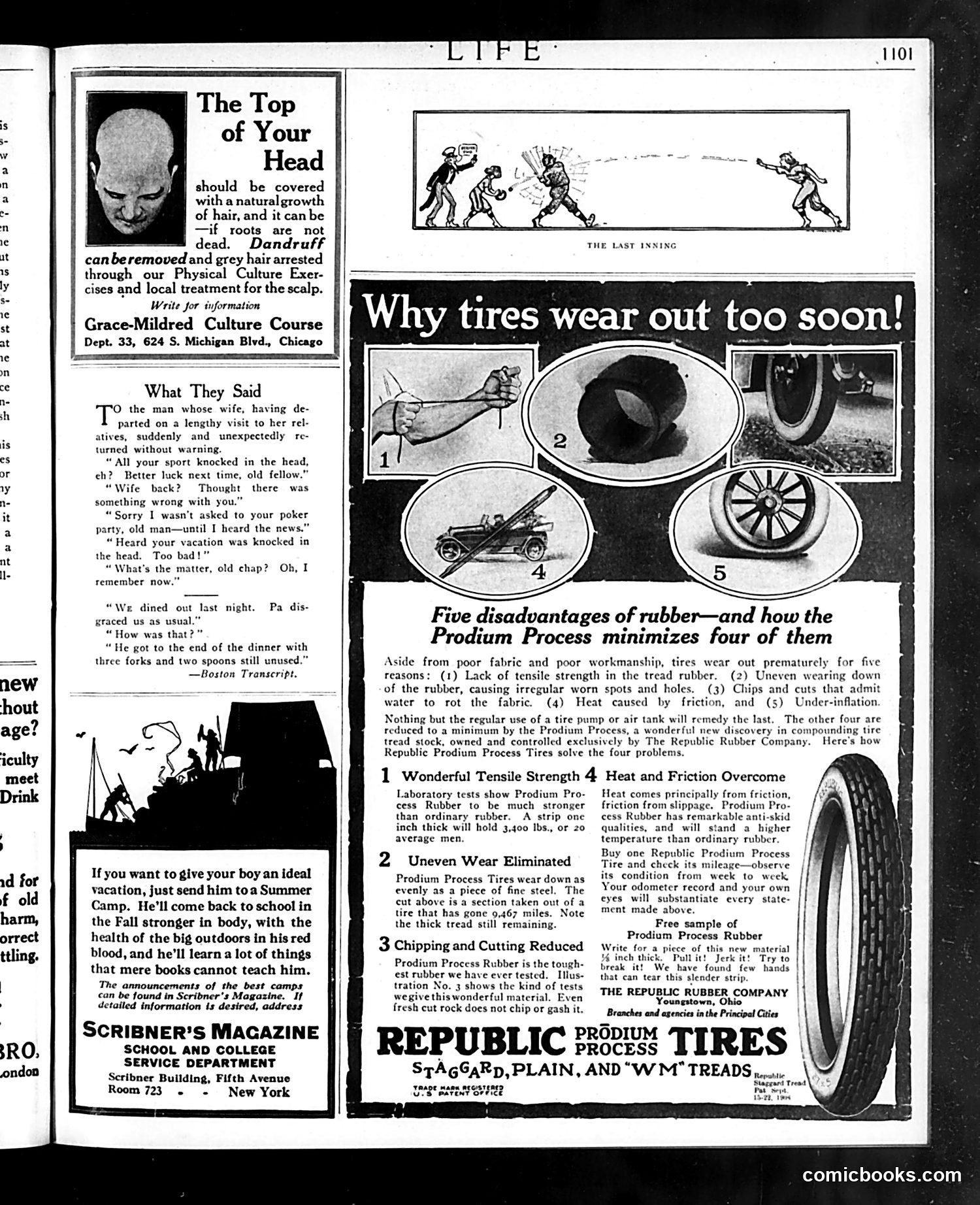
This page contains two distinct sections: **social humor** and **tire advertising**. The left side presents a humorous piece titled "What They Said" featuring a domestic joke: a man whose wife unexpectedly returns from visiting relatives finds his freedom curtailed. His friends offer mock-sympathetic quips about his "sport knocked in the head" and cancelled poker parties. A separate anecdote mocks poor table manners at dinner. This reflects early 20th-century gender dynamics and the assumption that wives constrain husbands' leisure activities. The dominant right side is a **Republic Rubber Company advertisement** for "Prodium Process Tires." It addresses tire durability through five failure causes—weak tread rubber, uneven wear, cuts, heat, and under-inflation. The ad claims the Prodium Process (apparently a proprietary rubber compound) solves four of these problems through superior tensile strength and anti-skid properties. Numbered illustrations demonstrate tire cross-sections and stress tests. This represents typical early automotive-era advertising combining technical claims with visual evidence to convince buyers of product superiority—a period when tire quality significantly affected vehicle safety and reliability.
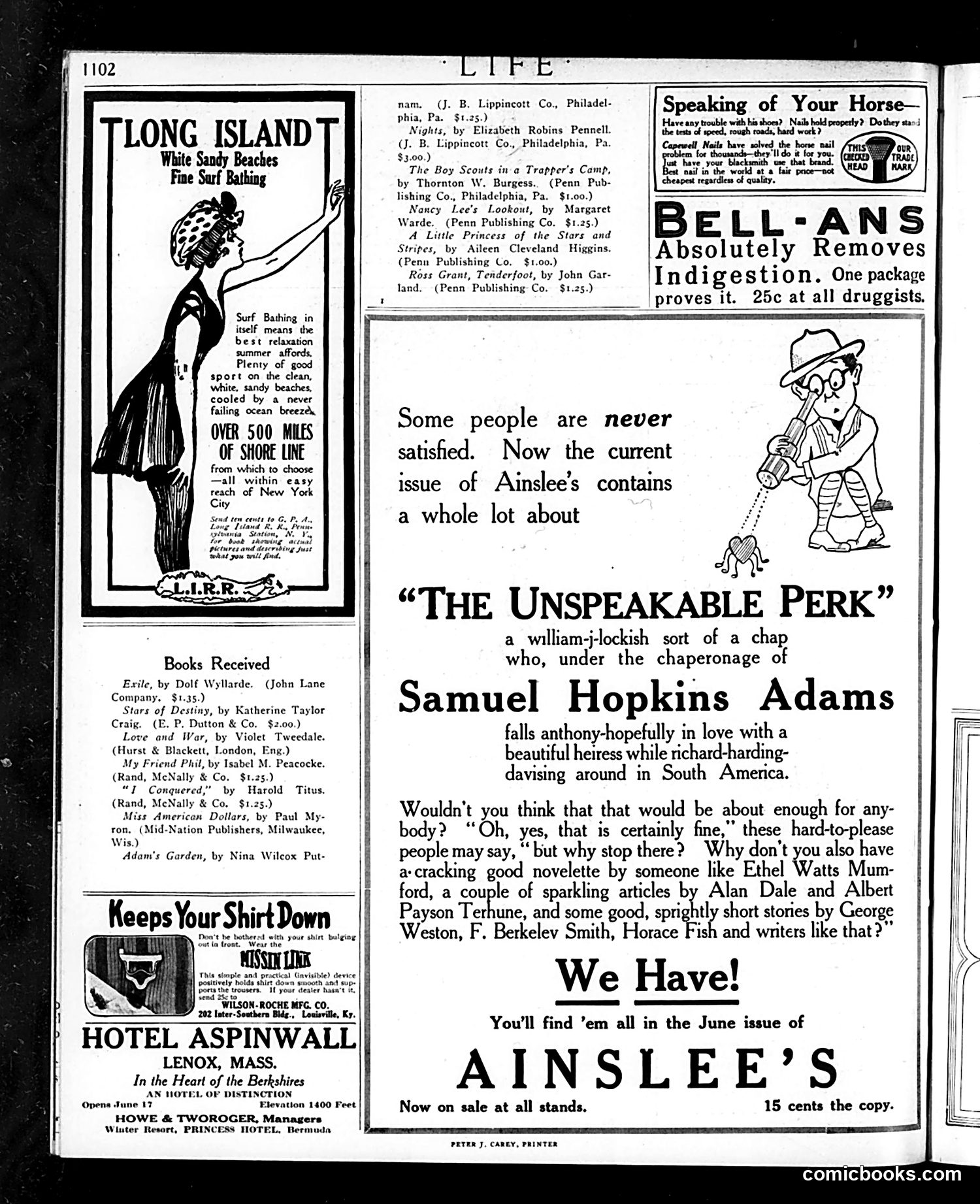
This page is primarily **advertising and literary promotion**, not political satire. The main content advertises the June issue of *Ainslee's Magazine*. The central feature promotes a serialized story titled **"The Unspeakable Perk"** by Samuel Hopkins Adams, featuring a stock romantic character who falls in love with a wealthy heiress while traveling in South America. The advertisement humorously acknowledges reader complaints that one story isn't enough, sarcastically suggesting readers want additional content by popular authors (Ethel Watts Mumford, Alan Dale, George Weston, etc.). **The satire is mild**: it gently mocks unsatisfiable magazine readers who always demand more entertainment value for their 15-cent purchase. The page also includes typical period advertising for patent medicines (Bell-Ans for indigestion), a shirt-holder device, a hotel, and a book review section. A decorative Long Island beach tourism ad appears on the left. There is **no political cartoon or significant satire** beyond the lighthearted jab at demanding readers.
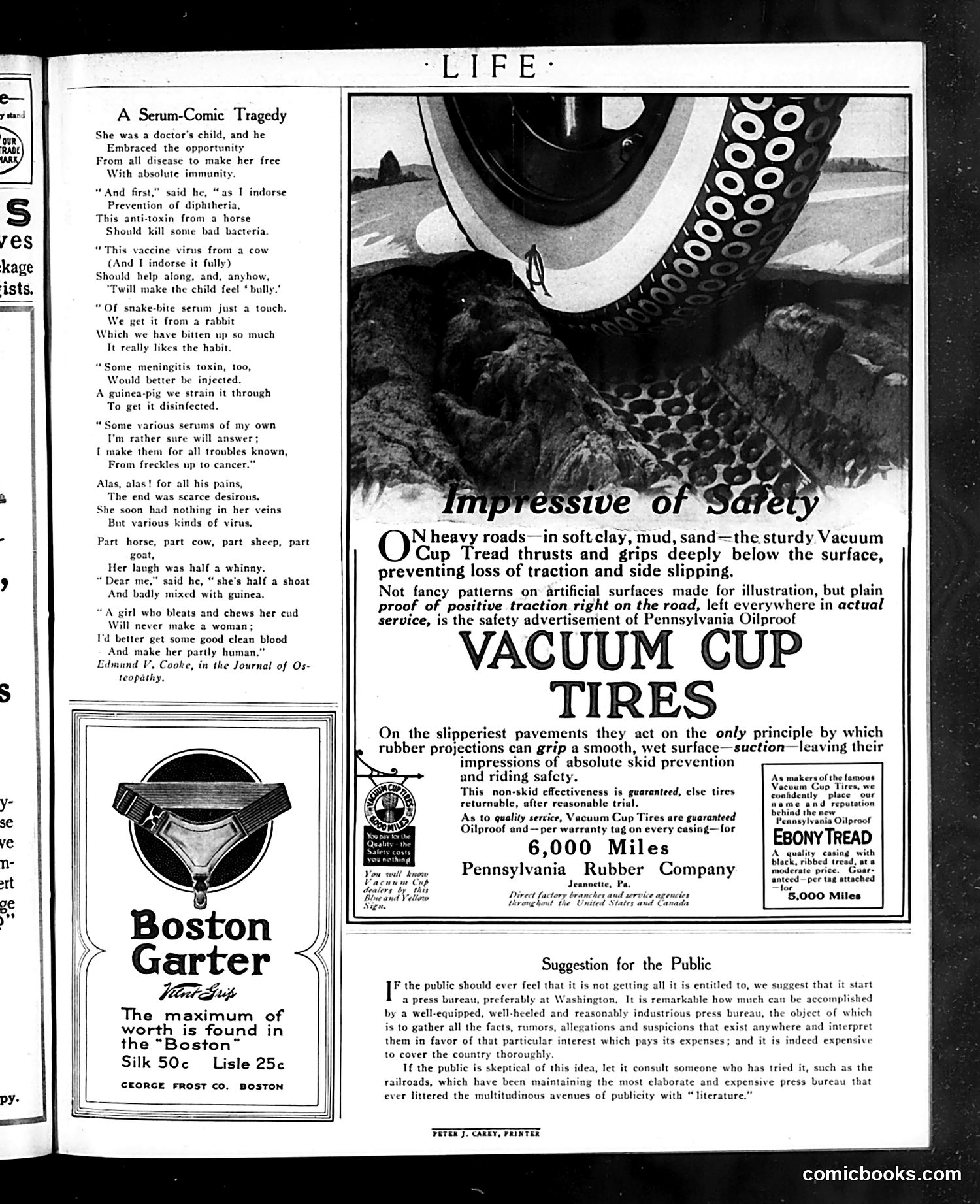
This satirical poem mocks medical overreach and the early-20th-century obsession with serums and vaccines. A well-meaning doctor injects his daughter with numerous serums—derived from horses, cows, sheep, rabbits, and guinea pigs—claiming to prevent various diseases. The joke escalates absurdly: after all these treatments, the girl becomes a bizarre chimera, "part horse, part cow, part sheep, part goat," who "bleats and chews her cud." The satire targets two concerns: the indiscriminate use of animal-derived medical treatments (then genuine medical practice) and the hubris of doctors who believed they could make children immune to all disease. The punchline—that her father's "cure" turned her into a hybrid animal rather than protecting her—suggests such medical interventionism produces monsters rather than health. The poem is attributed to Edmund V. Cooke and published in the *Journal of Osteopathy*, indicating contemporary medical skepticism about trendy treatments.
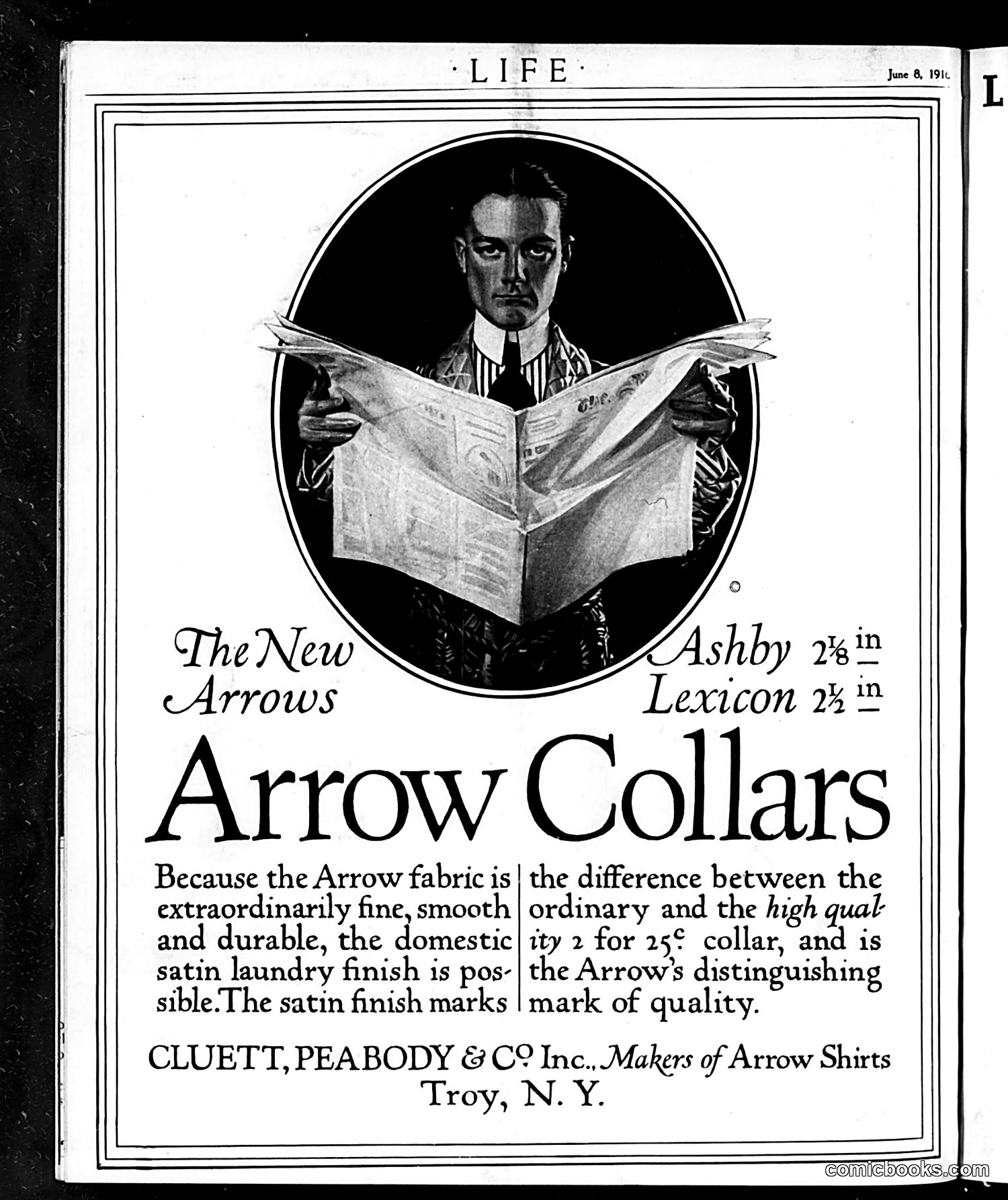
This page is **entirely an advertisement**, not political satire or comics content. It's a 1911 advertisement for Arrow Collars by Cluett, Peabody & Co., a Troy, New York shirtmaker. The image shows a well-dressed man in formal attire reading a newspaper, presumably to suggest respectability and refinement. The ad emphasizes Arrow Collars' superior quality: the fabric's fine, smooth, durable properties and distinctive satin laundry finish. It references two collar styles—"Ashby" and "Lexicon"—and highlights that Arrow offers "high quality" at the competitive price of two collars for 25 cents, presenting this as their "distinguishing mark of quality." There is no political commentary or satire present—this is straightforward commercial marketing from the early 20th century.