
Life, 1916-06-08 · page 30 of 46
Life — June 8, 1916 — page 30: what you’re looking at
What you’re looking at
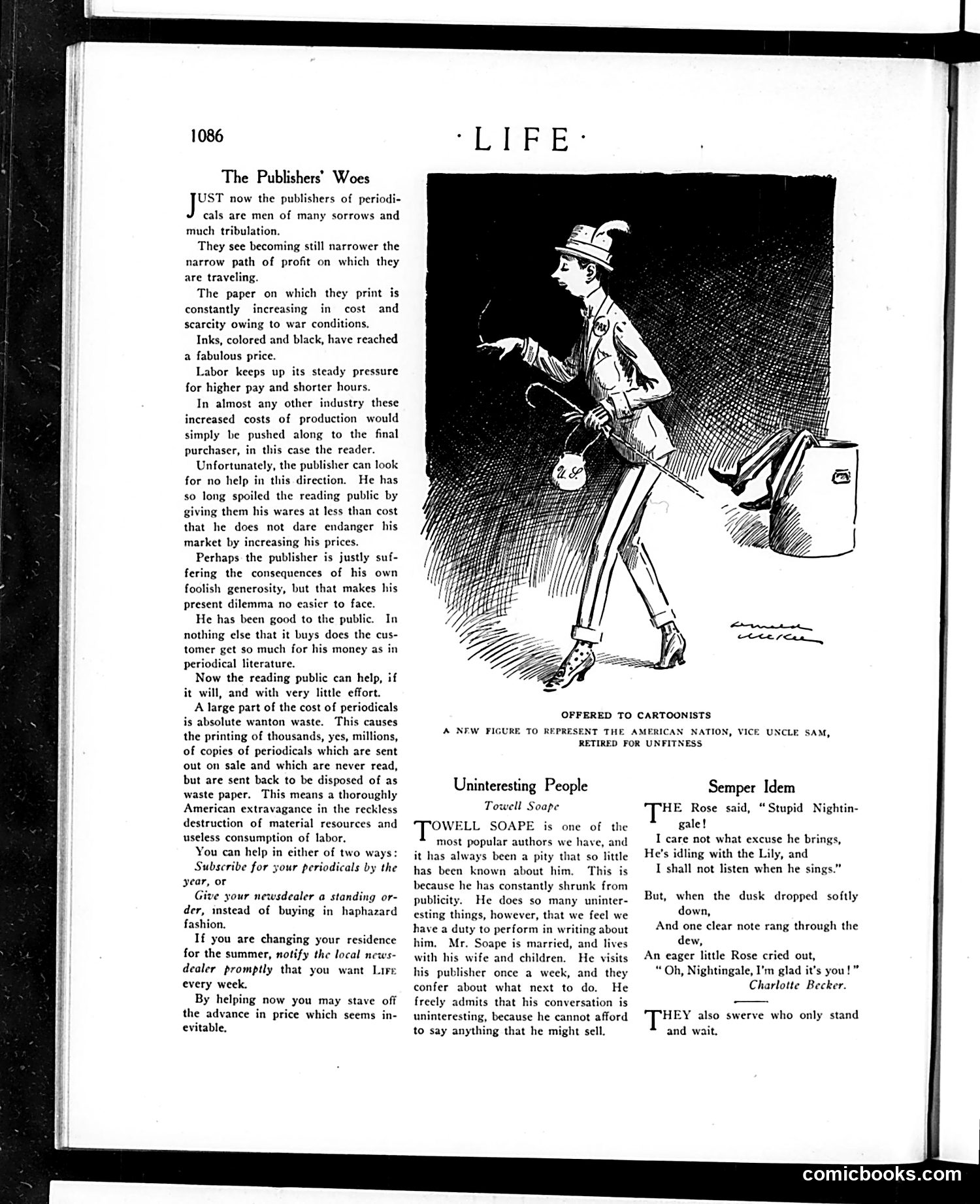
**"The Publishers' Woes"** is an editorial arguing that magazine publishers face financial crisis due to wartime scarcity and inflation (rising paper and ink costs, labor demands), yet cannot raise prices without losing readers they've conditioned to expect cheap rates. The text urges readers to subscribe annually or give standing orders to reduce waste from unsold copies—a practical appeal during what appears to be WWI-era paper shortages. **The cartoon** depicts a cheerful publisher juggling increasingly heavy costs (represented by the weighted bundle he's balancing), illustrating the precarious financial position described in the text. The page also includes two unrelated literary pieces: a humorous profile of author "Towell Soape" (likely a fictional name playing on his dull personality), and a sentimental poem "Semper Idem" by Charlotte Becker about a Rose and Nightingale reconciling at dusk. The header references seeking a new national symbol to replace Uncle Sam, though details are unclear from this excerpt.
📄 Transcribed text from this page (OCR, searchable)
Machine-transcribed from the original scan — historical spelling and the odd misread are preserved.
1086 The Publishers’ Woes UST now the publishers of periodi- cals are men of many sorrows and much tribulation. They see becoming still narrower the narrow path of profit on which they are traveling. The paper on which they print is constantly increasing in cost and scarcity owing to war conditions. Inks, colored and black, have reached a fabulous price. Labor keeps up its steady pressure for higher pay and shorter hours. In almost any other industry these increased costs of production would simply be pushed along to the final purchaser, in this case the reader. Unfortunately, the publisher can look for no help in this direction. He has so long spoiled the reading public by giving them his wares at less than cost that he does not dare endanger his market by increasing his prices. Perhaps the publisher is justly suf- fering the consequences of his own foolish generosity, but that makes his present dilemma no easier to face. He has been good to the public. In nothing else that it buys does the cus- tomer get so much for his money as in periodical literature. Now the reading public can help, if it will, and with very little effort. A large part of the cost of periodicals is absolute wanton waste. This causes the printing of thousands, yes, millions, of copies of periodicals which are sent out on sale and which are never read, but are sent back to be disposed of as waste paper. This means a thoroughly American extravagance in the reckless destruction of material resources and useless consumption of labor, You can help in either of two ways: Subscribe for your periodicals by the year, or ¢ your newsdealer a standing or- der, instead of buying in haphazard fashion, If you are changing your residence for the summer, notify the local news- dealer promptly that you want Lire every week. By helping now you may stave off the advance in price which seems in- evitable, OFFERED TO CARTOONISTS A NEW FIGURE TO REPRESENT THE AMERIC NATION, VICE UNCLE SAM, RETIRED FOR UNFITNESS Uninteresting People Towell Soape ‘OWELL SOAPE most popular authors we have, and it has always been a pity that so little has been known about him. This is because he has constantly shrunk from publicity. He does so many uninter- esting things, however, that we feel we have a duty to perform in writing about him, Mr. Soape is married, and lives with his wife and children. He visits his publisher once a week, and they confer about what next to do. He freely admits that his conversation is uninteresting, because he cannot afford to say anything that he might sell. is one of the Semper Idem HE Rose said, “Stupid Nightin- gale! I care not what excuse he brings, He's idling with the Lily, and I shall not listen when he sings.” But, when the dusk dropped softly down, And one clear note rang through the dew, An eager little Rose cried out, “Oh, Nightingale, I'm glad it’s you!” Charlotte Becker. HEY also swerve who only stand and wait. comicbooks.com