
Life, 1916-06-08 · page 25 of 46
Life — June 8, 1916 — page 25: what you’re looking at
What you’re looking at
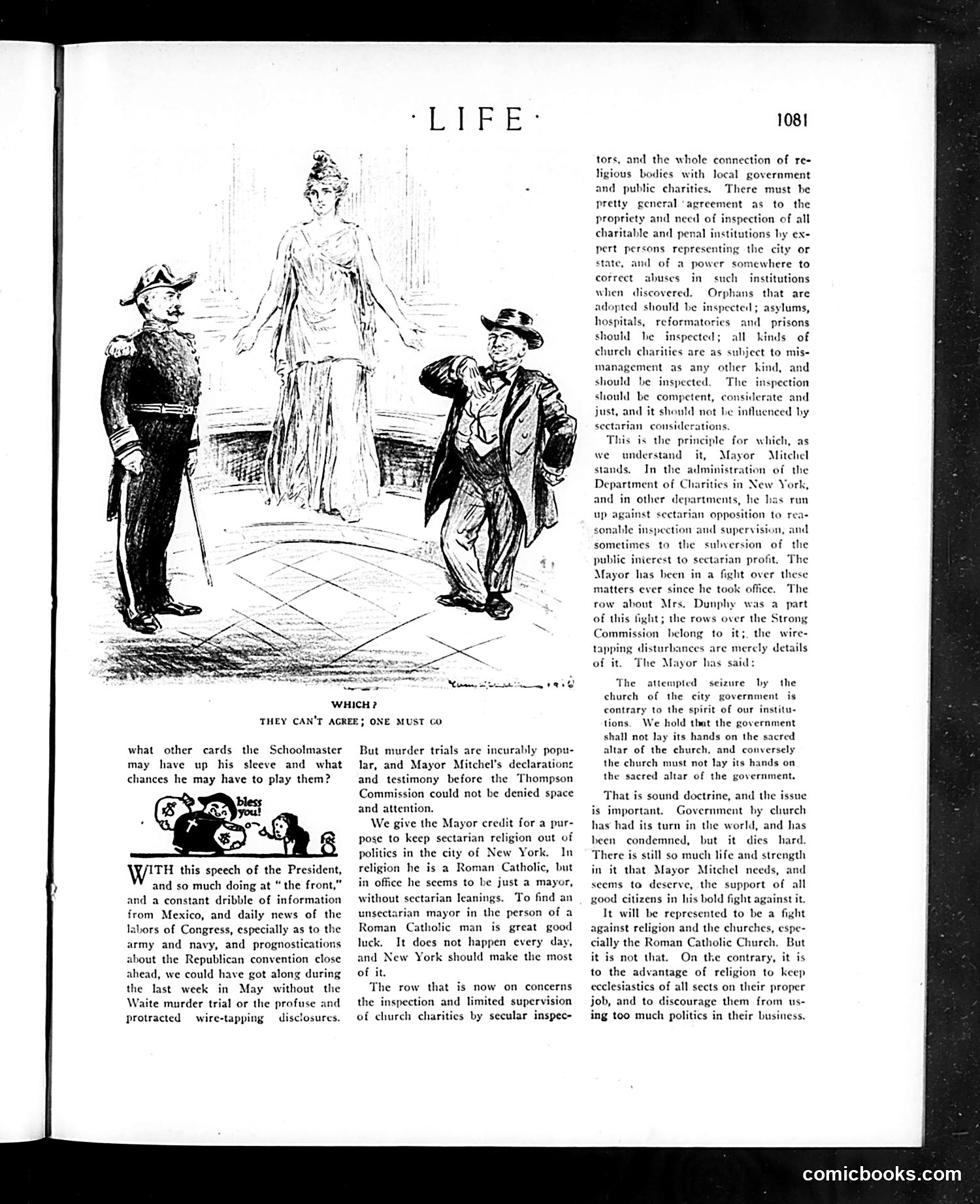
This cartoon depicts Mayor John Purroy Mitchel (center, in civilian dress) caught between two opposing figures—likely representing a military/government official (left) and a religious/church representative (right). The caption references a fundamental conflict of Mitchel's administration. The text clarifies the dispute: Mitchel championed government inspection of church-run charities and institutions (orphanages, asylums, hospitals) to prevent mismanagement, a position opposed by sectarian religious interests seeking autonomy from state oversight. The "one must go" refers to this irreconcilable conflict between secular governance accountability and religious institutional independence. Life's editorial supports Mitchel's secular inspection authority while defending his Catholic faith as irrelevant to his mayoral duties, arguing that religion should remain separate from both politics and government control.
📄 Transcribed text from this page (OCR, searchable)
Machine-transcribed from the original scan — historical spelling and the odd misread are preserved.
WHICH? THEY CAN'T AGREE; ONE MUST GO what other cards the Schoolmaster may have up his sleeve and what chances he may have to play them? With this speech of the President, and so much doing at “ the front, and a constant dribble of information from Mexico, and daily news of the labors of Congress, especially as to the army and navy, and prognostications out the Republican convention close ahead, we could have got along during the last week in May without the Waite murder trial or the profuse and Protracted wire-tapping disclosures. But murder trials are incurably popu- lar, and Mayor Mitchel’s declarations and testimony before the Thompson Commission could not be denied space and attention. We give the Mayor credit for a pur- pose to keep sectarian religion out of politics in the city of New York. In religion he is a Roman Catholic, but in office he seems to be just a mayor, without sectarian leanings. To find an unsectarian mayor in the person of a Roman Catholic man is great good luck. It does not happen every day, and New York should make the most of it. The row that is now on concerns the inspection and limited supervision of church charities by secular inspec- 1081 tors, and the whole connection of re- ligious bodies with local government and public charities. There must be pretty general ‘agreement as to the propriety and need of inspection of all charitable and penal institutions hy ex- pert persons representing the city or state, and of a power somewhere to correct such institutions when discovered. Orphans that are adopted should be inspected; asylums, hospitals, reformatories and prisons should be inspected; all kinds of church charities are as subject to mis- management as any other kind, and should be inspected. The inspection should be competent, considerate and just, and it should not he influenced by abuses in sectarian consider: This is the p ple for which, as we understand it, Mayor Mitchel stands. In the adn nm oof the Department of Charities in New York, and in other departments, he has run up against sectarian opposition to rea- sonable inspection and supervision, and sometimes to the subversion of the public inierest to sectarian profit. The Mayor has been in a fight over these matters ever since he took office. The row about Mrs, Dunphy was a part of this fight; the rows over the Strong Commission belong to it;. the w pping disturbances are merely details of it, The attempted seizure by the church of the city government is contrary to the spirit of our institu- tions. We hold that the government shall not lay its hands on the sacred altar of the church, and conversely the church must not lay its hands on the sacred altar of the government, That is sound doctrine, and the issue is important. Government by church has had its turn in the world, and has been condemned, but it dies d. There is still so much life and strength in it that Mayor Mitchel needs, and seems to deserve, the support of all good citizens in his bold fight against it. It will be represented to be a fight against religion and the churches, espe- cially the Roman Catholic Church, But it is not that. On the contrary, it is to the advantage of religion to keep ecclesiastics of all sects on their proper job, and to discourage them from us- ing too much politics in their business. comicbooks.com