
Life, 1916-06-08 · page 24 of 46
Life — June 8, 1916 — page 24: what you’re looking at
What you’re looking at
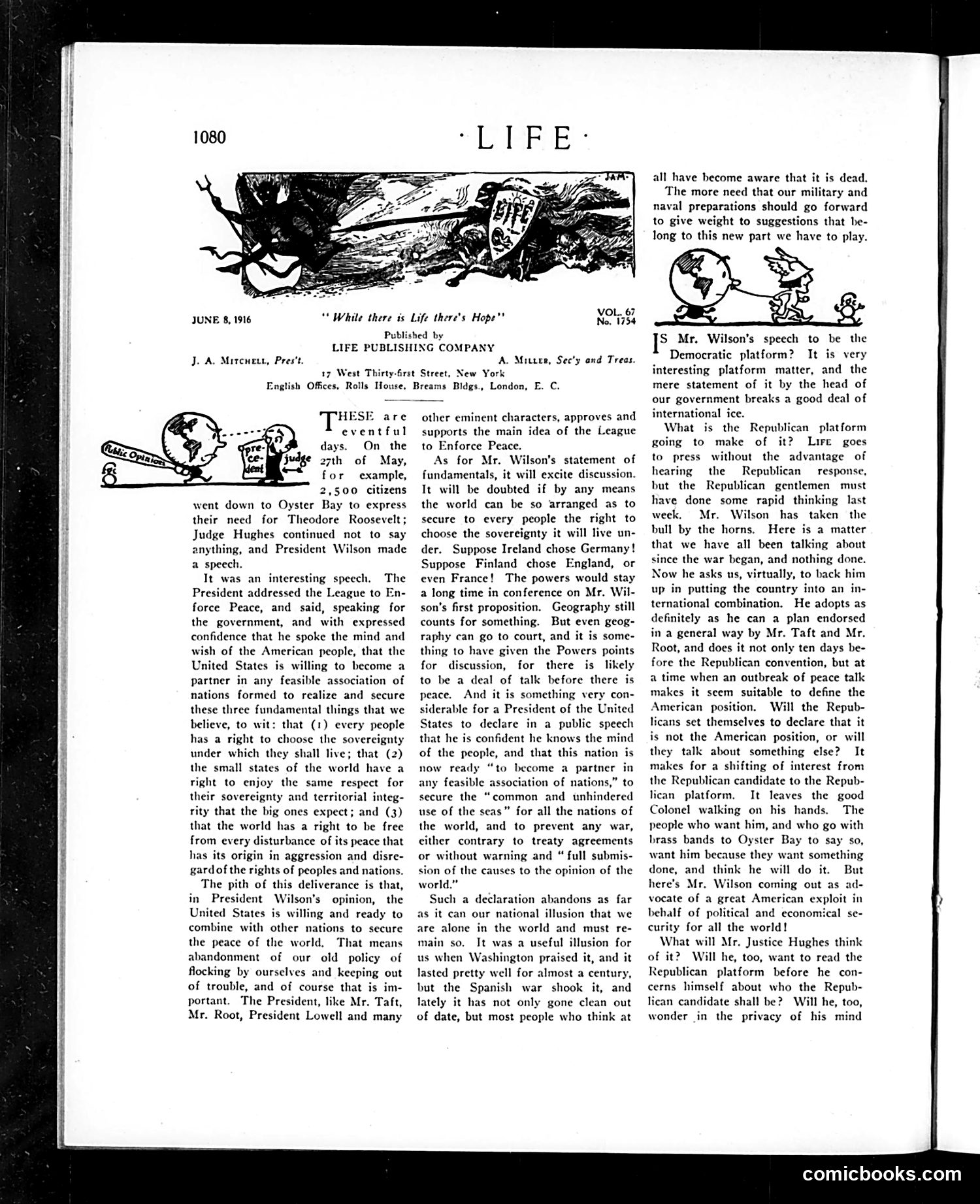
This *Life* editorial discusses President Wilson's May 27 speech to the League to Enforce Peace, which proposed America abandon isolationism and join international peacekeeping efforts—a dramatic shift from traditional U.S. policy. The piece examines Wilson's three stated principles: nations' self-determination, equal respect for small states, and freedom from aggression-caused disturbances. The author acknowledges the idealism but raises practical objections (e.g., "Suppose Ireland chose Germany!"), noting geography constrains such arrangements. The editorial frames this as potentially the Democratic platform for the 1916 election, while noting Republicans—and figures like Theodore Roosevelt (referenced at Oyster Bay), Judge Hughes, and Colonel Roosevelt—will respond. The satirical thrust: Wilson's lofty internationalism, while admirable, conflicts with real-world power politics and geographic realities that nations cannot ignore.
📄 Transcribed text from this page (OCR, searchable)
Machine-transcribed from the original scan — historical spelling and the odd misread are preserved.
JUNE 8, 1916 ‘* While there is Life there's Hope"" Published by LIFE PUBLISHING COMPANY J. A. Mrrcnrut, Pres't. A. Mutter, Sec'y and Treas. 17 West Thirty-first Street, New York English Offices, Rotls House, Breams Bldgs., London, E. C. HESE are eventful days. On the 27th of May, for example, 2,500 citizens went down to Oyster Bay to express their need for Theodore Roosevelt; Judge Hughes continued not to say anything, and President Wilson made a speech, It was an interesting speech. The President addressed the League to En- force Peace, and said, speaking for the government, and with expressed confidence that he spoke the mind and wish of the American people, that the United States is willing to become a partner in any feasible association of nations formed to realize and secure these three fundamental things that we believe, to wit: that (1) every people has a right to choose the sovereignty under which they shall live; that (2) the small states of the world have a right to enjoy the same respect for their sovereignty and territorial integ- rity that the big ones expect; and (3) that the world has a right to be free from every disturbance of its peace that has its origin in aggression and disre- gardof the rights of peoples and nations. The pith of this deliverance is that, in President Wilson's opinion, the United States is willing and ready to combine with other nations to secure the peace of the world. That means abandonment of our old policy of flocking by ourselves and keeping out of trouble, and of course that is im- portant. The President, like Mr. Taft, Mr. Root, President Lowell and many other eminent characters, approves and supports the main idea of the League to Enforce Peace. As for Mr. Wilson's statement of fundamentals, it will excite discussion. It will be doubted if by any means the world can be so arranged as to secure to every people the right to choose the sovereignty it will live un- der. Suppose Ireland chose Germany! Suppose Finland chose England, or even France! The powers would stay a long time in conference on Mr. Wil- son’s first proposition. Geography still counts for something. But even geog- raphy can go to court, and it is some- thing to have given the Powers points for discussion, for there is likely to be a deal of talk before there is peace. And it is something very con- siderable for a President of the United States to declare in a public speech that he is confident he knows the mind of the people, and that this nation is now ready “to become a partner in any feasible association of nations,” to secure the “common and unhindered use of the seas” for all the nations of the world, and to prevent any war, either contrary to treaty agreements or without warning and “ full submis- sion of the causes to the opinion of the world.” Such a declaration abandons as far as it can our national illusion that we are alone in the world and must re- main so, It was a useful illusion for us when Washington praised it, and it lasted pretty well for almost a century, but the Spanish war shook it, and lately it has not only gone clean out of date, but most people who think at all have become aware that it is dead, The more need that our military and naval preparations should go forward to give weight to suggestions that be- long to this new part we have to play. S Mr. Wilson’s speech to be the Democratic platform? It is very interesting platform matter, and the mere statement of it by the head of our government breaks a good deal of international ice. What is the Republican platform going to make of it? Lire goes to press without the advantage of hearing the Republican response, but the Republican gentlemen must have done some rapid thinking last week, Mr. Wilson has taken the bull by the horns. Here is a matter that we have all been talking about since the war began, and nothing done. Now he asks us, virtually, to back him up in putting the country into an in- ternational combination. He adopts as definitely as he can a plan endorsed in a general way by Mr. Taft and Mr. Root, and does it not only ten days be- fore the Republican convention, but at a time when an outbreak of peace talk makes it seem suitable to define the American position. Will the Repub- licans set themselves to declare that it is not the American position, or will they talk about something else? It makes for a shifting of interest from the Republican candidate to the Repub- lican platform. It leaves the good Colonel walking on his hands. The people who want him, and who go with brass bands to Oyster Bay to say so, want him because they want something done, and think he will do it. But here's Mr. Wilson coming out as ad- vocate of a great American exploit in behalf of political and economical se- curity for all the world! What will Mr. Justice Hughes think of it? Will he, too, want to read the Republican platform before he con- cerns himself about who the Repub- lican candidate shall be? Will he, too, wonder in the privacy of his mind comicbooks.com