
Life, 1916-06-08 · page 32 of 46
Life — June 8, 1916 — page 32: what you’re looking at
What you’re looking at
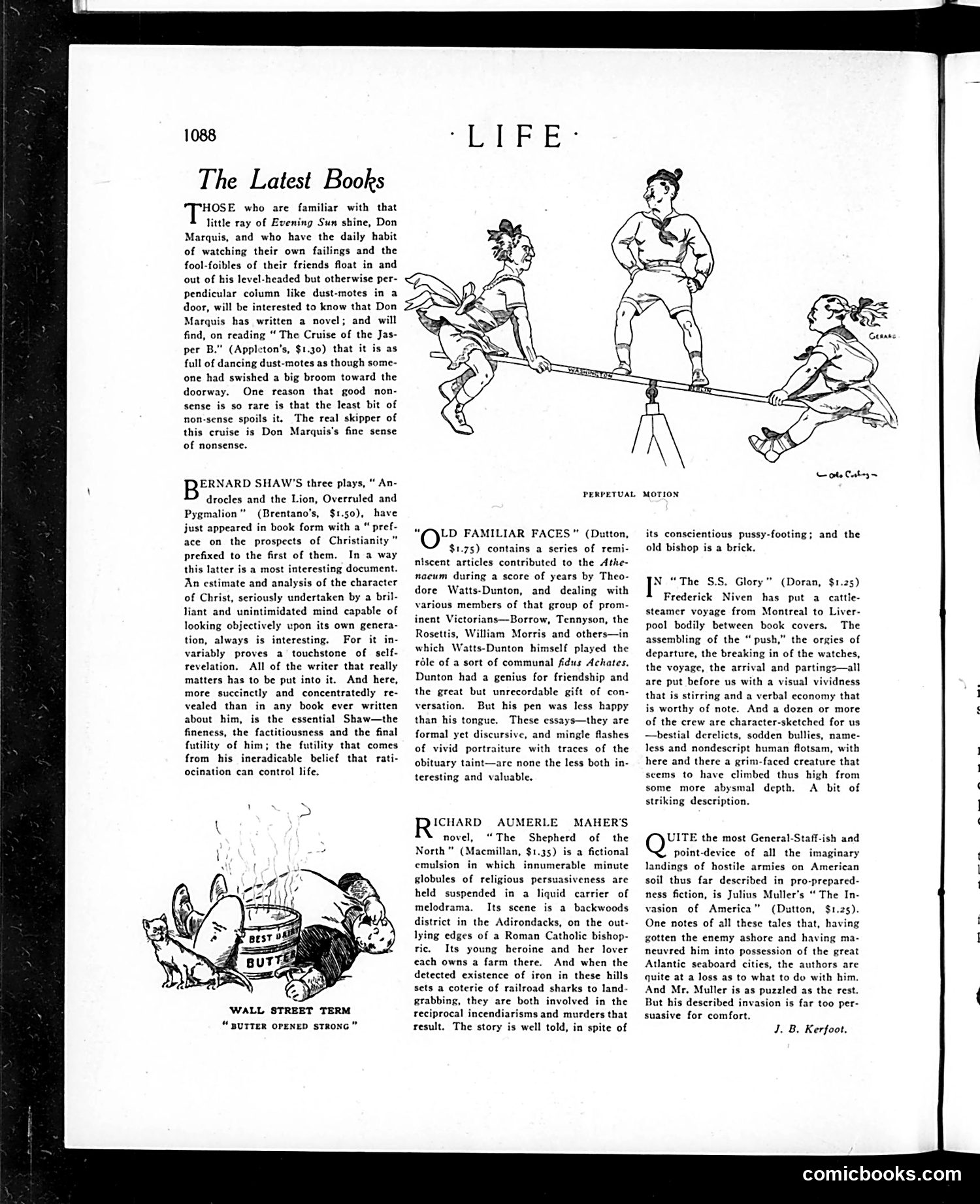
This is a book review section from *Life* magazine featuring satirical commentary on contemporary literature. The main cartoon, labeled "Perpetual Motion," depicts children on a seesaw operated by a telescope or surveying instrument—a visual pun suggesting the endless, mechanical nature of children's play. The reviews discuss Don Marquis's novel *The Cruise of the Jasper B.*, praising his "fine sense of nonsense"; Bernard Shaw's plays with a philosophical preface on Christianity, which the reviewer critiques as revealing Shaw's belief that "ratiocination can control life"; and several other contemporary works including novels by Theodore Watts-Dunton and Frederick Niven. The secondary cartoon, "Wall Street Term—'Butter Opened Strong,'" depicts butter as a commodity in financial terms, likely satirizing Wall Street's tendency to speak of food prices in market language. The page exemplifies *Life*'s role as a literary and cultural critic, combining wit with serious literary judgment.
📄 Transcribed text from this page (OCR, searchable)
Machine-transcribed from the original scan — historical spelling and the odd misread are preserved.
1088 The Latest Books ‘HOSE who are familiar with that little ray of Evening Sun shine, Don Marquis, and who have the daily habit of watching their own failings and the fool-foibles of their friends float in and out of his level-headed but otherwise per- pendicular column like dust-motes in a door, will be interested to know that Don Marquis has written a novel; and will find, on reading “ The Cruise of the Jas- per B.” (Appleton’s, $1.30) that it is as full of dancing dust-motes as though some- one had swished a big broom toward the doorway. One reason that good non- sense is so rare is that the least bit of non-sense spoils it. The real skipper of this cruise is Don Marquis’s fine sense of nonsense. ERNARD SHAW'S three plays, “ An- drocles and the Lion, Overruled and Pygmalion” (Brentano's, $1.50), have just appeared in book form with a “ pref- ace on the prospects of Christianity ” prefixed to the first of them. In a way this latter is a most interesting document. An estimate and analysis of the character of Christ, seriously undertaken by a bril- liant and unintimidated mind capable of looking objectively upon its own genera- tion, always is interesting. For it in- variably proves a touchstone of sclf- revelation. All of the writer that really matters has to be put into it. And here, more succinctly and concentratedly re- vealed than in any book ever written about him, is the essential Shaw—the fineness, the factitiousness and the final futility of him; the futility that comes from his ineradicable belief that rati- ocination can control life. =) ‘WALL STREET TERM “ BUTTER OPENED STRONG” PERPETUAL MOTION a LD FAMILIAR FACES” (Dutton, $1.75) contains a series of remi- niscent articles contributed to the Athe- nacum during a score of years by Theo- dore Watts-Dunton, and dealing with various members of that group of prom- inent Victorians—Borrow, Tennyson, the Rosettis, William Morris and others—in which Watts-Dunton himself played the role of a sort of communal fidus Achates. Dunton had a genius for friendship and the great but unrecordable gift of con- versation. But his pen was less happy than his tongue. These essays—they are formal yet discursive, and mingle flashes of vivid portraiture with traces of the obituary taint—are none the less both in- teresting and valuable. ICHARD AUMERLE MAHER'S novel, “The Shepherd of the North” (Macmillan, $1.35) is a fictional emulsion in which innumerable minute globules of religious persuasiveness are held suspended in a liquid carrier of melodrama. Its scene is a backwoods district in the Adirondacks, on the out- lying edges of a Roman Catholic bishop- ric. Its young heroine and her lover cach owns a farm there. And when the detected existence of iron in these hills sets a coterie of railroad sharks to land grabbing, they are both involved in the reciprocal incendiarisms and murders that result. The story is well told, in spite of its conscientious pussy-footing; and the old bishop is a brick. I “The S.S. Glory” (Doran, $1.25) Frederick Niven has put a cattle- steamer voyage from Montreal to Liver- pool bodily between book covers, The assembling of the “ push,” the orgies of departure, the breaking in of the watches, the voyage, the arrival and partings—all are put before us with a visual vividness that is stirring and a verbal economy that is worthy of note. And a dozen or more of the crew are character-sketched for us —bestial derelicts, sodden bullies, name- less and nondescript human flotsam, with here and there a grim-faced creature that scems to have climbed thus high from some more abysmal depth. A bit of striking description. UITE the most General-Staff-ish and point-device of all the imaginary landings of hostile armies on American soil thus far described in pro-prepared- ness fiction, is Julius Muller’s “ The In- vasion of America” (Dutton, $1.25). One notes of all these tales that, having gotten the enemy ashore and having ma- neuvred him into possession of the great Atlantic seaboard cities, the authors are quite at a loss as to what to do with him. And Mr. Muller is as puzzled as the rest. But his described invasion is far too per- suasive for comfort. J. B. Kerfoot. comicbooks.com