
Life, 1916-06-08 · page 28 of 46
Life — June 8, 1916 — page 28: what you’re looking at
What you’re looking at
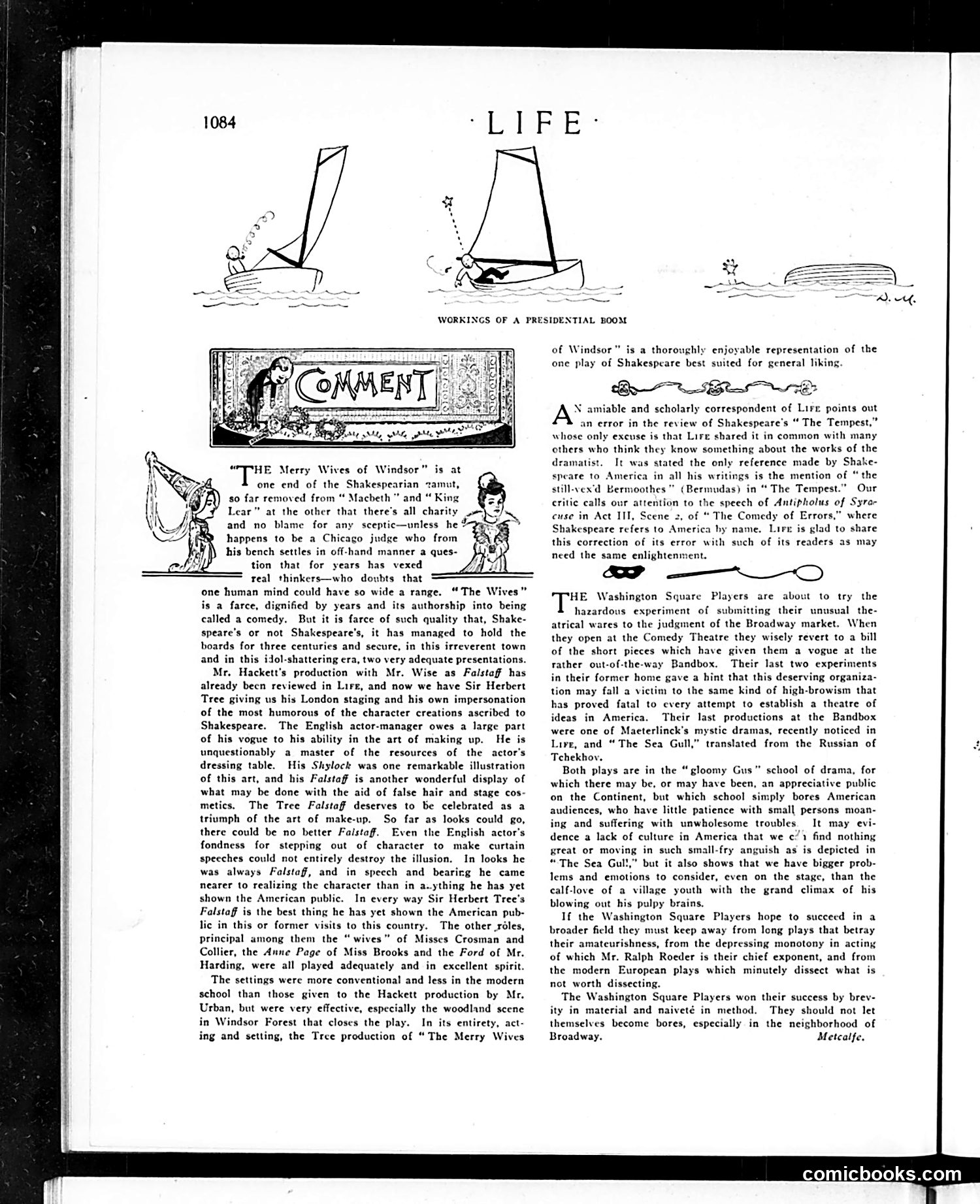
The three small cartoons at the top illustrate the phrase "presidential boom"—a political campaign gaining momentum. They show a boat progressively tipping and capsizing, with a figure being thrown into the water. The humor suggests that a presidential candidacy (the "boom") starts with optimistic fanfare but inevitably collapses spectacularly. The "COMMENT" section below reviews theatrical productions: Sir Herbert Tree's *Falstaff* in *The Merry Wives of Windsor* and discusses the Washington Square Players' experimental theater. The text corrects an earlier *Life* error about Shakespeare's references to America, acknowledging the magazine shared this mistake with other commentators. The page combines light political satire about campaign disasters with theater criticism—typical of *Life's* satirical approach to contemporary American culture and institutions.
📄 Transcribed text from this page (OCR, searchable)
Machine-transcribed from the original scan — historical spelling and the odd misread are preserved.
WORKINGS OF A PRESIDENTIAL BOOM HE Merry Wives of Windsor” is at one end of the Shakespearian amut, 80 far removed from “ Macbeth” and “ King Lear” at the other that there's all charity j= and no blame for any sceptic—unless he pq happens to be a Chicago judge who from ee his bench settles in off-hand manner aques- iy @ tion that for years has vexed real thinkers—who doubts that one human mind could have so wide a range. “The Wives” is a farce, dignified by years and its authorship into being called a comedy. But it is farce of such quality that, Shake- speare’s or not Shakespeare's, it has managed to hold the boards for three centuries and secure, in this irreverent town and in this idol-shattering era, two very adequate presentations. Mr. Hackett's production with Mr. Wise as Falstaff has already becn reviewed in Lirg, and now we have Sir Herbert Tree giving us his London staging and his own impersonation of the most humorous of the character creations ascribed to Shakespeare. The English actor-manager owes a large part of his vogue to his ability in the art of making up. He is unquestionably a master of the resources of the actor's dressing table. His Shylock was one remarkable illustration of this art, and his Falstaf is another wonderful display of what may be done with the aid of false hair and stage cos- metics. The Tree Falstaf deserves to be celebrated as a triumph of the art of make-up. So far as looks could go, there could be no better Falstaff. Even the English actor's fondness for stepping out of character to make curtain speeches could not entirely destroy the illusion. In looks he was always Falstaf, and in speech and bearing he came nearer to realizing the character than in a.ything he has yet shown the American public. In every way Sir Herbert Tree's Falstaff is the best thing he has yet shown the American pub- lic in this or former visits to this country. The other roles, principal among them the “wives” of Misses Crosman and Collier, the Anne Page of Miss Brooks and the Ford of Mr. Harding, were all played adequately and in excellent spirit. The settings were more conventional and less in the modern school than those given to the Hackett production by Mr. Urban, but were very effective, especially the woodland scene in Windsor Forest that closes the play. In its entirety, act- ing and setting, the Tree production of “The Merry Wives of Windsor" is a thoroughly enjoyable representation of the one play of Shakespeare best suited for general liking. N amiable and scholarly correspondent of Lire points out an error in the review of Shakespeare's “ The Tempest,” whose only excuse is that Lire shared it in common with many others who think they know something about the works of the 1m; It was stated the only reference made by Shake- speare to America in all his writings is the mention of “the still-vex'd Bermoothes” (Bermudas) in“ The Tempest.” Our critic calls our attention to the speech of Antipholus of Syra- cuse in Act IIT, Scene 2, of “ The Comedy of Errors,” where Shakespeare refers to America by name. Live is glad to share this correction of its error with such of its readers as may need the same enlightenment. PF o_O HE Washington Square Players are about to try the hazardous experiment of submitting their unusual the- atrical wares to the judgment of the Broadway market. When they open at the Comedy Theatre they wisely revert to a bill of the short pieces which have given them a vogue at the rather out-of-the-way Bandbox. Their last two experiments in their former home gave a hint that this deserving organiza- tion may fall a victim to the same kind of high-browism that has proved fatal to every attempt to establish a theatre of ideas in America. Their last productions at the Bandbox were one of Maeterlinck’s mystic dramas, recently noticed in Live, and “The Sea Gull,” translated from the Russian of Tehekhov. Both plays are in the “gloomy Gus" school of drama, for which there may be, or may have been, an appreciative public on the Continent, but which school simply bores American audiences, who have little patience with small persons moan- ing and suffering with unwholesome troubles It may evi- dence a lack of culture in America that we c/1 find nothing great or moving in such small-fry anguish as is depicted in “The Sea Gull,” but it also shows that we have bigger prob- lems and emotions to consider, even on the stage, than the calf-love of a village youth with the grand climax of his blowing out his pulpy brains. If the Washington Square Players hope to succeed in a broader field they must keep away from long plays that betray their amatcurishness, from the depressing monotony in acting of which Mr. Ralph Roeder is their chief exponent, and from the modern European plays which minutely dissect what is not worth dissecting. The Washington Square Players won their success by brev- ity in material and naiveté in method. They should not let themselves become bores, especially in the neighborhood of Broadway. Metcalfe. comicbooks.com