
A complete issue · 44 pages · 1916
Life — June 1, 1916
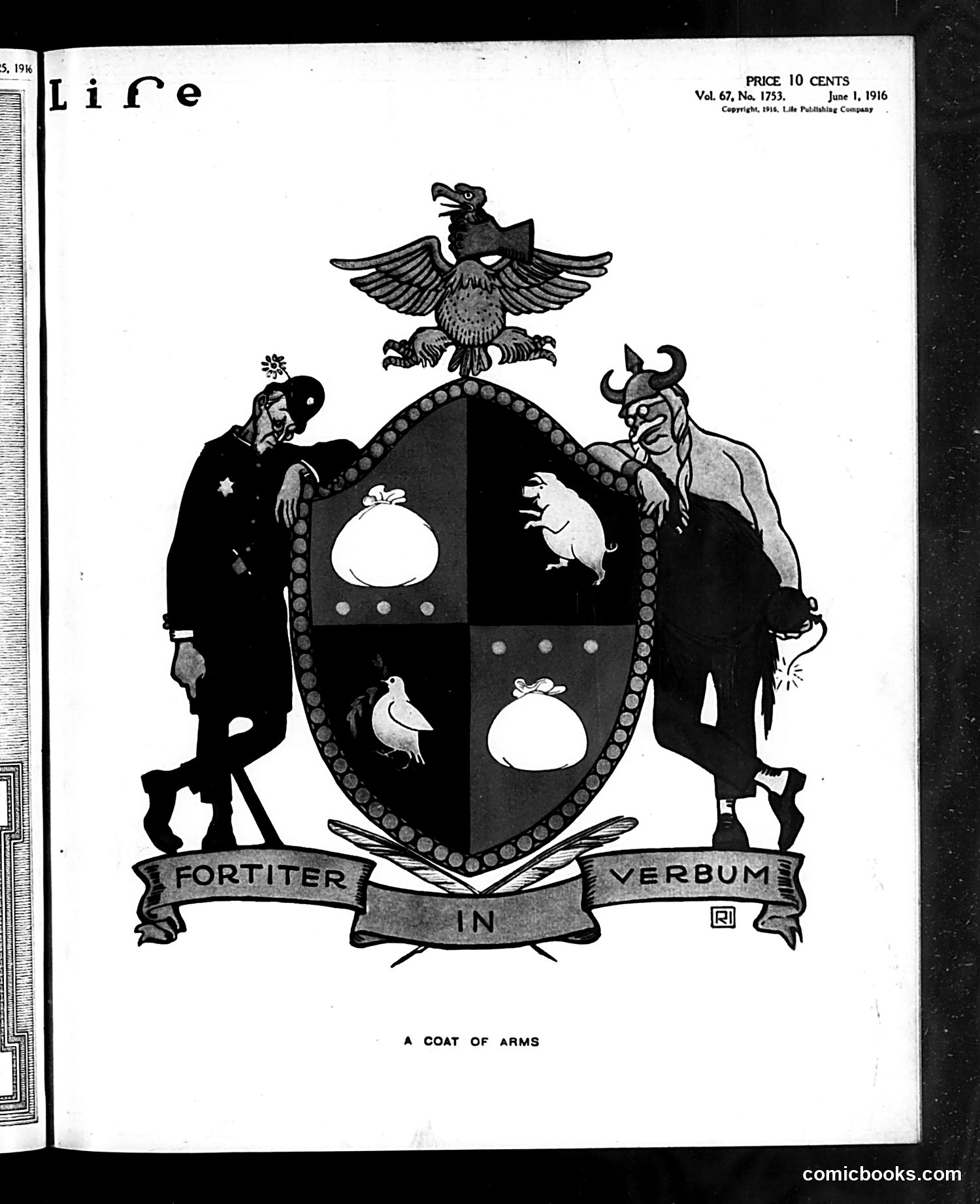
This is a heraldic coat of arms from *Life* magazine (June 1, 1916), a satirical American publication. The shield is quartered with white spheres and a rat, guarded by two figures—one wearing military dress on the left, one demonic with horns on the right. An eagle crowns the shield above. The Latin motto reads "FORTITER IN VERBUM" ("Boldly in Word"). The imagery appears to reference World War I tensions, likely satirizing German militarism and American policy responses. The demonic figure probably represents Germany, while the military figure represents American or Allied forces. The spheres likely symbolize weapons or ammunition. This mocks the grandiose pretensions of the combatants through mock-heraldic parody.
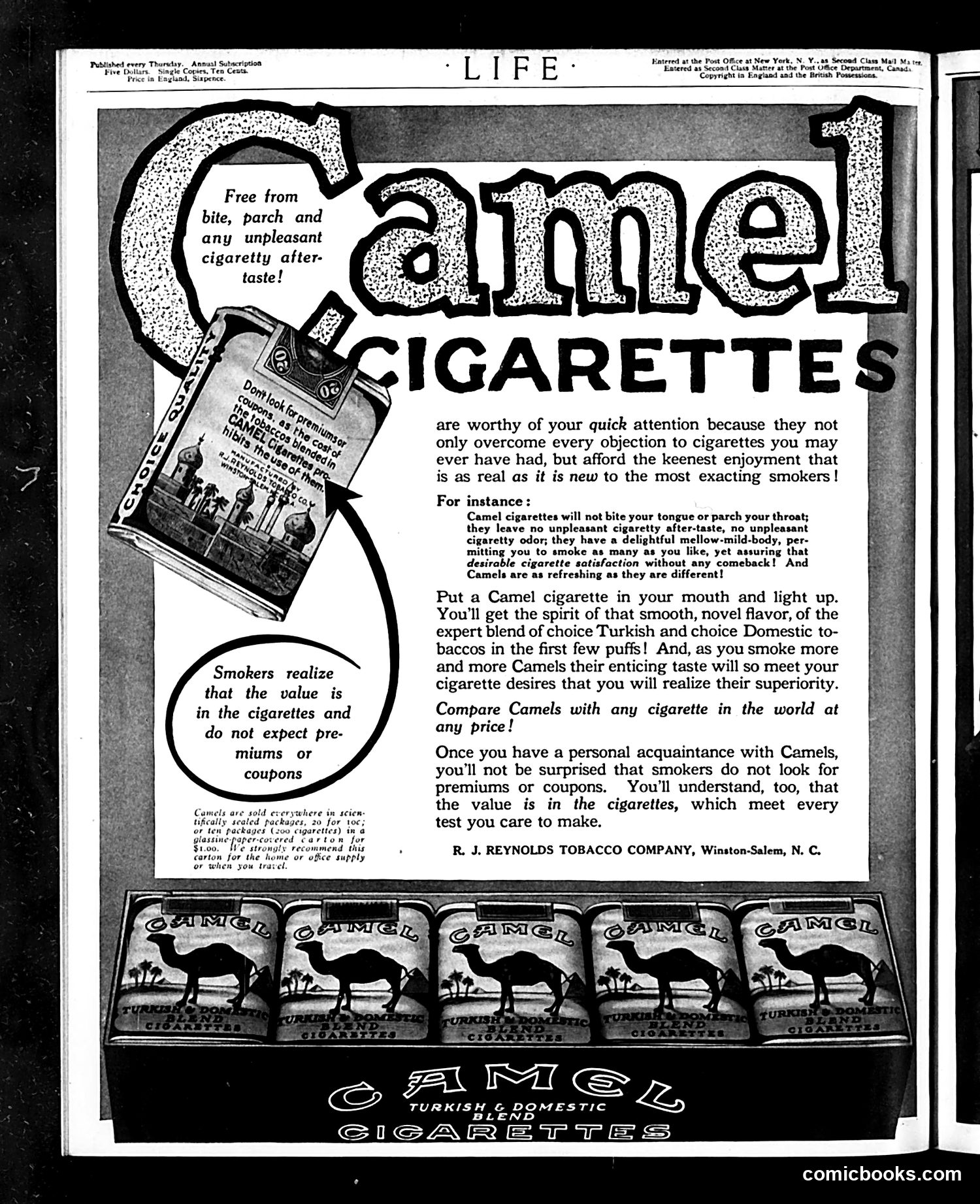
This is a **cigarette advertisement**, not satire or political commentary. The page promotes Camel cigarettes by the R.J. Reynolds Tobacco Company. The ad emphasizes that Camels are "free from bite, parch and any unpleasant cigarette after-taste" and claims they offer superior quality without requiring premiums or coupons. It highlights the blend of "Choice Turkish and choice Domestic tobaccos" as providing "smooth, novel flavor." There are no political cartoons or satirical figures on this page. The only imagery is a product display showing five Camel cigarette packs at the bottom, featuring the brand's iconic camel logo. This represents **straightforward early 20th-century advertising**, when cigarette marketing made direct health and quality claims that would later be restricted or banned.
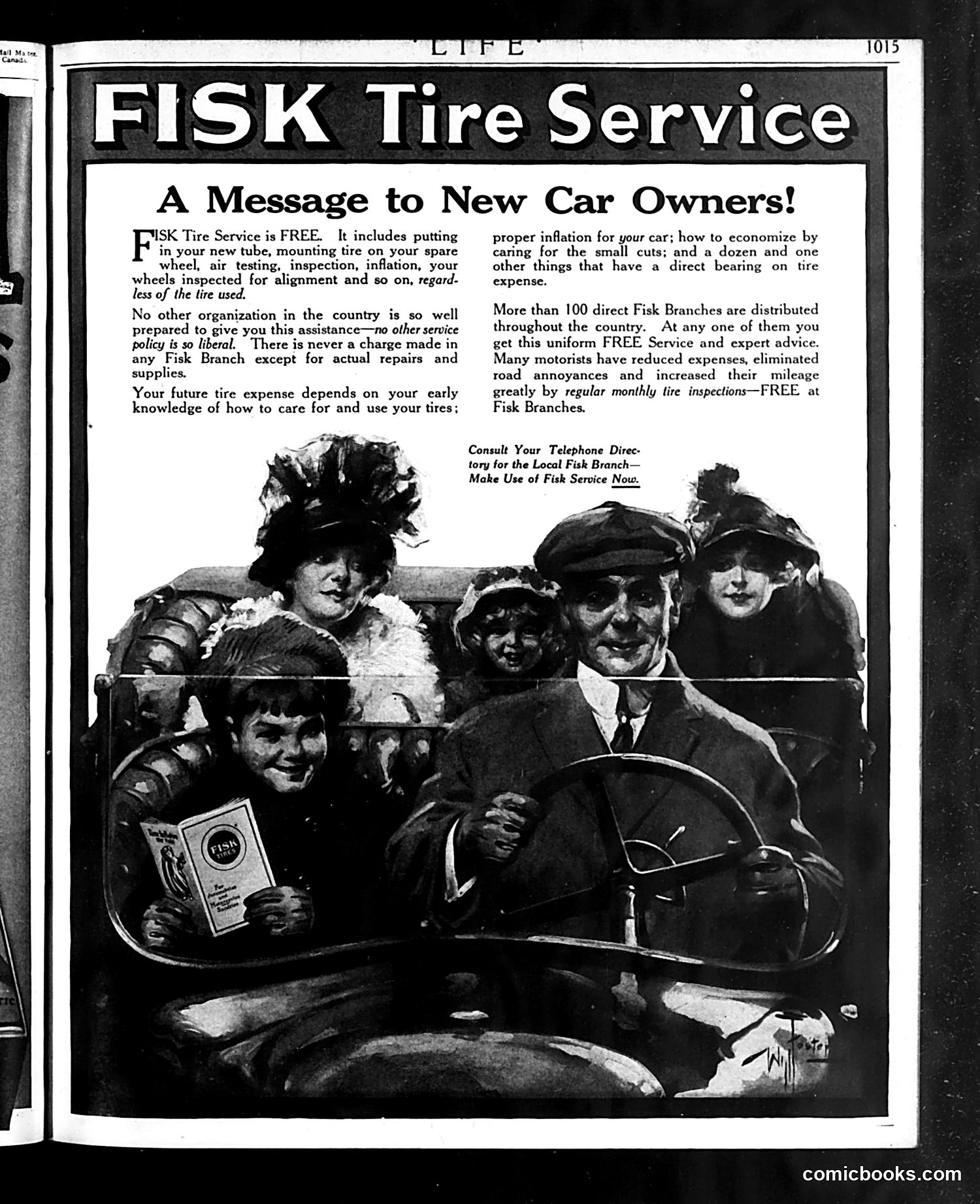
This is primarily a **commercial advertisement**, not political satire. The page promotes FISK Tire Service's free offerings to new car owners—including tube installation, tire mounting, wheel inspection, and monthly tire inspections at over 100 branches nationwide. The illustration shows a satisfied family (adults and children) gathered around a car wheel, appearing pleased with the service. The accompanying text emphasizes that FISK's service policy is "so liberal" with "no other organization in the country" offering comparable free assistance. This represents early automotive marketing targeting the growing class of new car owners in the early 20th century, when tire maintenance was a significant expense and concern for motorists.
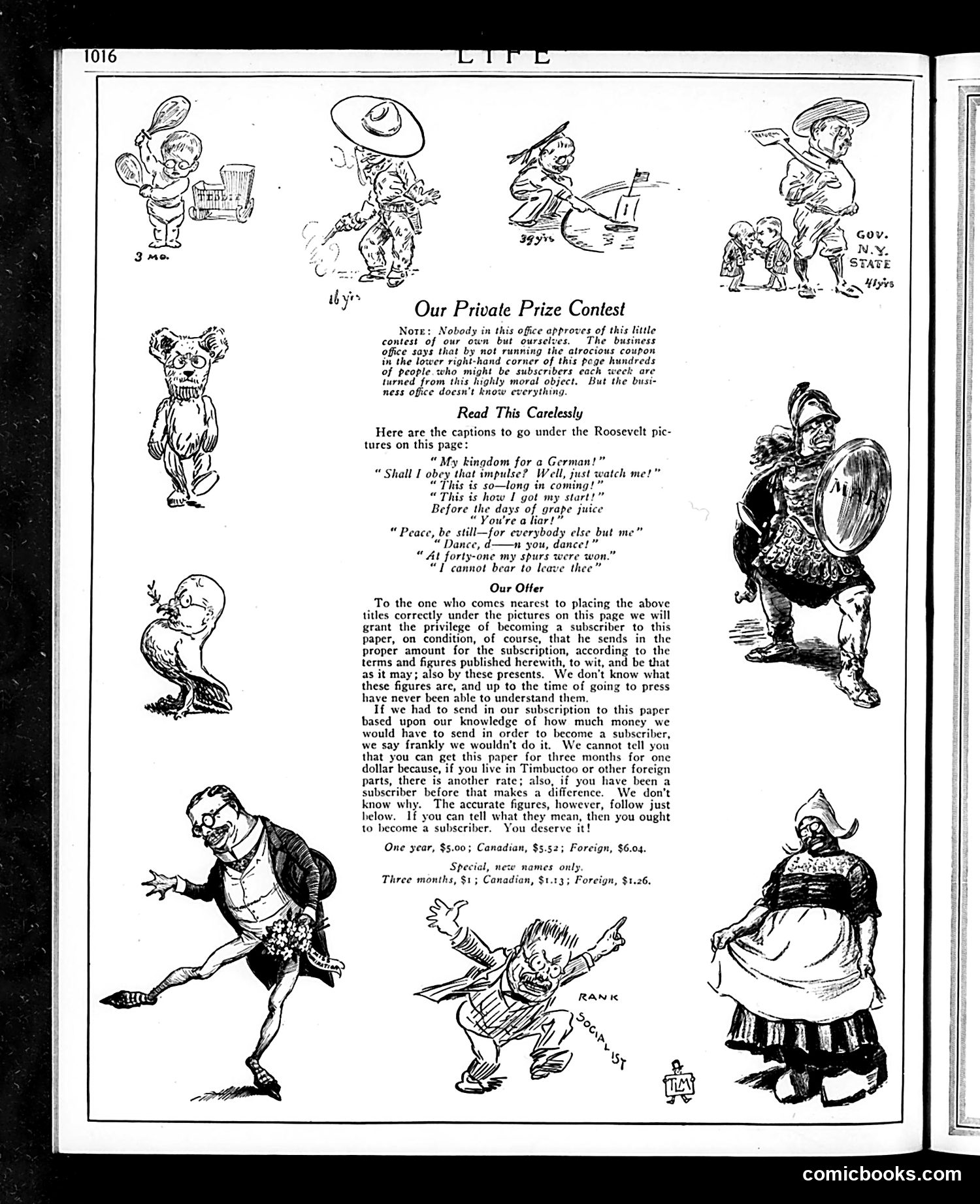
This page features "Our Private Prize Contest," a subscription drive disguised as a humorous competition. The central figure appears to be **Theodore Roosevelt** (identifiable by the distinctive large hat and robust physique characteristic of his caricature), shown as a large man in colonial/frontier dress holding a shield. The surrounding smaller cartoons depict various character types—a child, a woman, aristocratic figures, and a man in glasses—each labeled with brief captions serving as Roosevelt-themed contest entry titles (e.g., "My kingdom for a German!"). The satire targets subscription recruitment: Life frames the contest as high-minded while openly admitting they're using social pressure and moral obligation to convert readers into paying subscribers. The joke acknowledges the manipulative nature of the marketing scheme itself.
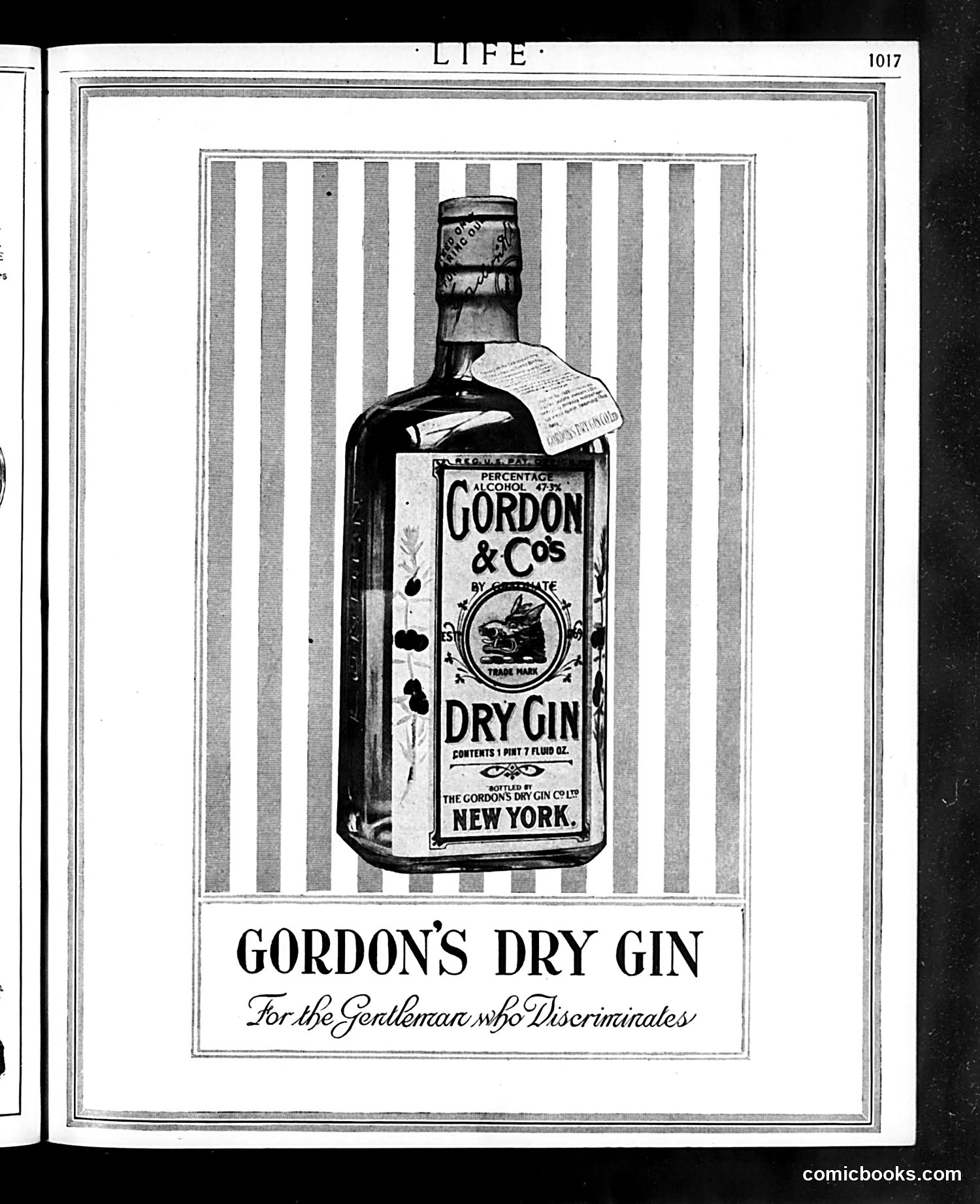
This is a straightforward advertisement rather than political satire. The page shows a bottle of Gordon's Dry Gin from New York against a striped background, with the tagline "For the Gentleman who Discriminates." The ad emphasizes product quality and appeals to upper-class masculine identity—suggesting that choosing Gordon's gin demonstrates refined taste and discernment. The phrase "who discriminates" implies selectivity and sophistication. This appears in *Life* magazine, which regularly carried luxury advertisements alongside humor and satire. The ad reflects early 20th-century marketing that linked alcohol consumption to gentlemanly status and social standing, before Prohibition would fundamentally alter American alcohol advertising.
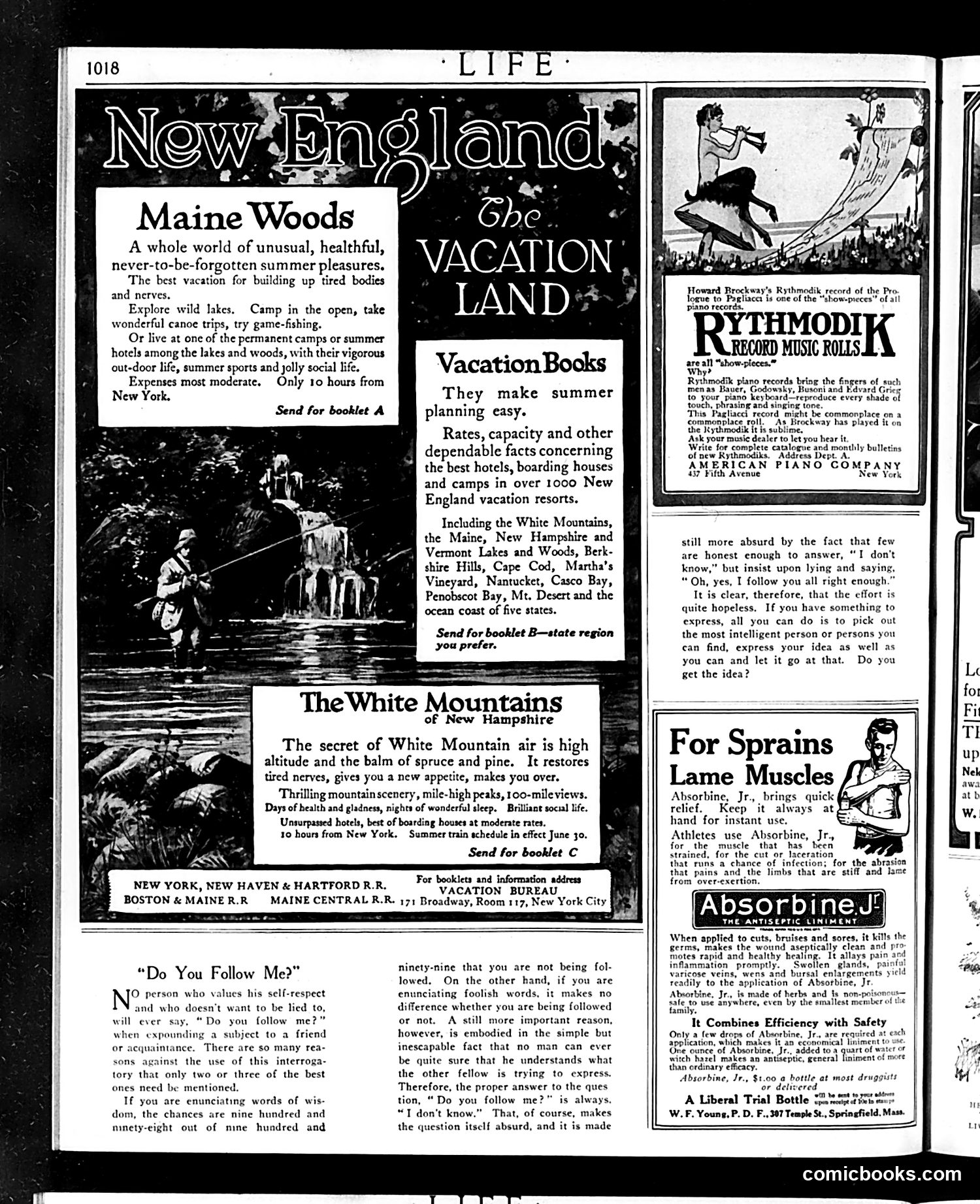
This page is primarily **advertising and travel promotion**, not political satire. It contains: 1. **"Maine Woods"** and **"The Vacation Land"** sections promoting New England summer tourism, offering vacation guides for hotels, camps, and resorts across the White Mountains, Cape Cod, Martha's Vineyard, and other regional destinations. 2. **"The White Mountains of New Hampshire"** advertisement emphasizing high altitude air and natural scenery as health benefits. 3. **Product advertisements** for Rythmodik Record Music Rolls, Absorbine Jr. (a muscle liniment), and a medical trial bottle. 4. **"Do You Follow Me?"** — a brief philosophical essay about self-respect and not blindly following others' opinions. The page reflects early 20th-century advertising that marketed leisure travel and patent medicines as modern consumer goods.
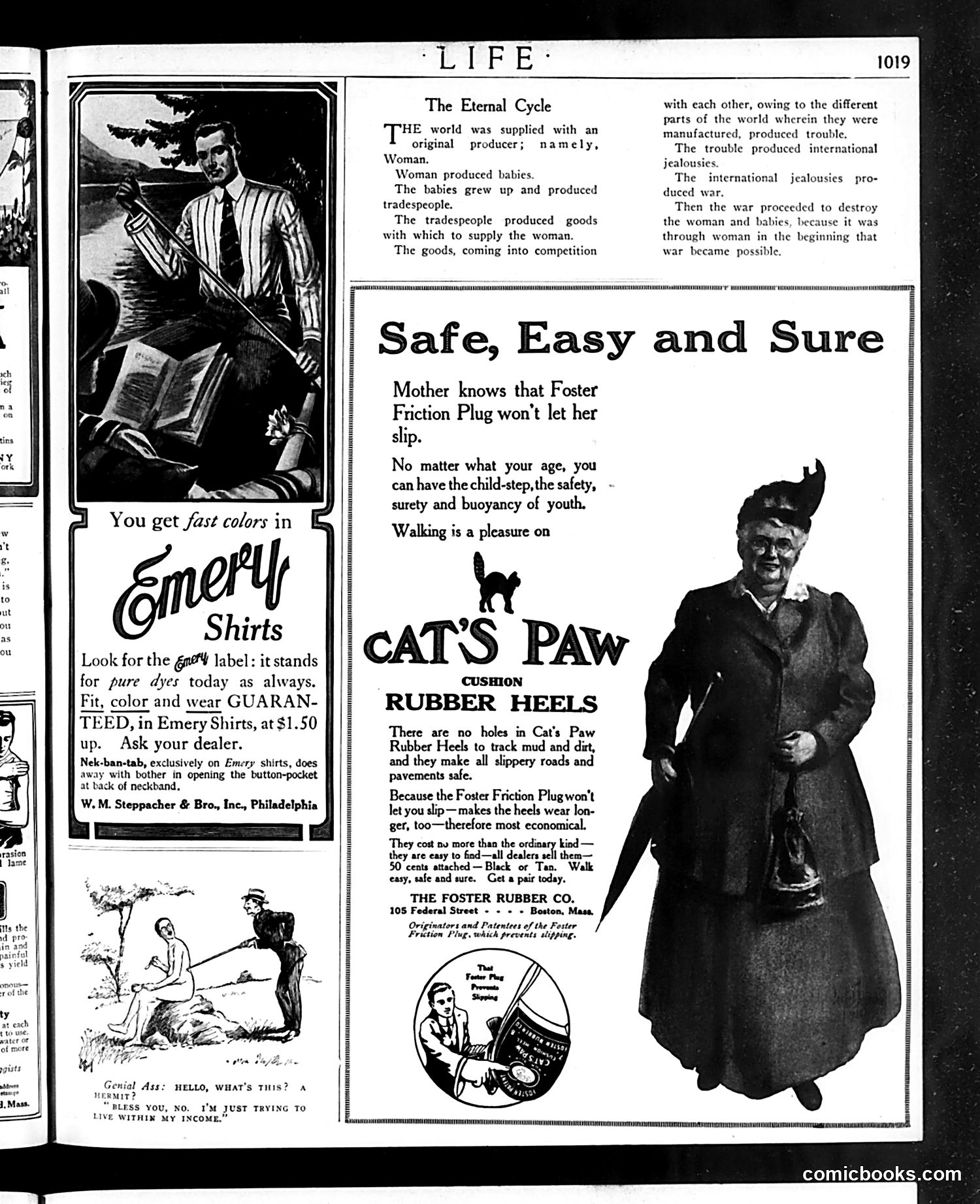
This Life magazine page is primarily **advertising content** rather than satirical editorial material. It contains three advertisements: 1. **Emery Shirts** - promoting fast colors and durability at $1.50, with a classical illustration of a man 2. **Cat's Paw Cushion Rubber Heels** - featuring a photograph of an elderly woman, emphasizing safety and comfort for walking 3. A small cartoon labeled "Genial Arts" - a joke about someone claiming poverty while living within their income The only satirical element is the bottom cartoon, a mild class-commentary joke. The page's main content is commercial rather than political or socially satirical. The "Eternal Cycle" text at top appears to be unrelated filler discussing war origins through an allegorical lens about producers and goods.
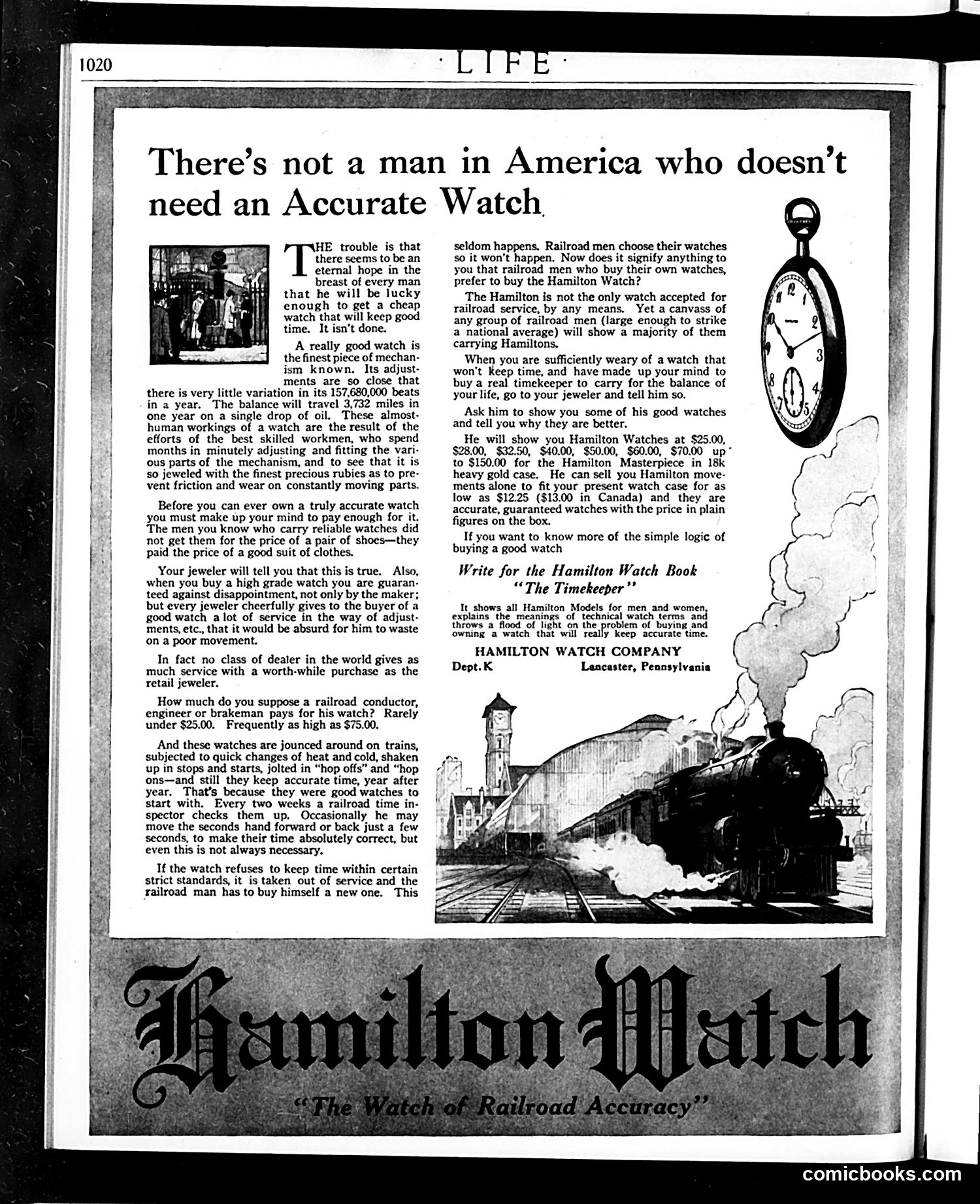
This is primarily a **watch advertisement**, not a political cartoon. The page features a Hamilton Watch company ad promoting their timepieces as essential for American men, particularly railroad workers. The ad emphasizes that railroad conductors and engineers require extremely accurate watches—their movements are checked every two weeks by railroad inspectors. The text argues that owning a quality Hamilton Watch (priced $25-$150) is a practical necessity rather than luxury, as poor timekeeping could cause railway accidents. The visual shows a steam locomotive, reinforcing the railroad safety angle. This reflects early 20th-century concerns about railroad reliability and the public trust placed in railway workers' precision. The "Timekeeper" book offer invites readers to learn more about watch mechanics and accuracy standards.
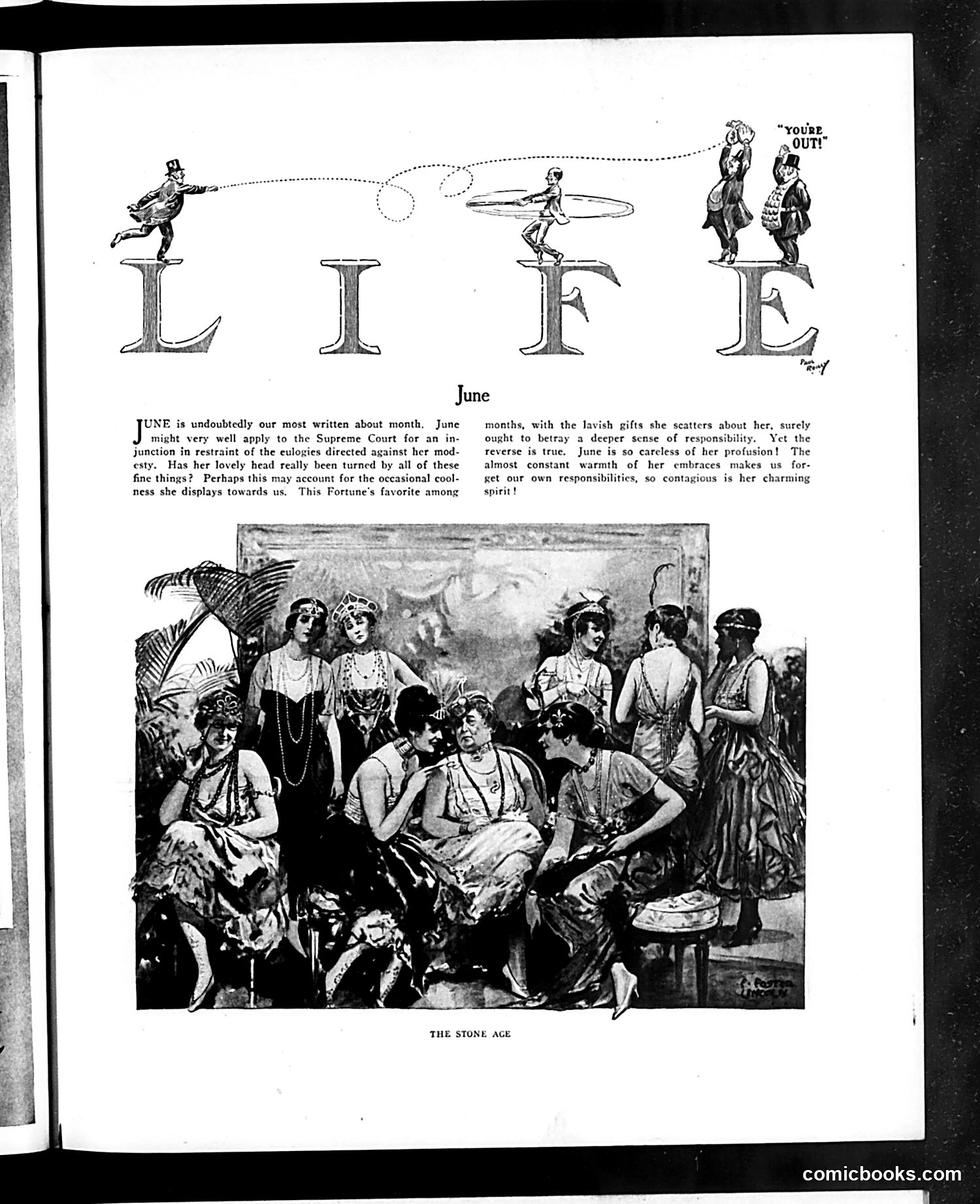
This page satirizes June through a visual pun on the letters "L I F E," each formed by figures engaged in activities. The accompanying text describes June as "undoubtedly our most written about month" and notes the Supreme Court's injunctions against modesty—suggesting June encourages frivolous behavior and irresponsibility. The lower illustration titled "The Stone Age" depicts women in what appears to be a social gathering, likely satirizing contemporary women's social behavior or fashion. The scene's title ironically contrasts primitive origins with modern women's conduct. Overall, the page uses wordplay and pictorial humor to mock June's cultural associations—romantic frivolity, carefree attitudes, and perceived loosening of social restraint—while offering social commentary on women's increasing independence and public visibility in the era.
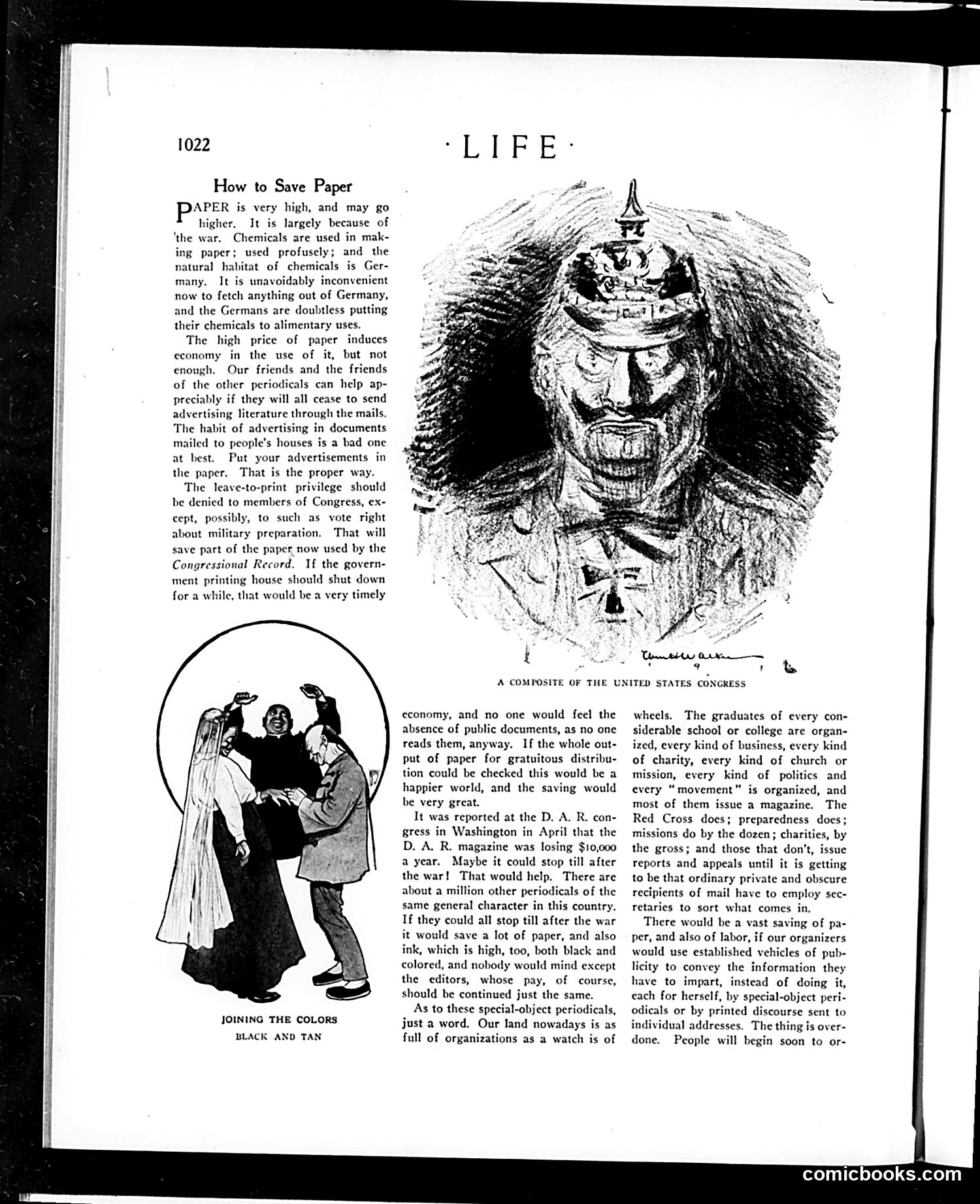
**"How to Save Paper"** is a wartime economy piece (references "the war" and German chemical use). The main cartoon depicts a grotesque German military figure—identifiable by the spiked helmet and iron cross—representing Germany's resource consumption. The accompanying editorial argues Americans should conserve paper by: - Stopping advertising mail circulation - Denying Congressional printing privileges except for military matters - Halting government printing temporarily A secondary cartoon labeled "Joining the Colors: Black and Tan" shows a figure joining military service. The satire criticizes wasteful American practices (especially congressional documents and periodical advertising) while framing paper conservation as patriotic duty during WWI. The German caricature emphasizes the enemy's material desperation, justifying American sacrifice.
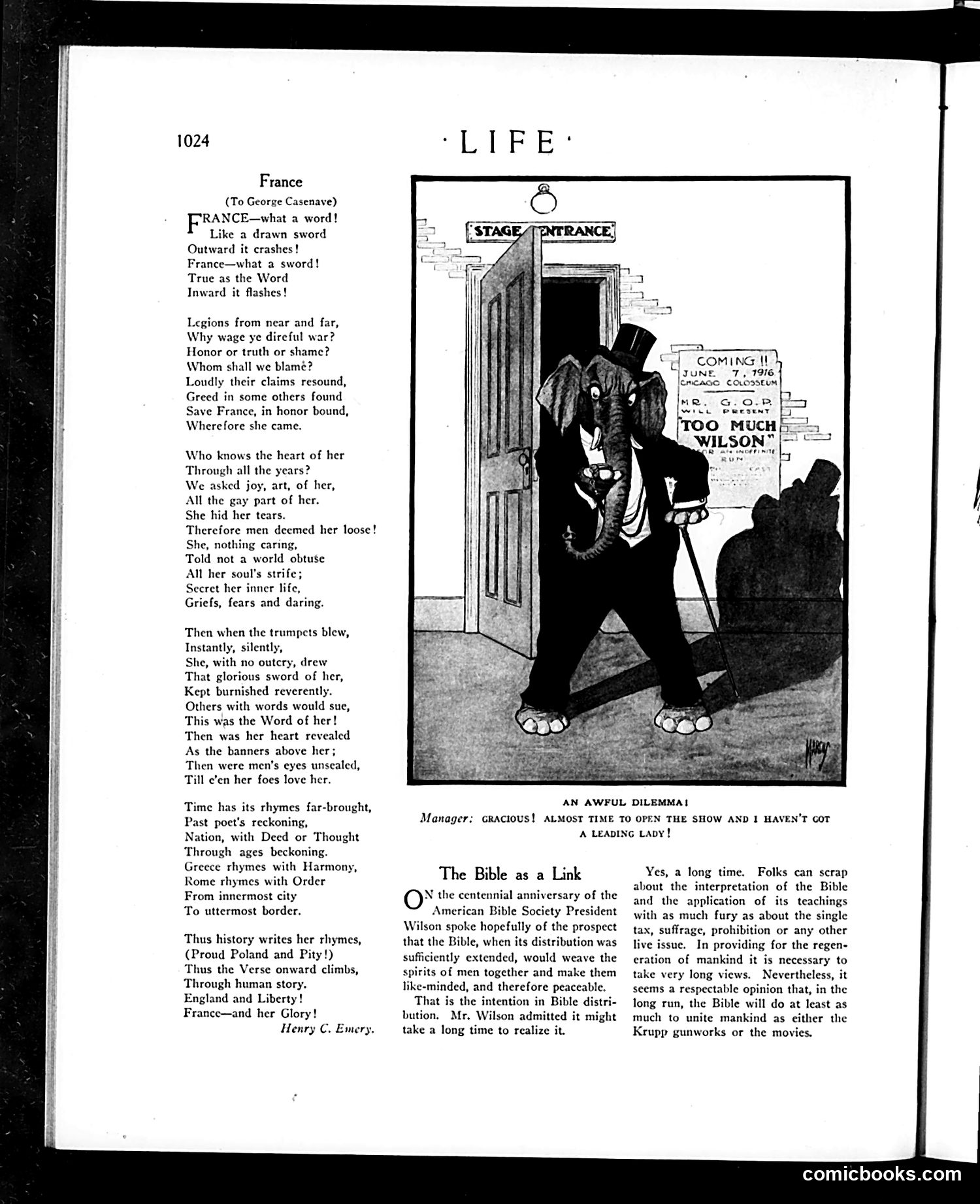
The main cartoon shows a theater manager in distress at the stage entrance, unable to find a leading lady to open a show scheduled for June 7, 1916. The playbill reads "Too Much Wilson." This is political satire about President Woodrow Wilson. The joke appears to reference Wilson's policies or public presence dominating American discourse so thoroughly that he's crowded out other topics—even theater productions. The elephant figure (likely representing Republican opposition or the Republican Party) adds to the satirical commentary. The accompanying poem "France" by Henry C. Emery praises France as a noble sword in WWI, contrasting with broader American debates about intervention that Wilson was navigating in 1916. The page's bottom section discusses using the Bible as a unifying force, citing Wilson's own optimistic views on Bible distribution's peacekeeping potential.
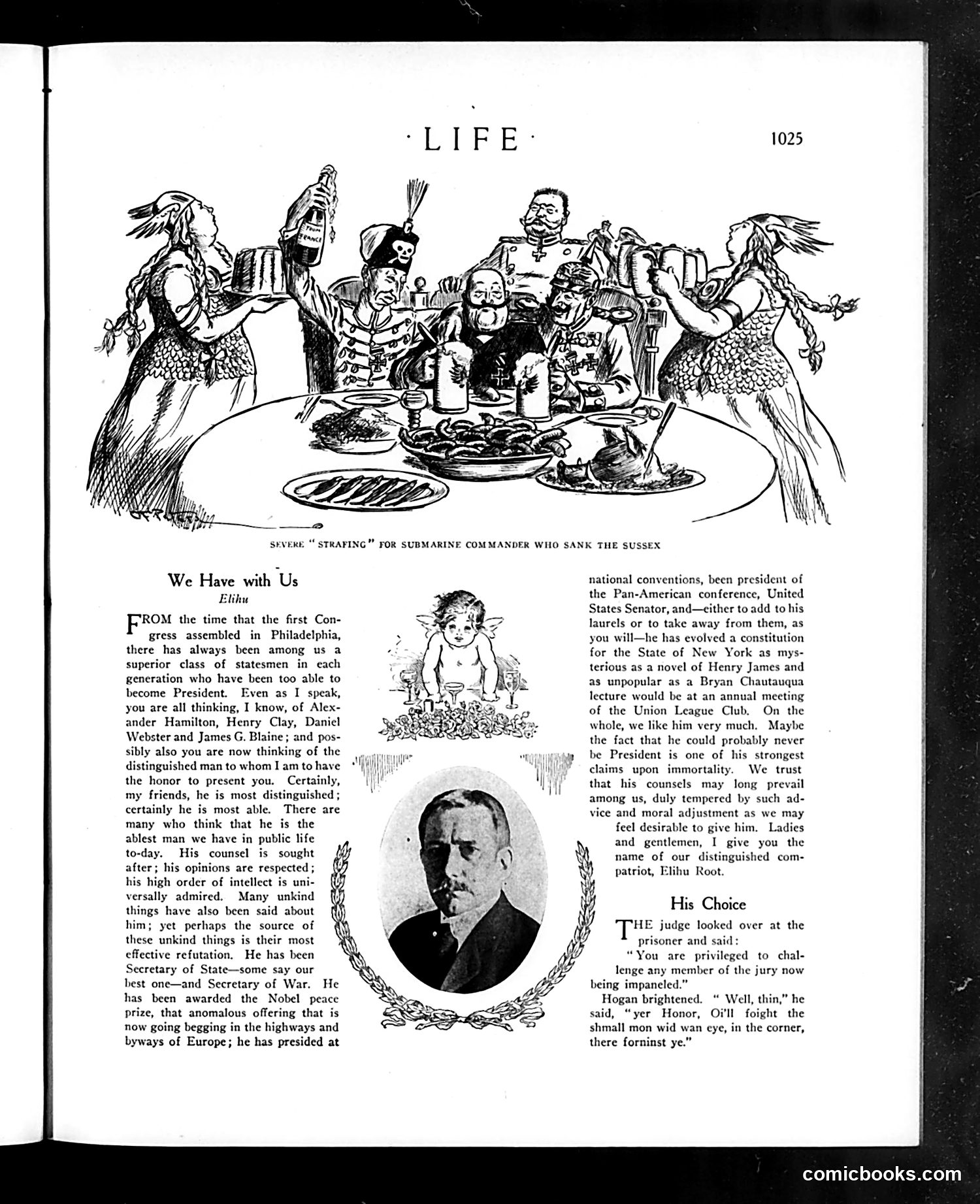
**Top Cartoon:** Depicts a "severe 'staffing' for submarine commander who sank the Sussex." The exaggerated figures around a dining table appear to be military and political officials celebrating or toasting. This references the 1916 sinking of the Sussex, a ship torpedoed by Germany, which caused American diplomatic outrage and nearly triggered U.S. entry into World War I. **"We Have with Us" Section:** Praises Elihu Root (shown in portrait), a distinguished statesman, former Secretary of State and War, Nobel Peace Prize winner. The text satirically suggests Root could "probably never be President," implying public preference for less qualified candidates—a commentary on American political judgment. **"His Choice" Section:** A brief anecdotal joke about jury duty and courtroom procedure.
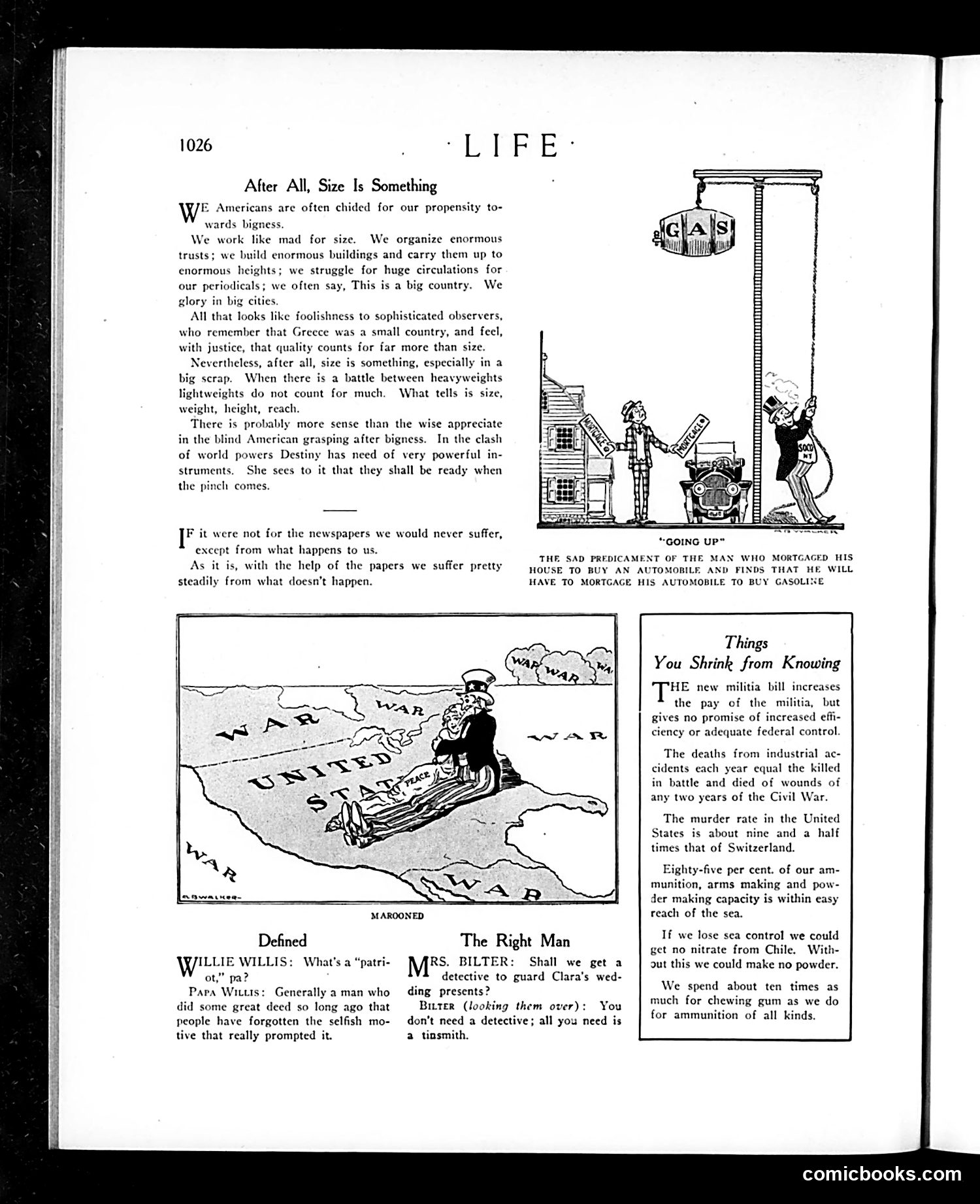
The main cartoon, titled "Marooned," depicts Uncle Sam trapped within the continental United States, surrounded by "WAR" labels. This satirizes American isolationism during World War I—the nation is figuratively boxed in by global conflict, unable to escape or act freely internationally. The "Going Up" illustration shows a man who mortgaged his house to buy an automobile, now discovering he must mortgage the car to buy gasoline. This critiques consumer debt culture and rising fuel prices, likely reflecting post-war economic strain. The dialogue jokes and "Things You Shrink from Knowing" section present wartime statistics about militia pay, industrial deaths, murder rates, and ammunition capacity—delivering grim facts with sardonic commentary typical of Life's satirical approach to serious national issues.
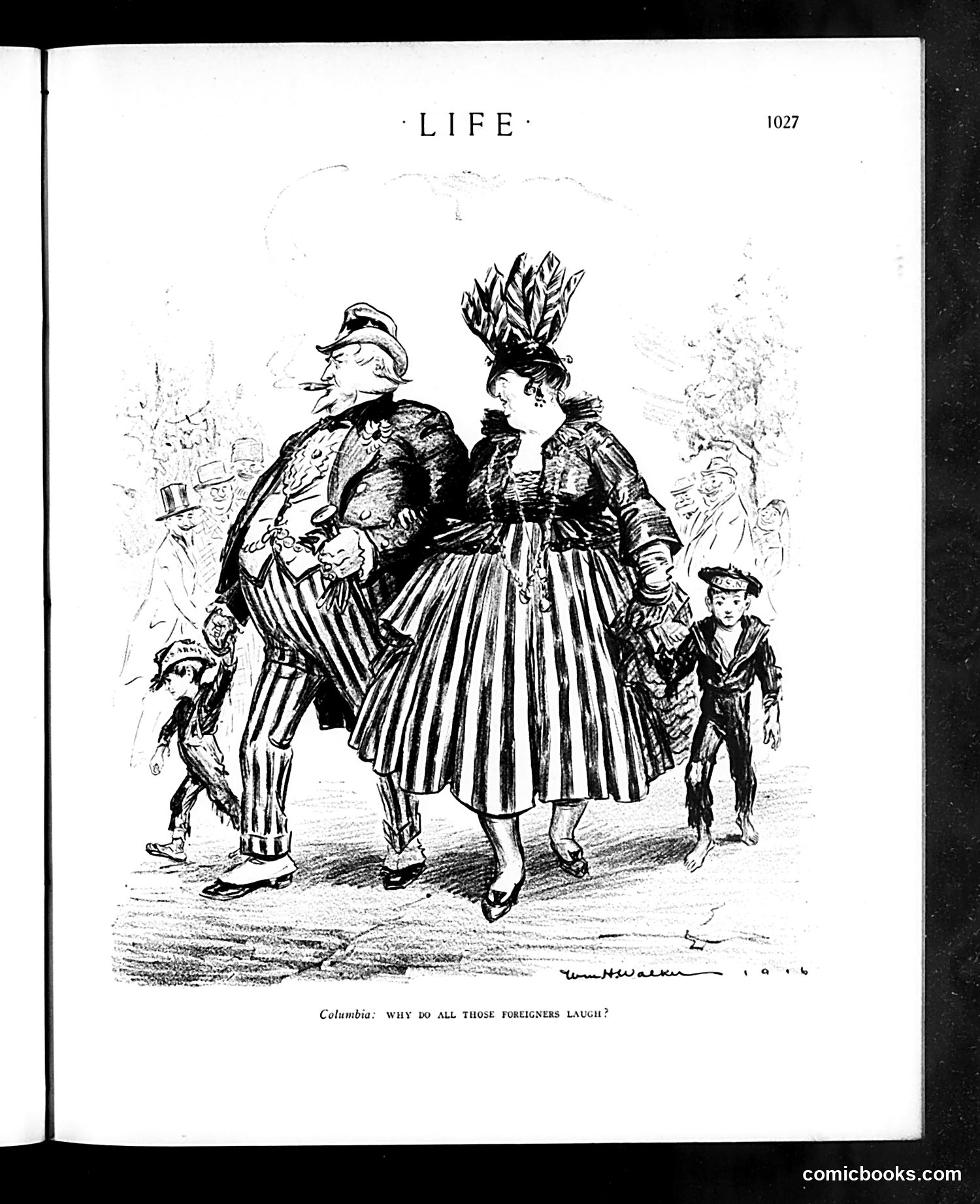
This political cartoon depicts "Columbia" (the female personification of America, identifiable by her distinctive headdress of feathers) alongside a rotund man in striped clothing. The caption reads: "COLUMBIA: WHY DO ALL THOSE FOREIGNERS LAUGH?" The satire appears to critique American diplomatic or foreign policy during a period when international observers were mocking U.S. conduct abroad. Columbia's naive question suggests America is confused about why foreigners find the nation ridiculous. The portly male figure likely represents either a specific politician or American leadership generally. The small figures in the background appear to be laughing foreigners. The cartoon mocks American obliviousness to its own embarrassing international reputation, a common theme in early 20th-century satirical magazines critiquing U.S. imperialism or diplomatic missteps.
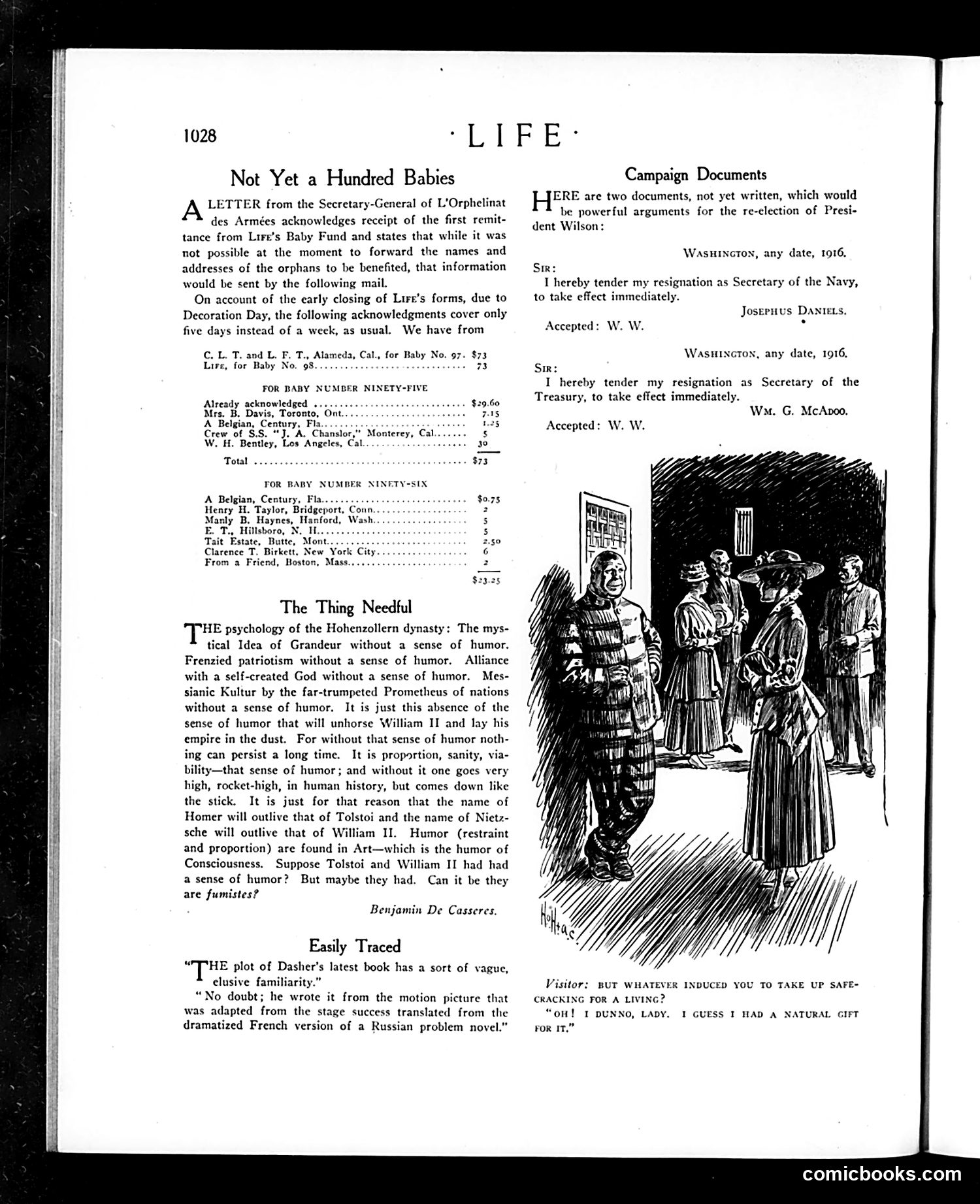
This page contains three distinct satirical pieces: **"Not Yet a Hundred Babies"** documents Life magazine's charitable fund for war orphans, listing small donations ($2-$6) from readers. The title suggests the fund hasn't yet reached 100 beneficiaries. **"The Thing Needful"** is an essay by Benjamin De Casseres attacking German Kaiser Wilhelm II, arguing his dynasty lacks humor—described as essential to any civilization's survival. The piece suggests Prussia's militarism and "Kultur" will fail precisely because of this humorless rigidity. This reflects WWI-era American sentiment against Germany. **"Campaign Documents"** presents fictional resignation letters from Secretary of Navy Josephus Daniels and Secretary of Treasury William G. McAdoo, sarcastically suggesting Wilson's re-election would be assured if these officials resigned. This appears to critique either their policies or Wilson's administration generally. **"Easily Traced"** mocks artistic unoriginality—a book adapted from a film adapted from a play adapted from a French translation of a Russian novel, suggesting nothing is original. The cartoon depicts a safecracker claiming it's a "natural gift"—gentle humor about career choices.
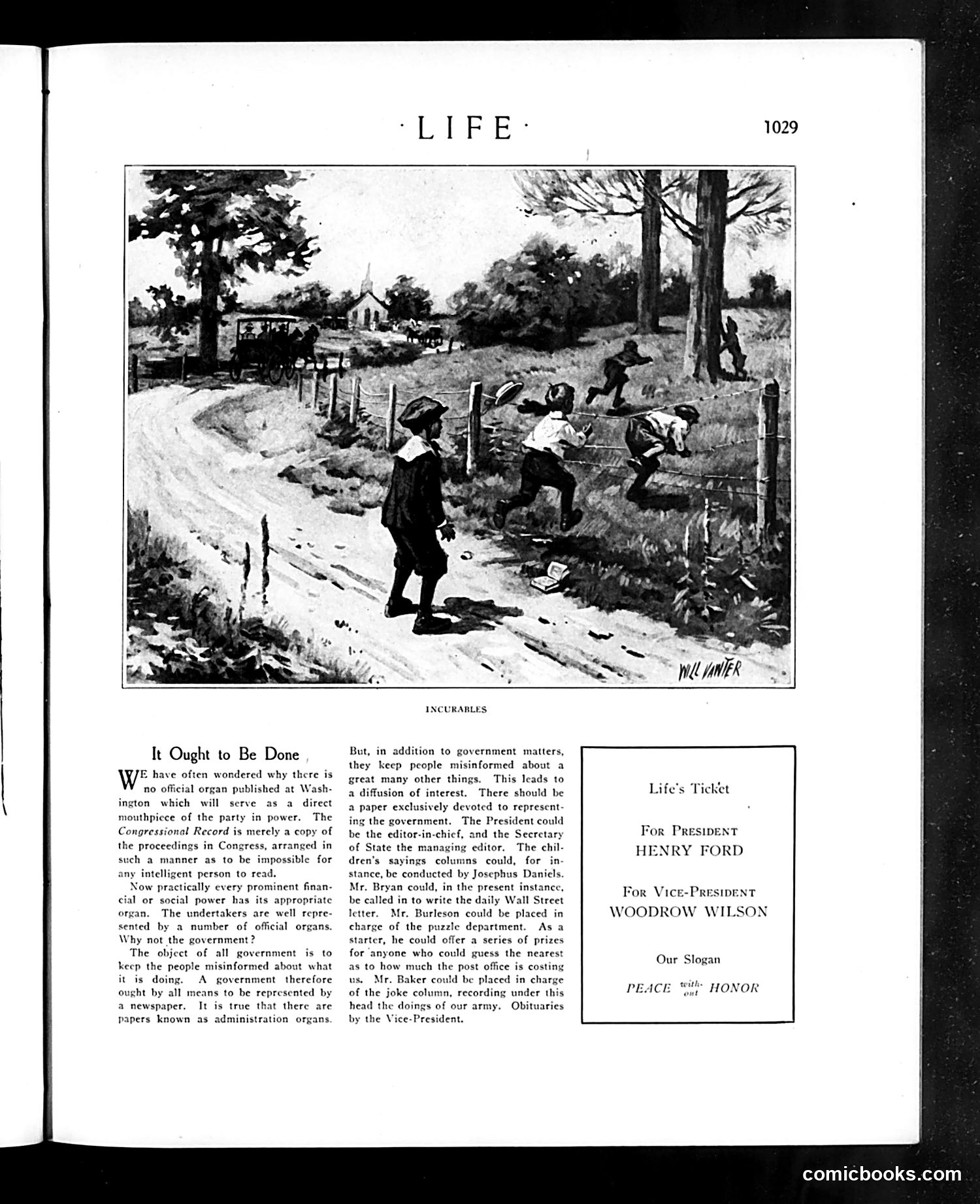
This satirical piece mocks the Wilson administration's control of information and management competence. The author argues the government should publish its own newspaper since "the object of all government is to keep the people misinformed." The satire proposes cabinet members for editorial roles, each a pointed jab: Secretary of State as managing editor, Josephus Daniels (Navy Secretary) writing children's columns, William Jennings Bryan covering Wall Street, Postmaster General Burleson running puzzles, Secretary of War Baker heading the joke column (sarcastically noting army "doings"), and Vice President Marshall writing obituaries. The accompanying illustration depicts rural workers clearing land—likely representing productive labor contrasted with government incompetence. **Life's Ticket** mockingly nominates Henry Ford for president and Woodrow Wilson for vice-president (inverting their actual relationship), with the slogan "Peace with Honor"—likely referencing Wilson's 1916 re-election campaign promise. The humor targets perceived government inefficiency, secrecy, and the incompetence of specific officials.
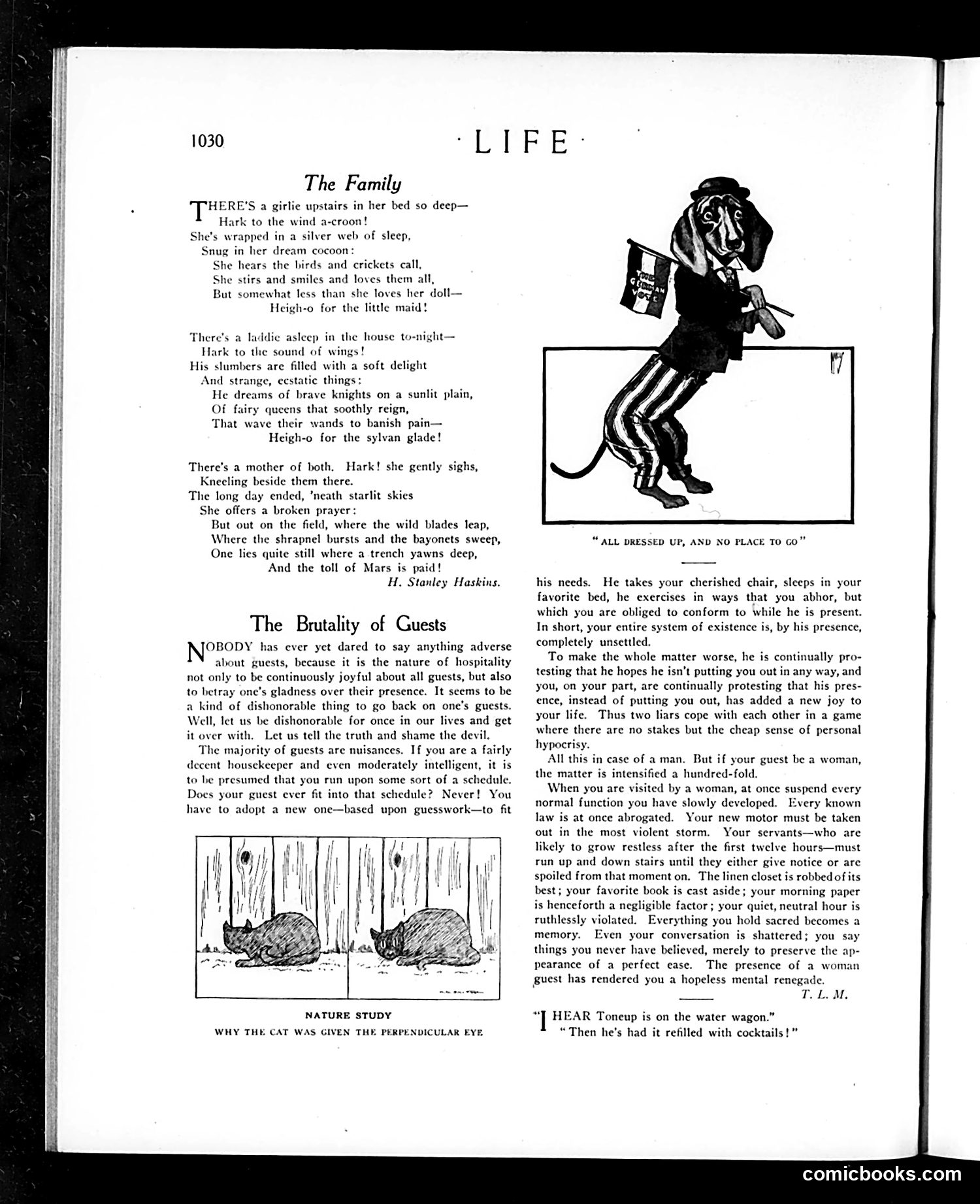
This page contains two distinct pieces of satire from early 20th-century American Life magazine: **"The Family" (poem by H. Stanley Haskins):** A sentimental poem contrasting children's innocent dreams with wartime reality. It describes a girl dreaming of dolls and a boy imagining knights and fairies, then reveals their mother praying while "one lies quite still where a trench yawns deep"—their son killed in combat. The satire works through dark irony: the poem inverts expected sentiment by juxtaposing domestic comfort against the brutal "toll of Mars" (war), likely critiquing society's disconnect from military casualties. **"The Brutality of Guests":** A humorous essay satirizing the hypocrisy of hospitality. It argues guests are genuine nuisances who disrupt schedules and routines, yet hosts must pretend joy. Female guests are portrayed as especially disruptive, demanding servants, linens, and attention. The satire exposes the fake politeness underlying host-guest relationships—both parties perform dishonest cheerfulness. The cartoon and animal study appear decorative rather than thematically connected.
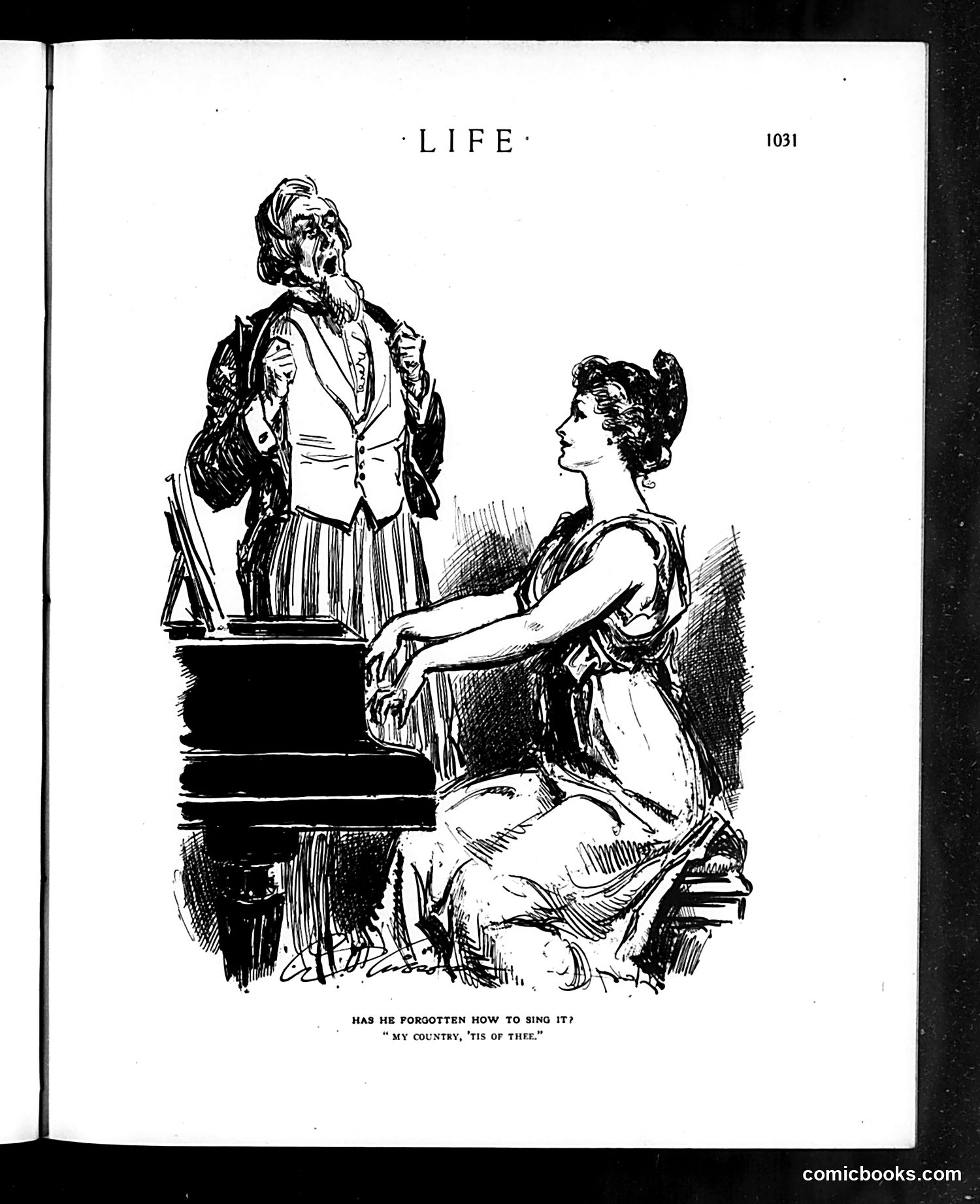
This Life magazine cartoon satirizes an older man (likely a political or public figure) who appears to have forgotten the words to "My Country, 'Tis of Thee," the patriotic American hymn. A woman sits at a piano, presumably trying to prompt him to sing. The satire suggests the figure has abandoned or forgotten American patriotic values—possibly implying he's become disconnected from national principles or has shifted his allegiances. The cartoon critiques what the artist saw as his loss of patriotic commitment or betrayal of American ideals. Without identifying information visible on the page, the specific target cannot be definitively determined, but the message is clear: this is mockery of a prominent figure accused of forgetting fundamental American values.
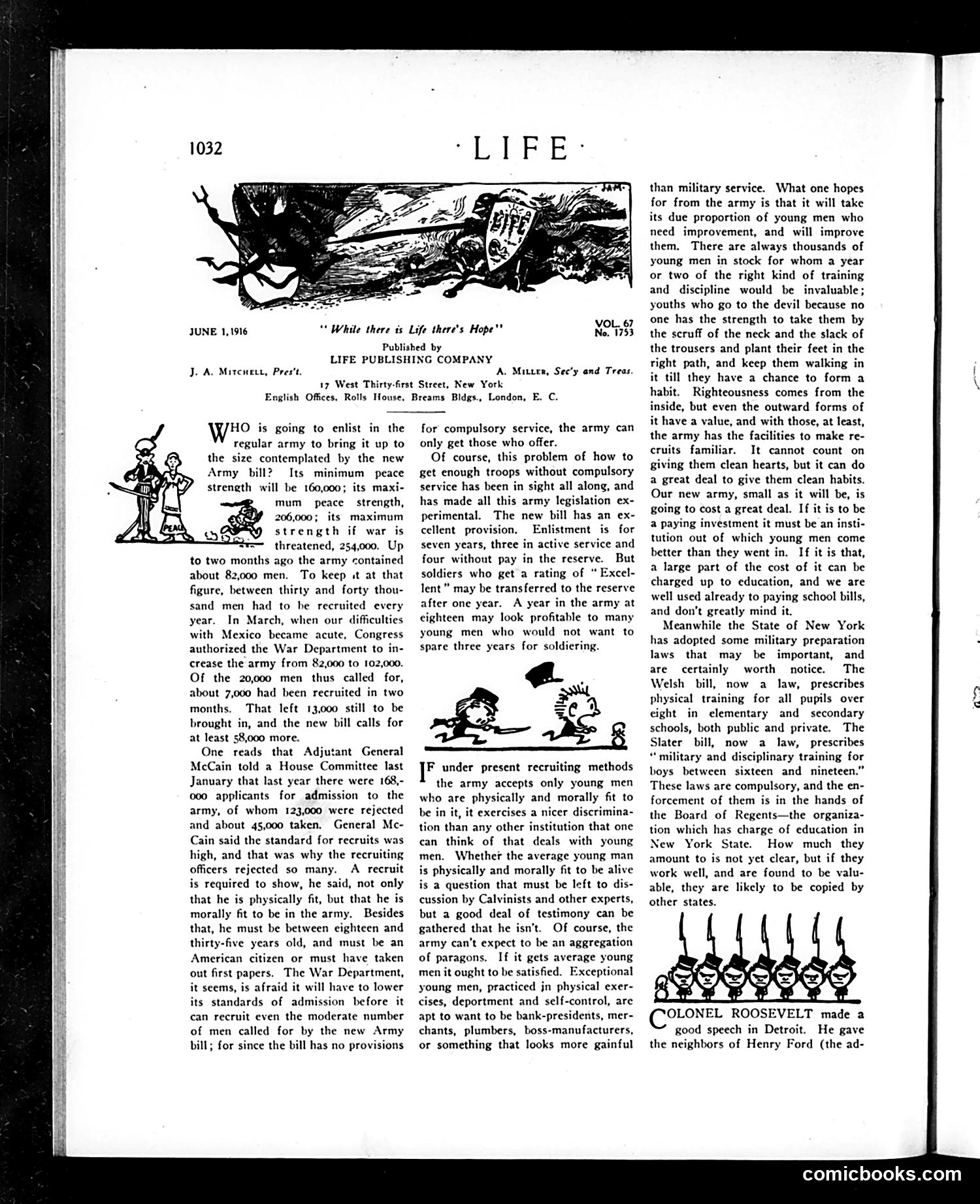
This page satirizes the U.S. Army's difficulty recruiting soldiers under the new Army bill (June 1916). The article discusses the contradiction between the War Department's high admission standards and its recruitment failures. **The satire's target:** General McCain claimed the army rejected applicants because standards were "high," yet the army struggled to recruit even modest numbers without compulsory service. The author mocks this disconnect—if the average young man is morally and physically unfit (a point debated by "Calvinists and other experts"), how can selective standards explain recruitment shortfalls? **The real critique:** The army actually needs to accept "average young men" who require discipline and improvement, not paragons. By maintaining impossible standards while facing recruitment crises, the War Department appears either dishonest about its criteria or unrealistic about available manpower. The small cartoons (showing soldiers/recruitment imagery) reinforce the theme of military training and preparation. This reflects pre-WWI American debates over military readiness and whether conscription would become necessary.
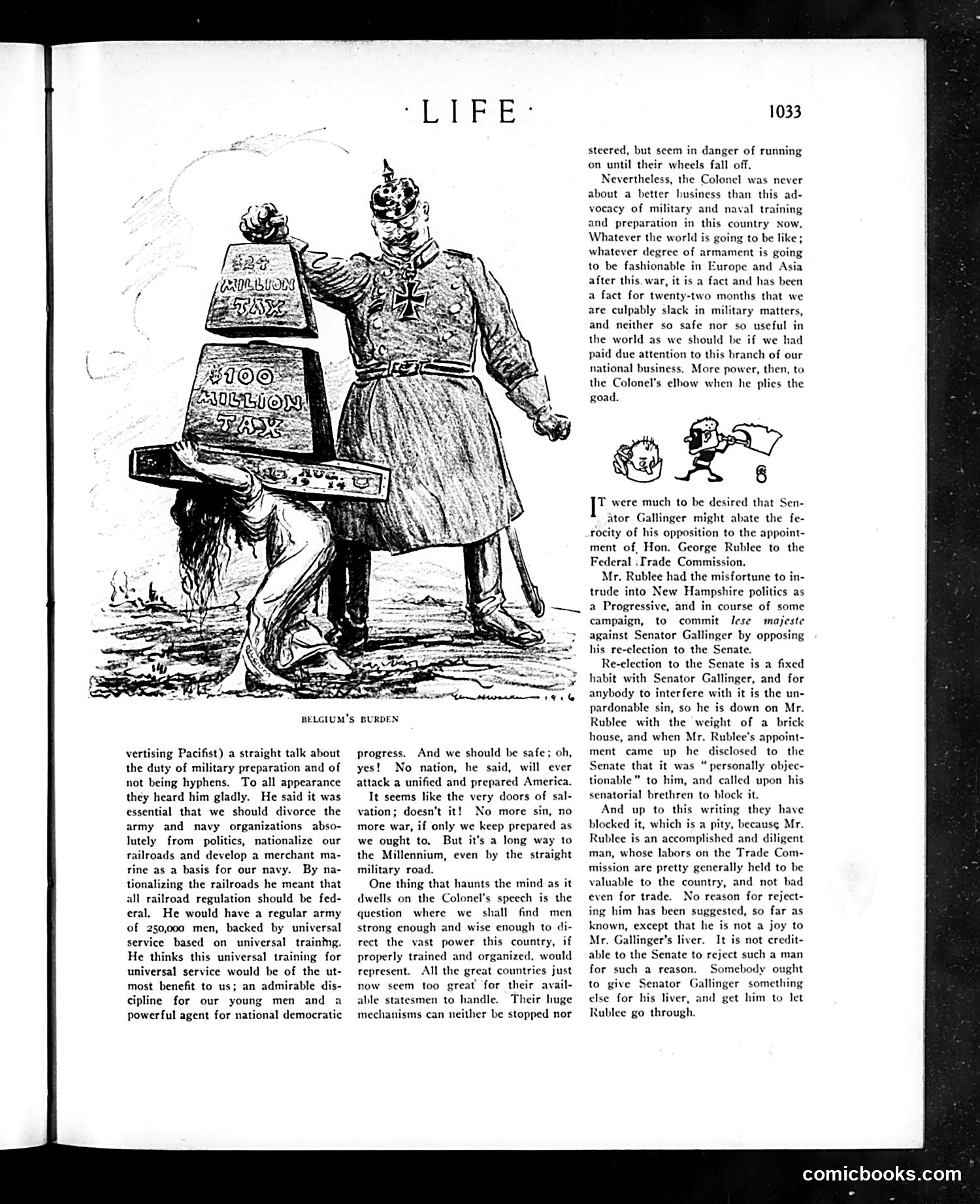
The main cartoon depicts **Belgium** (personified as a woman) crushed beneath stacked military burdens—labeled "MUNITIONS" and "100 MILLION PACK"—while two German military figures (identifiable by their spiked helmets) oversee her oppression. This illustrates Belgium's devastation under German occupation during World War I. The accompanying text discusses **Colonel** (likely Theodore Roosevelt) advocating for American military preparedness and universal military training. The article supports this position while criticizing American complacency. The second section attacks **Senator Gallinger** of New Hampshire for opposing **George Rublee's** appointment to the Federal Trade Commission solely because Rublee—a Progressive—once opposed Gallinger's Senate re-election. The satirist condemns this petty vindictiveness as unpatriotic and argues Rublee is qualified and valuable to the nation, but Gallinger's personal grudge blocks him from serving.
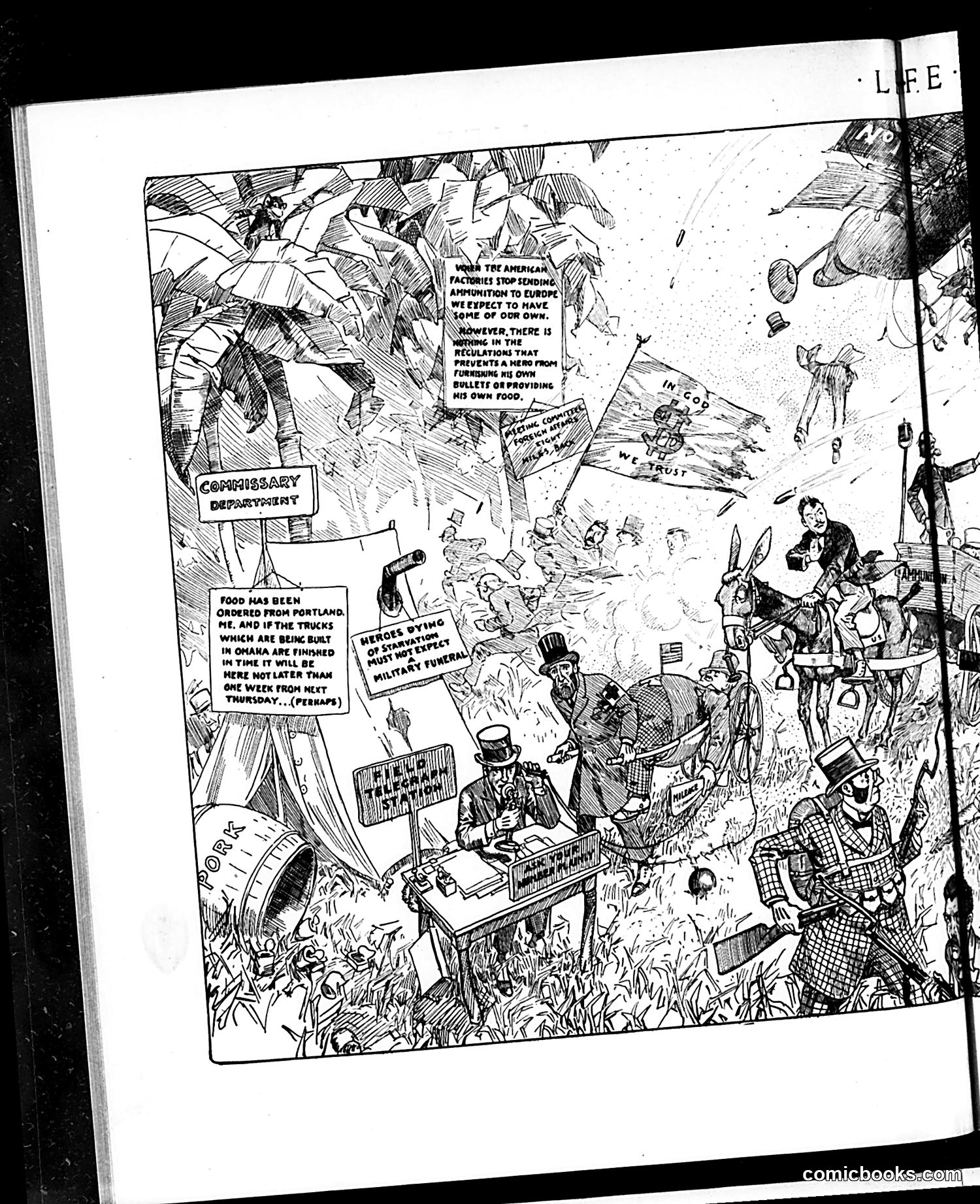
This appears to be a WWI-era satirical cartoon critiquing American military logistics and supply chains. The image shows chaos at what's labeled a "Commissary Department," with soldiers, supplies, and various activities depicted in crowded, disorganized fashion. The text references food ordered from Portland, Maine, and trucks being built in Omaha with uncertain delivery ("perhaps"). Speech bubbles mention factories stopping ammunition shipments to Europe and soldiers "dying of starvation" rather than combat injuries. The satire targets the inefficiency and bureaucratic confusion of American military supply operations—specifically the gap between promised deliveries and actual arrival, and the irony that soldiers lack adequate food despite America's industrial capacity. It suggests poor planning and coordination were hampering the war effort.
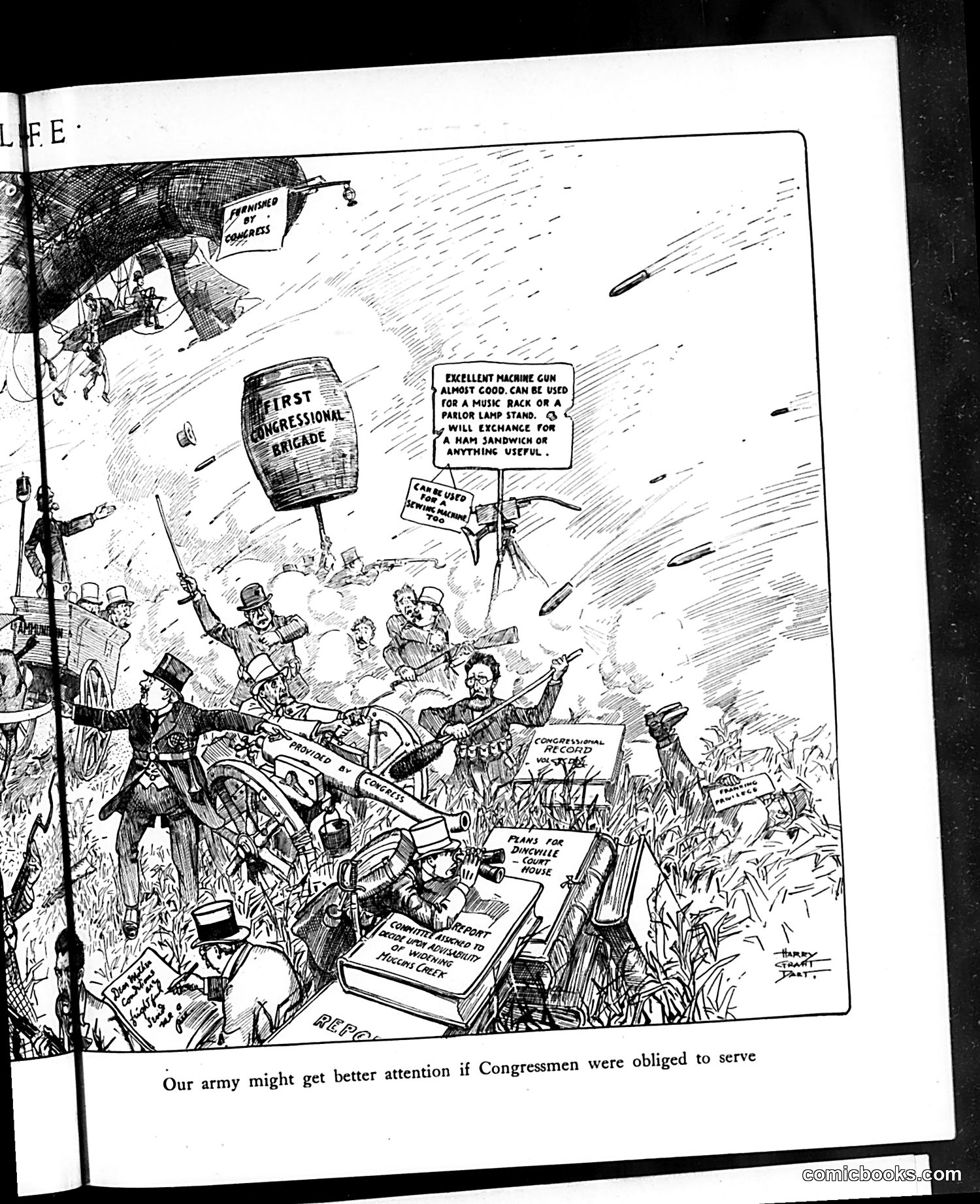
This Life magazine cartoon satirizes Congressional neglect of military readiness. It depicts soldiers in a battlefield surrounded by absurd "for sale" signs offering military equipment—machine guns, blueprints, supplies—as if they're worthless junk to be traded for ham sandwiches or repurposed as furniture. The caption criticizes members of Congress for failing to adequately fund and support the army. The cartoon suggests that because Congressmen face no personal military obligation, they treat defense spending as unimportant, leaving soldiers poorly equipped and desperate. The overall message: if politicians had to serve in the military themselves, they'd prioritize army resources more seriously. This appears to be pre-World War II commentary on American military preparedness and Congressional indifference.
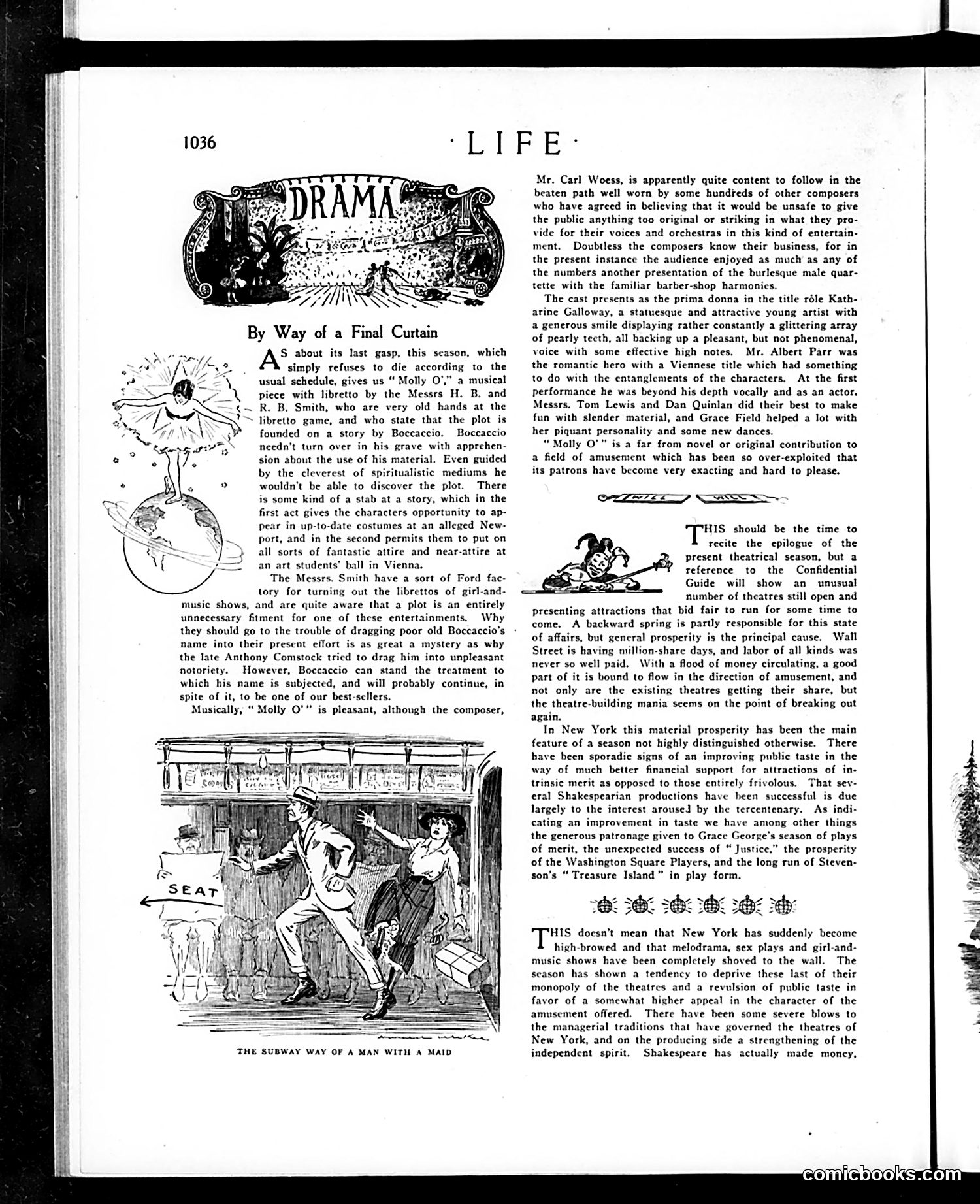
This is a theater review of the musical "Molly O'" by the Smith brothers (H.B. and R.B. Smith), satirizing formulaic Broadway musicals of the era. The critic mocks the show's threadbare plot—supposedly based on Boccaccio but bearing no resemblance—arguing that girl-and-music shows require no actual story, just excuses for actresses in fashionable costumes and men performing familiar barber-shop quartet numbers. The accompanying cartoon ("The Subway Way of a Man with a Maid") depicts a romantic encounter in a subway car, likely parodying the show's thin romantic plot or contemporary romantic comedies. The review criticizes composer Carl Woess for unoriginal music and most cast members for mediocre performances, though praising Katharine Galloway's stage presence. The author suggests Broadway's profitability (Wall Street prosperity, abundant labor wages) enables such uninspired theatrical production to succeed financially.
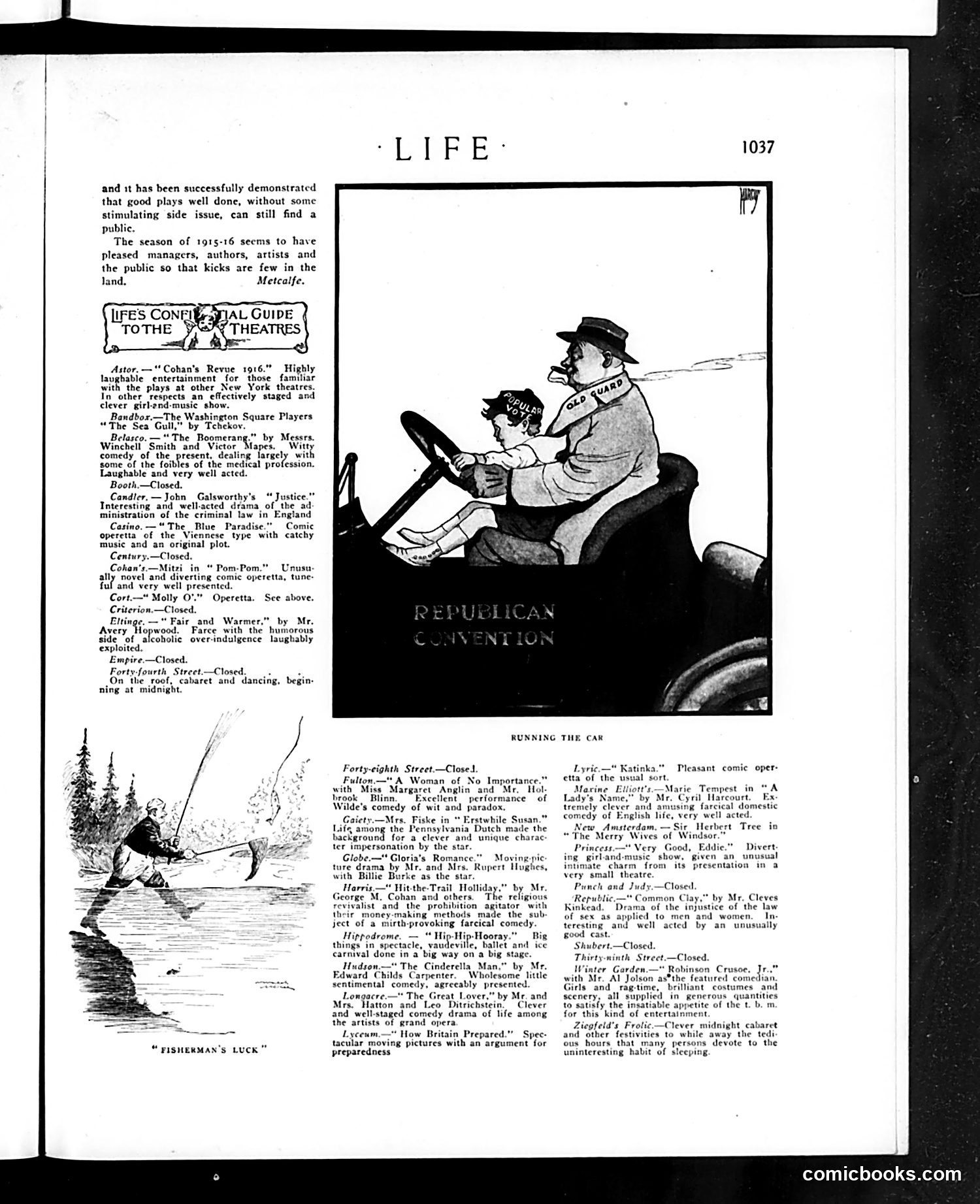
This page from Life magazine (1916) contains a theatrical review section and a political cartoon titled "Running the Car." The cartoon depicts two figures in an automobile labeled "Republican Convention." The larger figure (appearing to be a Republican Party leader or establishment figure) operates the steering wheel while a smaller figure (likely representing a candidate or faction) sits behind, seemingly along for the ride. The cartoon satirizes the 1916 Republican Convention process, suggesting that party leadership ("running the car") controlled the nomination rather than allowing genuine democratic competition among candidates. The joke plays on the metaphor of "running" — both controlling a vehicle and controlling a political process. It critiques how Republican power brokers dominated convention outcomes, reducing other contenders to passive passengers with no real influence on direction or destination. The surrounding theater reviews reflect Life's role as a satirical weekly covering entertainment and politics for educated urban audiences.
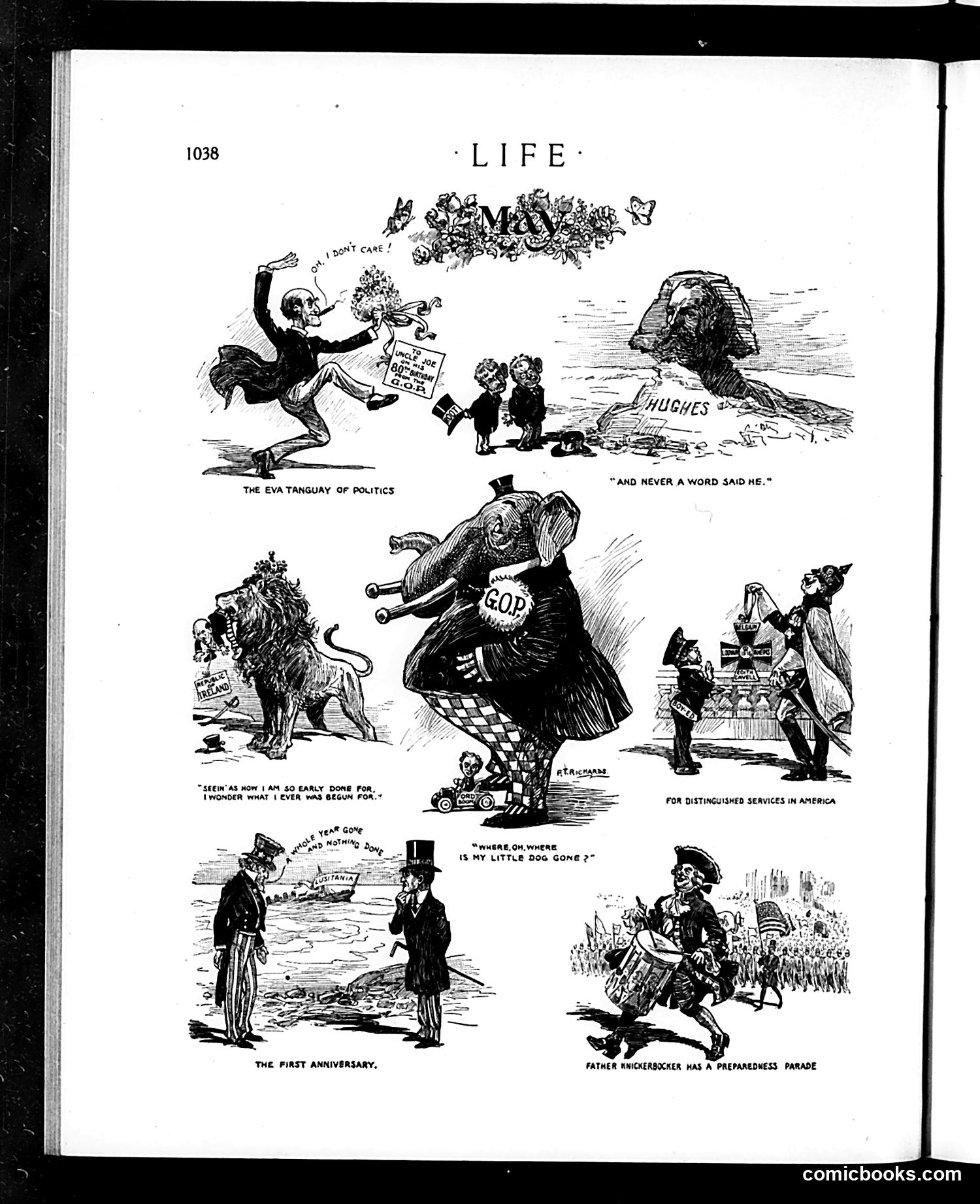
This page contains multiple satirical cartoons, likely from around 1917-1918 (based on "preparedness parade" reference). Key figures include: **Top cartoon**: "The Eva Tanguay of Politics" shows a performer juggling while saying "Oh, I don't care!" — likely mocking a political figure's frivolous attitude toward serious matters. **Center**: "And Never a Word Said He" depicts a silent figure labeled "Hughes," likely Charles Evans Hughes (1916 presidential candidate), suggesting ineffectiveness. **Other panels** reference: - A lion with political labels - A figure asking "Where is my little dog gone?" (referencing the popular song) - "The First Anniversary" showing two figures - "Father Knickerbocker" (personification of New York) with a "Preparedness Parade" The overall theme appears critical of political inaction, ineffectual leadership, and perceived unpreparedness during wartime tensions. The satirical tone mocks public figures for their passivity or irrelevance during serious national concerns.
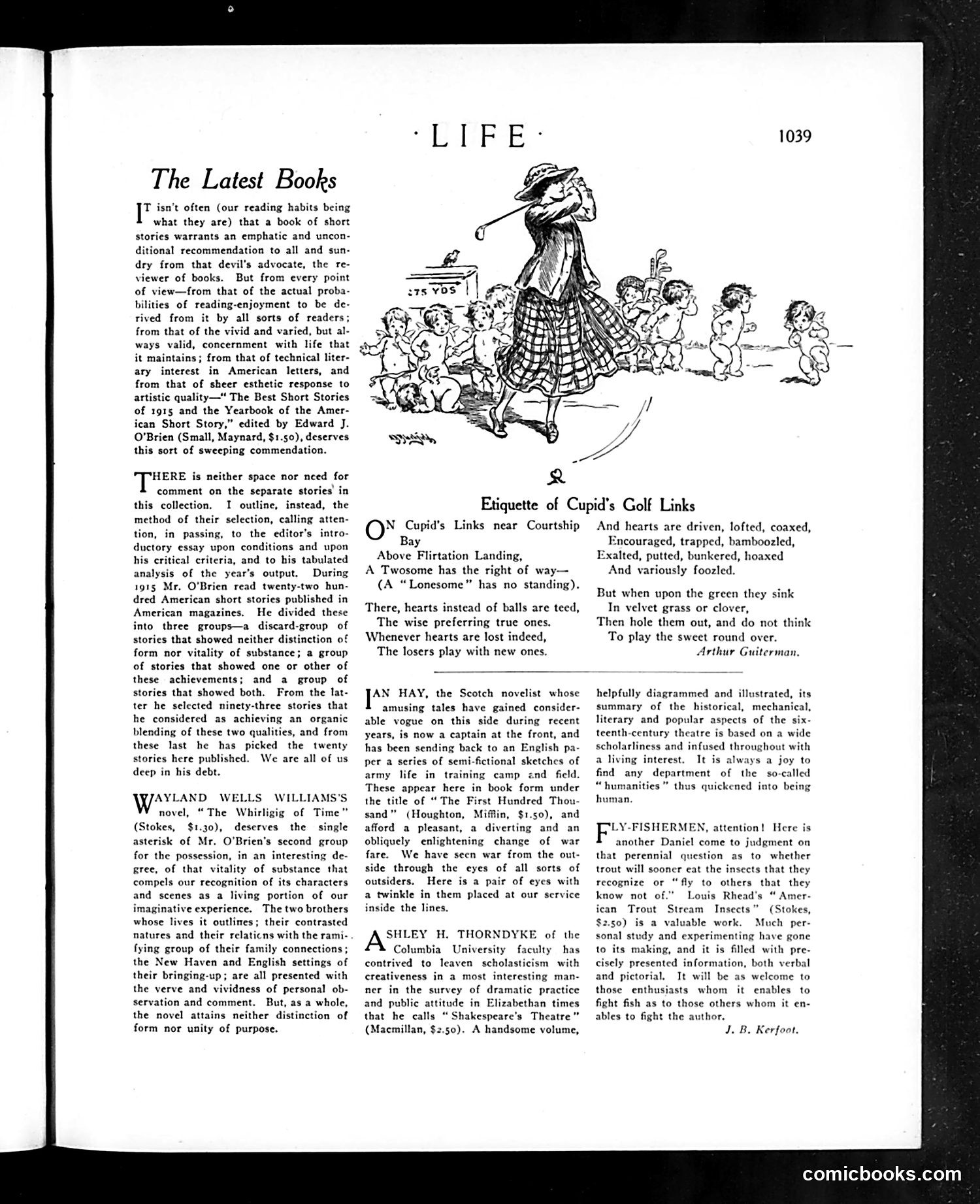
This is a **book review page**, not primarily a political cartoon. The main illustration shows a woman (representing "Cupid") playing golf with cherubs as caddies and spectators—a whimsical visual metaphor accompanying a poem about romantic "etiquette" using golf terminology. The page reviews four recent books: a 1915 short-story anthology, Wayland Wells Williams's novel "The Whirligig of Time," Ian Hay's military sketches "The First Hundred Thousand" (Hay was a Scotch novelist now serving as a captain in WWI), and Ashley H. Thorndyke's study of Elizabethan theatre. The satirical angle appears subtle here—the Cupid golf cartoon gently mocks courtship conventions ("hearts instead of balls are teed"), while the reviews themselves discuss serious literary merit without harsh mockery. This represents Life's typical 1916 blend of light illustration with substantive cultural criticism.
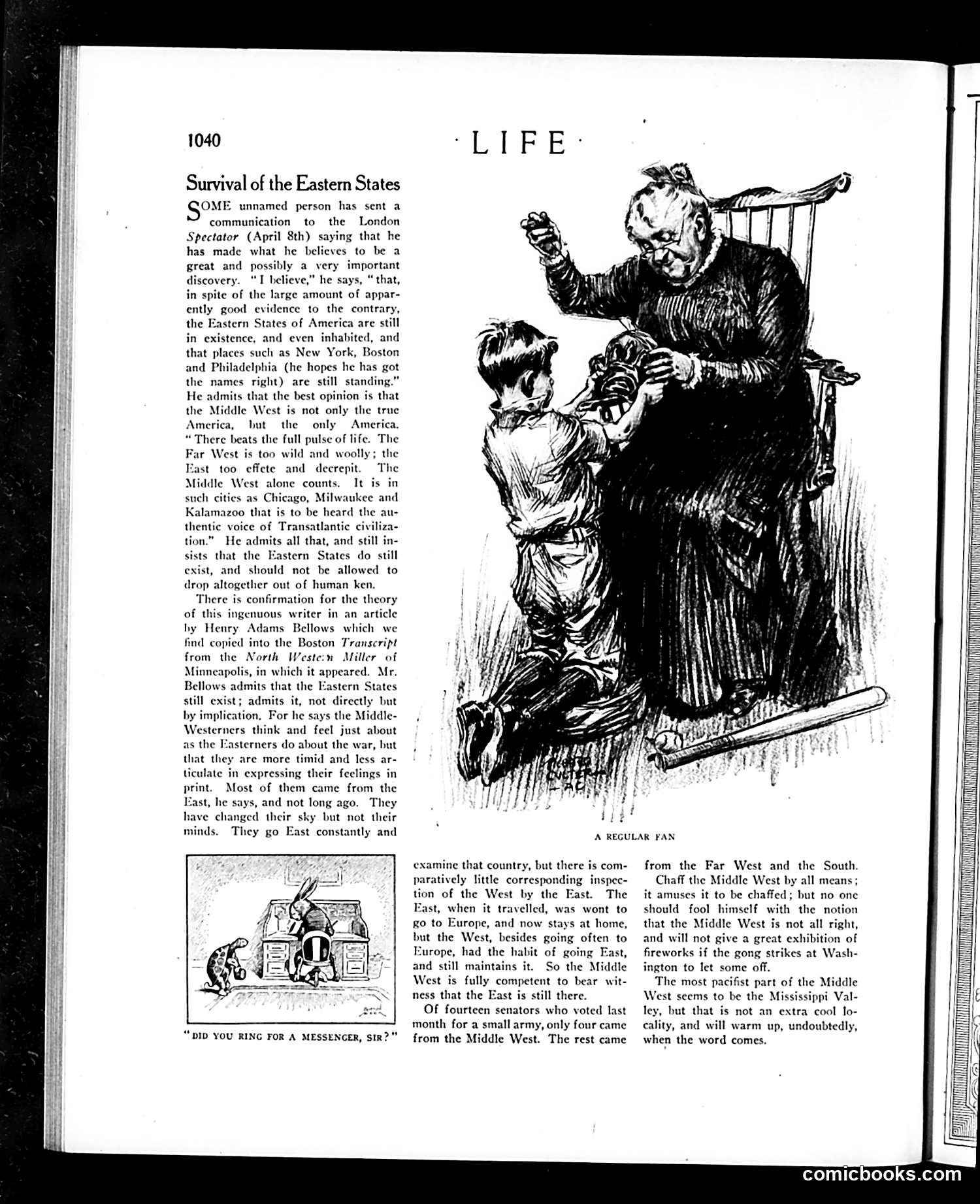
This satirical piece mocks the cultural dominance of America's Midwest in the early 20th century. The unnamed London *Spectator* correspondent humorously "discovers" that Eastern cities like New York, Boston, and Philadelphia still exist—implying they've been culturally dismissed as irrelevant by Americans who view the Middle West (Chicago, Milwaukee, Kalamazoo) as the "true America." The article argues Eastern elites have become "effete and decrepit" while the Midwest represents authentic American vitality. However, the piece defends the East, noting Middle Westerners are mostly Eastern emigrants maintaining Eastern values—they just express themselves less publicly. The cartoon captioned "A REGULAR FAN" (right) shows an adult male enthusiast, likely representing Midwestern cultural pride or bombastic patriotism. The smaller cartoon ("Did you ring for a messenger, sir?") appears to mock social pretension, though its specific reference is unclear from context alone.
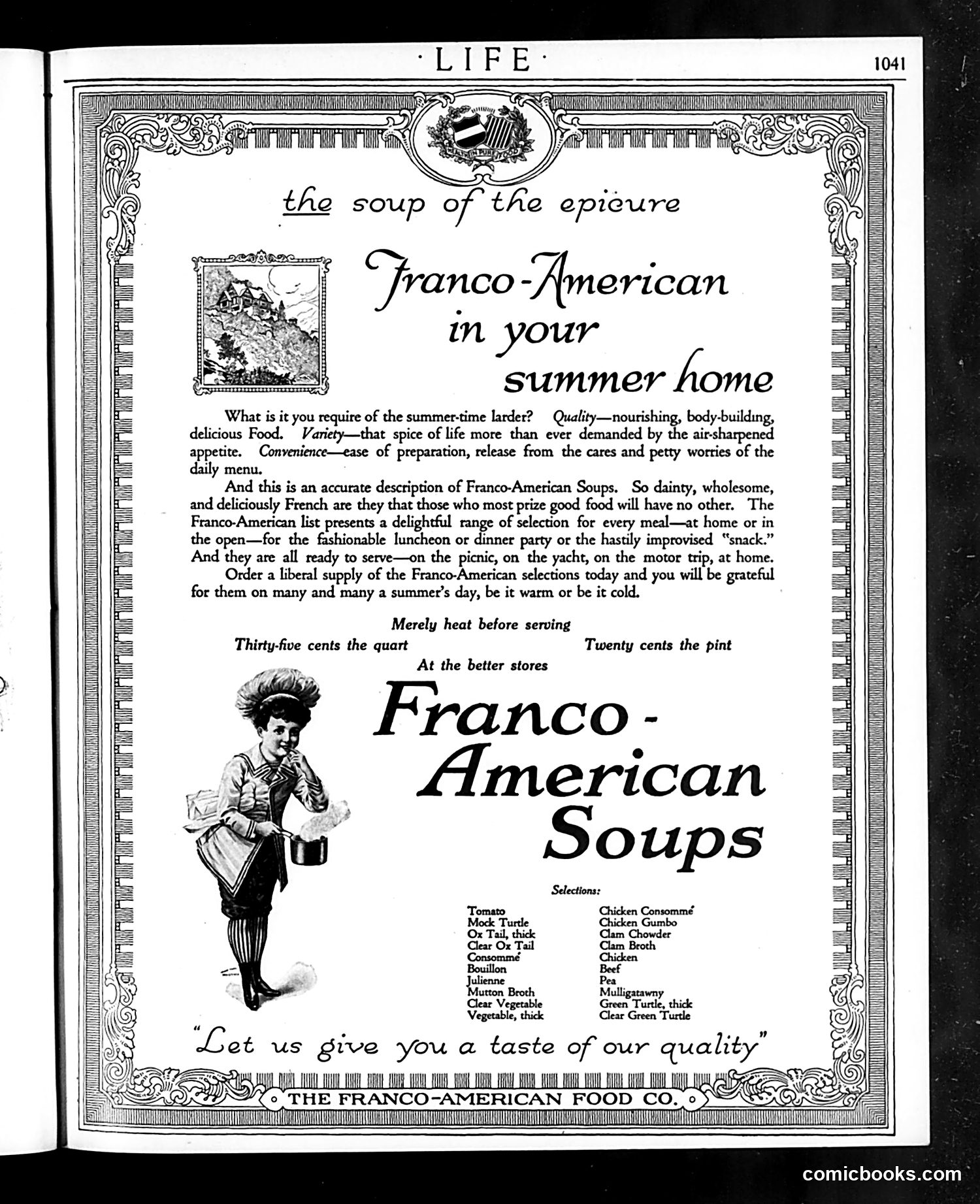
This is primarily a **product advertisement**, not political satire. The page promotes Franco-American canned soups to affluent summer homeowners, emphasizing convenience and French culinary prestige during the early 20th century. The illustration features a stylized French maid or chef character—a common advertising trope depicting European sophistication. The ad copy appeals to leisure-class consumers planning summer entertaining ("fashionable luncheon or dinner party," yacht trips, picnics). **Context for modern readers:** This reflects pre-refrigeration era marketing, when canned, ready-to-heat products represented cutting-edge convenience. The "Franco-American" branding capitalized on widespread American admiration for French cuisine and culture. The maid figure exploited ethnic/class stereotypes common in early advertising. Pricing (35¢ quart, 20¢ pint) targets middle-to-upper-class households who could afford both summer homes and branded convenience foods.
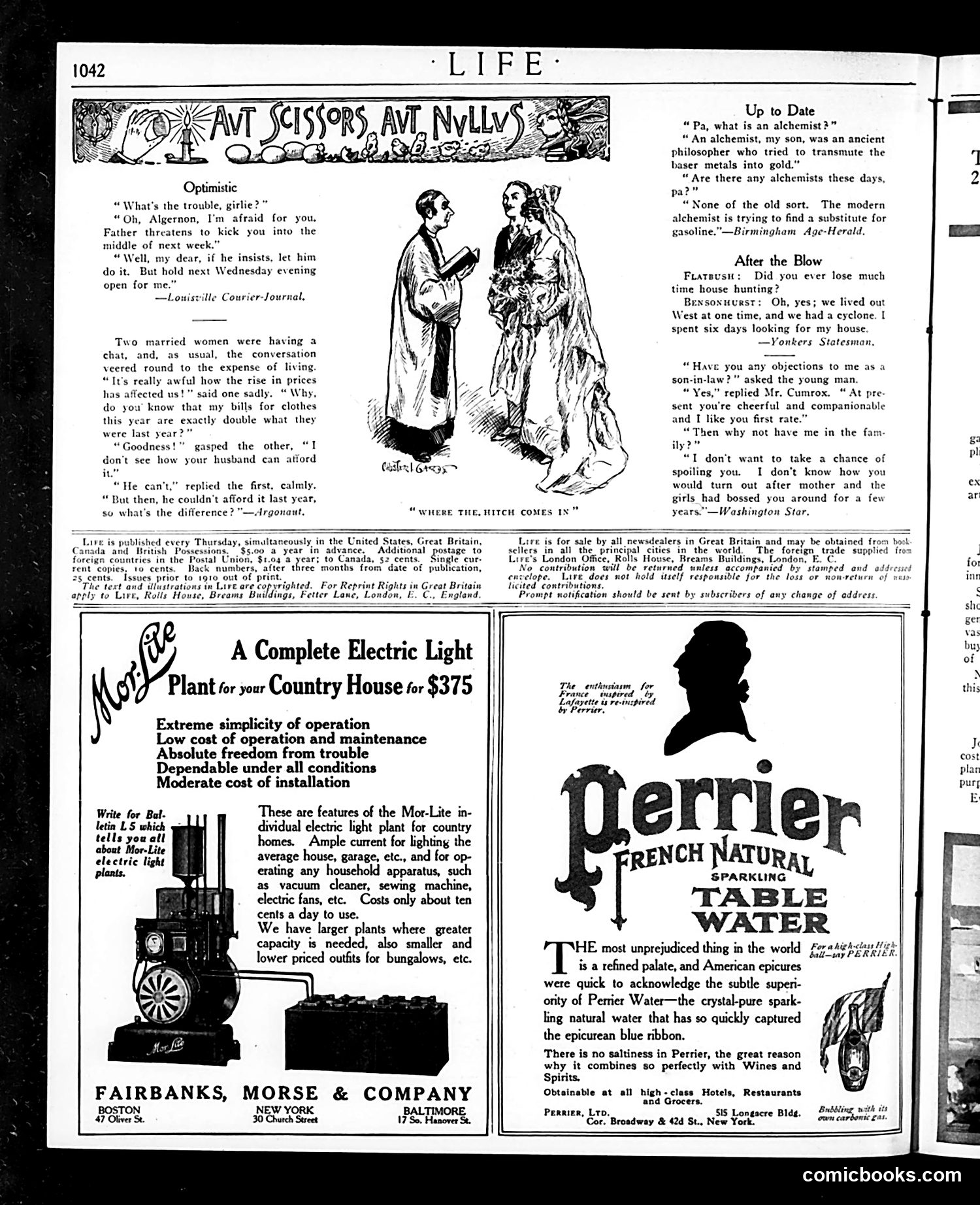
This page from *Life* magazine contains three distinct humor sections—short jokes and comic scenarios—plus period advertisements. The **cartoon jokes** use common domestic situations for satire: a young man facing an angry father-in-law remains absurdly optimistic; wives complain about rising living costs while their husbands paradoxically cannot afford last year's expenses (satirizing economic confusion); and a suitor is rejected despite being "cheerful and companionable" because the father fears his future in-laws will ruin him. These jokes reflect **early 20th-century anxieties**: inflation and cost-of-living crises (referenced in the "alchemist" joke about finding gasoline substitutes), courtship rituals, and class/family dynamics. The **advertisements**—for Mor-Lite electric generators and Perrier sparkling water—represent luxury goods marketed to affluent "country house" owners, typical of *Life*'s audience. The page is primarily **humor-focused rather than political satire**, offering gentle domestic comedy rather than hard-hitting social commentary. The overall tone is lighthearted and conservative.
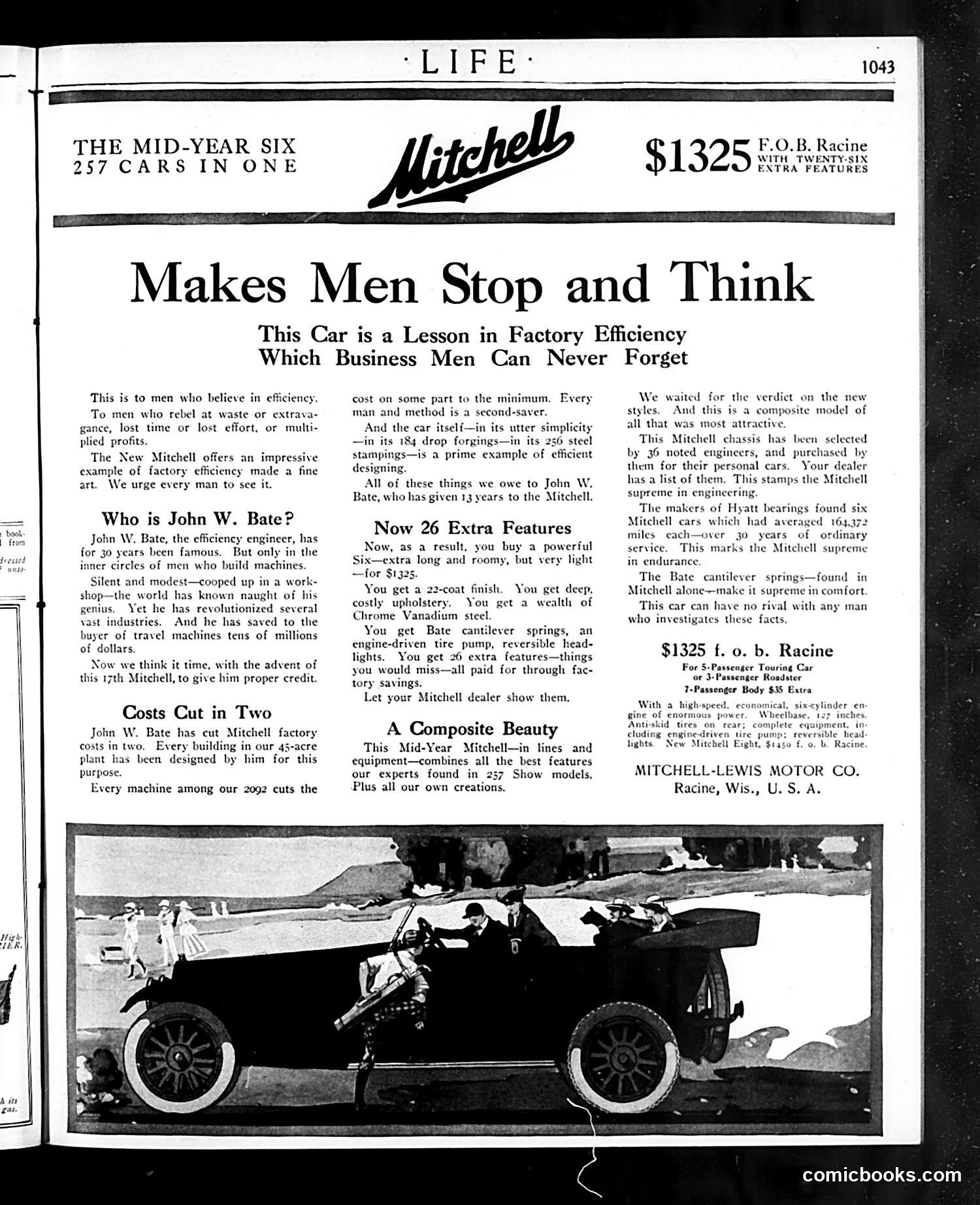
This is primarily a **product advertisement**, not political satire. It promotes the Mitchell automobile (priced at $1,325 F.O.B. Racine, Wisconsin) by emphasizing factory efficiency and engineering innovation. The page centers on **John W. Bate**, an efficiency engineer credited with revolutionizing manufacturing at Mitchell for 30 years. The advertisement argues that Bate's design principles—cutting factory costs in half, optimizing every machine and building—result in an affordable, high-quality vehicle with 26 "extra features." The appeal targets **business-minded men** who value efficiency and cost savings. The ad claims the car represents "a lesson in factory efficiency" and cites credibility markers: 36 engineers who personally purchased Mitchells, and Hyatt bearing tests showing 164,000-mile durability. This reflects early 20th-century **industrial-age marketing**, celebrating manufacturing innovation and the expertise of named engineers as selling points—very different from modern advertising approaches.
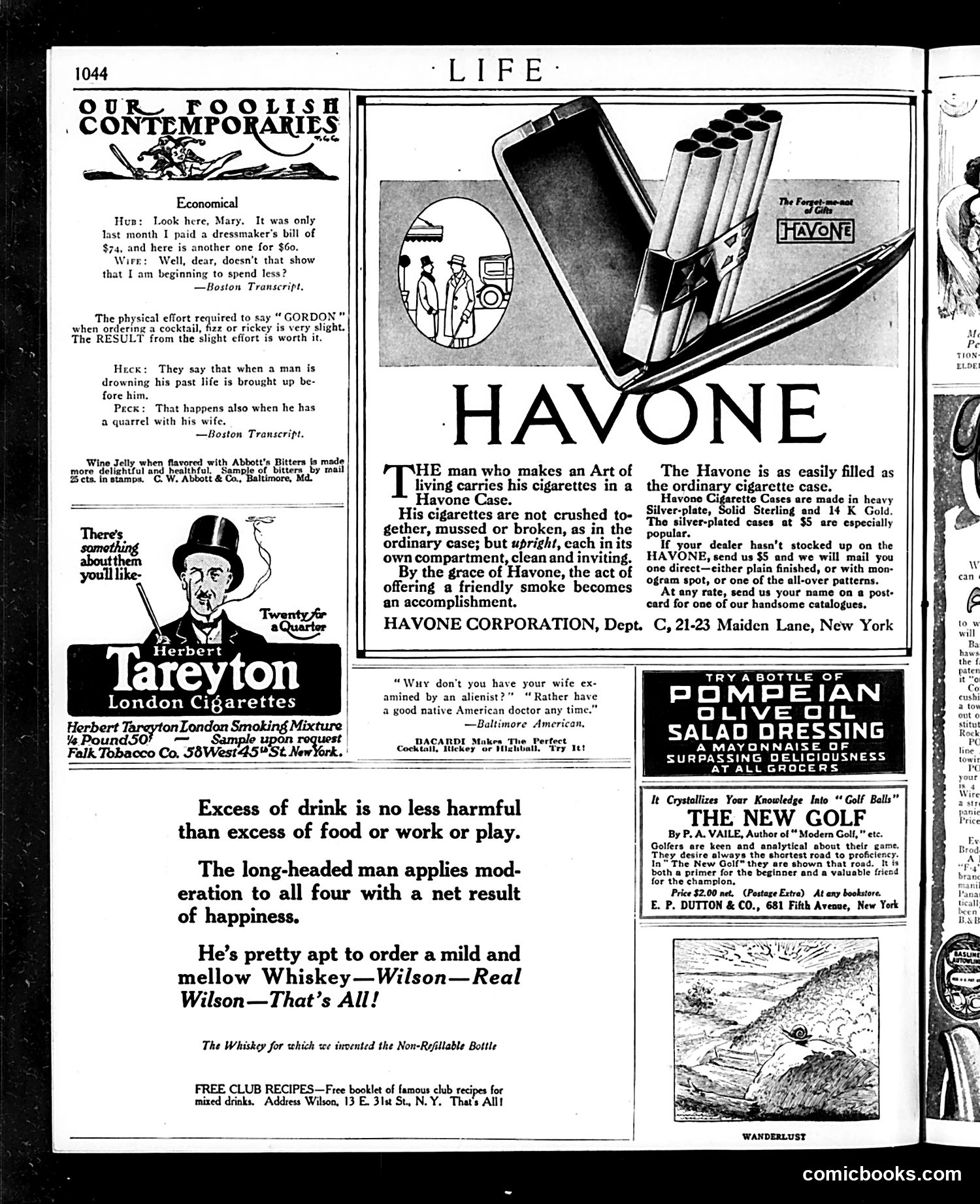
This page is primarily **advertising** with minimal editorial content. The small cartoons at top-left are brief jokes from *Boston Transcript*: one about a wife claiming reduced spending despite high bills (absurdist humor about accounting), another about men drowning in their past during quarrels with wives. The page is dominated by product advertisements typical of the 1920s era: **Havone cigarette cases** (luxury goods emphasizing gentlemanly presentation), **Herbert Tareyton London cigarettes**, **Wilson whiskey**, **Bacardi rum**, **Pompeian olive oil**, and a golf instructional book. One small joke mocks psychiatry: a man refuses an "alienist" (early term for psychiatrist) in favor of a "good native American doctor"—reflecting period skepticism toward emerging psychology and perhaps xenophobic attitudes. The whiskey ad references a "Non-Refillable Bottle," likely addressing Prohibition-era concerns about reusing bottles for illegal alcohol. Overall, this reflects 1920s consumer culture and period attitudes rather than political satire.
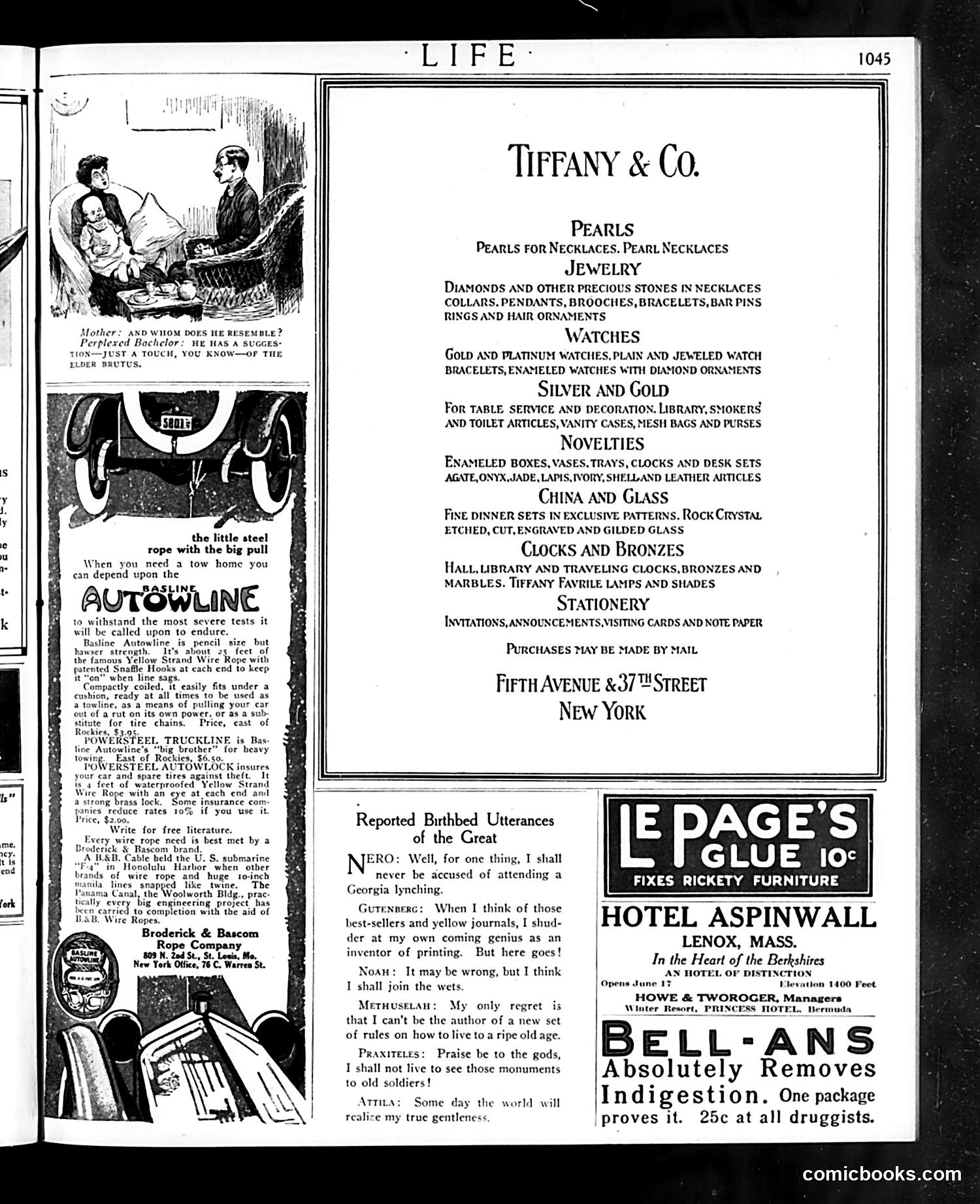
This page is primarily **advertisements** (Tiffany & Co., Autowline rope, hotels, patent medicines) with one satirical cartoon and a brief humorous text section. **The Cartoon:** A simple sketch shows a mother and "perplexed bachelor" discussing a baby. The joke plays on physical resemblance—the mother suggests the infant resembles the elder Brutus (the historical Roman figure), a pretentious or absurd comparison that satirizes affected conversation among the upper classes about genealogy and distinguished ancestry. **"Reported Birthbed Utterances of the Great":** This section parodies famous historical/cultural figures making supposedly profound first statements. The humor comes from anachronistic or ironic "deathbed wisdom"—Nero rejecting Georgia lynchings (which didn't exist in his era), Gutenberg regretting printing's effect on journalism, Noah supporting Prohibition ("the wets"). The satire mocks both historical reverence and contemporary concerns being retroactively imposed on the past. The page reflects early-20th-century Life magazine's blend of luxury advertising and gentle social satire targeting educated, affluent readers.
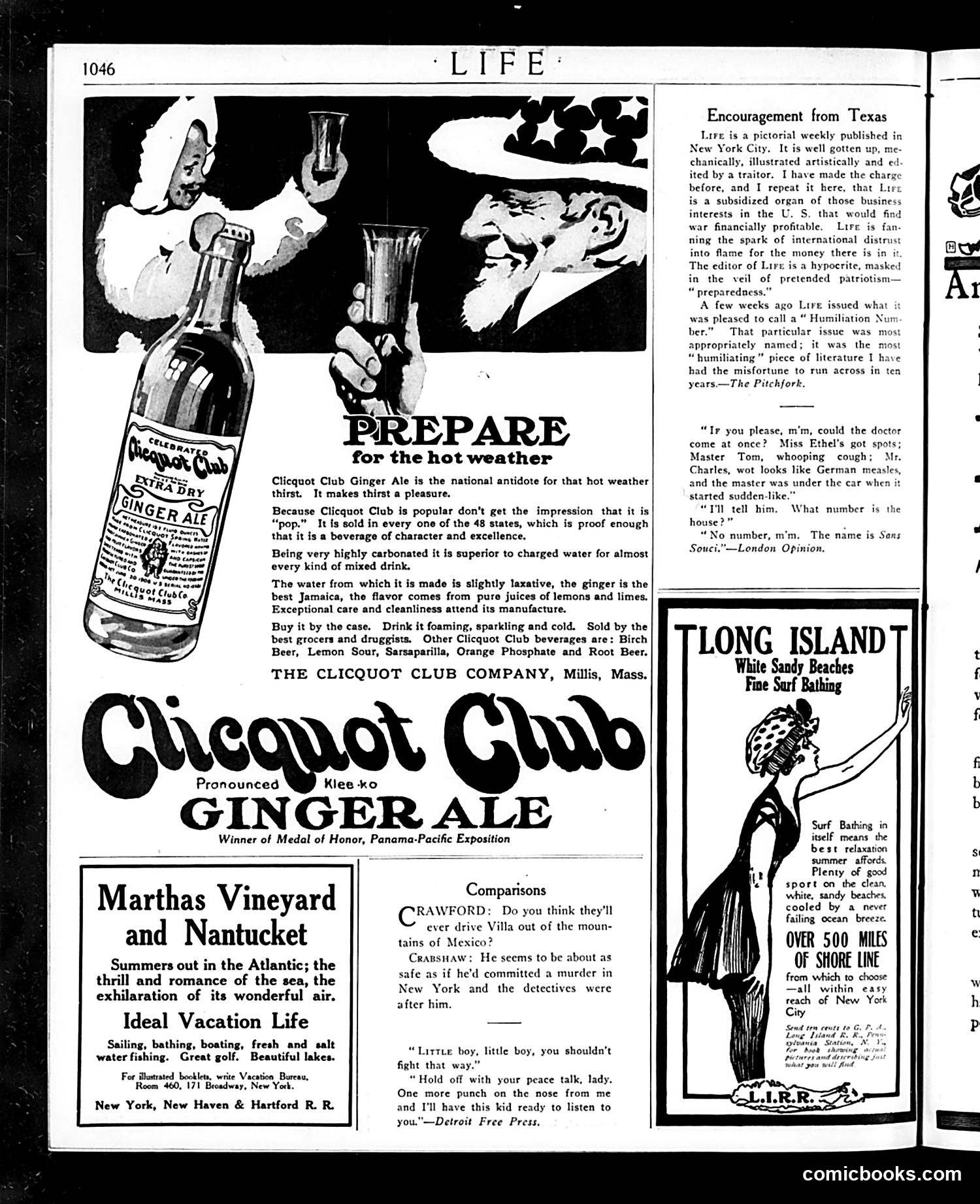
This page contains **primarily advertising** with a sidebar attack on *Life* magazine itself. The **political element**: A Texas reader accuses *Life* of being a "subsidized organ" profiting from war through sensationalism. The critic specifically condemns *Life's* recent "Humiliation Number" as inflammatory propaganda masquerading as patriotism—likely referencing pre-WWI "preparedness" debates when American interventionists and isolationists clashed bitterly. The **cartoon humor** (bottom right) references **Pancho Villa**, the Mexican revolutionary general. The joke relies on contemporary frustration: Villa commits crimes in Mexico yet evades U.S. law enforcement pursuing him across the border—comparing his immunity to a murderer loose in New York whom detectives can't catch. This satirizes American military intervention debates and border tensions of the 1910s. The larger page features vintage beverage and vacation advertisements unrelated to the political content.
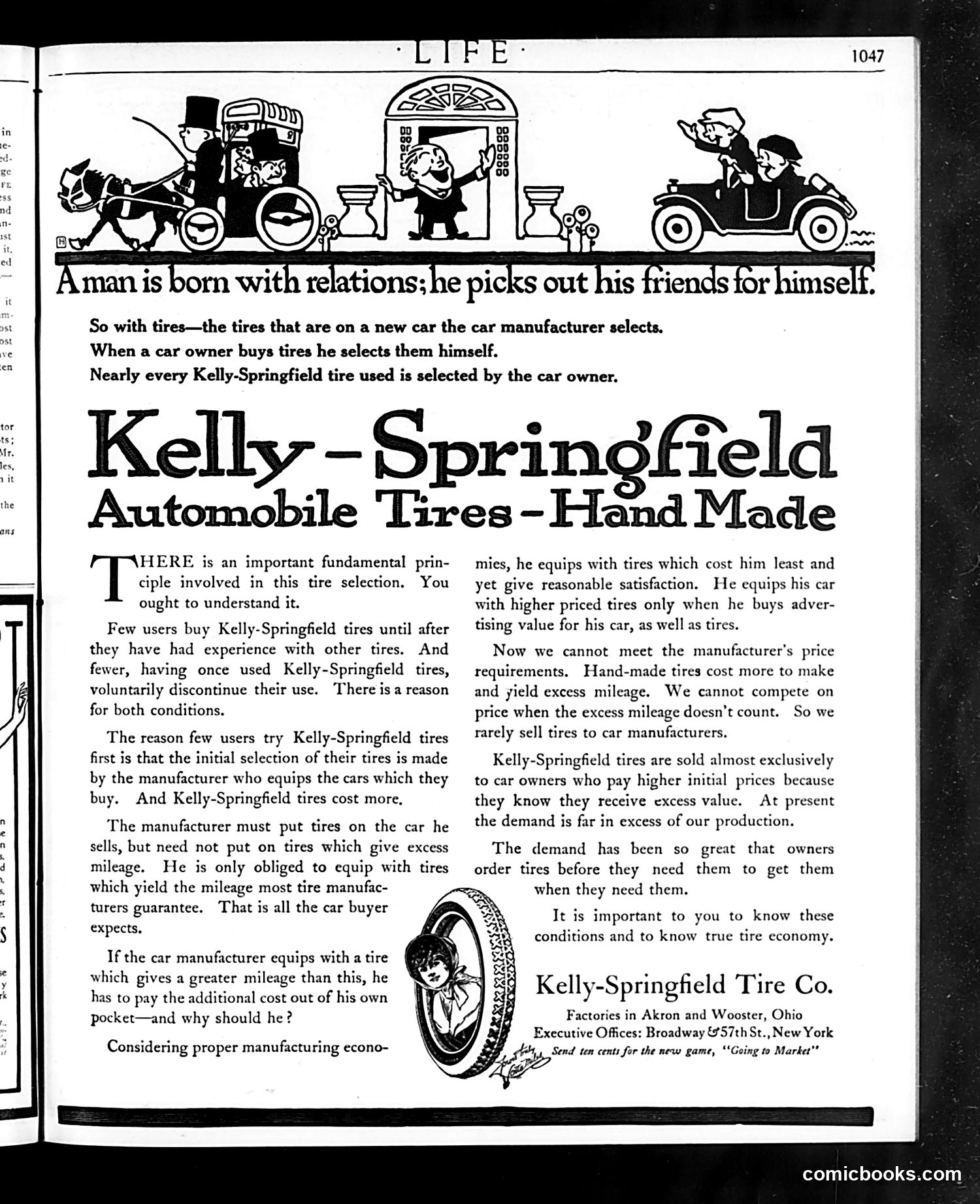
This is a **full-page advertisement**, not satire. The cartoon at top illustrates the headline: just as people choose their own friends rather than having them assigned, car buyers choose replacement tires themselves (unlike original equipment tires selected by manufacturers). The ad's argument is economic: manufacturers equip cars with cheap tires meeting only minimum guarantees to save costs. Kelly-Springfield, a premium hand-made tire, costs more but lasts longer. Since manufacturers won't pay extra for excess mileage they don't profit from, Kelly-Springfield sells directly to **individual car owners** willing to pay higher prices for superior value. The ad emphasizes high demand—customers must pre-order tires before needing them—suggesting quality reputation and scarcity. The factories are located in Akron and Wooster, Ohio (historically America's tire manufacturing hub). This targets the growing market of affluent car owners valuing durability over initial cost.
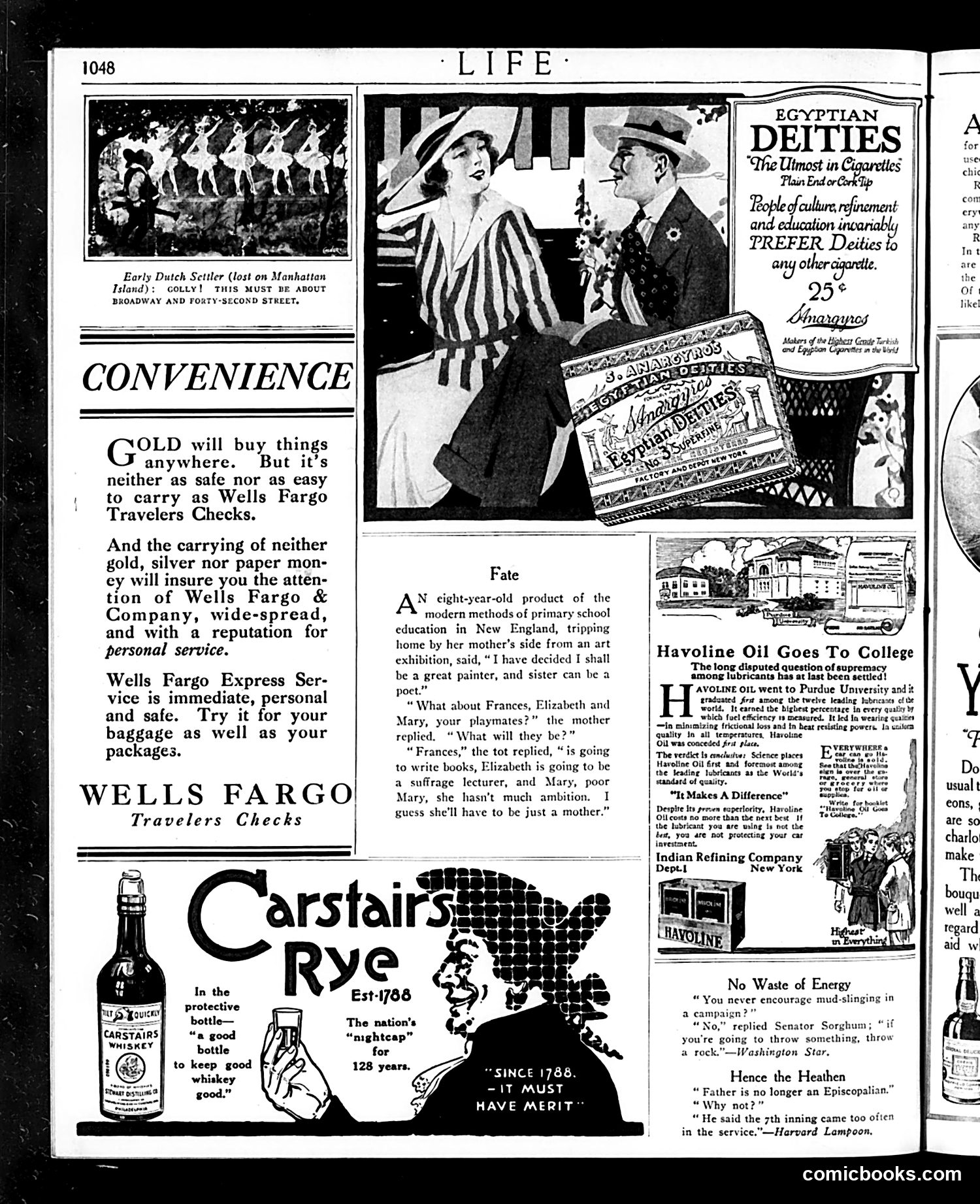
This page contains mostly **period advertisements** mixed with brief humorous pieces typical of early 20th-century Life magazine. ## Main Content: The top cartoon shows an Early Dutch settler lost on Manhattan, commenting that modern Broadway must be where he is—a light joke about urban development. The "Fate" piece satirizes **early feminist aspirations**: an eight-year-old girl declares ambitious career goals (painter, poet, suffragist lecturer) for herself and friends, while dismissing motherhood as having "not much ambition" for the friend "poor Mary." This reflects **contemporary anxieties about women's education and changing roles**—the joke mocks the girl's youthful dismissal of traditional domesticity, which would have resonated with readers debating women's suffrage and education. ## Advertisements: Wells Fargo Travelers Checks, Egyptian Deities cigarettes, Carstairs Rye whiskey, Havoline Oil, and Indian Refining Company ads fill the page—typical of Life's revenue model. The brief humor snippets at bottom mock mud-slinging politics and religious inconsistency, standard satirical fare.
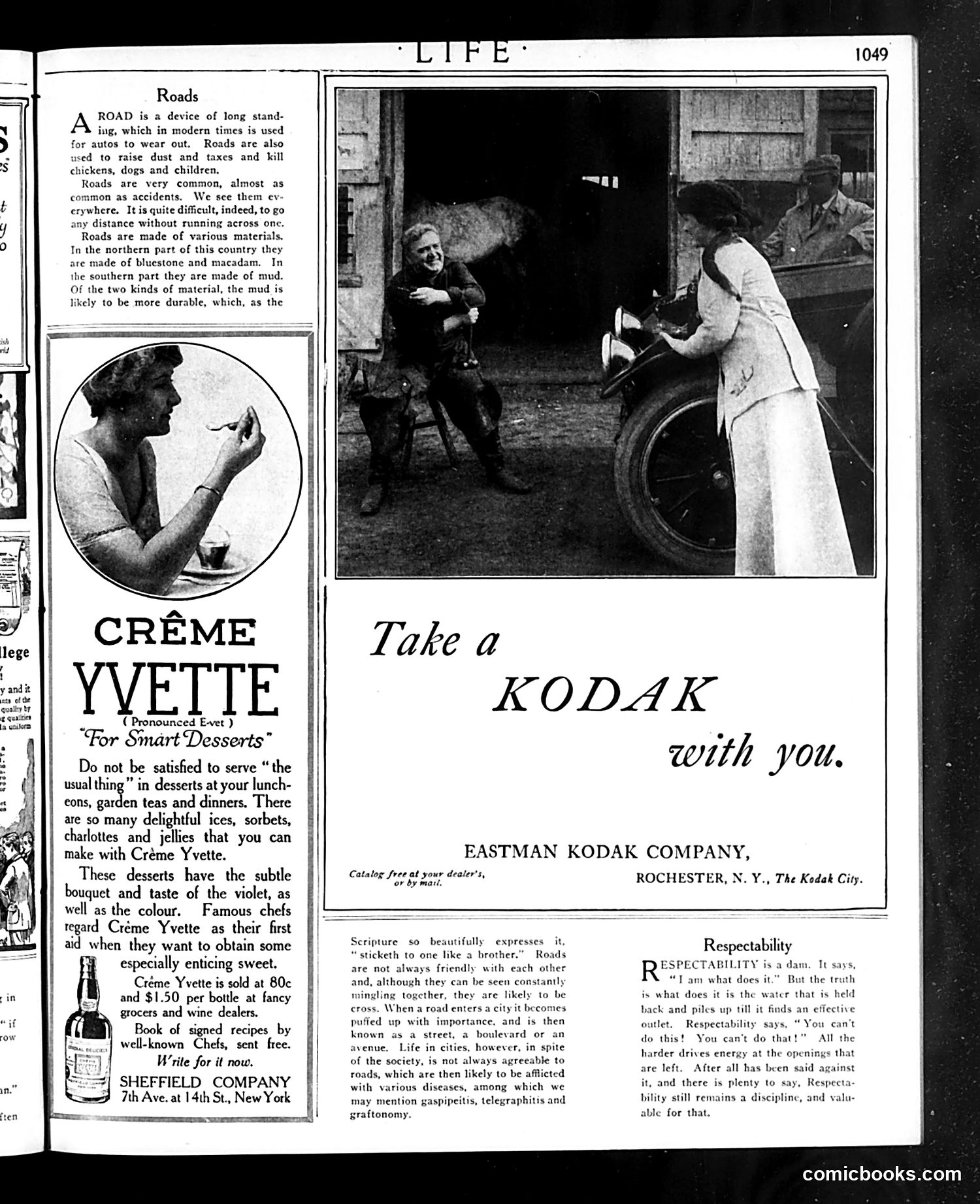
This page contains **satirical commentary and advertisements** rather than a political cartoon. The main satire is the "Roads" essay—a mock-serious piece using deadpan humor to critique American roads and automobiles. Life sarcastically defines roads as devices "for autos to wear out" and notes they "kill chickens, dogs and children." The joke extends to personifying roads: when they enter cities, they become "puffed up with importance" and develop "diseases" like "gaspipeitis" and "graftonomy" (invented ailments suggesting gas pipes and grafting/corruption). This mocks both poor road conditions and urban pretension. The advertisements—**Crème Yvette** dessert liqueur and **Kodak cameras**—are straightforward period ads. The brief essay on **"Respectability"** uses metaphor (a dam holding back water) to argue that respectability, while restrictive, provides necessary discipline and channels human energy productively. **Context for modern readers:** The 1920s auto boom created notorious road conditions; satirizing roads and urban "importance" would resonate with contemporary readers frustrated by infrastructure problems.
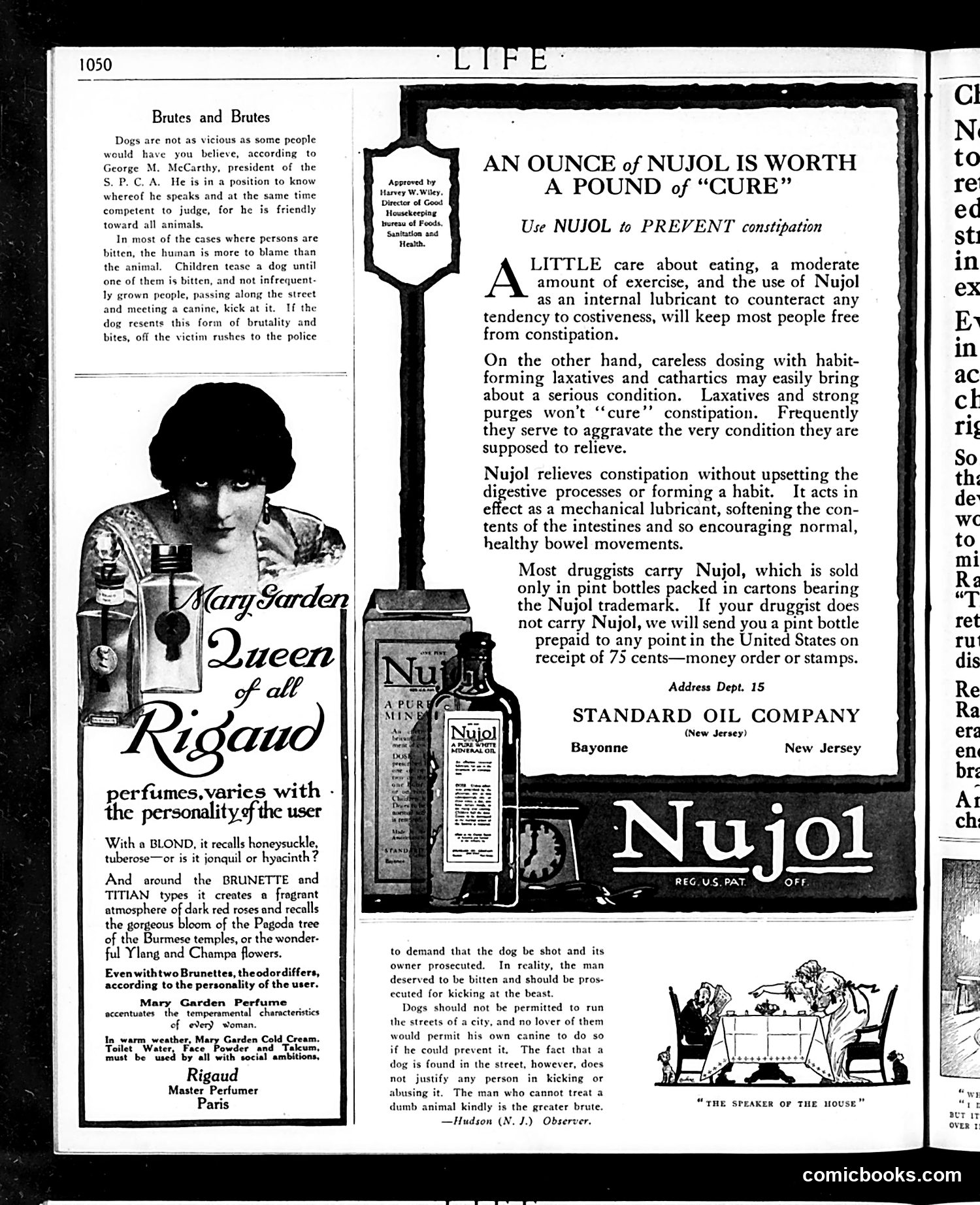
This page contains an editorial essay (not a cartoon) defending dogs against human cruelty. The author, citing S.P.C.A. president George M. McCarthy, argues that dog-bite incidents are typically caused by human abuse—children teasing dogs or adults kicking them—rather than inherent canine viciousness. The satire's target is human hypocrisy: people who provoke dogs, get bitten, then demand the animal be shot and prosecuted. The essay's sharp reversal—"The man who cannot treat a dumb animal kindly is the greater brute"—criticizes this injustice. The headline itself is ironic: humans, not dogs, are the real "brutes." The page also contains unrelated advertisements for Rigaud perfume and Nujol laxative, typical of the magazine's mixed editorial-advertising format.
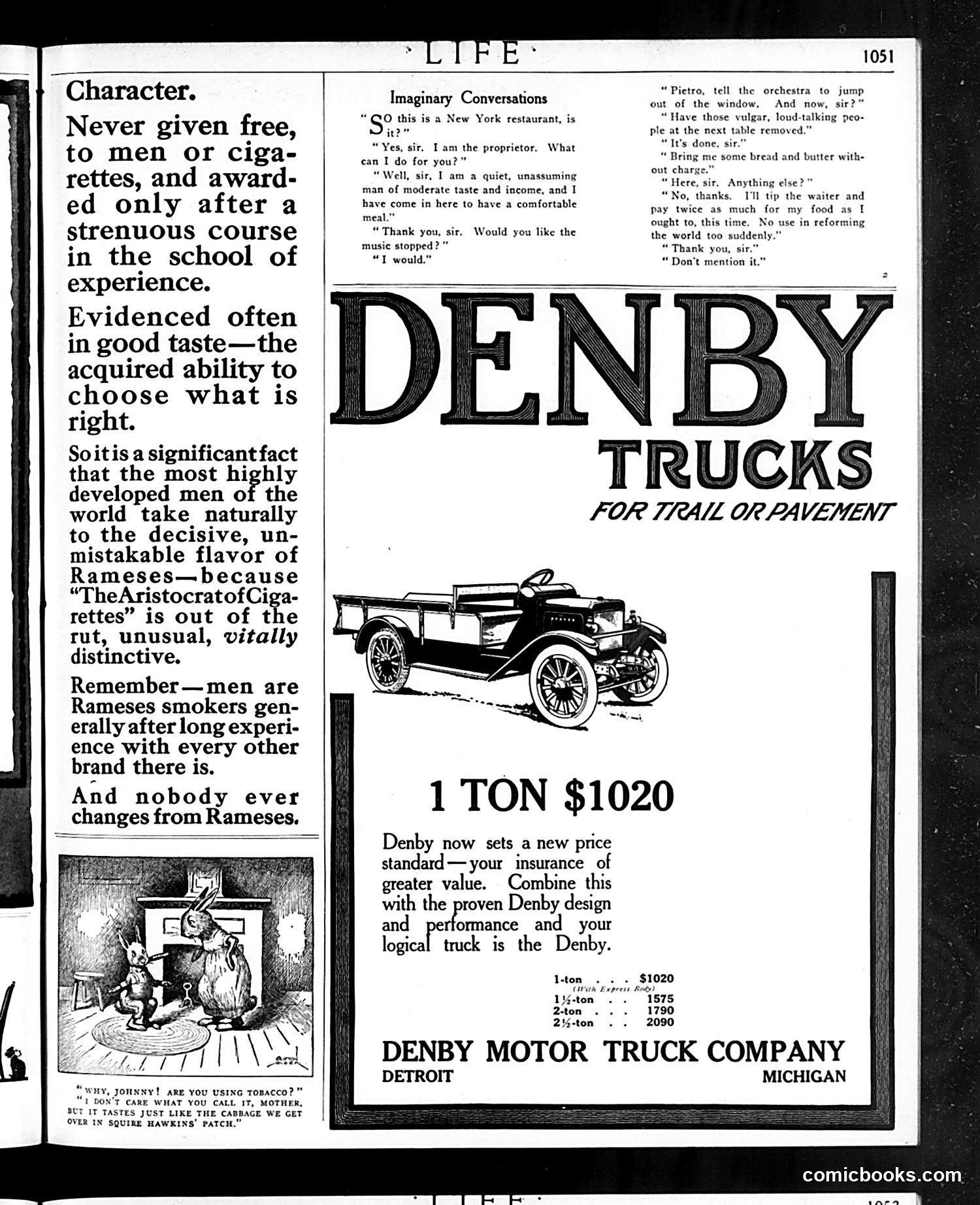
This page combines two distinct advertisements with satirical editorial content. **Left side:** A Rameses cigarettes ad uses character-building language to sell smoking as a mark of sophistication and refined taste. It claims that experienced, "highly developed men" naturally prefer Rameses' distinctive flavor—a humorous appeal to male vanity and social aspiration typical of early 20th-century tobacco marketing. **Center:** A brief "Imaginary Conversation" satirizes pretentious New York restaurant culture. A modest customer requests quiet dining, but a snobbish establishment removes "vulgar" patrons and stops the orchestra at his request—mocking both obsequious service and the customer's obvious self-importance despite his claimed modesty. **Bottom left:** A small cartoon jokes that homegrown tobacco tastes indistinguishable from cabbage, undercutting the premium cigarette advertising above it through crude humor. **Right side:** A Denby Motor Trucks advertisement for commercial vehicles ($1020 for 1-ton models). The page exemplifies Life's satirical approach: advertising-heavy publications using humor to gently mock consumer culture and social pretension.
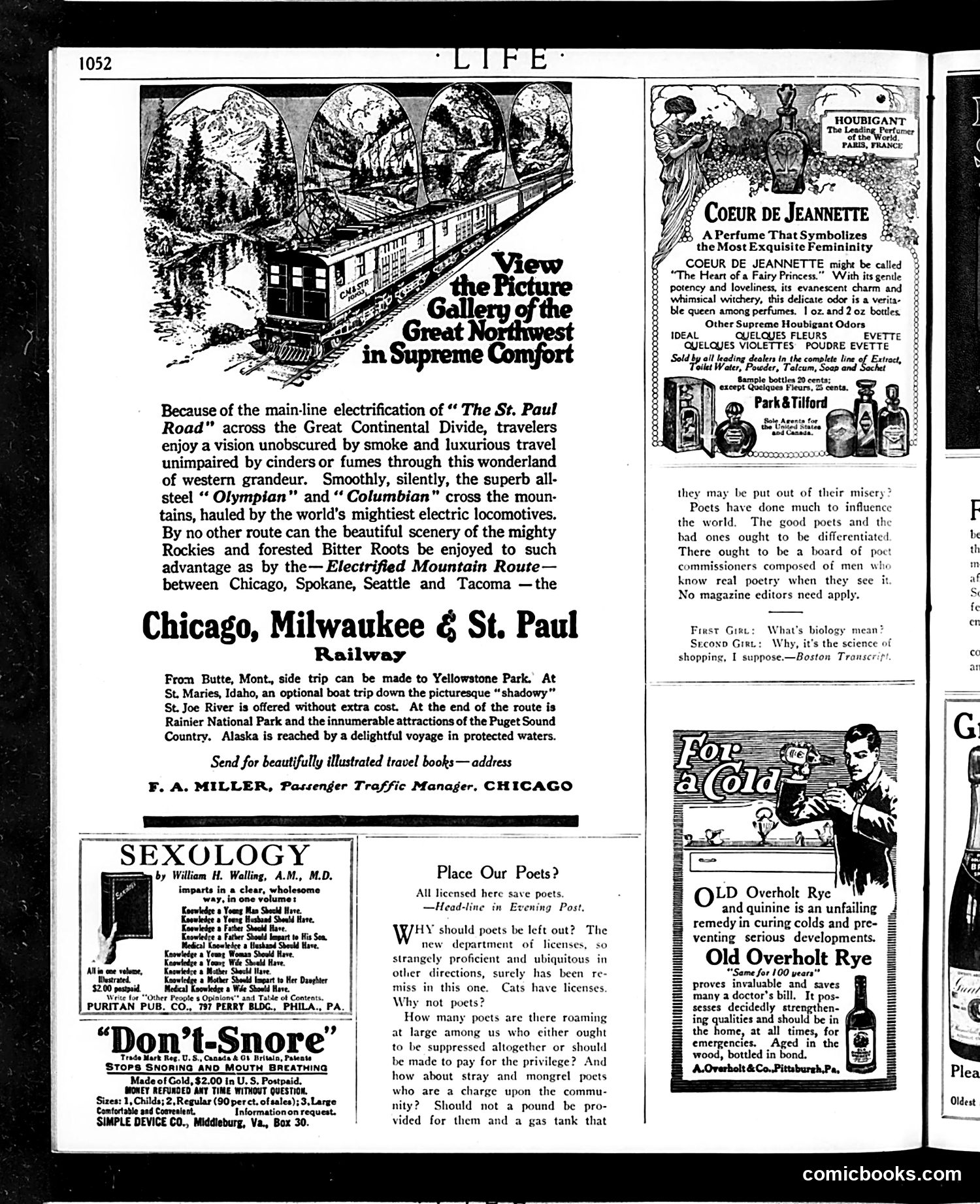
This page is primarily **advertising and editorial content** rather than political cartoons. The main advertisement promotes the **Chicago, Milwaukee & St. Paul Railway's "Electrified Mountain Route,"** highlighting luxury train travel through the Rocky Mountains without smoke or cinders—a selling point for newly electrified rail technology. The **"Place Our Poets?" section** is a satirical editorial commentary on licensing. It humorously suggests poets should require licenses like cats do, mocking the era's expanding bureaucratic regulation. The joke: poets are treated as quasi-vermin—some should be "suppressed" entirely, others are "stray and mongrel" public nuisances deserving "a pound" (animal shelter) and even euthanasia ("gas tank"). This reflects early 20th-century cynicism about regulation run amok and perhaps skepticism about poetry's social value. The page also includes period advertisements for perfume, medical books, and patent medicines—typical Life magazine content from this era.
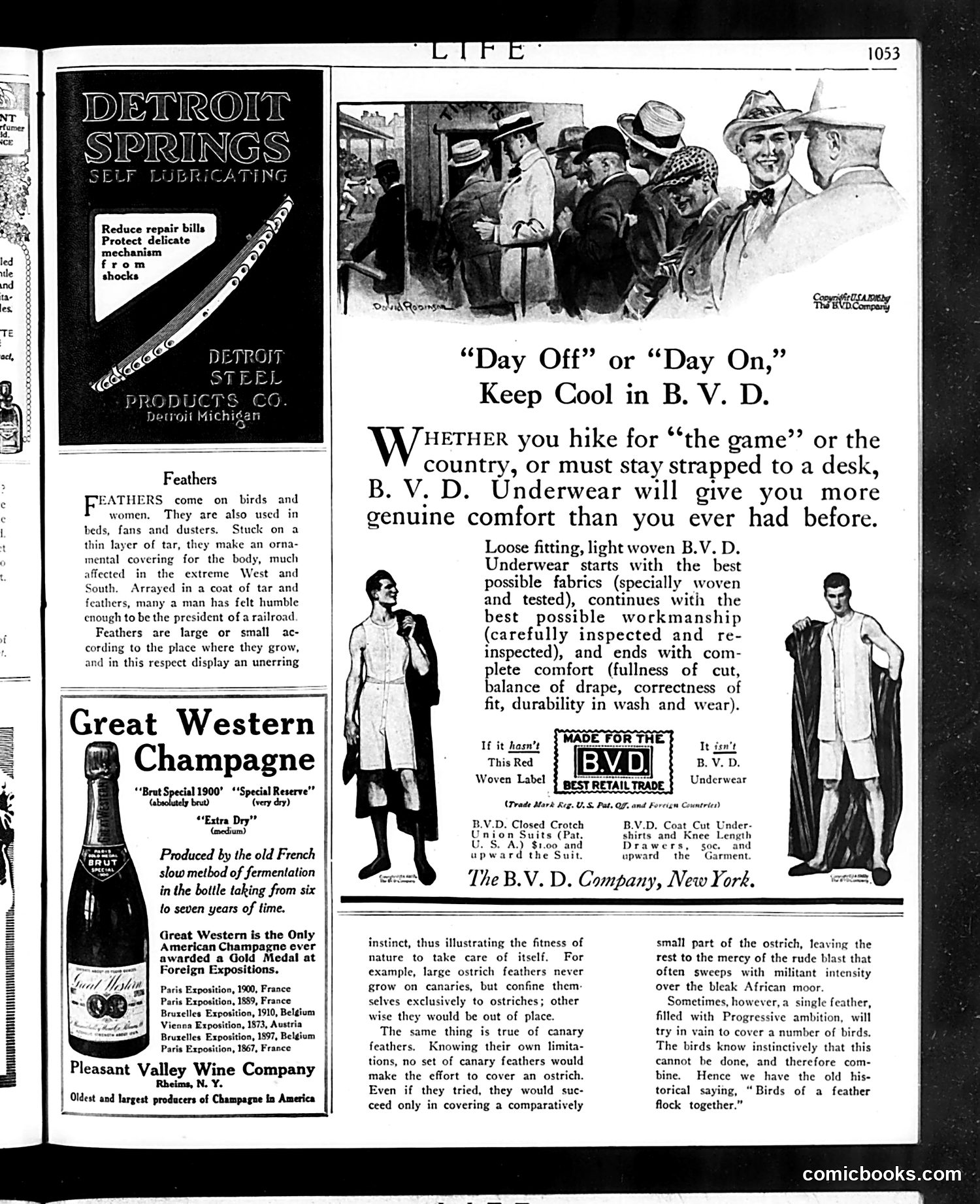
This page is primarily **advertising** with one satirical article. The main cartoon/illustration shows a group of men in hats and suits gathered together, accompanying an article titled **"Day Off" or "Day On," Keep Cool in B.V.D."** The illustration appears to reference the colloquial phrase "tar and feathers"—a historical form of public humiliation and mob justice used against unpopular figures. The accompanying text humorously describes feathers' uses (clothing, beds, fans) and their historical association with tarring-and-feathering, mentioning that men "humbled enough to be the president of a railroad" underwent this treatment. This likely alludes to **unpopular railroad magnates** of the era who faced public anger. The bulk of the page features **product advertisements**: Detroit Springs lubricant, Great Western Champagne (emphasizing its American origin and international awards), and B.V.D. underwear (stressing comfort and quality). The satirical content is minimal—primarily the feather article's wry commentary on mob justice and social conformity ("Birds of a feather flock together").
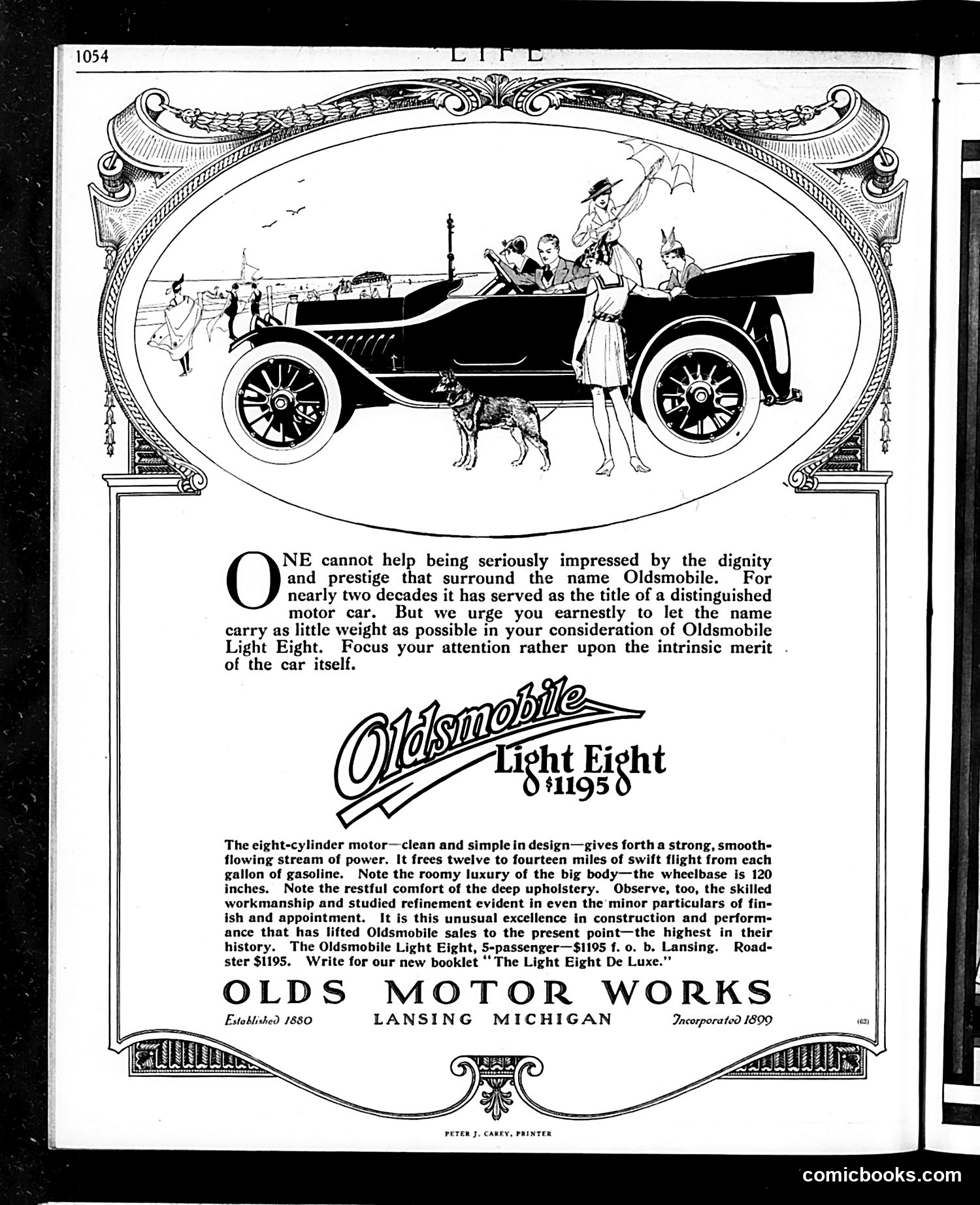
This is a **full-page automobile advertisement**, not political satire. It promotes the Oldsmobile Light Eight, a 1920s car model priced at $1,195. The illustration shows a fashionable roadster with elegantly dressed passengers and pedestrians, reflecting the aspirational lifestyle marketing of the era. The decorative art-deco border and refined aesthetic typical of *Life* magazine advertisements emphasize luxury and prestige. The ad's argument is noteworthy: it acknowledges the Oldsmobile brand's two-decade reputation but *urges readers to ignore* brand prestige and instead focus on the car's technical merits—eight-cylinder engine, fuel efficiency (12-14 miles per gallon), wheelbase, upholstery, and craftsmanship. This suggests Oldsmobile was competing against newer rivals by emphasizing engineering excellence rather than heritage alone. The copy reveals competitive pressure in the growing automobile market of the 1920s.
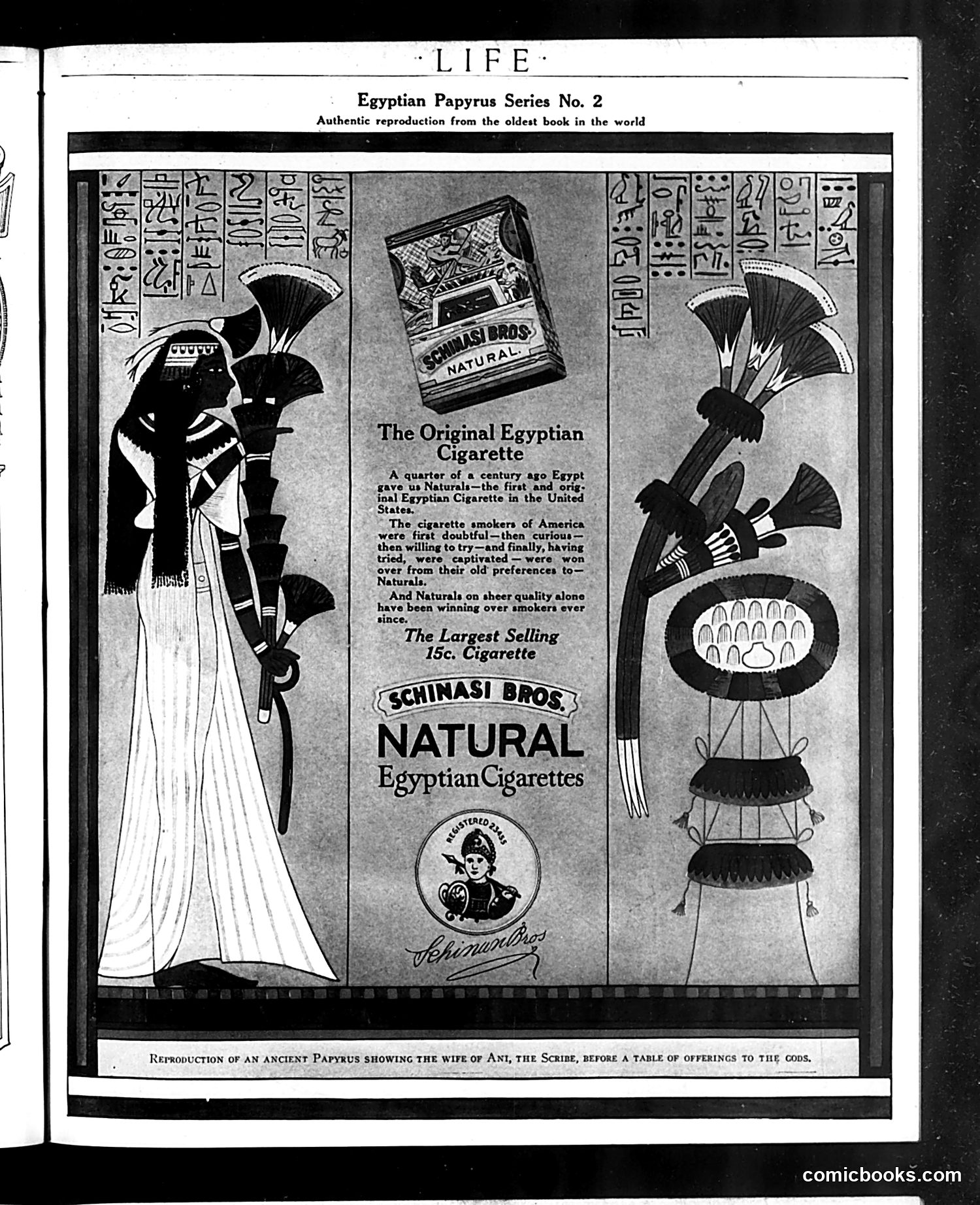
This is primarily a **cigarette advertisement** for Schinasi Bros. Natural Egyptian Cigarettes, dressed up as educational content. The "satire" is subtle: the page frames a mass-market commercial product (15-cent cigarettes) as if it were a scholarly reproduction from ancient Egyptian papyri. The Egyptian hieroglyphic borders and the formal caption about "the wife of Ani, the scribe" create faux-archaeological legitimacy. The joke for readers would be the absurd juxtaposition—treating a cheap American cigarette brand with the gravitas of "the oldest book in the world." The advertisement claims Naturals were "the first and original Egyptian Cigarette in the United States," implying ancient authenticity when it's actually a modern product. The Egyptian imagery served marketing purposes: exotic appeal and pseudo-historical authority to sell cigarettes as a premium, quality product. Modern readers would recognize this as misleading advertising—using fake "educational" framing to promote tobacco.
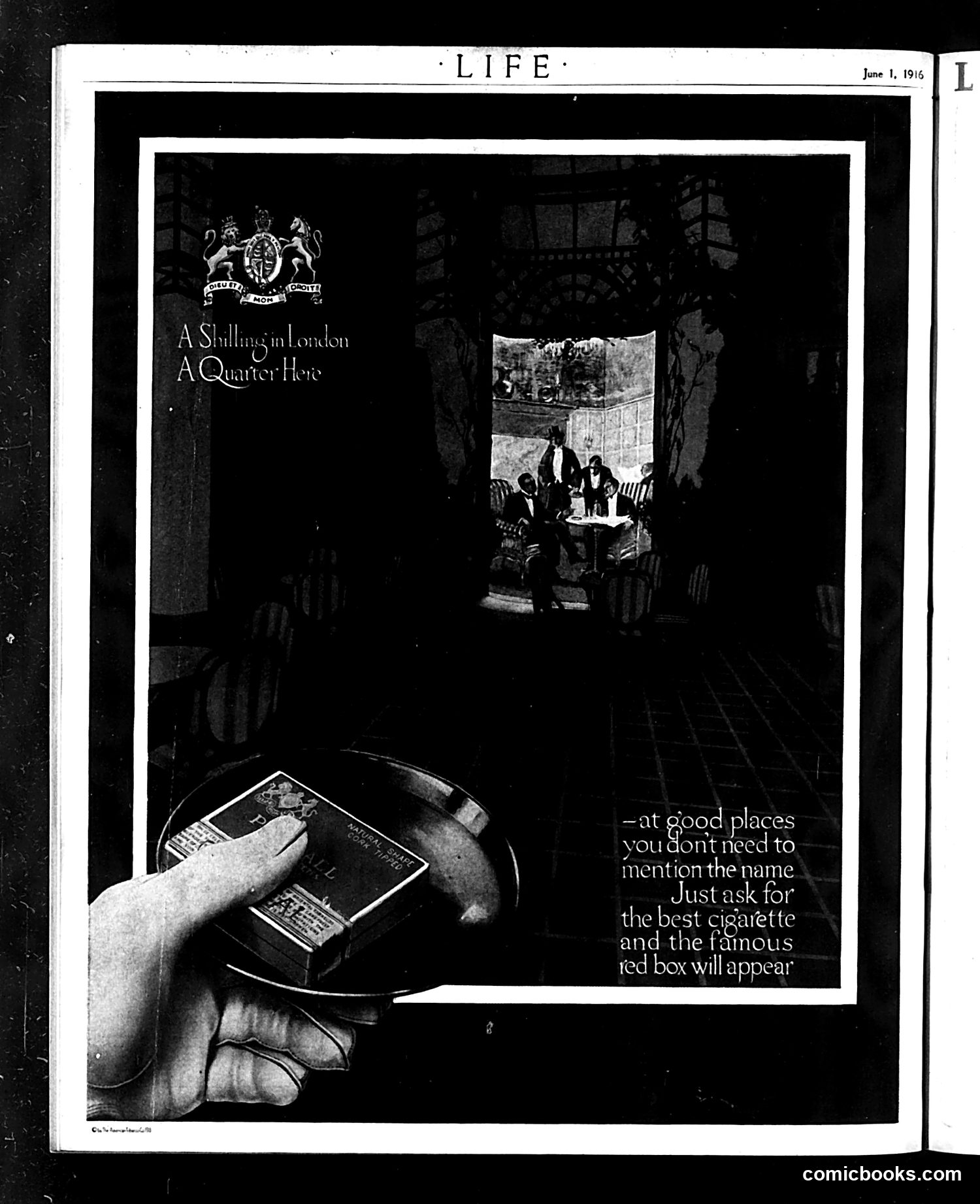
This is a cigarette advertisement disguised as satirical content in Life magazine (June 1, 1916). The ad shows a hand holding a cigarette box in what appears to be an upscale London establishment, with well-dressed diners visible in the background. The "joke" is that at prestigious venues, the product is so famous and desirable that patrons need only request "the best cigarette" without naming it—the distinctive red box will automatically materialize. This is aspirational advertising: smoking this brand signals membership in an elite social class where such goods are understood and expected. The phrase "A Shilling in London / A Quarter Here" suggests pricing comparison between British and American markets. The satire is minimal; this is primarily brand promotion wrapped in the magazine's satirical format.