
Life, 1916-06-01 · page 27 of 44
Life — June 1, 1916 — page 27: what you’re looking at
What you’re looking at
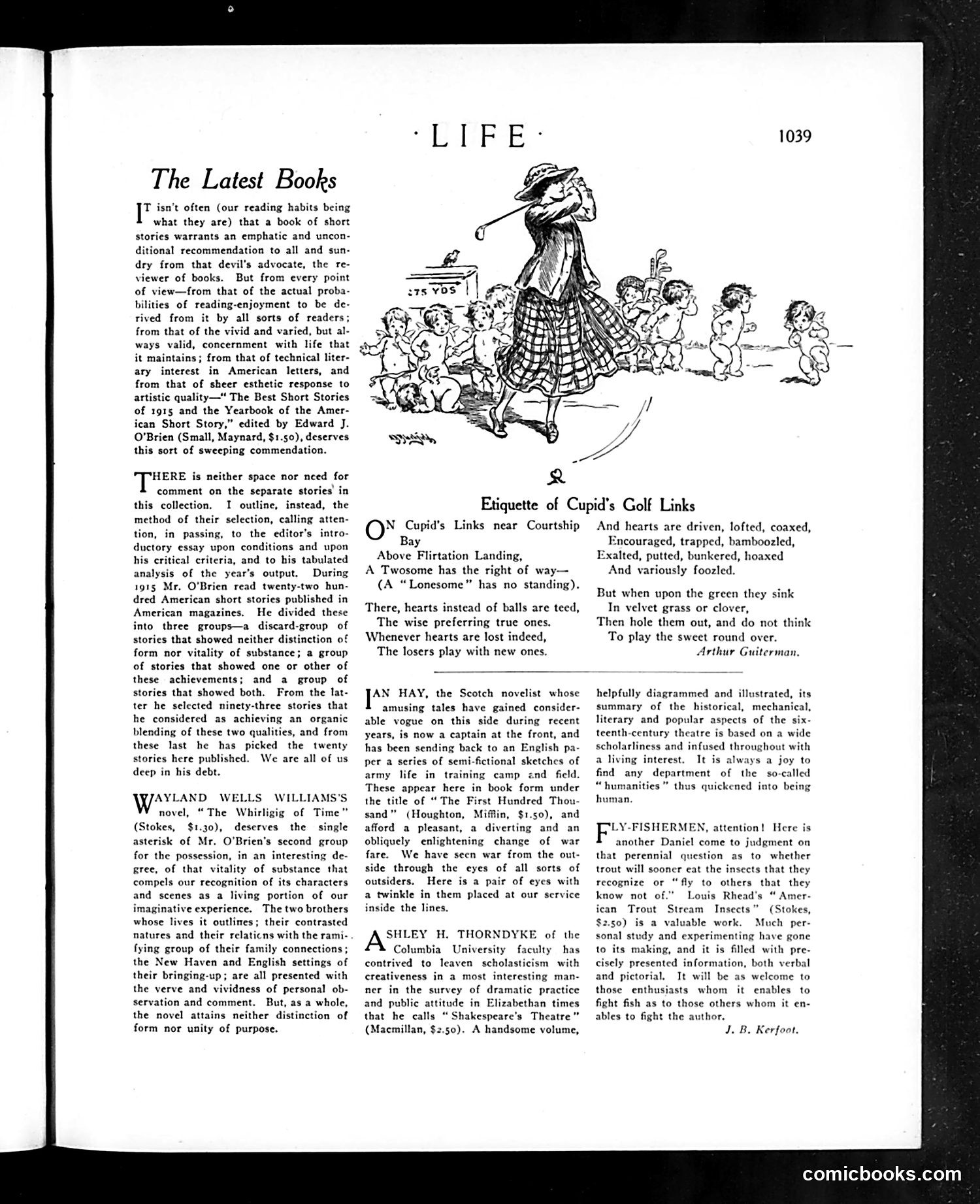
This is a **book review page**, not primarily a political cartoon. The main illustration shows a woman (representing "Cupid") playing golf with cherubs as caddies and spectators—a whimsical visual metaphor accompanying a poem about romantic "etiquette" using golf terminology. The page reviews four recent books: a 1915 short-story anthology, Wayland Wells Williams's novel "The Whirligig of Time," Ian Hay's military sketches "The First Hundred Thousand" (Hay was a Scotch novelist now serving as a captain in WWI), and Ashley H. Thorndyke's study of Elizabethan theatre. The satirical angle appears subtle here—the Cupid golf cartoon gently mocks courtship conventions ("hearts instead of balls are teed"), while the reviews themselves discuss serious literary merit without harsh mockery. This represents Life's typical 1916 blend of light illustration with substantive cultural criticism.
📄 Transcribed text from this page (OCR, searchable)
Machine-transcribed from the original scan — historical spelling and the odd misread are preserved.
The Latest Books T isn’t often (our reading habits being what they are) that a book of short stories warrants an emphatic and uncon- ditional recommendation to all and sun- dry from that devil's advocate, the re- viewer of books. But from every point of view—from that of the actual proba- bilities of reading-enjoyment to be de- rived from it by all sorts of readers; from that of the vivid and varied, but al- ways valid, concernment with life that it maintains; from that of technical liter- ary interest in American letters, and from that of sheer esthetic response to artistic quality—" The Best Short Stories of 1915 and the Yearbook of the Amer- n Short Story,” edited by Edward J. O'Brien (Small, Maynard, $1.50), deserves this sort of sweeping commendation. HERE is neither space nor need for comment on the separate stories’ in this collection. I outline, instead, the method of their selection, calling atten- tion, in passing, to the editor's intro- ductory essay upon conditions and upon his critical criteria, and to his tabulated analysis of the year’s output. During 1915 Mr. O'Brien read twenty-two hun- dred American short stories published in American magazines. He divided these into three groups—a discard-group of stories that showed neither distinction of form nor vitality of substance; a group of stories that showed one or other of these achievements; and a group of stories that showed both. From the lat- ter he selected ninety-three stories that he considered as achieving an organic blending of these two qualities, and from these last he has picked the twenty stories here published. We are all of us deep in his debt. 'AYLAND W S WILLIAMS'S novel, “The Whirligig of Time” (Stokes, $1.30), deserves the single asterisk of Mr. O'Brien's second group for the possession, in an interesting de- gree, of that vitality of substance that compels our recognition of its characters and scenes as a living portion of our imaginative experience. The two brothers whose lives it outlines; their contrasted natures and their relaticns with the rami- fying group of their family connections; the New Haven and English settings of their bringing-up; are all presented with the verve and vividness of personal ob- servation and comment. But, as a whole, the novel attains neither distinction of form nor unity of purpose. Etiquette of Cupid's Golf Links Cupid's Links near Courtship Bay Above Flirtation Landing, A Twosome has the right of way— (A “Lonesome” has no standing). There, hearts instead of balls are teed, The wise preferring true ones. Whenever hearts are lost indeed, The losers play with new ones. AN HAY, the Scotch novelist whose amusing tales have gained consider- able vogue on this side during recent years, is now a captain at the front, and has been sending back to an English pa- per a series of semi-fictional sketches of army life in training camp and field. These appear here in book form under the title of “The First Hundred Thou- sand” (Houghton, Mifflin, $1.50), and afford a pleasant, a diverting and an obliquely enlightening change of war fare. We have secn war from the out- side through the eyes of all sorts of outsiders. Here is a pair of eyes with a twinkle in them placed at our service inside the lines. SHLEY H. THORNDYKE of the Columbia University faculty has contrived to leaven scholasticism with creativeness in a most interesting man- ner in the survey of dramatic practice and public attitude in Elizabethan times that he calls “Shakespeare's. Theatre” (Macmillan, $2.50). A handsome volume, And hearts are driven, lofted, coaxed, Encouraged, trapped, bamboozled, Exalted, putted, bunkered, hoaxed And variously foozled. But when upon the green they sink In velvet grass or clover, Then hole them out, and do not think To play the sweet round over. Arthur Guiterman, helpfully diagrammed and illustrated, its summary of the historical, mechanical, literary and popular aspects of the six- teenth-century theatre is based on a wide scholarliness and infused throughout with a living interest. It is always a joy to find any department of the so-called “ humanities" thus quickened into being human. LY-FISHERMEN, attention! another Daniel come to judgment on that perennial question as to whether trout will sooner eat the insects that they recognize or “fly to others that they know not of.” Louis Rhead’s “ Amer- ican Trout Stream Insects” (Stokes, $2.50) is a valuable work. Much per- sonal study and experimenting have gone to its making, and it is filled with pre- cisely presented information, both verbal and pictorial. It will be as welcome to those enthusiasts whom it enables to fight fish as to those others whom it en- ables to fight the author. J.B. Kerfoot. Here is comicbooks.com