
Life, 1916-06-01 · page 20 of 44
Life — June 1, 1916 — page 20: what you’re looking at
What you’re looking at
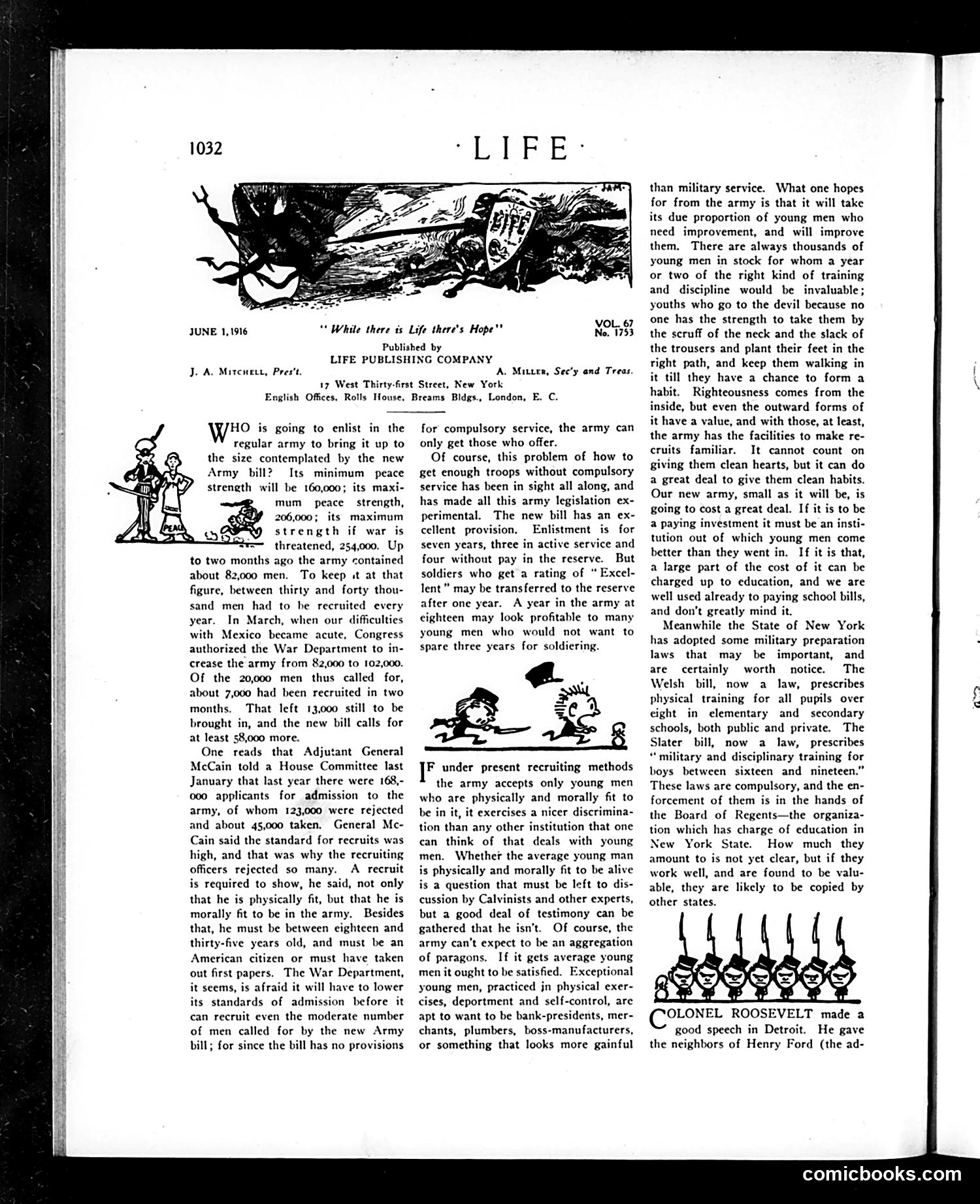
This page satirizes the U.S. Army's difficulty recruiting soldiers under the new Army bill (June 1916). The article discusses the contradiction between the War Department's high admission standards and its recruitment failures. **The satire's target:** General McCain claimed the army rejected applicants because standards were "high," yet the army struggled to recruit even modest numbers without compulsory service. The author mocks this disconnect—if the average young man is morally and physically unfit (a point debated by "Calvinists and other experts"), how can selective standards explain recruitment shortfalls? **The real critique:** The army actually needs to accept "average young men" who require discipline and improvement, not paragons. By maintaining impossible standards while facing recruitment crises, the War Department appears either dishonest about its criteria or unrealistic about available manpower. The small cartoons (showing soldiers/recruitment imagery) reinforce the theme of military training and preparation. This reflects pre-WWI American debates over military readiness and whether conscription would become necessary.
📄 Transcribed text from this page (OCR, searchable)
Machine-transcribed from the original scan — historical spelling and the odd misread are preserved.
JUNE 1,1916 ‘* While there is Life there's Hope" No, 1753 Published by LIFE PUBLISHING COMPANY J. A. Mitewent, Pres’t. HO is going to enlist in the regular army to bring it up to the size contemplated by the new Army bill? Its minimum peace strength will be 160,000; its maxi- mum peace strength, 206,000; its maximum strength if war is threatened, 254,000. Up to two months ago the army contained about 82,000 men. To keep st at that figure, between thirty and forty thou- sand men had to be recruited every year. In March, when our difficulties with Mexico became acute, Congress authorized the War Department to in- crease the army from 82,000 to 102,000. Of the 20,000 men thus called for, about 7,000 had been recruited in two months, That left 13,000 still to be brought in, and the new bill calls for at least 58,000 more. One reads that Adjutant General McCain told a House Committee last January that last year there were 168,- 000 applicants for admission to the army, of whom 123,000 were rejected and about 45,000 taken. General Mc- Cain said the standard for recruits was high, and that was why the recruiting officers rejected so many. A recruit is required to show, he said, not only that he is physically fit, but that he is morally fit to be in the army, Besides that, he must be between eighteen and thirty-five years old, and must be an American citizen or must have taken out first papers. The War Department, it seems, is afraid it will have to lower its standards of admission before it can recruit even the moderate number of men called for by the new Army bill; for since the bill has no provisions A. Mitten, Sec’y and Treas. 17 West Thirty-first Street, New York English Offices, Rolls House, Breams Bldgs., London, E. C. for compulsory service, the army can only get those who offer. Of course, this problem of how to get enough troops without compulsory service has been in sight all along, and has made all this army legislation ex- perimental. The new bill has an ex- cellent provision. Enlistment is for seven years, three in active service and four without pay in the reserve. But soldiers who get a rating of “ Excel- lent” may be transferred to the reserve after one year. A year in the army at eighteen may look profitable to many young men who would not want to spare three years for soldiering. F under present recruiting methods the army accepts only young men who are physically and morally fit to be in it, it exercises a nicer discrimina- tion than any other institution that one can think of that deals with young men. Whether the average young man is physically and morally fit to be alive is a question that must be left to dis- cussion by Calvinists and other experts, but a good deal of testimony can be gathered that he isn’t. Of course, the army can’t expect to be an aggregation of paragons. If it gets average young men it ought to be satisfied. Exceptional young men, practiced jn physical exer- cises, deportment and self-control, are apt to want to be bank-presidents, mer- chants, plumbers, boss-manufacturers, or something that looks more gainful than military service. What one hopes for from the army is that it will take its due proportion of young men who need improvement, and will improve them. There are always thousands of young men in stock for whom a year or two of the right kind of training and discipline would be invaluable; youths who go to the devil because no one has the strength to take them by the scruff of the neck and the slack of the trousers and plant their feet in the right path, and keep them walking in it till they have a chance to form a habit. Righteousness comes from the inside, but even the outward forms of it have a value, and with those, at least, the army has the facilities to make re- cruits familiar. It cannot count on giving them clean hearts, but it can do a great deal to give them clean habits. Our new army, small as it will be, is going to cost a great deal. If it is to be a paying investment it must be an insti- tution out of which young men come better than they went in. If it is that, a large part of the cost of it can be charged up to education, and we are well used already to paying school bills, and don’t greatly mind it. Meanwhile the State of New York has adopted some military preparation laws that may be important, and are certainly worth notice. The Welsh bill, now a law, prescribes physical training for all pupils over eight in elementary and secondary schools, both public and private. The Slater bill, now a law, prescribes “military and disciplinary training for boys between sixteen and nineteen.” These laws are compulsory, and the en- forcement of them is in the hands of the Board of Regents—the organiza- tion which has charge of education in New York State. How much they amount to is not yet clear, but if they work well, and are found to be valu- able, they are likely to be copied by other states. OLONEL ROOSEVELT made a good speech in Detroit. He gave the neighbors of Henry Ford (the ad- comicbooks.com