
Life, 1916-06-01 · page 21 of 44
Life — June 1, 1916 — page 21: what you’re looking at
What you’re looking at
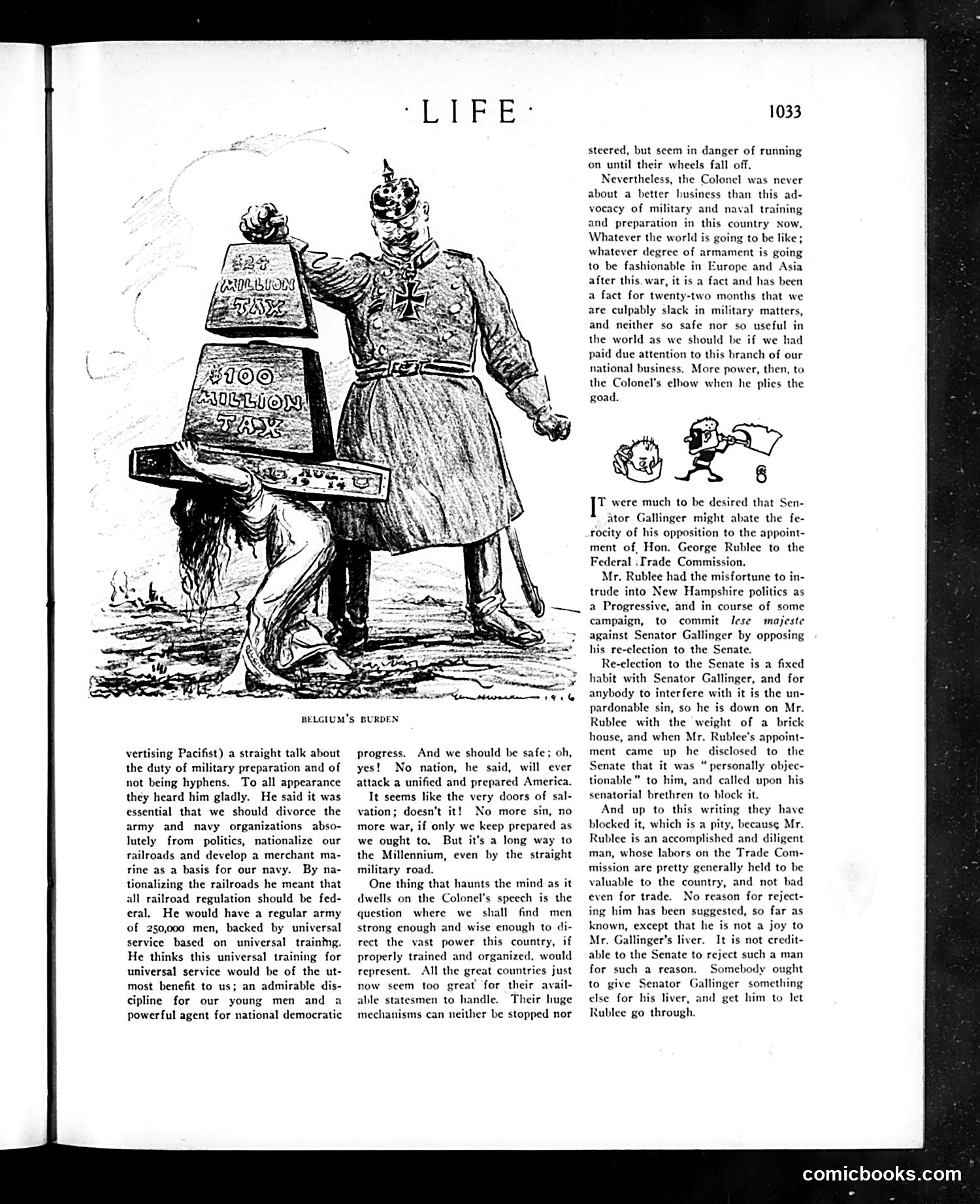
The main cartoon depicts **Belgium** (personified as a woman) crushed beneath stacked military burdens—labeled "MUNITIONS" and "100 MILLION PACK"—while two German military figures (identifiable by their spiked helmets) oversee her oppression. This illustrates Belgium's devastation under German occupation during World War I. The accompanying text discusses **Colonel** (likely Theodore Roosevelt) advocating for American military preparedness and universal military training. The article supports this position while criticizing American complacency. The second section attacks **Senator Gallinger** of New Hampshire for opposing **George Rublee's** appointment to the Federal Trade Commission solely because Rublee—a Progressive—once opposed Gallinger's Senate re-election. The satirist condemns this petty vindictiveness as unpatriotic and argues Rublee is qualified and valuable to the nation, but Gallinger's personal grudge blocks him from serving.
📄 Transcribed text from this page (OCR, searchable)
Machine-transcribed from the original scan — historical spelling and the odd misread are preserved.
o hss Xe * BELGIUM'S BURDEN vertising Pacifist) a straight talk about the duty of military preparation and of not being hyphens. To all appearance they heard him gladly. He said it was essential that we should divorce the army and navy organizations abso- lutely from politics, nationalize our railroads and develop a merchant ma- rine as a basis for our navy. By na- tionalizing the railroads he meant that all railroad regulation should be fed- eral. He would have a regular army of 250,000 men, backed by universal service based on universal training. He thinks this universal training for universal service would be of the ut- most benefit to us; an admirable dis- cipline for our young men and a powerful agent for national democratic progress. And we should be safe; oh, yes! No nation, he said, will ever attack a unified and prepared America. It seems like the very doors of sal- vation; doesn’t it! No more sin, no more war, if only we keep prepared as we ought to. But it’s a long way to the Millennium, even by the straight military road. One thing that haunts the mind as it dwells on the Colonel's speech is the question where we shall find men strong enough and wise enough to di- rect the vast power this country, if properly trained and organized, would represent. All the great countries just now seem too great for their avail- able statesmen to handle. Their huge mechanisms can neither be stopped nor 1033 steered, but seem in danger of running on until their wheels fall off. Nevertheless, the Colonel was never about a better business than this ad- vocacy of military and naval training and preparation in this country now, Whatever the world is going to be like; whatever degree of armament is going to be fashionable in Europe and Asia after this. war, it is a fact and has been a fact for twenty-two months that we are culpably slack in military matters, and neither so safe nor so useful in the world as we should be if we had paid due attention to this branch of our national business. More power, then, to the Colonel's elbow when he plies the goad. QRS T were much to be desired that Sen- ator Gallinger might abate the fe: rocity of his opposition to the appoint- ment of, Hon. George Rublee to the Federal .Trade Commission. Mr. Rublee had the misfortune to in- trude into New Hampshire politics as a Progressive, and in course of some campaign, to commit lese majeste against Senator Gallinger by opposing his re-election to the Senate. Re-election to the Senate is a fixed habit with Senator Gallinger, and for anybody to interfere with it is the un- pardonable sin, so he is down on Mr. Rublee h the weight of a brick house, and when Mr. Rublee’s appoint- ment came up he disclosed to the Senate that it was “personally objec- tionable” to him, and called upon his senatorial brethren to block it. And up to this writing they have blocked it, which is a pity, becausg Mr. Rublee is an accomplished and diligent man, whose labors on the Trade Com- mission are pretty generally held to be valuable to the country, and not bad even for trade. No reason for reject- ing him has been suggested, so far as known, except that he is not a joy to Mr. Gallinger’s liver. It is not credit- able to the Senate to reject such a man for such a reason. Somebody ought to give Senator Gallinger something else for his liver, and get him to let Rublee go through. comicbooks.com