
Life, 1916-06-01 · page 28 of 44
Life — June 1, 1916 — page 28: what you’re looking at
What you’re looking at
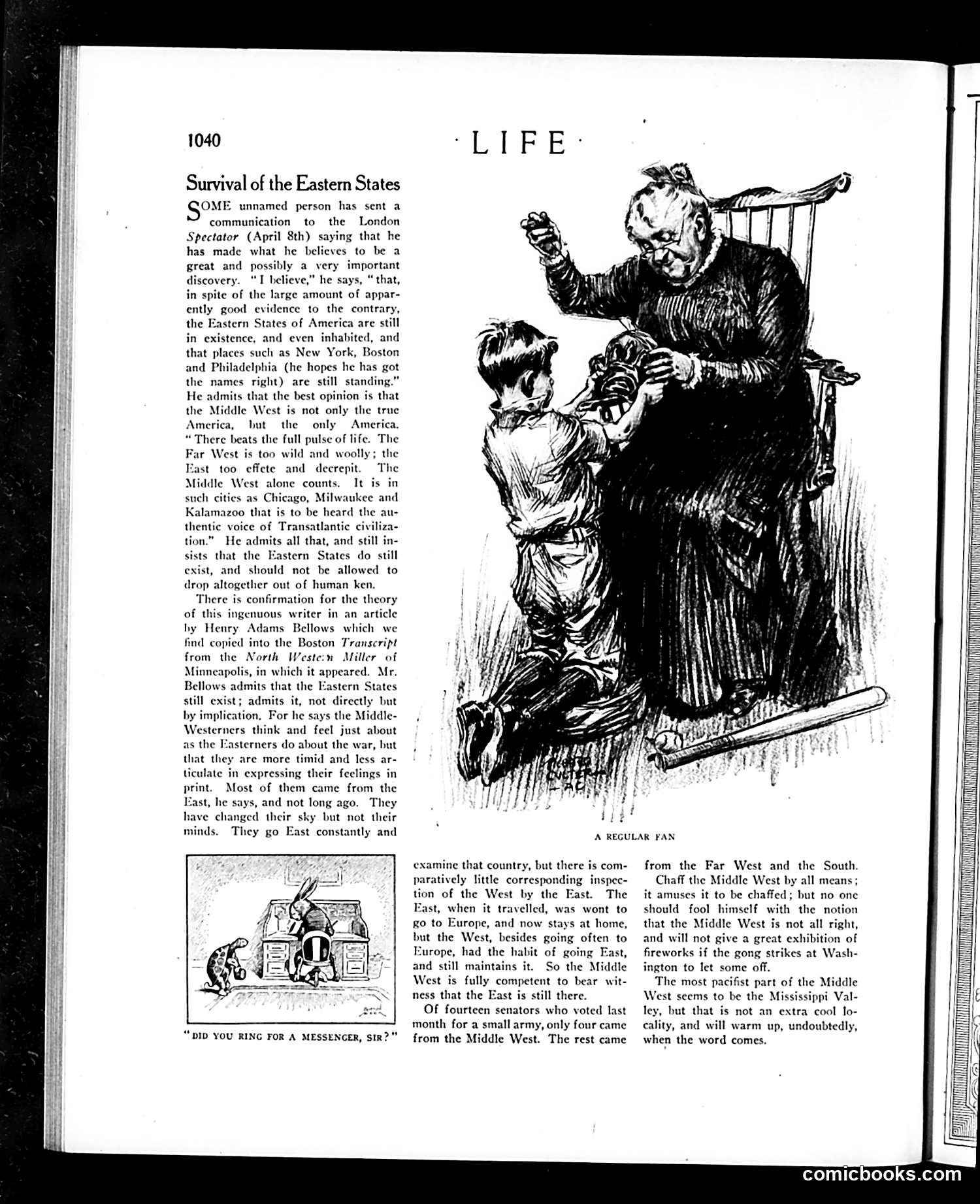
This satirical piece mocks the cultural dominance of America's Midwest in the early 20th century. The unnamed London *Spectator* correspondent humorously "discovers" that Eastern cities like New York, Boston, and Philadelphia still exist—implying they've been culturally dismissed as irrelevant by Americans who view the Middle West (Chicago, Milwaukee, Kalamazoo) as the "true America." The article argues Eastern elites have become "effete and decrepit" while the Midwest represents authentic American vitality. However, the piece defends the East, noting Middle Westerners are mostly Eastern emigrants maintaining Eastern values—they just express themselves less publicly. The cartoon captioned "A REGULAR FAN" (right) shows an adult male enthusiast, likely representing Midwestern cultural pride or bombastic patriotism. The smaller cartoon ("Did you ring for a messenger, sir?") appears to mock social pretension, though its specific reference is unclear from context alone.
📄 Transcribed text from this page (OCR, searchable)
Machine-transcribed from the original scan — historical spelling and the odd misread are preserved.
1040 Survival of the Eastern States OME unnamed person has sent a communication the London Spectator (April 8th) saying that he has made what he believes to be a great and possibly a very important discovery. “I believe,” he says, “ that, in spite of the large amount of appar- ently good evidence to the contrary, the Eastern States of America are still in existence, and even inhabited, and that places such as New York, Boston and Philadelphia (he hopes he has got the names right) are still standin, He admits that the best opinion is that the Middle West is not only the true America, but the only America. “There beats the full pulse of life. The Far West is too wild and woolly; the East too effete and decrepit. The Middle West alone counts. It is in such cities as Chicago, Milwaukee and Kalamazoo that is to be heard the au- then oice of Transatlantic civiliza- tion.” He admits all that, and still in- sists that the Eastern States do still exist, and should not be allowed to drop altogether out of human ken, There is confirmation for the theory of this ingenuous writer in an article hy Henry Adams Bellows which we find copied into the Boston Transcript from the North Weste:n Miller of Minneapolis, in which it appeared. Mr. Bellows admits that the Eastern States still exist; admits it, not directly but by implication, For he says the Middle- Westerners think and feel just about as the Easterners do about the war, but that they are more timid and less ar- ticulate in expressing their feelings in print. Most of them came from the East, he and not long ago. They have changed their sky but not their minds. They go East constantly and “DID YOU RING FOR A MESSENGER, SIR?" ULAR FAN examine that country, but there is com- paratively little corresponding inspec- tion of the West by the East. The East, when it travelled, was wont to go to Europe, and now s! at home, but the West, besides going often to Europe, had the habit of going East, and still maintains it. So the Middle West is fully competent to bear wit- ness that the East is still there. Of fourteen senators who voted last month for a small army, only four came from the Middle West. The rest came from the Far West and the South Chaff the Middle West by all means; it amuses it to be chaffed; but no one should fool himself with the notion that the Middle West is not all right, and will not give a great exhibition of fireworks if the gong strikes at Wash- ington to let some off. The most pacifist part of the Middle West seems to be the Mississippi Val- ley, but that is not an extra cool lo- cality, and will warm up, undoubtedly, when the word comes. comicbooks.com