
Life, 1916-06-01 · page 10 of 44
Life — June 1, 1916 — page 10: what you’re looking at
What you’re looking at
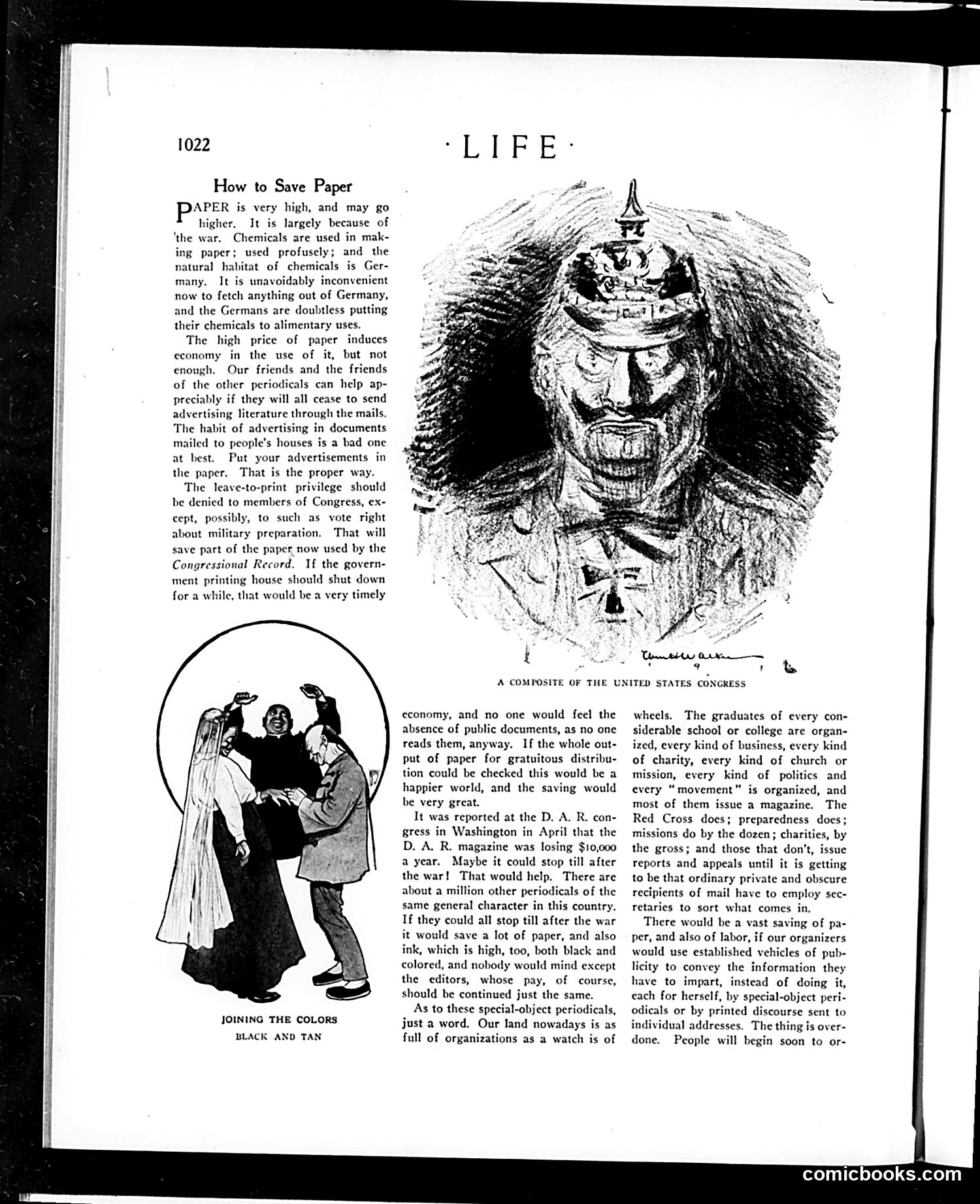
**"How to Save Paper"** is a wartime economy piece (references "the war" and German chemical use). The main cartoon depicts a grotesque German military figure—identifiable by the spiked helmet and iron cross—representing Germany's resource consumption. The accompanying editorial argues Americans should conserve paper by: - Stopping advertising mail circulation - Denying Congressional printing privileges except for military matters - Halting government printing temporarily A secondary cartoon labeled "Joining the Colors: Black and Tan" shows a figure joining military service. The satire criticizes wasteful American practices (especially congressional documents and periodical advertising) while framing paper conservation as patriotic duty during WWI. The German caricature emphasizes the enemy's material desperation, justifying American sacrifice.
📄 Transcribed text from this page (OCR, searchable)
Machine-transcribed from the original scan — historical spelling and the odd misread are preserved.
1022 How to Save Paper APER is very high, and may go higher, It is largely because of ‘the war. Chemicals are used in mak- ing paper; used profusely; and the natural habitat of chemicals is Ger- many. It is unavoidably inconvenient now to fetch anything out of Germany, and the Germans are doubtless putting their chemicals to alimentary uses. The high price of paper induces economy in the use of it, but not enough. Our friends and the friends of the other periodicals can help ap- preciably if they will all cease to send advertising literature through the mails. The habit of advertising in documents mailed to people's houses is a bad one at best. Put your advertisements in the paper. That is the proper way. The leave-to-print privilege should be denied to members of Congress, ex- cept, possibly, to such as vote right about military preparation. That will save part of the paper now used by the Congressional Record. If the govern- ment printing house should shut down for a while, that would be a very timely JOINING THE COLORS BLACK AND TAN A COMPOSITE OF THE UNITED STATES CONGRESS economy, and no one would feel the absence of public documents, as no one reads them, anyway. If the whole out- put of paper for gratuitous distribu- tion could be checked this would be a happier world, and the saving would be very great. It was reported at the D. A. R. con- gress in Washington in April that the D. A. R. magazine was losing $10,000 a year. Maybe it could stop till after the war! That would help. There are about a million other periodicals of the same general character in this country. If they could all stop till after the war it would save a lot of paper, and also ink, which is high, too, both black and colored, and nobody would mind except the editors, whose pay, of course, should be continued just the same. As to these special-object periodicals, just a word. Our land nowadays is as full of organizations as a watch is of wheels, The graduates of every con- siderable school or college are organ- ized, every kind of business, every kind of charity, every kind of church or mission, every kind of politics and every “movement” is organized, and most of them issue a magazine. The Red Cross does; preparedness does; missions do by the dozen; charities, by the gross; and those that don't, issue reports and appeals until it is getting to be that ordinary private and obscure recipients of mail have to employ sec- retaries to sort what comes in. There would be a vast saving of pa- per, and also of labor, if our organizers would use established vehicles of pub- licity to convey the information they have to impart, instead of doing it, each for herself, by special-object peri- odicals or by printed discourse sent to individual addresses. The thing is over- done. People will begin soon to or- comicbooks.com