
Life, 1916-06-01 · page 24 of 44
Life — June 1, 1916 — page 24: what you’re looking at
What you’re looking at
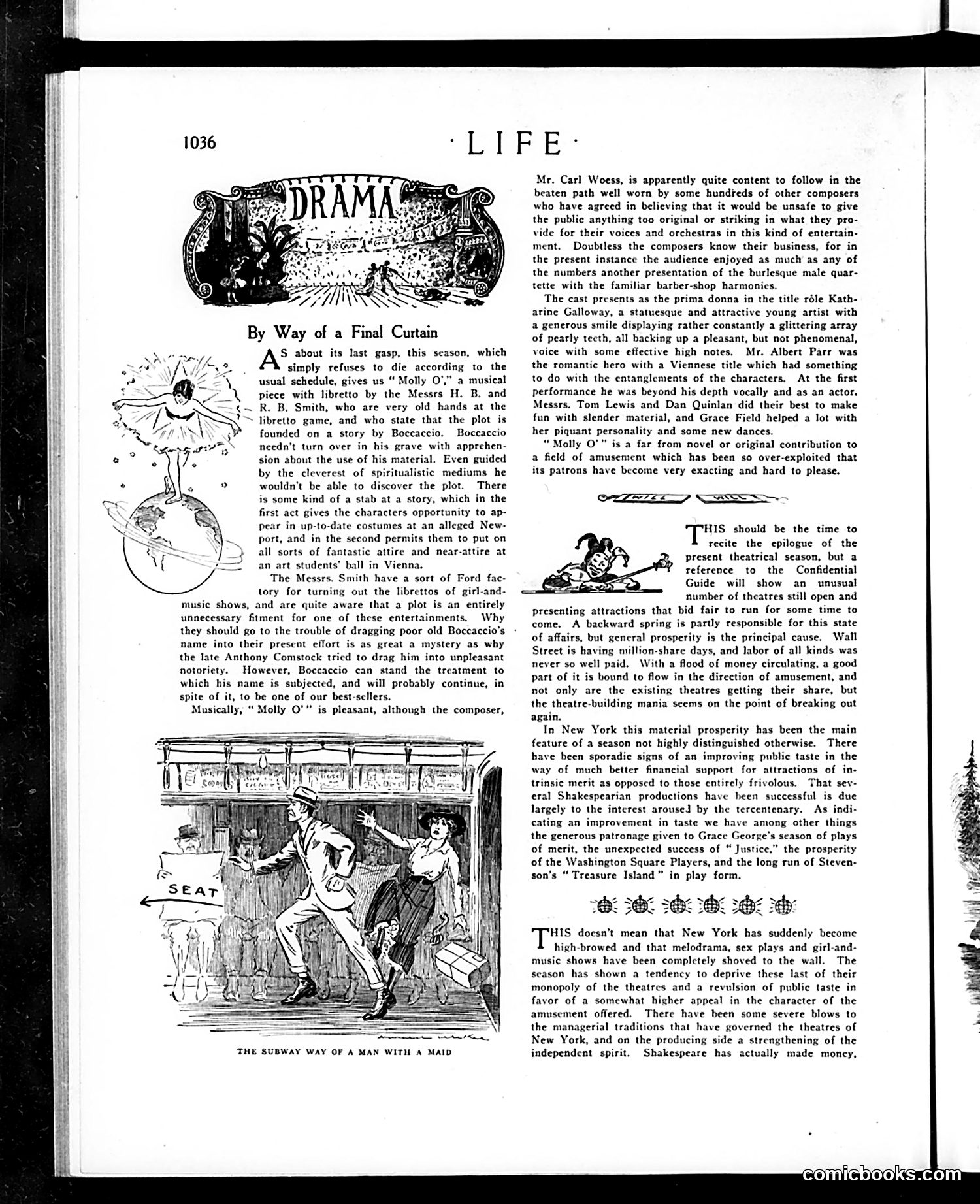
This is a theater review of the musical "Molly O'" by the Smith brothers (H.B. and R.B. Smith), satirizing formulaic Broadway musicals of the era. The critic mocks the show's threadbare plot—supposedly based on Boccaccio but bearing no resemblance—arguing that girl-and-music shows require no actual story, just excuses for actresses in fashionable costumes and men performing familiar barber-shop quartet numbers. The accompanying cartoon ("The Subway Way of a Man with a Maid") depicts a romantic encounter in a subway car, likely parodying the show's thin romantic plot or contemporary romantic comedies. The review criticizes composer Carl Woess for unoriginal music and most cast members for mediocre performances, though praising Katharine Galloway's stage presence. The author suggests Broadway's profitability (Wall Street prosperity, abundant labor wages) enables such uninspired theatrical production to succeed financially.
📄 Transcribed text from this page (OCR, searchable)
Machine-transcribed from the original scan — historical spelling and the odd misread are preserved.
‘LIFE By Way of a Final Curtain AS about its last gasp, this season, which simply refuses to die according to the usual schedule, gives us “ Molly O',” a musical piece with libretto by the Messrs H. B. and R. B, Smith, who are very old hands at the libretto game, and who state that the plot is founded on a story by Boccaccio. Boccaccio needn’t turn over in his grave with apprehen- sion about the use of his material. Even guided by the cleverest of spiritualistic mediums he wouldn't be able to discover the plot. There is some kind of a stab at a story, which in the first act gives the characters opportunity to ap- pear in up-to-date costumes at an alleged New- port, and in the second permits them to put on all sorts of fantastic attire and near-attire at an art students’ ball in Vienna. The Messrs. Smith have a sort of Ford fac- tory for turning out the librettos of girl-and- music shows, and are quite aware that a plot is an entirely unnecessary fitment for one of these entertainments. Why they should go to the trouble of dragging poor old Boccaccio’s name into their present effort is as great a mystery as why the late Anthony Comstock tried to drag him into unpleasant notoriety. However, Boccaccio can stand the treatment to which his name is subjected, and will probably continue, in spite of it, 10 be one of our best-sellers. Musically, “ Molly O°” is pleasant, although the composer, THE SUBWAY WAY OF A MAN WITH A MAID Mr. Carl Woess, is apparently quite content to follow in the beaten path well worn by some hundreds of other composers who have agreed in believing that it would be unsafe to give the public anything too original or striking in what they pro- vide for their voices and orchestras in this kind of entertain- ment. Doubtless the composers know their business, for in the present instance the audience enjoyed as much as any of the numbers another presentation of the burlesque male quar- tette with the familiar barber-shop harmonics. The cast presents as the prima donna in the title réle Kath- arine Galloway, a statuesque and attractive young artist with a generous smile displaying rather constantly a glittering array of pearly tecth, all backing up a pleasant, but not phenomenal, voice with some effective high notes. Mr. Albert Parr was the romantic hero with a Viennese title which had something to do with the entanglements of the characters. At the first performance he was beyond his depth vocally and as an actor. Messrs. Tom Lewis and Dan Quinlan did their best to make fun with slender material, and Grace Field helped a lot with her piquant personality and some new dances. “Molly O'" is a far from novel or original contribution to a field of amusement which has been so over-exploited that its patrons have become very exacting and hard to please. ome SSS HIS should be the time to recite the epilogue of the Present theatrical season, but a reference to the Confidential Guide will show an unusual number of theatres still open and Presenting attractions that bid fair to run for some time to come. A backward spring is partly responsible for this state of affairs, but gencral prosperity is the principal cause. Wall Street is having million-share days, and labor of all kinds was never so well paid. With a flood of money circulating, a good part of it is bound to flow in the direction of amusement, and not only are the existing theatres getting their share, but the theatre-building mania seems on the point of breaking out again. In New York this material prosperity has been the main feature of a season not highly distinguished otherwise. There have been sporadic signs of an improving public taste in the way of much better financial support for attractions of in- trinsic merit as opposed to those entirely frivolous. That sev- eral Shakespearian productions have heen successful is due largely to the interest aroused by the tercentenary. As indi- cating an improvement in taste we have among other things the generous patronage given to Grace George's season of plays of merit, the unexpected success of “Justice,” the prosperity of the Washington Square Players, and the long run of Steven- son’s “Treasure Island” in play form. ~@yt Teac aa: tebe sah 266 566 KO HIS doesn’t mean that New York has suddenly become high-browed and that melodrama, sex plays and girl-and- music shows have been completely shoved to the wall. The season has shown a tendency to deprive these last of their monopoly of the theatres and a revulsion of public taste in favor of a somewhat higher appeal in the character of the amusement offered. There have been some severe blows to the managerial traditions that have governed the theatres of New York, and on the producing side a strengthening of the independent spit Shakespeare has actually made moncy,