
A complete issue · 44 pages · 1916
Life — April 27, 1916
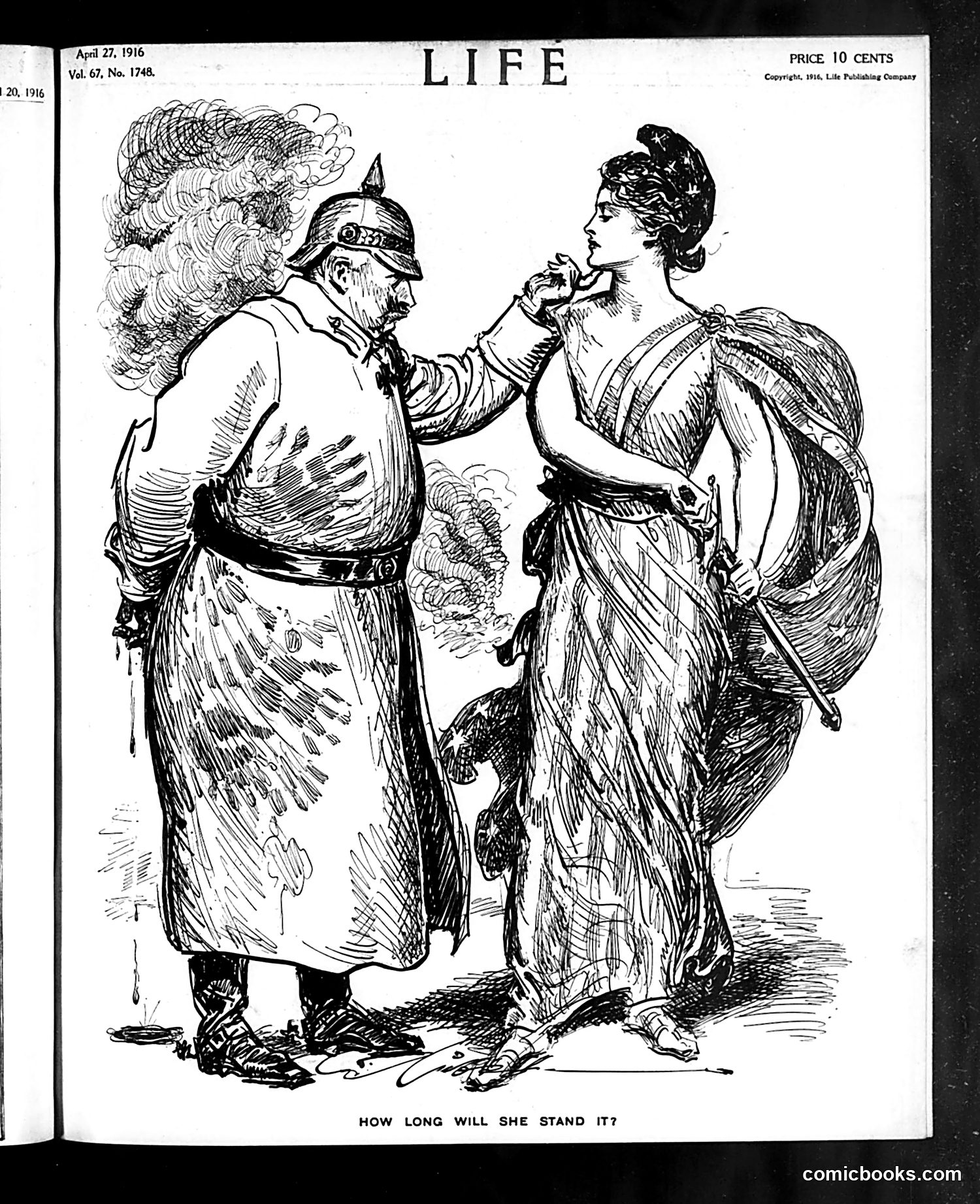
This April 1916 *Life* magazine cartoon depicts a German military officer (identifiable by the spiked Prussian helmet) confronting a woman in classical dress, likely representing either Liberty or a neutral nation. The caption "HOW LONG WILL SHE STAND IT?" suggests commentary on enduring German aggression during World War I. The woman's defensive posture and the officer's aggressive approach satirize German militarism. Given the 1916 date—before U.S. entry into WWI—this likely critiques either American patience with German conduct (unrestricted submarine warfare) or questions how long neutral nations could resist Prussian pressure. The classical female figure emphasizes civilization under threat from militaristic brutality, a common rhetorical device in anti-German wartime propaganda.
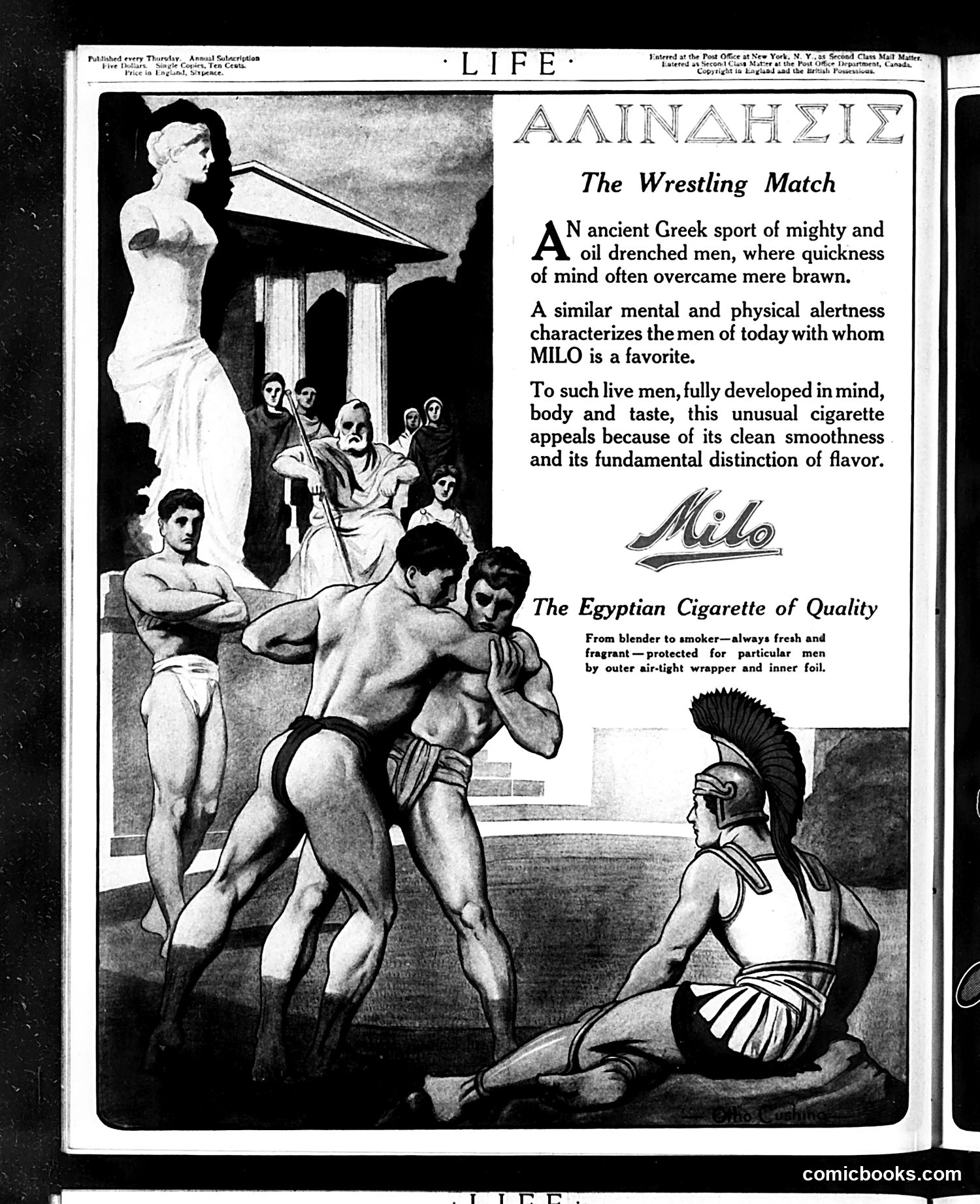
This page is primarily a **cigarette advertisement for Milo**, not political satire. The ad uses classical imagery—depicting ancient Greek wrestling—to market cigarettes to men by associating the product with physical prowess, mental alertness, and refined taste. The headline "The Wrestling Match" draws a parallel between Greek athletes' combination of strength and intelligence with modern men who smoke Milo. The ad explicitly targets "fully developed" men, suggesting that smoking Milo signals sophistication and athleticism to potential consumers. This represents early 20th-century advertising strategy: linking cigarettes to idealized masculinity and classical civilization. The "Egyptian Cigarette of Quality" tagline emphasizes exotic appeal and premium positioning. By modern standards, the health claims and masculine targeting appear deeply problematic.
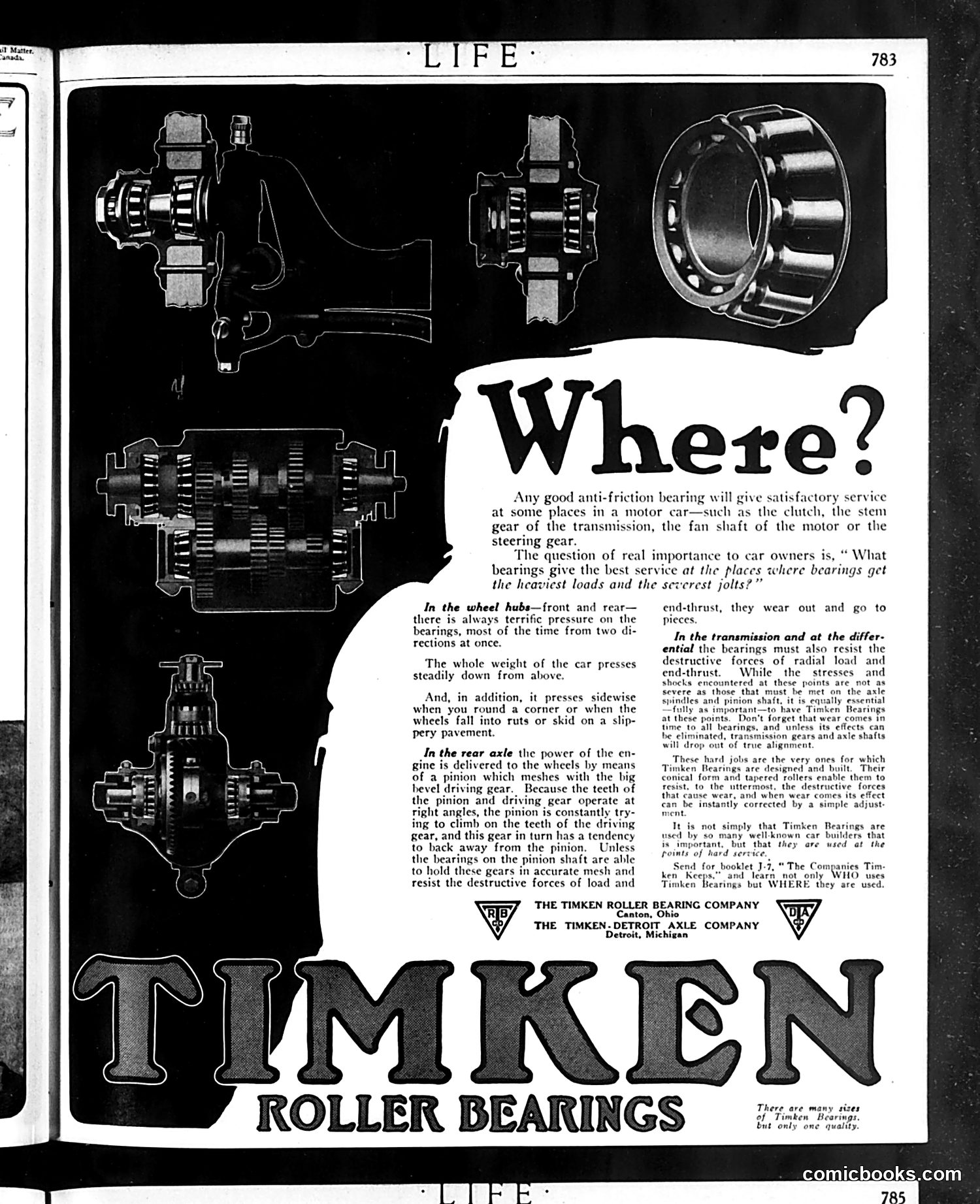
This is **not a political cartoon or satire**—it's a straightforward advertisement for Timken Roller Bearings, published in *Life* magazine (page 783). The page displays technical diagrams of automobile bearing components: wheel hubs, transmission gears, differentials, and pinion shafts. The accompanying text explains where bearings are used in vehicles and why Timken bearings specifically perform well under stress. The headline "Where?" poses a rhetorical question answered by the detailed technical explanation: Timken bearings belong in critical automotive locations where friction and load are heaviest. The advertisement emphasizes durability and precision engineering as selling points. This represents typical early-20th-century industrial advertising, using educational content about mechanical components to build brand credibility among vehicle owners and mechanics.
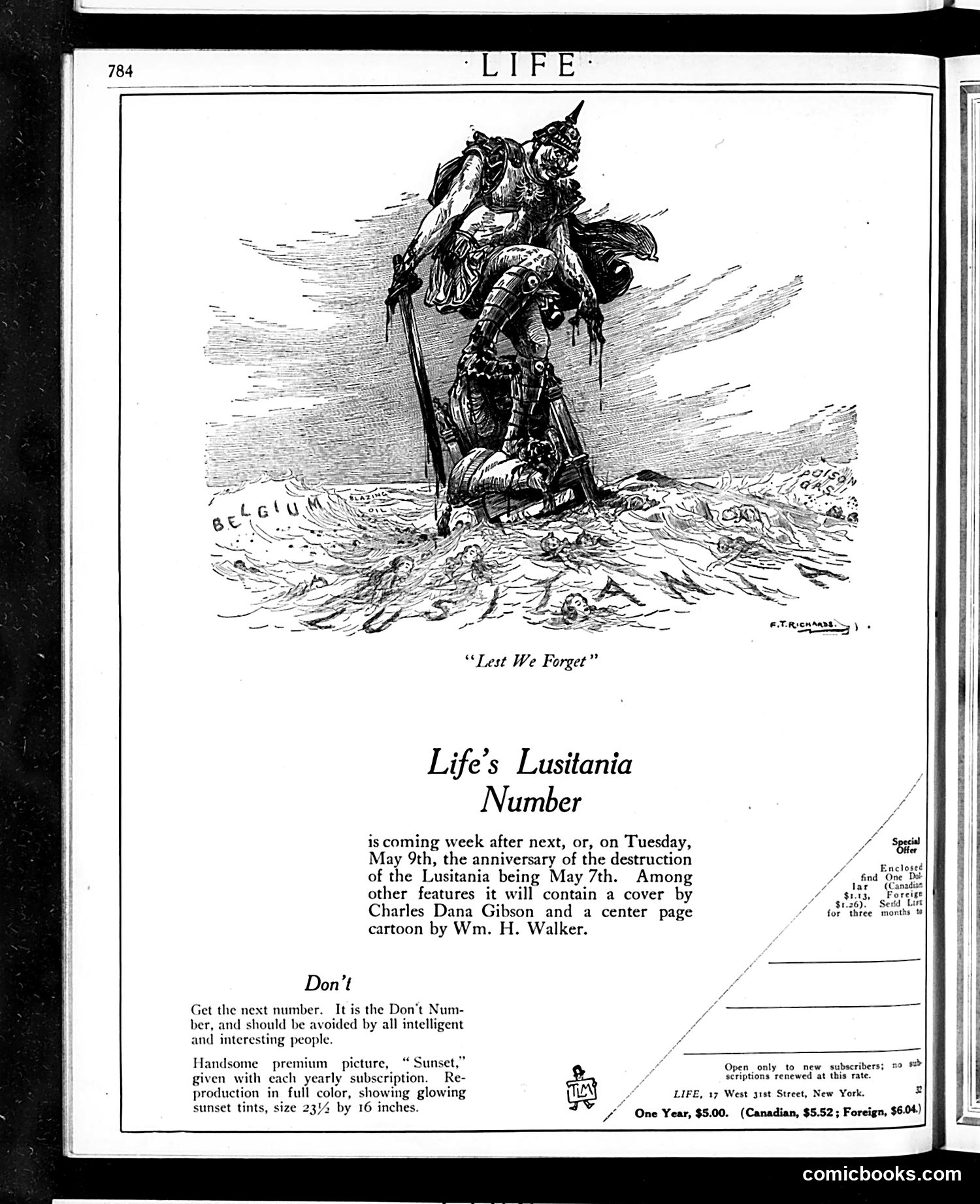
This editorial cartoon commemorates the sinking of the RMS Lusitania, which occurred on May 7th (the text references an upcoming anniversary issue on May 9th). The image depicts a demonic or skeletal figure—likely representing Germany or the perpetrator of the attack—impaled on a sword or spike, standing amid battlefield debris labeled "Belgium." The cartoon conflates two major German atrocities from World War I: the invasion of Belgium and the 1915 Lusitania sinking, which killed nearly 1,200 civilians including 128 Americans. The title "Lest We Forget" urges remembrance of these war crimes. The grotesque imagery serves to demonize Germany and rally American sentiment, particularly relevant as the U.S. was debating entry into the war.
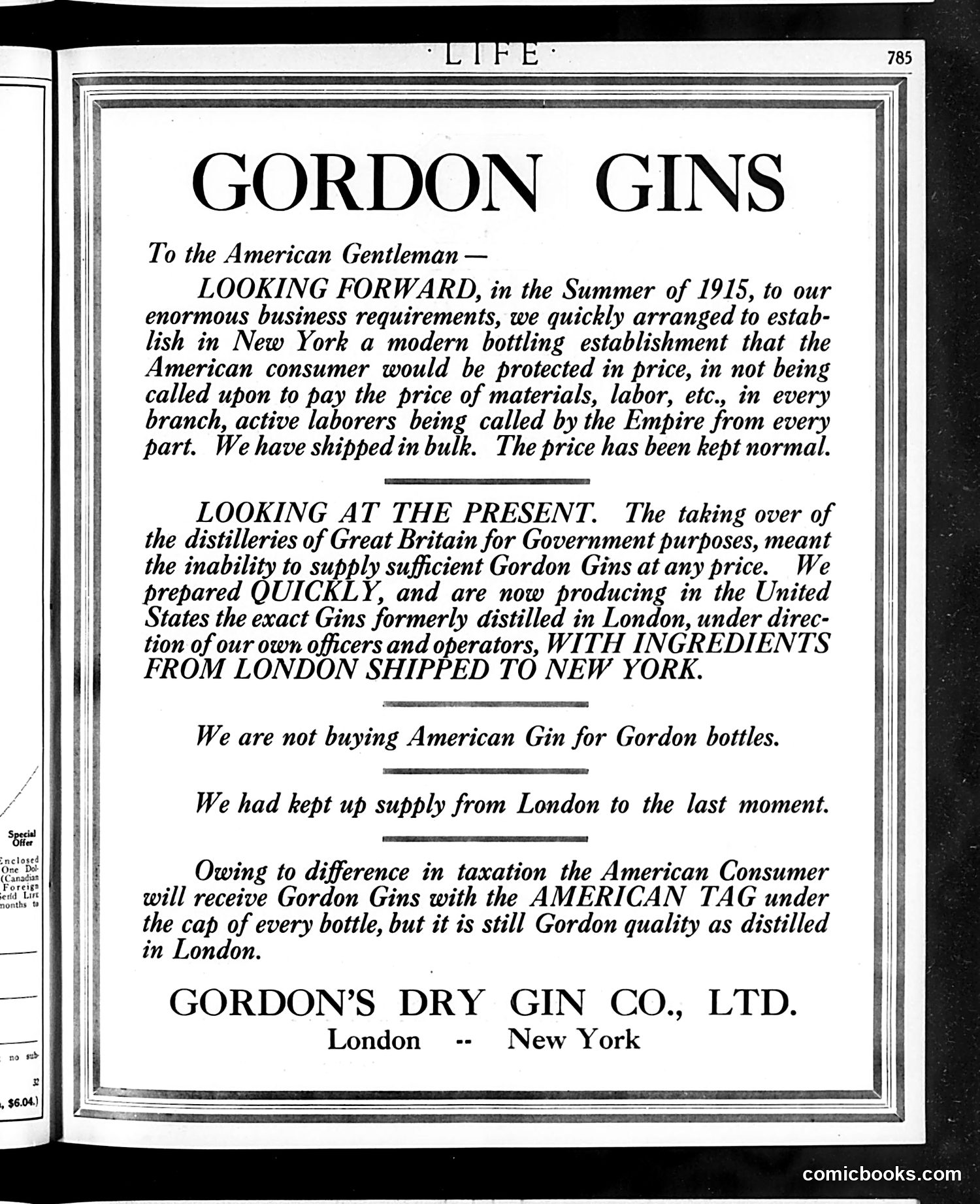
This is **not a cartoon or satire page** — it's a straightforward advertisement for Gordon's Dry Gin, placed in *Life* magazine (page 785). The ad addresses American consumers during World War I (1915 context mentioned). It explains that Gordon's, a London gin distillery, had to relocate production to New York because British distilleries were commandeered by the British government for war purposes. The company emphasizes that despite American production, they're using ingredients shipped from London to maintain quality. Notably, they stress they're **not** using American gin as a substitute, and bottles will carry an "American tag" due to taxation differences—but remain "Gordon quality as distilled in London." This is essentially a wartime business explanation, not satire.
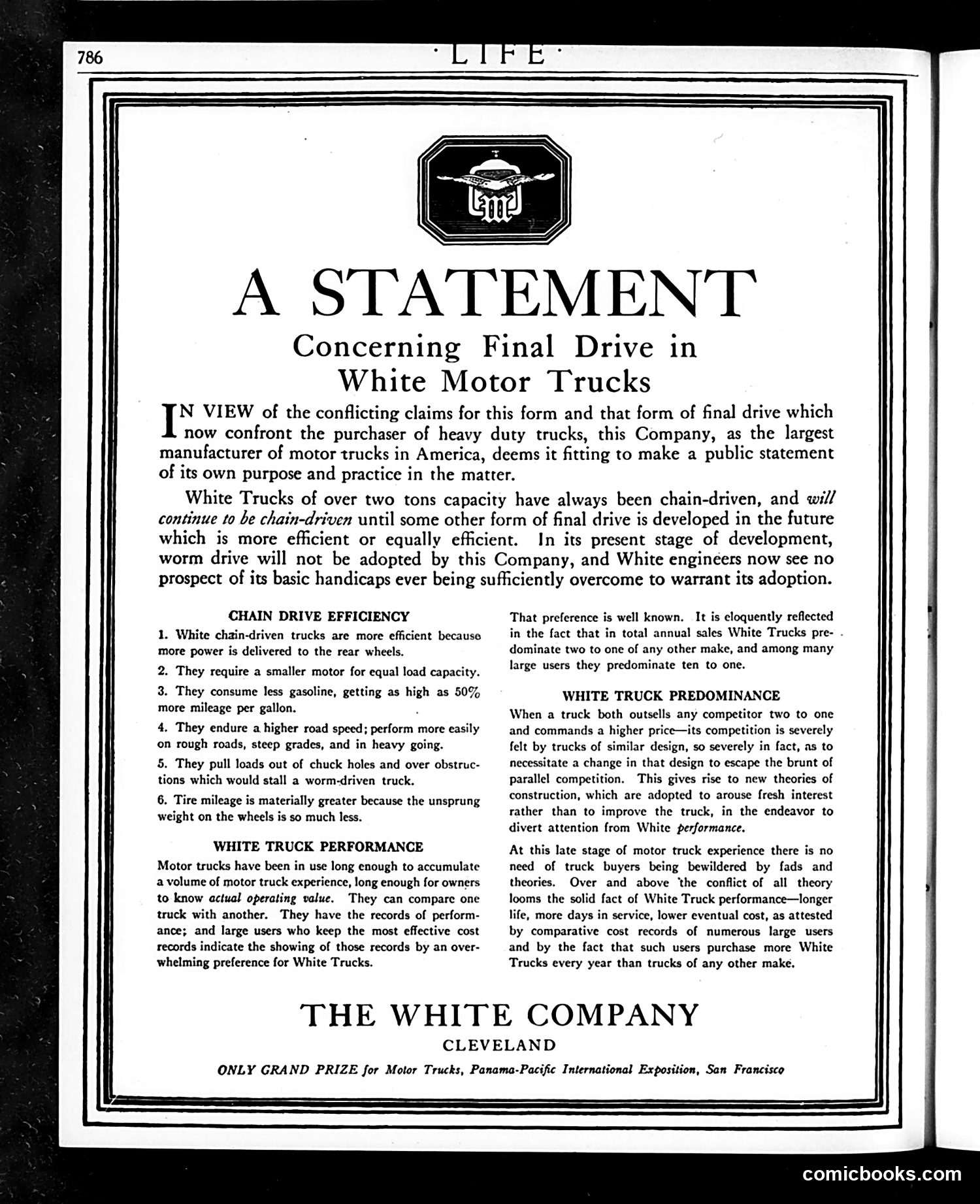
This is **not a satirical cartoon page** but rather a straightforward **advertisement** for White Motor Trucks, published in Life magazine (page 786). The White Company of Cleveland makes a formal statement defending their choice of chain-drive systems in heavy-duty trucks against competing designs (likely worm drive). The ad lists six technical advantages of chain drive—greater power delivery, smaller motor requirements, fuel efficiency, road performance, obstacle clearance, and tire longevity. The text emphasizes White's market dominance and customer loyalty, claiming comparative cost records prove their trucks' superiority. This appears to address real industry debates about truck transmission technology during the early-to-mid 20th century automotive era.
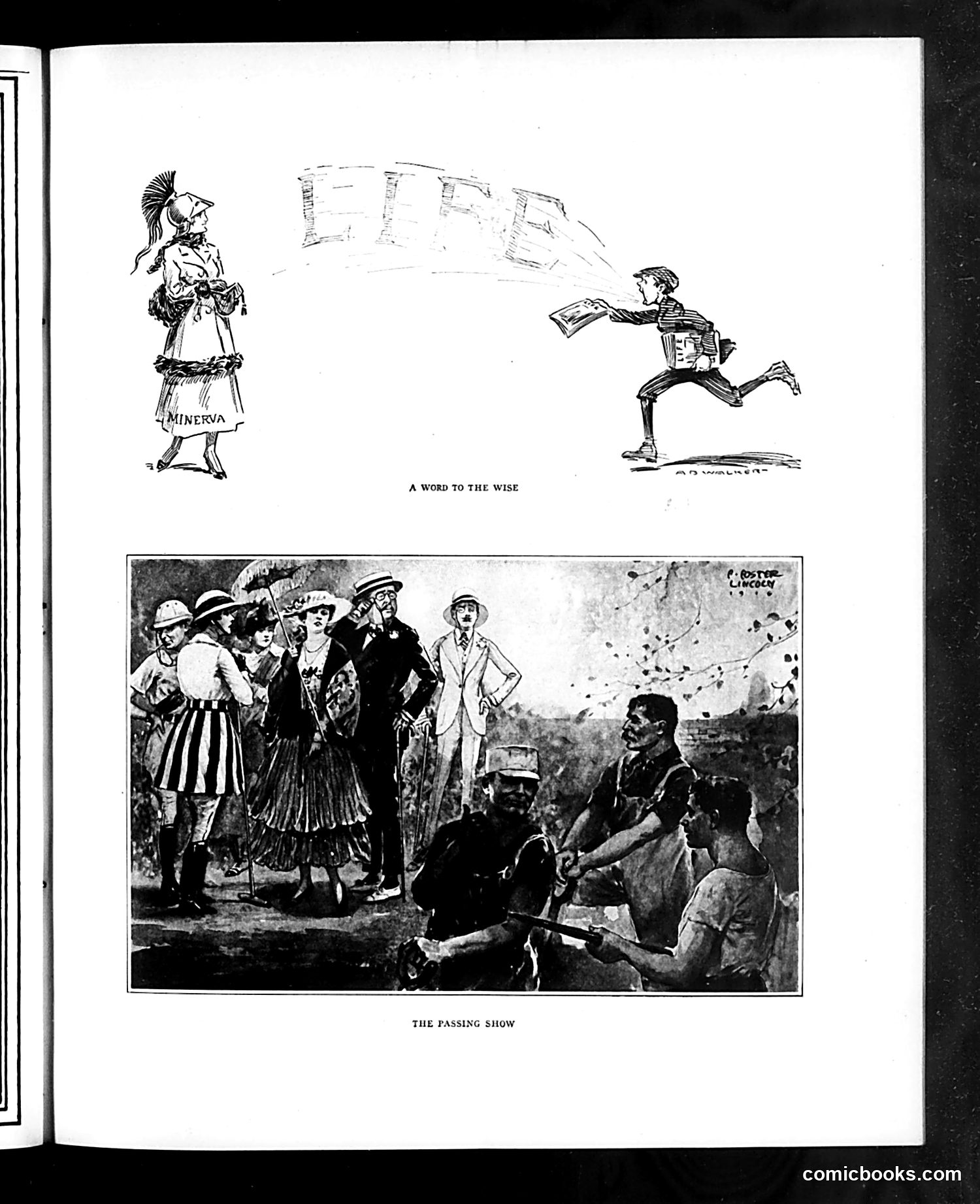
**Top cartoon "A Word to the Wise":** A figure labeled "Minerva" (Roman goddess of wisdom) stands on the left holding a shield, while a man on the right runs away carrying what appears to be a newspaper or document. This appears to satirize someone ignoring wisdom or warnings—"a word to the wise" being an expression meaning a hint should be sufficient for intelligent people. The running figure suggests someone disregarding advice. **Bottom image "The Passing Show":** This photographic or heavily illustrated scene depicts a crowd of well-dressed civilians observing what appears to be military or uniformed personnel below them. The composition suggests social commentary on class divisions or public spectacle, though the specific historical event remains unclear without additional context.
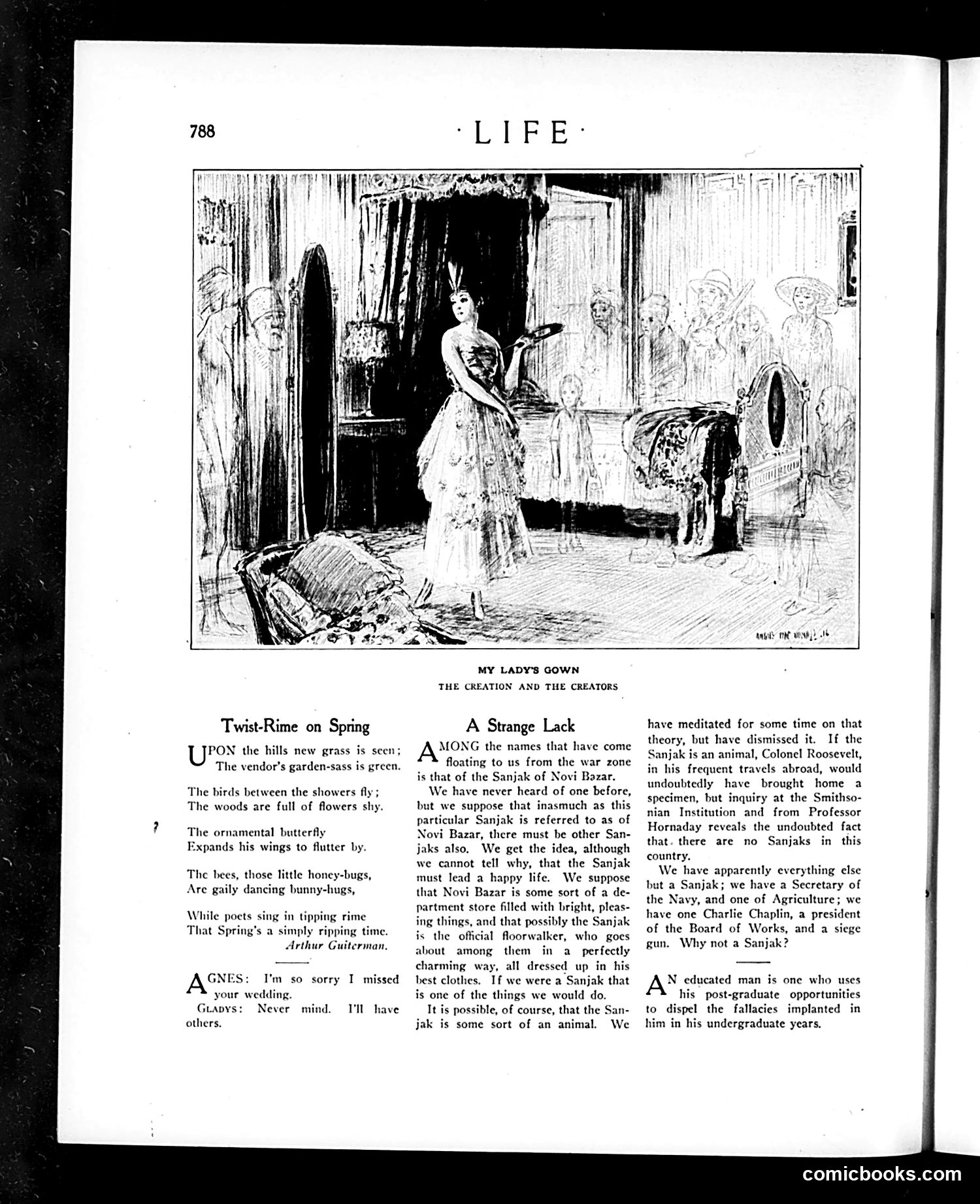
This page contains a satirical sketch titled "My Lady's Gown: The Creation and the Creatures," depicting a fashionable woman's dress-making process. The illustration shows a woman in an elaborate gown surrounded by attendants in what appears to be a dressmaker's salon. The accompanying text discusses a "Sanjak" (a Turkish administrative division/official), using it as a humorous metaphor. The joke appears to be social commentary on high fashion and luxury—comparing the elaborate process of creating a lady's gown to exotic, mysterious foreign bureaucracy. The separate poem "Twist-Rime on Spring" celebrates seasonal imagery (birds, flowers, bees, butterflies) in light verse. The page satirizes both pretentious fashion culture and contemporary fascination with exotic foreign concepts among the American upper classes.
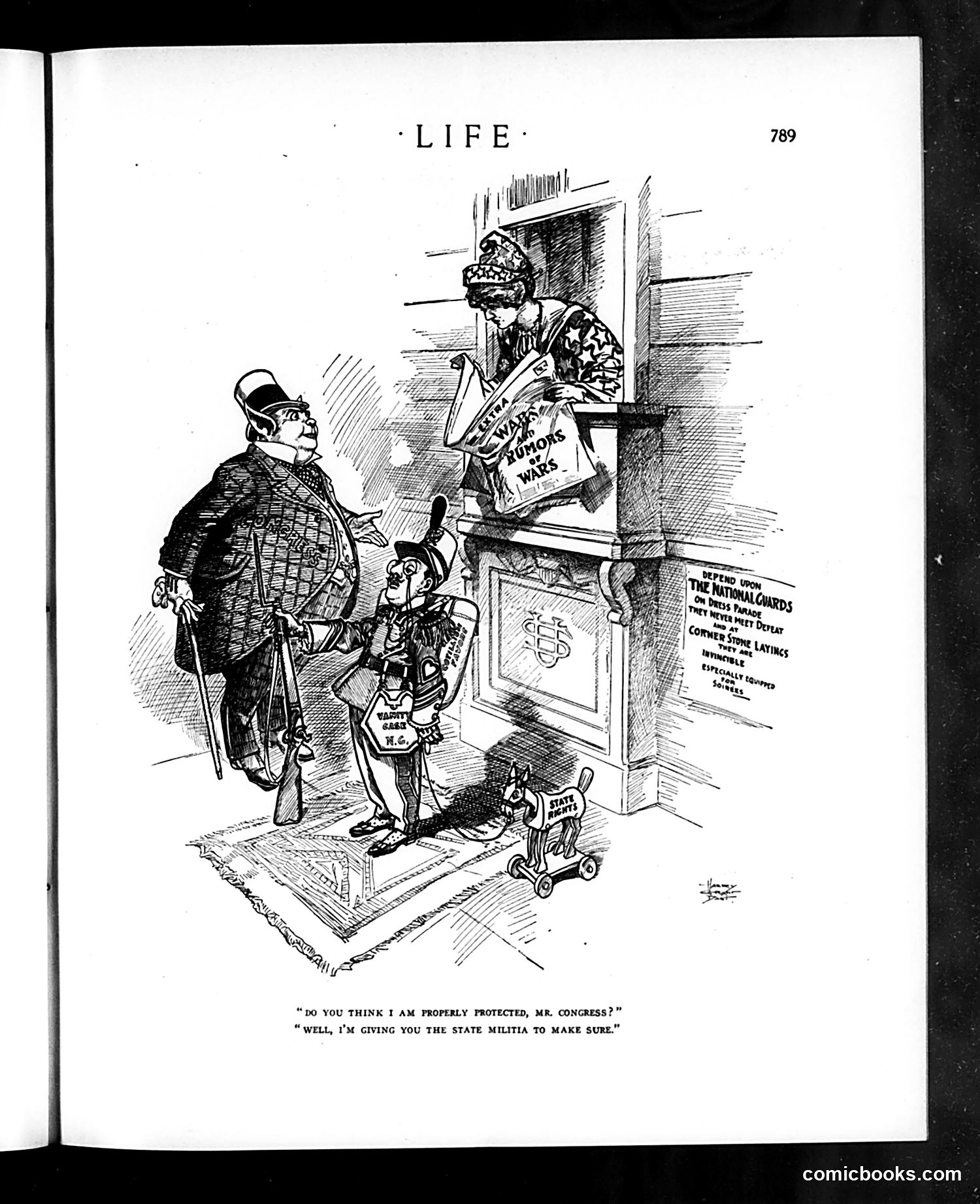
This cartoon satirizes concerns about **Congressional protection and state militia forces**. A figure labeled "Congress" (left, wearing a hat and formal dress) appears anxious, asking "Do you think I am properly protected, Mr. Congress?" A woman in a window above—appearing to represent state or local authority—responds by offering "the State Militia to make sure." The cartoon's humor lies in the irony: Congress is asking itself about protection while being offered protection by a separate state authority. The visible sign advertising "National Guard" protection suggests the satire concerns debates over **federal versus state military control**—a recurring tension in American governance about which authority should defend Congress itself. The small dog or animal at bottom adds visual detail to the domestic security scene.
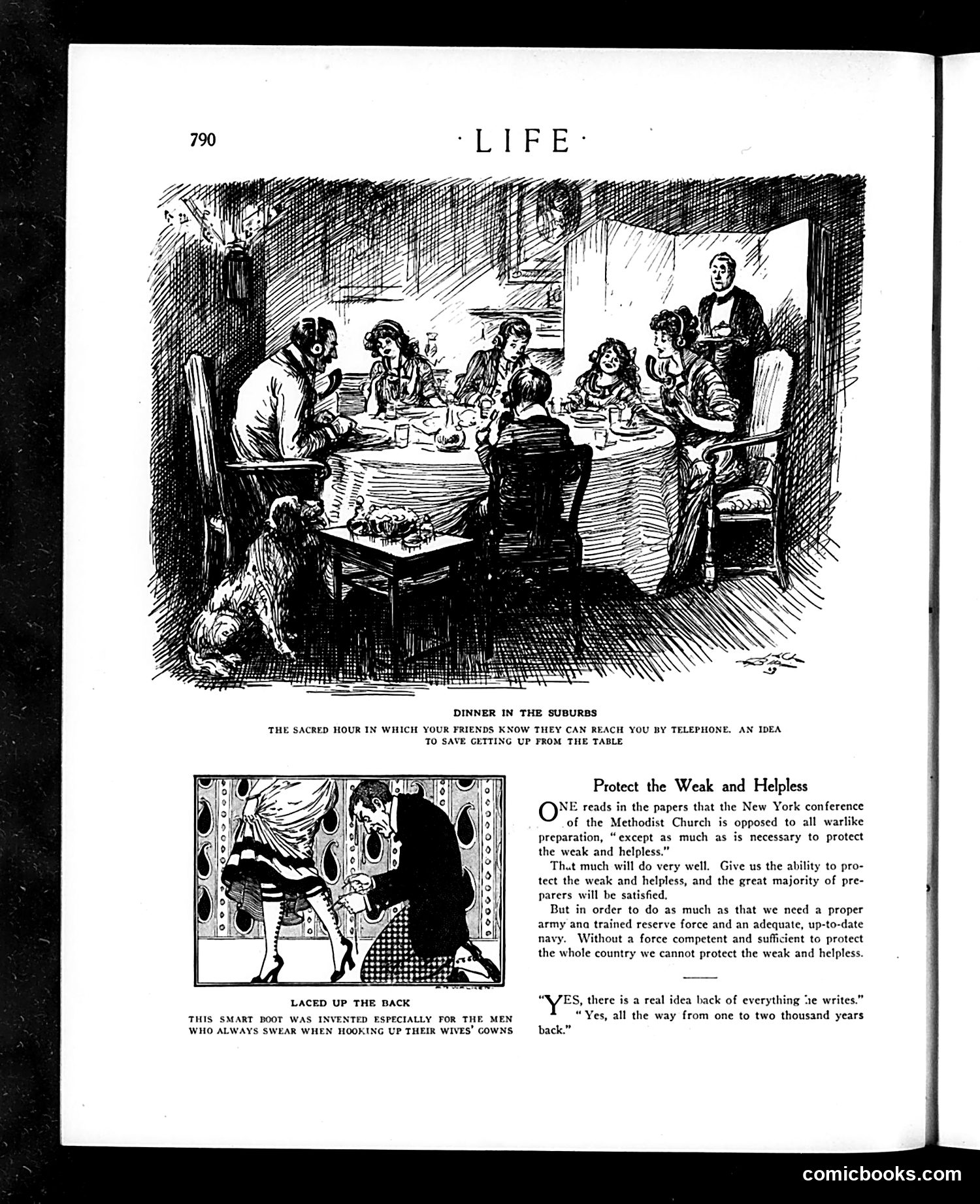
**Top Cartoon: "Dinner in the Suburbs"** This sketch satirizes suburban dinner etiquette and the emerging telephone culture. The caption humorously notes that dinner is "the sacred hour in which your friends know they can reach you by telephone"—mocking the intrusion of early telephone technology into family dining. The joke is that people interrupt meals with calls, making dinner an unsuitable "sacred" time for peace. **Bottom Cartoon: "Laced Up the Back"** This cartoon ridicules a boot designed specifically for men "who always swear when hooking up their wives' gowns." It's a satire on the impracticality of women's Victorian-era fashion with lacing, which required husbands' assistance to fasten—creating domestic friction and profanity. **Editorial Section: "Protect the Weak and Helpless"** A Methodist Church policy opposing military preparedness is critiqued, arguing pacifism cannot protect vulnerable populations without military strength.
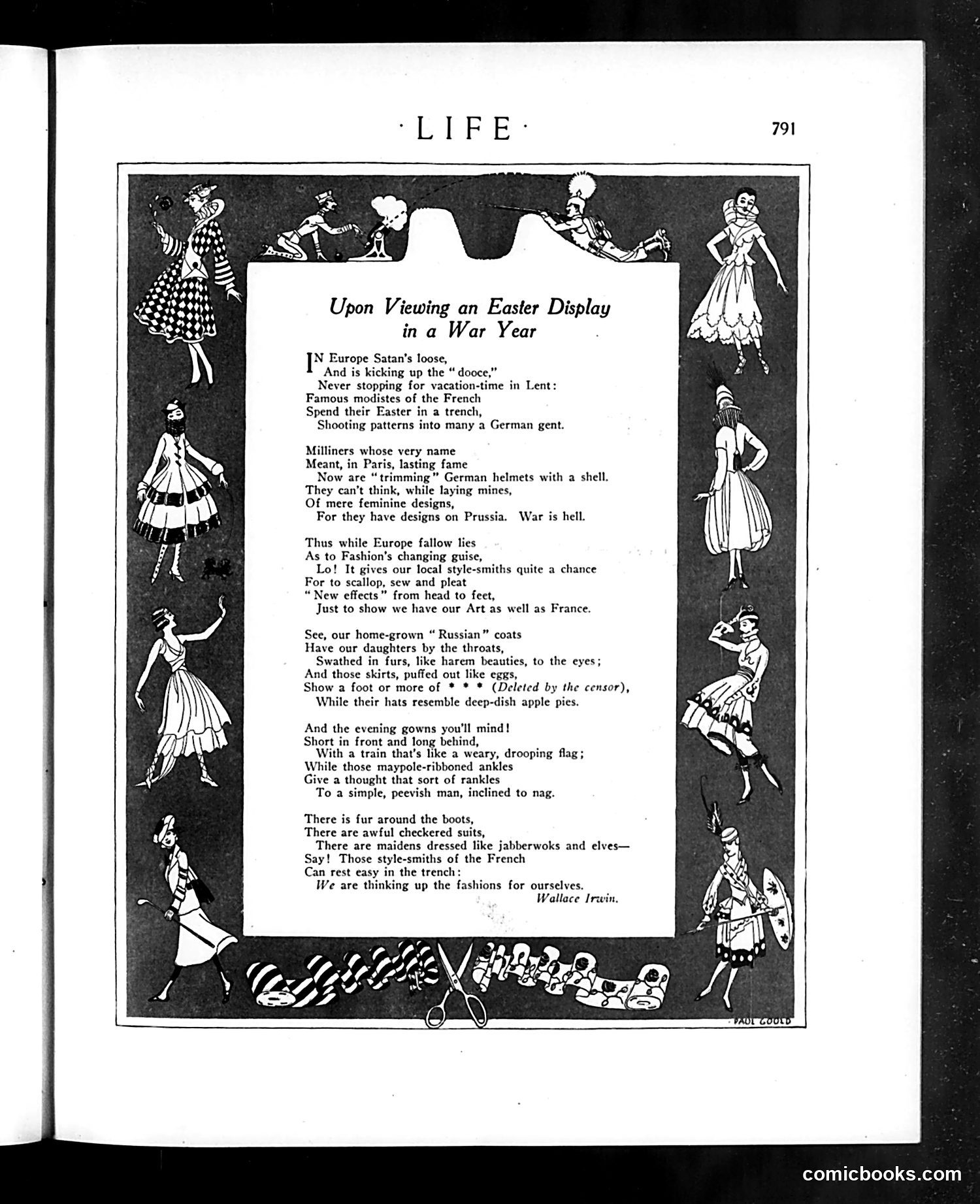
This satirical poem by Wallace Irwin critiques European fashion during World War I. The illustrated border shows stylishly dressed women in extravagant Easter outfits, creating ironic contrast with the poem's content. The satire targets: - **French and German combatants** for continuing fashion concerns during wartime (French modistes trimming helmets, Germans designing patterns) - **American fashion industry** profiting from European war by creating "new effects" and copying styles - **Women's fashion** during wartime—exaggerated silhouettes, fur coats, puffed skirts, checkered suits, and elaborate hats—presented as frivolous given soldiers' trenches The closing line, "We are thinking up the fashions for ourselves," suggests Americans are commercializing European suffering. The joke: while Europe bleeds, fashionable society obsesses over hemlines and ankles.
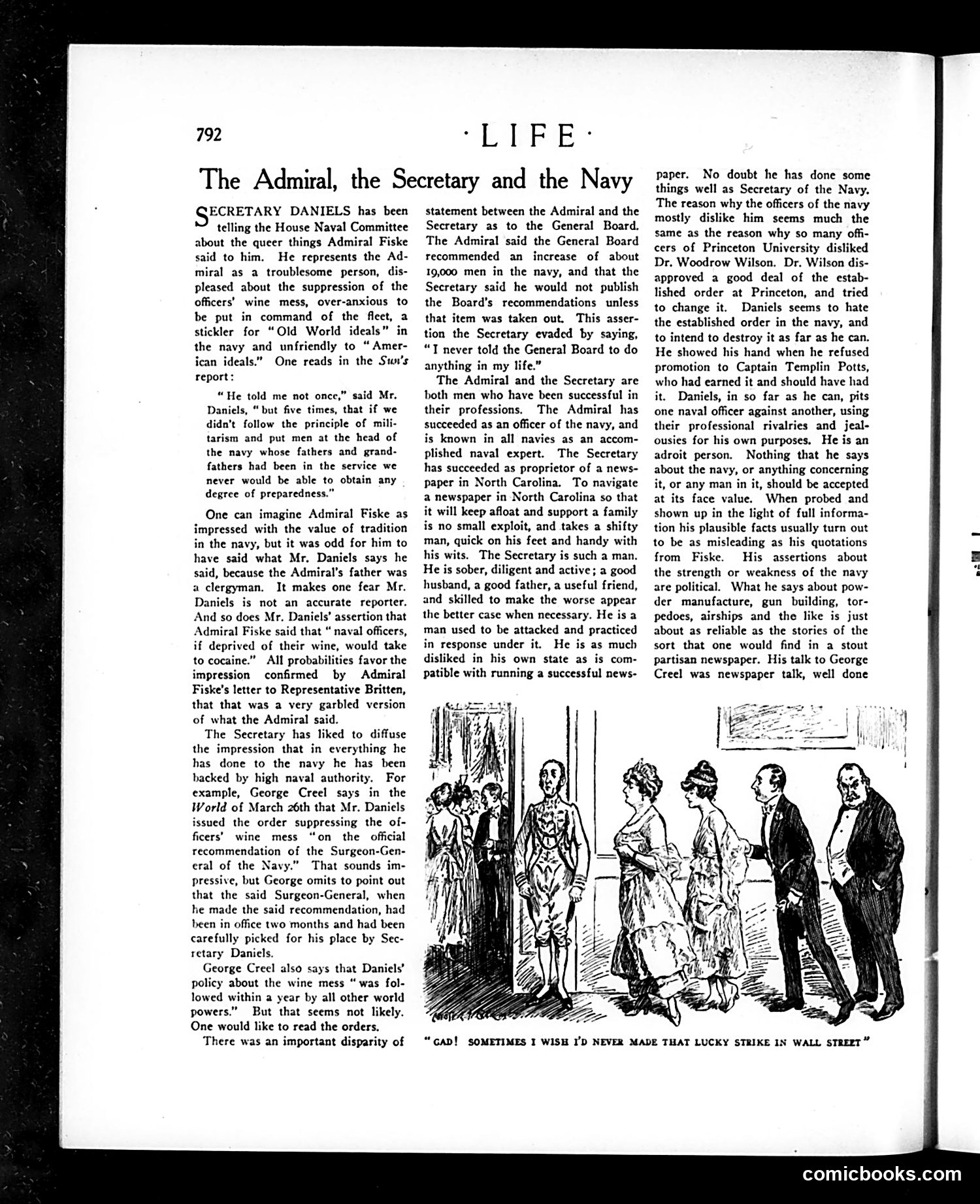
This satirical piece criticizes **Secretary Daniels** (likely Josephus Daniels, Secretary of the Navy) for conflicts with naval officers. The text argues Daniels suppressed officers' wine rations and interfered with naval tradition, claiming admirals like Fiske opposed his reforms. The cartoon caption reads: "Gad! Sometimes I wish I'd never made that lucky strike in Wall Street"—depicting well-dressed men in what appears to be a social setting. This likely represents wealthy financiers or those suddenly enriched, contrasting with the naval disputes discussed above. The satire suggests Daniels' administrative overreach damaged navy morale and officer relations, while the cartoon mockingly comments on unearned wealth or fortune among the social elite.
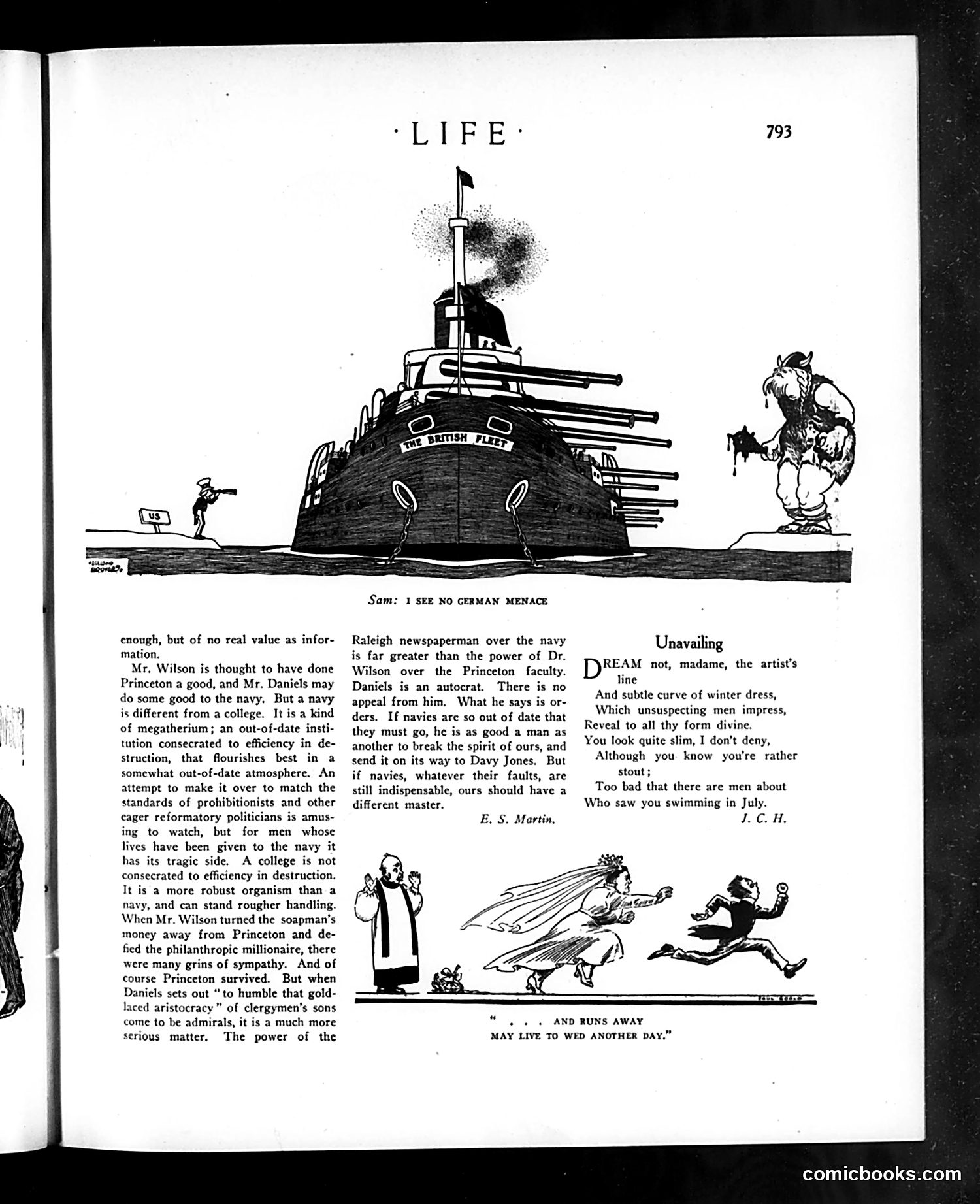
The top cartoon, titled "Sam: I See No German Menace," depicts a large British warship with guns, while a small figure labeled "US" stands to the left and a caricatured figure (appearing to represent a British or Allied perspective) stands to the right. The satire addresses American isolationism versus European military concerns during what appears to be a pre-WWI or interwar period context. The accompanying article discusses Princeton and navy matters, debating institutional efficiency and leadership. The lower cartoon, "And Runs Away / May Live to Wed Another Day," shows figures in comedic flight, likely satirizing cowardice or romantic entanglements—a common humor theme in Life magazine. The page overall uses visual satire to comment on military preparedness, institutional leadership, and social behavior of the era.
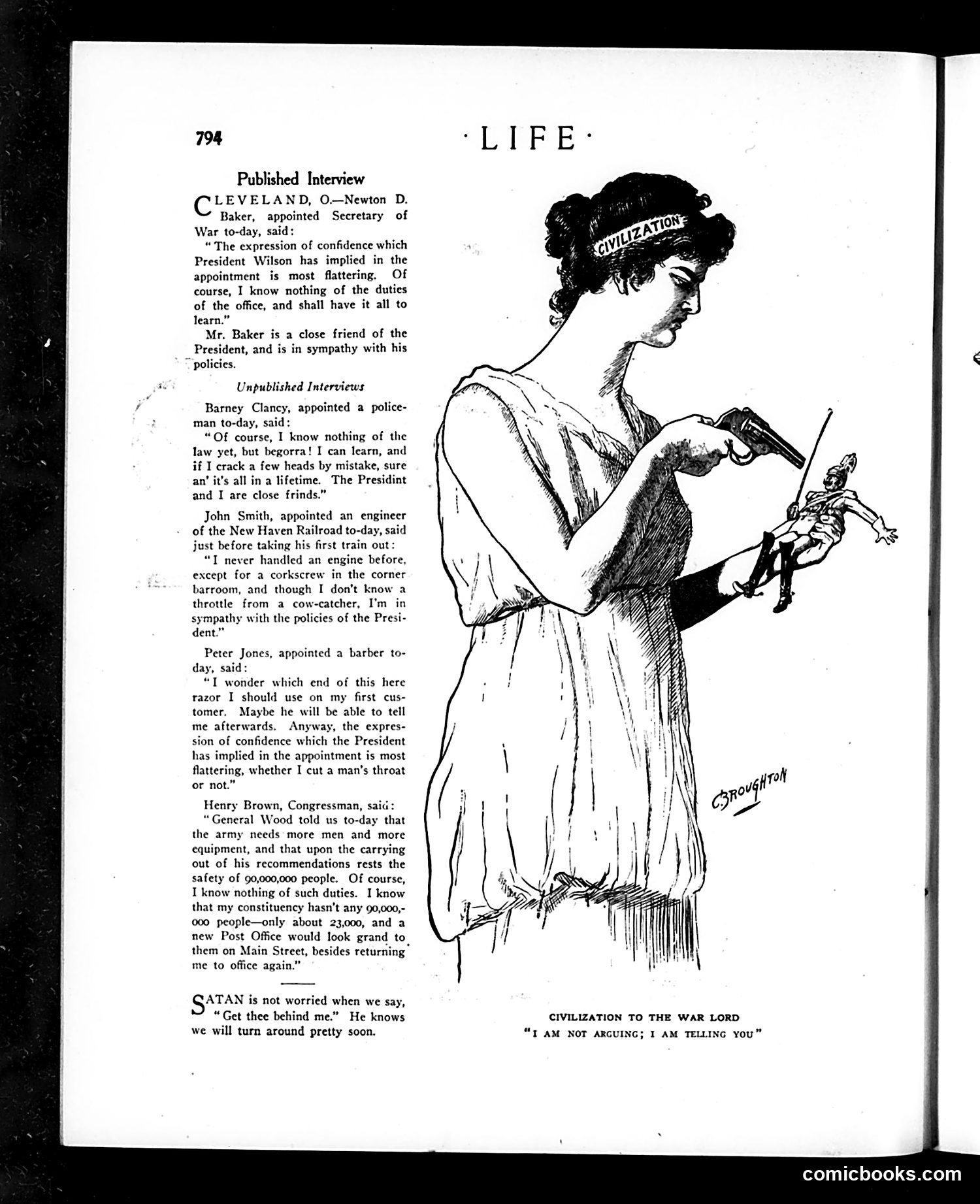
This satirical cartoon depicts **Civilization** (personified as a classical female figure wearing a headband labeled "CIVILIZATION") presenting a tiny, underdeveloped military figure to a powerful "War Lord." The image mocks President Wilson's recent military appointments and policies. The accompanying published and unpublished interviews ridicule Wilson's administration for appointing unqualified men to important positions—a barber as police officer, an engineer with no engine experience, etc.—while claiming "confidence" in them. The cartoon's caption—"I am not arguing; I am telling you"—suggests the War Lord/military establishment dismisses Civilization's protests about unpreparedness. The satire criticizes Wilson's wartime administrative competence and cronyism during America's military mobilization (likely WWI era).
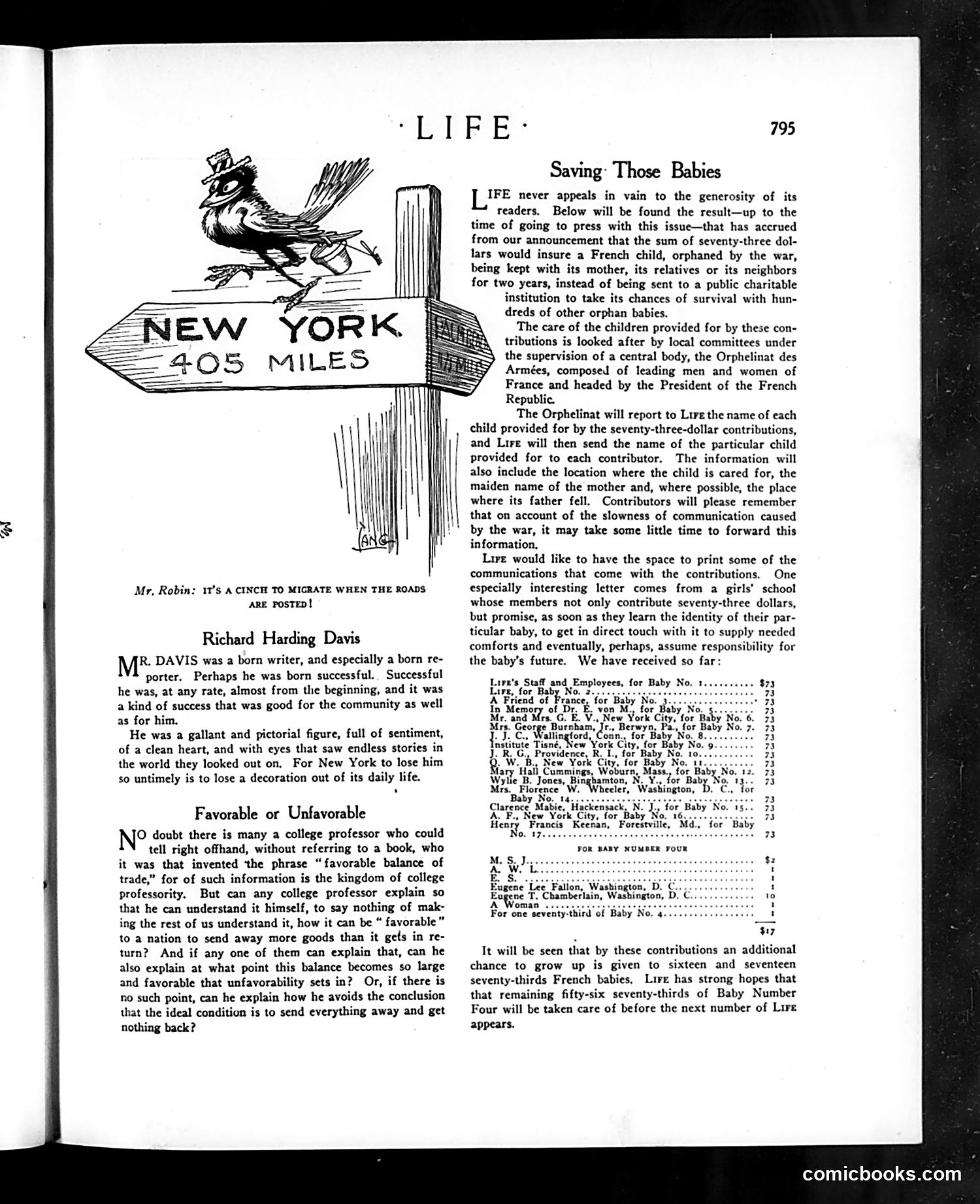
This page contains a satirical cartoon and articles about charitable contributions to French war orphans. The cartoon shows a stork (symbol of babies) carrying a bundle, with a signpost reading "NEW YORK 405 MILES." The caption reads "Mr. Robin: it's a circus to migrate when the roads are posted!"—a joke about transportation difficulties during wartime, anthropomorphizing birds discussing travel logistics. The main articles address "Saving Those Babies" (a fundraising campaign for French orphans) and "Richard Harding Davis" (a war correspondent/writer). A second article, "Favorable or Unfavorable," appears to satirize college professors' inability to explain abstract concepts clearly. The page reflects WWI-era American charitable efforts toward war-displaced European children and contains typical Life magazine social commentary and humor.
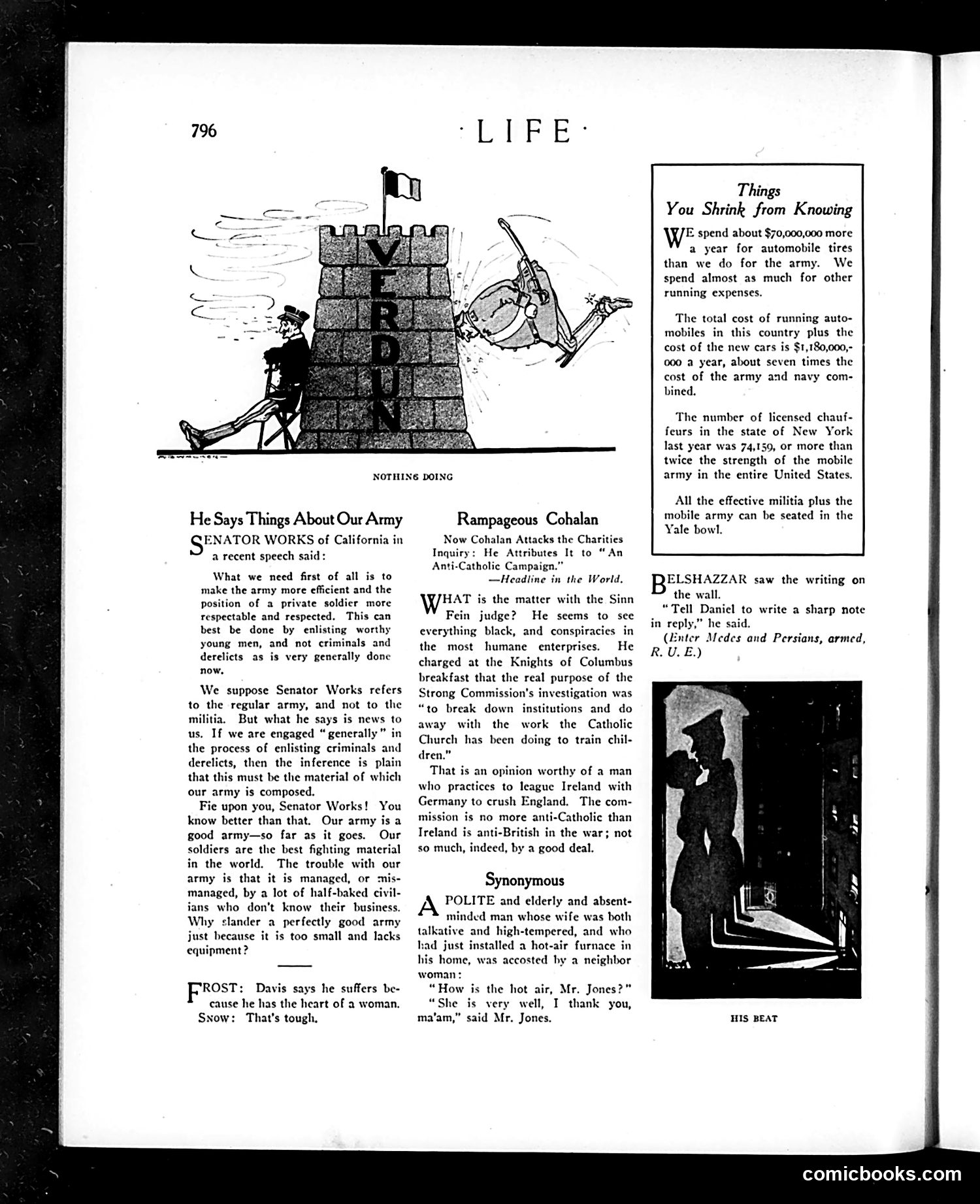
**Main Cartoon ("Nothing Doing"):** Depicts a figure trying to scale a tower labeled "WAR" while another figure pulls them down. This critiques Senator Works' 1920s speech advocating for army expansion—Life's editors sarcastically agree with him while actually mocking the priorities of American spending. **Political Context:** The "Things You Shrink from Knowing" box presents damning statistics: Americans spend seven times more on automobiles than the entire military budget. This satirizes civilian indifference to national defense while obsessing over consumer goods—a critique of 1920s American materialism. **Secondary Pieces:** Judge Cohalan (a New York political figure) is attacked for blaming Catholic charities of anti-Catholic conspiracy. Life defends the charities, arguing Cohalan's logic absurdly conflates Irish independence movements with the Church's legitimate charitable work. **Overall Point:** The page ridicules both misplaced national priorities and baseless conspiracy-mongering, while defending the military's actual capabilities against Senator Works' implicit insults about soldier quality.
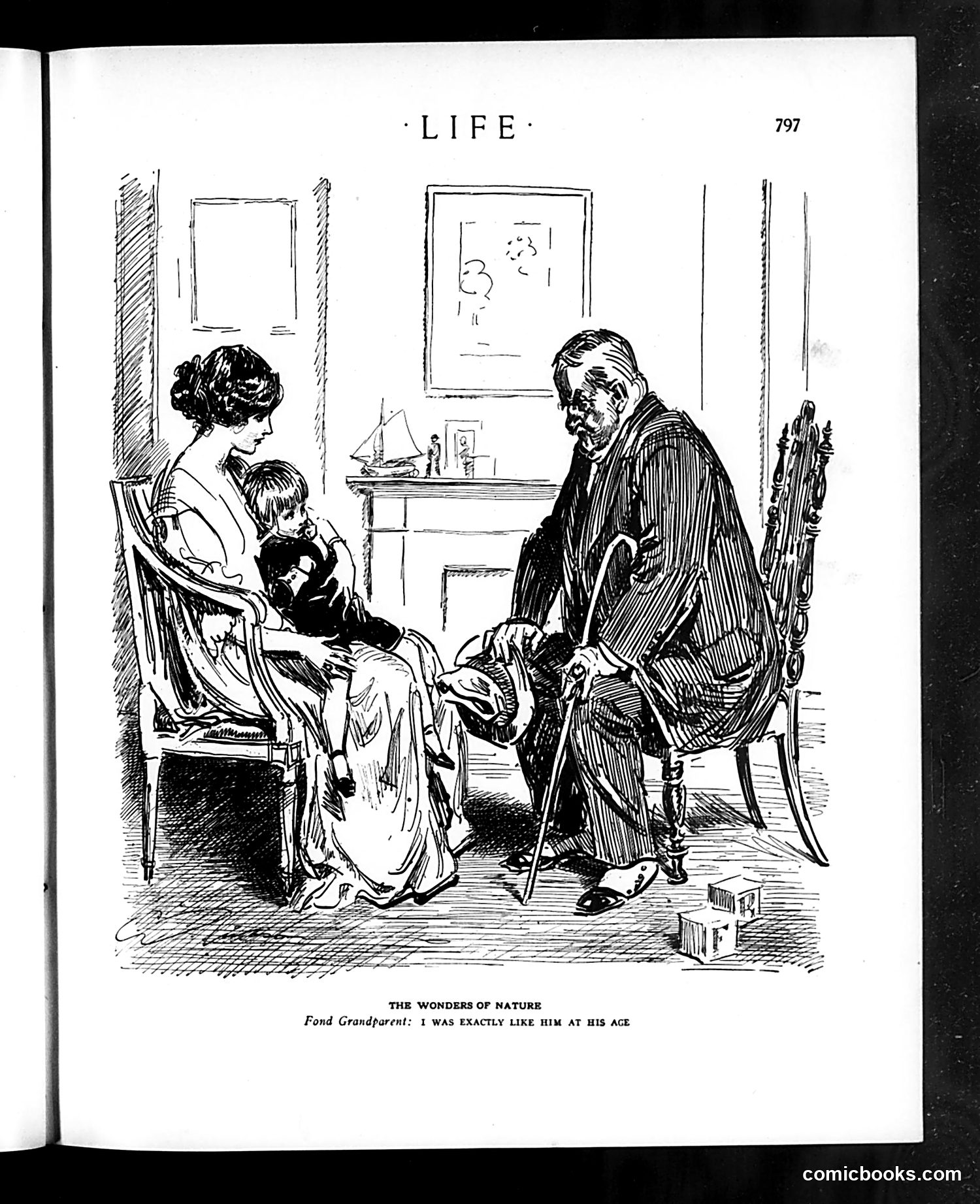
This cartoon depicts a domestic scene where a fond grandfather shows his young grandchild toys (visible blocks on the floor) while the child's mother watches. The caption reads: "Fond Grandparent: I was exactly like him at his age." The satire plays on a common human tendency—grandparents attributing their own childhood characteristics to grandchildren, often flatteringly or nostalgically. The joke suggests the grandfather sees himself in the boy, implying either endearing or unflattering traits he's projecting onto the child. The "Wonders of Nature" title likely refers ironically to heredity or family resemblance, suggesting that personality traits (for better or worse) run in families. This is gentle domestic humor typical of Life's satirical approach to everyday family life.
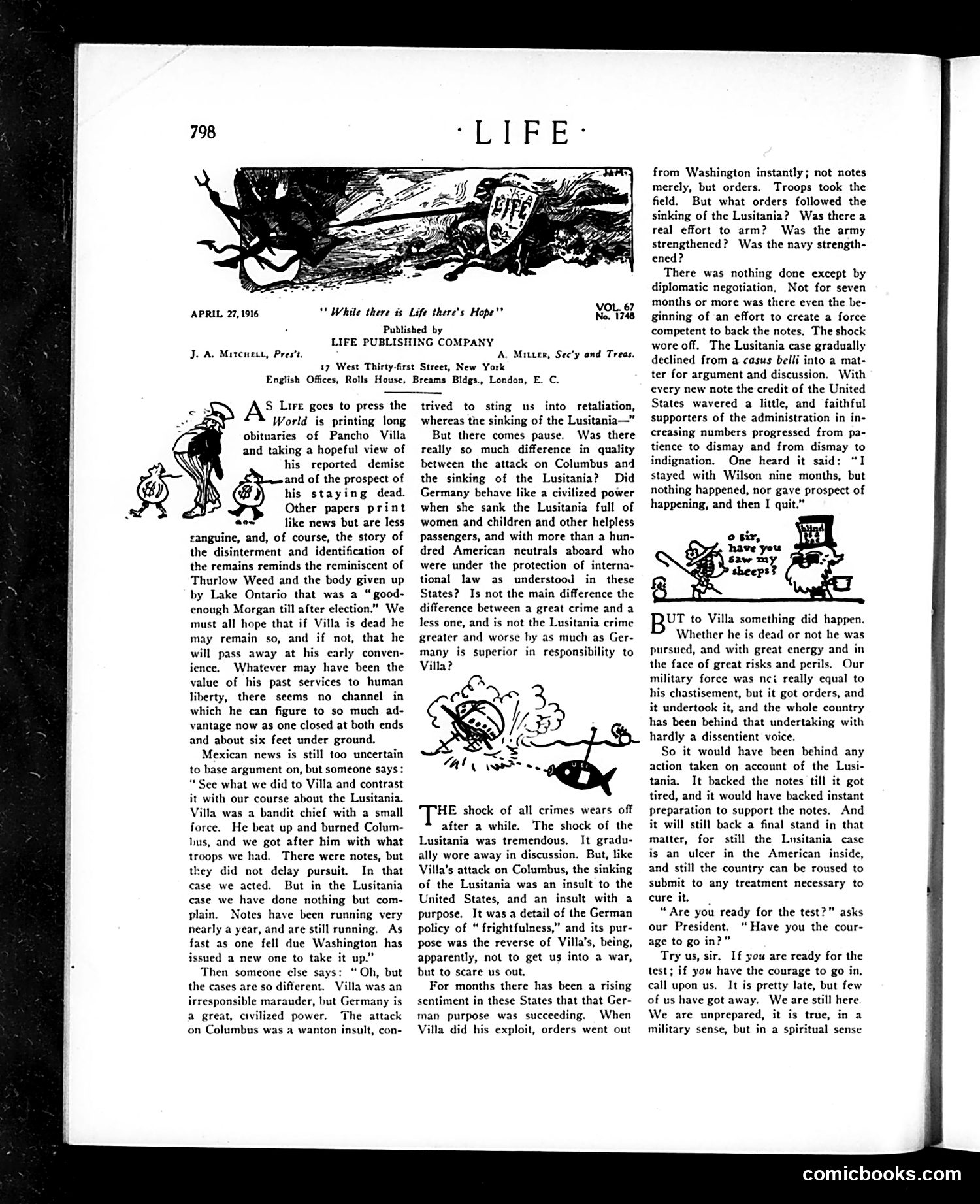
This editorial compares America's swift military response to Pancho Villa's 1916 raid on Columbus, Mexico with its diplomatic-only response to Germany's 1915 sinking of the Lusitania (which killed American citizens). The author argues the cases are morally equivalent: both were deliberate insults to American sovereignty. Yet the U.S. immediately deployed troops against Villa while merely sending protest notes to Germany for months. The cartoons mock this inconsistency—depicting Villa as a bandit deserving swift punishment, while questioning why Germany, a "civilized power," escaped similar consequences. The piece criticizes American inaction, suggesting that Germany's "frightfulness" policy (deliberately terrorizing civilians) successfully intimidated the U.S. into inaction, whereas Villa's provocation triggered immediate military mobilization. The implicit message: America's tepid response to the Lusitania emboldened German aggression.
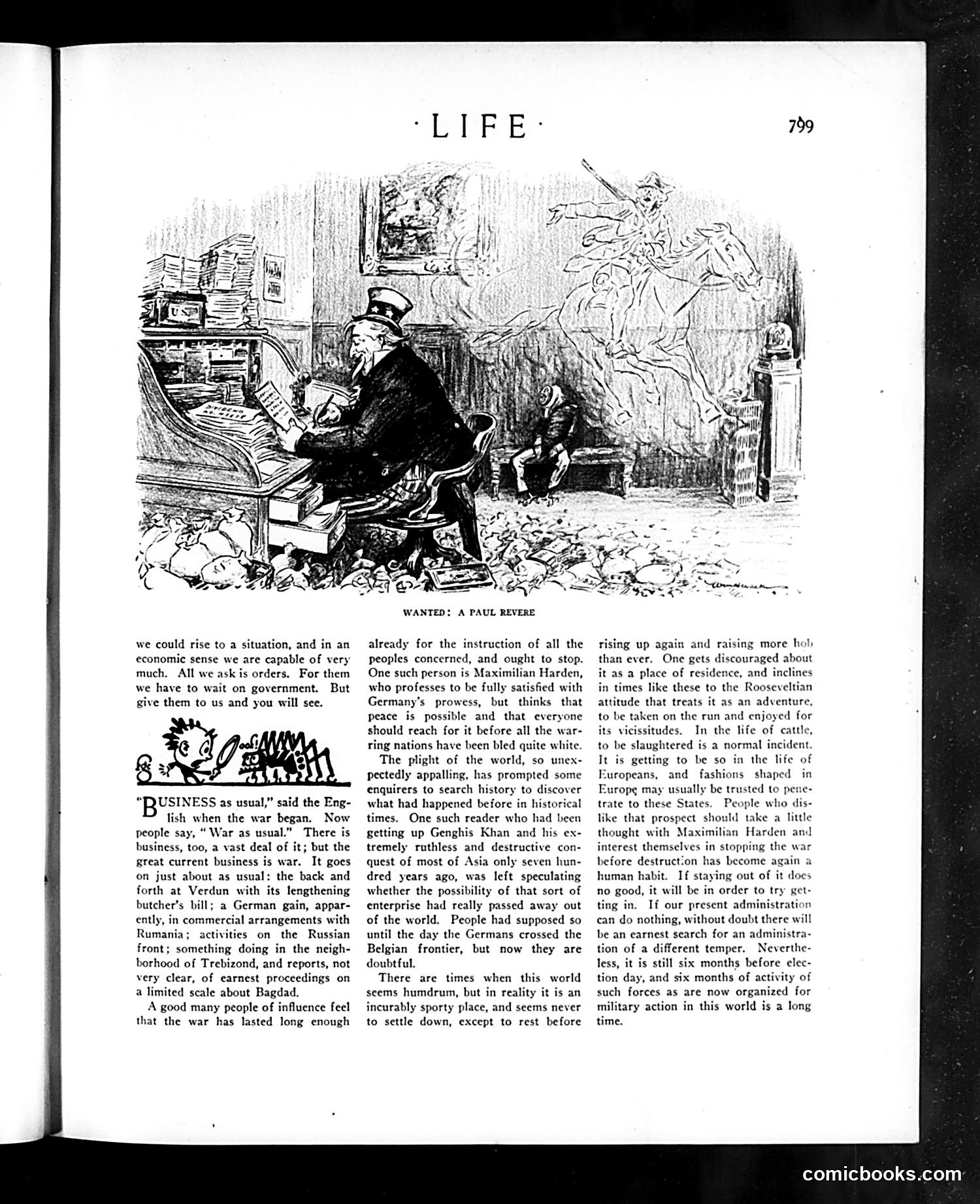
This Life magazine editorial cartoon and accompanying text criticize American inaction during World War I (then ongoing). The cartoon depicts an elderly man at a desk—likely representing a political or intellectual figure—while a horseman (evoking Paul Revere) rides frantically in the background, a visual metaphor for urgent warning being ignored. The text references **Maximilian Harden**, a German pacifist who advocated ending the war. The cartoonist uses Harden ironically: while acknowledging Germany's military strength, the piece suggests America needs someone to sound an alarm about the war's destructive trajectory—a "Paul Revere" to warn the nation. The satire criticizes American complacency during WWI's devastating attrition (mentioning Verdun's casualties). The author argues that if the current administration cannot stop the war through diplomacy, voters should demand change in the upcoming election. The "Paul Revere" reference thus represents the need for urgent political action to prevent America's inevitable involvement.
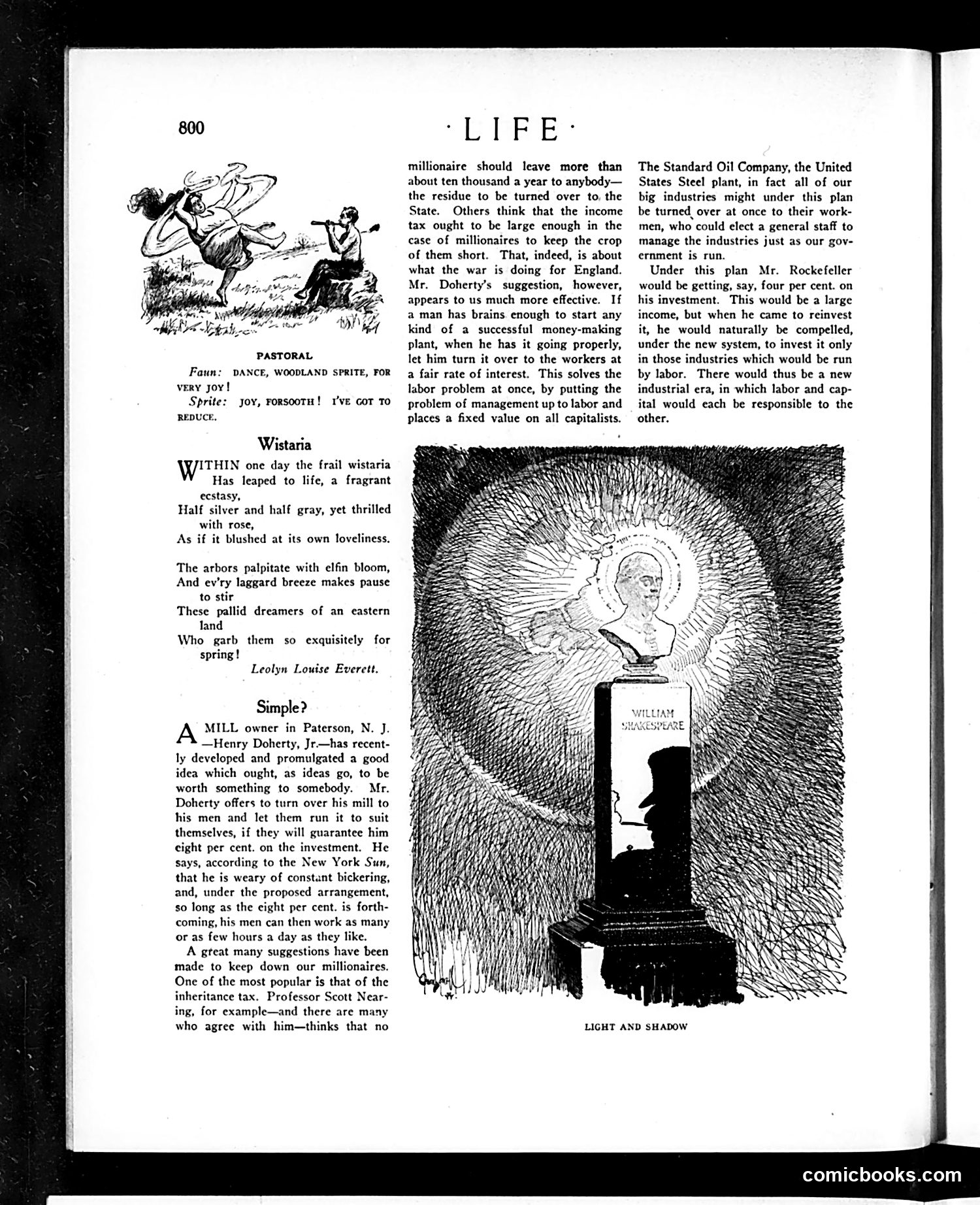
**The Political Content:** This page satirizes early 20th-century labor and wealth debates. The main article "Simple?" discusses Henry Doherty Jr., a Paterson, N.J. mill owner who proposed letting workers run his factory for guaranteed 8% returns to him—positioning this as a solution to labor unrest. **The Satire's Point:** Life magazine endorses Doherty's idea as superior to other wealth-control proposals (inheritance taxes, income taxes). The satire suggests that allowing workers to manage industry while capitalists collect guaranteed dividends is idealistic but naive—hence "Simple?" The article extends this mockingly to Standard Oil and Rockefeller, implying such arrangements would transform capitalism entirely. **Visual Elements:** The "Pastoral" cartoon depicts a sprite reluctant to dance despite "joy," suggesting forced optimism about labor relations. The "Light and Shadow" illustration shows Shakespeare's bust amid radiant light, unrelated to the economic discussion—possibly contrasting enduring culture with temporary economic schemes. **Context:** This reflects Progressive Era debates about redistributing wealth and resolving labor conflicts through structural reform rather than regulation.
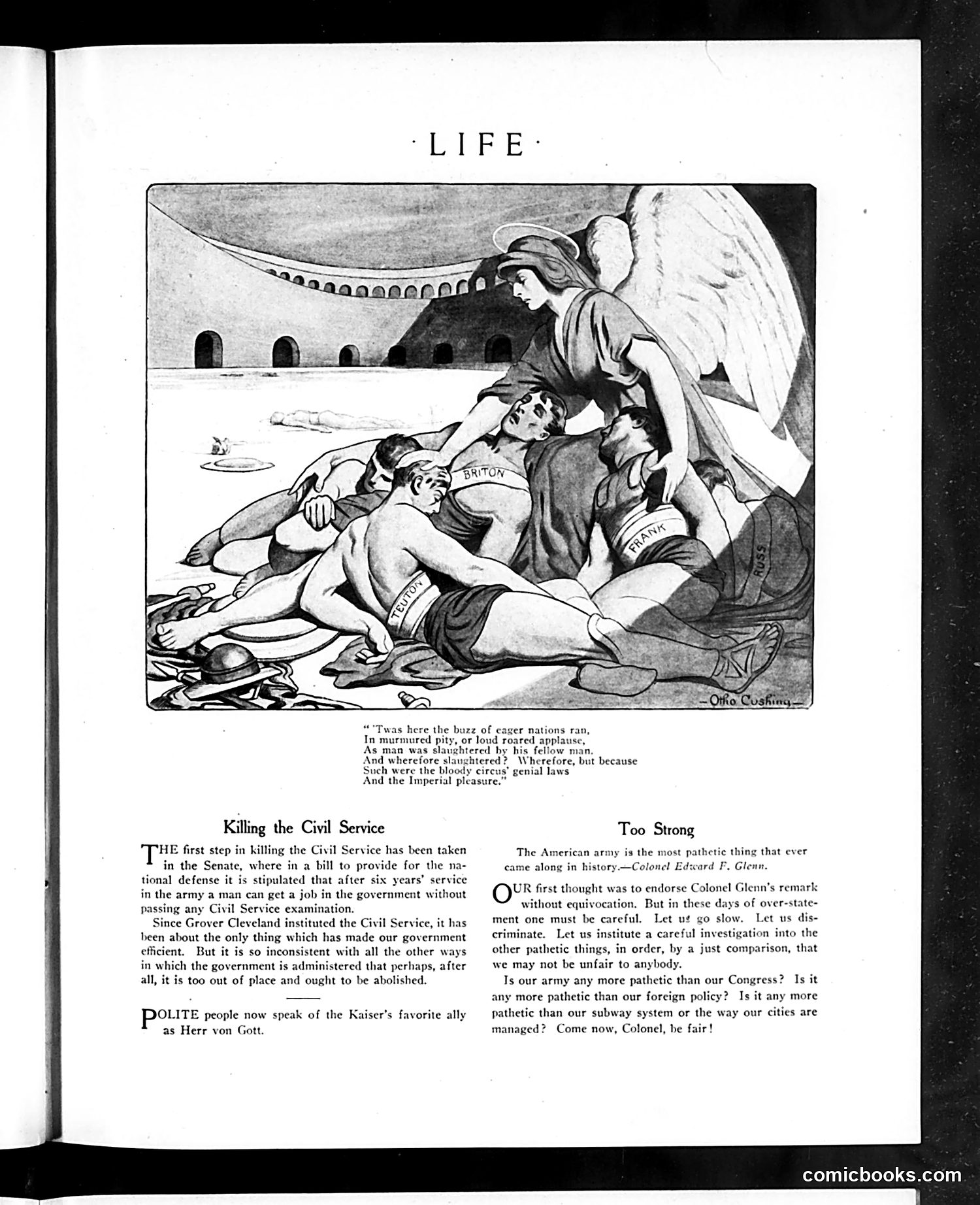
This page features political satire on two unrelated topics: **"Killing the Civil Service"** critiques a Senate bill allowing military veterans to bypass civil service exams for government jobs after six years' service. The author argues this undermines the merit-based system instituted by Grover Cleveland, which the magazine credits as the only efficient government mechanism. The satire suggests the exemption is inconsistent with how government otherwise operates. **"Too Strong"** responds to Colonel Edward F. Glenn's claim that the American army is "pathetic." The writer sarcastically agrees but challenges the comparison—is the army *more* pathetic than Congress, foreign policy, the subway system, or city management? The satire uses comparative ridicule to defend the military while mocking broader government incompetence. The opening illustration (artist: Otto Cushing) depicts classical figures in what appears to be a Roman amphitheater, illustrating the epigraph about slaughter and "imperial pleasure"—suggesting these government failings represent decay comparable to historical decline.
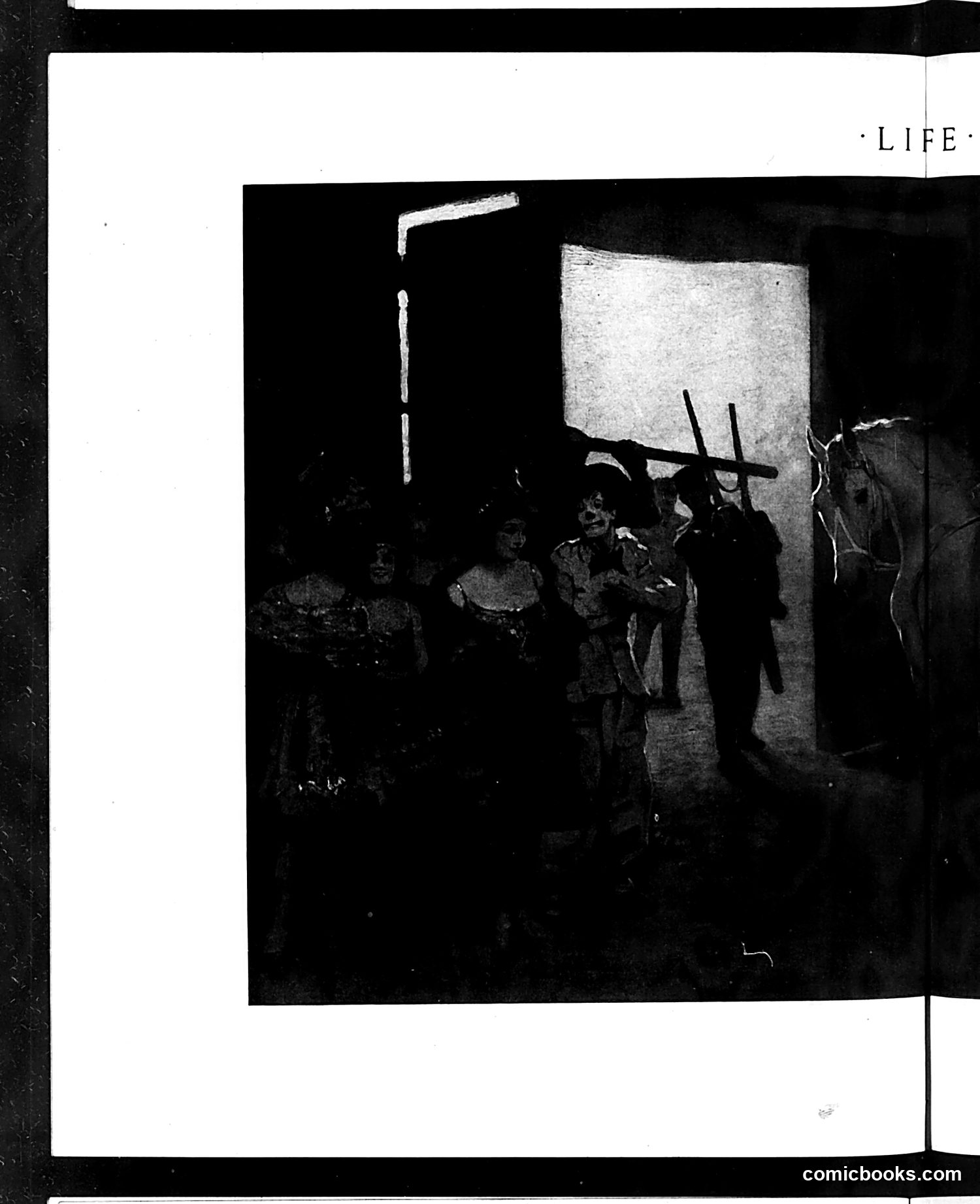
This page from *Life* magazine shows a black and white photograph rather than a drawn cartoon. The image depicts what appears to be a theatrical or religious scene: a group of people gathered in a darkened interior space, with a large illuminated cross visible in the background. The lighting and composition suggest either a stage production or a formal religious ceremony. Without clearer text or caption visible on this page, I cannot definitively identify the specific political or social reference intended. The OCR text provided is corrupted and illegible. To accurately explain the satire or commentary this image makes, I would need readable accompanying text identifying the subject, date, or context. The visual alone—showing a cross and gathered figures—could reference numerous historical events or social critiques, but asserting specifics would be speculation.
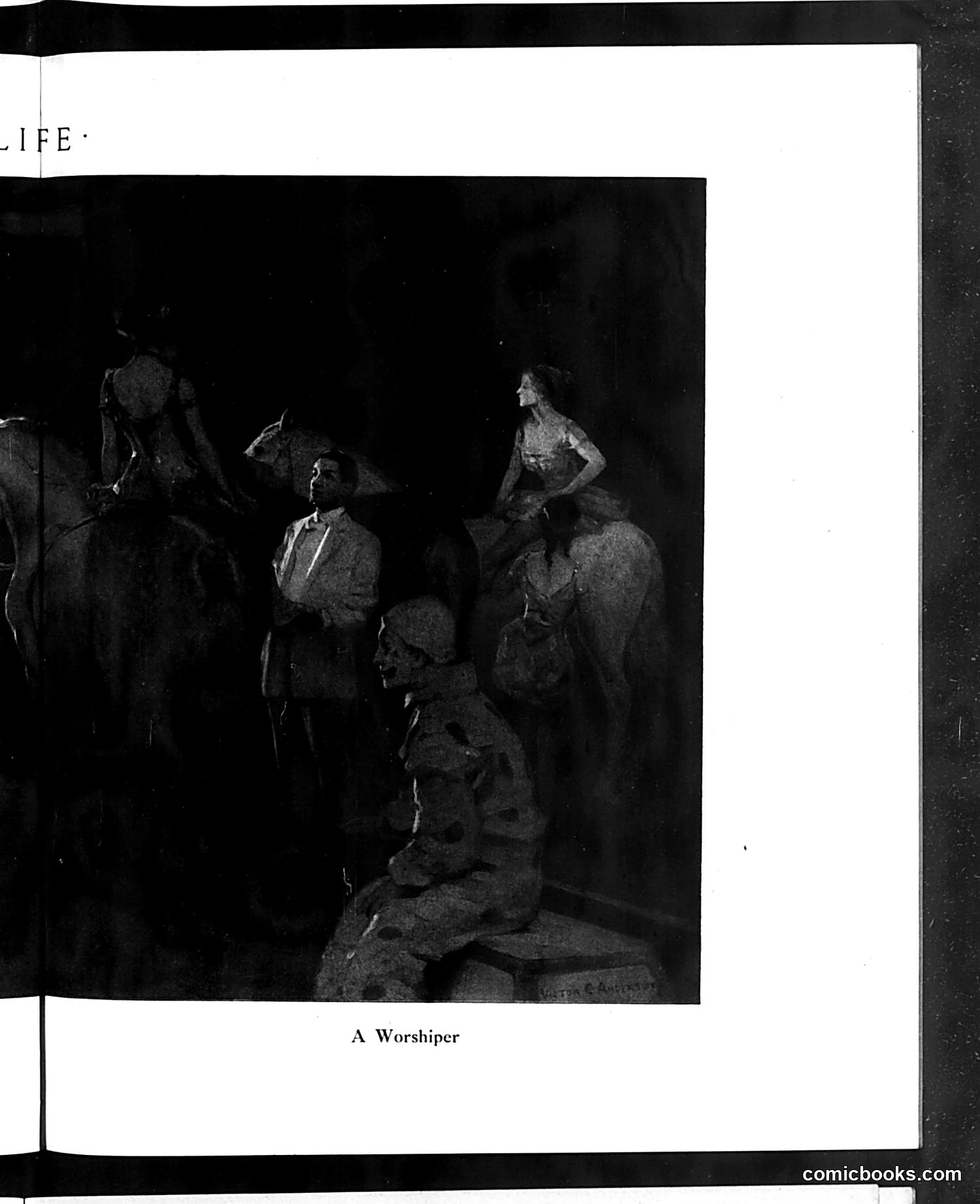
This page from *Life* magazine shows a dramatic black-and-white theatrical scene captioned "A Worshiper." The image depicts several figures in what appears to be a stage production, with one kneeling figure in the center appearing to genuinely revere or worship something or someone, while others stand around in various poses. Without additional context or visible text identifying specific political figures or events, the satire's exact target remains unclear. The caption suggests mockery of excessive devotion or idolatry—possibly directed at a contemporary political leader, social movement, or theatrical production itself. The theatrical staging emphasizes the performative, artificial nature of the "worship" being depicted. More contextual information would be needed to identify the specific historical reference.
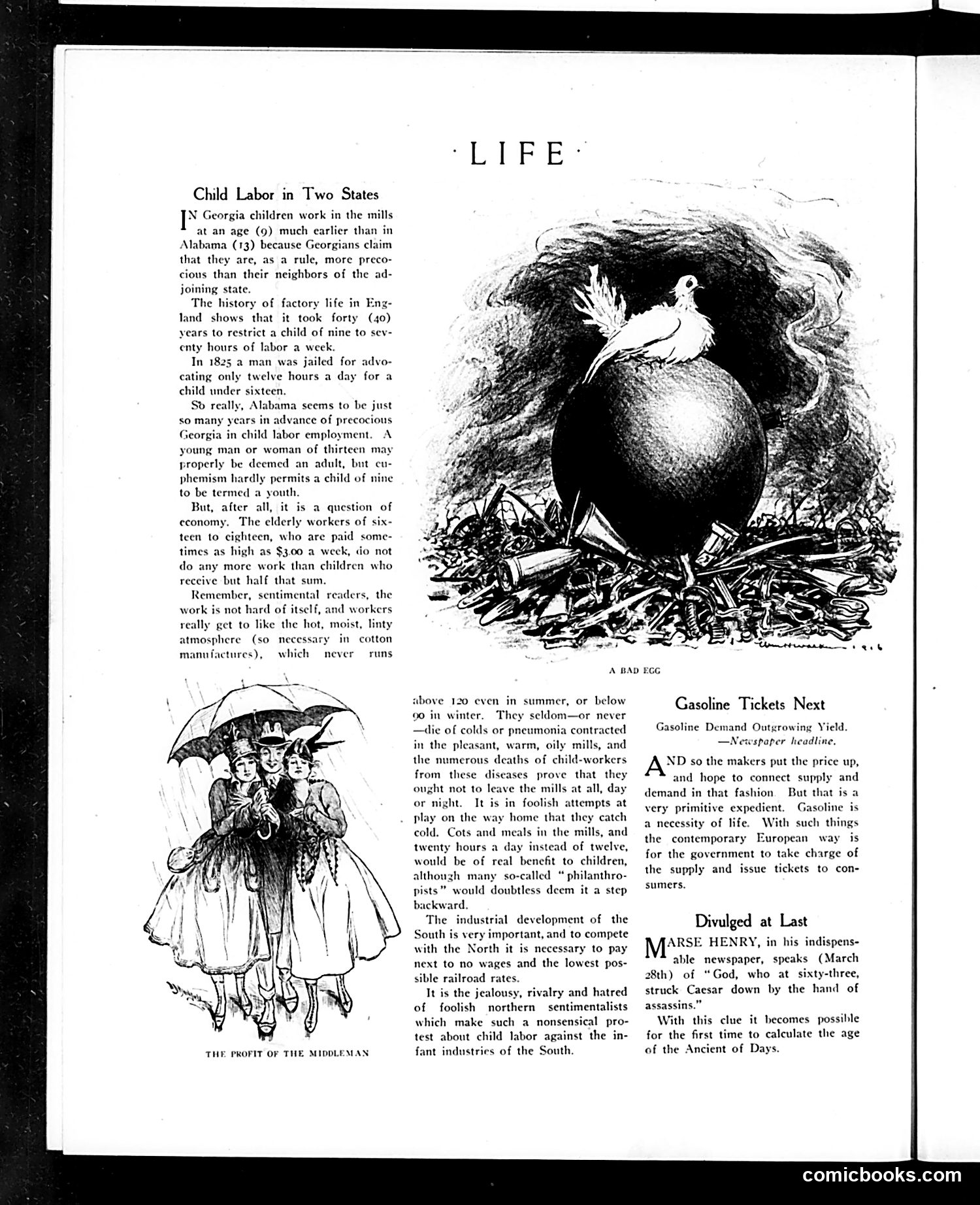
This page uses **heavy irony** to attack Southern child labor practices. The main article sarcastically defends Georgia and Alabama's employment of children as young as nine in cotton mills, claiming: - Georgia children are more "precocious" so deserve earlier work - The mills are pleasant and safe (children rarely die there) - Children should work 20 hours daily instead of 12 - Northern critics are jealous sentimentalists The cartoons reinforce this mockery: "A Bad Egg" shows a dove emerging from destruction (suggesting corruption masquerading as innocence), while "The Profit of the Middleman" depicts exploitation. Life's satire exposes how Southern industrialists justified child labor through economic necessity while dismissing reform as Northern interference. The article's sarcasm—praising conditions no reasonable person would accept—makes the actual cruelty devastatingly clear to readers. This reflects early 20th-century Progressive Era debates over industrial reform and regional economic competition.
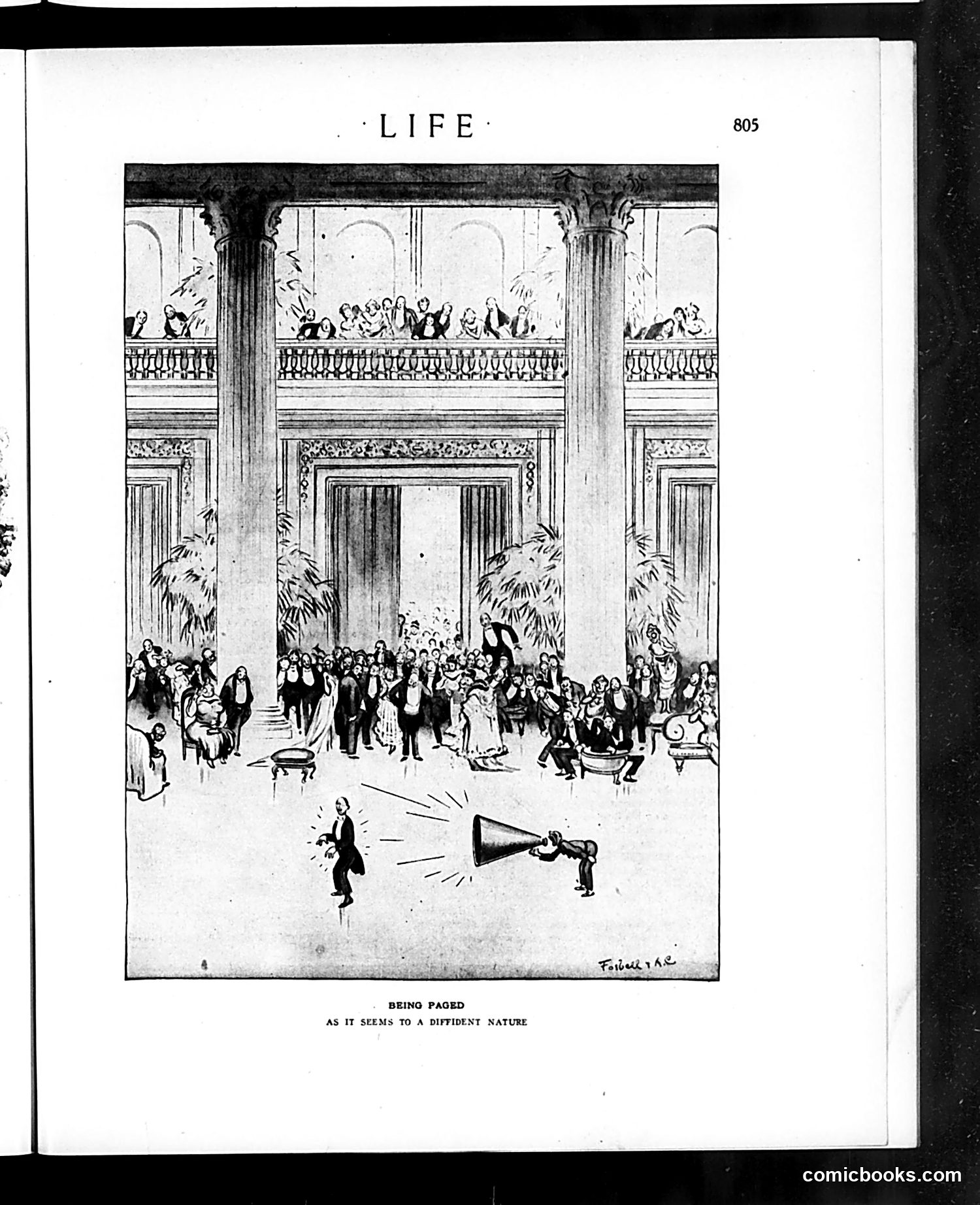
This single-panel cartoon depicts a grand, columned interior (possibly a hotel or public building) filled with formally dressed attendees at what appears to be a social gathering. In the foreground, a small, anxious man is being loudly paged by a bellhop using an enormous megaphone—the sound waves visibly radiating outward. The caption's phrase "diffident nature" is key: the joke targets shy or socially anxious people. The cartoon satirizes how mortifying public attention feels to introverts—being paged in a crowded room represents their worst social nightmare. The oversized megaphone amplifies this embarrassment, suggesting that what might be routine to others feels catastrophically public to someone with social anxiety. This reflects early-20th-century humor about personality types, poking gentle fun at self-conscious individuals.
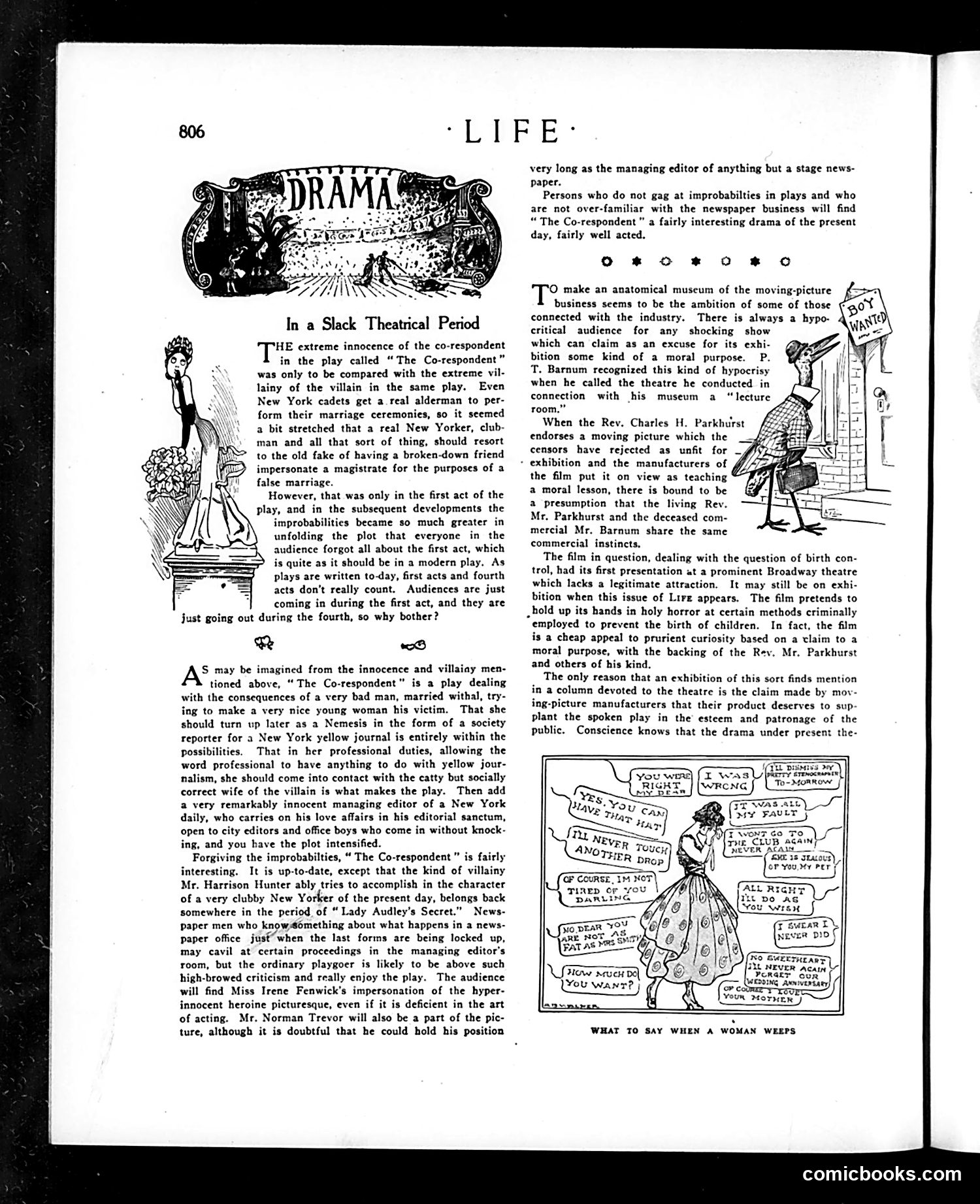
This page critiques theatrical and film industry practices circa early 1900s. The main article reviews "The Co-respondent," a stage play with implausible plots involving false marriages, yellow journalism, and newspaper office affairs. The critic mocks both the play's absurd premise and modern theatrical conventions—noting audiences arrive late and leave early, so acts one and four "don't really count." The lower section attacks moving-picture manufacturers for exploiting moral pretense. It references P.T. Barnum's cynical practice of calling his museum a "lecture room" to justify sensational exhibits. The passage criticizes how Rev. Charles H. Parkhurst's endorsement of a censorship-rejected film lends false moral authority, allowing manufacturers to exhibit it as "teaching" morality rather than mere entertainment. The satire targets hypocrisy: industries cloaking commercial sensationalism in moral justification to attract audiences who want to feel virtuous while consuming scandal.
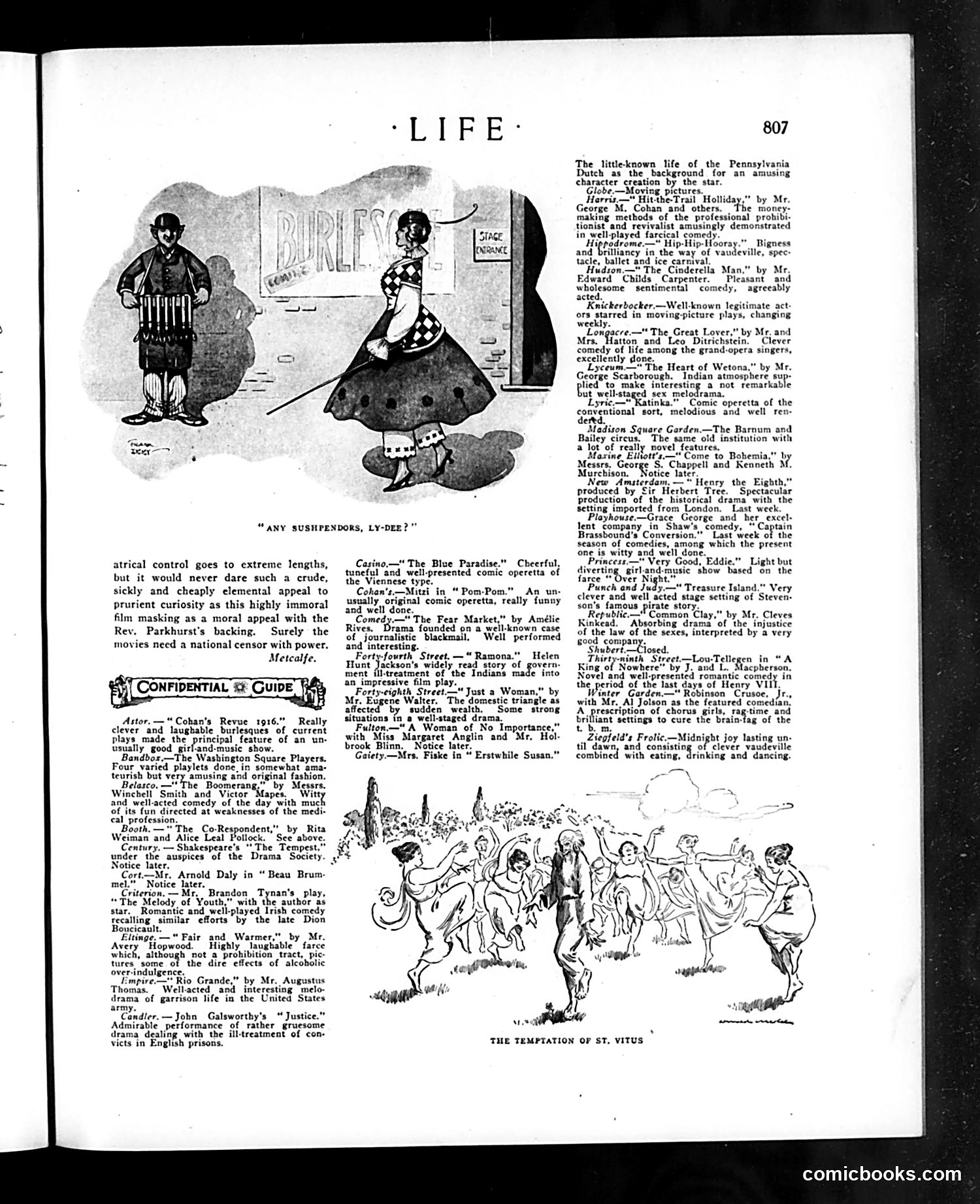
This single-panel cartoon depicts a domestic scene with a woman in a full skirt pointing at a man in striped clothing. The caption's misspelled, exaggerated dialect ("Ly-dee" for "lady") suggests working-class or immigrant speech—likely Pennsylvania Dutch, given the page's reference to that community elsewhere. The joke appears to be physical/slapstick humor: the woman's gesture and the man's posture suggest marital banter, probably about his disheveled appearance or lost suspenders. This reflects early 20th-century vaudeville-style comedy found in *Life* magazine, which frequently published crude, class-based humor mocking immigrants and working people through dialect and stereotypical situations. The humor relies on audience familiarity with ethnic caricature and domestic farce conventions of the era.
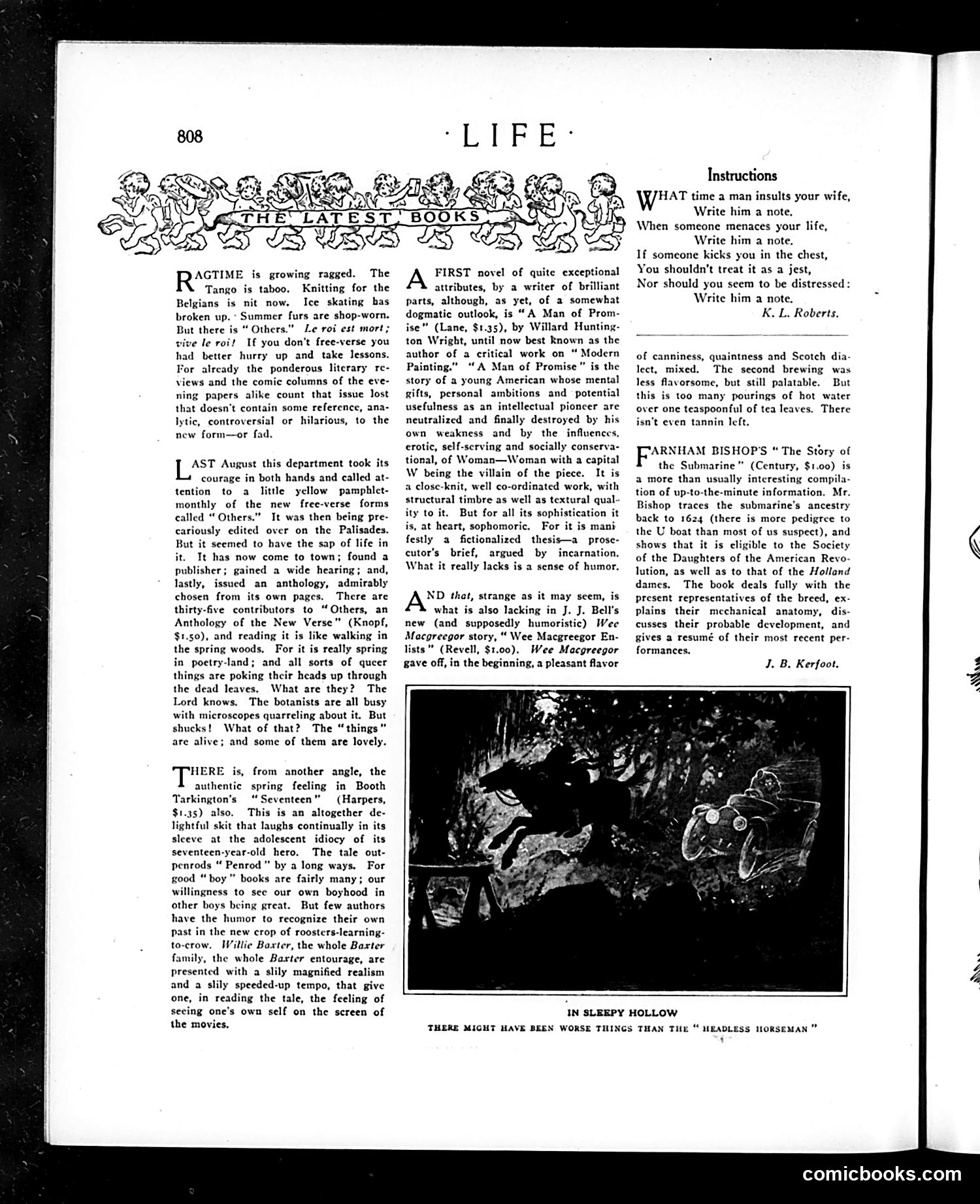
This page reviews contemporary literature and includes a humorous "Instructions" poem by K.L. Roberts about responding to insults and violence by writing notes—satirizing the genteel, passive-aggressive social conventions of the upper class. The main reviews discuss new books: "Others: An Anthology of the New Verse" (celebrating experimental free-verse poetry), Booth Tarkington's "Seventeen" (humorously depicting adolescent foolishness), Willard Huntington Wright's "A Man of Promise" (a sophomorically didactic novel about a talented man destroyed by weakness and women), and J.J. Bell's "Wee Macgreegor Enlists" (a Scottish dialect story). The photograph at bottom, captioned "In Sleepy Hollow" with the tagline "There might have been worse things than the 'Headless Horseman,'" likely references Irving's classic tale, suggesting modern anxieties exceed even that legendary horror. The overall page reflects pre-WWI American literary culture and social commentary.
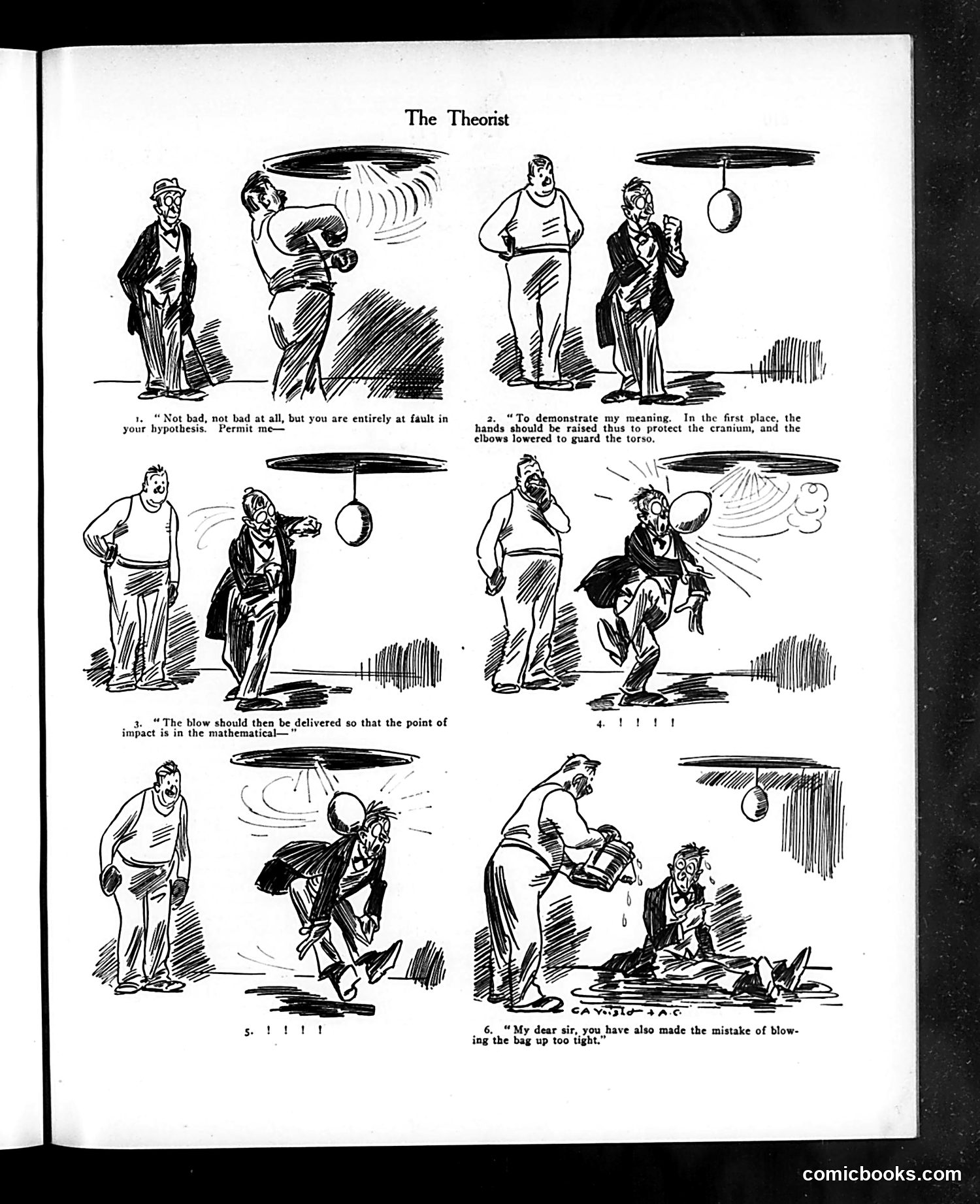
This six-panel satirical strip mocks an overly intellectual man who explains boxing technique with elaborate theory rather than practical demonstration. In panel 1, he corrects someone's boxing stance pedantically ("entirely at fault in your hypothesis"). He continues pontificating through panels 2-3, using mathematical language ("point of impact is in the mathematical") while gesturing instruction. Panels 4-5 show the inevitable result: when he actually attempts to punch a punching bag, he gets knocked backward comically. Panel 6 delivers the final humiliation—his opponent points out he's made a basic error: "blowing the bag up too tight." The satire targets armchair theorists and intellectuals who substitute verbose explanation for common sense or practical skill. His elaborate academic language cannot compensate for his actual incompetence at the task. The humor lies in the gap between his pretentious theorizing and his laughable failure at something straightforward.
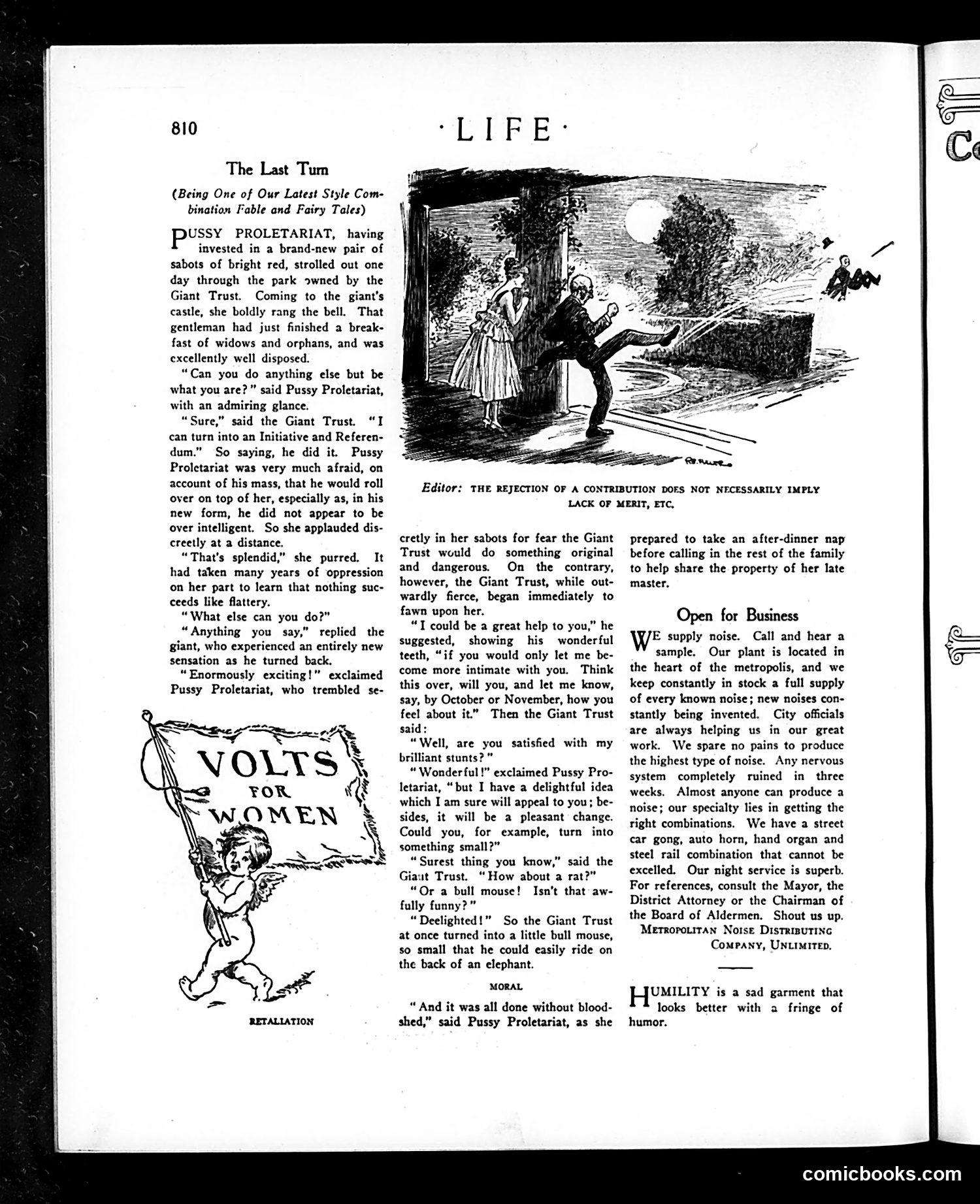
This is a political fable mocking the relationship between organized labor ("Pussy Proletariat," dressed in working-class red sabots) and big business (the "Giant Trust"). The satire works on multiple levels: **The Setup:** Pussy flatters and manipulates the powerful Giant Trust through deference, having "learned that nothing succeeds like flattery"—a critique of how workers must appease capitalists. **The Transformation Joke:** When the Trust transforms into "Initiative and Referendum" (progressive political reforms), Pussy remains fearful rather than liberated, suggesting these reforms lack real power or substance. **The Twist Ending:** The Trust shrinks to a harmless mouse, and Pussy immediately prepares to seize his wealth, calling family to "share the property"—satirizing the working class's dream of expropriating capitalist assets. **The Moral:** Revolution accomplished "without bloodshed" through cunning flattery rather than violent uprising. This reflects early 20th-century debates about labor organizing, trust-busting, and whether gradual reform or radical redistribution would solve economic inequality.
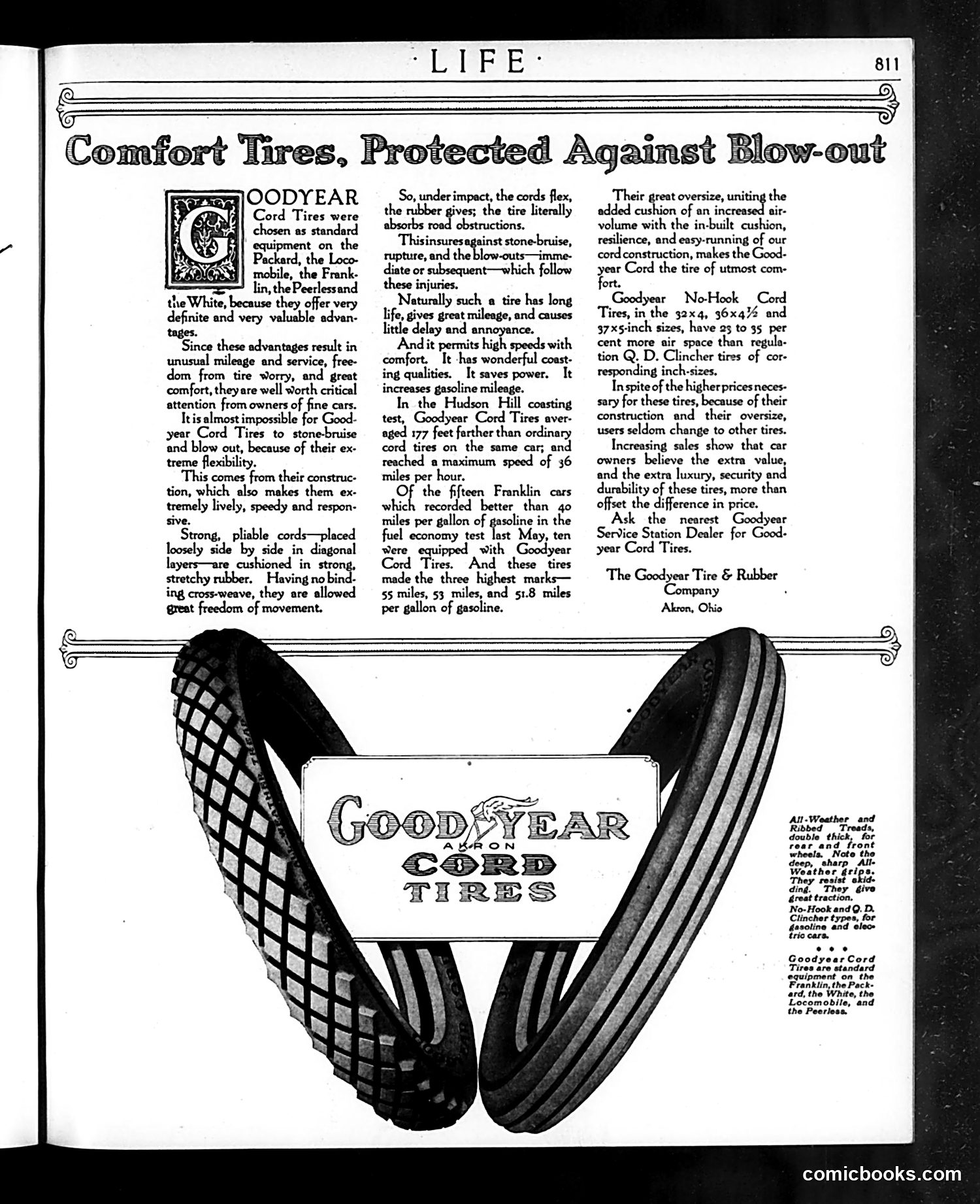
This is a straightforward **product advertisement**, not satire or political commentary. The page promotes Goodyear Cord Tires as premium equipment for luxury automobiles of the era (Packard, Locomobile, Franklin, Peerless, White). The advertisement emphasizes the tires' construction—strong, flexible cords in diagonal layers—which supposedly prevents blowouts and stone-bruises while improving fuel economy and ride comfort. The text cites performance tests: Hudson Hill coasting tests and Franklin cars achieving 40+ miles per gallon, with Goodyear-equipped vehicles recording 51-55 miles per gallon. The visual shows two tire cross-sections displaying the cord pattern and tread design. The ad targets owners of expensive cars willing to pay premium prices for durability and comfort. There is no satire intended—this is earnest marketing positioning Goodyear tires as the standard choice for high-end automobiles.
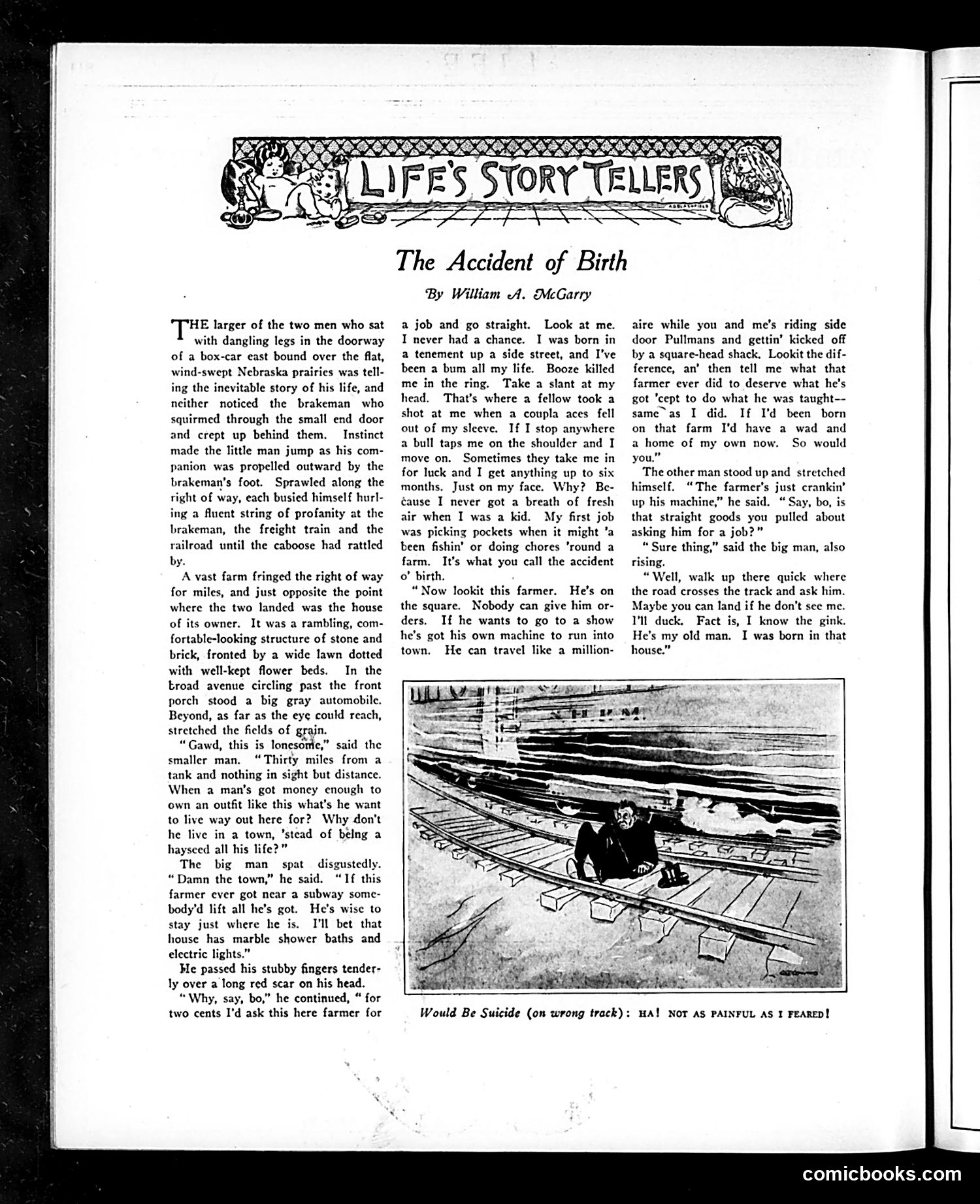
This is a satirical story about class and social mobility. Two hobos—traveling illegally on a freight train—debate their fate. The larger man laments his poverty, blaming his circumstances on being born into a tenement rather than rural wealth. He envies a nearby farmer's automobile, marble bathrooms, and freedom from police harassment. The twist: the second hobo reveals he *was* born on that farm but chose the vagrant life anyway. The satire targets the "accident of birth" excuse—the idea that one's circumstances are entirely determined by where you're born. By showing a man who rejected privilege, McGarry suggests personal choices, not just birth, shape one's destiny. The accompanying illustration shows the hobo nearly struck by a train, darkly comedic commentary on his self-destructive lifestyle.
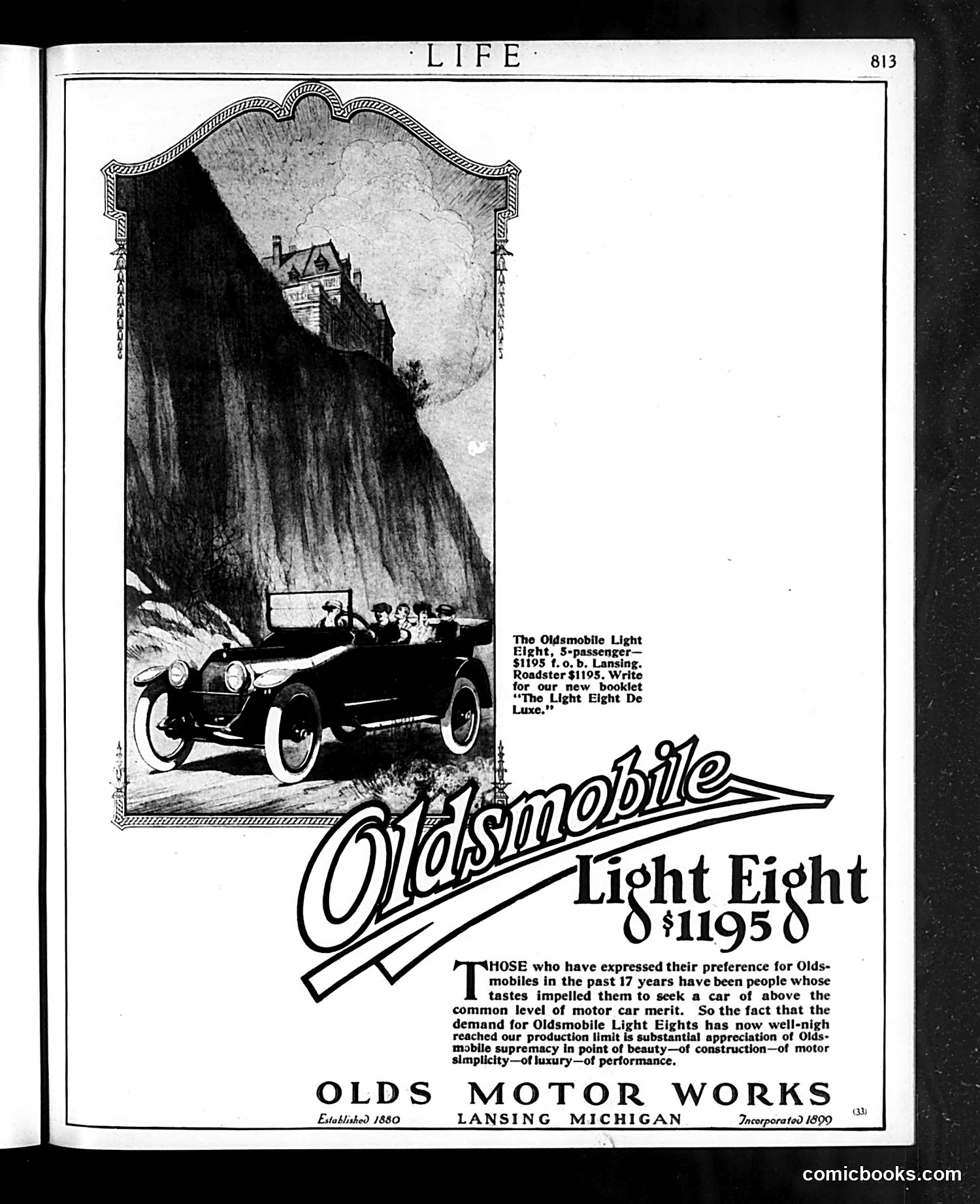
This is a full-page advertisement for the Oldsmobile Light Eight automobile, not a political cartoon. The page appears in *Life* magazine (page 813) and features a dramatic illustration of an open-top roadster driving beneath a castle perched on a cliff, evoking European romance and adventure. The ad copy appeals to affluent consumers by claiming that Oldsmobile owners for the past 17 years have had "tastes impelled them to seek a car of above the common level." The company emphasizes the vehicle's beauty, construction, motor simplicity, luxury, and performance to justify its $1,195 price point (substantial for the era). The advertisement positions Oldsmobile as a premium choice for discerning buyers, contrasting it implicitly against ordinary automobiles.
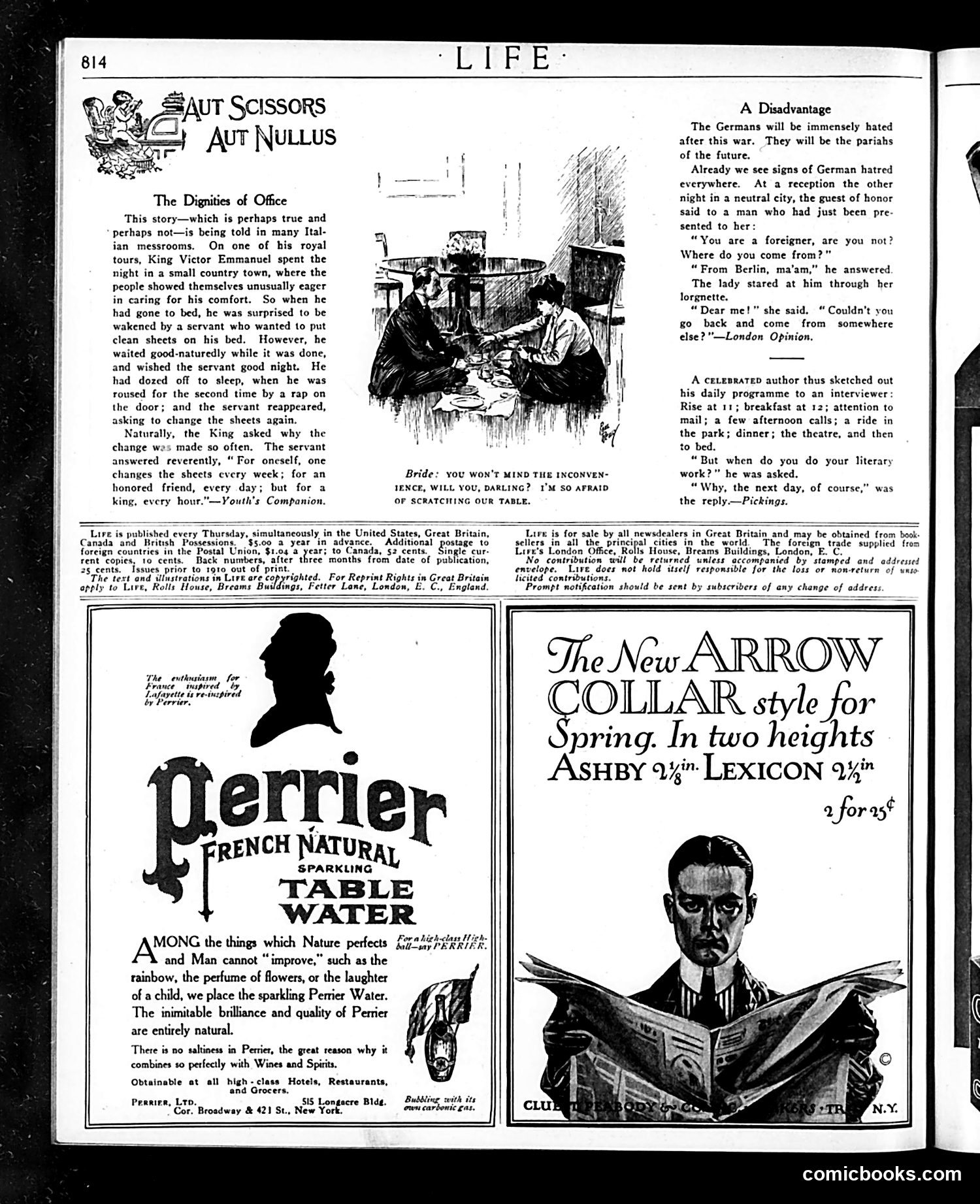
This page contains three satirical pieces and two advertisements from an early 20th-century Life magazine: **"The Dignities of Office"** mocks Italian royal protocol through an anecdote: King Victor Emmanuel is repeatedly awakened by a servant changing sheets. The joke's point—revealed in the punchline—is that servants change sheets weekly for themselves but "every hour" for a king, satirizing the absurd deference shown to monarchy. **"A Disadvantage"** comments on post-WWI anti-German sentiment. A German guest at a neutral city reception is so unwelcome that a lady asks him to claim he's from somewhere else, illustrating the severe social ostracism Germans faced after the war. **"A Celebrated Author"** jokes about a self-important writer's daily schedule that conspicuously lacks actual writing time—he claims to do his literary work "the next day," mocking pretentious authors. The advertisements for Perrier water and Arrow collars are period-appropriate luxury goods marketing.
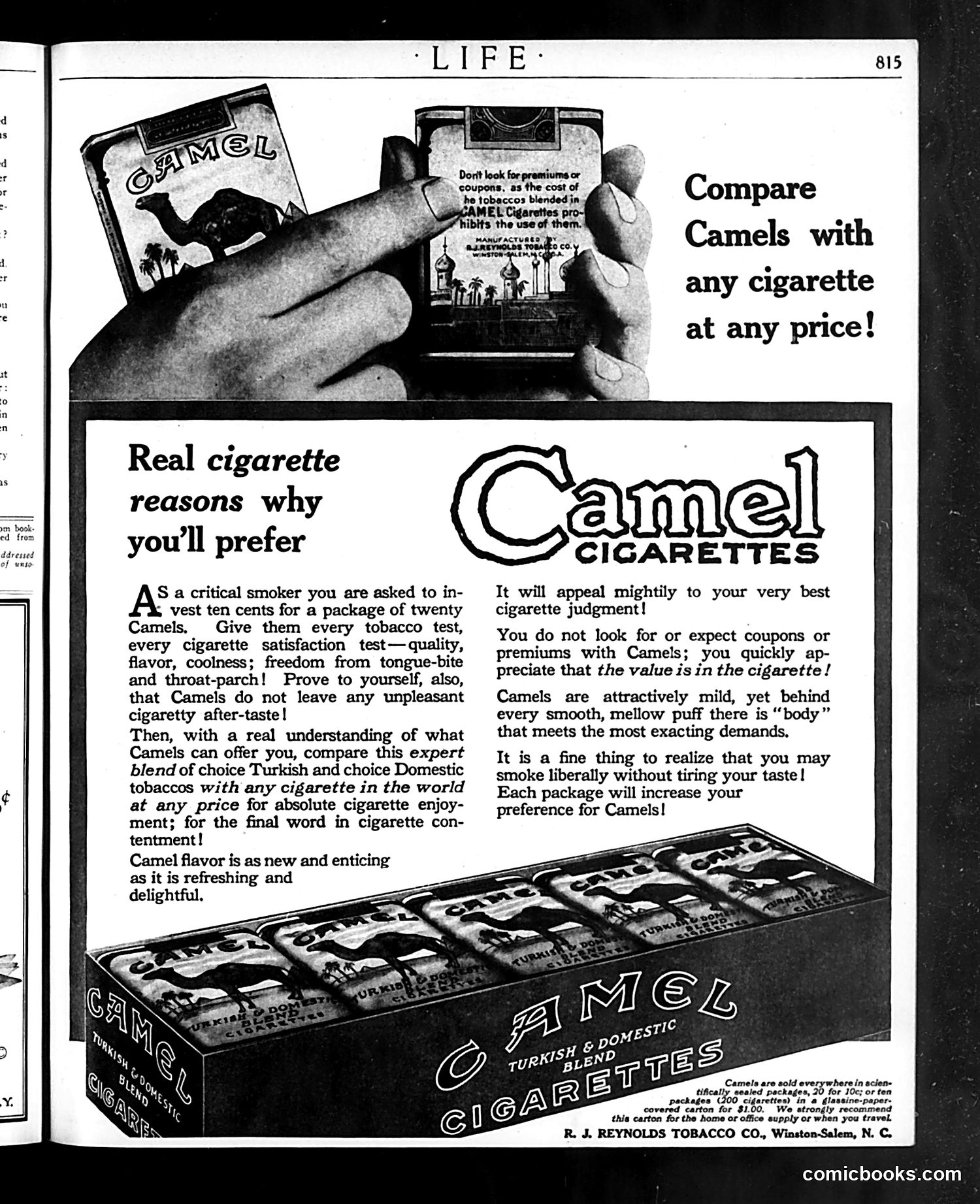
This is **not satire or political commentary**—it's a straightforward cigarette advertisement from Life magazine, likely from the 1920s-1930s based on styling and typography. The ad promotes Camel cigarettes by emphasizing product quality over marketing gimmicks. It explicitly tells consumers *not* to expect premiums or coupons (common sales tactics then), claiming the cigarette's inherent quality justifies its price. The "ten cent test" invites smokers to evaluate Camels against competitors on taste, coolness, and lack of aftertaste. The visual shows a hand holding two cigarette packages for direct comparison. The messaging targets "critical smokers" with appeals to sophistication and rational judgment rather than promotional rewards. **For modern readers:** This reflects pre-regulation tobacco advertising that made health/quality claims freely and marketed to mass audiences without age restrictions or health warnings—practices now illegal. The ad's tone assumes smoking is unremarkable and desirable.
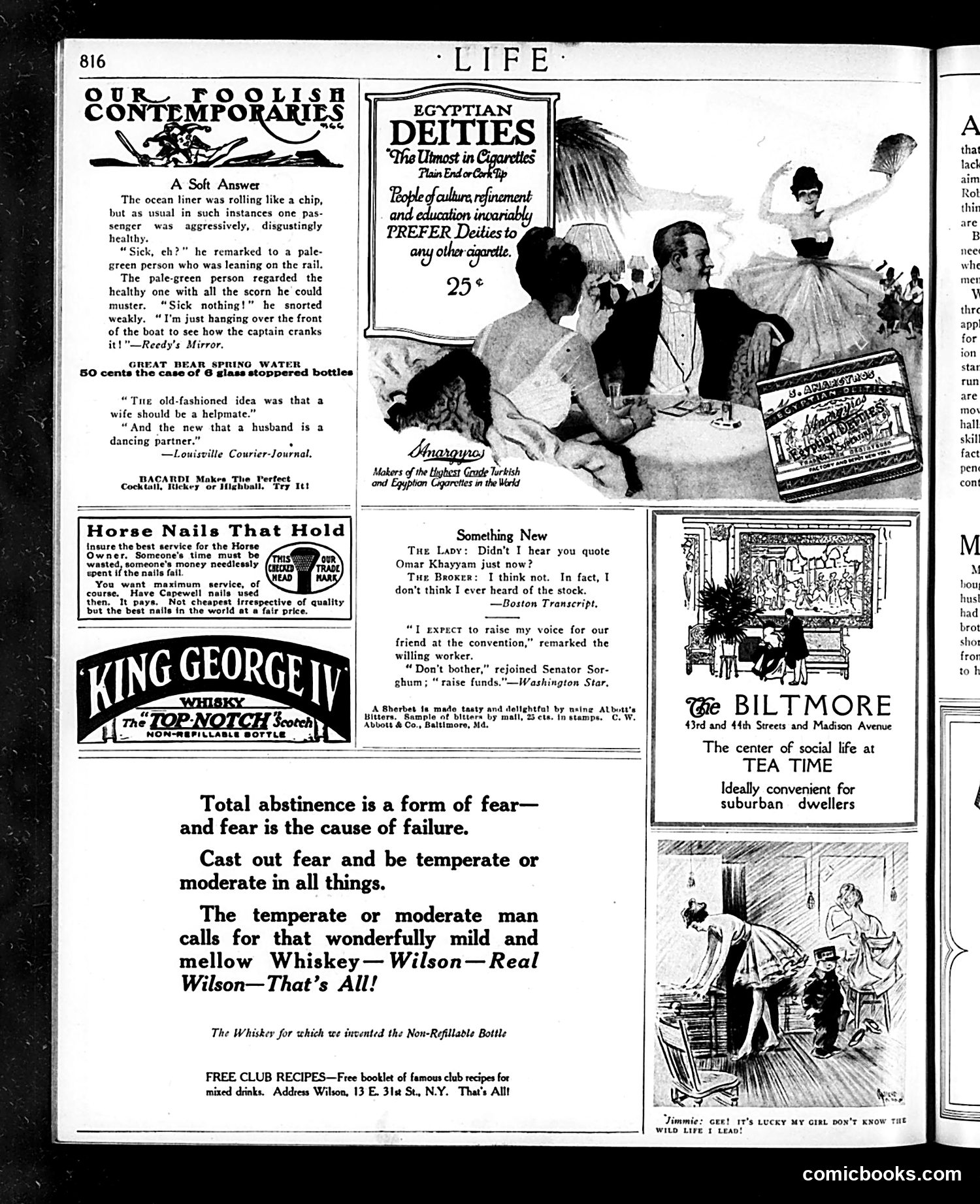
This page is primarily **advertising with occasional humorous short items** rather than political cartoons. The layout mixes ads for cigarettes, whiskey, spring water, and hotels with brief jokes. The main content includes: - **"A Soft Answer"**: A joke about a seasick ocean liner passenger who deflects concern by claiming he's just watching the captain operate the ship—a witty retort to unwanted sympathy. - **Brief satirical quips** on marriage (wives as helpmates vs. dancing partners) and politics (a senator prioritizes fundraising over convention speeches). - **An Omar Khayyam reference**: A broker claims not to know the famous Persian poet, treating his name as if it were a stock ticker—mocking financial preoccupation. The advertisements—particularly for whiskey and cigarettes—reflect early-20th-century marketing before health warnings. The Wilson Whiskey ad's claim about "temperance" promoting whiskey consumption reveals the era's contradictory attitudes toward alcohol during Prohibition's aftermath.
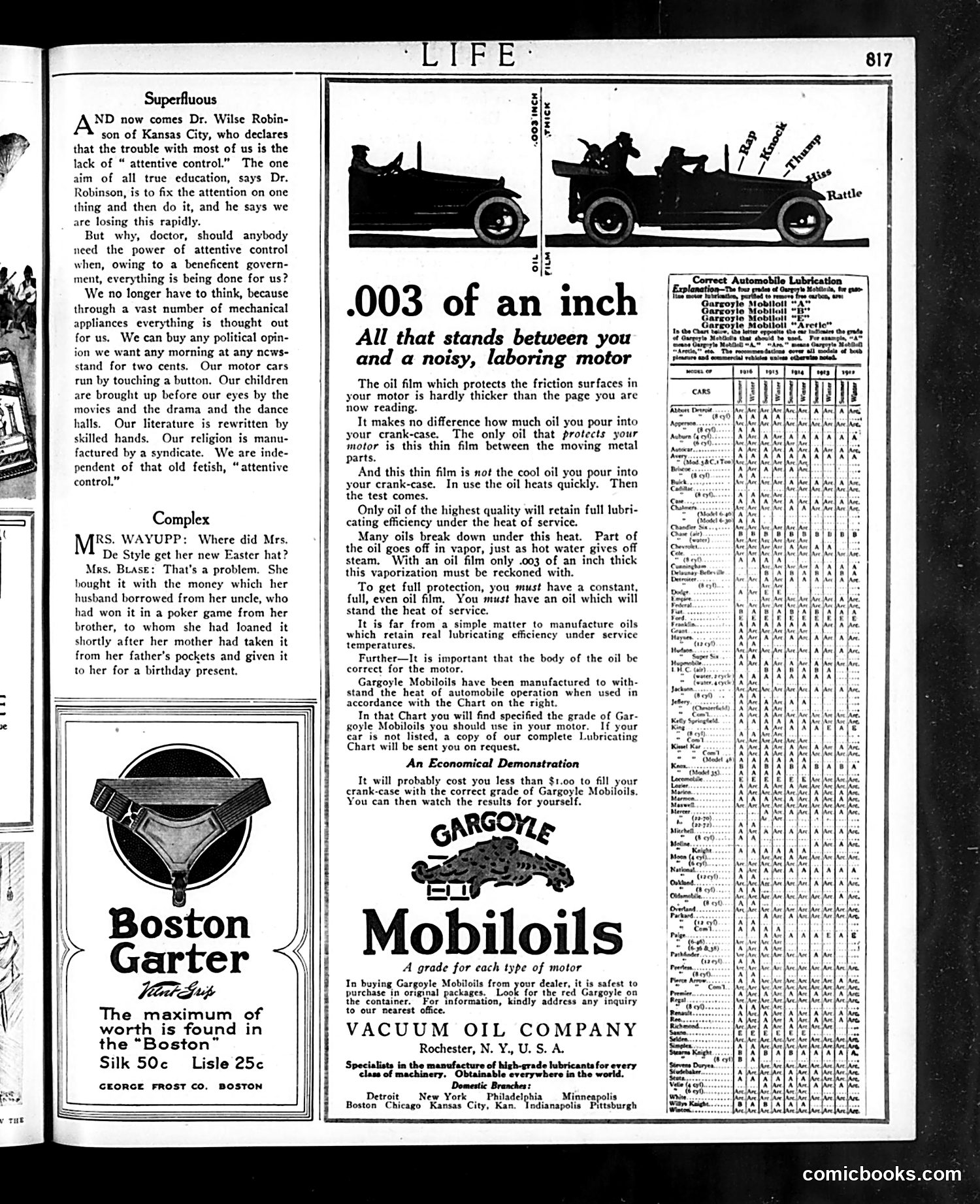
This page contains two satirical pieces and period advertisements. **"Superfluous"** mocks Dr. Wilse Robinson's advocacy for "attentive control" in education. The satire argues such mental discipline is unnecessary because modern life—mechanized appliances, mass-produced opinions ("buy any political opinion...for two cents"), movies, syndicated religion—does all our thinking for us. This is 1920s social commentary critiquing both mass culture and passive consumerism. **"Complex"** is a brief joke about a woman's Easter hat whose ownership history involves circular borrowing and gambling among family members, satirizing the tangled financial dependencies and social complications of domestic life. The bulk of the page is a **Gargoyle Mobiloils advertisement** explaining motor oil viscosity through an extended metaphor: the crucial oil film protecting engine friction is only .003 inches thick—thinner than the page itself. This demonstrates why quality oil matters under heat stress. The ad includes a technical lubrication chart for different car models, representing early automotive marketing that combined education with sales pitch.
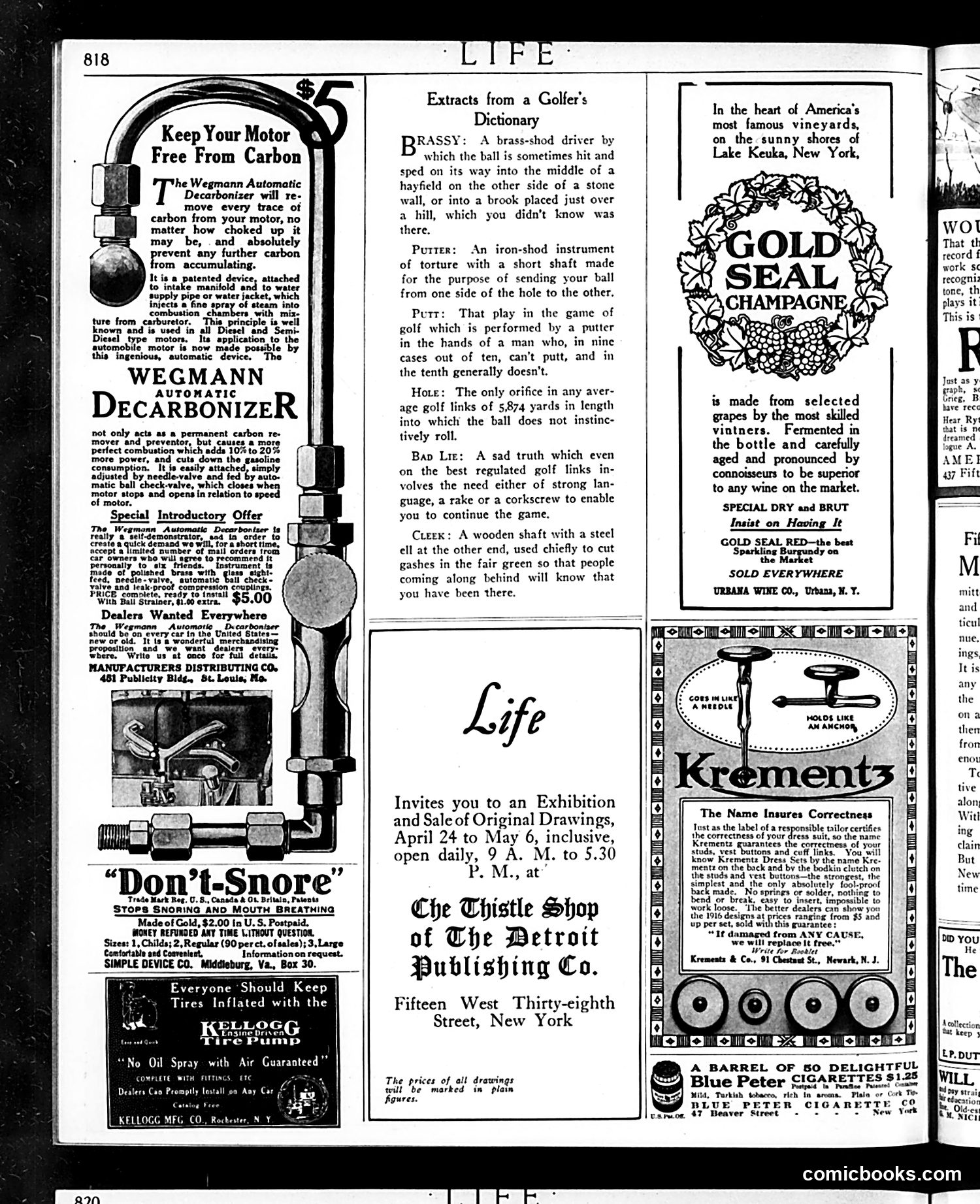
This is primarily an **advertising page** from Life magazine, with one satirical content section worth noting. ## The Satire: "Extracts from a Golfer's Dictionary" The central humor presents mock dictionary definitions of golf terms, offering **cynical commentary on the sport**. Examples include: - **"Brassy"**: describes hitting a ball into a hayfield or brook you didn't know existed - **"Putter"**: an "instrument of torture" - **"Hole"**: "the only orifice...into which the ball does not instinctively roll" - **"Bad Lie"**: requires "strong language, a rake or a corkscrew" - **"Cleek"**: used to cut gashes in the green The joke mocks golfers' frustration and incompetence—poking fun at the sport as inherently aggravating and poorly played by amateurs. This reflects common early-20th-century satirical attitudes toward golf as an absurd pastime for the wealthy. The surrounding advertisements (tire pumps, champagne, snore-stoppers, motor decarbonizers) are unrelated to the satire.
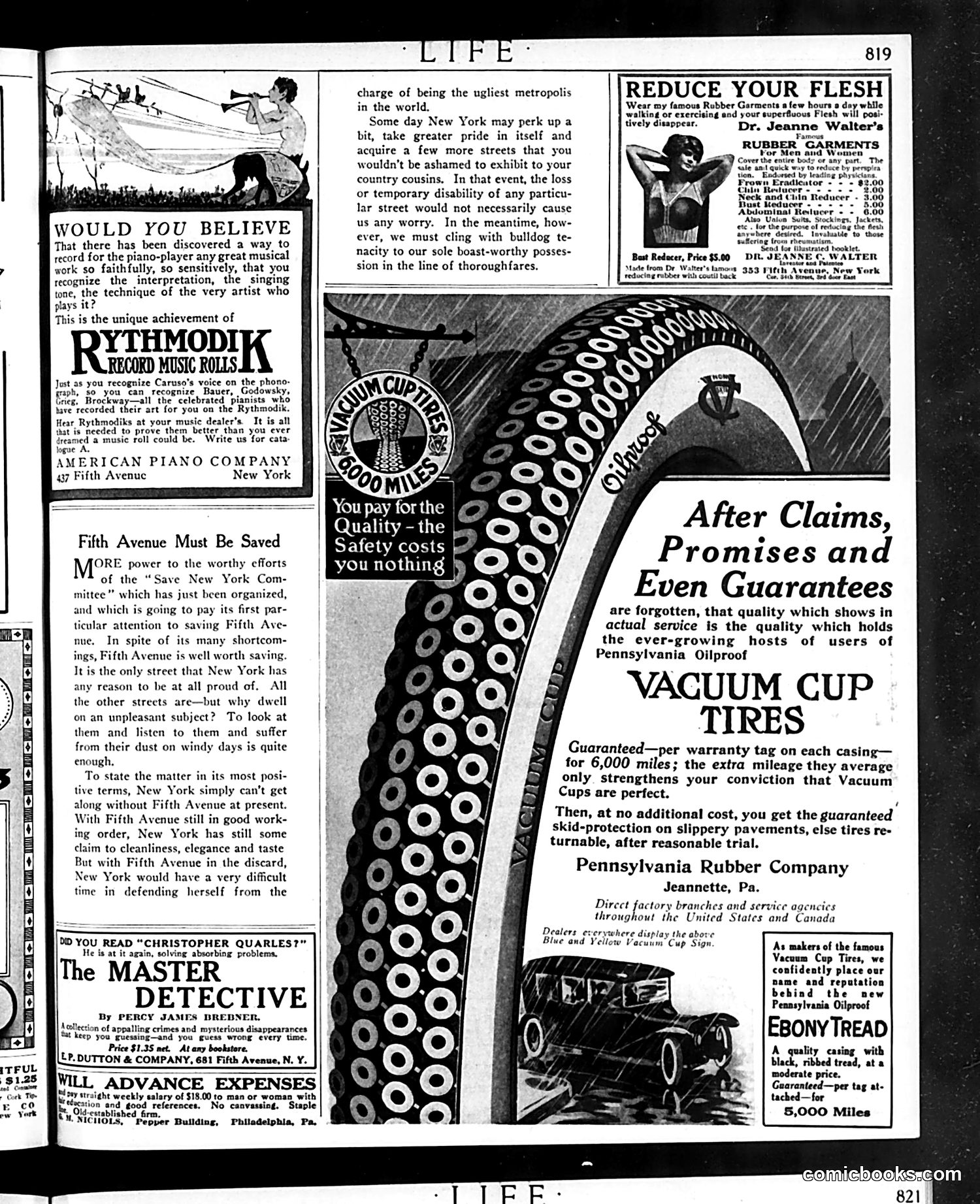
This page is primarily **advertising with one editorial piece**—not political satire. The main content is a brief editorial defending **Fifth Avenue** as New York's only street worthy of pride. The writer argues the city is otherwise aesthetically poor ("ugliest metropolis in the world") and must preserve Fifth Avenue as its sole claim to elegance. The tone is gently mocking: New York should "cling with bulldog tenacity" to this one decent street until it can acquire more. The page is otherwise filled with period advertisements: piano rolls claiming to reproduce famous pianists' performances; rubber reducing garments; tire guarantees; and a detective serial. **No identifiable political figures or caricatures appear.** The Fifth Avenue piece reflects early-20th-century anxiety about American urban development and taste—a recurring theme in Life magazine's satirical commentary on American society's contradictions between ambition and actual achievement.
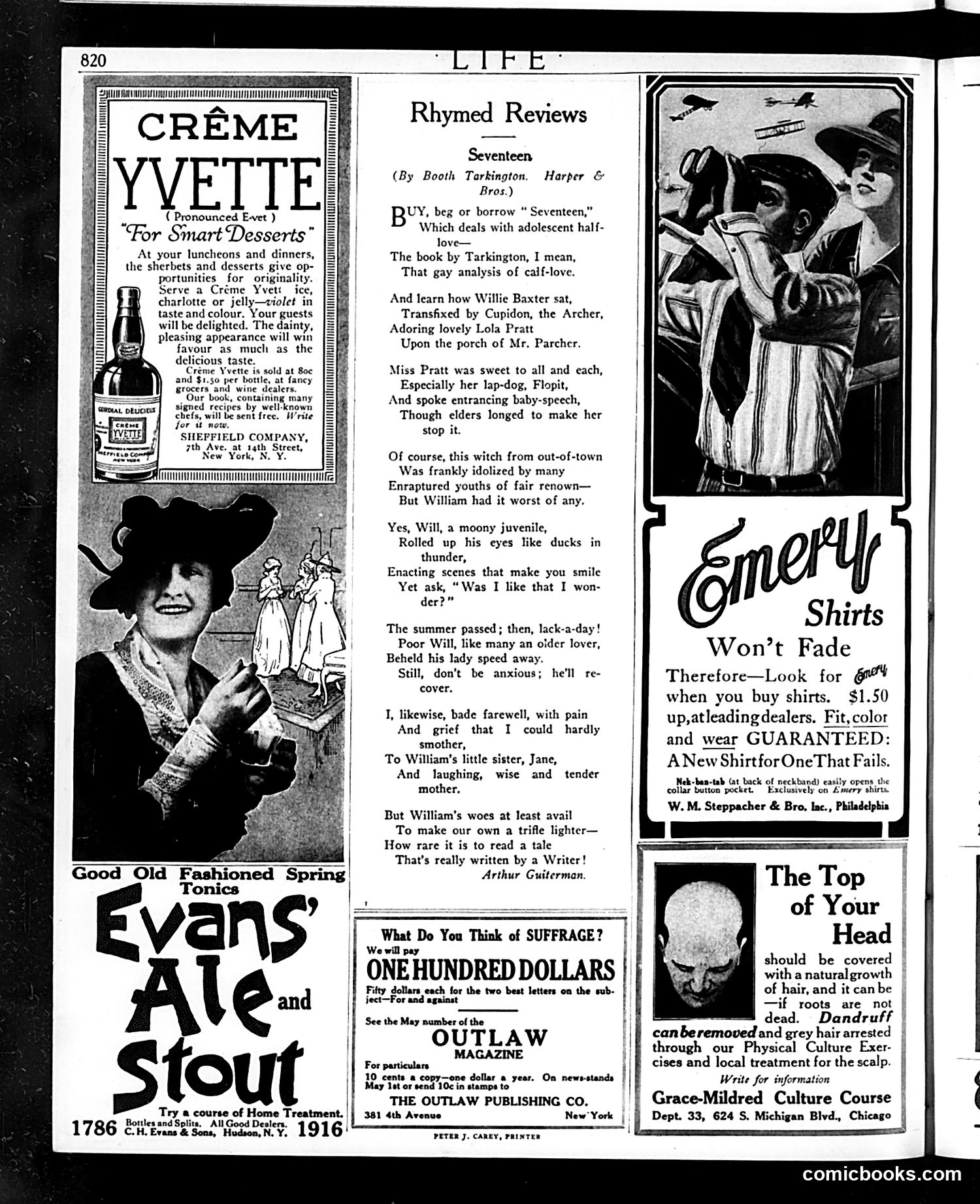
This page combines literary review, advertisements, and a social commentary contest typical of Life's satirical format. **"Rhymed Reviews" – "Seventeen":** Arthur Guiterman's verse review of Booth Tarkington's novel about adolescent infatuation. The poem humorously describes Willie Baxter's moony obsession with visiting girl Lola Pratt, mocking the intensity of teenage crushes. Guiterman celebrates Tarkington for authentically capturing this universal experience—the joke being that reading a *writer* tell the truth about love is rare. **Social Context:** The review reflects early 20th-century anxiety about youth courtship and the "boy meets girl" sentiment dominating popular literature. **Bottom Contest:** Life solicits reader letters debating women's suffrage for $100 prize money ($50 each side), positioning the magazine as a forum for contemporary political argument—here, the nascent women's voting rights movement. **Advertisements** for Crème Yvette dessert liqueur, Emery Shirts, and hair/dandruff treatments fill remaining space—standard period marketing.
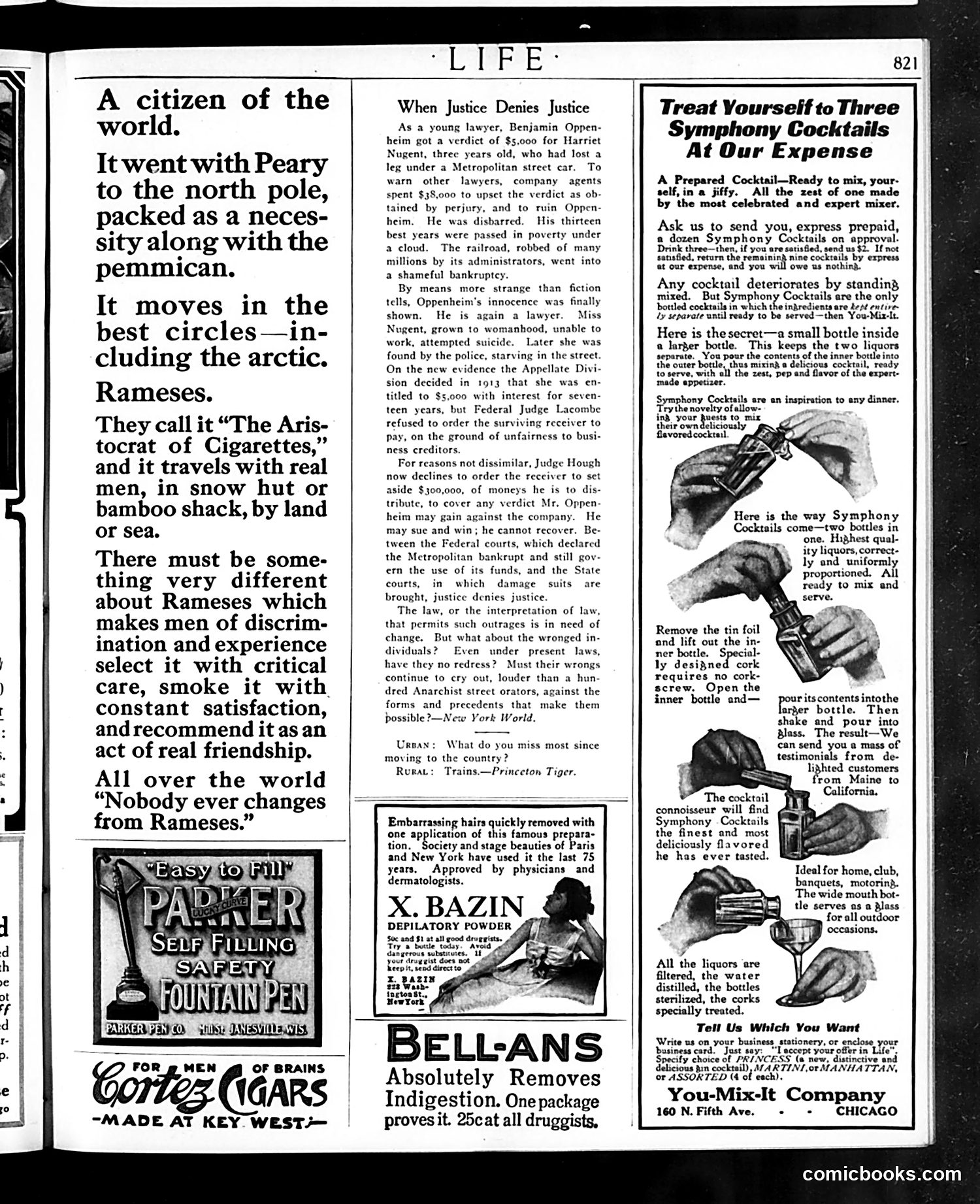
This page is primarily **advertising**, with one editorial piece about judicial injustice. The main article, "When Justice Denies Justice," describes a real 1913 case: a young girl (Harriet Nugent) lost her leg in a streetcar accident; lawyer Benjamin Oppenheim won her a $5,000 verdict, but the railroad company spent $38,000 to overturn it and destroy Oppenheim's career. Years later, his innocence was proven, but federal judges refused to enforce payment, prioritizing creditors over the injured child—now destitute and suicidal. The piece satirizes the legal system's failure: state and federal courts create a bureaucratic maze where justice becomes impossible despite technical legal remedies. The page also advertises Rameses cigarettes (marketed as an "aristocrat" for discriminating men), Bell-Ans indigestion remedy, and "Symphony Cocktails"—pre-mixed bottled drinks. These ads reflect early 20th-century consumer culture and product marketing to urban professionals.
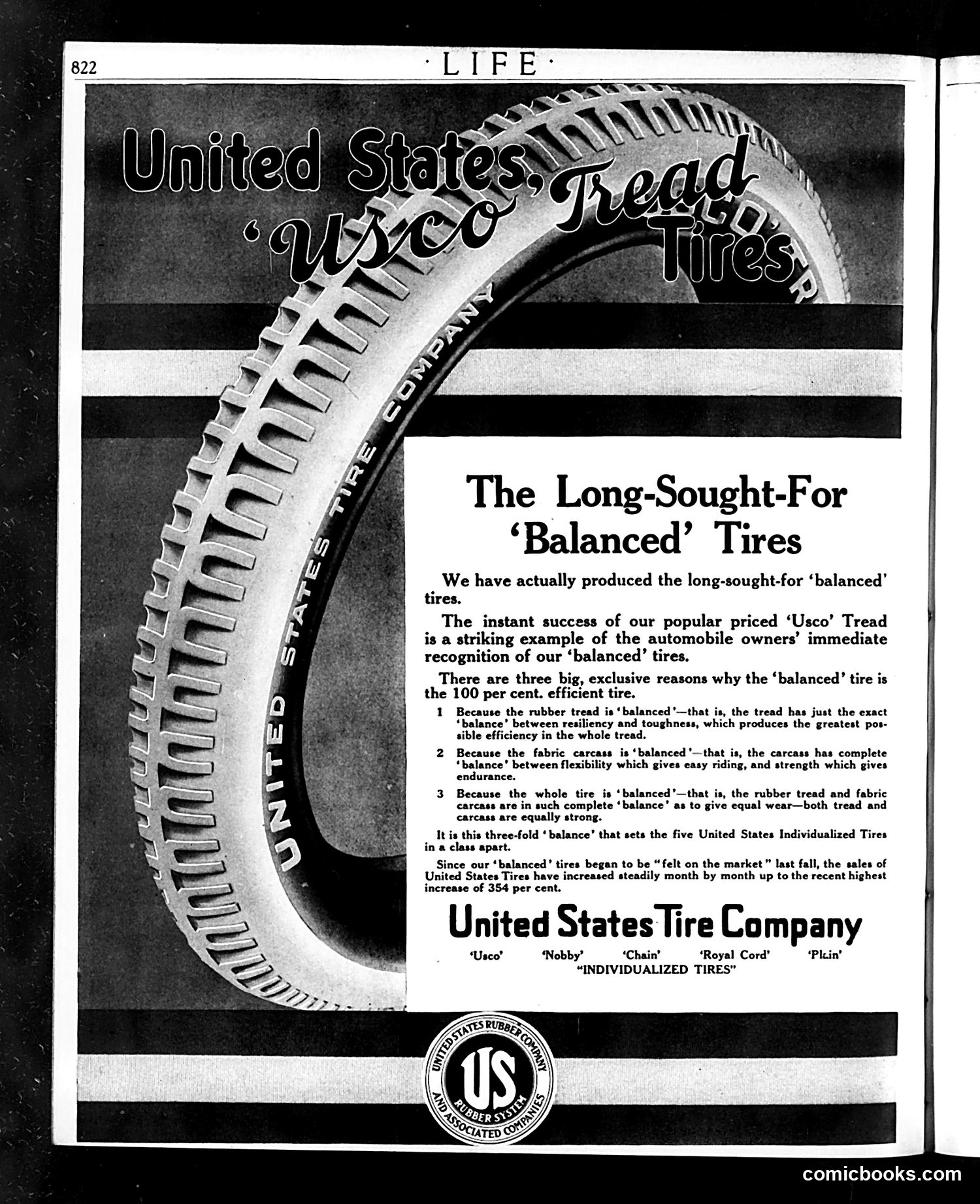
This is a **United States Tire Company advertisement**, not political satire. It promotes their "balanced" tire technology to automobile owners, emphasizing three engineering advantages: balanced rubber tread, balanced fabric carcass, and overall tire balance for even wear. The page showcases the "Usco" brand alongside four other product lines ("Nobby," "Chain," "Royal Cord," "Plein"). The advertisement claims remarkable commercial success—a 354 percent sales increase since fall launch—positioning balanced tires as a revolutionary consumer innovation. The large tire photograph serves as product display. The repeated emphasis on "balance" (appearing in quotation marks) suggests this was a novel marketing concept for early automotive consumers, likely dating to the 1920s based on typography and design conventions. This is straightforward commercial advertising, not editorial cartooning.
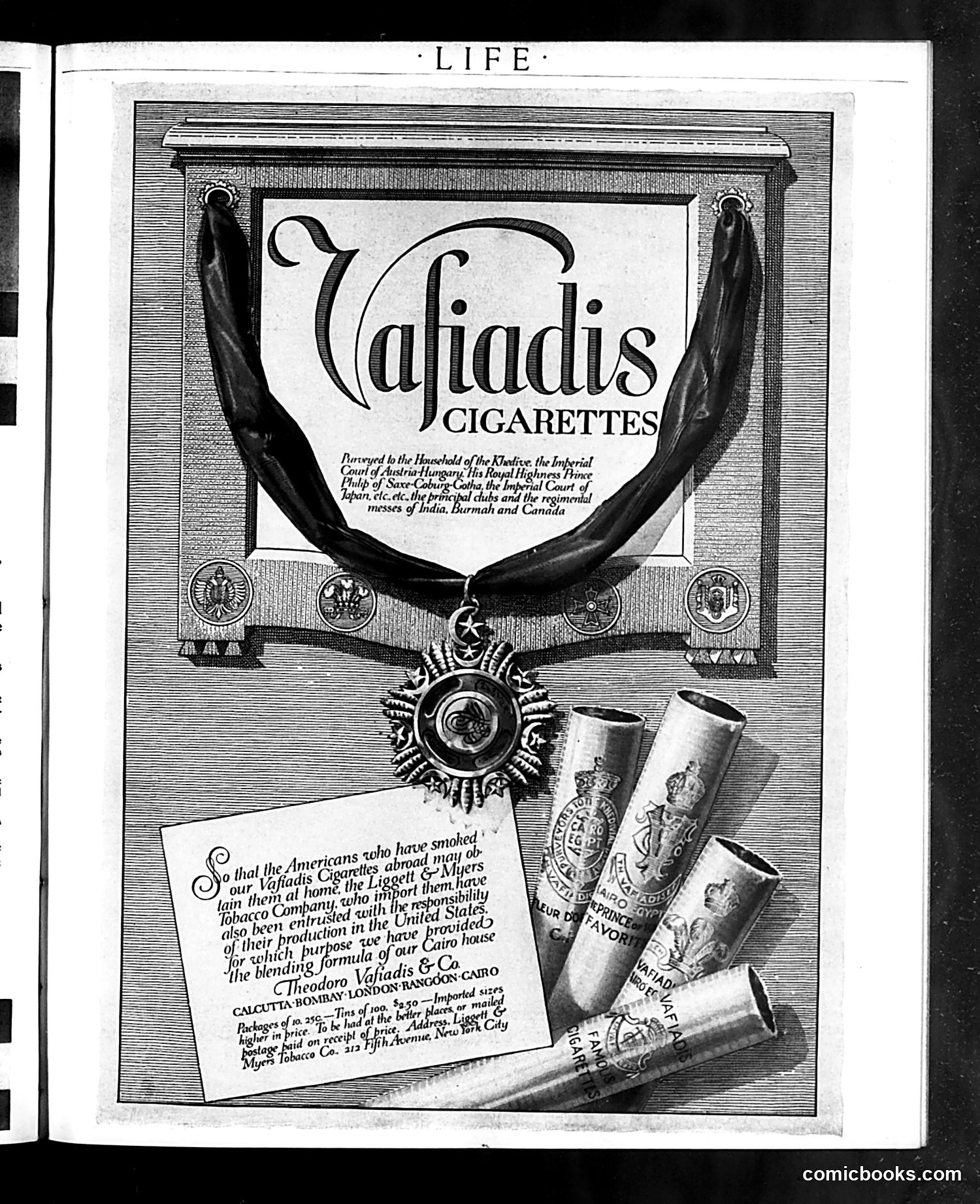
This is a **cigarette advertisement**, not a political cartoon. It promotes Caifadis Cigarettes, manufactured by Theodoro Vafiadis & Co. in Cairo. The ad uses ornate imperial imagery—royal seals, medals, and formal heraldry—to establish prestige and legitimacy. The text claims the brand has been "patronized" by European royalty and Indian nobility, lending it aristocratic credibility. The elaborate decorative elements (the curved tusks, ornamental medallion, and ceremonial styling) reinforce an exotic, luxurious brand identity. This was typical early 20th-century advertising strategy: linking consumer products to wealth, status, and global sophistication to justify premium pricing. The reference to "Cairo house" emphasizes foreign origin as a selling point—suggesting quality and exclusivity.
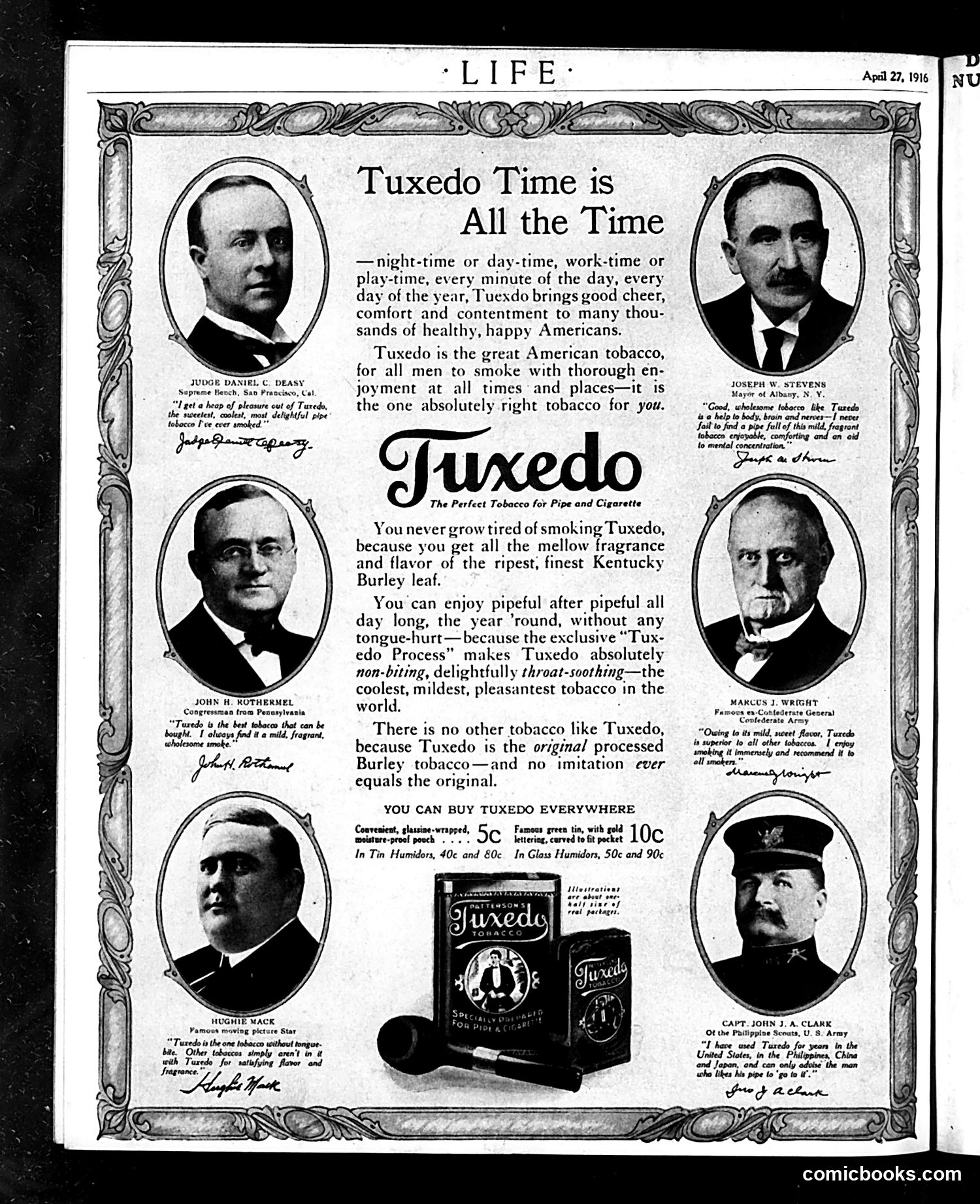
This is a **tobacco advertisement**, not a political cartoon. It features endorsements from six prominent American figures—a congressman, mayor, and military officer among them—vouching for Tuxedo brand tobacco's mildness and quality. The ad's central claim is that Tuxedo tobacco is "non-biting" and "throat-soothing" due to an exclusive "Tuxedo Process," making it suitable for constant use throughout the day. The testimonials emphasize health benefits ("help to body, broin and nerves") and describe the product as an "American tobacco" for all men. **Modern context**: This reflects early 20th-century advertising practices before tobacco's health dangers were widely acknowledged or regulated. The use of authority figures (government officials, military captains) to legitimize the product was standard marketing. The repeated claims of safety and mild effects now read as deeply misleading, representing an era when such advertising faced no FDA oversight or health warnings.