
Life, 1916-04-27 · page 18 of 44
Life — April 27, 1916 — page 18: what you’re looking at
What you’re looking at
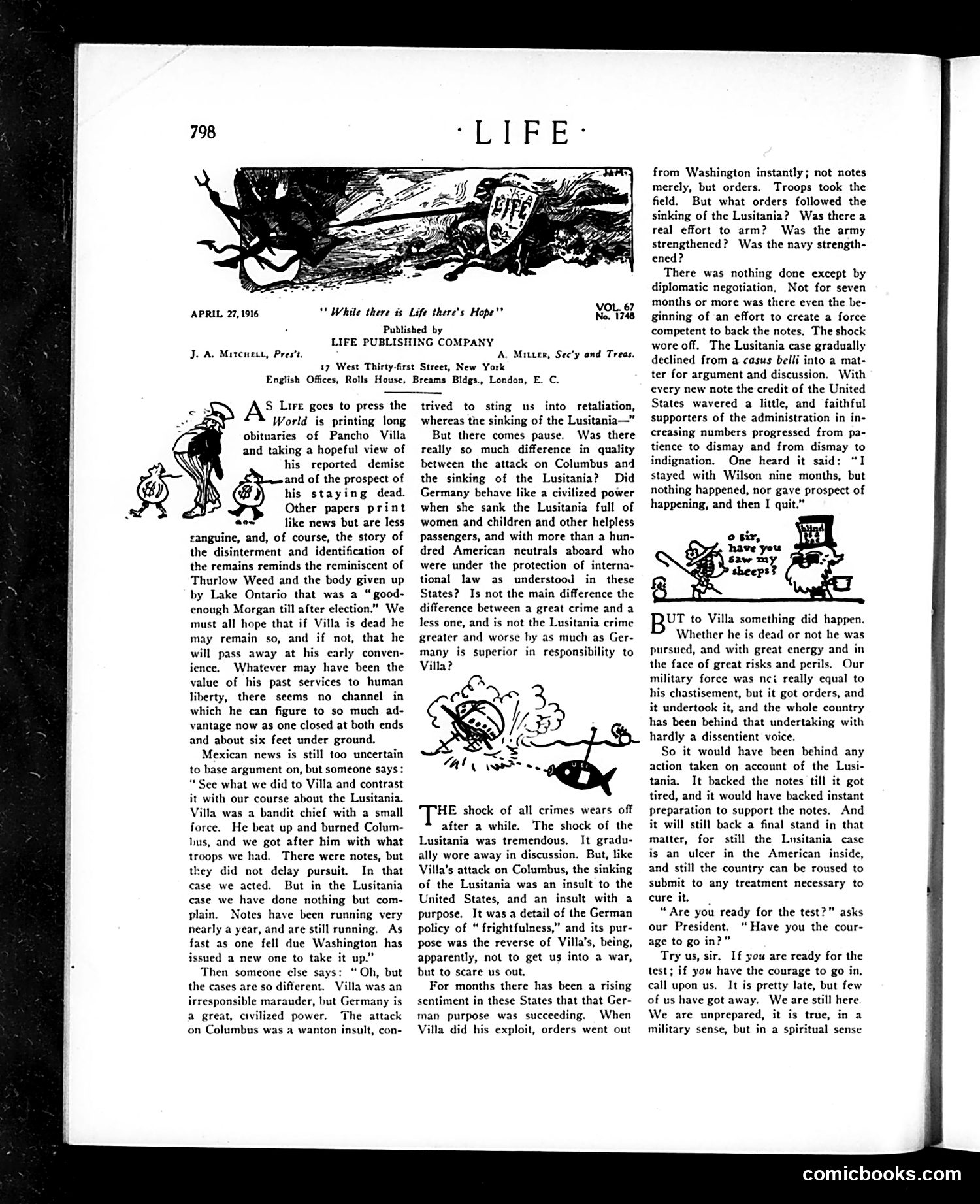
This editorial compares America's swift military response to Pancho Villa's 1916 raid on Columbus, Mexico with its diplomatic-only response to Germany's 1915 sinking of the Lusitania (which killed American citizens). The author argues the cases are morally equivalent: both were deliberate insults to American sovereignty. Yet the U.S. immediately deployed troops against Villa while merely sending protest notes to Germany for months. The cartoons mock this inconsistency—depicting Villa as a bandit deserving swift punishment, while questioning why Germany, a "civilized power," escaped similar consequences. The piece criticizes American inaction, suggesting that Germany's "frightfulness" policy (deliberately terrorizing civilians) successfully intimidated the U.S. into inaction, whereas Villa's provocation triggered immediate military mobilization. The implicit message: America's tepid response to the Lusitania emboldened German aggression.
📄 Transcribed text from this page (OCR, searchable)
Machine-transcribed from the original scan — historical spelling and the odd misread are preserved.
& APRIL 27,1916 “While there és Life there's Hope” Published by LIFE PUBLISHING COMPANY J. A. Mircuent, Pres’t. A. Mitter, Sec’y and Treas. 17 West Thirty-first Street, New York English Offices, Rolls House, Breams Bldgs., London, E. C. S Lire goes to press the World is printing long obituaries of Pancho Villa and taking a hopeful view of his reported demise band of the prospect of @) his staying dead. Other papers print ao sed like news but are less ¢anguine, and, of course, the story of the disinterment and identification of the remains reminds the reminiscent of Thurlow Weed and the body given up by Lake Ontario that was a “good- enough Morgan till after election.” We must all hope that if Villa is dead he may remain so, and if not, that he will pass away at his early conven- ence. Whatever may have been the value of his past services to human liberty, there seems no channel in which he can figure to so much ad- vantage now as one closed at both ends and about six feet under ground. Mexican news is still too uncertain to base argument on, but someone says: “See what we did to Villa and contrast it with our course about the Lusitania. Villa was a bandit chief with a small force. He beat up and burned Colum- lus, and we got after him with what troops we had. There were notes, but they did not delay pursuit. In that case we acted. But in the Lusitania case we have done nothing but com- plain. Notes have been running very nearly a year, and are still running. As fast as one fell due Washington has issued a new one to take it up.” Then someone else says: “Oh, but the cases are so different. Villa was an irresponsible marauder, but Germany is a great, civilized power. The attack on Columbus was a wanton insult, con- trived to sting us into retaliation, whereas tne sinking of the Lusitania—” But there comes pause. Was there really so much difference in quality between the attack on Columbus and the sinking of the Lusitania? Did Germany behave like a civilized power when she sank the Lusitania full of women and children and other helpless passengers, and with more than a hun- dred American neutrals aboard who were under the protection of interna- tional law as understood in these States? Is not the main difference the difference between a great crime and a less one, and is not the Lusitania crime greater and worse by as much as Ger- many is superior in responsibility to 'HE shock of all crimes wears off after a while. The shock of the Lusitania was tremendous. It gradu- ally wore away in discussion. But, like Villa's attack on Columbus, the sinking of the Lusitania was an insult to the United States, and an insult with a purpose. It was a detail of the German policy of “ frightfulness,” and its pur- pose was the reverse of Villa's, being, apparently, not to get us into a war, but to scare us out. For months there has been a rising sentiment in these States that that Ger- man purpose was succeeding. When Villa did his exploit, orders went out from Washington instantly; not notes merely, but orders. Troops took the field. But what orders followed the sinking of the Lusitania? Was there a real effort to arm? Was the army strengthened? Was the navy strength- ened? There was nothing done except by diplomatic negotiation, Not for seven months or more was there even the be- ginning of an effort to create a force competent to back the notes. The shock wore off. The Lusitania case gradually declined from a casus belli into a mat- ter for argument and discussion. With every new note the credit of the United States wavered a little, and faithful supporters of the administration in in- creasing numbers progressed from pa- tience to dismay and from dismay to indignation. One heard it said: “I stayed with Wilson nine months, but nothing happened, nor gave prospect of happening, and then I quit.” Bt to Villa something did happen. Whether he is dead or not he was pursued, and with great energy and in the face of great risks and perils. Our military force was nci really equal to his chastisement, but it got orders, and it undertook it, and the whole country has been behind that undertaking with hardly a dissentient voice. So it would have been behind any action taken on account of the Lusi- tania. It backed the notes till it got tired, and it would have backed instant preparation to support the notes. And it will still back a final stand in that matter, for still the Lusitania case is an ulcer in the American inside, and still the country can be roused to submit to any treatment necessary to cure it. “Are you ready for the test?” asks our President. “Have you the cour- age to go in?” Try us, sir, If you are ready for the test; if you have the courage to go in, call upon us. I pretty late, but few of us have got away. We are still here. We are unprepared, it is true, in a military sense, but in a spiritual sense comicbooks.com