
Life, 1916-04-27 · page 20 of 44
Life — April 27, 1916 — page 20: what you’re looking at
What you’re looking at
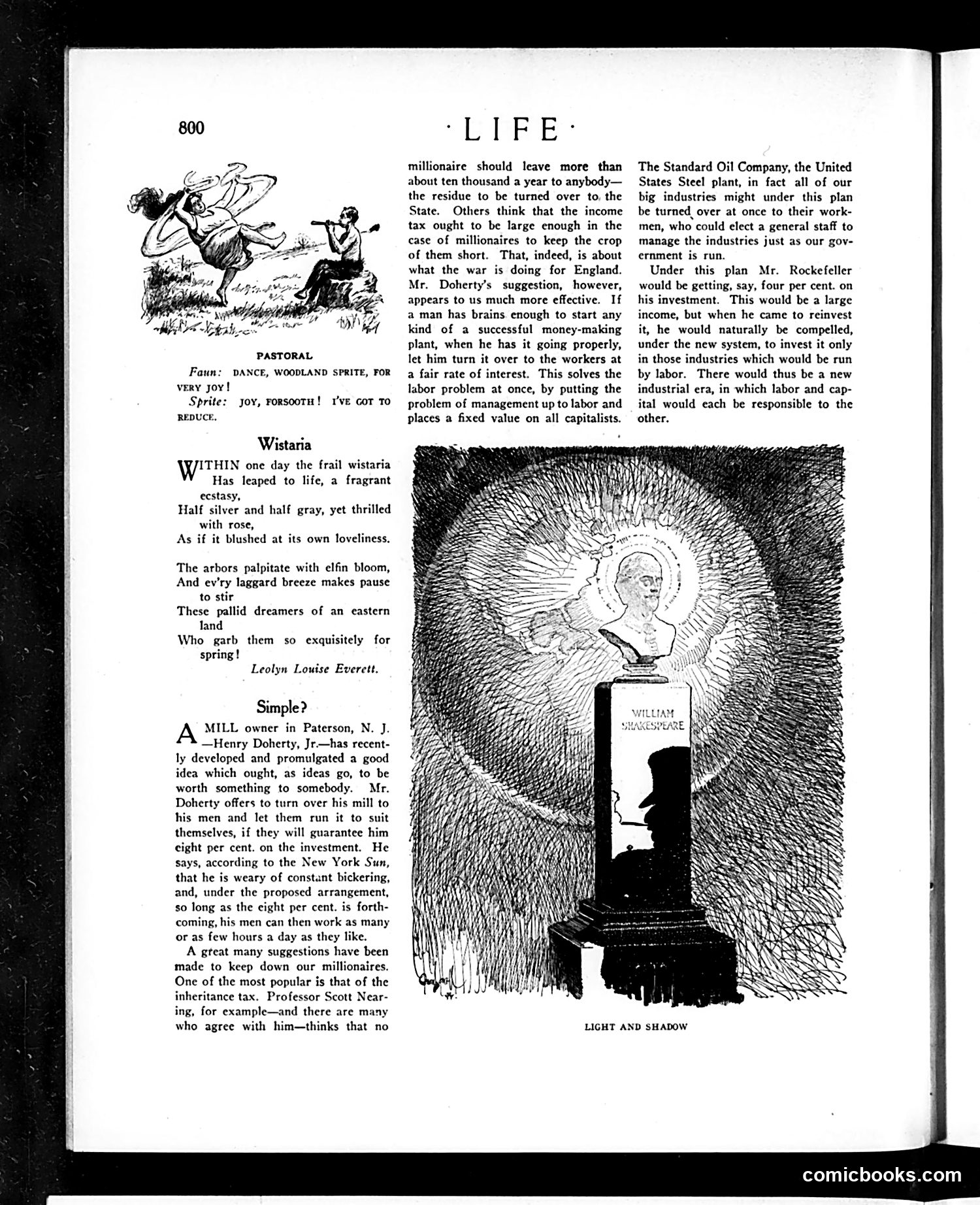
**The Political Content:** This page satirizes early 20th-century labor and wealth debates. The main article "Simple?" discusses Henry Doherty Jr., a Paterson, N.J. mill owner who proposed letting workers run his factory for guaranteed 8% returns to him—positioning this as a solution to labor unrest. **The Satire's Point:** Life magazine endorses Doherty's idea as superior to other wealth-control proposals (inheritance taxes, income taxes). The satire suggests that allowing workers to manage industry while capitalists collect guaranteed dividends is idealistic but naive—hence "Simple?" The article extends this mockingly to Standard Oil and Rockefeller, implying such arrangements would transform capitalism entirely. **Visual Elements:** The "Pastoral" cartoon depicts a sprite reluctant to dance despite "joy," suggesting forced optimism about labor relations. The "Light and Shadow" illustration shows Shakespeare's bust amid radiant light, unrelated to the economic discussion—possibly contrasting enduring culture with temporary economic schemes. **Context:** This reflects Progressive Era debates about redistributing wealth and resolving labor conflicts through structural reform rather than regulation.
📄 Transcribed text from this page (OCR, searchable)
Machine-transcribed from the original scan — historical spelling and the odd misread are preserved.
PASTORAL Faun: DANCE, WOODLAND SPRITE, FOR very joy! Sprite: Joy, ForsooTH! I've GoT TO Wistaria ITHIN one day the frail wistaria Has leaped to life, a fragrant ecstasy, Half silver and half gray, yet thrilled with rose, As if it blushed at its own loveliness. The arbors palpitate with elfin bloom, And ev'ry laggard breeze makes pause to stir These pallid dreamers of an eastern land Who garb them so exquisitely for spring! Leolyn Louise Everett. Simple? MILL owner in Paterson, N. J. —Henry Doherty, Jr—has recent- ly developed and promulgated a good idea which ought, as ideas go, to be worth something to somebody. Mr. Doherty offers to turn over his mill to his men and let them run it to suit themselves, if they will guarantee him cight per cent. on the investment. He says, according to the New York Sun, that he is weary of constant bickering, and, under the proposed arrangement, so long as the cight per cent. is forth- coming, his men can then work as many or as few hours a day as they like. A gteat many suggestions have been made to keep down our millionaires. One of the most popular is that of the inheritance tax, Professor Scott Near- ing, for example—and there are many who agree with him—thinks that no *E RPE: millionaire should leave more than about ten thousand a year to anybody— the residue to be turned over to, the State. Others think that the income tax ought to be large enough in the case of millionaires to keep the crop of them short. That, indeed, is about what the war is doing for England. Mr. Doherty’s suggestion, however, appears to us much more effective. If a man has brains. enough to start any kind of a successful money-making plant, when he has it going properly, let him turn it over to the workers at a fair rate of interest. This solves the labor problem at once, by putting the problem of management up to labor and places a fixed value on all capitalists. i ~~ The Standard Oil Company, the United States Steel plant, in fact all of our big industries might under this plan be turned over at once to their work- men, who could elect a general staff to manage the industries just as our gov- ernment is run. Under this plan Mr. Rockefeller would be getting, say, four per cent. on his investment. This would be a large income, but when he came to reinvest it, he would naturally be compelled, under the new system, to invest it only in those industries which would be run by labor. There would thus be a new industrial era, in which labor and cap- ital would each be responsible to the LIGHT AND SHADOW comicbooks.com