
Life, 1916-04-27 · page 15 of 44
Life — April 27, 1916 — page 15: what you’re looking at
What you’re looking at
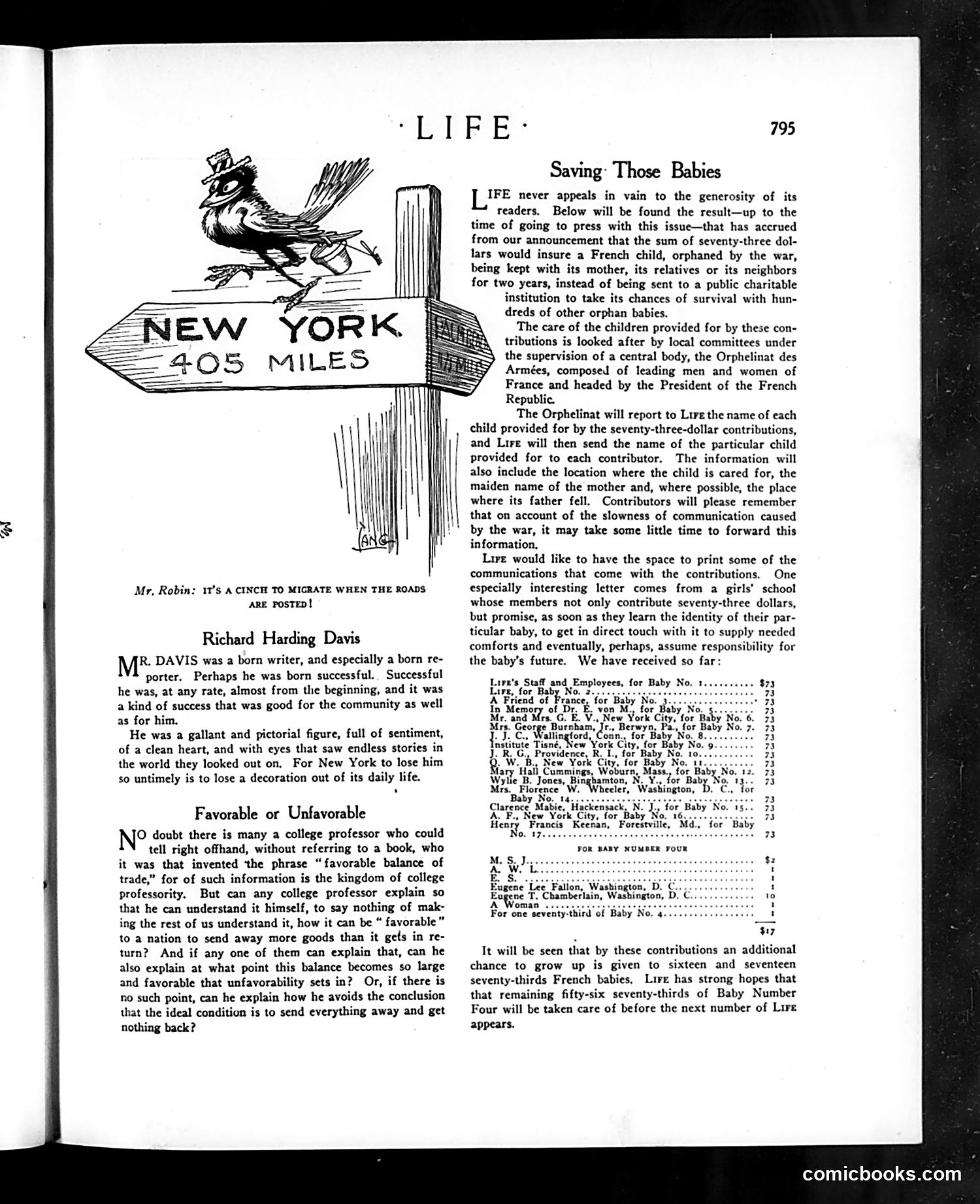
This page contains a satirical cartoon and articles about charitable contributions to French war orphans. The cartoon shows a stork (symbol of babies) carrying a bundle, with a signpost reading "NEW YORK 405 MILES." The caption reads "Mr. Robin: it's a circus to migrate when the roads are posted!"—a joke about transportation difficulties during wartime, anthropomorphizing birds discussing travel logistics. The main articles address "Saving Those Babies" (a fundraising campaign for French orphans) and "Richard Harding Davis" (a war correspondent/writer). A second article, "Favorable or Unfavorable," appears to satirize college professors' inability to explain abstract concepts clearly. The page reflects WWI-era American charitable efforts toward war-displaced European children and contains typical Life magazine social commentary and humor.
📄 Transcribed text from this page (OCR, searchable)
Machine-transcribed from the original scan — historical spelling and the odd misread are preserved.
Mr. Robin: 17's A CINCH TO MIGRATE WHEN THE ROADS ARE POSTED! Richard Harding Davis 'R. DAVIS was a born writer, and especially a born re- porter. Perhaps he was born successful.. Successful he was, at any rate, almost from the beginning, and it was a kind of success that was good for the community as well as for him, He was a gallant and pictorial figure, full of sentiment, of a clean heart, and with eyes that saw endless stories in the world they looked out on, For New York to lose him so untimely is to lose a decoration out of its daily life. Favorable or Unfavorable 'O doubt there is many a college professor who could tell right offhand, without referring to a book, who it was that invented the phrase “favorable balance of trade,” for of such information is the kingdom of college professority. But can any college professor explain so that he can understand it himself, to say nothing of mak- ing the rest of us understand it, how it can be “ favorable” to a nation to send away more goods than it gets in re- turn? And if any one of them can explain that, can he also explain at what point this balance becomes so large and favorable that unfavorability sets in? Or, if there is no such point, can he explain how he avoids the conclusion that the ideal condition is to send everything away and get nothing back? 795 Saving: Those Babies LY never appeals in vain to the generosity of its readers. Below will be found the result—up to the time of going to press with this issue—that has accrued from our announcement that the sum of seventy-three dol- lars would insure a French child, orphaned by the war, being kept with its mother, its relatives or its neighbors for two years, instead of being sent to a public charitable institution to take its chances of survival with hun- dreds of other orphan babies. The care of the children provided for by these con- tributions is looked after by local committees under the supervision of a central body, the Orphelinat des Armées, composed of leading men and women of France and headed by the President of the French Republic. The Orphelinat will report to Lire the name of each child provided for by the seventy-three-dollar contributions, and Lire will then send the name of the particular child provided for to each contributor. The information will also include the location where the child is cared for, the maiden name of the mother and, where possible, the place where its father fell. Contributors will please remember that on account of the slowness of communication caused by the war, it may take some little time to forward this information, Lire would like to have the space to print some of the communications that come with the contributions. One especially interesting letter comes from a girls’ school whose members not only contribute seventy-three dollars, but promise, as soon as they learn the identity of their par- ticular baby, to get in direct touch with it to supply needed comforts and eventually, perhaps, assume responsibility for the baby’s future. We have received so far: Live's Staff and Employees, for Baby No. 1 Live, for Bab; i K Friend of France, for Baby In Memory of Dr. E, von M., for, Mr. and Mrs. G. E. V., New York City, for Baby No. 6. Mee - George Burnham, Jr., Berwyn, en fe fm N fonn., for R. Baby No. 10. B, New York cit , for Baby No. 14 ry Hall Cummings, Woburn, Mass., for Bi Wyle B. Jones, Binghamton, N.Y. for Baby Mra, Florence |W. “Wheeler, Washington, D. Clarence. Mabie,” Hackensack, A. F., New York City, for Baby No. 16. Francis Keenan, Forestvill 10. 17. Poroue seventyrthird of Baby’ Ne $17 It will be seen that by these contributions an additional chance to grow up is given to sixteen and seventeen seventy-thirds French babies. Lire has strong hopes that that remaining fifty-six seventy-thirds of Baby Number Four will be taken care of before the next number of Lire appears. comicbooks.com