
Life, 1916-04-27 · page 24 of 44
Life — April 27, 1916 — page 24: what you’re looking at
What you’re looking at
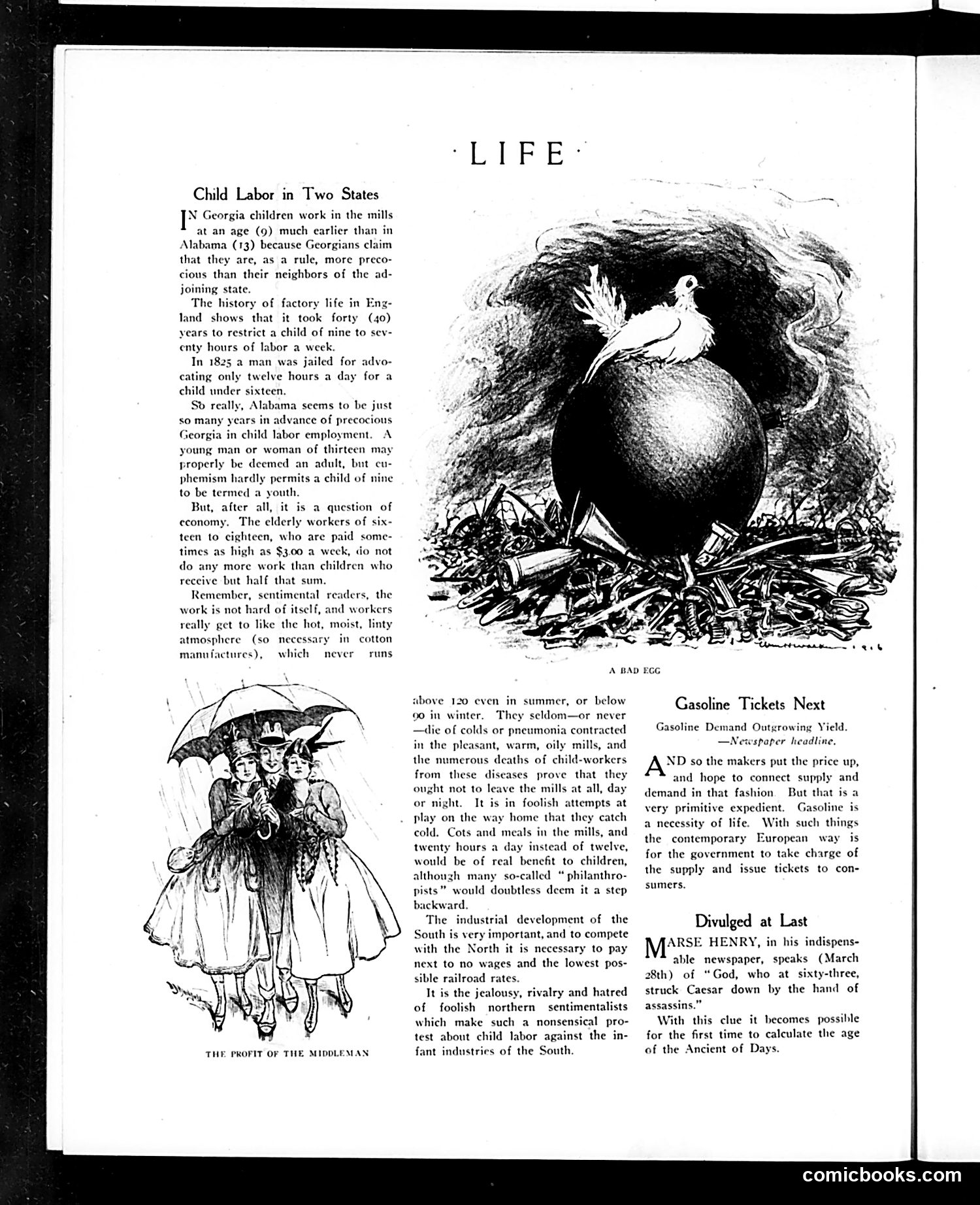
This page uses **heavy irony** to attack Southern child labor practices. The main article sarcastically defends Georgia and Alabama's employment of children as young as nine in cotton mills, claiming: - Georgia children are more "precocious" so deserve earlier work - The mills are pleasant and safe (children rarely die there) - Children should work 20 hours daily instead of 12 - Northern critics are jealous sentimentalists The cartoons reinforce this mockery: "A Bad Egg" shows a dove emerging from destruction (suggesting corruption masquerading as innocence), while "The Profit of the Middleman" depicts exploitation. Life's satire exposes how Southern industrialists justified child labor through economic necessity while dismissing reform as Northern interference. The article's sarcasm—praising conditions no reasonable person would accept—makes the actual cruelty devastatingly clear to readers. This reflects early 20th-century Progressive Era debates over industrial reform and regional economic competition.
📄 Transcribed text from this page (OCR, searchable)
Machine-transcribed from the original scan — historical spelling and the odd misread are preserved.
Child Labor in Two States N Georgia children work in the mills at an age (9) much earlier than in Alabama (13) because Georgians claim that they are, as a rule, more preco- cious than their neighbors of the ad- joining state. The history of factory life in land shows that it took forty (40) years to restrict a child of nine to sev- enty hours of labor a week. In 1825 a man was jailed for advo- cating only twelve hours a day for a child under sixteen, Sd really, Alabama seems to be just so many years in advance of precocious Georgia in child labor employment. A young man or woman of thirteen may properly be deemed an adult, but cu- phemism hardly permits a child of nine to be termed a youth. But, after all, it is a question of economy. The elderly workers of six- teen to cighteen, who are paid some- i s th as $3.00 a week, «io not y more work than children who ¢ but half that sum. Remember, sentimental readers, the work is not hard of itself, and workers really get to like the hot, moist, linty cotton Sigs necess: in which — never atmosphere (so uifactures), runs THE PROFIT OF THE MIDDLEMAN. A BAD EGG above 120 ever 90 in iter. in summer, or below They seldom—or never —die of colds or pneumonia contracted in the pleasant, warm, oily mills, and the numerous deaths of child-workers. from these diseases prove that they ought not to leave the mills at all, day or night. It is in foolish attempts at play on the y home that they catch cold. Cots and meals in the mills, and twenty hours a day instead of twelve, would be of real benefit to children, although many so-called “ philanthro- pists” would doubtless deem it a step backward, The industrial development of the South is very important, and to compete with the North it is necessary to pay next to no wages and the lowest pos- sible railroad rates. It is the jealousy, rivalry and hatred of foolish northern sentimentalists which make such a nonsensical pro- test about child labor against the in- fant industries of the South. Gasoline Tickets Next Gasoline Demand Outgrowing Yield. —Newspaper headline, D so the makers put the price up, and hope to connect supply and demand in that fashion. But that is a very primitive expedient. Gasoline is a necessity of life. With such things the contemporary European way is for the government to take charge of the supply and issue tickets to con- sumers. Divulged at Last MASE HENRY, in his indispens- able newspaper, speaks (March 28th) of “God, who at sixty-three, struck Caesar down by the hand of assassins.” With this clue it becomes possible for the first time to calculate the age of the Ancient of Days. comicbooks.com