
Life, 1916-04-27 · page 28 of 44
Life — April 27, 1916 — page 28: what you’re looking at
What you’re looking at
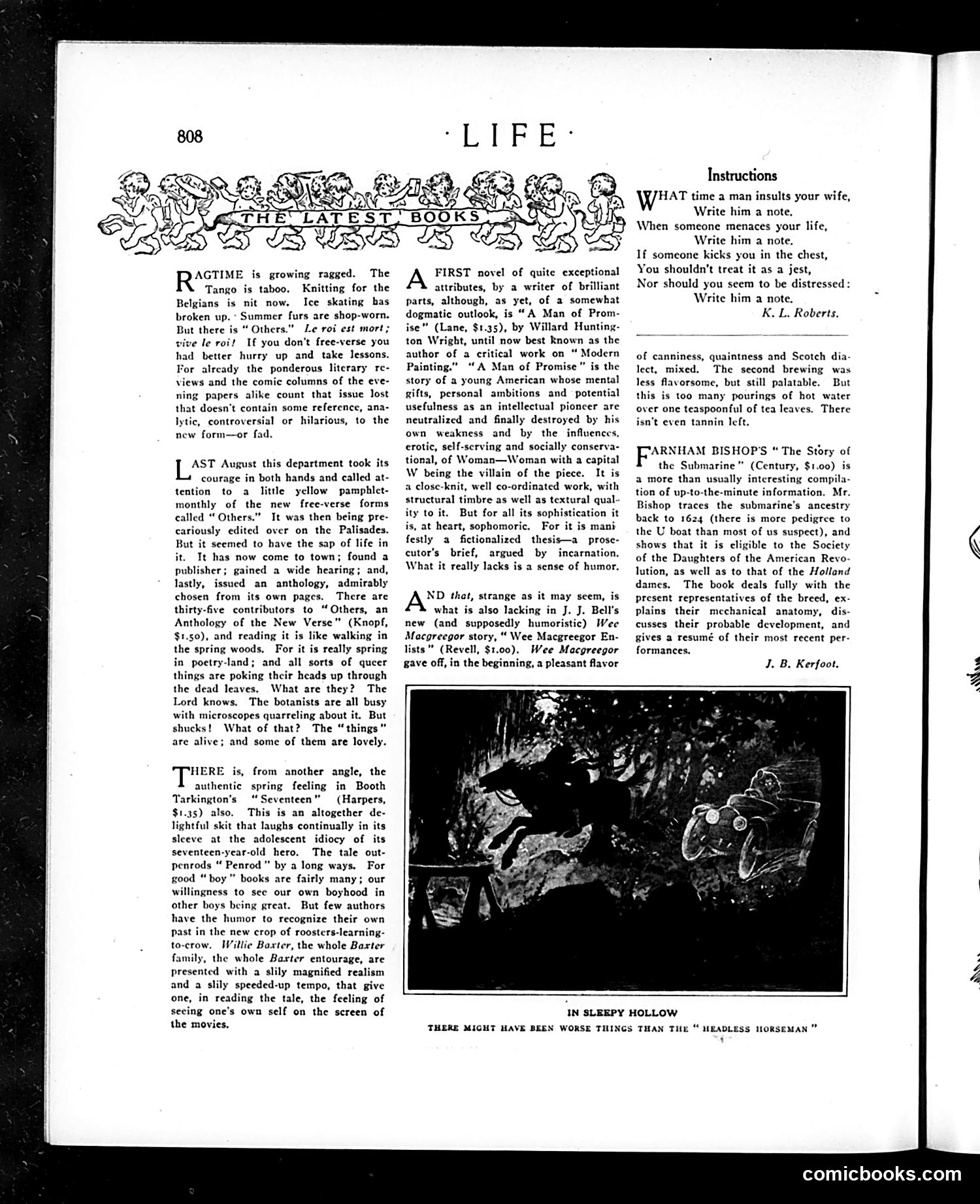
This page reviews contemporary literature and includes a humorous "Instructions" poem by K.L. Roberts about responding to insults and violence by writing notes—satirizing the genteel, passive-aggressive social conventions of the upper class. The main reviews discuss new books: "Others: An Anthology of the New Verse" (celebrating experimental free-verse poetry), Booth Tarkington's "Seventeen" (humorously depicting adolescent foolishness), Willard Huntington Wright's "A Man of Promise" (a sophomorically didactic novel about a talented man destroyed by weakness and women), and J.J. Bell's "Wee Macgreegor Enlists" (a Scottish dialect story). The photograph at bottom, captioned "In Sleepy Hollow" with the tagline "There might have been worse things than the 'Headless Horseman,'" likely references Irving's classic tale, suggesting modern anxieties exceed even that legendary horror. The overall page reflects pre-WWI American literary culture and social commentary.
📄 Transcribed text from this page (OCR, searchable)
Machine-transcribed from the original scan — historical spelling and the odd misread are preserved.
AGTIME is growing ragged. The Tango is taboo. Knitting for the Belgians is nit now. Ice skating bas broken up. Summer furs are shop-worn. But there is “Others.” Le roi est mort; vive le roi! If you don't free-verse you had better hurry up and take lessons. For already the ponderous literary re- views and the comic columns of the eve- ning papers alike count that issue lost that doesn't contain some reference, ana- lytic, controversial or hilarious, to the new form—or fad. AST August this department took its courage in both hands and called at- tention to a little yellow pamphlet- monthly of the new free-verse forms called “ Others.” It was then being pre- cariously edited over on the Palisades. But it seemed to have the sap of life in it. It has now come to town; found a publisher; gained a wide hearing; and, lastly, issued an anthology, admirably chosen from its own pages. There are thirty-five contributors to “Others, an Anthology of the New Verse” (Knopf, $1.50), and reading it is like walking in the spring woods. For it is really spring in poetry-land; and all sorts of queer things are poking thcir heads up through the dead leaves. What are they? The Lord knows. The botanists are all busy with microscopes quarreling about it. But shucks! What of that?) The “things” are alive; and some of them are lovely. ‘HERE is, from another angle, the authentic spring feeling in Booth Tarkington's “Seventeen” (Harpers, $1.35) also, This is an altogether de- lightful skit that laughs continually in its sleeve at the adolescent idiocy of its seventeen-year-old hero. The tale out- penrods “ Penrod” by a long ways. For good “boy” books are fairly many; our willingness to see our own boyhood in other boys being great. But few authors have the humor to recognize their own past in the new crop of roosters-learning- to-crow. Willie Baxter, the whole Baxter family, the whole Barter entourage, are presented with a slily magnified realism and a slily speeded-up tempo, that give one, in reading the tale, the feeling of seeing one’s own self on the screen of the movies, A FIRST novel of quite exceptional attributes, by a writer of brilliant parts, although, as yet, of a somewhat dogmatic outlook, is “A Man of Prom- ise” (Lane, $1.35), by Willard Hunting- ton Wright, until now best Known as the author of a critical work on “ Modern Painting.” “A Man of Promise” is the story of a young American whose mental gifts, personal ambitions and potential usefulness as an intellectual pioneer are neutralized and finally destroyed by his own weakness and by the influences, erotic, self-serving and socially conserva- tional, of Woman—Woman with a capital W being the villain of the piece. It is a close-knit, well co-ordinated work, with structural timbre as well as textural qual- ity to it. But for all its sophistication it is, at heart, sophomoric, For it is mani festly a fictionalized thesis—a prose- cutor’s brief, argued by incarnation. What it really lacks is a sense of humor. ND that, strange as it may seem, is what is also lacking in J. J. Bell's new (and supposedly humoristic) Wee Macgreegor story, “ Wee Macgreegor En- lists” (Revell, $1.00), Wee Macgreegor gave off, in the beginning, a pleasant flavor Instructions HAT time a man insults your wife, Write him a note, When someone menaces your life, Write him a note. If someone kicks you in the chest, You shouldn't treat it as a jest, Nor should you seem to be distressed : Write him a note, K. L. Roberts. of canniness, quaintness and Scotch dia- lect, mixed. The second brewing was less flavorsome, but still palatable. But this is too many pourings of hot water over one teaspoonful of tea leaves, There isn’t even tannin left, Passe BISHOP'S “ The Story of the Submarine” (Century, $1.00) is a more than usually interesting compila- tion of up-to-the-minute information. Mr. Bishop traces the submarine’s ancestry back to 1624 (there is more pedigree to the U boat than most of us suspect), and shows that it is cligible to the Society of the Daughters of the American Revo- lution, as well as to that of the Holland dames, The book deals fully with the present representatives of the breed, ex- plains their mechanical anatomy, dis- cusses their probable development, and gives a resumé of their most recent per- formances, J. B. Kerfoot. IN SLEEPY HOLLOW THERE MIGHT HAVE BEEN WORSE THINGS THAN THE “ HEADLESS HORSEMAN" comicbooks.com