
Life, 1916-04-27 · page 26 of 44
Life — April 27, 1916 — page 26: what you’re looking at
What you’re looking at
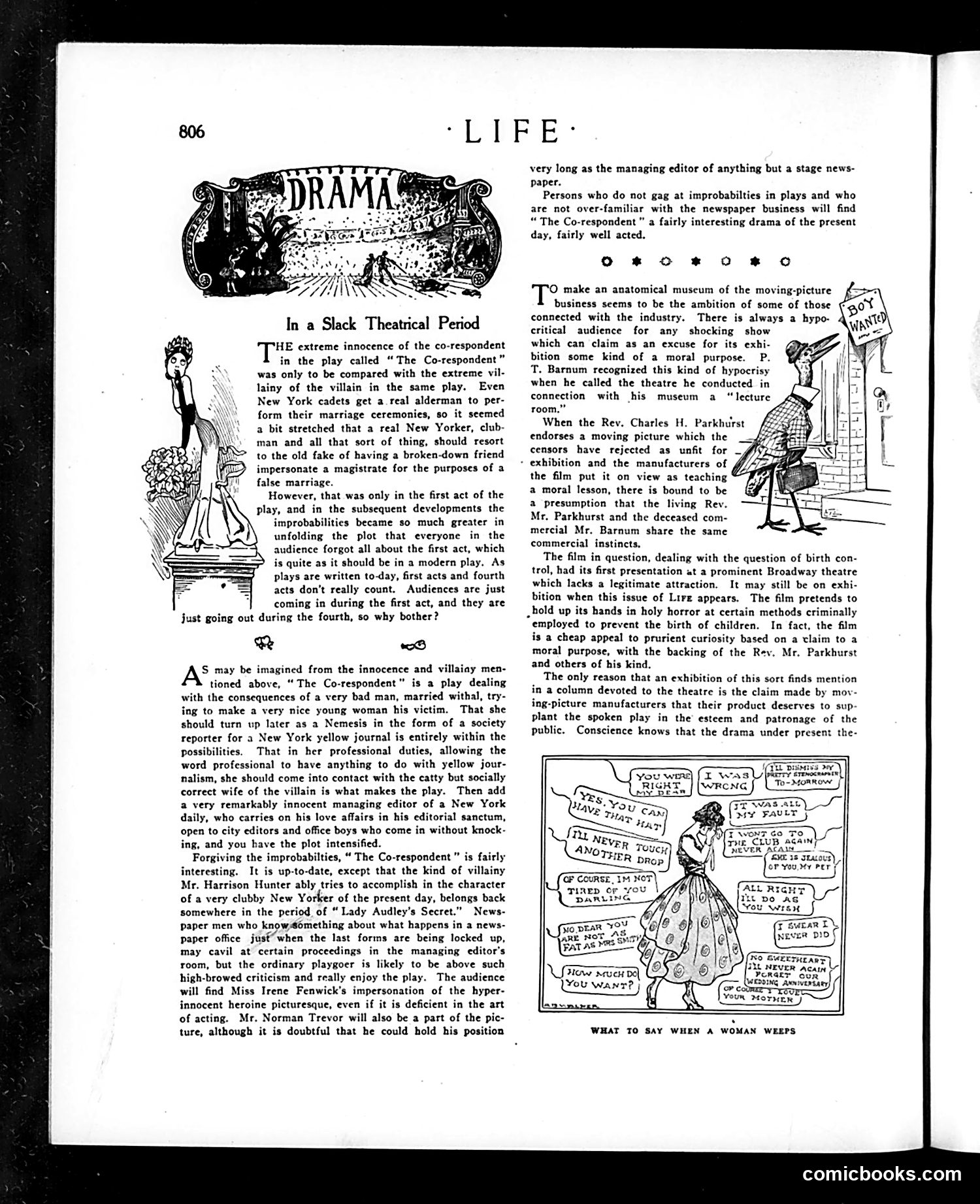
This page critiques theatrical and film industry practices circa early 1900s. The main article reviews "The Co-respondent," a stage play with implausible plots involving false marriages, yellow journalism, and newspaper office affairs. The critic mocks both the play's absurd premise and modern theatrical conventions—noting audiences arrive late and leave early, so acts one and four "don't really count." The lower section attacks moving-picture manufacturers for exploiting moral pretense. It references P.T. Barnum's cynical practice of calling his museum a "lecture room" to justify sensational exhibits. The passage criticizes how Rev. Charles H. Parkhurst's endorsement of a censorship-rejected film lends false moral authority, allowing manufacturers to exhibit it as "teaching" morality rather than mere entertainment. The satire targets hypocrisy: industries cloaking commercial sensationalism in moral justification to attract audiences who want to feel virtuous while consuming scandal.
📄 Transcribed text from this page (OCR, searchable)
Machine-transcribed from the original scan — historical spelling and the odd misread are preserved.
LIFE In a Slack Theatrical Period HE extreme innocence of the co-respondent in the play called “The Co-respondent” was only to be compared with the extreme vil- lainy of the villain in the same play. Even New York cadets get a real alderman to per- form their marriage ceremonies, so it seemed a bit stretched that a real New Yorker, club- man and all that sort of thing, should resort to the old fake of having a broken-down friend impersonate a magistrate for the purposes of a false marriage. However, that was only in the first act of the play, and in the subsequent developments the improbabilities became so much greater in unfolding the plot that everyone in the audience forgot all about the first act, which is quite as it should be in a modern play. As plays are written to-day, first acts and fourth acts don’t really count. Audiences are just coming in during the first act, and they are just going out during the fourth, so why bother? Re —<S S may be imagined from the innocence and villainy men- tioned above, “The Co-respondent” is a play dealing with the consequences of a very bad man, married withal, try- ing to make a very nice young woman his victim. That she should turn up later as a Nemesis in the form of a society reporter for a New York yellow journal is entirely within the possibilities. That in her professional duties, allowing the word professional to have anything to do with yellow jour- nalism, she should come into contact with the catty but socially correct wife of the villain is what makes the play. Then add a very remarkably innocent managing editor of a New York daily, who carries on his love affairs in his editorial sanctum, open to city editors and office boys who come in without knock- ing, and you have the plot intensified. Forgiving the improbabilties, “ The Co-respondent ” is fairly interesting. It is up-to-date, except that the kind of villainy Mr. Harrison Hunter ably tries to accomplish in the character of a very clubby New Yorker of the present day, belongs back somewhere in the period of “ Lady Audley’s Secret.” News- paper men who know-@émething about what happens in a news- paper office just@when the last forms are being locked up, may cavil at certain proceedings in the managing editor's room, but the ordinary playgoer is likely to be above such high-browed criticism and really enjoy the play. The audience will find Miss Irene Fenwick’s impersonation of the hyper- innocent heroine picturesque, even if it is deficient in the art of acting. Mr. Norman Trevor will also be a part of the pic- ture, although it is doubtful that he could hold his position very long as the managing editor of anything but a stage news- Paper. Persons who do not gag at improbabilties in plays and who are not over-familiar with the newspaper business will find “ The Co-respondent ” a fairly interesting drama of the present day, fairly well acted. o *£# Oo * 0 *® © ‘O make an anatomical museum of the moving-picture business seems to be the ambition of some of those connected with the industry. There is always a hypo- critical audience for any shocking show which can claim as an excuse for its exhi- bition some kind of a moral purpose. P. T. Barnum recognized this kind of hypocrisy when he called the theatre he conducted in connection with his museum a “lecture room,” When the Rev. Charles H. Parkhurst endorses a moving picture which the censors have rejected as unfit for » exhibition and the manufacturers of the film put it on view as teaching a moral lesson, there is bound to be a presumption that the living Rev. Mr, Parkhurst and the deceased com- mercial Mr. Barnum share the same commercial instincts. The film in question, dealing with the question of birth con- trol, had its first presentation at a prominent Broadway theatre which lacks a legitimate attraction. It may still be on exhi- bition when this issue of Lire appears. The film pretends to hold up its hands in holy horror at certain methods criminally employed to prevent the birth of children. In fact, the film is a cheap appeal to prurient curiosity based on a claim to a moral purpose, with the backing of the Rev. Mr. Parkhurst and others of his kind. The only reason that an exhibition of this sort finds mention in a column devoted to the theatre is the claim made by mov- ing-picture manufacturers that their product deserves to sup- plant the spoken play in the esteem and patronage of the public. Conscience knows that the drama under present the- You wine) eeeey wa ES eeeey ee Sem =a} ‘aremocearee® f)- MORROW Ceti S| MY FAULT ey Twos co To pin CLUB AGAINy NEVER ACA LS Sue 18 gracot2) , on you.my Perf — F ouran DS never p10 Ro GUEETEART} me BX Never Acuna V| Ponatr Son WerDoIng Aewivensiey (& CORSE 1H xe7| Tine cr vou | DARLING. WHAT TO SAY WHEN A WOMAN WEEPS comicbooks.com