
Life, 1916-04-27 · page 27 of 44
Life — April 27, 1916 — page 27: what you’re looking at
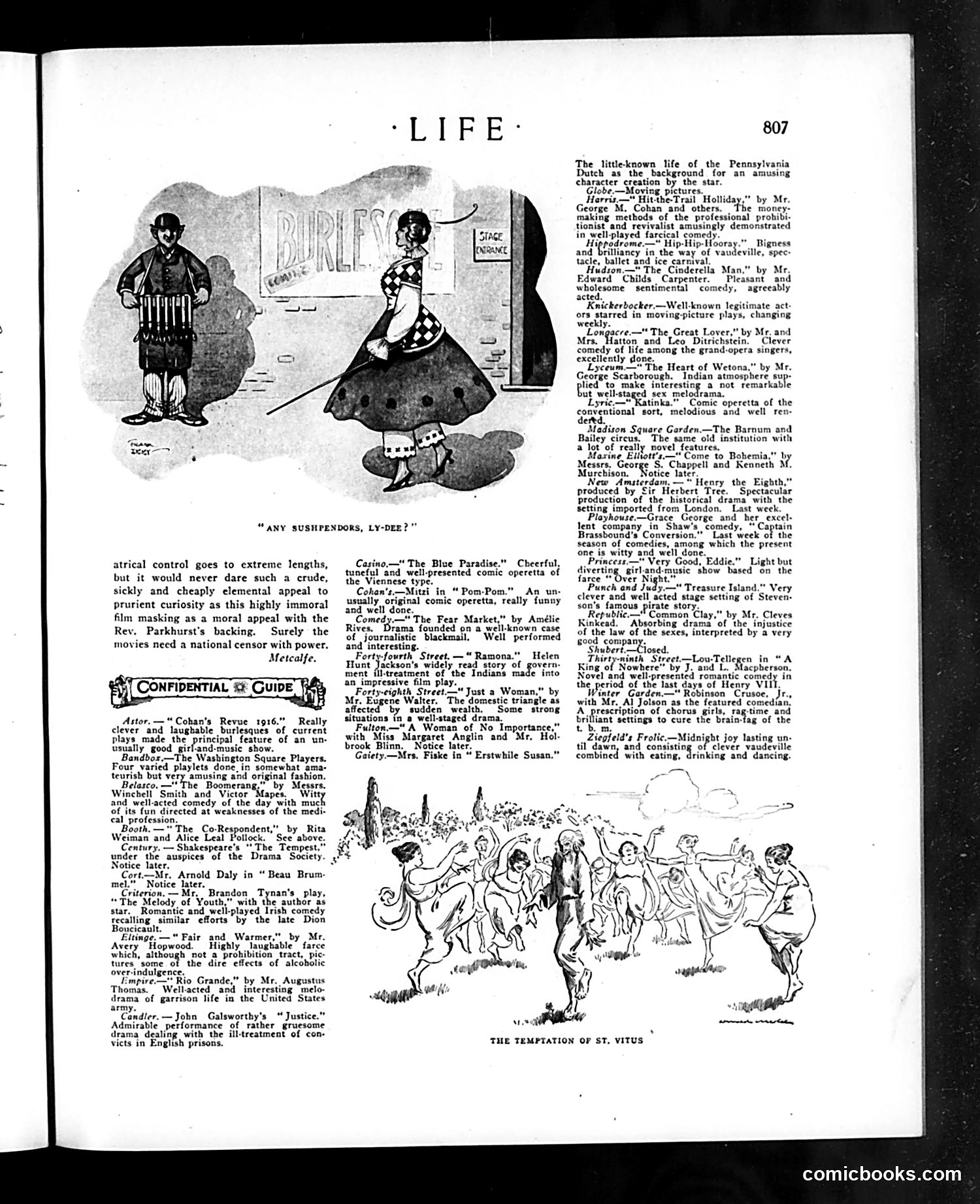
What you’re looking at
This single-panel cartoon depicts a domestic scene with a woman in a full skirt pointing at a man in striped clothing. The caption's misspelled, exaggerated dialect ("Ly-dee" for "lady") suggests working-class or immigrant speech—likely Pennsylvania Dutch, given the page's reference to that community elsewhere. The joke appears to be physical/slapstick humor: the woman's gesture and the man's posture suggest marital banter, probably about his disheveled appearance or lost suspenders. This reflects early 20th-century vaudeville-style comedy found in *Life* magazine, which frequently published crude, class-based humor mocking immigrants and working people through dialect and stereotypical situations. The humor relies on audience familiarity with ethnic caricature and domestic farce conventions of the era.
📄 Transcribed text from this page (OCR, searchable)
Machine-transcribed from the original scan — historical spelling and the odd misread are preserved.
“ANY SUSHPENDORS, LY-DEE?” atrical control goes to extreme lengths, but it would never dare such a crude, sickly and cheaply elemental appeal to prurient curiosity as this highly immoral film masking as a moral appeal with the Rev, Parkhurst's backing, Surely the movies need a national censor with power. Metcalfe, (CONFIDENTIAL a GuibEf Astor. —“ Cohan's Revue 1916." Really clever and laughable burlesques of current plays made the principal feature of an un- usually good girland-music show. Bandbox.—The Washington Square Players. Four varied playlets done, in somewhat ama- teurish but very amusing ahd original fashion. Belasco. —" The Boomerang.” by Messrs. Winchell Smith and Victor Mapes. Witt and well-acted comedy of the day with muc of its fun directed at weaknesses of the medi- cal_profession, Booth.—" The Co-Respondent,". by Rita Weiman and Alice Leal Pollock. See above. Century, — Shakespeare's “The Tempest,” under the auspices of the Drama Society. Notice later. Cort—Mr. Arnold Daly in “ Beau Brum- mel.” Notice later. Criterion, — Mr," Brandon Tynan’s play, “The Melody of Youth,” with the author as star. Romantic and_well-played Irish comedy recalling similar efforts by the late Dion Boucicault, 3 Eltinge. —“ Fair and Warmer,” by Mr. Avery Hopwood. Highly laughable fa which, although not a prohibition tract, pic- tures ‘some of the dire effects of alcoholic over-indulgence. Empire—" Rio Grande,” by Mr. Augustus Thomas. Well-acted and interesting melo- drama of garrison life in the United States army. ‘ Candler. —John Galsworthy’s “Justice.” Admirable performance of rather gruesome drama dealing with the ill-treatment of con- victs in English prisons, Casino.—" The Blue Paradise.” Cheerful, tuneful and well-presented comic operetta of the Viennese type. Cokan's.—Mitzi in “ Pom-Pom.” An un- usually original comic operetta, really funny and well done. Comedy.—" The Fear Market.” by Améli Rives. founded on a well-known case of journalistic blackmail, Well performed and interesting. Forty-fourth Street, —“ Ramona.” Helen Hunt Jackson's widely read story of govern- ment ill-treatment of the Indians made into an impressive film pla Forty-cighth Street.—" Just a Woman,” by My. Eugene Walter, The domestic triangle as affected’ by sudden wealth. Some strong situations in @ well-staged drama. “A Woman of No Importance,” Margaret Anglin and Mr. Hol- brook Blinn. Notice later. Gaiety.—Mrs. Fiske in “ Erstwhile Su 807 The little-known life of the Pennsylvania Dutch as the background for an amusing character creation by the star. ing pictures. i it-the-Trail Holliday,” by Mr. George M. Cohan and others. The money- making methods of the professional probibi- tionist and revivalist amusingly demonstrated in well-played farcical comedy. Hippodrome.—" Hip-Hip-Hooray.” Bigness and brilliancy in the way of vaudeville, spec- tacle, ballet and ice carnival. The Cinderella Man,” by Mr. Ids Carpenter. Pleasant and wholesome sentimental comedy, agreeably acted, Knickerbocker —Well-known legitimate act- ors starred in moving-picture plays, changing weekly. Longacre.—" The Great Lover,” by Mr, and Mrs, fisiton and Leo Ditrichsiein. Clever comedy of life among the grand-opera singers, excellently gone. Lyceum—" The Heart of Wetona,” by Mr. George Scarborough. Indian atmosphere sup- flied te make interesting @ not remarkable ut well-staged sex melodrama. Lyric.—" Katinka.” Comic operetta of the conventional sort, melodious and well ren- dered. Madison Square Garden.—The Barnum and Bailey circus. The same old institution with a lot of really novel features. Marine, Elliott’s.—" Come to Bohemia," ty Messrs. George S. Chappell and Kenneth M. Murchison. Notice later. New Amsterdam. —* Henry the Eighth,” produced by Sir Herbert Tree. Spectacular production of the historical drama with the Setting imported from London. Last week. Playhouse.—Grace George and her excel- Jent company in Shaw's comedy, “Captain Brassbound’s Conversion.” Last week of the season of comedies, among which the present one is witty and well done. Very Good, Eddie.” Light but irland-music show based on the r Night. Punch and Judy.—" Treasure Island.” Very clever and well acted stage setting of Steven: son's famous pirate story. Republic.—" Common Clay,” by Mr. Cleves Kinkead. “Absorbing drama ‘of the injustice of the law of the sexes, interpreted by a very good company. ‘Shubert—Ciosed. Thirty-ninth Strect.—Lou-Tellegen in “A King of Nowhere” by J. and L. Macpherson, Novel and well-presented romantic comedy in the period of the last days of Henry VIlT. Winter Garden.—" Robinson Crusoe, jr. with Mr. Al Jolson as the featured comedian, A prescription of chorus girls, ragtime, and brilliant settings to cure the biaintag of the t bom Ziegfeld's Fro! til’ dawn, and consisting of clever vaudeville combined with eating, drinking and dancing. Midnight joy lasting un- THE TEMPTATION OF ST, VITUS comicbooks.com