
A complete issue · 46 pages · 1916
Life — April 13, 1916
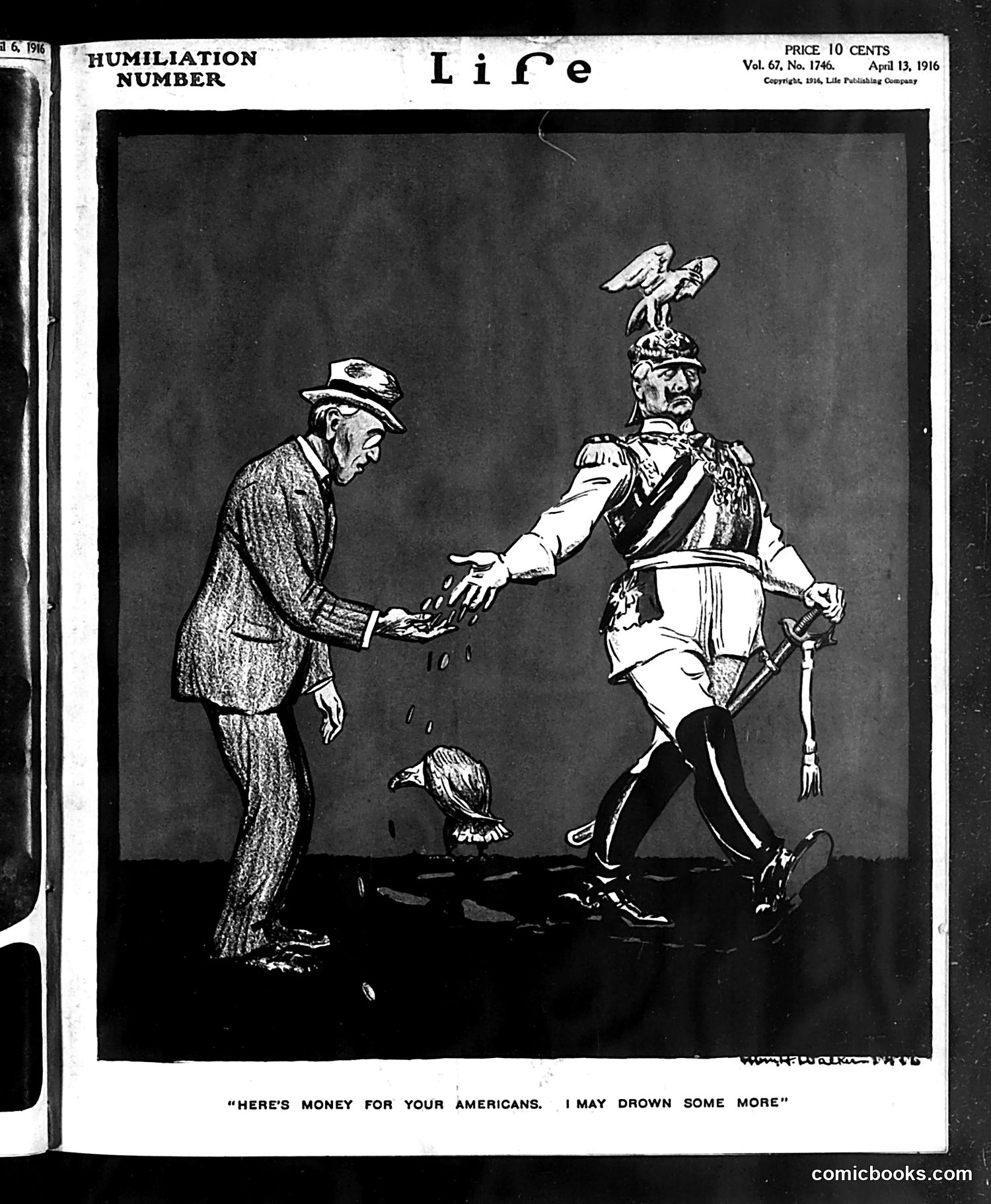
This April 1916 *Life* magazine cartoon depicts a German military figure (identifiable by the spiked Prussian helmet and imperial uniform) handing money to a poorly-dressed American civilian. The caption's ominous threat—"I may drown some more"—references German submarine warfare against merchant ships, including American vessels. The satire criticizes American financial dealings with Germany despite its attacks on American interests at sea. The cartoon suggests the U.S. is accepting German money while German U-boats continue drowning Americans. This reflects pre-World War I tensions and American debates over neutrality versus economic entanglement with belligerent nations. The "Humiliation Number" header suggests the magazine's view that accepting such payments was shameful.
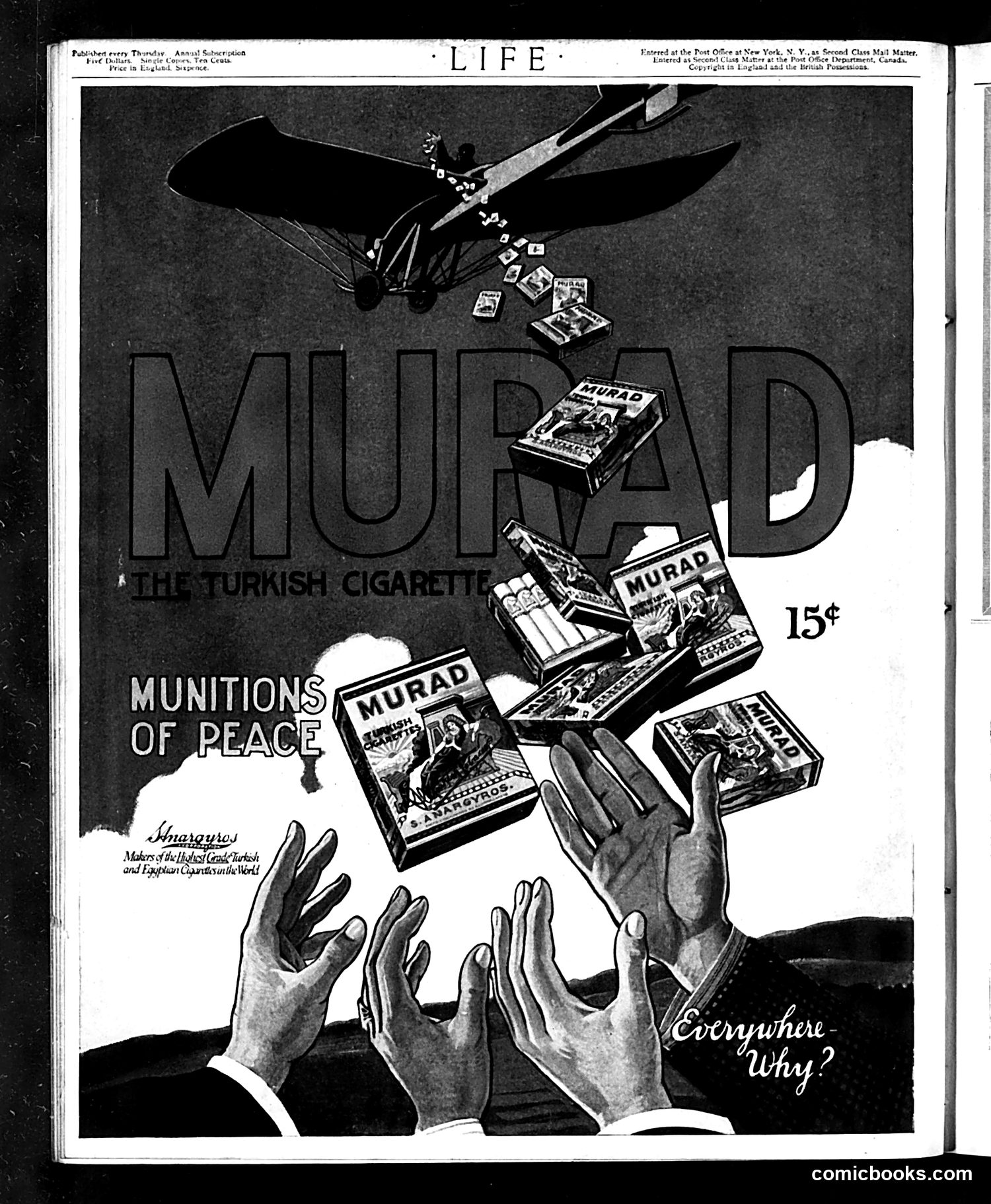
This is a **commercial advertisement**, not political satire. The full-page ad promotes MURAD Turkish cigarettes (priced at 15¢) to American consumers. The imagery uses **World War I-era messaging**: an airplane drops cigarette packages like munitions, while hands below reach upward to catch them. The text reads "MUNITIONS OF PEACE" with the tagline "Everywhere—Why?" This plays on the recent end of WWI (1918), transforming warfare language into marketing. The ad suggests cigarettes are peaceful "weapons" or necessities, distributed worldwide. The cigarette maker is identified as "Sycamore" (visible in small print), claiming to make "the finest cigarettes in the world." The advertisement exploits post-war patriotism and global commerce rhetoric to sell a luxury product.
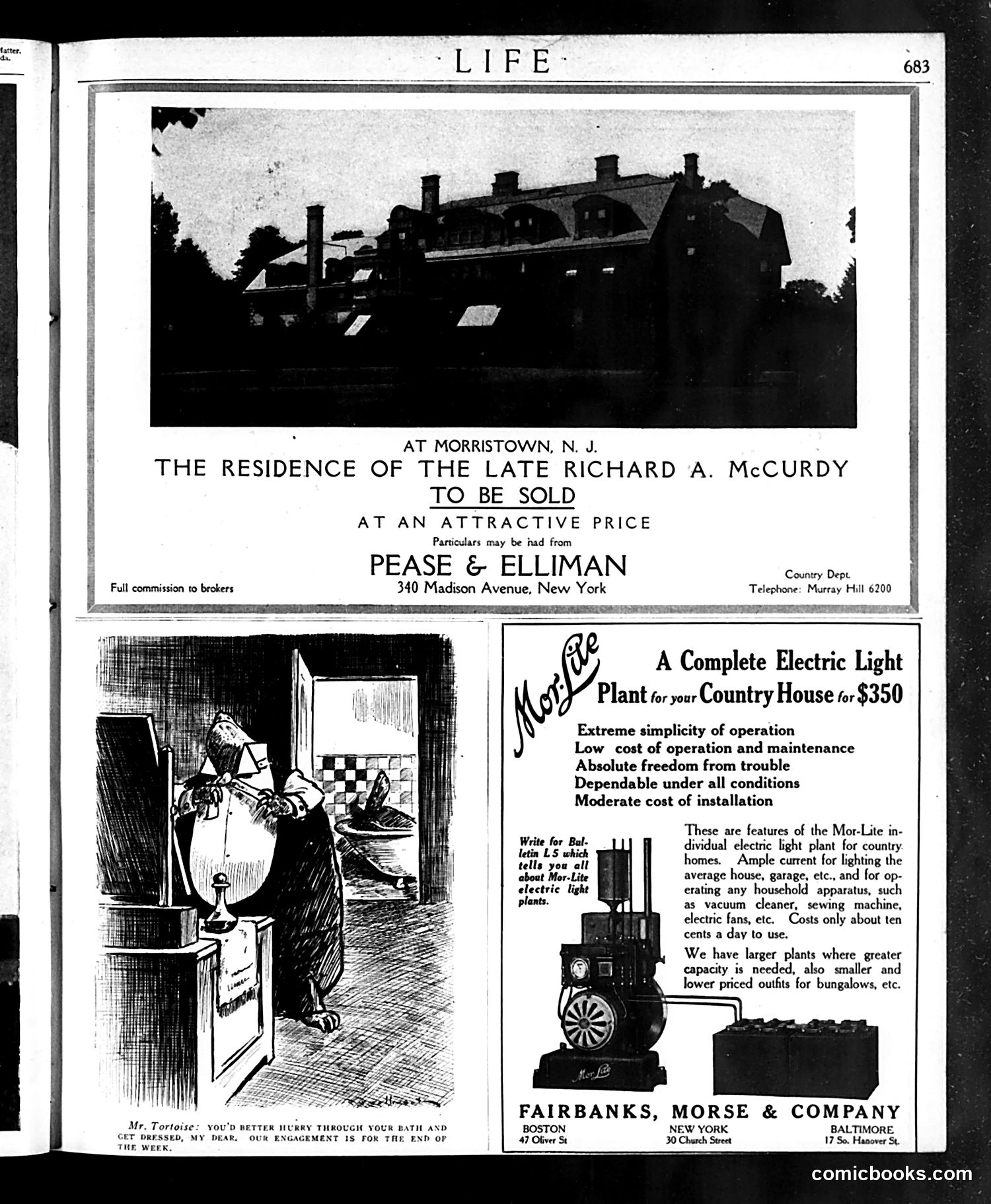
This page is primarily **advertising**, not satire or political commentary. The top advertisement promotes a residential property in Morristown, New Jersey, formerly owned by "the late Richard A. McCurdy," handled by real estate broker Pease & Elliman. The lower left contains a **domestic humor cartoon** showing a woman in a kitchen with the caption: "Mr. Torloue: You'd better hurry through your bath and get dressed, dear. We have our engagement is for the end of the week." The joke appears to reference marital domesticity and time management—a common theme in early 20th-century Life magazine humor. The right side advertises a Mor-Lite electric light plant for country homes, priced at $350, marketed by Fairbanks, Morse & Company. This reflects the era's technological advancement and rural electrification efforts.
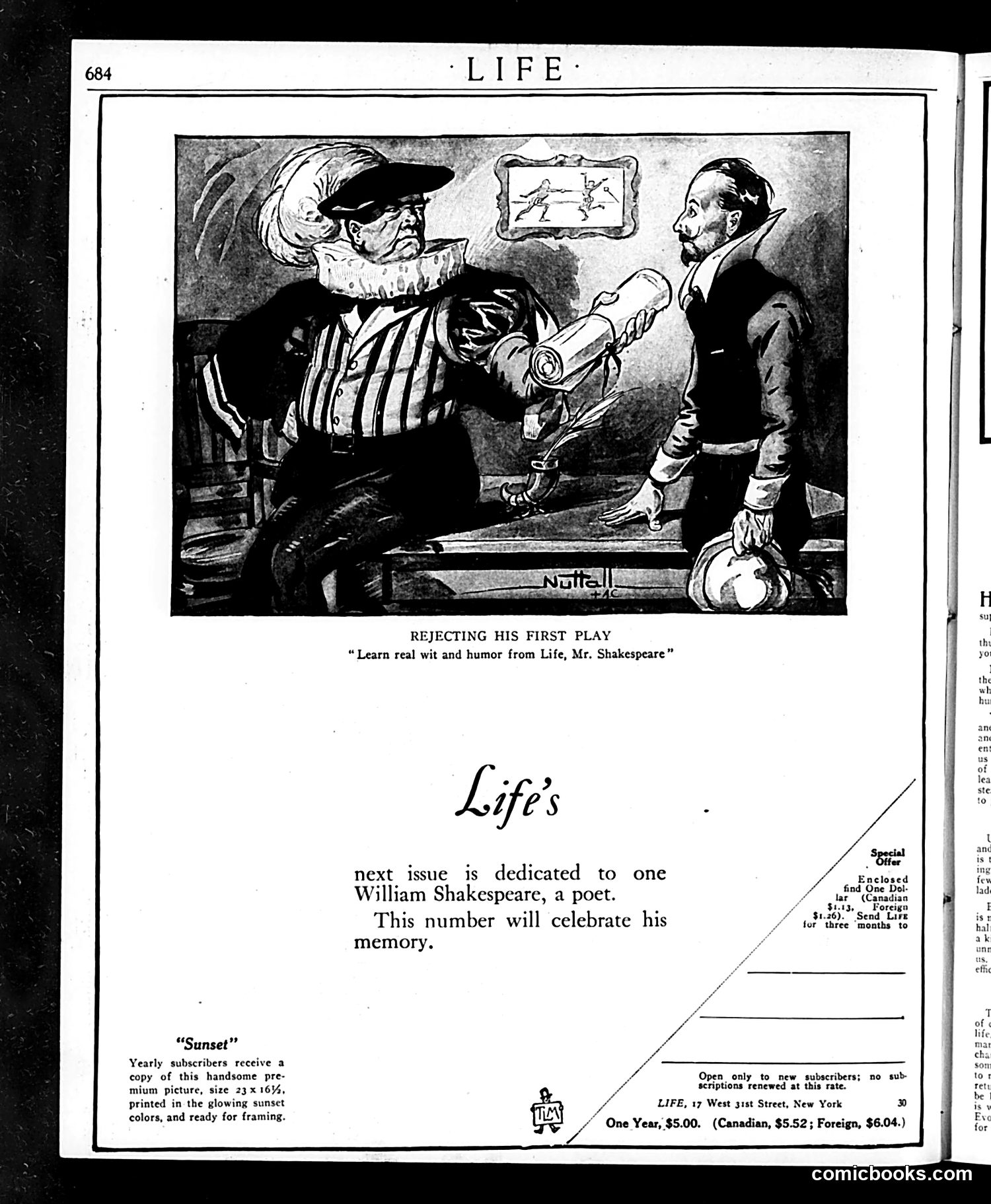
The cartoon titled "Rejecting His First Play" depicts two men in period costume. The figure on the left, wearing an elaborate feathered hat and striped doublet, appears to be a theater producer or patron rejecting a manuscript from the figure on the right. The caption advises the rejected playwright to "Learn real wit and humor from Life, Mr. Shakespeare." This is satirical commentary on Shakespeare's early work, humorously suggesting his initial plays were poor enough to warrant rejection. The joke positions Life magazine as a superior source of wit and humor compared to the young Shakespeare's efforts—a tongue-in-cheek advertisement for the magazine's comedic content. The page announces that the next issue will be dedicated to Shakespeare's memory.
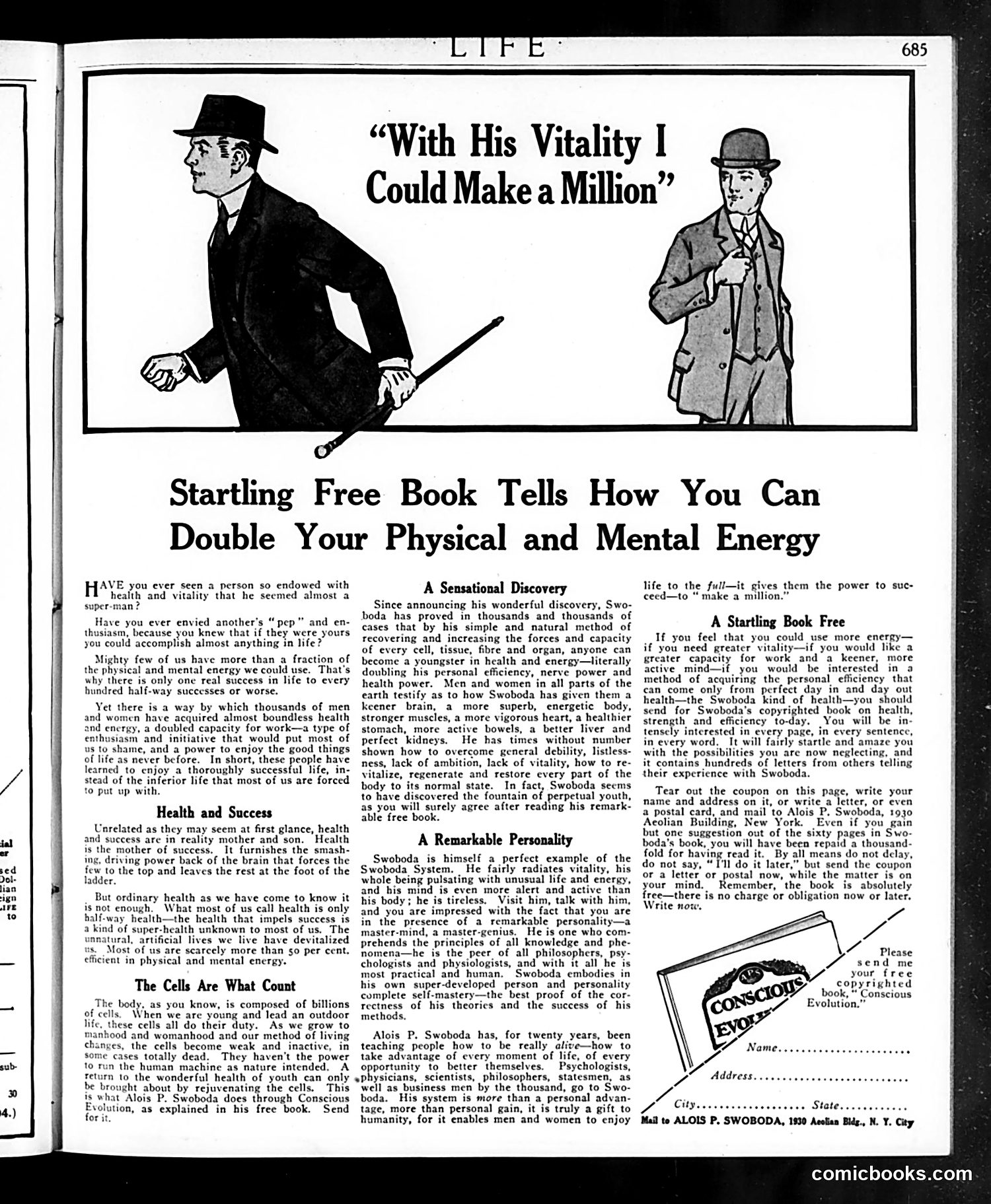
This page is primarily an **advertisement**, not satire. It promotes "Conscious Evolution," a self-help book by Alois P. Swoboda promising to double "your physical and mental energy." The cartoon at top depicts two men—one vigorous and energetic (left), one seemingly ordinary (right)—illustrating the book's central pitch: Swoboda claims to have discovered a method to dramatically increase vitality and personal efficiency through understanding cellular biology and natural body mechanics. The ad uses period health-reform language ("super-health," "perfect efficiency") common to early 20th-century self-improvement culture. The copy promises readers can become like Swoboda's "remarkable personality"—portrayed as a master-mind with superior vitality—through his system. This reflects genuine era anxieties about modern exhaustion and vitality, exploited through pseudoscientific wellness claims.
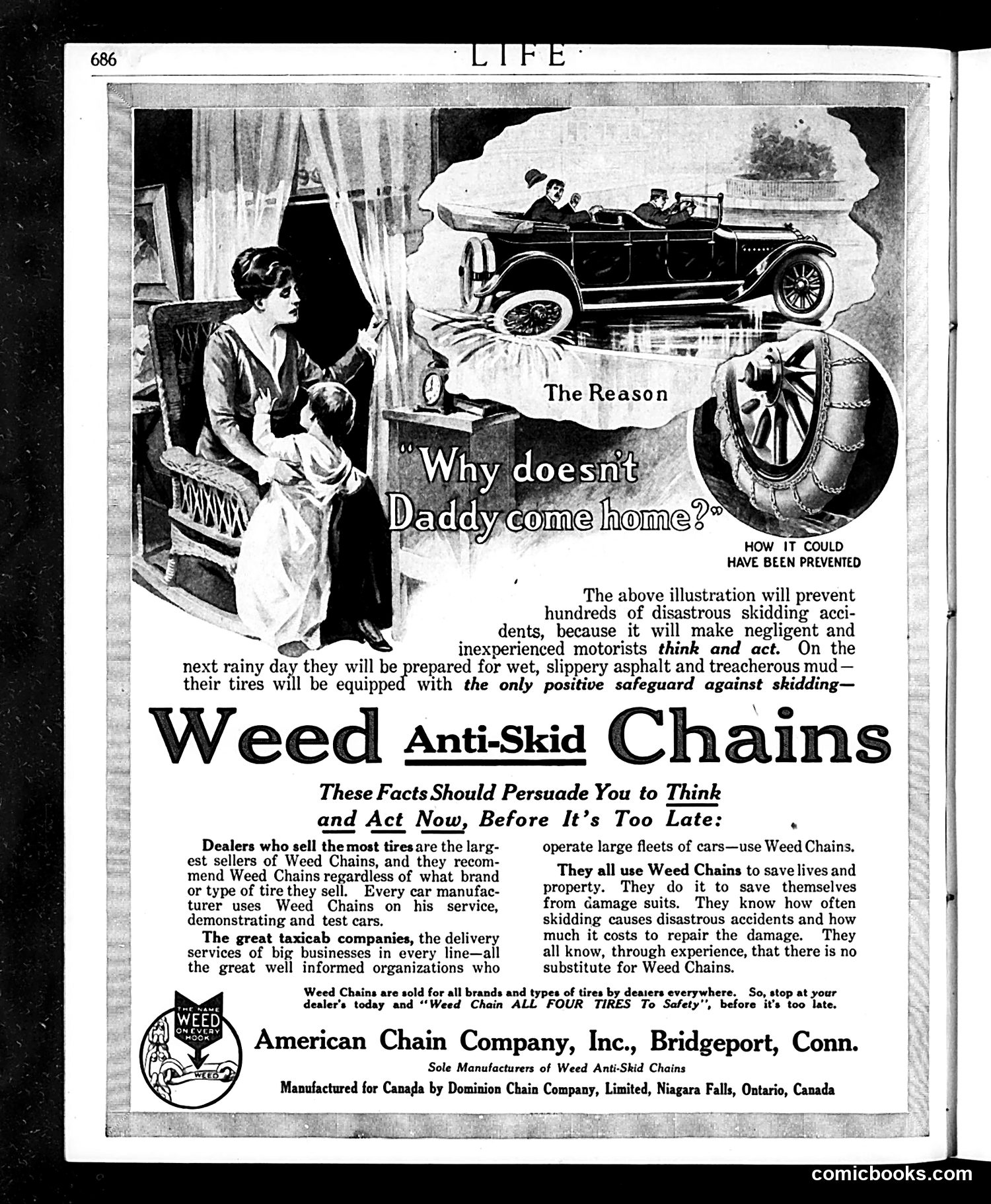
This is primarily an **advertisement**, not political satire. It's a Weed Anti-Skid Chains ad from an early automotive era (likely 1910s-1920s, based on the car design). The emotional appeal uses a domestic scene: a mother with child asking "Why doesn't Daddy come home?" The implied answer is that without tire chains, fathers have accidents on wet, slippery roads. The car illustration shows the chains as safety equipment. The ad targets motorists' fears about dangerous driving conditions and family safety, positioning Weed Chains as essential winter equipment. It references how taxi companies and commercial fleets already used them, appealing to consumer logic through professional adoption. The "How It Could Have Been Prevented" caption frames the product as accident prevention—a common early auto-safety marketing strategy when vehicle accidents were a significant public concern.
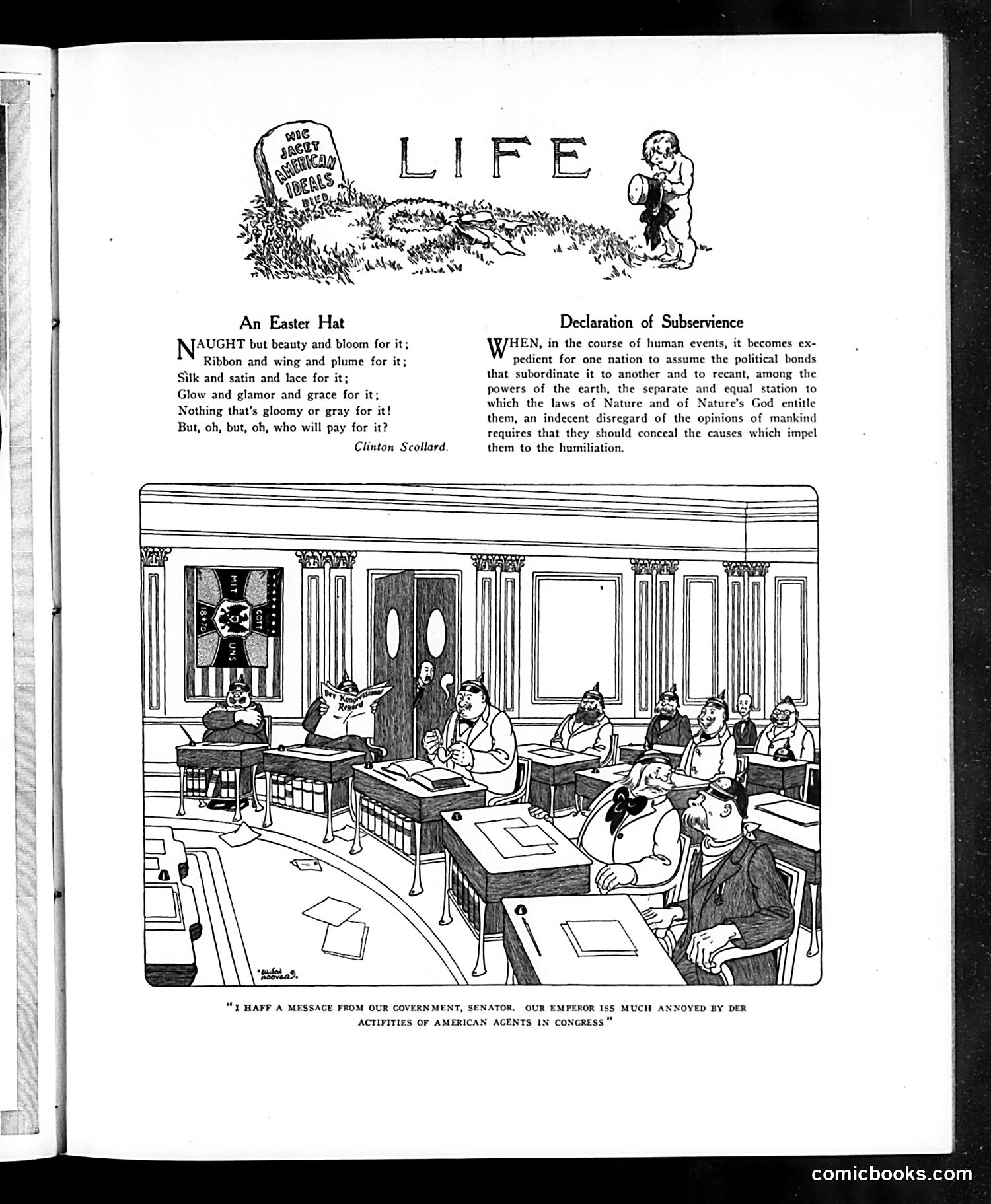
This page contains political satire about American-German relations, likely from the early 20th century. The cartoon depicts a formal government meeting where one figure announces receiving "a message from our government, Senator. Our Emperor is much annoyed by her activities of American agents in Congress." The satire appears to mock American politicians who were perceived as being unduly deferential to German interests or influence. The "Declaration of Subservience" text above reinforces this theme of political subordination. The poem "An Easter Hat" by Clinton Scollard is unrelated social commentary. The cartoon's humor relies on depicting American congressmen as literally taking orders from a German emperor—a sharp jab at suspected German diplomatic influence in U.S. politics during a tense period of international relations.
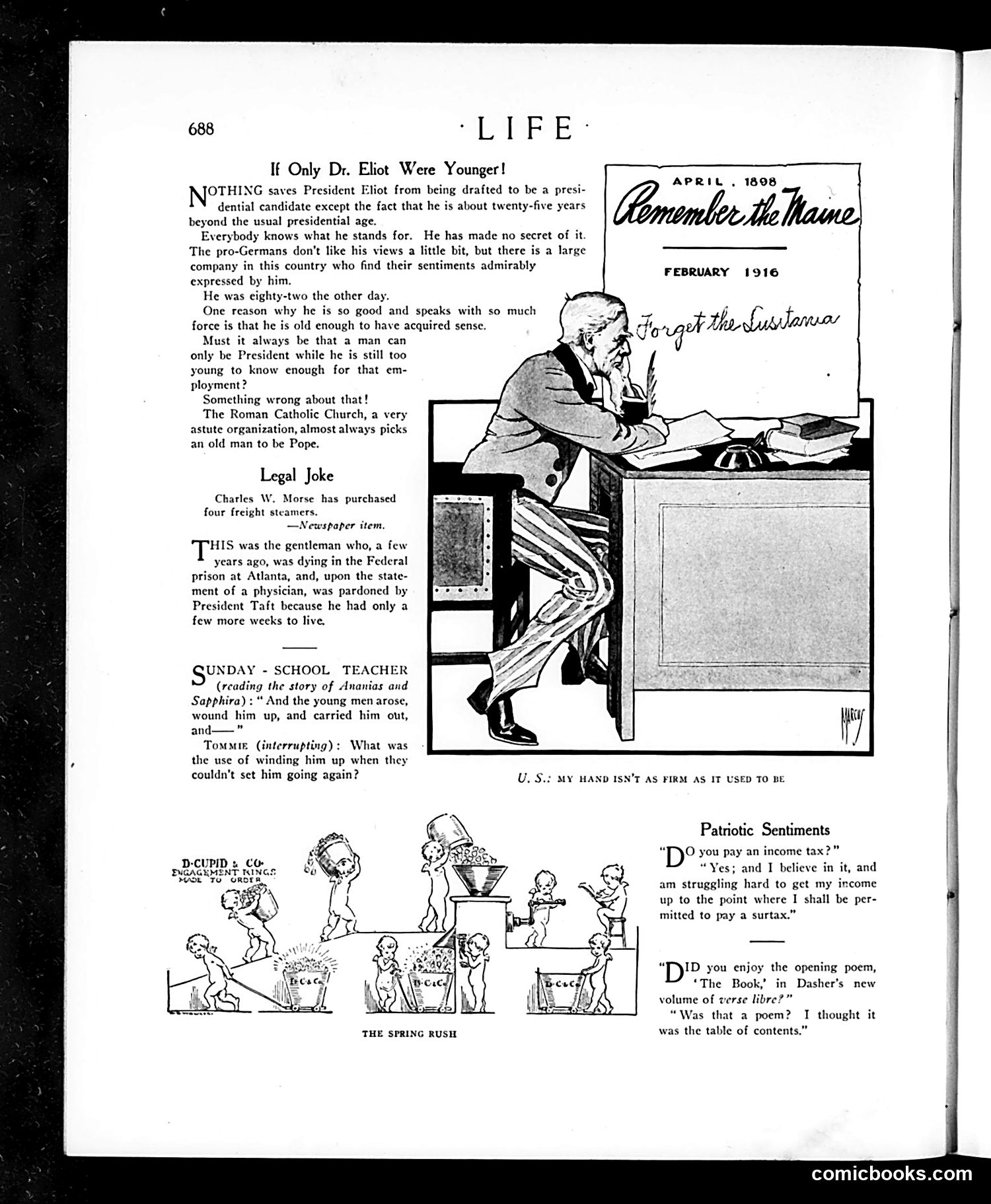
**Main Article & Cartoon (Top):** The article "If Only Dr. Eliot Were Younger!" critiques President Eliot as a presidential candidate, noting his age (eighty-two) as a liability. The accompanying cartoon shows an elderly man at a desk with a calendar marked "April 1908" and "February 1916," captioned "Forget the Sysstemma [sic]." This satirizes concerns about Eliot's advanced age for high office—the joke being that even the Pope typically appoints older men, so why not accept an elderly president? The visual emphasizes his physical decline through exaggeration. **"Legal Joke" & Other Content:** Below are brief humorous anecdotes and a multi-panel comic strip titled "The Spring Rush" depicting Cupid's romantic engagement activities. The page blends political satire with general humor typical of early-20th-century Life magazine's format.
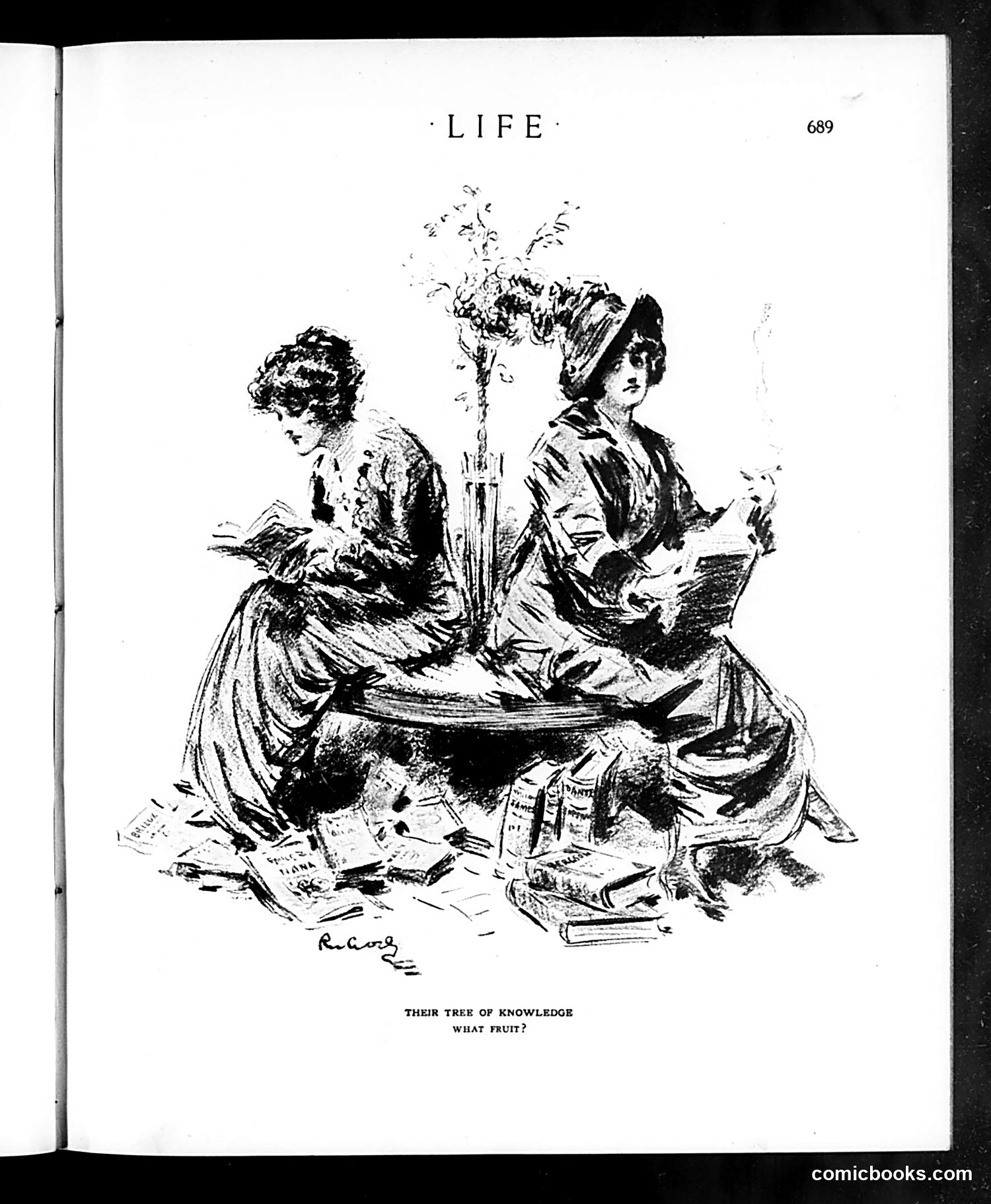
This satirical illustration depicts two well-dressed women sitting beneath a flowering plant or tree, surrounded by scattered books and papers. The women appear to be engaged in reading or study. The caption poses a critical question about female education: "What Fruit?" suggests skepticism about the practical outcomes or value of women's intellectual pursuits. This reflects early 20th-century social debates about women's higher education—whether educated women would contribute meaningfully to society or simply abandon domestic duties. The scattered books and refined setting suggest these are educated, upper-class women, yet the artist's questioning tone implies the satire mocks either women's intellectual ambitions or society's doubts about their usefulness. The "tree of knowledge" reference alludes to classical learning and enlightenment ideals, which the caption ironically undercuts.
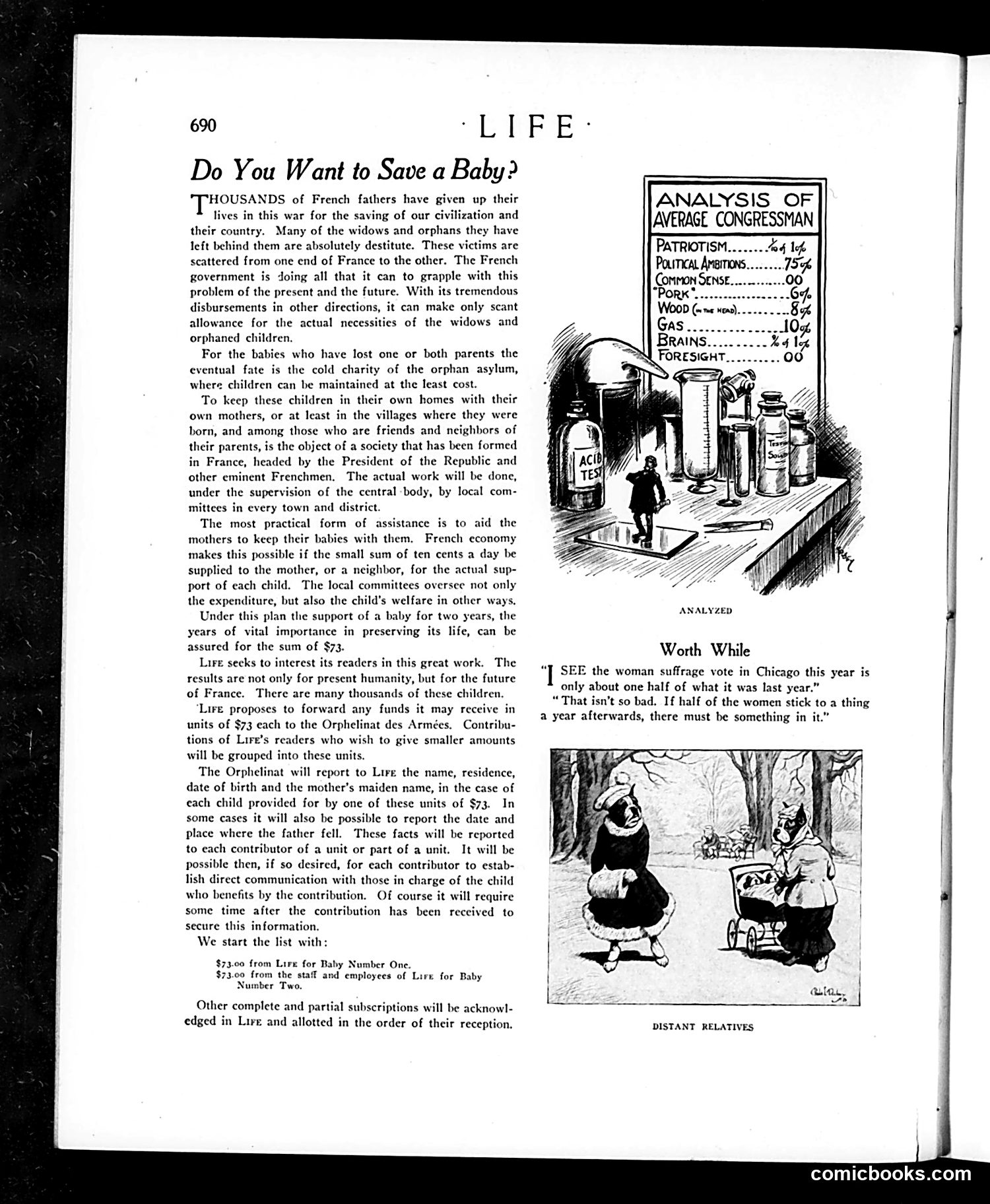
**Main Article: "Do You Want to Save a Baby?"** This article advocates for a French charitable organization supporting war orphans and widows left by World War I casualties. It describes a plan where contributors provide small monthly amounts ($73 mentioned) to support individual children, allowing them to remain in their home villages rather than in orphanages. **"Analysis of Average Congressman" Cartoon** The right-side illustration satirizes politicians, depicting them as composed primarily of "Political Ambitions" (75%), with minimal amounts of "Common Sense," "Patriotism," and other virtues. This is vintage American political satire criticizing congressional corruption or self-interest. **"Worth While" and "Distant Relatives" Cartoons** These appear to comment on women's suffrage and family dynamics, though specific details are unclear from the images alone.
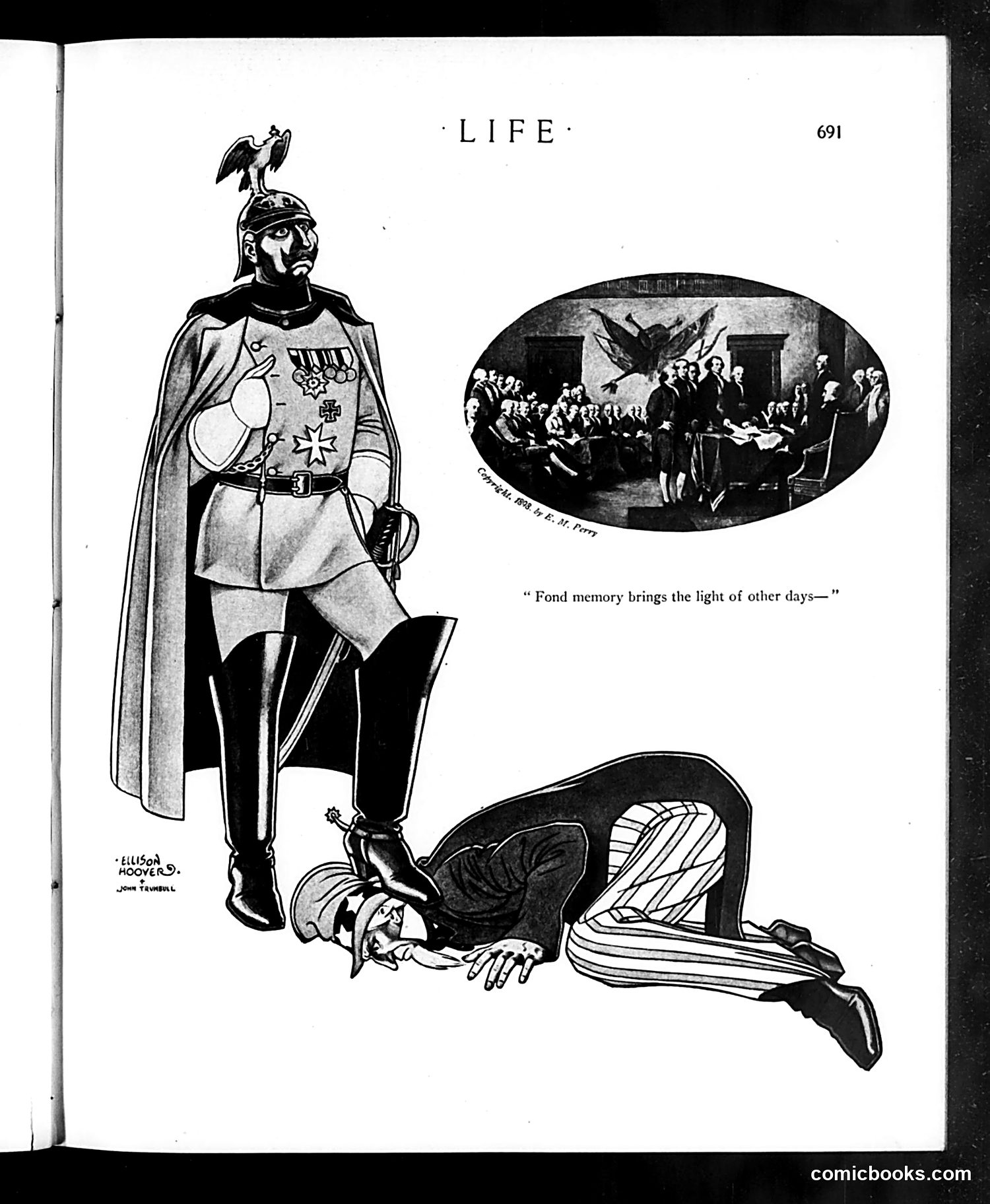
This page from *Life* magazine (page 691) contains political satire by artist Ellison Hoover. The main illustration depicts a German military officer in full Imperial regalia—complete with spiked helmet, eagle emblem, medals, and cape—standing triumphantly over a defeated, prostrate figure in civilian clothes. The satire appears to critique German militarism and imperialism, likely from the early 20th century. The contrast between the imposing, decorated military figure and the humbled civilian below suggests commentary on German military dominance and aggression. The upper illustration shows what appears to be a formal diplomatic or governmental scene, while the quoted phrase "Fond memory brings the light of other days" adds ironic nostalgia to the overall message about past conflicts and power dynamics.
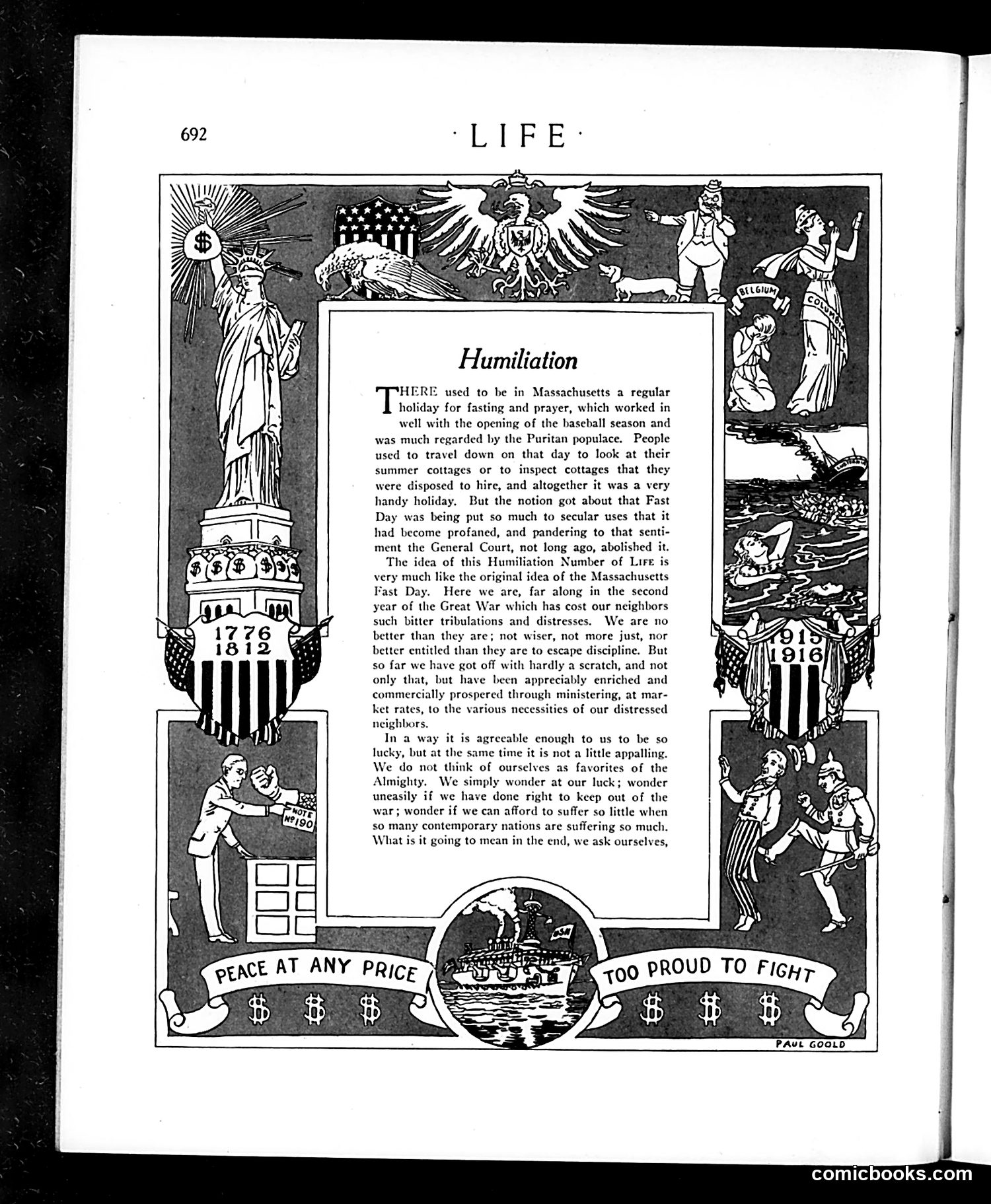
This satirical piece critiques American prosperity and complacency during World War I. The border imagery includes the Statue of Liberty (marked "1776-1812"), an eagle, and a warship (marked "1916"), alongside banners reading "PEACE AT ANY PRICE" and "TOO PROUD TO FIGHT"—likely referencing President Wilson's pre-war pacifist rhetoric. The text argues that America has profited from others' suffering in the war while avoiding combat, enriching itself through trade with distressed nations. The cartoonist suggests this is morally problematic—we've "hardly a scratch" while others suffer terribly. The piece questions whether America's luck and financial gain come at the cost of moral responsibility, framing American neutrality and profit as a form of national humiliation rather than fortune.
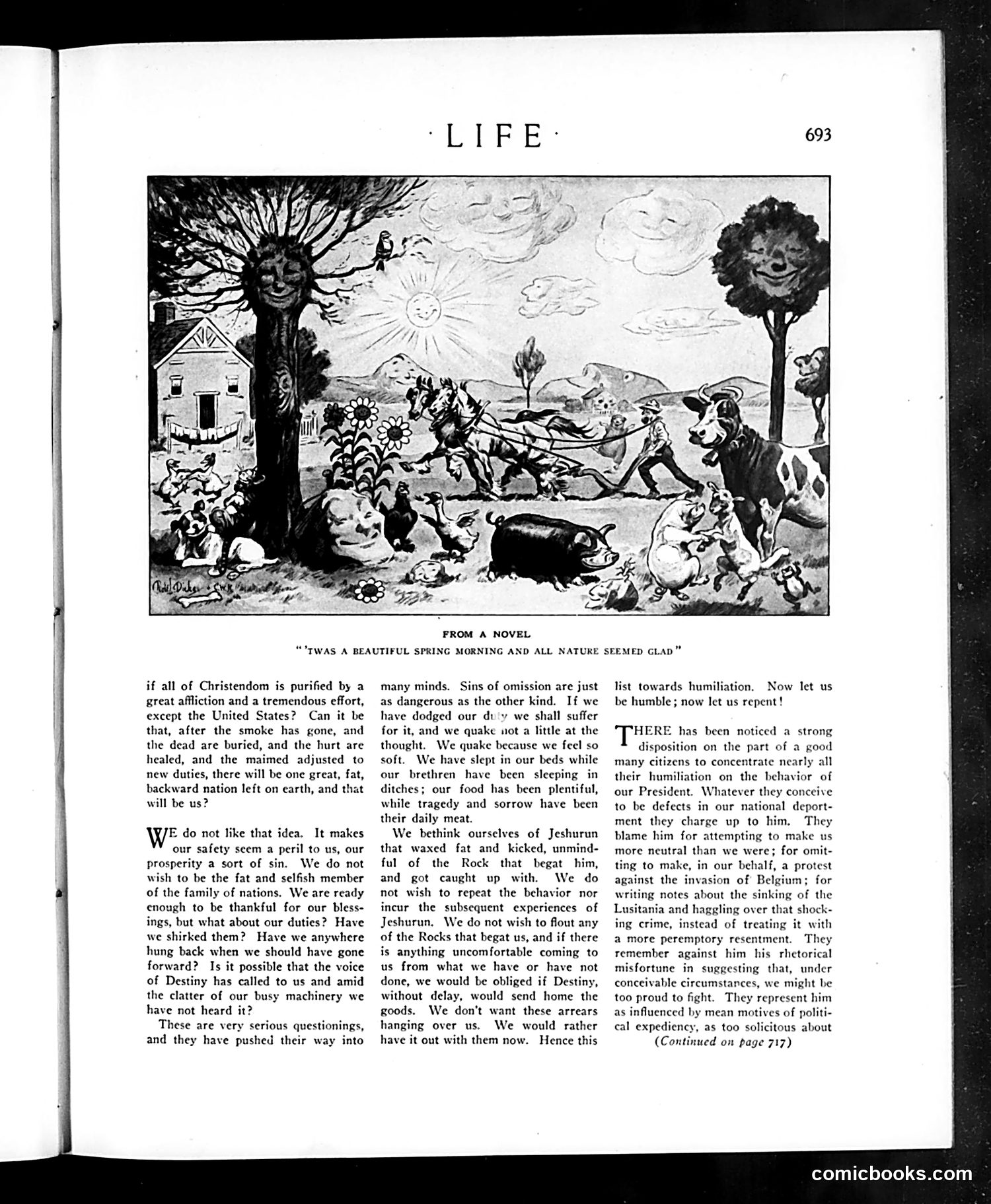
This page features an illustrated scene titled "FROM A NOVEL — 'TWAS A BEAUTIFUL SPRING MORNING AND ALL NATURE SEEMED GLAD." The whimsical cartoon depicts anthropomorphized animals and nature elements in a pastoral landscape—trees with faces, cheerful creatures, and farm animals in an idealized spring setting. The accompanying text discusses Christian humility and national duty, criticizing citizens who concentrate complaints on the President rather than accepting shared responsibility for national challenges. The piece argues against dwelling on past mistakes ("sins of omission") and advocates for forward-looking repentance and humble acceptance of hardship. The juxtaposition of the cheerful pastoral scene with this serious moral commentary creates satirical contrast—the idealized nature illustration contrasts with the text's stern calls for civic virtue and acceptance of wartime sacrifice.
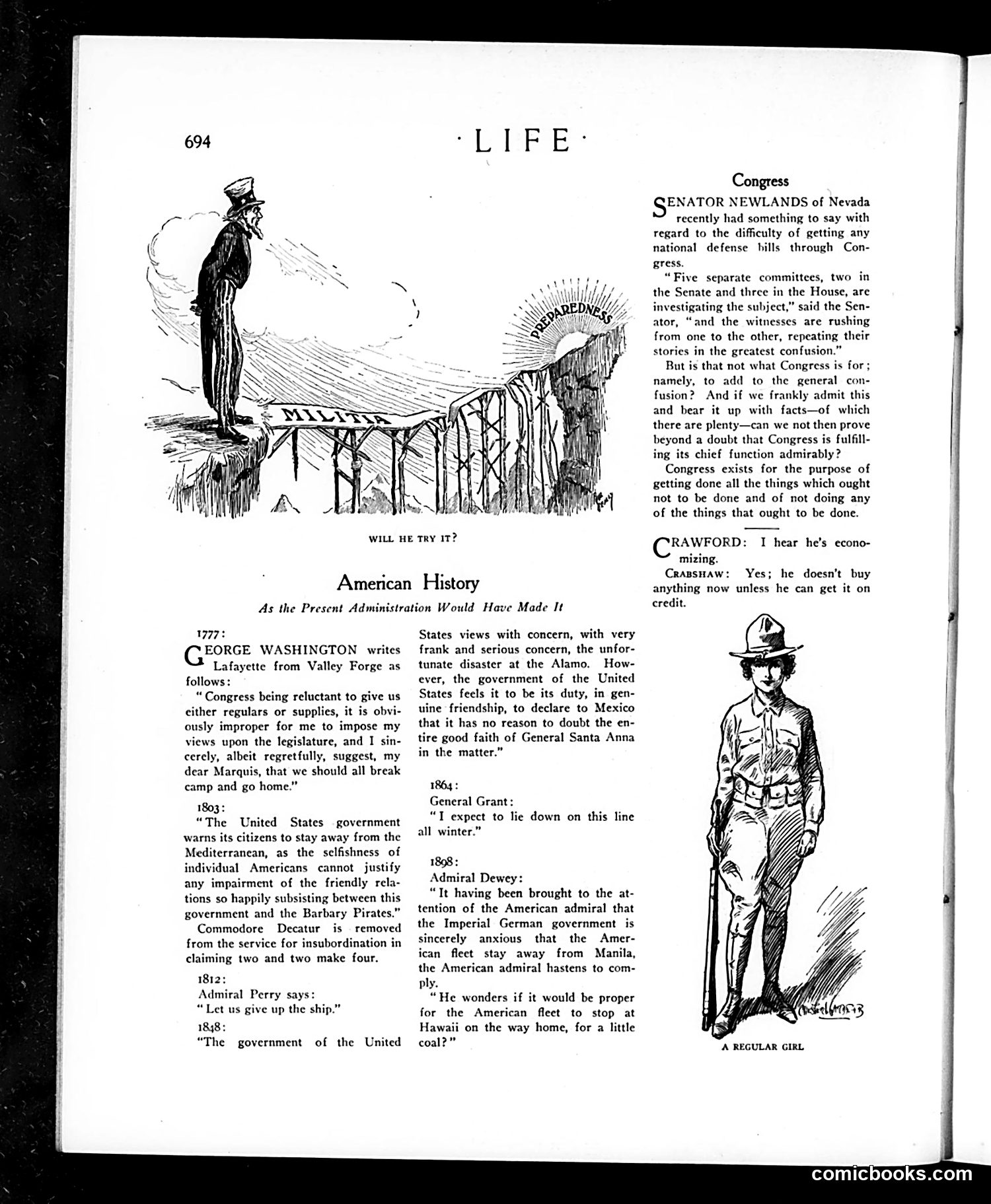
This cartoon depicts a tightrope walker (representing Congress) attempting to cross a chasm labeled "PREPAREDNESS." The figure appears precarious and uncertain—the caption "Will He Try It?" questions whether Congress will actually act on national defense preparation. The accompanying "Congress" article criticizes legislative inefficiency, arguing Congress fails its fundamental purpose: "getting done all the things which ought not to be done and not doing any of the things that ought to be done." The "American History" section provides historical context for Congressional indecision, citing statements from Washington, Jefferson, and Civil War-era leaders expressing frustration with Congress's reluctance to authorize military spending and action. The satire targets Congressional paralysis on military preparedness issues.
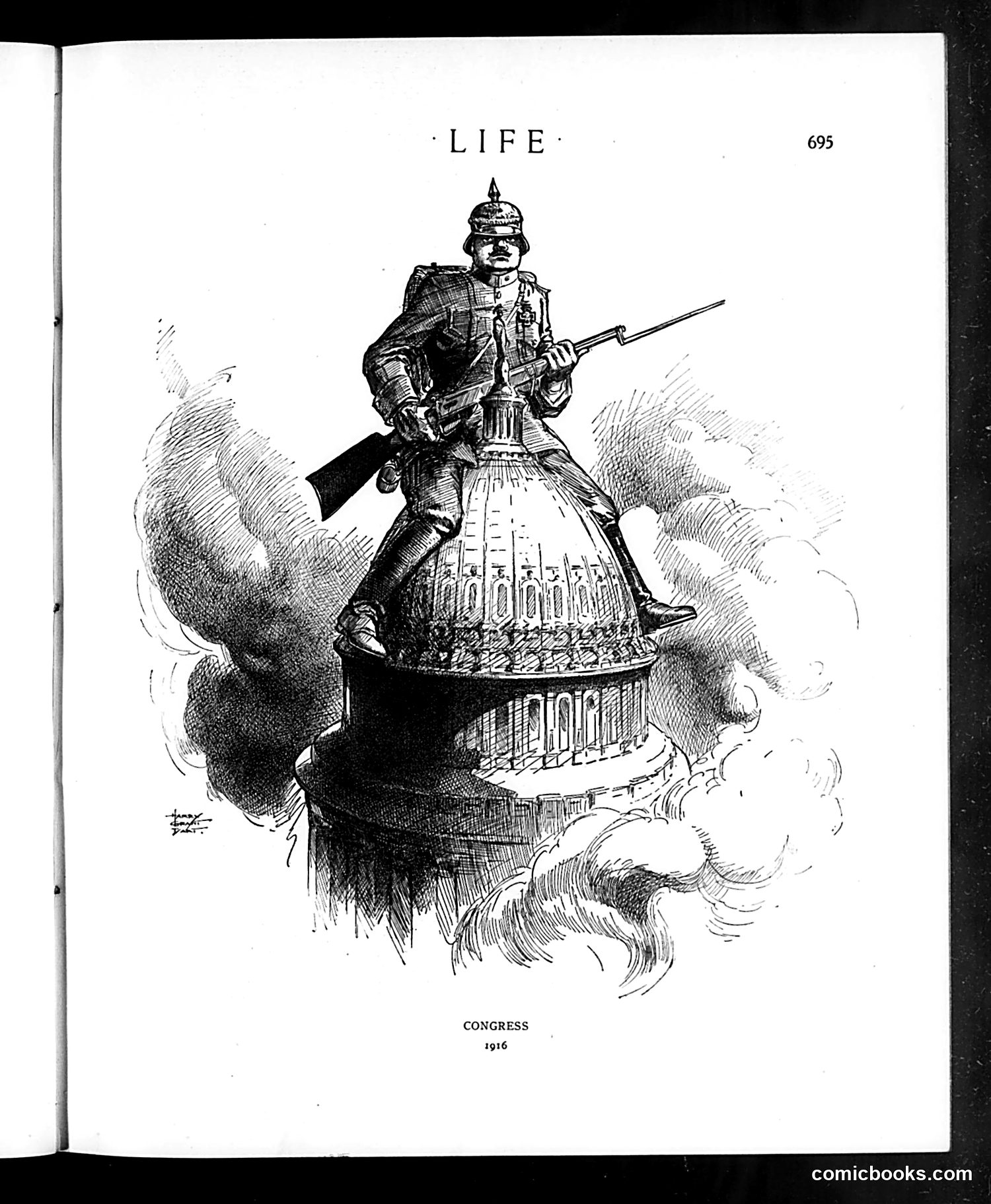
This is a satirical cartoon from *Life* magazine depicting a German soldier in a spiked Prussian helmet (Pickelhaube) standing atop the U.S. Capitol dome, wielding a rifle with bayonet. The soldier appears to dominate or control the building, with clouds of smoke or destruction surrounding the scene. The cartoon critiques American Congress during World War I, suggesting that German military interests or influence have come to dominate U.S. legislative decision-making. The image implies Congress is either controlled by German power or failing to adequately resist German interests—a common anxiety in 1916 as the U.S. debated entering the war on the Allied side. The satirical point is that Congress has surrendered its independence to foreign military power.
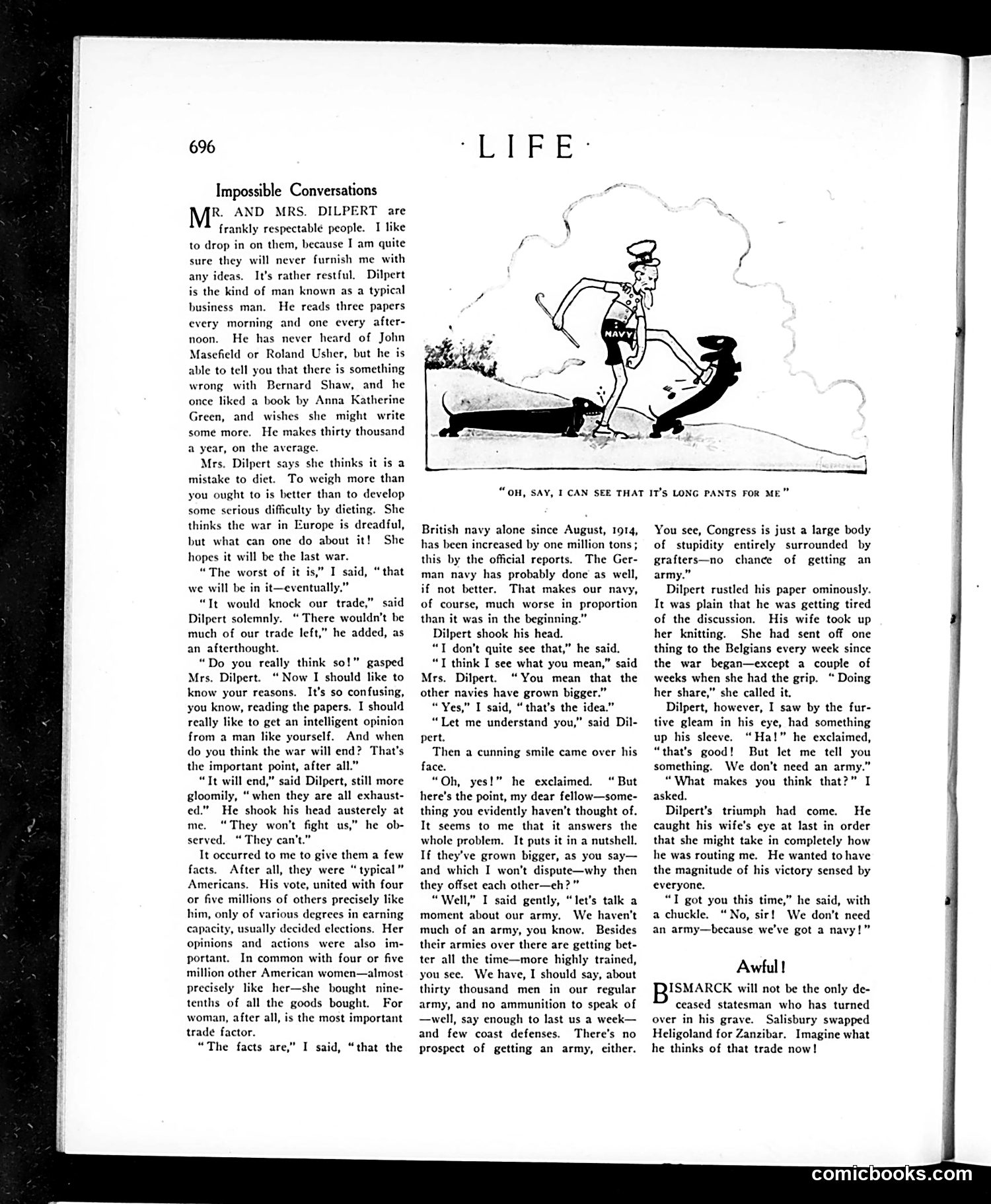
This piece satirizes typical American middle-class indifference to World War I (then ongoing in Europe). Mr. and Mrs. Dilpert represent the average American voter and consumer—conventional, complacent, and deliberately uninformed. The narrator attempts to explain why U.S. military preparedness matters using factual arguments about naval and army strength. The satire lies in their willful incomprehension: Dilpert misunderstands basic facts, then dismisses the argument with illogical reasoning ("they offset each other"). Mrs. Dilpert feigns interest while remaining oblivious. The cartoon caption mocks wartime anxiety about conscription ("long pants for me"). The author argues these "typical Americans" are important—their votes and purchasing power shape policy—yet they actively resist understanding geopolitical reality. The piece expresses frustration that citizens responsible for democratic decisions prefer comfortable ignorance over difficult facts about potential war.
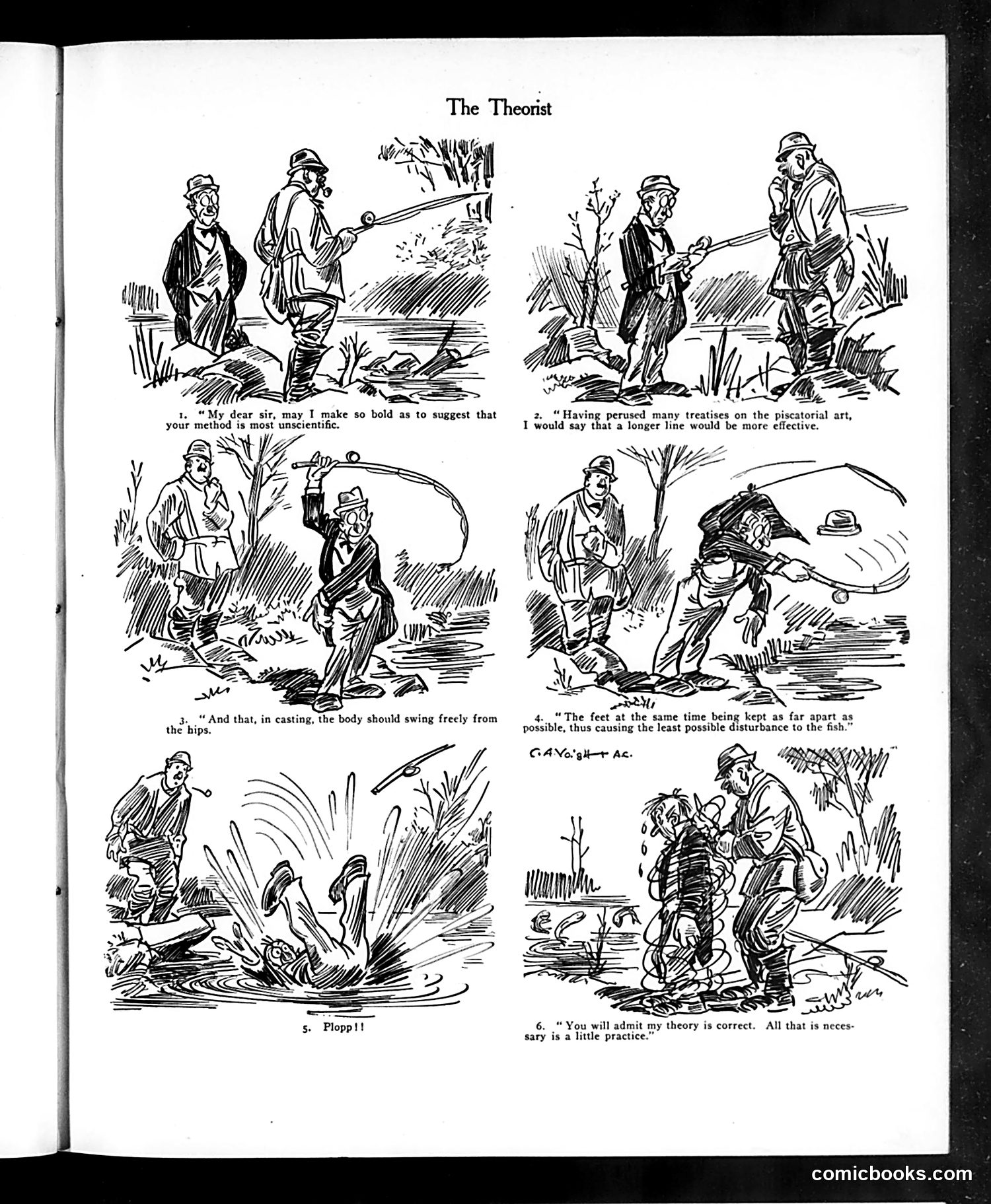
This comic satirizes someone who teaches fishing theory without practical experience. The sequence shows a "theorist" giving increasingly elaborate advice to an actual fisherman—about casting technique, body mechanics, and foot placement—while demonstrating none of it himself. The humor culminates when the theorist falls into the water (panel 5: "Plop!!"), and the fisherman responds with gentle condescension: "You will admit my theory is correct. All that is necessary is a little practice" (panel 6). The satire mocks armchair experts who pontificate about proper methods based on books or abstract knowledge while lacking real-world experience. It's a timeless critique of theory divorced from practice—particularly relevant to any field where untested experts presume to instruct seasoned practitioners.
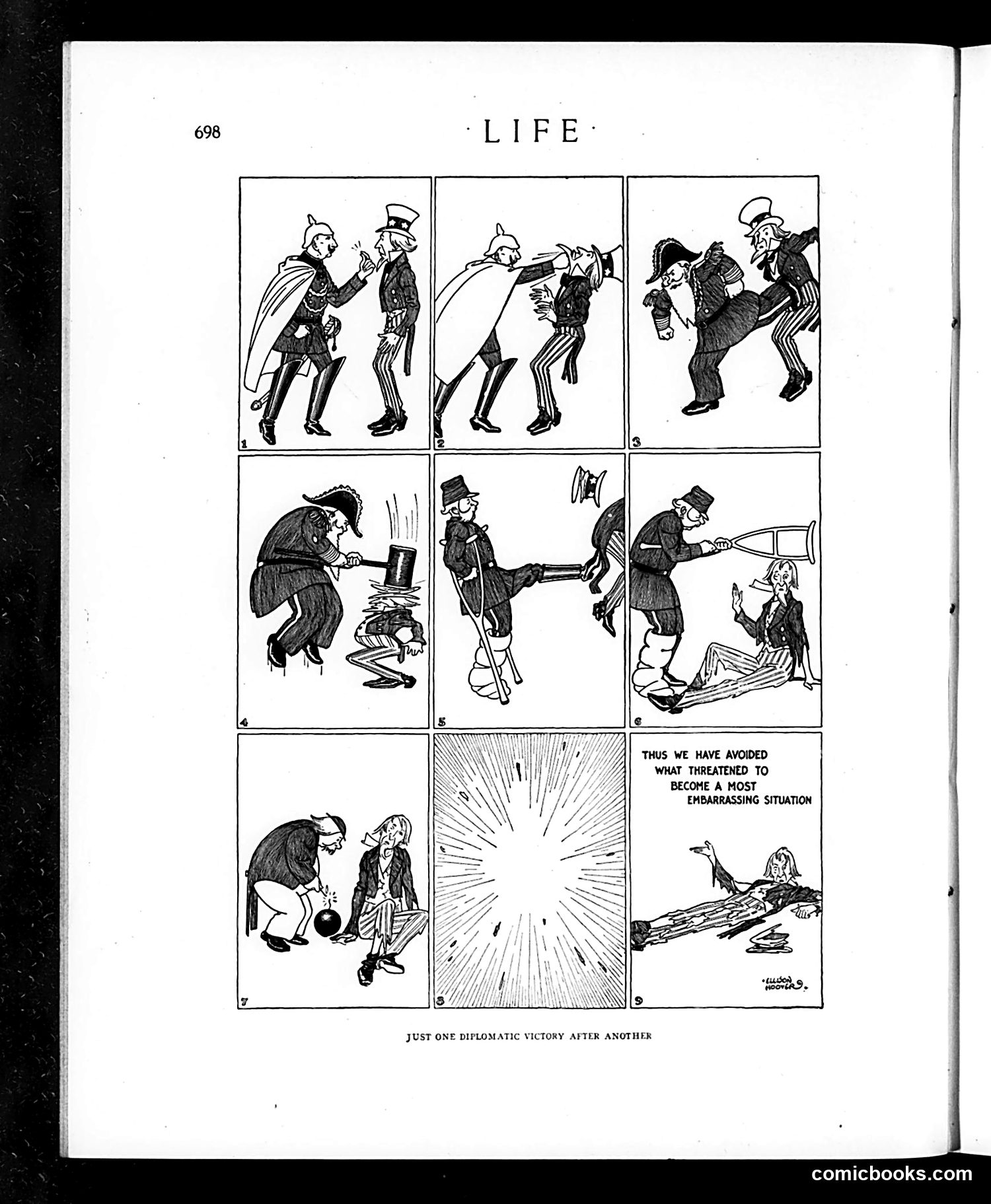
This is a nine-panel satirical comic about diplomatic maneuvering. Two officials (appearing to represent diplomats or politicians) engage in an escalating series of conflicts: they argue, fight physically, pull weapons on each other, and finally one appears knocked down. Panel 8 shows an explosion or bright flash—suggesting catastrophe averted. The final panel reveals the joke: one diplomat congratulates the other, claiming "Thus we have avoided what threatened to become a most embarrassing situation," while the other lies defeated on the ground. The satire mocks diplomatic language and posturing—how officials frame mutual destruction or humiliation as diplomatic "victory." The caption "Just one diplomatic victory after another" reinforces the irony: what looks like violent conflict is repackaged as successful statecraft. This likely critiques early 20th-century diplomatic rhetoric surrounding international disputes.
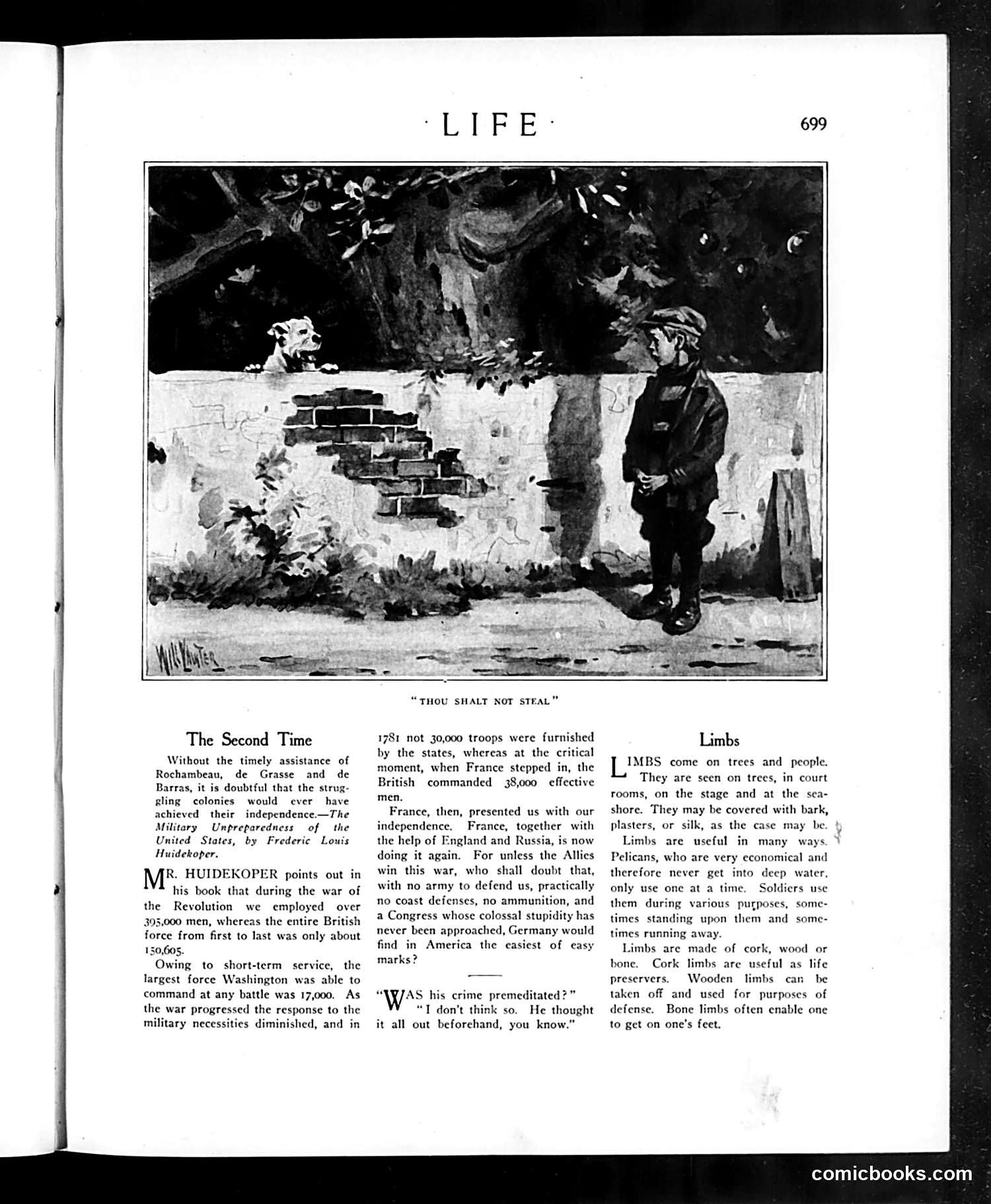
**The Main Cartoon ("Thou Shall Not Steal"):** Shows a figure in dark clothing standing before a deteriorating wall with exposed bricks—likely representing America's weak military defenses. A dog watches from above. This illustrates the article's argument that America is currently defenseless. **The Article's Point:** Written during World War II (references to current Allies and Germany), it argues America faces danger because of military unpreparedness. It draws a historical parallel: during the Revolution, France saved the struggling colonies. Now, the author warns, unless the Allies win WWII, America—with no army, coast defenses, or ammunition—would be easy prey for Germany. The critique is sharp: Congress is called "colossal stupidity," and the piece warns Americans cannot rely on foreign aid twice. **The "Limbs" Section:** Appears to be satirical filler content—an absurdist digression about literal and figurative "limbs" (possibly mocking something contemporary, unclear from context alone). The overall message: America must rearm immediately or face invasion.
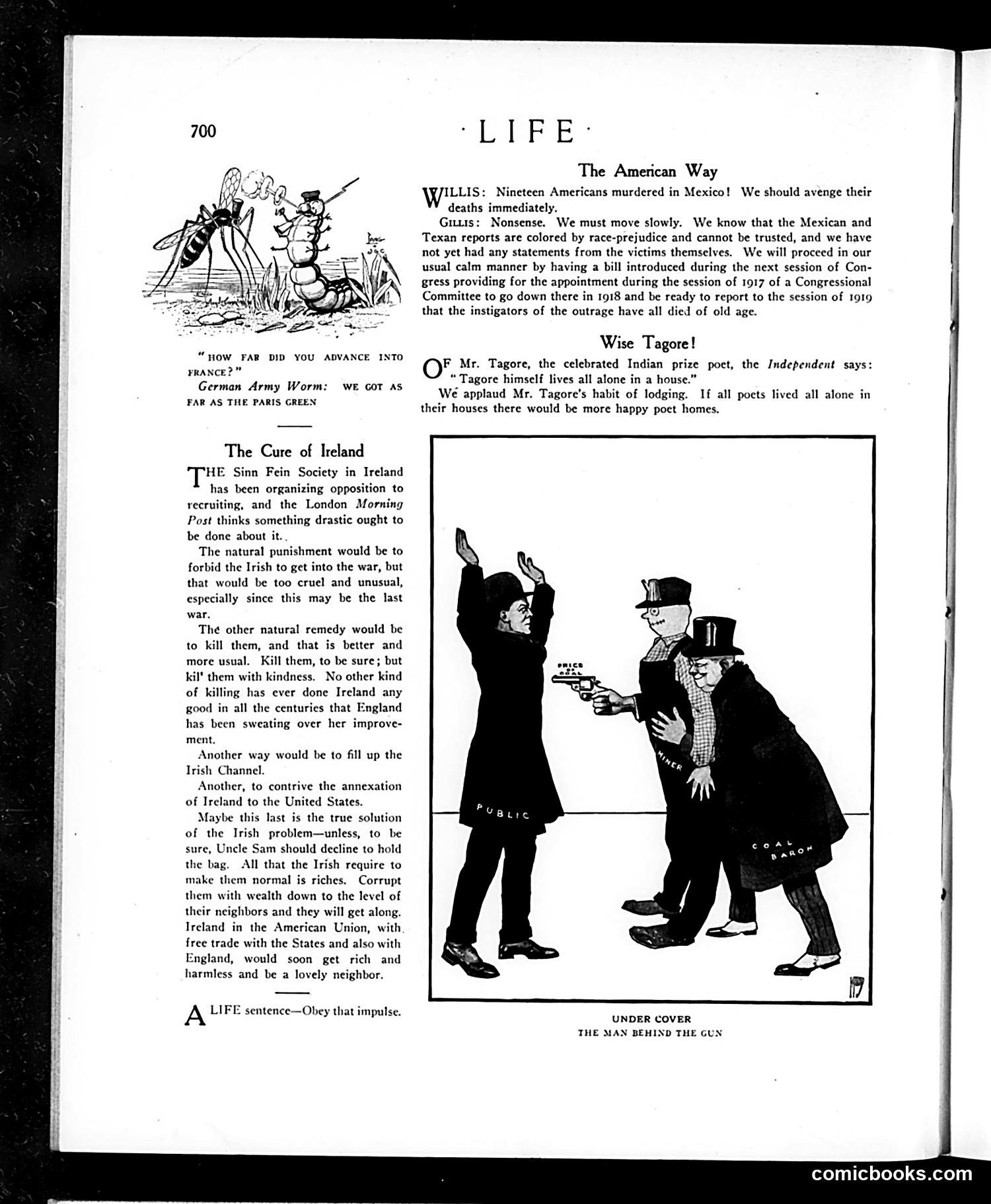
This Life magazine page (circa 1917-1919, based on references) contains three satirical pieces mocking American political responses to international crises: **"The American Way"** satirizes bureaucratic delay. Willis demands swift revenge for nineteen Americans killed in Mexico; Gillis proposes establishing a Congressional committee that won't report findings until 1919—by which time the perpetrators will have died of old age. The joke targets American governmental sluggishness during wartime. **"Wise Tagore"** briefly mocks Indian poet Rabindranath Tagore's solitary lifestyle, sardonically suggesting poets would be happier living alone. **"The Cure of Ireland"** presents darkly ironic "solutions" to Irish resistance to WWI recruitment by Sinn Féin. The piece sarcastically proposes forbidding Irish participation in war, killing them "with kindness," or annexing Ireland to the U.S. and corrupting them with wealth. It critiques both British heavy-handedness toward Ireland and American complacency about Irish independence. The cartoon "Under Cover" (bottom) depicts armed figures but its meaning is unclear without caption context.
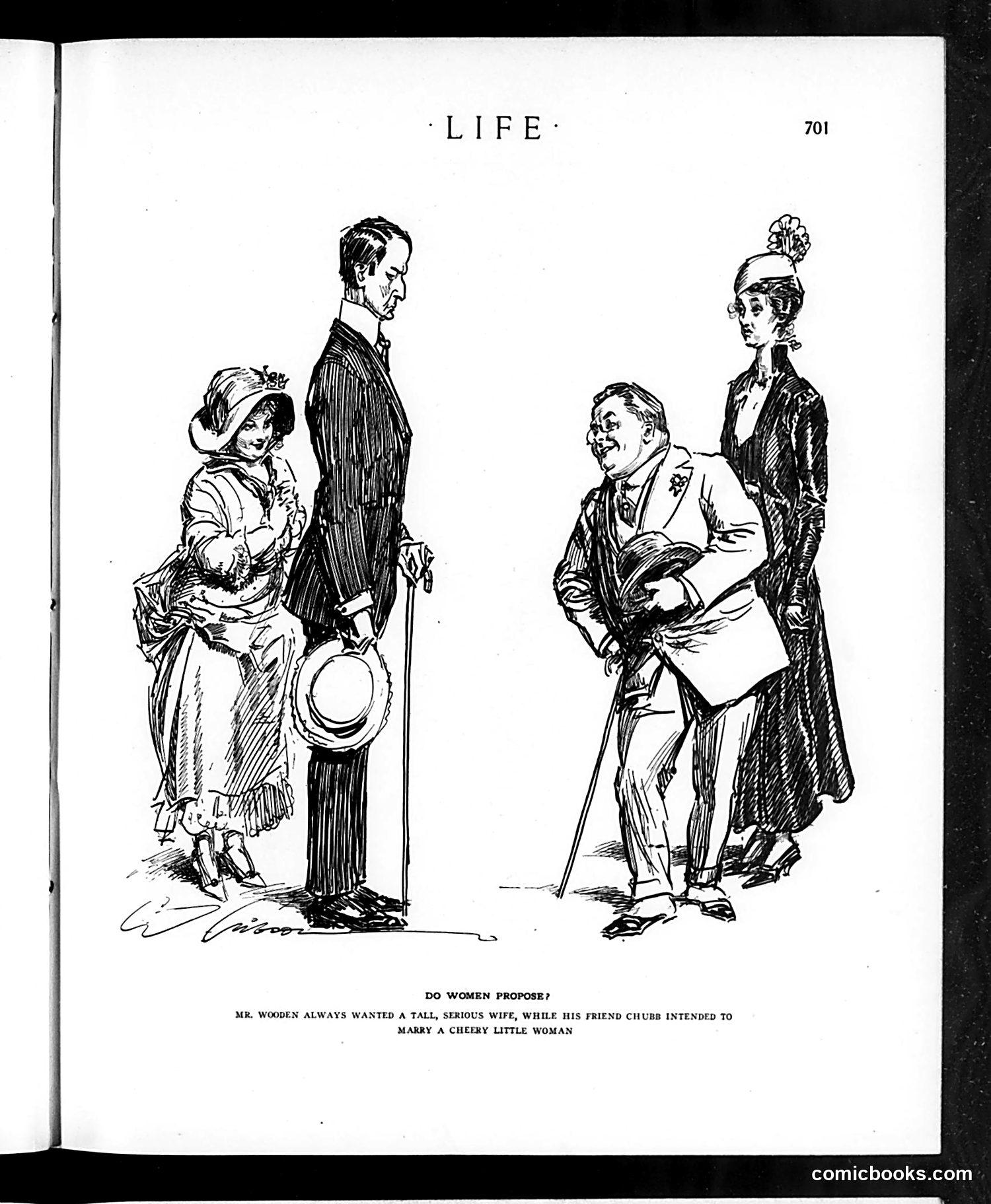
This satirical cartoon addresses early 20th-century marriage customs. The title "Do Women Propose?" presents a scenario involving two contrasting male types: Mr. Wooden (the tall, serious man on left) and his friend Chubb (the portly, cheerful man on right). The joke appears to hinge on marital preferences: Wooden desires a "tall, serious wife" while Chubb wants a "cheery little woman." The cartoon likely satirizes rigid gender roles and marriage expectations of the era, when women were generally expected to be passive recipients of proposals rather than active participants. The accompanying illustrations show elegantly dressed couples, suggesting upper-class courtship conventions. The satire probably mocks how men's predetermined "types" don't match reality, or questions whether women had any agency in these arrangements despite societal assumptions about gender and marriage.
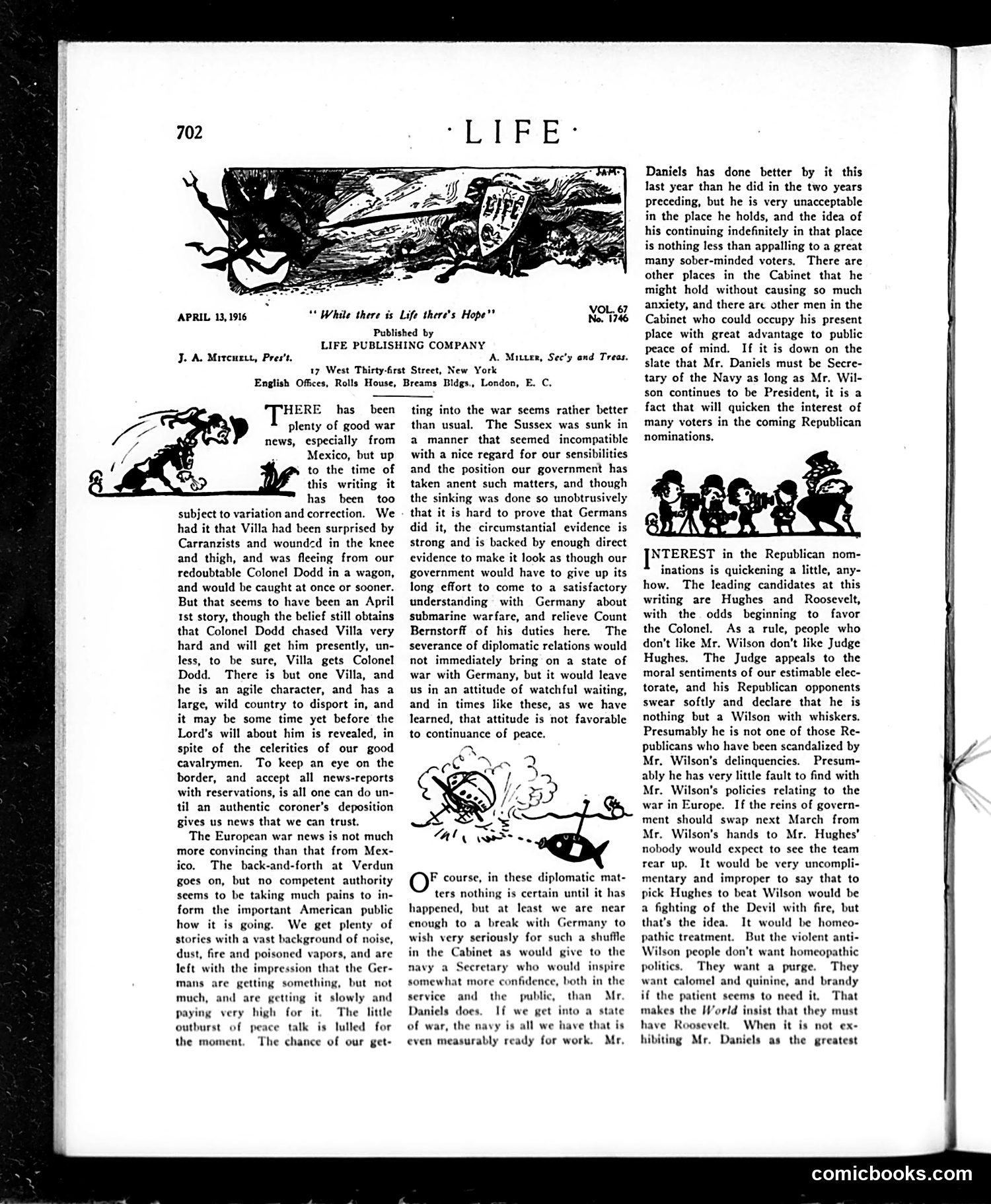
This editorial page discusses two major 1916 concerns: the Mexican border conflict with Pancho Villa and the looming possibility of American entry into World War I, particularly following Germany's sinking of the Sussex. The cartoons appear to be decorative headers rather than specific political caricatures. The main text criticizes Secretary of the Navy Josephus Daniels, arguing that while he has improved naval readiness in the past year, he remains "unacceptable" for his position and deeply unpopular with voters. The author suggests removing Daniels from the Navy Department and reassigning him elsewhere in the Cabinet—a pointed critique of his leadership at a moment when potential war with Germany looms. The piece reflects anxiety about American military preparedness and frustration with Wilson administration personnel, particularly as submarine warfare threatened to force American intervention.
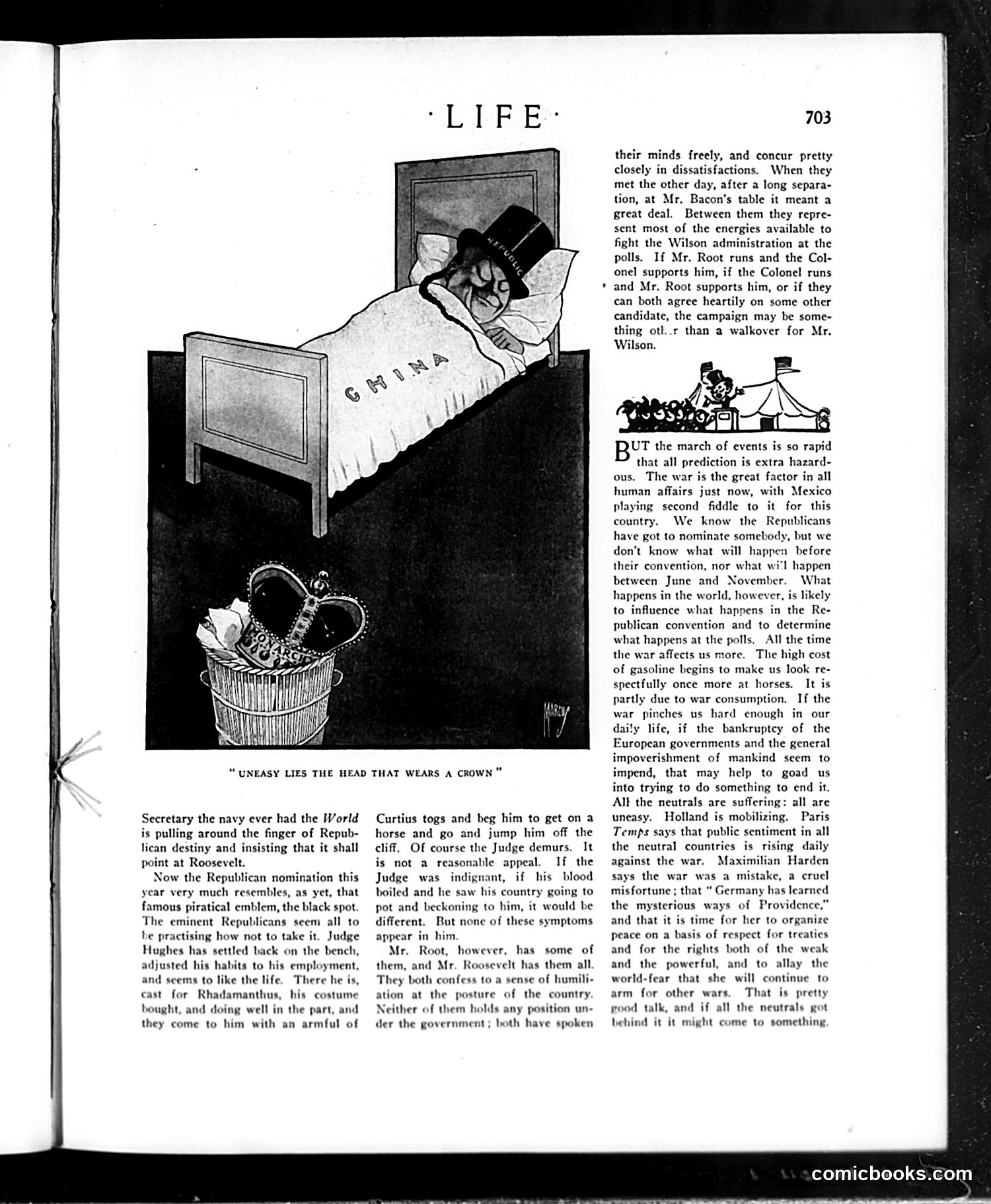
This page satirizes the 1916 Republican presidential nomination process. The main cartoon ("Uneasy Lies the Head That Wears a Crown") depicts "Omina" (likely representing the Republican Party or nomination itself) in an uncomfortable bed, with a crown in a basket below—suggesting the party leadership is anxious about who will accept the nomination. The text discusses three potential candidates: **Judge Hughes** (who prefers his judicial position), **Elihu Root**, and **Theodore Roosevelt**. The satire mocks how Republicans are reluctant to take on the nomination, despite needing to field a strong candidate against President **Wilson**. The article notes that unpredictable world events—particularly **World War I** and **Mexico**—make political prediction hazardous. It argues that war's effects on American life (rising gasoline costs, economic disruption) may ultimately influence both the Republican convention and November's election outcome. The cartoon and commentary express anxiety about Republican party dynamics during an unstable international period.
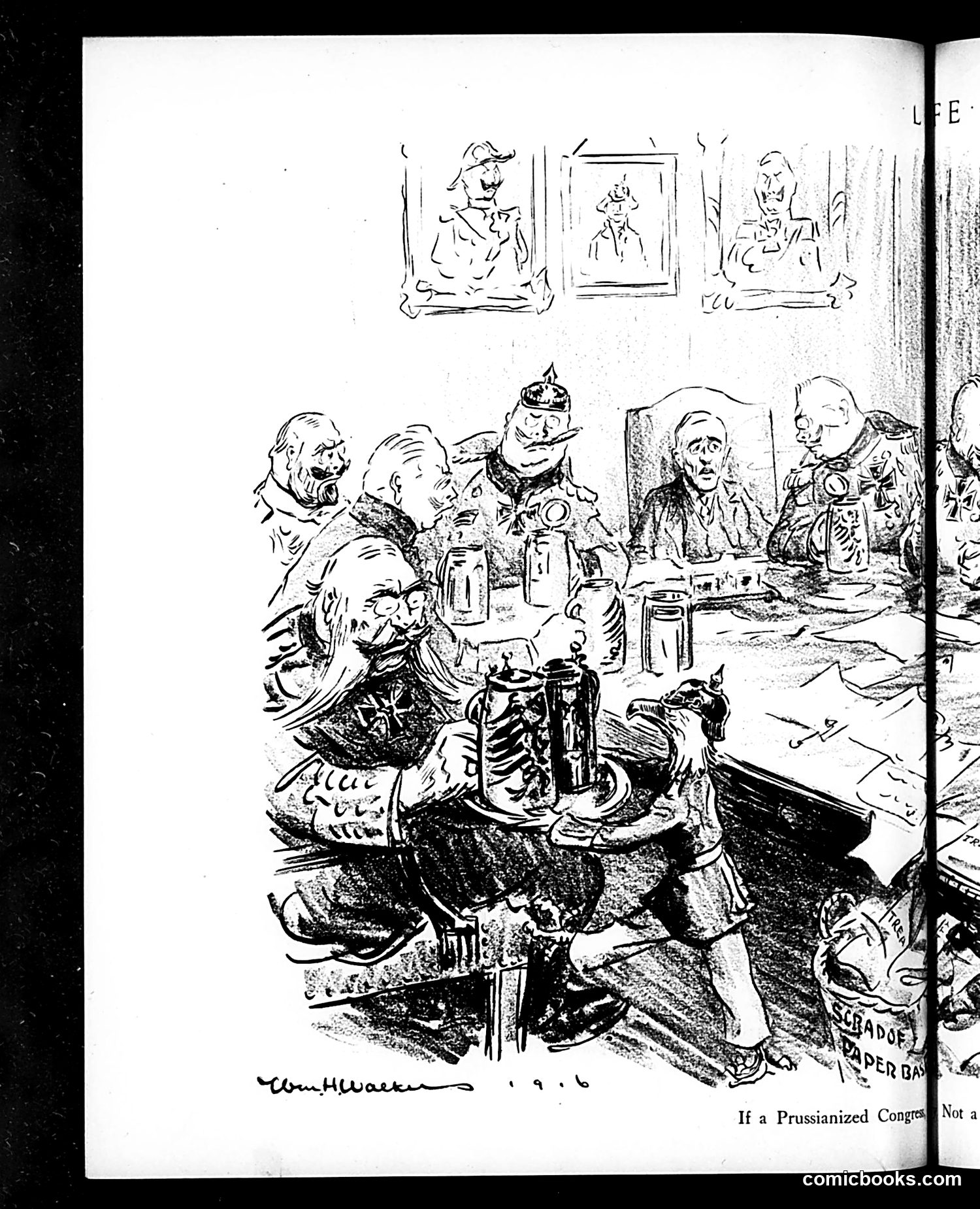
This 1906 Life magazine cartoon depicts a satirical scenario titled "If a Prussianized Congress" (text cut off). The scene shows military figures in Prussian-style uniforms seated around a table with beer steaks, suggesting German militarism's influence. The three small framed portraits at top likely represent contemporary American political figures. The satire warns against "Prussianization" of American institutions—a common Progressive Era concern about German imperial militarism and autocracy spreading to democratic America. By showing Congress transformed into a Prussian-style military gathering, the cartoonist ridicules the threat of militaristic values corrupting American democracy and civilian government. The specific political figures referenced are unclear without fuller context, but the cartoon reflects anxieties about foreign influence and militarism prevalent in early 1900s American discourse.
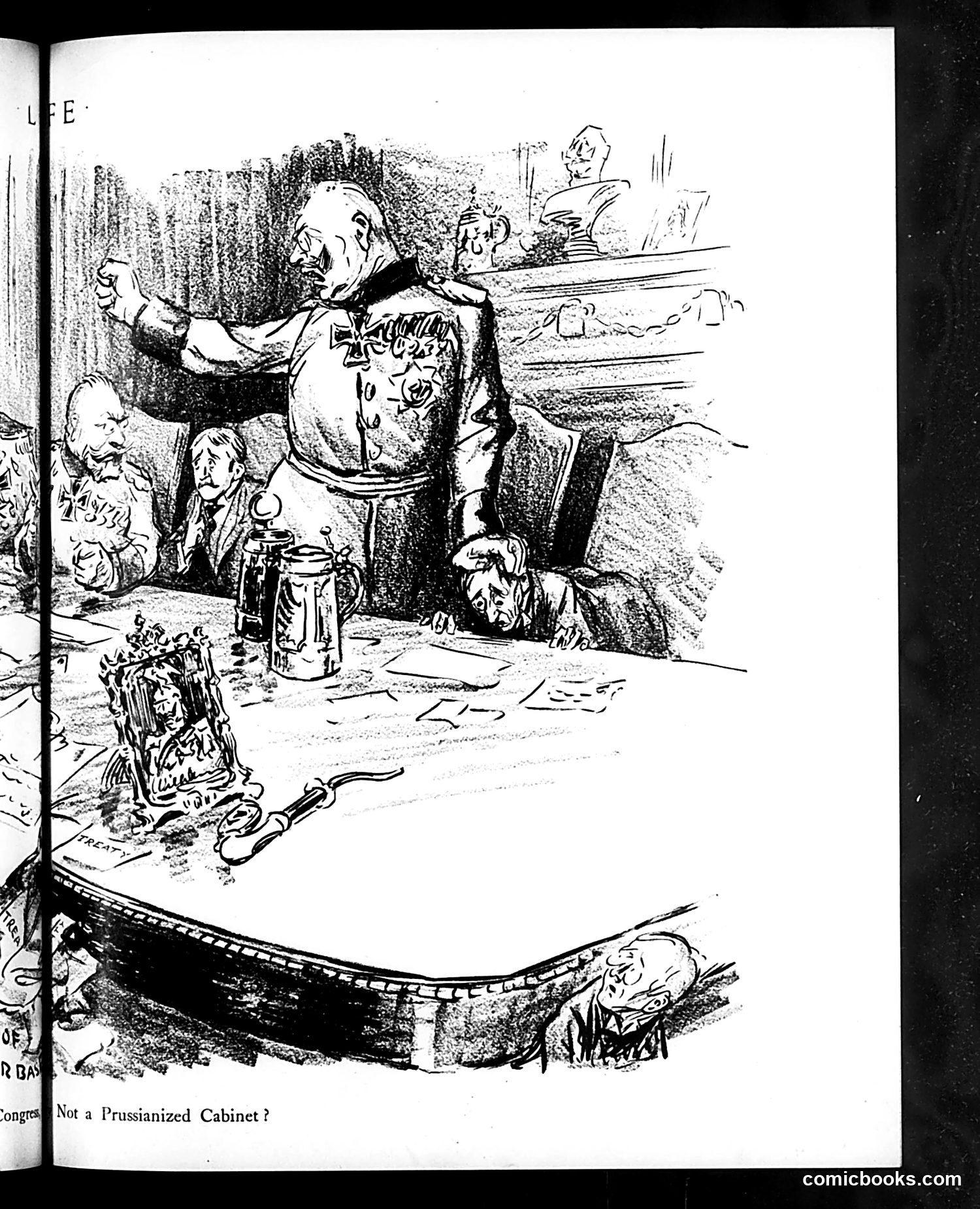
This political cartoon satirizes an American government cabinet by depicting it in militaristic, Prussian style. The central figure wears a heavily decorated military uniform with medals and insignia, adopting the authoritarian aesthetic associated with Imperial Prussia/Germany. Smaller figures surround him in subservient poses, suggesting hierarchical military command rather than democratic governance. The caption poses the question sarcastically—implying the cabinet *has* become "Prussianized," meaning excessively militaristic and autocratic rather than democratic. The cartoon criticizes what the artist views as dangerous German military influence on American government structure or leadership style. This likely reflects early 20th-century American anxieties about foreign influence or militarism in domestic politics, possibly referencing tensions before or during World War I.
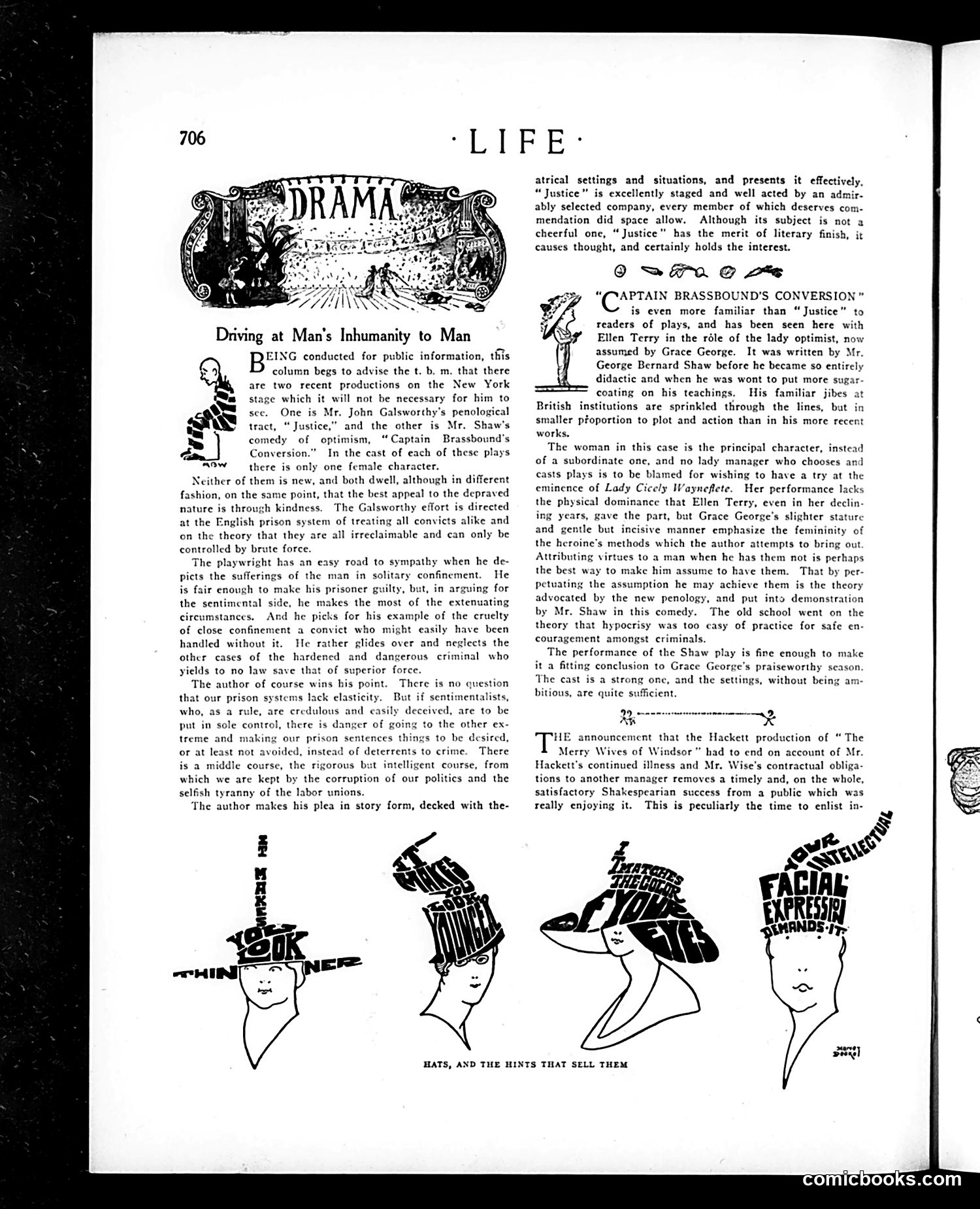
This page reviews two contemporary Broadway plays: John Galsworthy's "Justice" and George Bernard Shaw's "Captain Brassbound's Conversion." The critic argues both plays make sentimental pleas for reform—Galsworthy advocating for humane prison reform, Shaw promoting optimism and kindness as solutions to human problems. The reviewer is skeptical of their extremism, warning that sentimentalists might overcorrect by making prison too lenient or by naively assuming people will improve if treated well. The bottom illustration shows four stylized women's heads wearing elaborate hats, captioned "Hats, and the Hints That Sell Them"—likely fashion advertising or commentary on women's fashion trends. The column's tone reflects Progressive-era debate: praising the plays' theatrical merit while criticizing their idealistic reform messages as potentially dangerous if implemented without "rigorous but intelligent" practical balance.
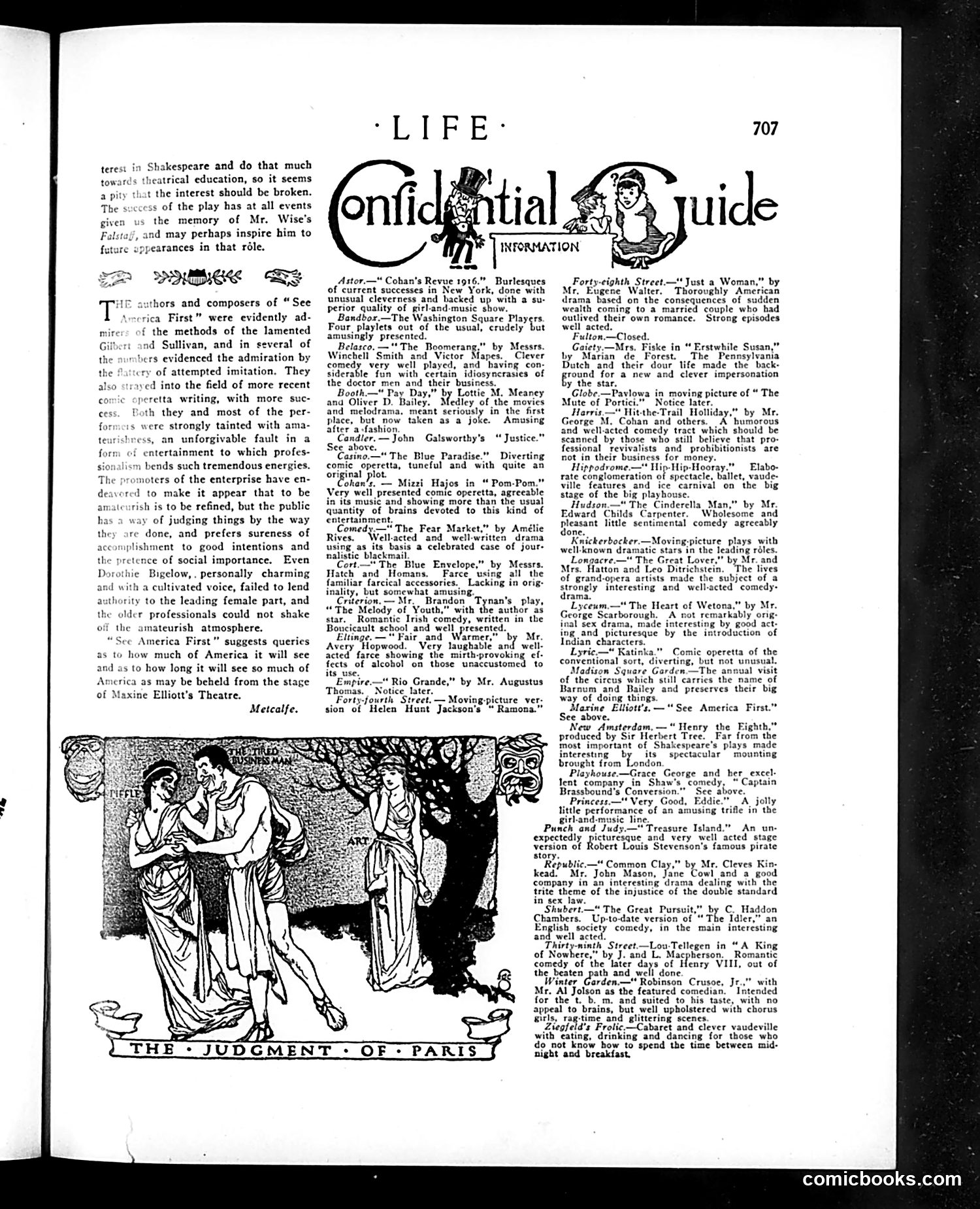
This page is primarily a **theater review column** titled "Confidential Guide," not a political cartoon. It contains capsule reviews of Broadway productions from approximately 1916. The only illustration is "The Judgment of Paris," a classical mythological scene depicting the famous moment from Greek mythology where Paris must choose among three goddesses. This appears decorative rather than satirical—a common artistic flourish in period magazines. The reviews themselves offer sharp theatrical criticism. The critic, identified as Metcalfe, dismisses "See America First" for its amateurish quality despite its subject matter, and critiques various productions for lacking originality or relying on tired theatrical conventions. References to Gilbert and Sullivan suggest the critic valued well-crafted operetta over inferior imitations. The column functions as contemporary entertainment journalism—opinionated guidance for theatergoers—rather than political satire.
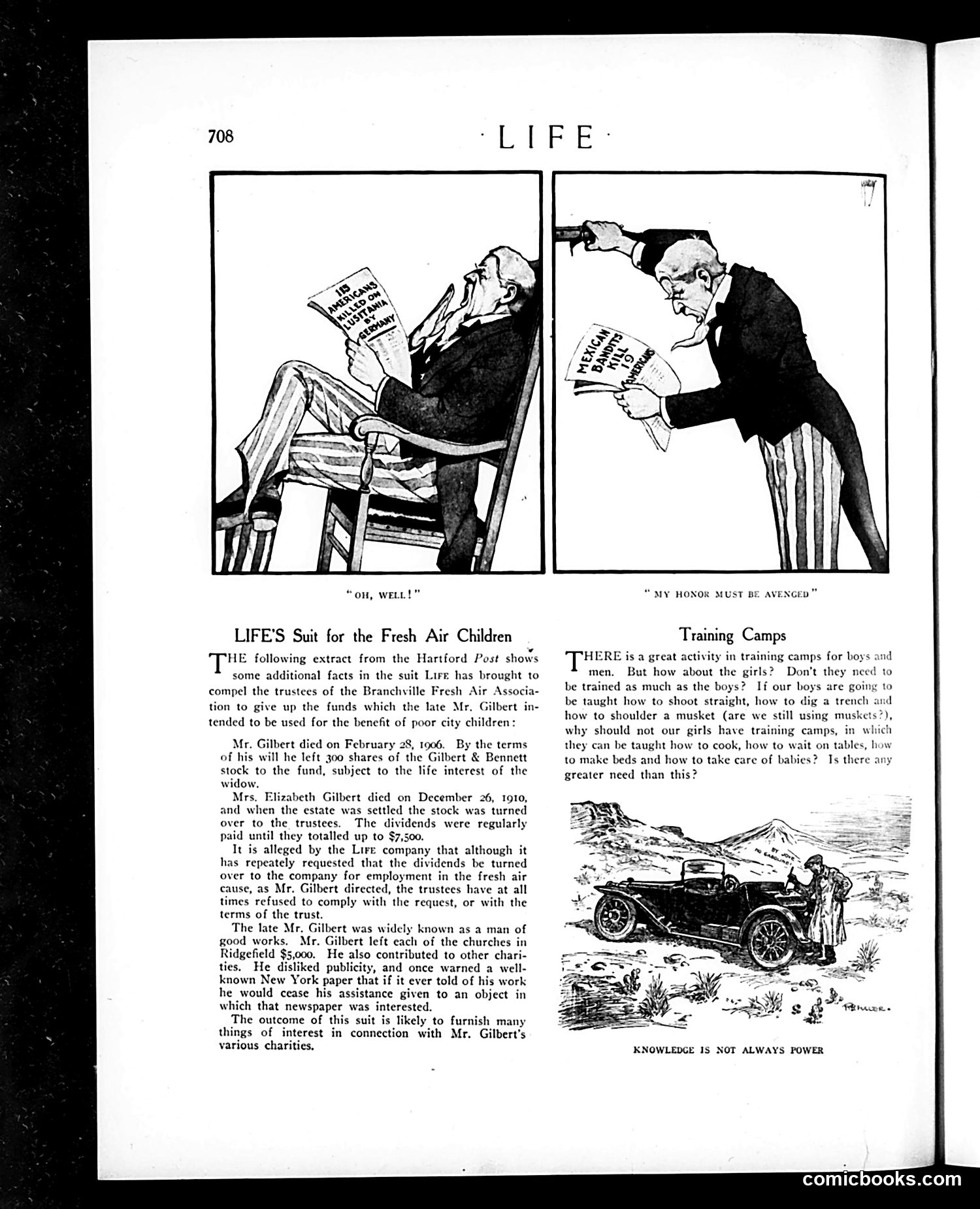
The page contains two distinct sections: **Left cartoon**: Two panels showing a man reading a newspaper labeled "LIFE'S SUIT FOR FRESH AIR CHILDREN" with captions "Oh, well!" and "My honor must be avenged." This illustrates a legal dispute over charitable funds. **Main article**: Documents a lawsuit by *Life* magazine against trustees of the Branchville Fresh Air Association. The late Mr. Gilbert (died 1906) bequeathed stock dividends ($7,300 accumulated) specifically for poor city children's fresh air programs. The trustees allegedly refused to distribute these funds as directed, prompting *Life*'s legal action. **Right section**: A satirical commentary on gender and military training. It mocks contemporary enthusiasm for boys' military training camps while questioning why girls aren't similarly trained—sarcastically suggesting they should learn cooking, table service, and childcare instead. The illustration "Knowledge Is Not Always Power" shows a car accident, implying practical knowledge matters more than theory. The page satirizes both charitable mismanagement and contemporary gender assumptions about education and training.
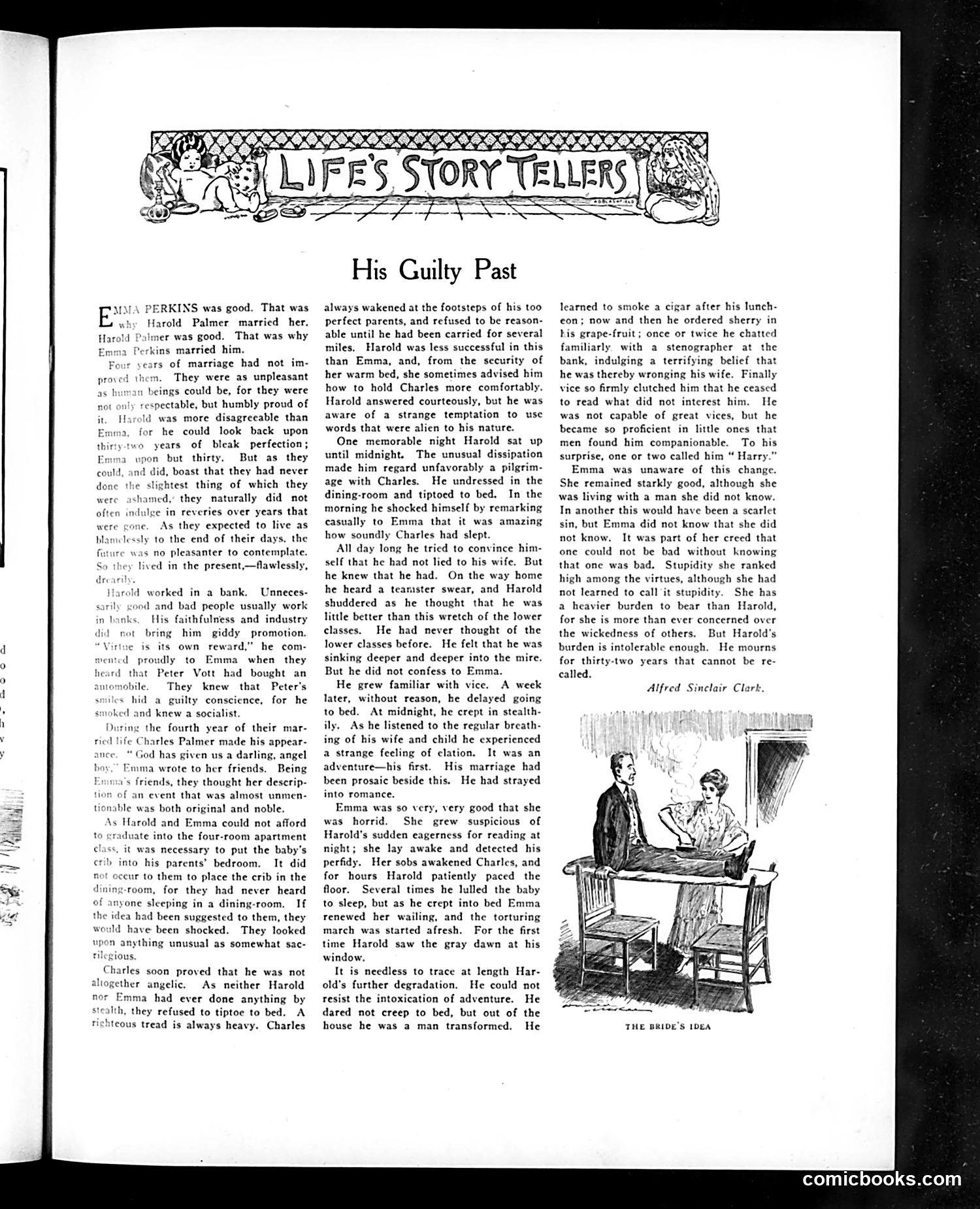
This is a satirical story (not a cartoon) by Alfred Sinclair Clark mocking Victorian morality and hypocrisy. Harold and Emma Palmer are a relentlessly "perfect" married couple—so rigid in their righteousness they won't even allow a baby's crib in the dining room, considering it improper. The satire centers on Harold's minor "transgression": one night, exhausted, he undresses in the dining room and lies about it to Emma. This small dishonesty becomes his gateway to "vice." He experiences a thrill from sneaking to bed at night—framing basic human spontaneity as moral degradation. The joke is the absurdity of such rigid propriety: Harold's "guilty conscience" over a tiny fib reveals how suffocating and unnatural their perfect facade truly is. Emma, being "so very, very good," becomes "horrid"—her suspicion and tears over his innocent behavior expose how their sanctimonious lifestyle corrupts actual human connection and family peace. The story critiques early 20th-century middle-class respectability as psychologically damaging performance art.
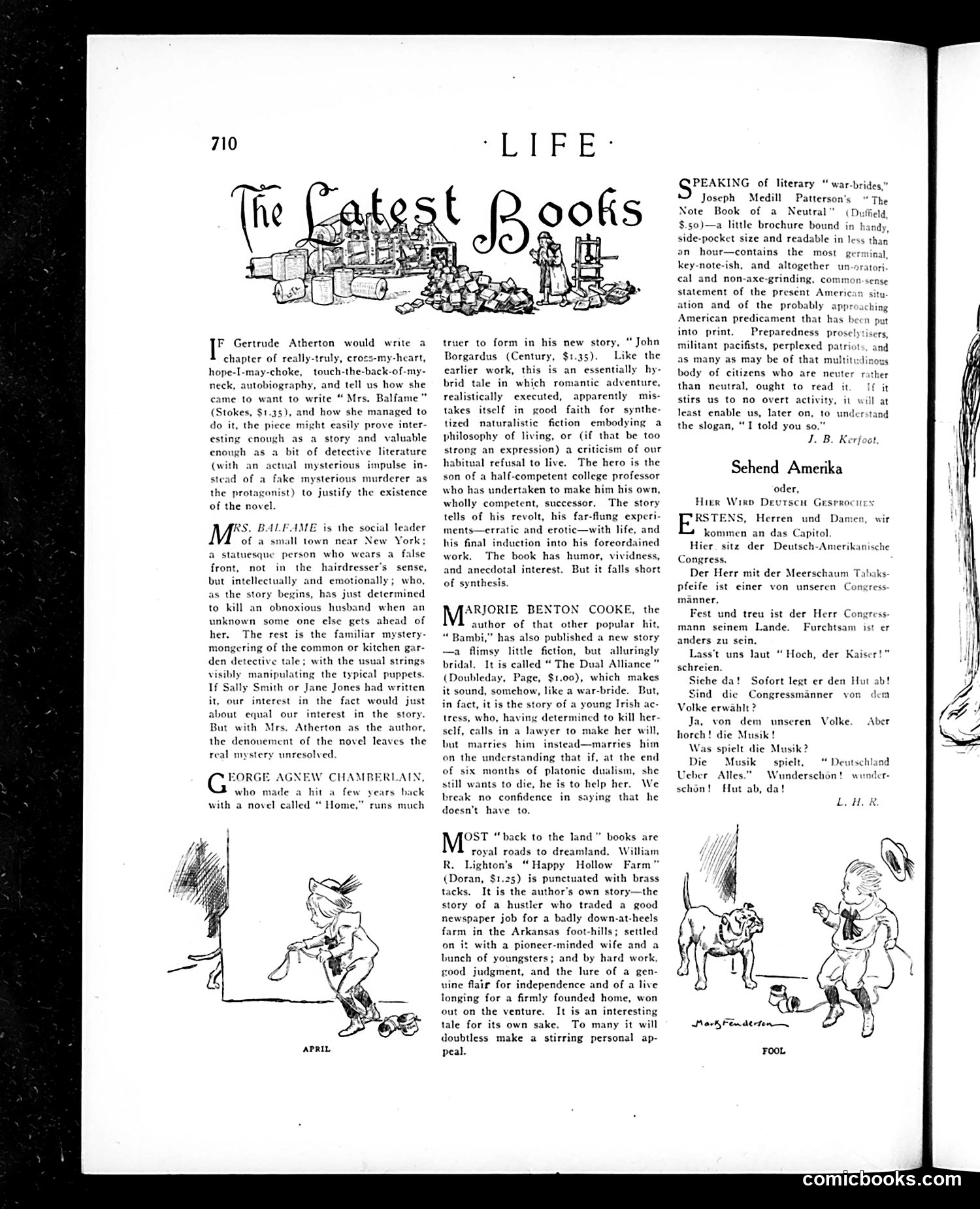
This page from *Life* magazine reviews recent books. The visible content consists entirely of **literary criticism**—there are no political cartoons here, despite the page header. The reviews critique contemporary novels by authors including Gertrude Atherton, George Agnew Chamberlain, and Marjorie Benton Cooke. The critic is notably **sarcastic**: Atherton's mystery novel is dismissed as derivative detective fiction that only gains value from her name; Chamberlain's work is praised but falls short of genuine synthesis; Cooke's romance is called "flimsy" despite its appeal. Two small **decorative illustrations** appear (labeled "April" and "Fool")—these are generic character sketches, not political commentary. The page's tone reflects *Life*'s satirical approach to culture: mocking pretension while acknowledging commercial success. References to "war-brides" as literary subjects suggest this was published during or shortly after World War I, when such themes were timely. The content is primarily for educated readers interested in contemporary American literature.
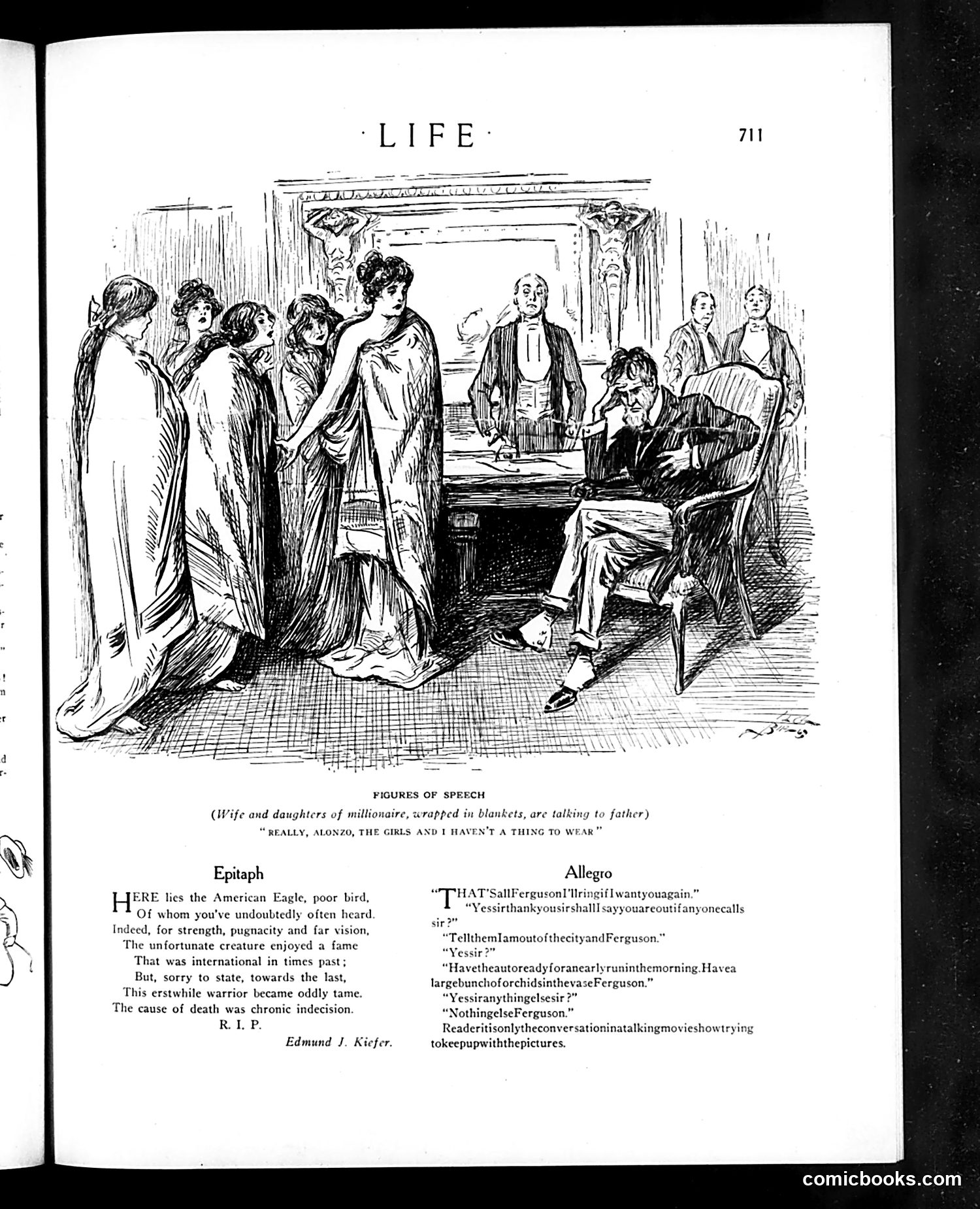
**The Main Cartoon:** "Figures of Speech" depicts a wealthy millionaire surrounded by his wife and daughters—all wrapped in blankets—complaining they have nothing to wear. The satire mocks the absurd complaints of the ultra-rich: despite obvious material excess, they perform poverty to justify more spending. This targets the disconnect between millionaires' actual wealth and their theatrical displays of need. **The "Epitaph":** A biting commentary on American foreign policy, portraying the nation as an "American Eagle" that has died from "chronic indecision." This likely references early 20th-century isolationism or hesitation regarding international military involvement—the bird once fierce and visionary has become "oddly tame." **The "Allegro":** A humorous piece about early talking pictures (talkies), satirizing their rapid, overlapping dialogue that audiences struggled to follow. The servant Ferguson delivers rapid-fire instructions in nearly unintelligible speech, mirroring the incomprehensible chatter audiences experienced in early sound films.
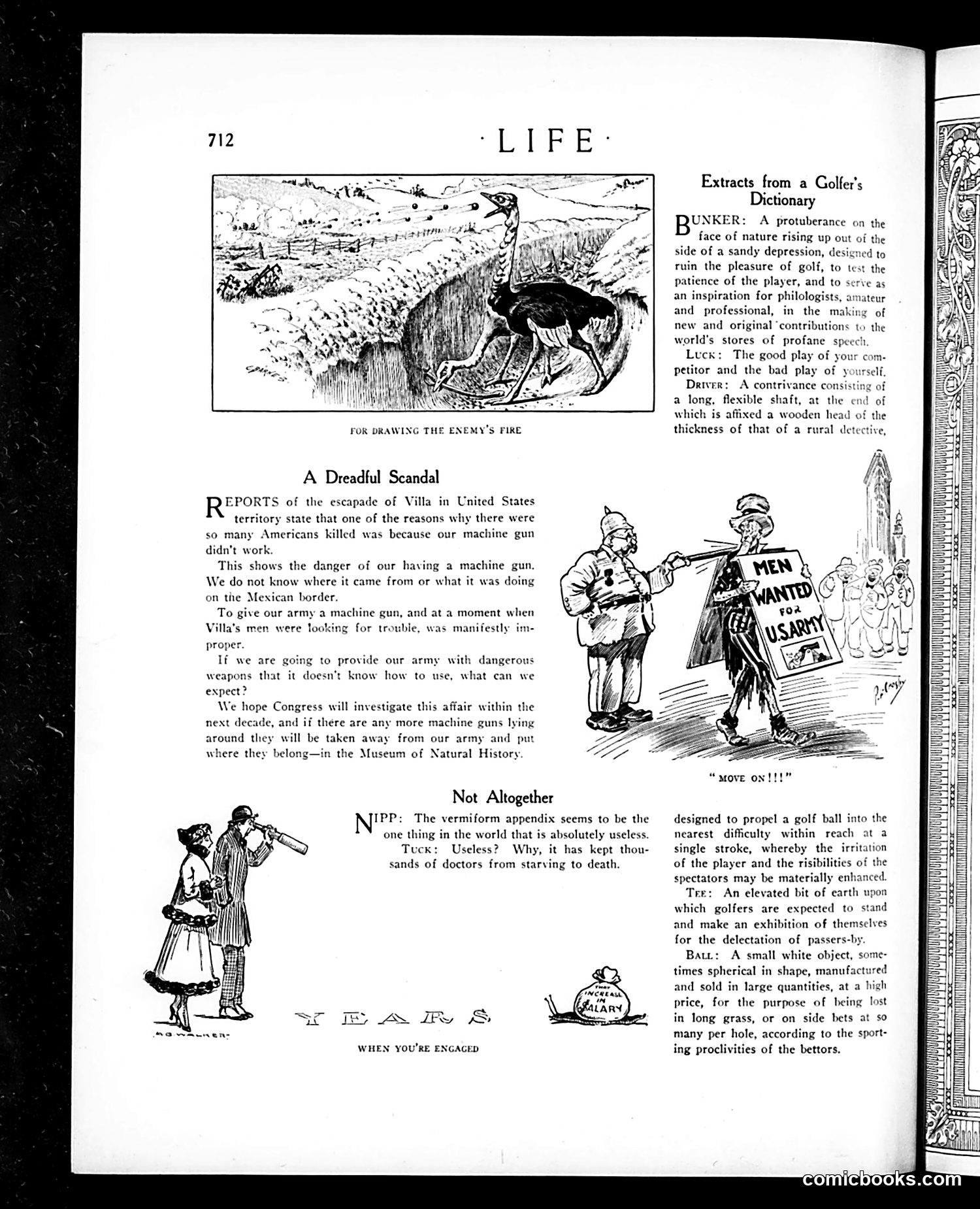
**"A Dreadful Scandal"** satirizes isolationist criticism of U.S. military intervention on the Mexican border. The text references Pancho Villa's 1916 raid into New Mexico, which killed Americans. Rather than blame Villa or advocate military preparedness, the piece ironically argues the *real* problem was the Army having a machine gun it didn't know how to operate—suggesting the critic's logic is absurdly backwards. The satire mocks those who opposed providing the military with modern weapons, implying their pacifism was dangerously naive. **"Not Altogether"** is a lighter humor piece. Two doctors debate the appendix's usefulness: one calls it useless; the other quips it's kept thousands of surgeons employed (by needing removal). This reflects early-20th-century medical debates over appendectomies. **The golf dictionary** and related cartoons are unrelated humor about golfing terminology and etiquette—the "Move On!!!" cartoon shows recruitment contrasting with social propriety.
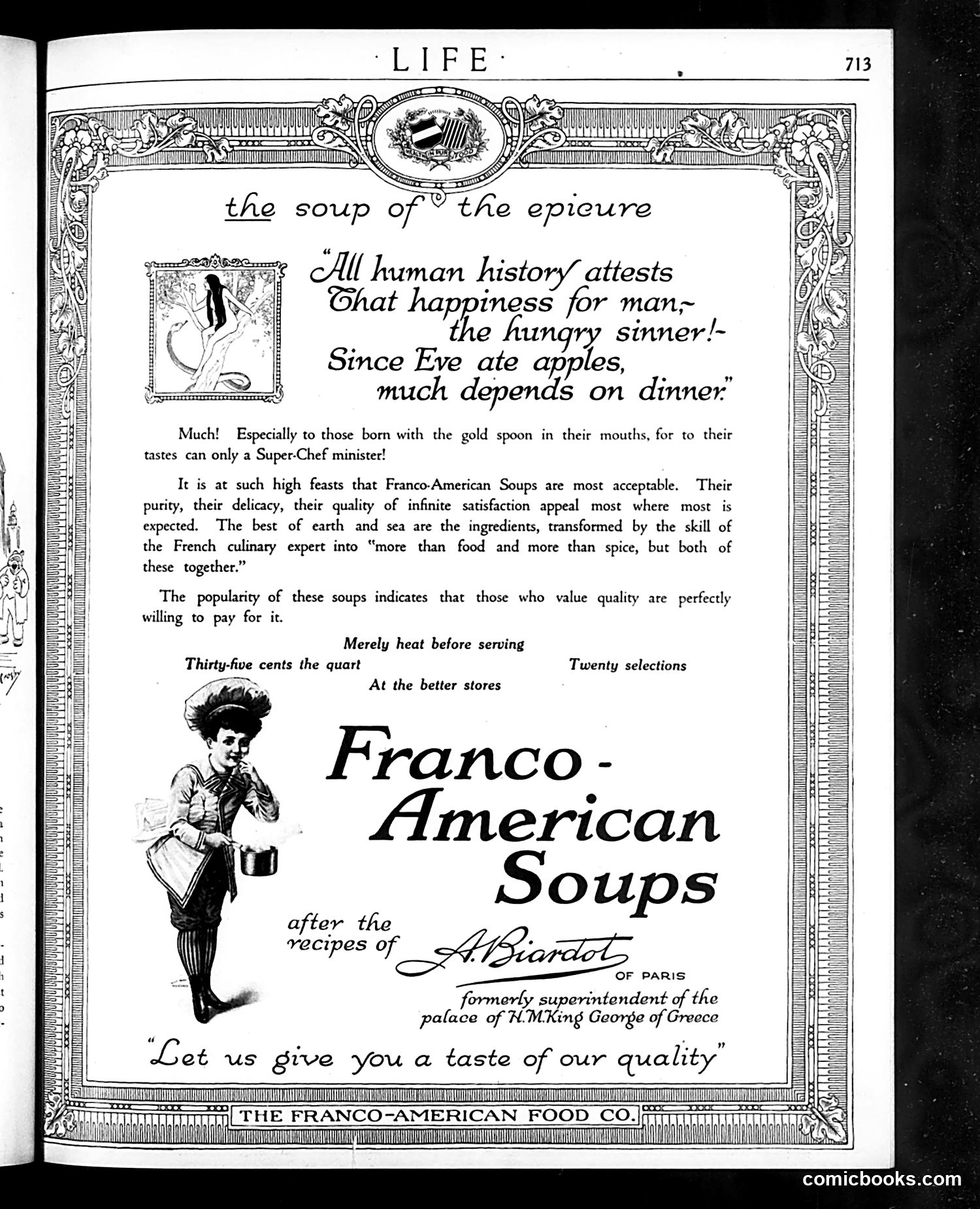
This is primarily a **product advertisement** rather than political satire. The page uses humor to market canned soup to wealthy consumers. The opening verse satirizes class distinctions—joking that happiness depends on dinner, and especially for those "born with the gold spoon in their mouths" (the wealthy). The ad claims Franco-American Soups meet the refined tastes of the elite, despite being affordable (35 cents per quart) and requiring only heating. The illustration shows a **chef or server** carrying soup, representing culinary expertise. The brand credits recipes to "A.Biardot of Paris," identified as formerly superintendent of the palace of King George of Greece—lending false prestige and European sophistication to a mass-market American product. The satire is gentle: it flatters wealthy consumers while suggesting that even the rich needn't cook from scratch. The joke is that quality soup comes pre-made, contradicting the implied snobbery about fine dining.
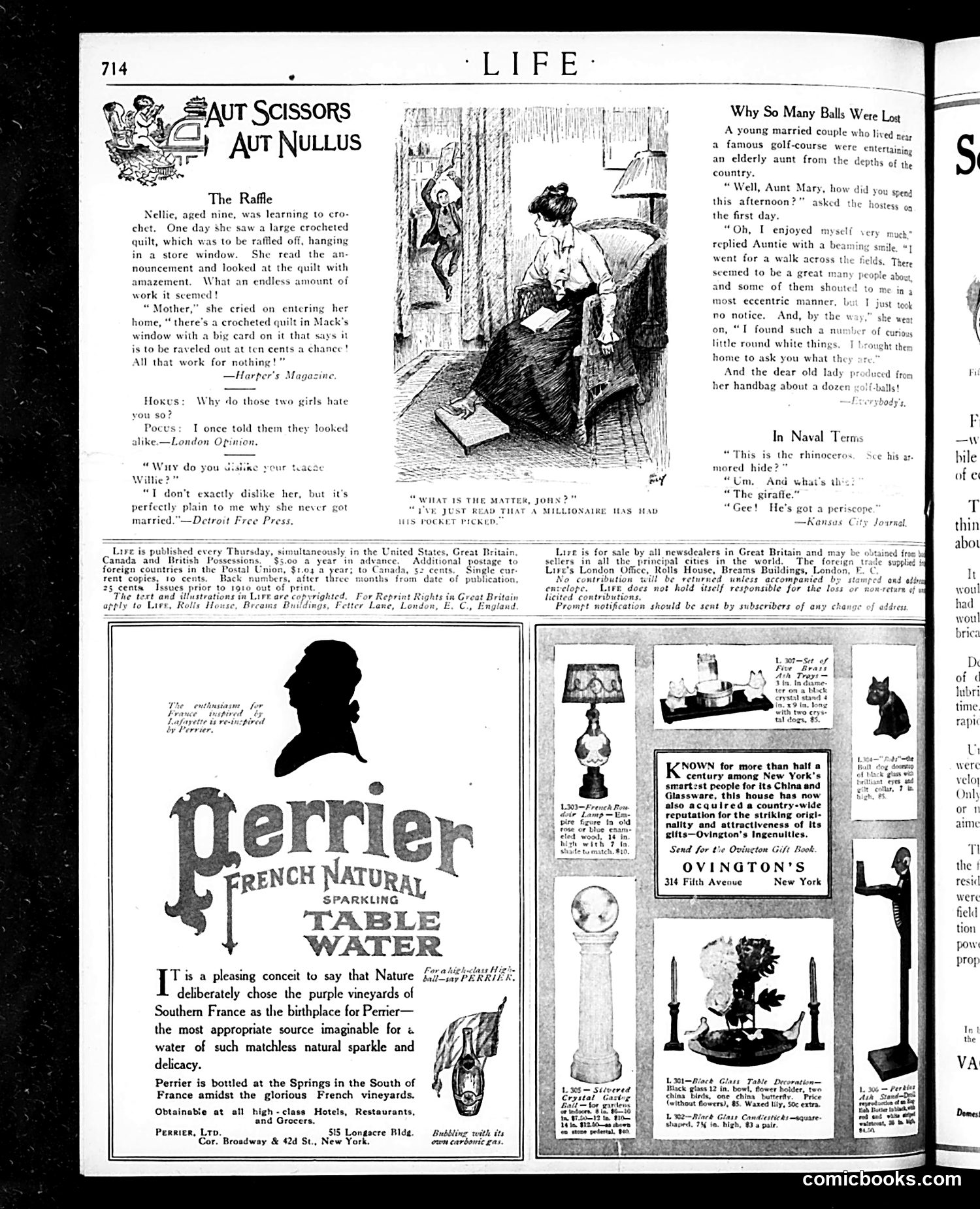
This page mixes humor with advertising. The main satirical content includes brief jokes under "Aut Scissors Aut Nullus": **"The Raffle"** mocks the naiveté of a nine-year-old girl who sees extensive handcrafted work being raffled for charity and expresses concern that the crafter receives nothing—missing the point that raffles are fundraising, not commercial transactions. **Other jokes** mock women's appearance and marital prospects with the casual misogyny typical of early 20th-century humor magazines. The page is otherwise dominated by **period advertisements**: Perrier sparkling water emphasizes its French origins and natural carbonation, while Ovington's showcases decorative home goods (lamps, candlesticks) marketed to wealthy New Yorkers as status symbols. The illustration of a girl reading appears unrelated to the surrounding text. No specific political references are evident—this is general-interest satirical content and luxury advertising for Life's affluent readership.
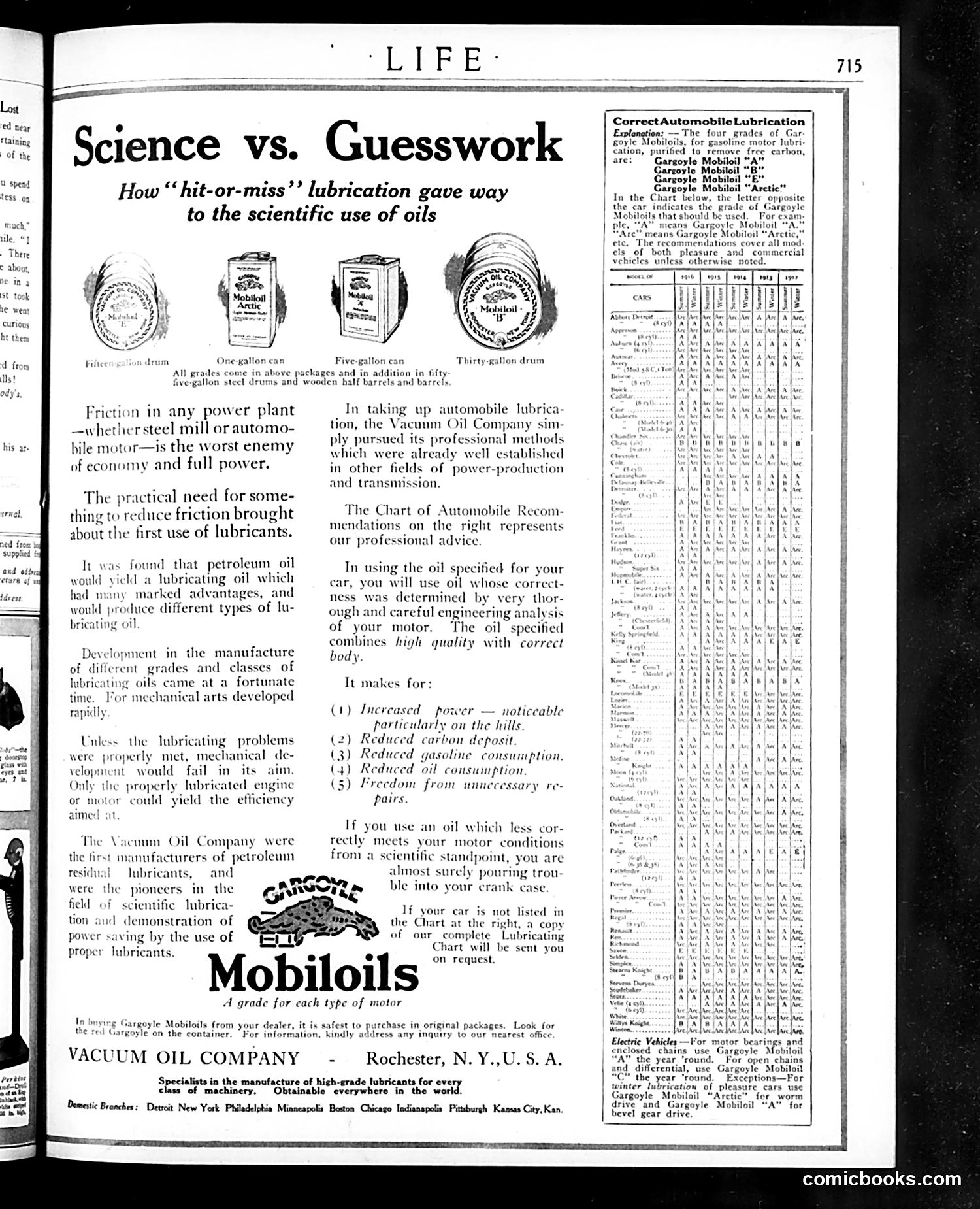
This is primarily a **Vacuum Oil Company advertisement**, not satire. The page contrasts "hit-or-miss" lubrication practices with scientific, engineered oil selection for automobiles. The cartoon imagery shows oil containers of increasing size, illustrating standardized grades. The central argument: proper lubrication requires professional engineering analysis, not guesswork. The company positions itself as the pioneer bringing "scientific" methodology to automobile maintenance. For modern readers: This reflects early automotive culture (likely 1920s-30s) when engine care was poorly standardized. Different cars required different oils, but consumers often used whatever was convenient—"pouring trouble into your crank case," as the text warns. Vacuum Oil Company marketed Gargoyle Mobiloils as the solution: a chart-based system matching specific oils to specific vehicles, backed by "thorough and careful engineering analysis." The satire is implicit: it mocks careless motorists while positioning the advertiser as the rational, scientific alternative. This was persuasive marketing in an era when automotive maintenance lacked clear standards.
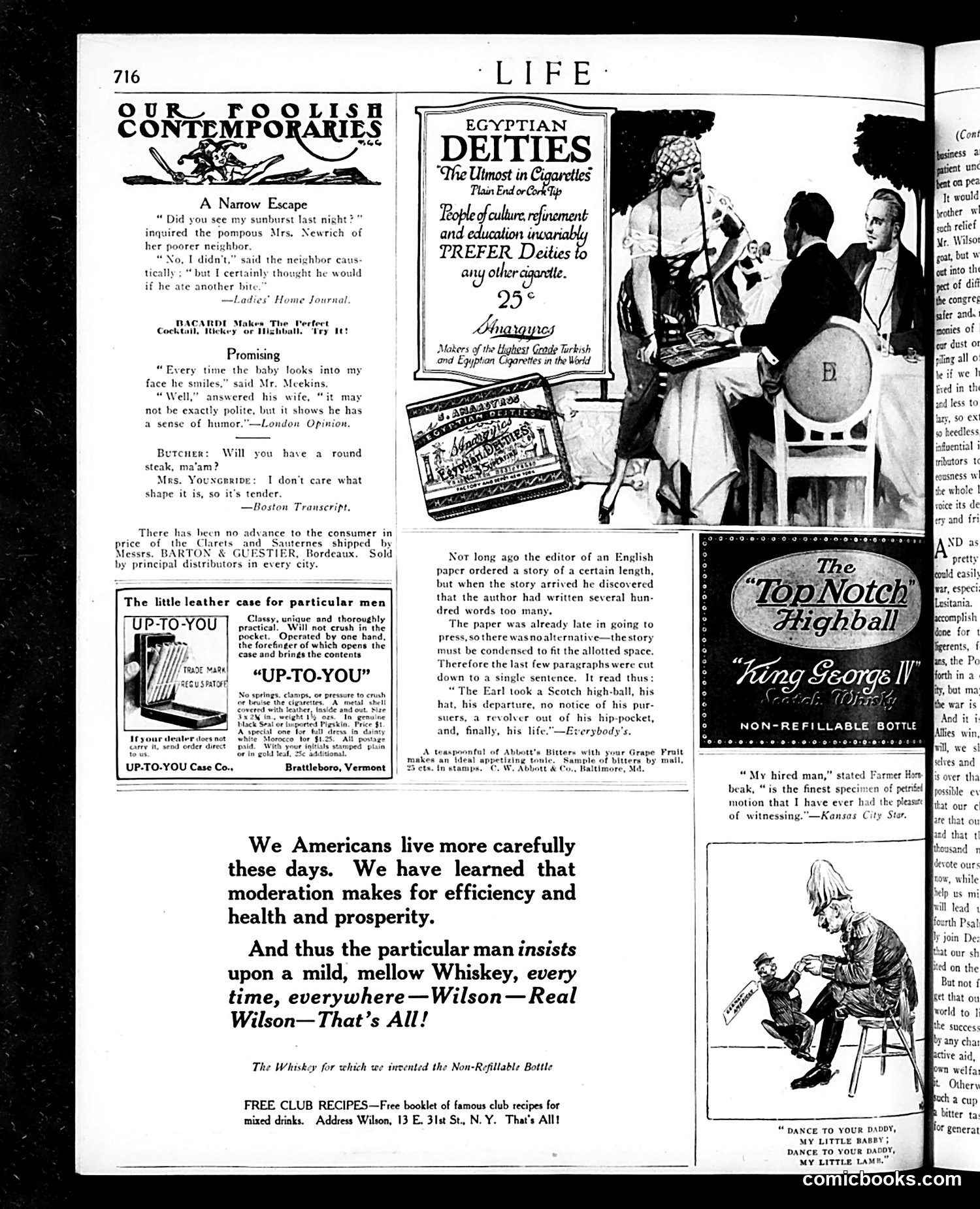
This page from *Life* magazine consists primarily of **short humorous anecdotes and advertisements** rather than political cartoons. The joke snippets mock social pretension and domestic life: - **"A Narrow Escape"** satirizes wealthy social climbers ("Mrs. Newrich") and their ostentatious displays - **"Promising"** plays on a baby smiling at his father as evidence of humor rather than politeness - **"Butcher" exchange** jokes about a wife's indifference to steak shape if it's tender The advertisements include cigarettes ("Egyptian Deities"), whiskey (Wilson brand, emphasizing moderation as patriotic duty), and a leather case product. **Notable context**: The Wilson whiskey ad explicitly connects drinking moderation to American efficiency and prosperity—likely post-Prohibition messaging (Prohibition ended 1933). The ad promotes the "Non-Refillable Bottle," a sales innovation. The page contains no obvious political satire or caricature of specific figures. It's primarily lighthearted domestic humor typical of 1920s-30s magazine content, mixed with consumer advertising.
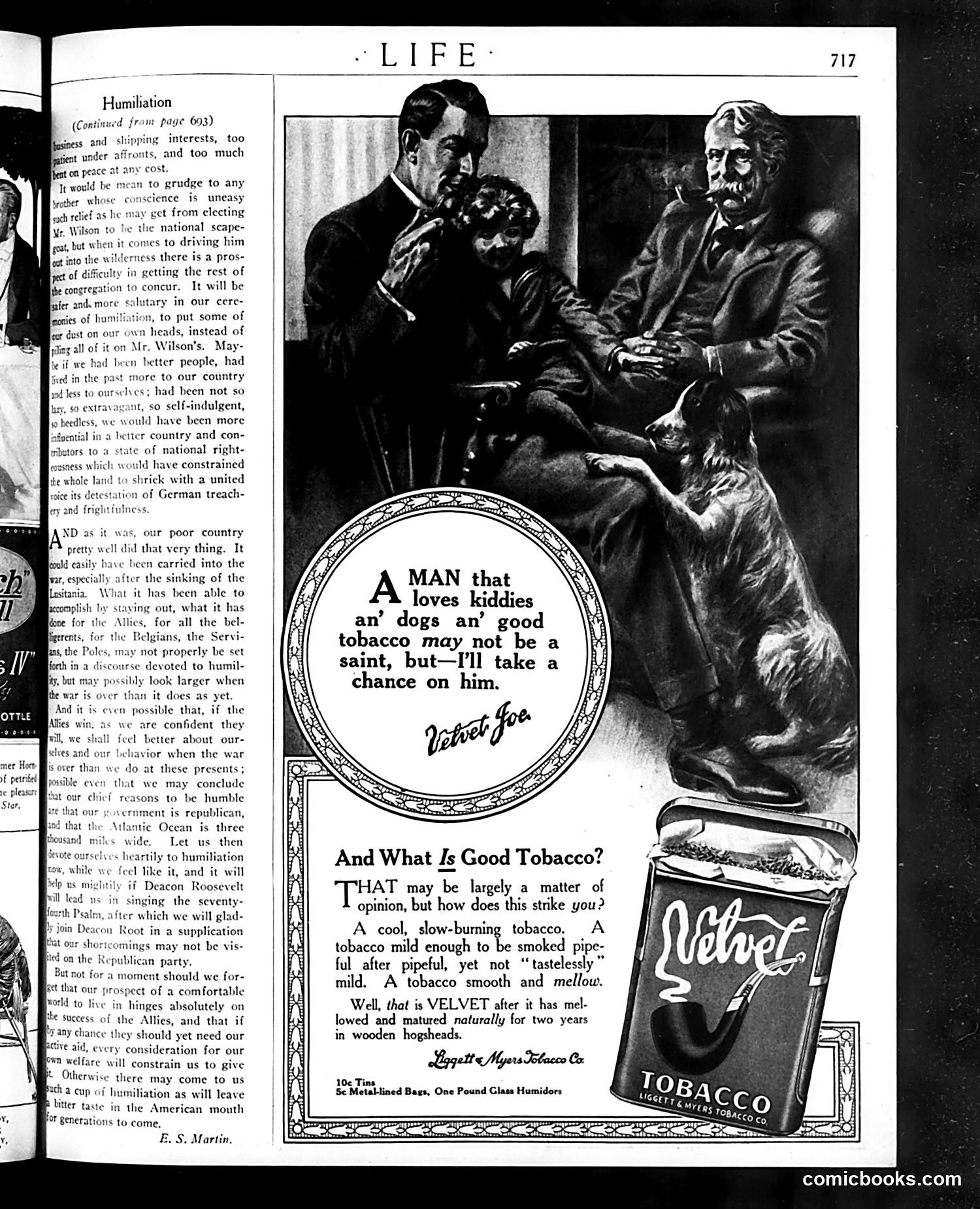
This page combines editorial commentary with advertising. The text discusses American humility during World War I, arguing the nation should acknowledge its own shortcomings rather than judge President Wilson exclusively. The author (E.S. Martin) suggests America's support for the Allied cause depends on self-reflection and moral clarity. The advertisement below features "Velvet Joe," a character endorsing Velvet tobacco. The slogan—"A man that loves kiddies an' dogs an' good tobacco may not be a saint, but—I'll take a chance on him"—uses folksy charm to market cigarettes by associating the product with likable masculine virtues. This reflects early 20th-century advertising that hadn't yet acknowledged tobacco's health dangers. The ad emphasizes the tobacco's mild, mellow qualities and two-year aging process as marks of quality.
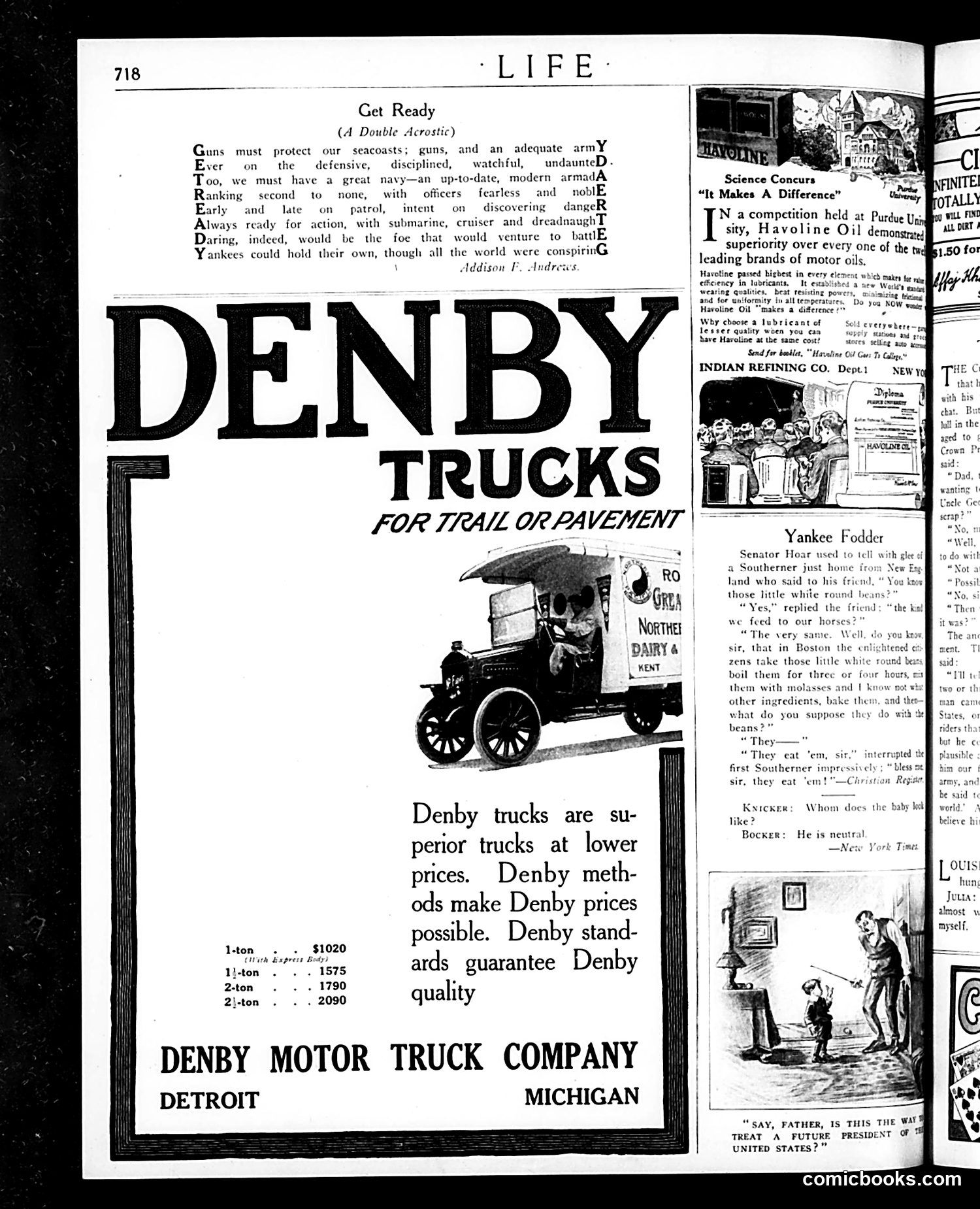
This page combines military preparedness advocacy with commercial advertising, typical of early 20th-century American magazines. **"Get Ready" Acrostic Poem**: The acrostic spells "GUARDED NAVY" vertically, promoting American military buildup—particularly naval strength. Written by Addison F. Andrews, it reflects pre-WWI or interwar anxieties about national defense, emphasizing submarines, cruisers, and dreadnoughts. The repeated emphasis on readiness and protecting "seacoasts" suggests concern about foreign threats. **Denby Trucks Advertisement**: A straightforward industrial ad for Detroit-based truck manufacturer, emphasizing affordability and quality across multiple tonnage classes ($1020-$2090). **Other Content**: The page also includes Havoline Oil advertising (competing motor oil brands), a "Yankee Fodder" humor piece about regional differences in bean preparation, and what appears to be a political cartoon about treating "a future president" (unclear which child or context is referenced). The page reflects early 20th-century American concerns: naval competition anxiety, industrial manufacturing pride, and regional/sectional humor.
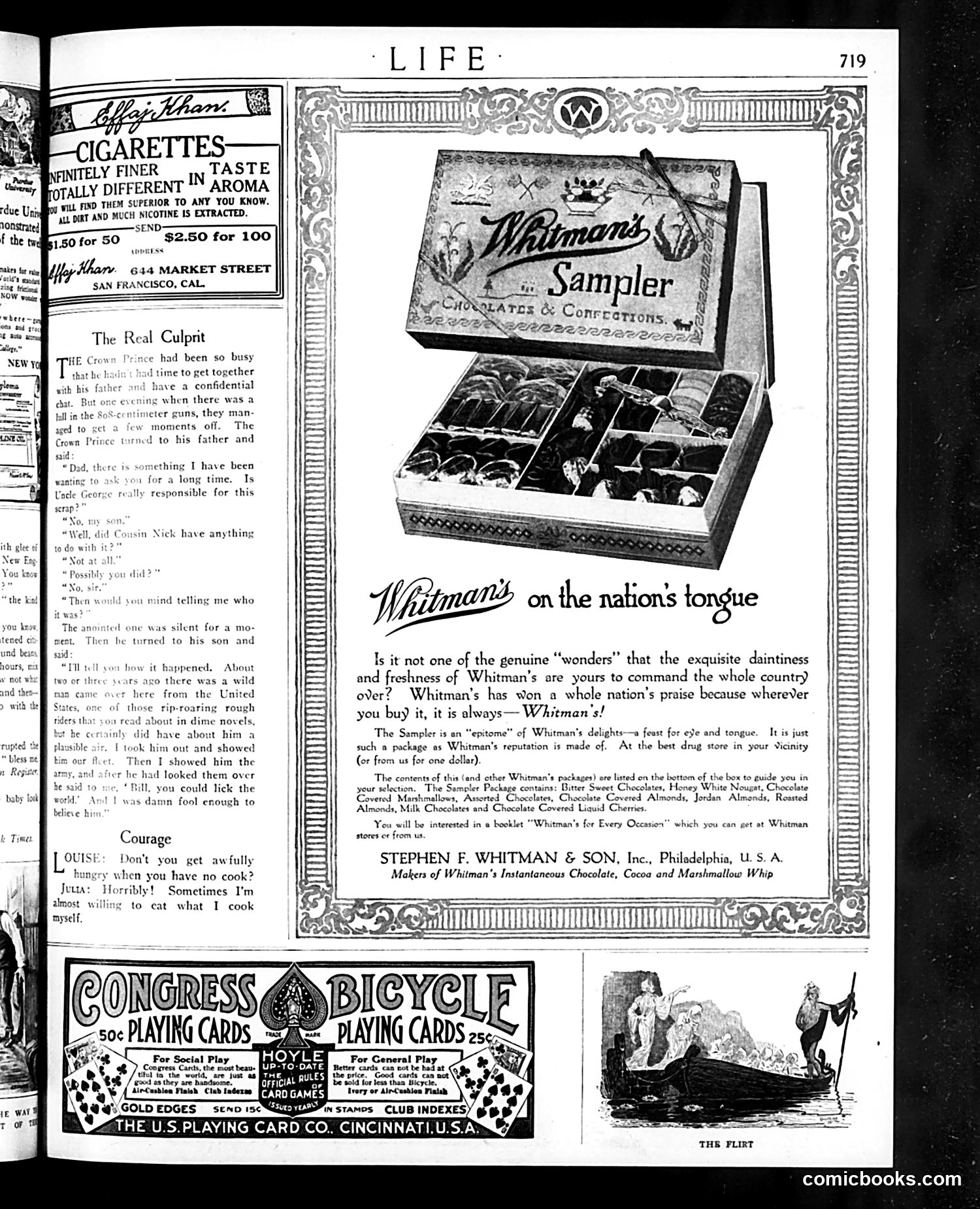
This page consists primarily of **advertisements** rather than editorial cartoons. The main content includes: 1. **Whitman's Chocolates ad**: Features a product image of the "Sampler" box with text emphasizing the brand's national reputation and quality. The phrase "on the nation's tongue" uses period advertising language typical of early 20th-century marketing. 2. **Supporting stories/text**: "The Real Culprit" appears to be a short humorous piece about a Crown Prince and his father, seemingly unrelated to the ads—typical filler content in magazines of this era. 3. **Minor ads**: Include cigarettes (Wy Tharv brand), Congress Bicycle playing cards, and what appears to be "The Flirt" illustration at bottom right. **No political satire is evident on this page.** It's a standard advertising and entertainment page from *Life* magazine, reflecting consumer goods marketing from approximately the 1910s-1920s era.
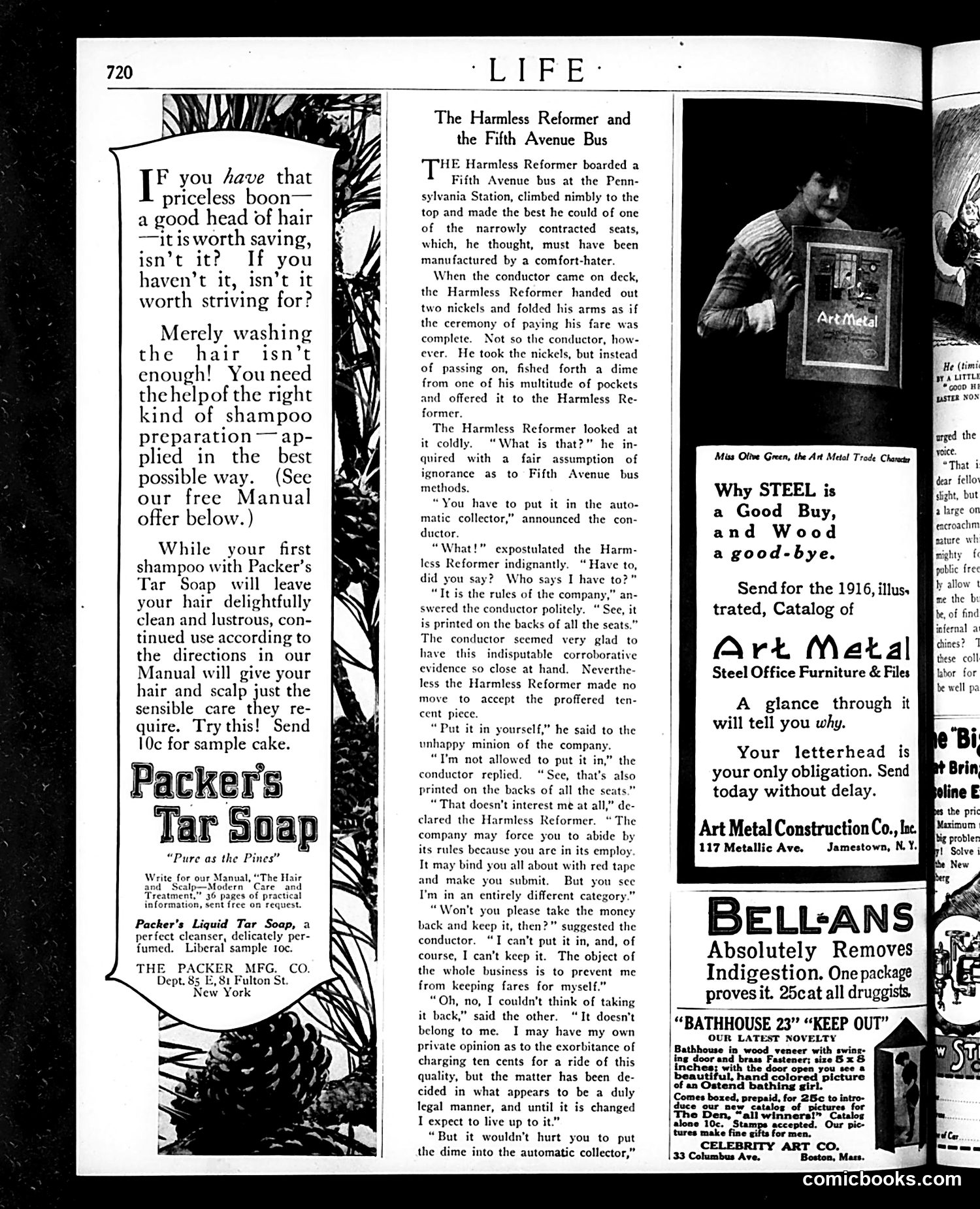
This satirical story mocks a self-righteous reformer who objects to newly installed automatic fare collectors on a Fifth Avenue bus. When the conductor offers him a dime to insert into the machine (the required new system), the reformer refuses on principle—not because he opposes the rule, but because he philosophically objects to *being told* what to do. The satire targets "harmless" reform types: those who voice moral objections to systems they dislike but refuse to actually *act* against them. The reformer won't use the machine himself, but also won't prevent the conductor from doing so, leaving the conductor helpless. He's critiquing the company's rules while passively complying—essentially performing righteousness without substance. The joke is that his "harmless" reform amounts to performative principle: he gets to feel superior without actually changing anything.
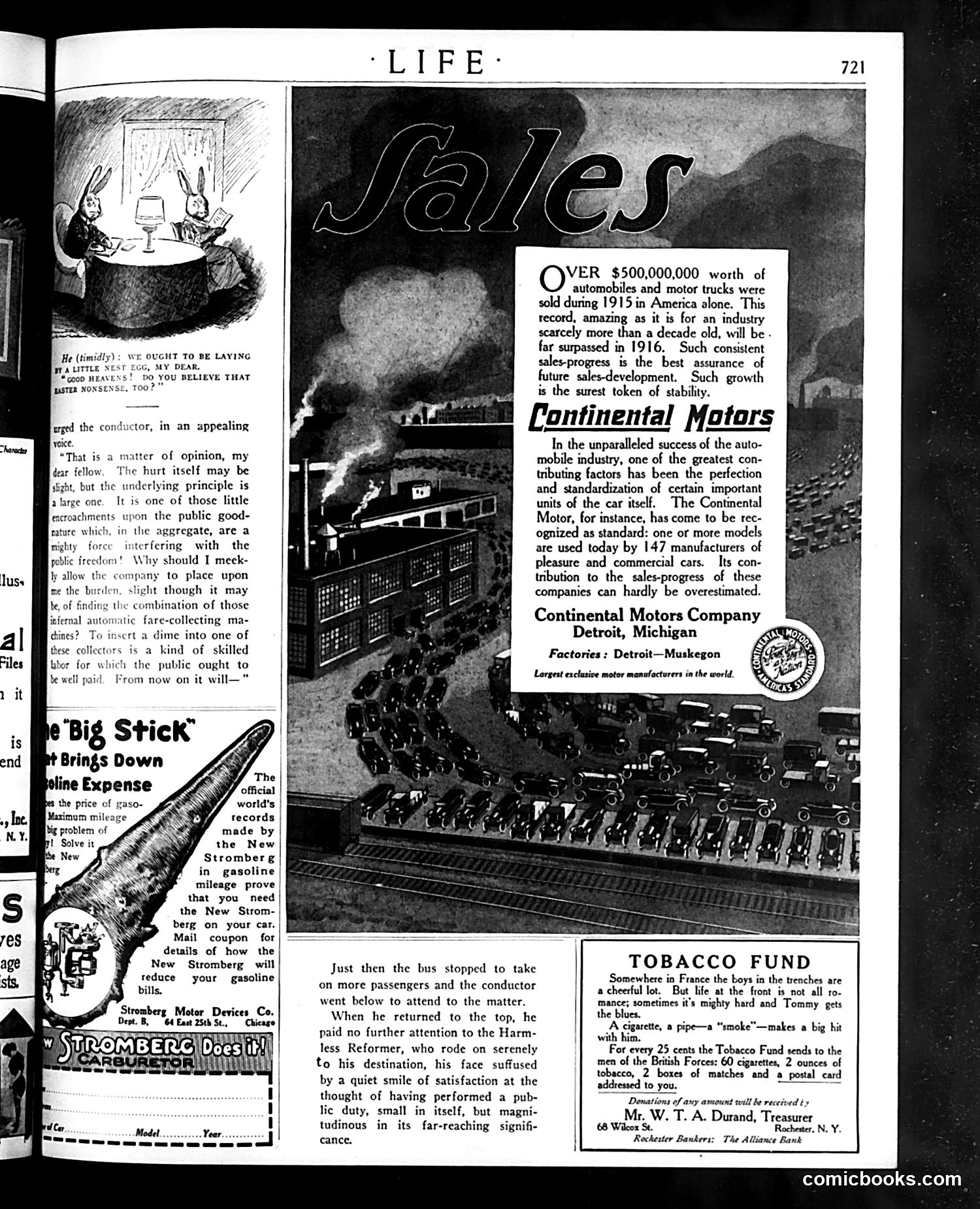
This page is primarily **advertising**, not editorial content. The dominant ad is for **Continental Motors**, emphasizing that their standardized engines power 147 automobile manufacturers—a sales pitch framed around the booming auto industry (over $500 million in 1915 sales alone). The small cartoon at top-left depicts two figures at a table (likely rabbits or similar creatures) discussing whether they should be "laying a little nest egg." The joke appears to satirize financial prudence or cautious saving, though the full context is cut off. Other ads include the **Stromberg carburetor** (reducing gasoline costs) and a **Tobacco Fund** charity soliciting donations to send cigarettes and matches to British soldiers in World War I trenches—described as morale-boosters for homesick troops. A brief narrative story about a "Harmless Reformer" on a bus discusses public duty and fare collection, though its point remains unclear without full text. The page captures early 1916 advertising targeting middle-class consumers during wartime.
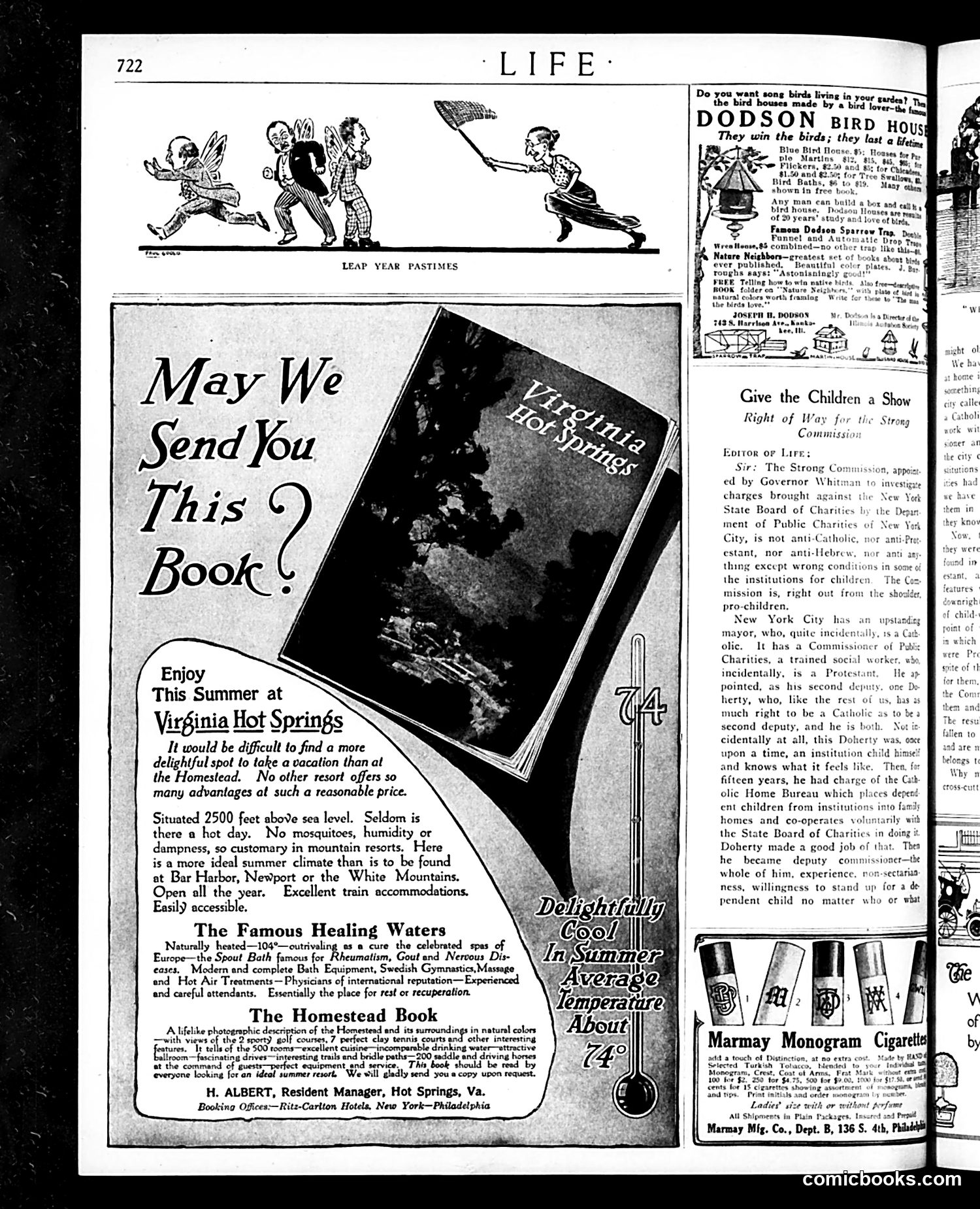
The top cartoon depicts **Leap Year pastimes**—showing figures in increasingly energetic poses chasing or pursuing each other with a net. This references the tradition that during leap years (occurring every four years), women were socially permitted to propose to men, reversing conventional gender roles. The cartoon humorously illustrates this temporary role reversal through active, playful pursuit, capturing the social novelty and comedic potential of women taking the romantic initiative. The page is otherwise dominated by **advertisements**: a large Virginia Hot Springs resort ad and smaller ads for bird houses, cigarettes, and charitable organizations. The editorial content discusses a "Strong Commission" investigating children's institutions in New York—appearing to defend against accusations of sectarian bias in charitable work.
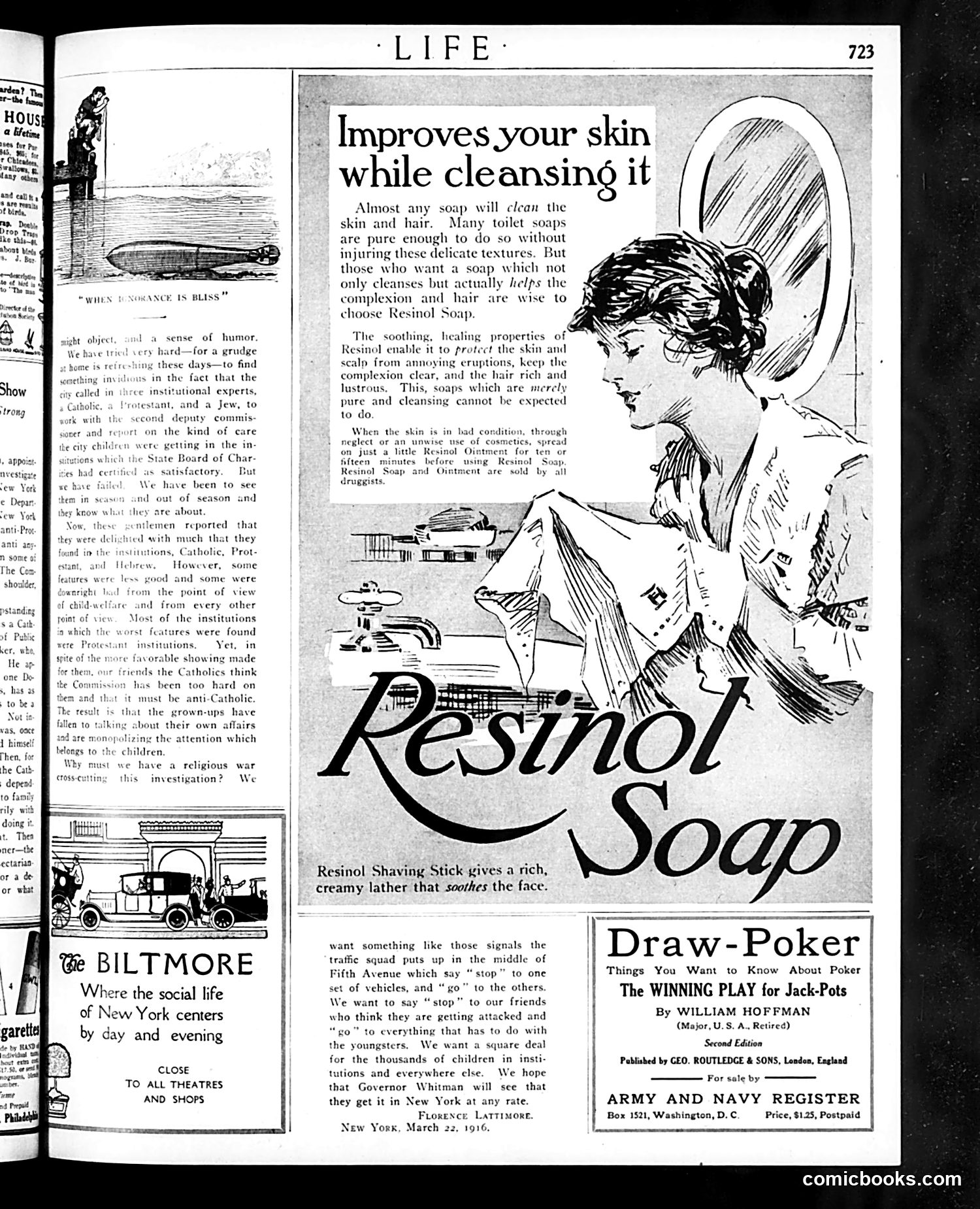
This page is primarily **advertising**, not political satire. The dominant content is a Resinol Soap advertisement featuring an illustrated woman applying soap, with text claiming the product both cleanses and improves skin condition—a common beauty product pitch of the era. The left column contains a brief editorial piece titled "When Ignorance is Bliss," discussing religious institutions (Catholic, Protestant, Hebrew) caring for New York City children. The writer expresses frustration that institutional leaders seem defensive about criticism, arguing that oversight serves children's welfare. The bottom includes an advertisement for the Biltmore hotel and a classified notice for a poker instruction book. **Modern context:** This reflects early-20th-century Progressive Era concerns about child welfare and institutional accountability, before modern regulatory agencies existed. The religious institution tension reflects ongoing Catholic-Protestant tensions in American society.
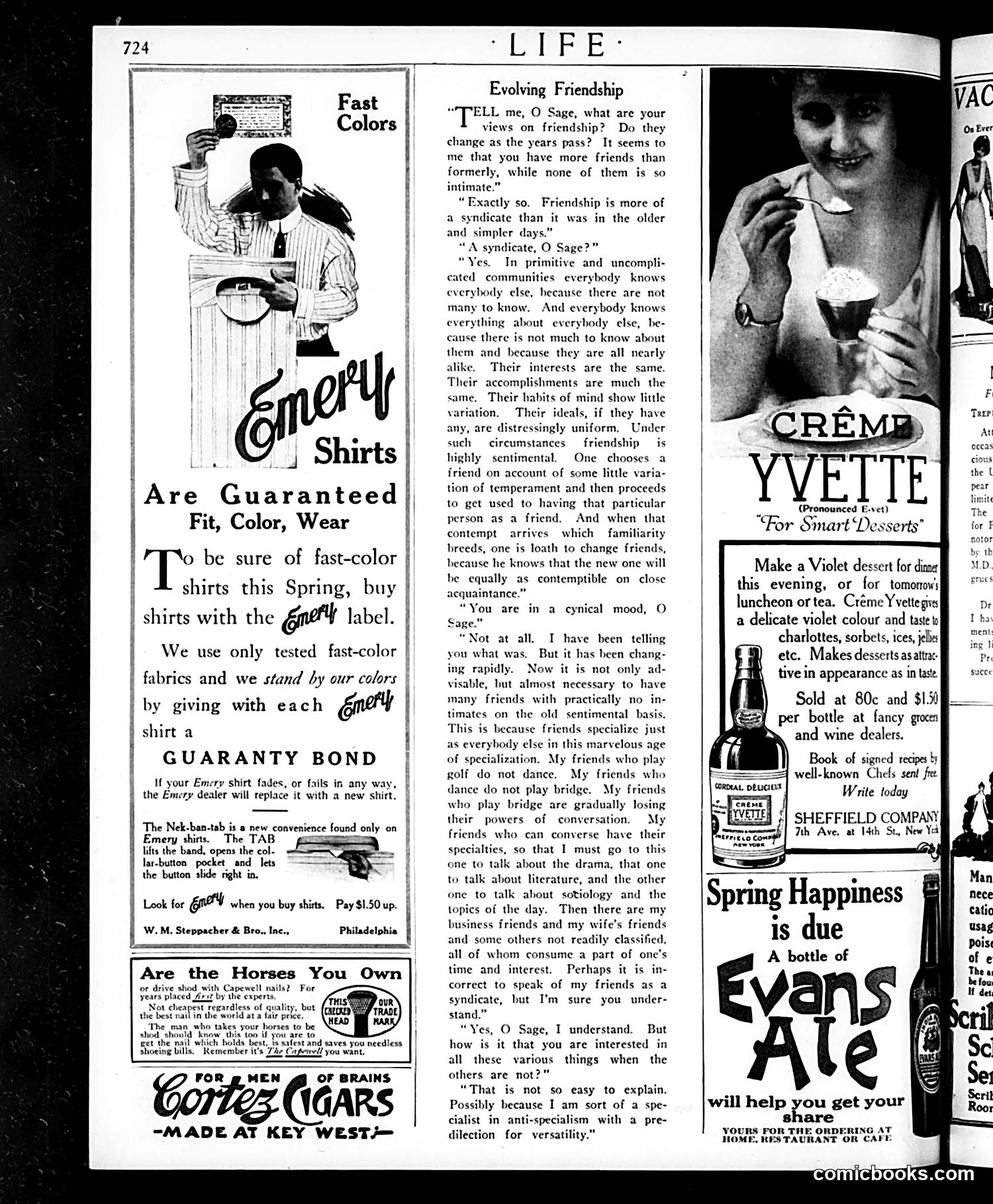
This page presents a dialogue between "O Sage" and an unnamed questioner about how friendship has changed with modern society. The Sage argues that in primitive communities, friendships were intensely sentimental because everyone was similar and people had few social options. In contemporary times, however, friendship has become "a syndicate"—a transactional arrangement rather than deep intimacy. Modern specialization means friends have narrow expertise or interests: some golf, some dance, some discuss drama or sociology. Rather than maintaining one intimate confidant, people now cultivate multiple specialized friendships serving specific purposes—business contacts, spouse's friends, hobby companions. The Sage acknowledges seeming cynical but frames this as descriptive rather than judgmental. The satire gently mocks modern life's fragmentation and the loss of well-rounded social connection, while accepting its inevitability. The surrounding advertisements for shirts, ale, and dessert liqueur are unrelated commercial content typical of period magazines.
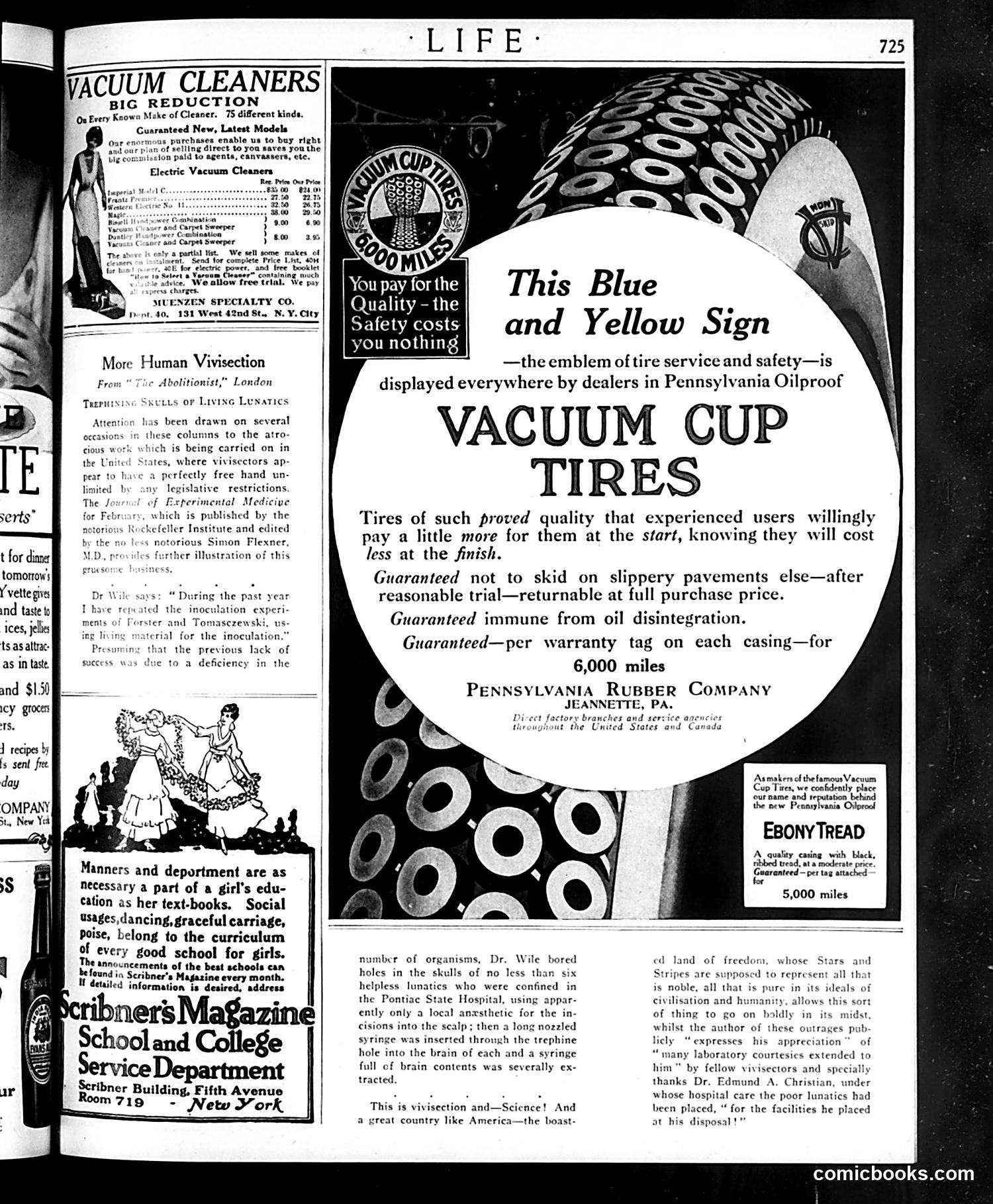
This page mixes commercial advertising with social critique. The dominant content is a **Vacuum Cup Tires advertisement** from Pennsylvania Rubber Company—a straightforward product pitch using period marketing language about quality and guaranteed mileage. However, the left side contains a serious editorial piece titled "More Human Vivisection," attacking medical experimentation on human subjects. It references Dr. Wile's controversial work at Pontiac State Hospital, where he allegedly drilled holes in the skulls of institutionalized patients and extracted brain tissue for research—described here as cruel exploitation of vulnerable "lunatics" who couldn't consent. The piece invokes the Rockefeller Institute and appears to criticize American medical ethics as unregulated and inhumane compared to European standards ("The Abolitionist" from London). The juxtaposition is jarring: **consumer product advertising adjacent to accusations of medical atrocities**—likely intentional editorial commentary on American society's moral contradictions, where progress and profit coexist with exploitation of the powerless.
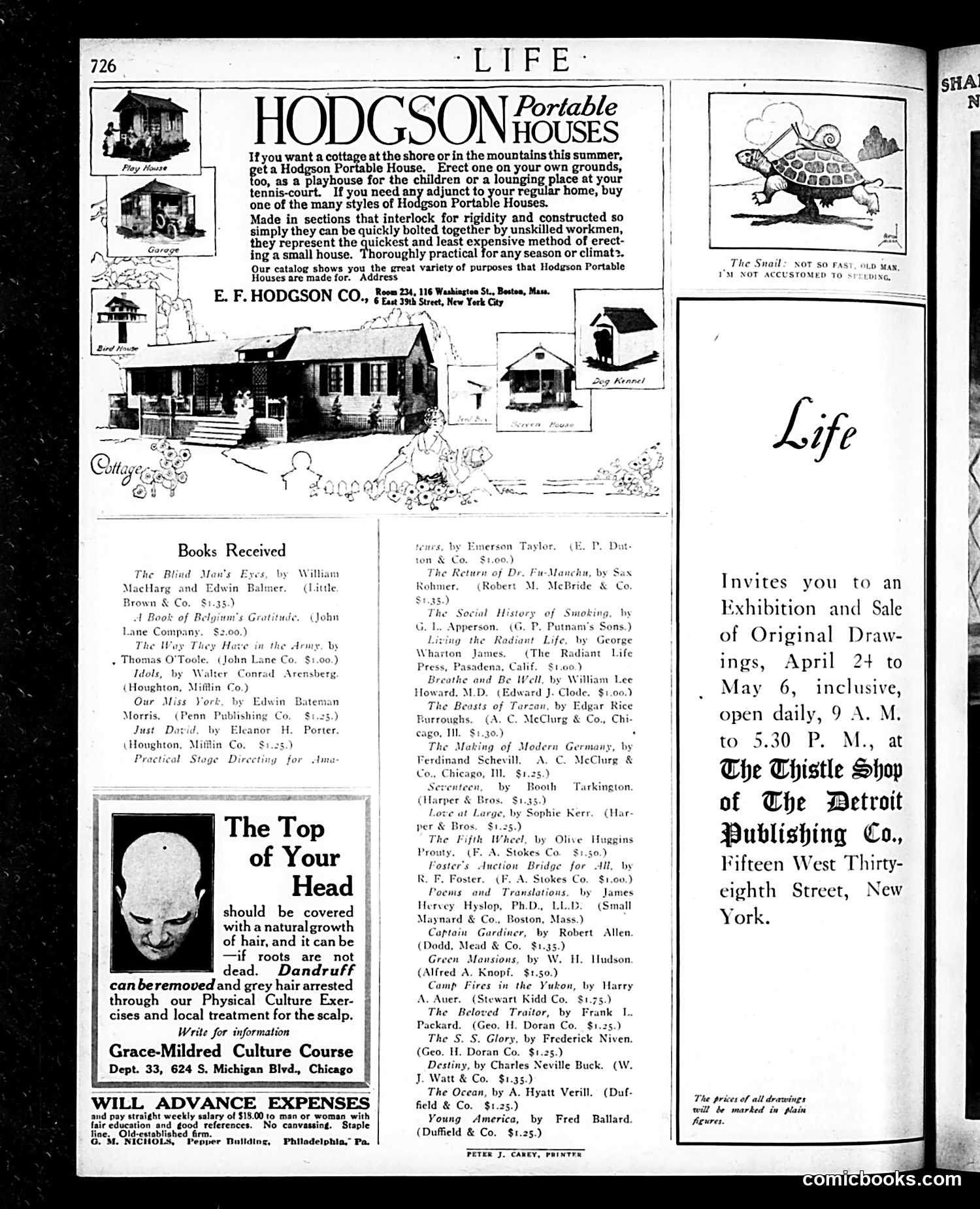
This page is primarily **advertising and book reviews**, not political satire. The main content features: **Hodgson Portable Houses**: An advertisement for prefabricated, sectional homes marketed as affordable, quick-to-assemble cottages for summer homes or children's playhouses. The appeal was practicality and speed of construction by unskilled workers. **The cartoon** (upper right) shows "The Snail" telling "Old Max" he's "not accustomed to sprinting"—a mild joke about a snail's naturally slow pace, unrelated to the advertisements. **Books Received section**: Lists recently published books including adventure fiction (*The Beasts of Tarzan*), mystery (*The Return of Dr. Fu-Manchu*), and literary works—typical of Life's book review feature. Other ads include a hair-loss treatment and employment opportunity. This is **not a satirical or political cartoon page**—it's a standard magazine layout mixing consumer advertising with cultural content.