
Life, 1916-04-13 · page 27 of 46
Life — April 13, 1916 — page 27: what you’re looking at
What you’re looking at
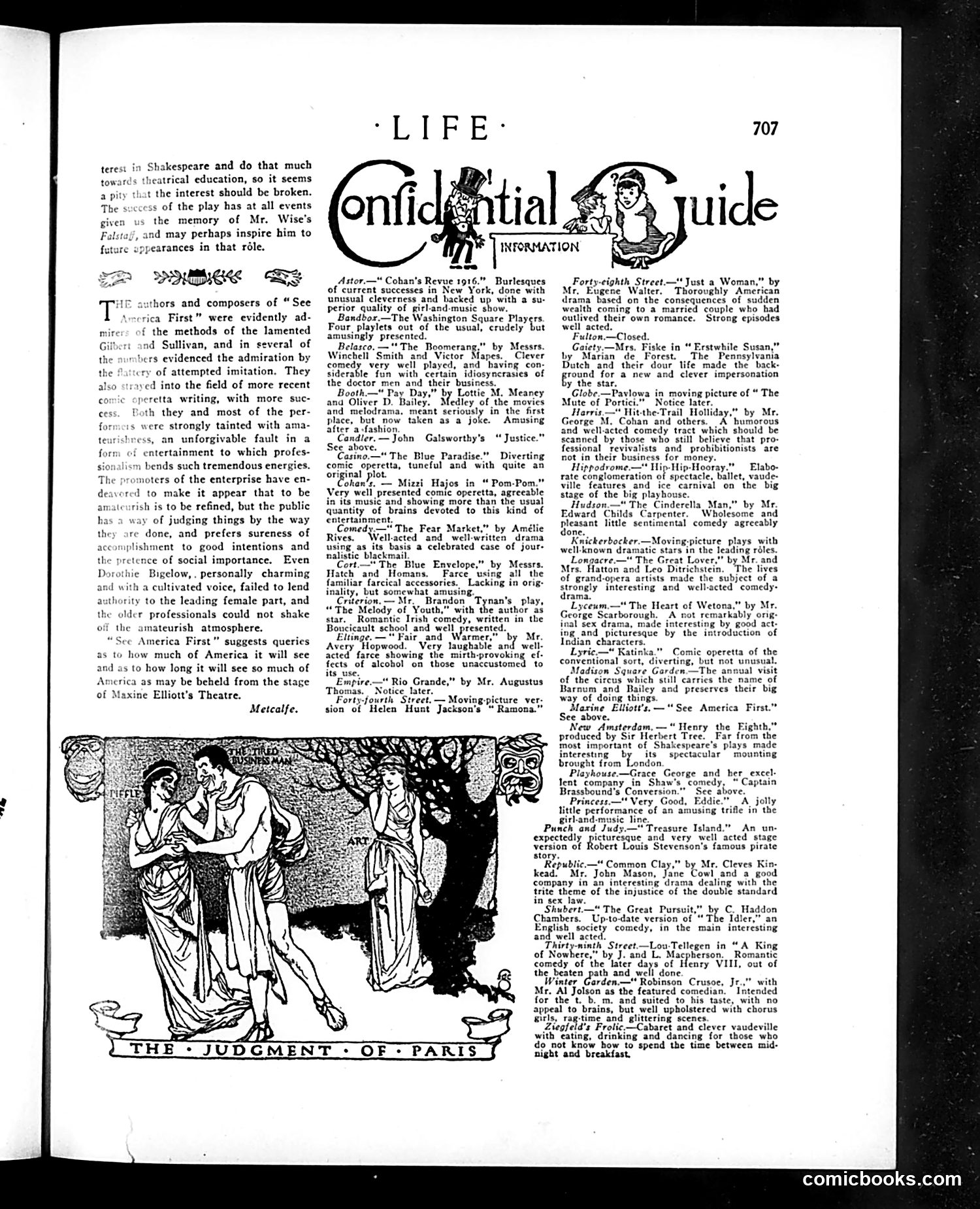
This page is primarily a **theater review column** titled "Confidential Guide," not a political cartoon. It contains capsule reviews of Broadway productions from approximately 1916. The only illustration is "The Judgment of Paris," a classical mythological scene depicting the famous moment from Greek mythology where Paris must choose among three goddesses. This appears decorative rather than satirical—a common artistic flourish in period magazines. The reviews themselves offer sharp theatrical criticism. The critic, identified as Metcalfe, dismisses "See America First" for its amateurish quality despite its subject matter, and critiques various productions for lacking originality or relying on tired theatrical conventions. References to Gilbert and Sullivan suggest the critic valued well-crafted operetta over inferior imitations. The column functions as contemporary entertainment journalism—opinionated guidance for theatergoers—rather than political satire.
📄 Transcribed text from this page (OCR, searchable)
Machine-transcribed from the original scan — historical spelling and the odd misread are preserved.
terest in Shakespeare and do that much towards theatrical education, so it seems a pity that the interest should be broken. The seccess of the play has at all events the memory of Mr. Wise’s ind may perhaps inspire him to oppearances in that rdle. DIMBRE Qe = authors and composers of “See scrica First” were evidently ad- { the methods of the lamented nd Sullivan, and in several of rs evidenced the admiration by cry of attempted imitation. They rayed into the field of more recent peretta writing, with more suc- Both they and most of the per- 1s were strongly tainted with ama- ess, an unforgivable fault in a entertainment to which profes- ism bends such tremendous energies. oters of the enterprise have en- ored to make it appear that to be rish is to be refined, but the public of judging things by the way re done, and prefers sureness of shment to good intentions and pretence of social importance, Even tie Bigelow, personally charming given ity to the leading female part, and older professionals could not shake the amateurish atmosphere. “See America First” suggests queries as to how much of America it will see and as to how long it will see so much of crica as may be beheld from the stage i Maxine Elliott's Theatre. Metcalfe. Astor.— Cohan's Revue 1916." Burlesques of current successes in New York, done with unusual cleverness and backed up’ with a su- perior quality of girl-and-music show. Bandbor.—The Washington Square Players. Four playlets out of the usual, crudely but amusingly presented. Belasco. —"" The Boomerang.” by Messrs. Winchell Smith and Victor Mapes. Clever comedy very well played, and having con- siderable fun with certain idiosyncrasies of the doctor men and their business. Booth.—" Pay Day,” by Lottie \ and Oliver D. Bailey: Mediey.of the movies and melodrama, meant seriously in the first place, but now taken as a joke. Amusing after a-fashion. John “The Blue Paradise.” Diverting comic operetta, tuneful and with quite an original plot. ‘ohan's, — Mizzi Hajos in “ Pom-Pom.” Very well presented comic operetta, agreeable in its music and showing more than the usual quantity of brains devoted to this kind of entertainment, Comedy —" The Fear Market,” by Amélie Rives. Well-acted and well-written drama using as its basis a celebrated case of jour- nalistic blackmail. Cort—" The Blue Envelope,” by Messrs. Hatch and Homans. Farce using all the familiar farcical accessories. Lacking in orig- inality, but somewhat amusing. Criterion. — Mr, Brandon ‘Tynan’s play, “The Melody of Youth,” with the author as star. Romantic Irish comedy, written in the Boucicault schoo! and well presented. Eltinge. —"* and Warmer,” by Mr. Avery Hopwood. Very laughable and well: acted farce showing the mirth-provoking ef- fects of alcohol on those unaccustomed to its use. use |. Meaney Galsworthy’s “* Justice.” Rio Grande,” by Mr. Augustus be ‘otice later. Forts-fourth Street. — Moving-pi sion of Helen Hunt Jackson's “ Ramona.” SEVIS Ad SON AG i x ae % Forty-eighth Street-—" Just a Woman,” by Mr. Eugene Walter, Thoroughly American drama based on the consequences of sudden wealth coming to a married couple who had outlived their own romance. Strong episodes well acted. Fulton.—Closed. Gaiety —Mrs, Fiske in “Erstwhile Susan,” by Marian de. Forest. The Pennsylvania Dutch and their dour life made the back- fround for a new and clever impersonation y the star. Globe.—Pavlowa in moving picture of “ The Mute of Por Notice later. Harris —" Hitthe-Trail Holliday,” by Mr. George M. Cohan and others. A‘ humorous and well-acted comedy tract which should be scanned by those who still believe that pro- fessional revivalists and probibitionists are not in their business for money. Hippodrome.—"' Hip-Hip-Hooray.” Elabo- rate conglomeration of spectacle, ballet, vaude- ville features and ice carnival on the big stage of the playhouse. Hudson. — Cinderella, Man,” by Mr. Edward Childs Carpenter, Wholesome and pleasant little sentimental comedy agreeably done. Knickerbocker.—Moving-picture plays with well-known dramatic stars in the leading rdles. Longacre.—" The Great Lover,” by Mr. and Mrs. Hatton and Leo Ditrichstein. ‘The lives of grand-opera artists made the subject of a strongly interesting and well-acted comedy+ drama. Lyceum.—" The Heart of Wetona,” by Mr. George Scarborough. not remarkably orig: nal sex drama, made interesting by good act- ing and picturesque by the introduction of Indian characters. Lyric.—" Katinka." Comic operetta of the conventional sort, diverting, but not unusual. Madison Square Garden—The annual visit of the circus which still carries the name of Barnum and Bailey and preserves their big way of doing things. Marine Elliott's. —“See America First.” See above. New Amsterdam.—" Henry the Fighth, produced by Sir Herbert Tree. Far from the most important of Shakespeare's plays made interesting by its spectacular mounting brought from London. Playhouse-—Grace George and her_excel- Tent company in Shaw's comedy, “Captain Brassbound's Conversion.” See abov; Princess.—"" Very Good, Eddie little performance of an amusing girland-music line. Punch and Judy.—" Treasure Island.” expectedly picturesque and very well acted stage version of ‘obert Louis Stevenson's famous pirate story. kead. Republic.— Common Clay,” by, Mr. Cleves Kins Mr. John Mason, Jane Cowl and a good company in an interesting drama dealing with the trite theme of the injustice of the double standard in sex law. Chambers. Up-to-date version of English, society comedy, in the main interesting an of Nowhere,” by J. and L. Macpherson. comedy. of the later days of i the beaten path and well Mr. Al Jolson as the featured comedian. well acted. Thirty-ninth Street.—Lou-Tellegen in “A King Romantic fenry VIII, out of done. ‘arden.—" Robinson Crusoe, Jr.,"" with Winter Intended for the t. b. m. and suited to his taste, with no appeal to brains, but well upholstered with chorus girls, ral ittering scenes. Ziegfeld's Frolic—Cabaret and clever vaudeville with eating, drinking and dancing for those who do not know how to spend the time between mid- night and breakfast, comicbooks.com