
Life, 1916-04-13 · page 30 of 46
Life — April 13, 1916 — page 30: what you’re looking at
What you’re looking at
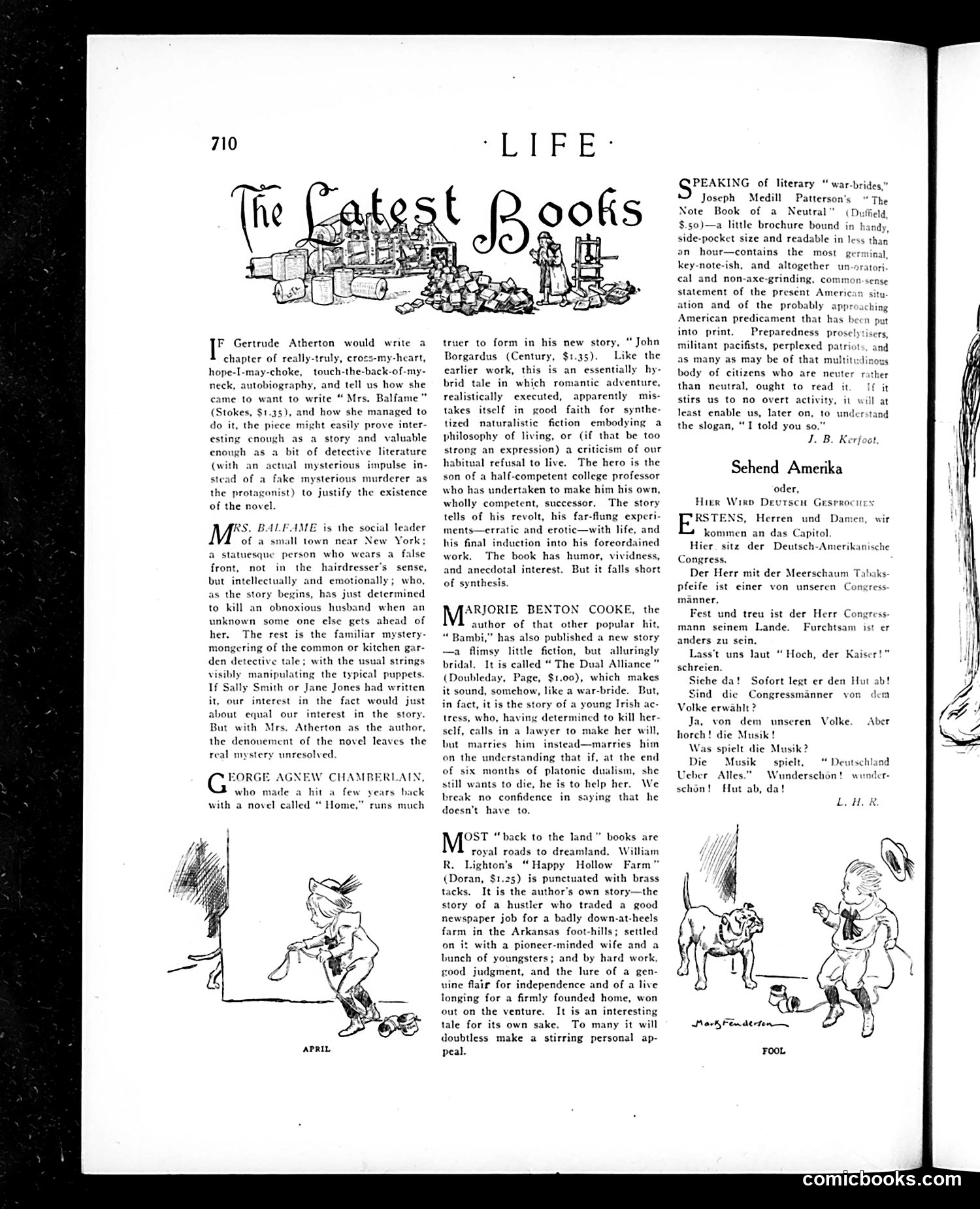
This page from *Life* magazine reviews recent books. The visible content consists entirely of **literary criticism**—there are no political cartoons here, despite the page header. The reviews critique contemporary novels by authors including Gertrude Atherton, George Agnew Chamberlain, and Marjorie Benton Cooke. The critic is notably **sarcastic**: Atherton's mystery novel is dismissed as derivative detective fiction that only gains value from her name; Chamberlain's work is praised but falls short of genuine synthesis; Cooke's romance is called "flimsy" despite its appeal. Two small **decorative illustrations** appear (labeled "April" and "Fool")—these are generic character sketches, not political commentary. The page's tone reflects *Life*'s satirical approach to culture: mocking pretension while acknowledging commercial success. References to "war-brides" as literary subjects suggest this was published during or shortly after World War I, when such themes were timely. The content is primarily for educated readers interested in contemporary American literature.
📄 Transcribed text from this page (OCR, searchable)
Machine-transcribed from the original scan — historical spelling and the odd misread are preserved.
F Gertrude Atherton would chapter of really-truly, crocs-my-heart, hope-I-may-choke, touch-the-back-of-my- neck, autobiography, and tell us how she came to want to write “ Mrs, Balfame” (Stokes, $1.35), and how she managed to do it, the piece might easily prove inter- esting cnough as a story and valuable enough of detective literature (with an actual mysterious impulse in- stead of a fake mysterious murderer as the protagonist) to justify the existence of the novel. write as a bit RS. BALFAME is the social leader of a Yor! a statuesque who wears a false front, not in the hairdresser’s sense, but intellectually and emotionally ; who, as the story begins, has just determined to kill an obnoxious husband when an unknown some one else gets ahead of her. The rest is the familiar mystery- mongering of the common or kitchen gar- den detective tale; with the usual strings visibly manipulating the typical puppets. If Sally Smith or Jane Jones had written it, our interest in the fact would just about equal our interest in the story. But with Mrs. Atherton as the author, the denovement of the novel leaves the real mystery unresolved. ill town near New person EORGE AGNEW CHAMBERLAIN, who made with a novel called a hit a few years back “Home,” runs much truer to form in his new story, “John Borgardus (Century, $1.35). Like the earlier work, this is an essentially brid tale in which romantic adventure, realistically executed, apparently mis- takes itself in good faith for synthe- tized naturalistic fiction embodying a philosophy of living, or (if that be too strong an expression) a criticism of our habitual refusal to live. The hero is the son of a half-competent college professor who has undertaken to make him his own, wholly competent, successor. The story tells of his revolt, his far-flung experi- ments—erratic and erotic—with life, and his final induction into his foreordained work, The book has humor, vividness, and anecdotal interest. But it falls short of synthesis. ARJORIE BENTON COOKE, the author of that other popular hit, “ Bambi,” has also published a new story flimsy little fiction, but alluringly bridal. It is called “ The Dual Alliance” (Doubleday, Page, $1.00), which makes it sound, somehow, like a war-bride. But, in fact, it is the story of a young Irish ac- tress, who, having determined to kill her- self, calls in a lawyer to make her will, but marries instead—marries him on the understanding that if, at the end of six months of platonic dualism, she We break no confidence in saying that he —a him still wants to die, he is to help her. doesn't have to. OST “back to the land” books are royal roads to dreamland. William R. Lighton’s “Happy Hollow Farm (Doran, $1.25) is punctuated with brass tacks, It is the author's own story—the story of a hustler who traded a good newspaper job for a badly down-at-heels farm in the Arkansas foot-hills; settled on it with a pioneer-minded wife and a bunch of youngsters; and by hard work, good judgment, and the lure of a gen- uine flair for independence and of a live longing for a firmly founded home, won out on the venture. It is an interesting tale for its own sake. To many it will doubtless make a stirring personal ap- peal. PEAKING of literary “ war-brides,” Joseph Medill Patterson's“ The Note Book of a Neutral” (Duifield, $.50)—a little brochure bound in han side-pocket size and readable in less than an hour—contains the most germinal key-note-ish, and altogether un-oratori cal and non-axe-grinding, common-sense statement of the present American situ- ation and of the probably approaching American predicament that has been into print. Preparedness prosely militant pacifists, perplexed p: as many as may be of that multitid body of citizens who are neuter rather than neutral, ought to read it stirs us to no overt activity, it will at least enable us, later on, to understand the slogan, “I told you so.” J. B. Kerfoot. Sehend Amerika oder, Hier Wikp Deutscn Gesrrocirs ES NS, Herren und Damen, wir kommen an das Capitol Hier der Congress, Der Herr mit der Meerschaum Tabaks pfeife ist einer von unseren Congress manner, Fest und trea ist der Herr Congress mann seinem Lande. Furchtsam ist er anders zu sein. Lass't uns laut “Hoch, der Kais schreien. Siche da! Sofort legt er den Hut ab! Sind die Congressmanner dem Volke erwahit? Ja, von unseren Volke horch! die Musik ! Was spielt die Musik? Die Musik spielt, —“ Deutschl Ueber Alles.” Wunderschén! schon! Hut ab, da! isers, sitz Deutsch-Amerikanische von dem Aber wine hack Fen derten FOOL comicbooks.com