
Life, 1916-04-13 · page 26 of 46
Life — April 13, 1916 — page 26: what you’re looking at
What you’re looking at
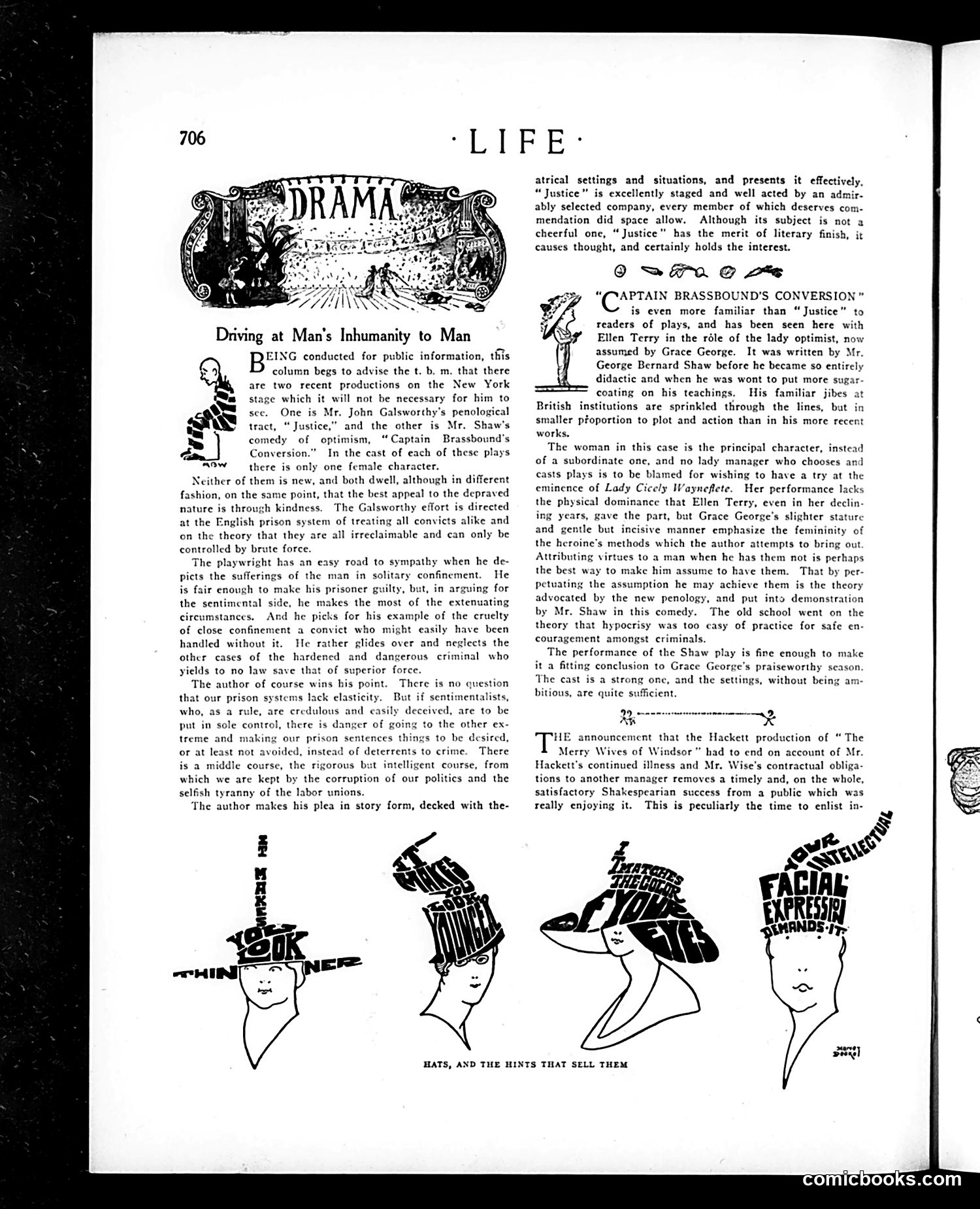
This page reviews two contemporary Broadway plays: John Galsworthy's "Justice" and George Bernard Shaw's "Captain Brassbound's Conversion." The critic argues both plays make sentimental pleas for reform—Galsworthy advocating for humane prison reform, Shaw promoting optimism and kindness as solutions to human problems. The reviewer is skeptical of their extremism, warning that sentimentalists might overcorrect by making prison too lenient or by naively assuming people will improve if treated well. The bottom illustration shows four stylized women's heads wearing elaborate hats, captioned "Hats, and the Hints That Sell Them"—likely fashion advertising or commentary on women's fashion trends. The column's tone reflects Progressive-era debate: praising the plays' theatrical merit while criticizing their idealistic reform messages as potentially dangerous if implemented without "rigorous but intelligent" practical balance.
📄 Transcribed text from this page (OCR, searchable)
Machine-transcribed from the original scan — historical spelling and the odd misread are preserved.
~LIFE- Tee INS Dnving at Man's Inhumanity to Man EING conducted for public information, this column begs to advise the t. b, m. that there are two recent productions on the New York stage which it will not be necessary for him to sce. One is Mr. John Galsworthy’s penological tract, “Justice,” and the other is Mr. Shaw's comedy of optimism, “Captain Brassbound’s Conversion.” In the cast of each of these plays there only one female character. Neither of them is new, and both dwell, although in different fashion, on the same point, that the best appeal to the depraved nature is throu kindness. The Galsworthy effort is directed at the English prison system of treating all convicts alike and on the theory that they are all irreclaimable and can only be controlled by brute force. The playwright has an easy road to sympathy when he de- picts the sufferings of the man in solitary confinement. He is fair enough to make his prisoner guilty, but, in arguing for the sentimental side, he makes the most of the extenuating circumstances. And he picks for his example of the cruelty of close confinement a convict who might easily have been handled without it. He rather glides over and neglects the other cases of the hardened and dangerous criminal who yields to no law save that of superior force. The author of course wins his point. There is no question that our prison systems lack elasticity. But if sentimentalists, who, as a rule, are credulous and easily deceived, are to be put in sole control, there is danger of going to the other ex- treme and making our prison sentences things to be desired, or at least not avoided, instead of deterrents to crime. There is a middle course, the rigorous but intelligent course, from which we are kept by the corruption of our politics and the selfish tyranny of the labor unions. The author makes his plea in story form, decked with the- atrical settings and situations, and presents it effectively, “ Justice” is excellently staged and well acted by an admi ably selected company, every member of which deserves com- mendation did space allow. Although its subject is not a cheerful one, “Justice” has the merit of literary finish, it causes thought, and certainly holds the interest. O&K. oO ZH** “(P-APTAIN BRASSBOUND'S CONVERSION” is even more familiar than “Justice” to readers of plays, and has been seen here with Ellen Terry in the réle of the lady optimist, now assumed by Grace George. It was written by Mr. George Bernard Shaw before he became so entirely didactic and when he was wont to put more sugar- coating on his teachings. His familiar jibes at British institutions are sprinkled through the lines, but in smaller pfoportion to plot and action than in his more recent work: The woman in this case is the principal character, instead of a subordinate one, and no lady manager who chooses and casts plays is to be blamed for wishing to have a try at the eminence of Lady Cicely Wayneflete. Her performance lacks the physical dominance that Ellen Terry, even in her declin- ing years, gave the part, but Grace George's slighter stature and gentle but incisive manner emphasize the femininity of the heroine’s methods which the author attempts to bring out Attributing virtues to a man when he has them not is perhaps the best way to make him assume to have them. That by per- petuating the assumption he may achieve them is the theory advocated by the new penology, and put into demonstration by Mr. Shaw in this comedy. The old school went on the theory that hypocrisy was too casy of practice for safe en- couragement amongst criminals. The performance of the Shaw play is fine enough to make ita fitting conclusion to Grace George’s praiseworthy season. The cast is a strong one, and the settings, without being am- bitious, are quite sufficient. RO rennet AD, HE announcement that the Hackett production of “ The Merry Wives of Windsor” had to end on account of Mr. Hackett’s continued illness and Mr. Wise’s contractual obliga- tions to another manager removes a timely and, on the whole, satisfactory Shakespearian success from a public which was really enjoying it. This is peculiarly the time to enlist in- HATS, AND THE HINTS THAT SELL THEM Ccomicbooks.com