
Life, 1916-04-13 · page 23 of 46
Life — April 13, 1916 — page 23: what you’re looking at
What you’re looking at
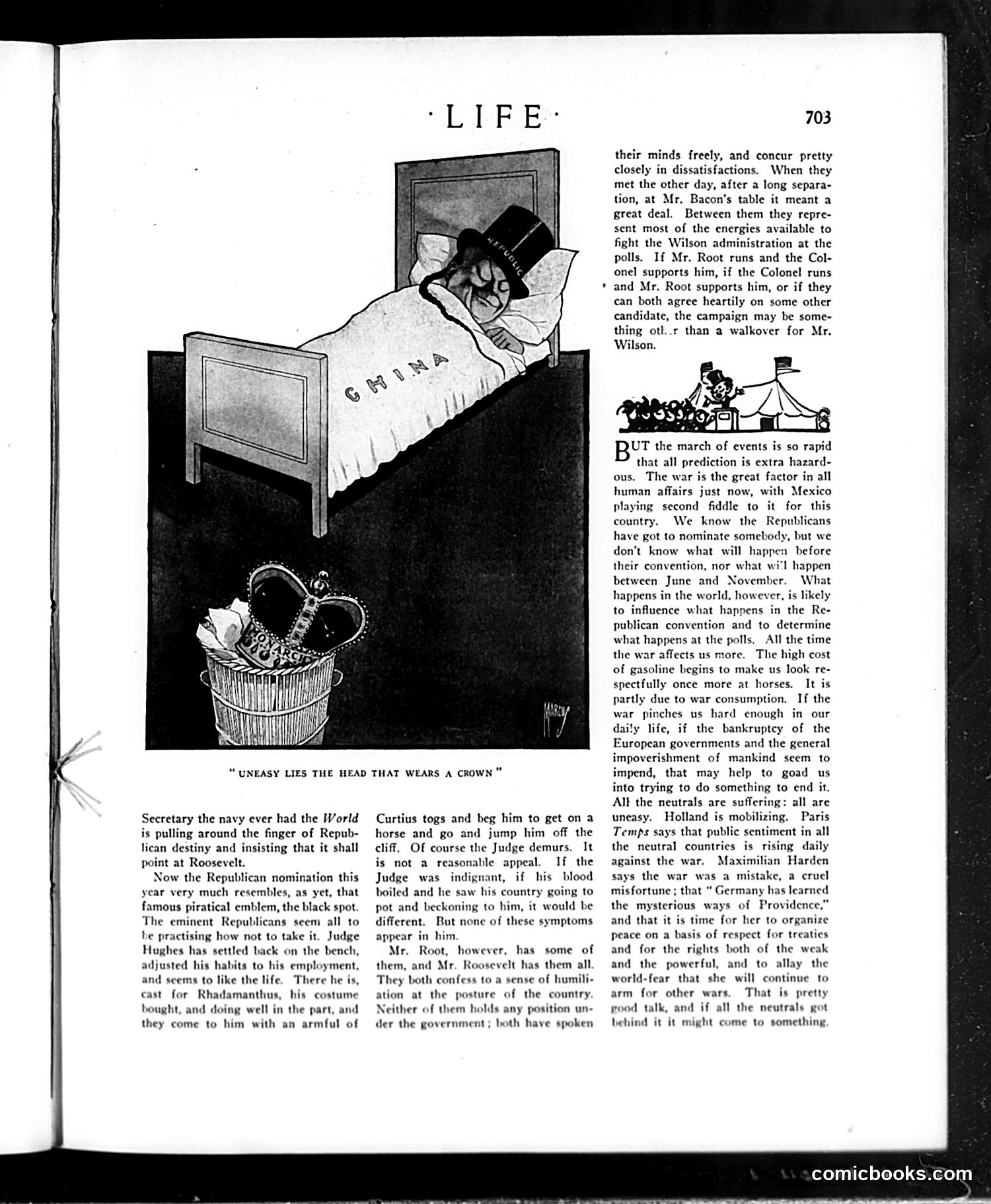
This page satirizes the 1916 Republican presidential nomination process. The main cartoon ("Uneasy Lies the Head That Wears a Crown") depicts "Omina" (likely representing the Republican Party or nomination itself) in an uncomfortable bed, with a crown in a basket below—suggesting the party leadership is anxious about who will accept the nomination. The text discusses three potential candidates: **Judge Hughes** (who prefers his judicial position), **Elihu Root**, and **Theodore Roosevelt**. The satire mocks how Republicans are reluctant to take on the nomination, despite needing to field a strong candidate against President **Wilson**. The article notes that unpredictable world events—particularly **World War I** and **Mexico**—make political prediction hazardous. It argues that war's effects on American life (rising gasoline costs, economic disruption) may ultimately influence both the Republican convention and November's election outcome. The cartoon and commentary express anxiety about Republican party dynamics during an unstable international period.
📄 Transcribed text from this page (OCR, searchable)
Machine-transcribed from the original scan — historical spelling and the odd misread are preserved.
“UNEASY LIES THE HEAD THAT WEARS A CROWN" Secretary the navy ever had the World is pulling around the finger of Repub- lican destiny and insisting that it shall point at Roosevelt. Now the Republican nomination this year very much resembles, as yet, that famous piratical emblem, the black spot. The eminent Republicans seem all to he practising how not to take it. Judge Hughes has settled back on the bench, adjusted his habits to his employment, nd seems to like the life. There he is, cast for Rhadamanthus, his costume bought, and doing well in the part, and they come to him with an armful of Curtius togs and beg him to get on a horse and go and jump him off the cliff. Of course the Judge demurs. It is not a reasonable appeal. If the Judge was indignant, if his blood boiled and he saw his country going to pot and beckoning to him, it would be different. But none of these symptoms appear in him. Mr. Root, however, has some of them, and Mr. Roosevelt has them all. They both confess to a sense of humili- ation at the posture of the country. Neither of them holds any position w der the government; both have spo 703 their minds freely, and concur pretty closely in dissatisfactions. When they met the other day, after a long separa- tion, at Mr. Bacon's table it meant a great deal. Between them they repre- sent most of the energies available to fight the Wilson administration at the polls. If Mr. Root runs and the Col- onel supports him, if the Colonel runs and Mr. Root supports him, or if they can both agree heartily on some other candidate, the campaign may be some- thing otl..r than a walkover for Mr. Bet the march of events is so rapid that all prediction is extra hazard- ous. The war is the great factor in all human affairs just now, with Mexico playing second fiddle to it for this country. We know the Republicans have got to nominate somebody, but we don’t know what will happen before their convention, nor what wi'l happen between June and November. What happens in the world, however, is likely to influence what happens in the Re- publican convention and to determine what happens at the polls, All the time the war affects us more. The high cost of gasoline begins to make us look re- spectfully once more at horses. It is partly due to war consumption. If the war pinches us hard enough in our daily life, if the bankruptcy of the European governments and the general impoverishment of mankind seem to impend, that may help to goad us into trying to do something to end it. Alt the neutrals are suffering: all are uneasy. Holland is mobilizing. Paris Temps says that public sentiment in all the neutral countries is rising daily against the war. Maximilian Harden says the war was a mistake, a cruel misfortune; that “ Germany has learned the mysterious ways of Providence,” and that it is time for her to organize peace on a basis of respect for treaties and for the rights both of the weak and the powerful, and to allay the world-fear that she will continue to arm for other wars. That is pretty ’ talk, and if all the neutrals got behind it it might come to something. comicbooks.¢om