
Life, 1916-04-13 · page 16 of 46
Life — April 13, 1916 — page 16: what you’re looking at
What you’re looking at
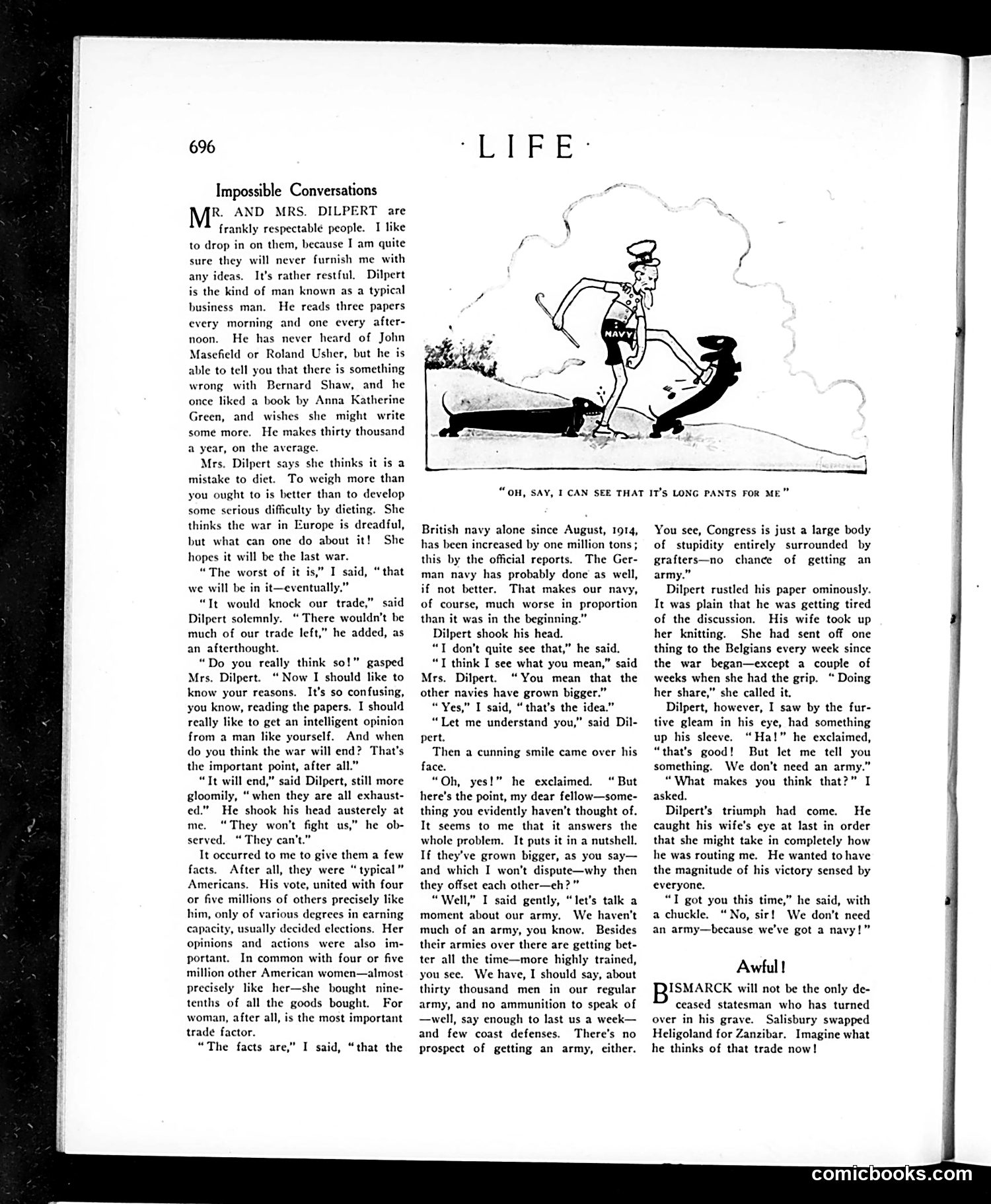
This piece satirizes typical American middle-class indifference to World War I (then ongoing in Europe). Mr. and Mrs. Dilpert represent the average American voter and consumer—conventional, complacent, and deliberately uninformed. The narrator attempts to explain why U.S. military preparedness matters using factual arguments about naval and army strength. The satire lies in their willful incomprehension: Dilpert misunderstands basic facts, then dismisses the argument with illogical reasoning ("they offset each other"). Mrs. Dilpert feigns interest while remaining oblivious. The cartoon caption mocks wartime anxiety about conscription ("long pants for me"). The author argues these "typical Americans" are important—their votes and purchasing power shape policy—yet they actively resist understanding geopolitical reality. The piece expresses frustration that citizens responsible for democratic decisions prefer comfortable ignorance over difficult facts about potential war.
📄 Transcribed text from this page (OCR, searchable)
Machine-transcribed from the original scan — historical spelling and the odd misread are preserved.
696 Impossible Conversations R. AND MRS. DILPERT are frankly respectablé people. I like to drop in on them, because I am quite sure they will never furnish me with any ideas. It's rather restful, Dilpert is the kind of man known as a typical business man. He reads three papers every morning and one every after- noon. He has never heard of John Masefield or Roland Usher, but he is able to tell you that there is something wrong with Bernard Shaw, and he once liked a book by Anna Katherine Green, and wishes she might write some more. He makes thirty thousand a year, on the average. Mrs. Dilpert says she thinks it is a mistake to diet. To weigh more than you ought to is better than to develop some serious difficulty by dieting. She thinks the war in Europe is dreadful, but what can one do about it! She hopes it will be the last war. “The worst of it is,” I said, “that we will be in it—eventually,” “It would knock our trade,” said Dilpert solemnly. ‘“ There wouldn’t be much of our trade left,” he added, as an afterthought. “Do you really think so!” gasped Mrs. Dilpert. “Now I should like to know your reasons. It’s so confusing, you know, reading the papers. I should really like to get an intelligent opinion from a man like yourself. And when do you think the war will end? That's the important point, after all.” “Tt will end,” said Dilpert, still more gloomily, “ when they are all exhaust- ed.” He shook his head austerely at me. “They won't fight us,” he ob- served, “ They can’t It occurred to me to give them a few facts. After all, they were “typical” Americans. His vote, united with four or five millions of others precisely like him, only of various degrees in earning capacity, usually decided elections. Her opinions and actions were also im- portant. In common with four or five million other American women—almost precisely like her—she bought nine- tenths of all the goods bought. For woman, after all, is the most important trade factor. “The facts are,” I said, “that the “OH, SAY, I CAN SEE THAT IT’S LONG PANTS FOR ME British navy alone since August, 1914, has been increased by one million tons; this by the official reports. The Ger- man navy has probably done as well, if not better, That makes our navy, of course, much worse in proportion than it was in the beginning.” Dilpert shook his head. “T don’t quite see that,” he said. “T think I see what you mean,” said Mrs. Dilpert. “You mean that the other navies have grown bigger.” “Yes,” I said, “that’s the “Let me understand you, pert. Then a cunning smile came over his face. “Oh, yes!” he exclaimed. “But here's the point, my dear fellow—some- thing you evidently haven't thought of. It seems to me that it answers the whole problem. It puts it in a nutshell. If they’ve grown bigger, as you say— and which I won't dispute—why then they offset each other—eh?” “Well,” I said gently, “let’s talk a moment about our army. We haven't much of an army, you know. Besides their armies over there are getting bet- ter all the time—more highly trained, you see, We have, I should say, about thirty thousand men in our regular army, and no ammunition to speak of —well, say enough to last us a week— and few coast defenses. There’s no Prospect of getting an army, cither. said Dil- You see, Congress is just a large body of stupidity entirely surrounded by grafters—no chance of getting an army.” Dilpert rustled his paper ominously. It was plain that he was getting tired of the discussion. His wife took up her knitting. She had sent off one thing to the Belgians every week since the war began—except a couple of weeks when she had the grip. “ Doing her share,” she called it. Dilpert, however, I saw by the fur- tive gleam in his eye, had something up his sleeve. “Ha!” he exclaimed, “that's good! But let me tell you something. We don’t need an army.” “What makes you think that?” I asked. Dilpert’s triumph had come. He caught his wife's eye at last in order that she might take in completely how he was routing me. He wanted to have the magnitude of his victory sensed by everyone. “T got you this time,” he said, with a chuckle. “No, sir! We don’t need an army—because we've got a navy!” Awful! BISMARCK will not be the only de- ceased statesman who has turned over in his grave. Salisbury swapped Heligoland for Zanzibar. Imagine what he thinks of that trade now! comicbooks.com